r/TheDeepDraft • u/TheDeepDraft • 11h ago
Live Wire MIRO G Salvage Enters Tidal Window Off France

4
Upvotes
r/TheDeepDraft • u/TheDeepDraft • Nov 16 '25
Hey everyone ! I’m u/TheDeepDraft, the founding mod of this community.
This subreddit is our space to explore the real depth of shipping, navigation, seamanship, tanker operations, maritime security, and bridge decision-making, the kind of conversations only people who live this profession truly understand.
What You Can Post Here
Anything that adds value to professional maritime thinking: • Shiphandling and pilotage • Bridge team management • COLREG / AIS / ECDIS insights • Tanker & cargo operations • Maritime security updates • Photos from sea (weather, traffic, engineering, ops) • Real-life dilemmas and high-IQ seamanship discussions • Professional opinions and technical analysis
If it helps seafarers think sharper or operate safer, it belongs here.
A Note for New Joiners
We know many cadets and aspiring seafarers are eager to learn and you’re welcome here. However, this is not a recruitment or job-seeking community. The conversations in r/TheDeepDraft are primarily from and for professionals already in the field.
If you’re learning and want to read and ask thoughtful questions, you are absolutely welcome. Just keep the focus on knowledge, not employment.
Community Vibe
Professional. Respectful. Sharp. No noise. No trolling. No low-effort content. Just clear thinking and honest seamanship.
How to Get Started 1. Introduce yourself below. 2. Post something today — a photo, thought, question, or scenario from your last watch. 3. Invite anyone you know who enjoys serious maritime discussion. 4. If you want to help build this place, message me about modding.
Thanks for being part of the first crew here. Let’s shape a subreddit that reflects the reality, nuance, and depth of life at sea.
Welcome to r/TheDeepDraft. ⚓️
r/TheDeepDraft • u/TheDeepDraft • 11h ago
r/TheDeepDraft • u/TheDeepDraft • 1d ago

One of the recent observations submitted through DeepDraft's SIRE 2.0 module concerned a tanker whose deck safety inspections had been completed and recorded, yet small openings on deck-light fittings were found painted over. The accompanying officer was also unable to explain their purpose. The observation prompted me to examine a detail of flameproof lighting that I had never explored closely, particularly the purpose of these openings and what happens when paint or sealant obstructs them.
The difficulty with flameproof electrical equipment is that normal operation tells us little about the integrity of its protective construction. An Ex d enclosure is designed to prevent an internal ignition from propagating outside, while some certified components provide breathing or drainage through engineered passages. A painted opening therefore requires closer examination, although its function cannot be established without the manufacturer's documentation.
The shipboard concern extends beyond the individual fitting. If deck painting or repairs to prevent water ingress interfere with a certified feature, the condition must be identified and properly assessed. A completed inspection record does not establish that such defects have been recognised, and closing an observation is meaningful only when the maintenance practice responsible has been corrected.
That concern became more apparent when I came across a Hyundai Ocean Service safety bulletin from December 2019. Silicone had been applied to openings and joints on Ex d deck lights and junction boxes to prevent moisture ingress. The practice had previously been identified during an internal audit, yet a subsequent SIRE inspection found it again. The company described the finding as a significant near miss.
The recurrence raises questions about technical supervision and corrective-action verification that are familiar to anyone responsible for managing shipboard inspections.
In this week's DeepDraft analysis, I examine the construction of flameproof lighting, the distinction between breathing and drainage devices and explosion-pressure relief, and what the documented inspection findings mean for officers responsible for hazardous-area equipment.
Read the complete DeepDraft analysis:
https://thedeepdraft.com/2026/11/23/painted-deck-lights-ex-d-sire-2-0/
r/TheDeepDraft • u/TheDeepDraft • 1d ago

r/TheDeepDraft • u/TheDeepDraft • 2d ago

A reader responding to my recent DeepDraft article described an unusual situation during a Suez Canal transit. The vessel's gyrocompass had already failed, and the crew was steering by magnetic compass. During an intense electrical storm, lightning reportedly struck the compass binnacle. According to his account, the magnetic compass remained unreliable for several weeks.
I cannot independently verify the incident, but the underlying phenomenon is recognised in maritime guidance. The UK's Maritime and Coastguard Agency advises Masters to check magnetic compass performance after severe electrical charges. Changes in a ship's retained magnetism can make the compass unreliable, and some induced magnetism may subsequently decay. Their normal heading source was already unavailable. The equipment they were relying upon was then affected by a completely different failure mechanism.
Another reader recalled a lightning strike that left the fire alarm panel sounding continuously. His Chief Engineer apparently resorted to unorthodox measures to silence it. The recollection is amusing, although the actual condition of the fire detection system would have required careful investigation.
I have experienced two lightning strikes at sea myself. One destroyed the forward anchor light and its spare, including the spare. Another damaged GMDSS equipment. Such incidents explain my interest in what happens to the equipment connected to the mast, even where the ship itself suffers little visible damage.
A third reader directed me towards Motorola's R56 manual on grounding, bonding and lightning protection. I reviewed its April 2017 edition. Although primarily intended for land-based communication installations, it contains engineering principles relevant to shipboard equipment. IACS Recommendation 178 addresses the marine application, including protection against secondary electrical damage, cable routing and surge protection.The condition of the complete installation deserves attention, especially after antenna replacements, equipment modifications or changes to cable arrangements.
On the bridge, we depend on redundancy. Yet the presence of alternative equipment tells us little about its survivability if several systems share an exposed electrical path. Following a lightning strike, the Master's immediate concern is whether reliable heading information, communications and essential safety systems remain available.
#MaritimeSafety #MarineEngineering #NavigationSafety #LightningProtection #TheDeepDraft
r/TheDeepDraft • u/TheDeepDraft • 2d ago

r/TheDeepDraft • u/TheDeepDraft • 2d ago

r/TheDeepDraft • u/TheDeepDraft • 3d ago

r/TheDeepDraft • u/Maritime_Faculty20 • 3d ago
r/TheDeepDraft • u/Glittering_Ad4656 • 4d ago
r/TheDeepDraft • u/TheDeepDraft • 4d ago

r/TheDeepDraft • u/TheDeepDraft • 4d ago

Here's an interesting consequence of the CII calculation.
An additional ballast passage can actually improve a ship's attained CII, provided its emissions per mile are below the vessel's existing annual average. Total fuel consumption and CO₂ emissions still increase.
The attached infographic works through this using a hypothetical VLCC. It raises a fair question about how we interpret annual CII performance, particularly when the ratings influence commercial assessments.
Are companies looking closely at these underlying numbers, or is most of the attention going to the final A–E grade?
Full analysis:
https://thedeepdraft.com/2026/11/16/cii-ratings-cargo-efficiency/
r/TheDeepDraft • u/TheDeepDraft • 4d ago

Most ships have now completed their PFOS compliance, obtained the necessary manufacturer's declaration, and met the survey requirements. But the firefighting foam remaining on board could still contain other chemicals that may come under future restrictions. For shipowners who have recently replaced their foam concentrates, this is a development worth examining before another replacement becomes necessary.
On 23 October 2026, new provisions under the European Union's wider restrictions on PFAS-containing firefighting foams began to apply. PFOS is only one member of the PFAS family, so a concentrate meeting IMO requirements may still contain substances affected by other regulations.
The EU has provided extended transition periods for certain applications, including existing civilian ship installations, recognising that replacing firefighting foam can involve substantial modifications and operational difficulties. Therefore, no ship is required to replace its recently approved concentrate immediately. However, the development raises questions about the long-term suitability of products currently supplied to the maritime industry.
Vessels changing firefighting foam is not as straightforward as replacing one chemical with another. The concentrate must remain compatible with the installed system, and its performance under actual operating conditions cannot be taken for granted. If another generation of replacement foams becomes necessary, shipowners may find themselves repeating an exercise that involves considerable expense, technical verification and potential modifications to existing equipment.
When I wrote about the approaching PFOS prohibition in October 2025, my concern was primarily with the firefighting performance of the alternatives being introduced.
A year later, with broader restrictions beginning to take effect in Europe, the original concern has acquired another dimension. How carefully are we considering the future suitability of replacement concentrates, and what happens when regulatory compliance is achieved without fully addressing the equipment already installed on board?
I examined these technical and operational concerns in the original DeepDraft analysis, including some of the less obvious difficulties associated with replacing conventional firefighting foams.
https://thedeepdraft.com/2025/10/10/pfos-in-firefighting-foam-what-the-imo-2026-ban-means-for-ships/
r/TheDeepDraft • u/TheDeepDraft • 5d ago

r/TheDeepDraft • u/TheDeepDraft • 6d ago

r/TheDeepDraft • u/TheDeepDraft • 6d ago
A ship's CII rating can affect its commercial prospects, but the calculation doesn't directly account for the cargo actually carried.
This short video looks at the gap between a ship's regulatory rating and its cargo transport efficiency.
Full analysis, including the worked VLCC comparison:
https://thedeepdraft.com/2026/11/16/cii-ratings-cargo-efficiency/
r/TheDeepDraft • u/Unable_Competition21 • 7d ago
Hi everyone, my name is Maksym, I am currently completing a Master of Science in Maritime Operations at Munster Technological University and am seeking participants from the maritime sector to contribute to my thesis research. If you work as Marine Engineers, Deck Officers, Ship Surveyors, Superintendents, Maritime Students and Researchers or other Maritime Professionals, your expertise and insights would be greatly valued. This research explores role of emerging technologies in supporting decarbonisation for ageing maritime fleet.
✅ Takes only a few minutes to complete
✅ Responses are for academic research purposes
✅ Open to professionals across the maritime industry
✅ Your contribution will support research into maritime decarbonisation and fleet modernisation.
👉 Participate in the survey: Role of Emerging technologies in supporting decarbonisation for ageing maritime fleet.
https://docs.google.com/forms/d/e/1FAIpQLSeQI1be-Ku7jOk2hb-3N0Vdfgxo-IHekQmDrEe6xGQl5OMDJA/viewform?usp=header
Please consider sharing this survey with colleagues, industry peers, and professional networks within the maritime sector. Every response helps strengthen the research findings and contributes to a broader understanding of how emerging technologies can support the decarbonisation of ageing maritime fleets.
Thank you for your time, support, and willingness to contribute to this academic research.
Best Regards,
Maksym Gyriak
r/TheDeepDraft • u/TheDeepDraft • 7d ago

r/TheDeepDraft • u/TheDeepDraft • 7d ago

A vessel's CII rating can influence how it is assessed for future employment, yet part of that rating is shaped by decisions the shipowner or Master may have little control over.
While examining the CII methodology, I compared two hypothetical sister VLCCs operating over identical annual distances but carrying different cargo quantities. Both received a C rating. One achieved a slightly better attained CII, despite producing approximately 80% more CO₂ per actual cargo tonne-mile.
The calculation is consistent with IMO's methodology, which makes the result particularly interesting.
There are legitimate reasons for the present system, including the difficulties of using actual cargo quantities across different trades. However, the implications become more complicated when a regulatory indicator begins influencing commercial decisions.
With IMO reviewing the framework, I have examined where the calculation diverges from actual transport work, why the methodology remains unchanged and what this could mean for owners and charterers.
Full DeepDraft analysis:
https://thedeepdraft.com/2026/11/16/cii-ratings-cargo-efficiency/
r/TheDeepDraft • u/TheDeepDraft • 8d ago

r/TheDeepDraft • u/TheDeepDraft • 9d ago
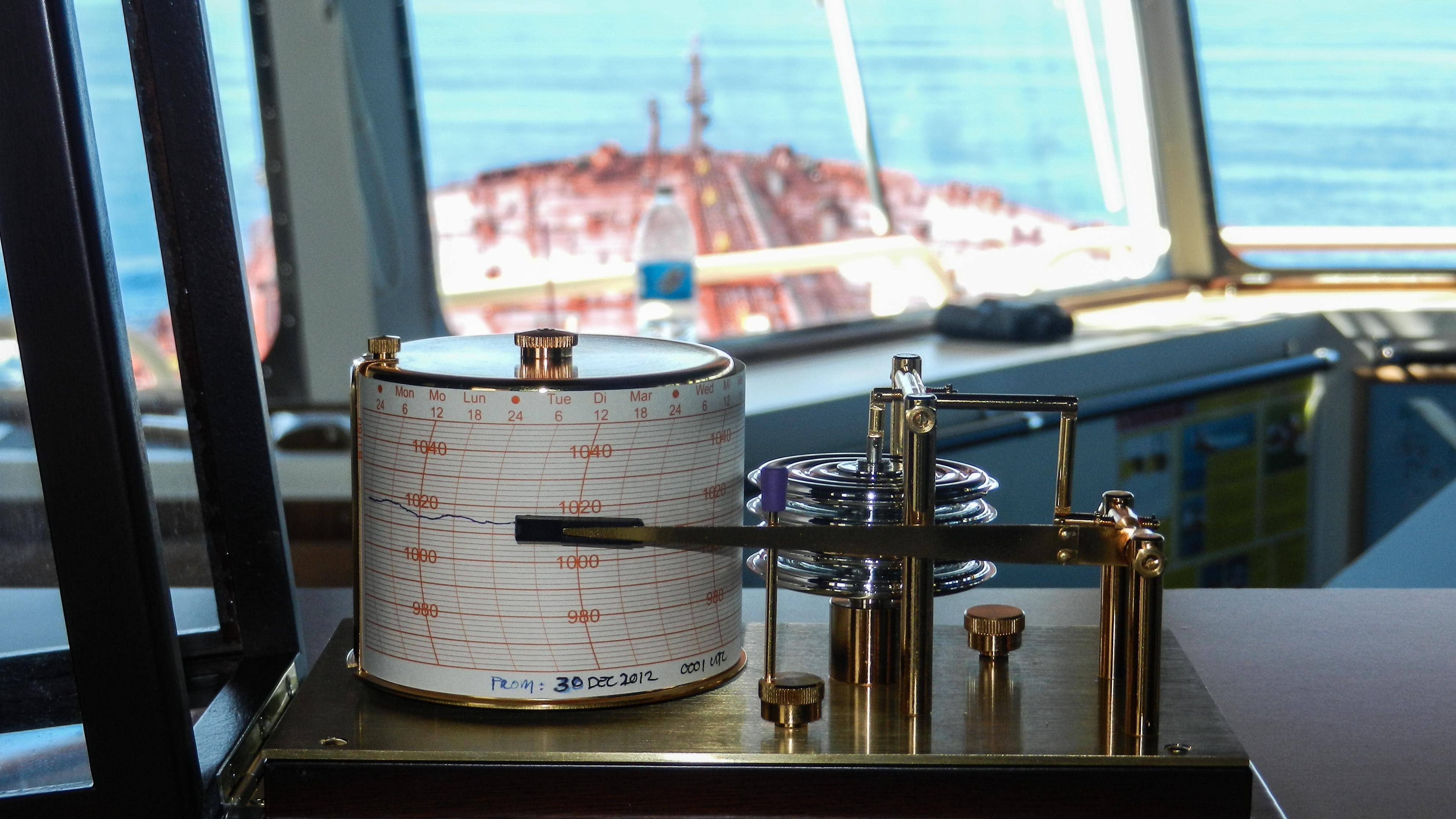
My recent DeepDraft analysis on atmospheric pressure and under-keel clearance triggered an unexpectedly strong debate among Masters, marine pilots, surveyors and navigating officers.
One argument appeared repeatedly: “If your vessel needs another ten centimetres of water to enter a channel, perhaps you shouldn't be entering at all.” This argument overlooks an important operational reality. Most shipping companies already prescribe minimum UKC requirements, either as a fixed clearance or as a percentage of the vessel's draught or beam, depending on operating conditions and vetted UKC procedures. The assessment considers squat, tide, vessel motion, and other applicable environmental factors.
Ten centimetres above the required minimum UKC is very different from ten centimetres between the keel and the seabed. Deep-draught vessels regularly navigate restricted waters close to their prescribed limits. Where a company's normal UKC requirement cannot be met, revised transit conditions, additional risk assessment and appropriate authorisation may be considered.
The debate also raised another question: are we making UKC calculations unnecessarily complicated? Several experienced mariners questioned whether atmospheric pressure warrants separate calculations. Others challenged the practical relevance of the SIRE 2.0 observation that prompted my original investigation. I believe there is merit in questioning both the observation and the operational value of another calculation.
My position is that atmospheric pressure does not require a separate numerical correction for every transit. Its significance depends on the available margin, changing conditions and what the existing UKC assessment already accounts for. But when a vessel approaches its minimum permitted clearance, even a modest difference between predicted and actual water levels may change the decision.
The original DeepDraft article examines precisely where that distinction matters, and why applying an additional correction can sometimes be as questionable as omitting one.
Read the full analysis: https://thedeepdraft.com/2026/11/02/atmospheric-pressure-ukc-arrival/
#UnderKeelClearance #MaritimeSafety #SIRE20 #ShipNavigation #Seamanship
r/TheDeepDraft • u/TheDeepDraft • 9d ago

r/TheDeepDraft • u/Maritime_Faculty20 • 9d ago

