r/SpiritScoresheets • u/Xenoraiser • 8m ago
Just the Sip: Peerless Henry Kraver’s Old Reserve 10-Year Review
Verdicts Explained
Special Occasions: Rare, special pours that go well and above. Something you pour to celebrate.
Treat Yourself: Obligatory weekend pour. Worth having on hand at all times if possible.
Daily Drinker: Affordable, available and tasty. Could have every day and be perfectly content.
Penseur Pour: Puzzling pours that won’t be to everyone’s liking.
Trophy Bottle: Something to show off more than anything. Likely allocated and overpriced.
Cocktail Request: Shines best in a cocktail, as opposed to neat or on the rocks.
Good If Affordable: Only worth buying if the price comfortably fits within the budget.
Serve to Guests: Something accessible that you don’t mind sharing or parting ways with. Likely belongs in a decanter.
Couch Pour: Something enjoyable enough, but ideal for drinking while doing another activity (movies, TV, games, etc.).
Find a Mixer: Grab the Coke or Sprite and relax.
Drain Pour: No. You deserve better.
Link to blog post: https://thewhiskeyramble.com/2026/11/24/just-the-sip-peerless-henry-kravers-old-reserve-10-year-review/
More scoresheets available at: https://www.reddit.com/r/SpiritScoresheets/
Brand revival is hardly a rare sight in the whiskey industry. One could even be forgiven for not realizing that a name like Kentucky Peerless (or simply “Peerless”) existed back in the late 19th century. It’s a classic example of “old name, new product” that modern-day enthusiasts are undoubtedly accustomed to. For those less in the know, a product like Peerless Henry Kraver’s Old Reserve 10-Year Bourbon can actually serve as an effective guiding point to the brand’s storied history.
Henry Kraver, the man in question, emigrated from Poland to America at a young age before moving from Manhattan to Henderson, Kentucky when he was 19 and ran out of money. He eventually bought a bar called Pucketts before purchasing the Worsham distillery in 1889, which had only opened eight years prior. Expansion between then and 1917 (when production ceased) was tremendous, going from eight barrels per day to over 200 by 1900, along with housing over 63,000 barrels shortly before Prohibition.
Speaking of Prohibition, there’s a particular detail on the Peerless website (under “Our Story”) worth mentioning. The site claims that “Peerless was one of the few whiskeys approved for medicinal use. The only legal way to a bottle ran through a doctor’s pad.” At first glance, this can read like Peerless being one of the distilleries that applied for and received a medical license to produce during Prohibition. However, if you check the six distilleries this applies to (Brown-Forman, Glenmore, Frankfort, Schenley, American Medicinal Spirits, and A. Ph. Stitzel), you’ll notice a certain name is MIA. I did a little digging and Peerless whiskey, including H. Kraver Bourbon, was available during Prohibition by medical prescription from 1921 to 1923. The distillery itself didn’t have a medicinal license. Instead, like other shuttered distilleries during that time, “Peerless stocks were consolidated into government warehouses and sold as medicinal whiskey.” (Brian Haara)
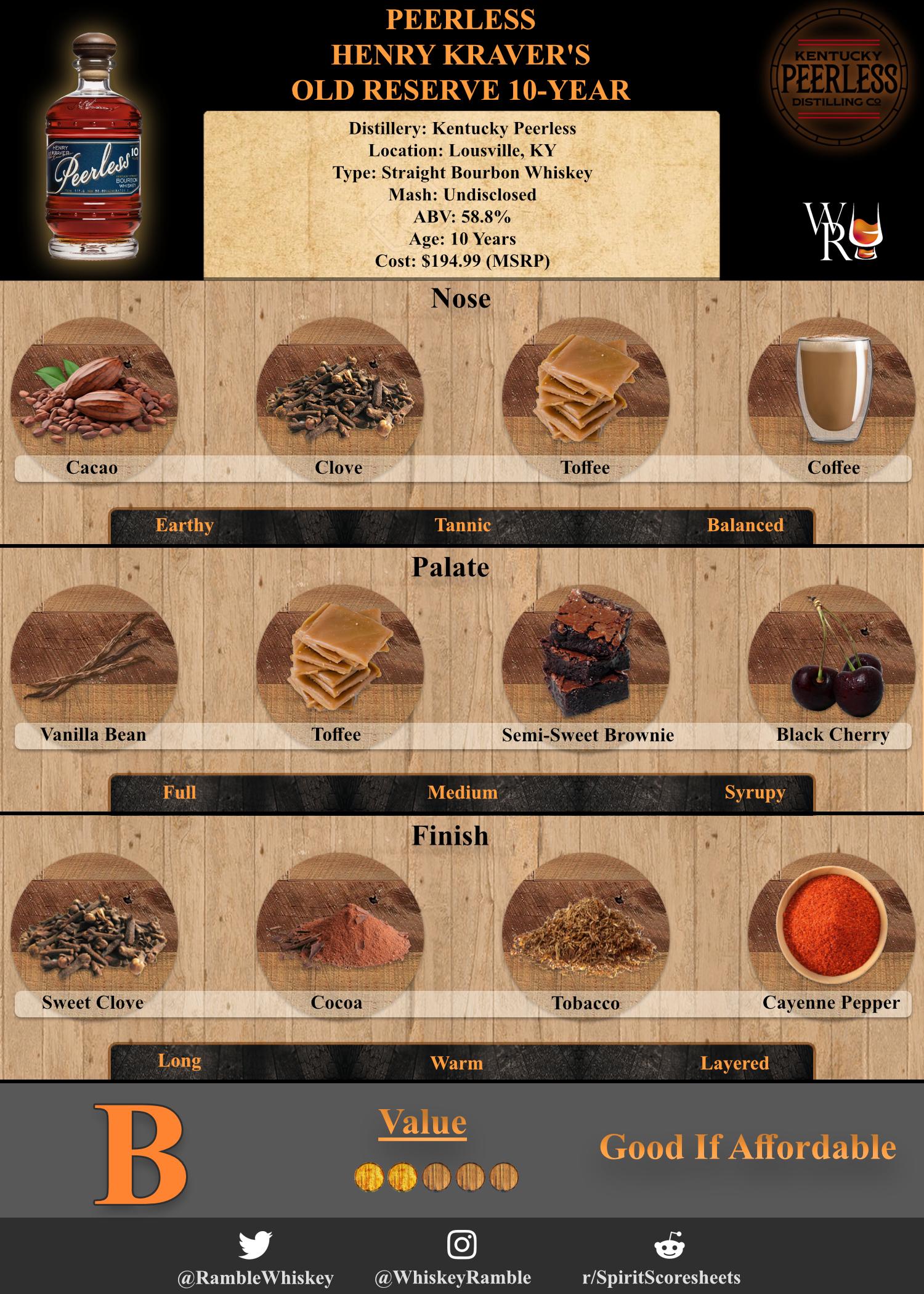
Anyway, that’s enough dwelling on minor marketing lingo, let’s get to the whiskey itself. Peerless Henry Kraver’s Old Reserve 10-Year Bourbon is the first age-stated Peerless bottle, named after “the man who started it all in 1889.” Like other Peerless products, it’s distilled from a sweet mash process and bottled at cask strength. MSRP was just shy of $200, making it one of the most expensive 10-year bourbons on the market.
Nose: Cacao, Clove, Toffee, Coffee
Earthy, Tannic, Balanced
Palate: Vanilla Bean, Toffee, Semi-Sweet Brownie, Black Cherry
Full, Medium, Syrupy
Finish: Sweet Clove, Cocoa, Tobacco, Cayenne Pepper
Long, Warm, Layered
I’m happy to report that this milestone product from Peerless isn’t just competently made: it’s an earnestly great pour. From the first nosing to the finish, Henry Kraver’s Old Reserve handily avoids feeling like “just another bottle” from a technically non-heritage producer. Much of that is thanks to the overall flavor profile, which leans quite heavily into the realm of chocolate and toffee. Both the flavors and the way they come across go far to create a sipping experience that eclipses certain heritage brands (Old Forester Birthday Bourbon springs to mind).
In fact, the profile here takes me right back to Peerless’ own Double Oak Bourbon. Both feature notable levels of oak influence manifesting as cocoa and vanilla bean, but Henry Kraver’s Old Reserve executes this profile with more grace. The development of flavors feels more organic, like a bass-heavy song that’s tactful rather than overdone. Think of drinking Henry Kraver’s like eating a semi-sweet brownie in a cigar shop, only to realize after the fact that the brownies had cayenne pepper in them (like certain chocolates).
For as good as Peerless tastes at 10 years, it doesn’t come cheap. Or necessarily easy to procure. It’s in a similar position to Michter’s 10-Year Bourbon, except that’s proofed down (Peerless is always cask strength) and decently distributed. Granted, the Michter’s product has existed for longer and is sourced (contract-distilled), so it has a couple advantages. Although a strong output, Henry Kraver’s struggles to justify the premium price tag, least of all in a market inundated by expensive LTOs. I’d liken it to trying Parker’s Heritage Collection for the first time, which for me was through the 14th Edition Heavy Char Bourbon—another 10-year product. Both are undeniably great, but compared to each distillery’s next closest and more affordably priced options (Elijah Craig Barrel Proof and Peerless Double Oak Bourbon), it’s difficult to see either as anything other than diminishing returns on full display.