r/SemiHydro • u/caaaitlin • Dec 13 '23
From a stub to this!!

689
Upvotes
I can’t believe how well it’s doing! The second photo was on the 6th of October when I first switched it to leca from soil and the first pic is today
r/SemiHydro • u/caaaitlin • Dec 13 '23
I can’t believe how well it’s doing! The second photo was on the 6th of October when I first switched it to leca from soil and the first pic is today
r/SemiHydro • u/roots_leaves_reads • Feb 18 '22

r/SemiHydro • u/stiina22 • May 23 '22
r/SemiHydro • u/heyfriendhowsitgoing • Apr 25 '22
r/SemiHydro • u/TheSaltyJ • Aug 07 '25

r/SemiHydro • u/bitchola • Nov 22 '20

r/SemiHydro
•
u/PetsAteMyPlants
•
Nov 03 '22

Update: Photos
This is an update from my previous post.
I've been seeing a lot of posts lately about people having problems converting from soil to semihydro. I would just like to address some of the things I keep reading and provide some tips that personally helped me.
When converting from soil to semihydro, ensure you have the proper materials and containers on hand. Materials such as porous substrates like LECA/hydroton/clay pebbles, Lechuza Pon, lava rock, and pumice. Porous substrates are necessary to allow air circulation to penetrate down to your substrate, root area, and water reservoir. The gas exchange will help oxygenate these areas.
A proper container is also highly recommended. Hydroponic or net pots are advisable because they have considerably more airflow compared to regular one-piece containers due to the holes on the sides and bottom of the pot. Additionally, they make maintenance such as flushing and refilling easier because you only need to remove the net pot from the reservoir pot to flush the substrate and refill the reservoir. You won't ever need to disturb the plant unless you truly have to. I recommend opaque ones that do not let light in to avoid algae blooms. Algae, aside from aesthetic issues, also absorb nutrients that could've otherwise gone to your plants (and like plants, they produce oxygen as a byproduct of photosynthesis).
When you have your plant, the first thing you need to do is gently remove the plant from its pot and clean off all the soil, or as much as you can. Remove any dead or rotting tissue. Removing organic material is necessary so the microorganisms that feed on them do not reproduce too fast especially when you start having anaerobic conditions in your substrate or root area. The beneficial microorganisms that you want will colonize on their own when you have a healthy environment for them—meaning, when the root area is healthy and the plant is healthy, you don't need to worry about beneficial bacteria, they will be there, albeit it takes time.
Oxygenation is the key. Well-oxygenated water will prevent anaerobic conditions from setting in. "Overwatering" is a prevalent misnomer in horticulture; rot is actually caused by anaerobic conditions setting in wherein compact substrates such as soil and stagnant water will asphyxiate the root area, cutting it off from oxygen, and thus kill it. The microorganisms that feed on organic matter will then set on this rotting organic material, and you have a dead plant. In semihydro, this is very preventable by using porous substrates that allow gas exchange and by frequently replacing the water reservoir (not just top-offs). Since the water is stagnant, you'll be relying solely on the gas exchange and water replacement for oxygenation. Once you see new root growth, then you can opt to change the water in the reservoir once a week or however you schedule your maintenance. Change the water and don't just top it off, and flush the substrate to remove the organic material and salt buildup as well. Replace the water in the reservoir and flush the substrate on the same day you're doing both for maintenance—as often as you can in the transition stage, and once a week or every two weeks once you're past the transition stage (when you see new robust root growth).
To add, once you have water roots, you can soak them in water all the time, if you should choose to do so. I have been reading about dry periods, and I've never practiced this, as even my succulents are in the same setups and maintenance process as the rest of my plants. In my ripariums, I have houseplants on top of my aquariums and container ponds whose roots are soaking in water 24/7. Water roots are designed to be moist or wet all the time. Keep the water level to the crown of the plant where the roots and stems meet. Do not let the water level past this area. Or you could let the water level meet the bottom/tip of the medium/substrate so the medium/substrate itself will wick the water to the plant's roots. Water level has been universal for me, whether I used LECA, lava rock, or pumice regardless of the plant. YMMV.
Moreover, in the transition period, fertilization is not needed yet. Your plants will have stored nutrients more than they can process. Start fertilization once you have robust root growth already.
Since a lot here are doing semihydro indoors, I highly suggest keeping constant air circulation around the plants. I personally have mine outdoors, so I don't have this problem. Stale air is easily fixed by using fans. Circulating air is also good for your health as we all know, so do keep this in mind. If you're having mold problems, this is the easiest fix. You don't have to worry much about humidity because the evaporation from your water reservoir should keep the area around the plants humid, but if you want, adding a humidifier is fine.
[Addenda]
How to convert most houseplants to passive hydroponics and plant big seeds (100% success in my experience):
If using cuttings, leave about two to three nodes at the bottom of the plant. Typically you want as few leaves as possible (with the plant still retaining the capacity to photosynthesize) to decrease evaporation from the leaves and energy usage. In aquarium plants, we practice this all the time. About two sets of leaves (four leaves) at the top and two to three leafless nodes at the bottom is what I usually do.
If using leafless cuttings, it should be self-explanatory.
If using soil-rooted plants, clean and lightly trim the roots.
If using seeds, place the seeds at the top of the substrate and cover with a layer of the same substrate.
Once the specimens are in their respective pots, water daily as you would normal potted plants until you see robust root growth. This step doesn't require the reservoir pot, for ease of draining excess water. If you still want to use a reservoir pot, you may just dump the excess water every other day or however often you like.
Place somewhere with bright indirect sunlight/bright artificial lights. Don't put in direct sunlight or somewhere too hot. Some seeds will only germinate in certain temperatures and without light, so take those into account.
No need to fertilize at any point in the conversion/germination process.
Safer alternative: Once the specimens are in their respective pots, add water to the reservoir pot to the point that the medium/substrate itself will wick the water to the plant, roots, or seeds. Place the cache pot inside the reservoir pot. Place inside a clear/transparent plastic bag. Seal it. You may poke holes if you like, or air it out every day/every other day. Place somewhere with bright indirect sunlight/bright artificial lights. Don't put in direct sunlight or somewhere too hot. Some seeds will only germinate in certain temperatures and without light, so take those into account. Check every other day and hopefully you have robust root growth or the seeds will have germinated after two weeks. After that, you may remove it from its sealed container and continue on normal maintenance. No need to fertilize at any point in the conversion/germination process.
How to convert succulents and cacti to passive hydroponics (100% success in my experience):
Clean and lightly trim the roots.
Put inside the pot.
Water daily as you would normal potted plants until you see robust root growth. This step doesn't require the reservoir pot, for ease of draining excess water. If you still want to use a reservoir pot, you may just dump the excess water every other day or however often you want.
Even though these are succulents, don't put them under direct sunlight or somewhere too hot just yet until you have seen new robust root growth. Place somewhere with bright indirect sunlight/bright articial lights until you have new robust root growth.
How to plant small seeds in passive hydroponics (100% success in my experience):
Put the seeds inside a plastic tub often used to store food in the fridge or microwave. You may use a paper towel as a blanket for the seeds.
Spray a little bit of water. Avoid excess. Just spray enough to moisten the seeds.
Seal the container and place somewhere dark. Some seeds require certain conditions like temperature-sensitive seeds to germinate.
Once they've sprouted leaves, transfer the seeds to your passive hydroponic setup.
Place the pot inside a transparent plastic bag and keep it somewhere bright with indirect sunlight/bright artificial lights.
Once the plant has matured in about two weeks or more, remove it from the bag.
No need to fertilize at any point in the germination process until after the plant has matured (typically two weeks or more).
[Troubleshooting/Notes/Miscellany]
I smell something funky/parts of the plant are rotting/wilted
Remove rotted parts and soak in alum (about a tablespon per gallon) for about half an hour. I don't recommend hydrogen peroxide or bleach since they are more destructive to tissues in general (even human) and are easy to make a mistake with. Alum is still used in pickling and in an older way of purifying water (food safe). It is generally safer to soak in alum when removing pathogens as opposed to bleach or hydrogen peroxide. In aquaria, we use alum to quarantine new plants from pathogens and snails. You may find alum in the spice section along with dried herbs and such. In developing countries, the powder is used as a deodorant/anti-perspirant.
Rinse the plant after the alum soak. You may also soak the medium/substrate in alum if you want, but an easier way is to rinse the medium/substrate and bathe it in UV light (sunlight) before usage.
My plant's leaves are drooping
Try placing it inside a clear/transparent plastic bag to keep it humid. Keep it somewhere with bright indirect light/bright artificial light. Once the plant has recovered, remove from the bag.
Overwatering
There is no such thing as overwatering water roots. If this were true, how would we have submerged plants in aquariums, ponds, etc.? Overwatering is a misnomer. It is rot caused by the lack of oxygen around the tissues of the plant, the same as you would if you cut off the oxygen supply of a human or animal limb, the same will happen with plants.
Water propagation
I don't like propagating in water only to transfer to your passive hydroponic setup (that most people do). I see a lot of people having trouble AFTER propagating in water. You just grew water roots, then transfer them to your setup which limits its water intake (again you have water roots designed to intake oxygen and nutrients from water, not soil) via using wicks (unnecessary, but more on this later) and doing the "1/3 rule" (same thing as one inch of fish per gallon in aquariums—largely a myth and baseless). Why would you do this? If you add medium/substrate to your water propagation setup, it already is a passive hydroponic setup on its own. Why do the extra step that could potentially undo the work you've done growing water roots? Sure some plants are fine doing this, but I guarantee it will not work all the time for all plants or without the extra maintenance, care, energy, etc. Make it simple. Propagate in your hydroponic setup and condition your plant properly.
For soil growers, water propagating is also entirely pointless, and I've seen so many having problems water propagating and transferring to soil. You just grew water roots. When you transfer that plant in soil, it will have to transition to soil roots again. You're stressing your plant again to grow roots that are more suitable to its conditions. If you're growing in soil, propagate in soil. Same thing if you're growing in water via passive hydroponics.
Wicks
This might be controversial, but wicks are largely unnecessary and possibly not the best for some plants. Wicks kind of limit the intake of water; this might be good, or bad, or whatever. Remember you have water roots which are designed for water. A lot of plants are also what we call "thirsty" and used to humidity aside from those that grow wild in the desert.
But what about capillary action? Well, your medium/substrate can do that, they will wick the water from your reservoir to the plants' roots no problem. Terracotta pots will wick the water from your reservoir to your plant too.
But what about the space in between the water reservoir and the medium/substrate and you yourself said oxygen is good? Well, that's why you use porous media/substrates like LECA, to facilitate gas exchange better, and that's why you hopefully use cache pots that have airflow on the sides and the bottom and not single containers like glass vases.
Apart from those, you have to ensure the wicks you use are synthetic and not organic to prevent rot. Wicks also become dirty over time. It's also another place for bacteria to grow on. Bacteria don't grow in the water column as much as they do on surfaces and hardscape, we know this from aquariums too. Bacteria will grow on water surface (biofilm), in your substrate, on your plant...and your wick. There's beneficial bacteria of course, but more likely than not, the bacteria that will grow on oxygen-starved water/stagnant water will not be the bacteria you want, especially if you have a lot of rotting organic material.
For all my plants, whether they're crops, herbs, houseplants, succulents, palms, etc. I don't use wicks. Most of them are outdoors too, so wicking is possibly more dangerous due to the increased evaporation and water intake of the plants. Indoors, if you really wanted to wick, go ahead. But if you see another post with "Help, Plant Looks Sad Even Though I Water Propagated, Used a Wick, and Followed the 1/3 Rule"...well, you know what happened.
Fertilization
At no point during the transition period do you really have to fertilize. Plants will have stored nutrients previously available and will absorb nutrients more than they process. This is why some plants are used for filtration, as they will filter heavy metals (of which they can't all use) and other pollutants from the water (of which they can't all use as well).
I'd underfertilize more than overfertilize. Half the recommended dosage for houseplants and GRADUALLY increase (over weeks) as necessary. Full dosage is more for crops to increase yields, and even then, you can just start with half and gradually increase as the plants mature.
Besides the NPK, micronutrients are also important. You can get fertilizers with added micronutrients. You also can get them via tap water, if your water is hard.
Dry fertilizers are more cost-efficient than liquid fertilizers. Save your money and get more plants and pots instead of investing in fancy, branded fertilizers. I prefer dry fertilizers due to the ease of rinsing the medium/substrate. Just ensure you get water soluble dry fertilizers (most of them are). Mix them in the medium/substrate.
Synthetic over organic fertilizers. Organic material might cause rot as they provide a food source for bacteria. Again, beneficial bacteria will grow on their own in your setups.
Beneficial bacteria
In aquaria, this is highly debated. Many claim they work. Many claim they are money sinks. I think the latter. Why? If you have a heavily planted tank, the filtration isn't done mainly by bacteria but by the plant itself (think dirted tanks like a Walstad or just a tank with a large plant volume). If you have a passive hydroponic setup, the bacteria will grow on its own granted the conditions are conducive for them. Expensive bacteria in a bottle are largely unnecessary. Again, save your money and buy more plants and pots instead. The only people you will impress with it are the novices or those who don't know any better. The plant, if healthy, will provide a haven for beneficial bacteria which will colonize on their own. Meanwhile, if you use bacteria in a bottle, if the conditions are toxic in your passive hydroponic setup, that bacteria isn't going to magically save your plant. What will save the plant is to give it an oxygenated environment, cleaning the medium/substrate of organic debric, proper maintenance, etc.
Media/Substrate
Any one or combination of LECA/hydroton/clay pebbles, pumice, lava rock, or perlite will do.
Lava rock is heavy and might be suitable for larger plants or if you want structural support. Pumice as well.
LECA/hydroton/clay pebbles and perlite are lightweight.
DIY Lechuza Pon is lava rock:pumice:zeolite 1:1:1, 2:2:1, 3:3:1, 2:4:1. You may skip the zeolite and use any one of the ratios. Lechuza Pon has dry fertilizers mixed in, so you will have to supply your own fertilizers.
Dry period
If you have water roots, why?
On which plants can be transitioned to passive hydroponics
I have yet to find a plant commonly used in gardens that cannot be transitioned to passive hydroponics. If they can grow in soil, they can grow in hydroponics. Houseplants, crops, trees, herbs, succulents, etc. can be transitioned and grown in passive hydroponics, so use your imagination and feel free to experiment!
pH
Is it worth it to check for pH? Yes and no, let me explain.
It's good practice to check for pH. However, pH fluctuates depending on temperature, CO2 concentration, media/buffer (presence and absence of), carbonate and bicarbonate concentrations, and decomposition.
Which means pH might differ from pot to pot, depending on the time of day (temperature, photosynthesis, and respiration), where the pot is located (temperature), what type of water you're using, amount of fertilizer, etc.
For active hydroponics wherein you have one big reservoir for hundreds of plants, it's worth it because you want to maximize yields, you likely have similar pH goals for most of the plant varieties, and you only have one container to check. For passive hydroponics wherein you're not trying to necessarily optimize yields/growth, you have a lot of containers to check, might not all be in the same place, might have varying pH needs, etc., it is likely too tedious to do so.
Have I ever regularly checked pH? Nope. Has it made a difference? Probably, but likely unnecessary and not glaringly obvious. Most of my passive hydroponic setups are outdoors and I live in a tropical country where it might be blazingly hot in the morning, cloudy in the afternoon, and then rainy at night...all in one day. I have a lot of plants too, so I can never probably check pH on schedule diligently without ever hating the chore. I also use tap water exclusively, which mixes with rain water, and use dry fertilizer. Checking pH would just be...
In any case, you may choose to check for pH, if you want to, but I promise it is not necessary. Should you choose to, do it properly (before and after fertilizing, on various times of the day, on schedule, etc.).
The basics are:
if CO2 increases, pH decreases
during photosynthetic periods, if O2 increases, CO2 decreases, pH increases
during respiration/non-photosynthetic periods, if O2 decreases, CO2 increases, pH decreases
if temperature increases, solubility of CO2 decreases, pH increases
if temperature decreases, solubility of CO2 increases, pH decreases
if carbonate and bicarbonate concentrations increase, pH increases
if organic material decomposition occurs, carbon increases, CO2 increases, pH decreases
Is there a fun reason to check and adjust for pH? Yes. Most plants that change flower colors in the same plant will vary hues depending on the pH. For example, hydrangea flowers turn blue or purple if the pH is acidic, and will turn red or pink if the pH is alkaline. Mine turned from blue to purple, and one was yellowish/off-white.
Water
I use tap water with dry fertilizers with no noticeable harmful effects to the plants. Our tap water is likely hard and I use tap water in my aquariums and ponds as well. I would say that it's more beneficial for me, because of the minerals/micronutrients in the water. I've also grown several plants on just tap water alone and with no added fertilizers (grown to maturity, not just grown roots with).
RODI seems wasteful to me (look up the ratio of waste water in RO systems compared to RO water produced). Not to mention the initial cost to install the system might be out of budget and the amount of time it takes to produce the amount you need might be too slow. That said, if you already have a system in place and/or really want to use RODI, feel free. Just remember to supply the necessary minerals and micronutrients that might be absent from your RODI and fertilizer.
Heavy metals in the water are absorbed by plants. Some plants are even grown and used as filters for these specifically (look up rhizofiltration and phytoremediation). Aquarium plants are a great benefit to fish, shrimp, livestock, etc. for this reason too. At some point the plant will have adverse effects from heavy metal toxicity, but if you're worried that your tap water contains traces of heavy metals (it probably does), trace amounts are generally fine and even useful until it accumulates too much, too fast (think of overfertilization).
Pruning
If you're transferring plants grown in soil and acclimating it to passive hydroponics, I advise pruning roots lightly. In this experimental study, the authors found that:
Light pruning (i.e. removal of a small proportion of fine roots) was the most effective treatment to encourage new root growth and aid the establishment in the two species we tested.
There was a short-term decrease of plants’ CO2 uptake (i.e. photosynthesis) after root-pruning, following by their recovery to control levels. However, photosynthesis was not increased by pruning, so the mechanism whereby new growth is sustained may be from existing carbohydrate reserves, re-distribution of assimilates or by direct effect of pruning on lateral root growth.
They defined light pruning as the removal of fine and coarse roots to reduce approximately 15% total root weight, as opposed to heavy pruning which reduced approximately 50% total root weight. These were in soil. If we're dealing with passive hydroponics, we need water roots, and the soil roots still attached will not be as efficient in nutrient and gas absorption in water, and in time may likely be discarded eventually by the plant in favor of growing water roots more suitable to its hydroponic environment. Personally, I've pruned heavily, lightly, and totally with success. At the very least, I would advise to do some light pruning when converting from soil to water and remove all rotting or unhealthy parts of the roots.
Root pruning is not only done to encourage new growth and aid in healthy development and establishment during acclimatization/conversion, but it can also help in maintaining the size of the plant to a level more manageable to you and its container. In bonsai, one of the reasons the roots are trimmed, is to keep the tree's dwarf shape. You can also do this if you want to keep the plant in its current container (provided it is already in a proper-sized one) instead of getting a bigger pot, if you don't want to detach the plant from the substrate, and/or if you want to save space/limited by space occupied by the plant in its setup.
Above root pruning is done if you want to make your plant bushier, preserve plant health/encourage better plant health, maintain desired shape and size, support good air circulation, allow more light to certain parts, remove diseased, dying, or dead parts, etc. Resources that would've otherwise gone to older or damaged parts would be diverted to existing or soon-to-grow newer parts of the plant. Additionally, you may prune to use trimmings as propagations.
Not a new technique, but recently picking up traction, is keeping fruit trees around human height (fruits will be within arm's reach). This here is to track my personal foray into this technique and will keep you guys updated on this in the future. Basically, you prune aggressively to keep, let's say an apple tree from reaching its normal size, to approximately six feet in height, thereby easing maintenance, limit fruit production to within personal consumption (imagine 1000+ apples per harvest without a plan or means for distribution compared to having handfuls), practicability, saving space to keep more varieties, etc. I'm basically just going to try it on passive hydroponically-grown fruit trees/plants instead of ones grown in soil.
I will update if I find something new or missing or you guys wanted to add something to this. Let's keep this a community post and feel free to ask questions and add your own experience and expertise.
Edit: Thank you kind strangers for the awards. Please let me know if you want more details or have a particular concern you want addressed and I will try to answer as best I can. Let's keep this a community-oriented discussion and feel free to share your own tips and experience. Would also appreciate people sharing photos of their plants and setups.
Edit2: Added pH, water, and pruning sections to addenda
Edit3: Added photos
r/SemiHydro • u/Mement0moriii • Nov 15 '25

what do you think about my setup and what could I improve? I‘m curious about fertilizing. do I just add some of it straight to the water or how does it work?
r/SemiHydro • u/BenevolentCheese • Jan 08 '23

r/SemiHydro • u/mycatsatemyplants • Feb 04 '22
I've been seeing a lot of posts lately about people having problems converting from soil to semihydro. I would just like to address some of the things I keep reading and provide some tips that personally helped me.
When converting from soil to semihydro, ensure you have the proper materials and containers on hand. Materials such as porous substrates like LECA/hydroton/clay pebbles, Lechuza Pon, lava rock, and pumice. Porous substrates are necessary to allow gas exchange and air to penetrate down to your substrate, root area, and water reservoir. The gas exchange will help oxygenate these areas.
A proper container is also highly recommended. Hydroponic or net pots are advisable because they have considerably more airflow compared to regular one-piece containers due to the holes on the sides and bottom of the pot. Additionally, they make maintenance such as flushing and refilling easier because you only need to remove the net pot from the reservoir pot to flush the substrate and refill the reservoir. You won't ever need to disturb the plant unless you truly have to. I recommend opaque ones that do not let light in to avoid algae blooms.
When you have your plant, the first thing you need to do is gently remove the plant from its pot and clean off all the soil, or as much as you can. Remove any dead or rotting tissue. Removing organic material is necessary so the microorganisms that feed on them do not reproduce too fast especially when you start having anaerobic conditions in your substrate or root area. The beneficial microorganisms that you want will colonize on their own when you have a healthy environment for them--meaning, when the root area is healthy and the plant is healthy, you don't need to worry about beneficial bacteria, they will be there, albeit it takes time.
In the initial transition period, I personally do daily flushings and water replacement. Sometimes even several times a day if I can help it. Oxygenation is the key. Well-oxygenated water will prevent anaerobic conditions from setting in. "Overwatering" is a prevalent misnomer in horticulture; rot is actually caused by anaerobic conditions setting in wherein compact substrates such as soil and stagnant water will asphyxiate the root area, cutting it off from oxygen, and thus kill it. The microorganisms that feed on organic matter will then set on this rotting organic material, and you have a dead plant. In semihydro, this is very preventable by using porous substrates that allow gas exchange and by frequently replacing the water reservoir. Since the water is stagnant, you'll be relying solely on the gas exchange and water replacement for oxygenation. Once you see new root growth, then you can opt to change the water in the reservoir once a week. Change the water and don't just top it off, and flush the substrate to remove the organic material and salt buildup as well. Replace the water in the reservoir and flush the substrate on the same day you're doing both for maintenance--daily or as often as you can in the transition stage, and once a week or every two weeks once you're past the transition stage (when you see new robust root growth).
To add, once you have water roots, you can soak them in water all the time. I have been reading about dry periods, and I've never practiced this, as even my succulents are in the same setups and maintenance process as the rest of my plants. In my ripariums, I have houseplants on top of my aquariums and container ponds whose roots are soaking in water 24/7. Water roots are designed to be moist all the time. Keep the water level to the crown of the plant where the roots and stems meet. Do not soak past this area. This water level has been universal for me, whether I used LECA, lava rock, or pumice. Some people will say keep the water level low and let the capillary action take care of moistening the substrate, but personally, I keep my water level to the crown of the plant regardless of the plant, and I haven't killed any yet. YMMV.
Moreover, in the transition period, fertilization is not needed yet. Your plants will have stored nutrients more than they can process. Start fertilization once you have robust root growth already. Perhaps after the first week up to a month depending on the plant. Use half the recommended dosage and increase it gradually as you see fit. Don't just double the amount and use the full dosage the succeeding week you start fertilizing, do it gradually. Try to avoid organic fertilizers and use liquid fertilizers such as hydroponic solutions, or dry fertilizers like Osmocote or Nutricote. I personally use dry fertilizers because: they're cheaper; do the same job as liquid fertilizers; and I can flush the substrate and replace the water in the reservoir as many times as I want without having to replace the nutrients in the water since the dry fertilizers are in the substrate and not in the water itself.
Since a lot here are doing semihydro indoors, I highly suggest keeping constant air circulation around the plants. I personally have mine outdoors, so I don't have this problem. Stale air is easily fixed by using fans. Circulating air is also good for your health as we all know, so do keep this in mind. If you're having mold problems, this is the easiest fix. You don't have to worry much about humidity because the evaporation from your water reservoir should keep the area around the plants humid, but if you want, adding a humidifier is fine.
That's it. Hopefully this helps some of you having problems.
Edit: Thank you for the awards kind strangers! Here's to hoping more people convert to semihydro!
r/SemiHydro • u/spicy3d • Apr 15 '22
r/SemiHydro • u/PlantDaddy80 • Dec 01 '24

Prior to transferring her to pon she was in soil and only gave me a few leaves in seven months. This is the difference of what only four months in pon did...
r/SemiHydro • u/Marz2604 • Jul 18 '26

(free for downloading and 3d printing, not sure if I can add links because of self-promo rules but I'll add them in the comments so the bot/mod doesn't erase the post.)
This pot design solves a few problems. First it's easy to clean the reservoir, you can un-thread the jar (uses a generic 3 inch, salsa/jam/pasta) without disturbing the plant, hanger or trellis. Huuuge pain solved! Second it cannot be over filled, the pot uses a gyroid infill texture on the walls, kind of like a mesh - so the pot is completely permeable (AND AIRY). I can leave it outside in the rain and not worry about over saturating the plant. Third, I finally have a good use for all these jars I normally throw out/recycle. anyway, I'm really excited to see how my plants like it. I think most epiphytes would like it. (hoyas, orchids) I just repotted my clem and pot of gold this morning.
I also made a simple device to put together a wire hanger and it's also available to d/l and print. (uses 14 gauge wire and a bike spoke or 11 gauge for the hook)
(yes! I am making other sizes and threads (mason jar threads 5" pot soon). Also open to suggestions and recommendations and brain storming.)
(Edit: added another file with small updates, increased the wall thickness to feel more robust and added two more sizes; a 4inch and 6inch pot. )
r/SemiHydro • u/haytu1 • Apr 05 '21

r/SemiHydro • u/DaisyNiko • Dec 21 '24

got it as a teeny tiny pup in September and look at her now
r/SemiHydro • u/Even-Economics1407 • May 13 '26

I posted this water propped top cut when I put it in leca two weeks ago. You couldn’t see any of the roots and they weren’t touching the reservoir. It was making new leaves while in the water but now it’s just been going crazy making roots and no new leaf growth. Should I just leave it alone?
r/SemiHydro • u/TheTexasGreenhouse • Jun 20 '25

Alocasias, calatheas, philodendrons, even my monstera Thais are doing great. The only one still transitioning is that last calathea but it’s shooting up new leaves so it can’t be doing terribly.
r/SemiHydro • u/Justin_Fox • Mar 06 '23

r/SemiHydro • u/ThePlantagonist • 16d ago
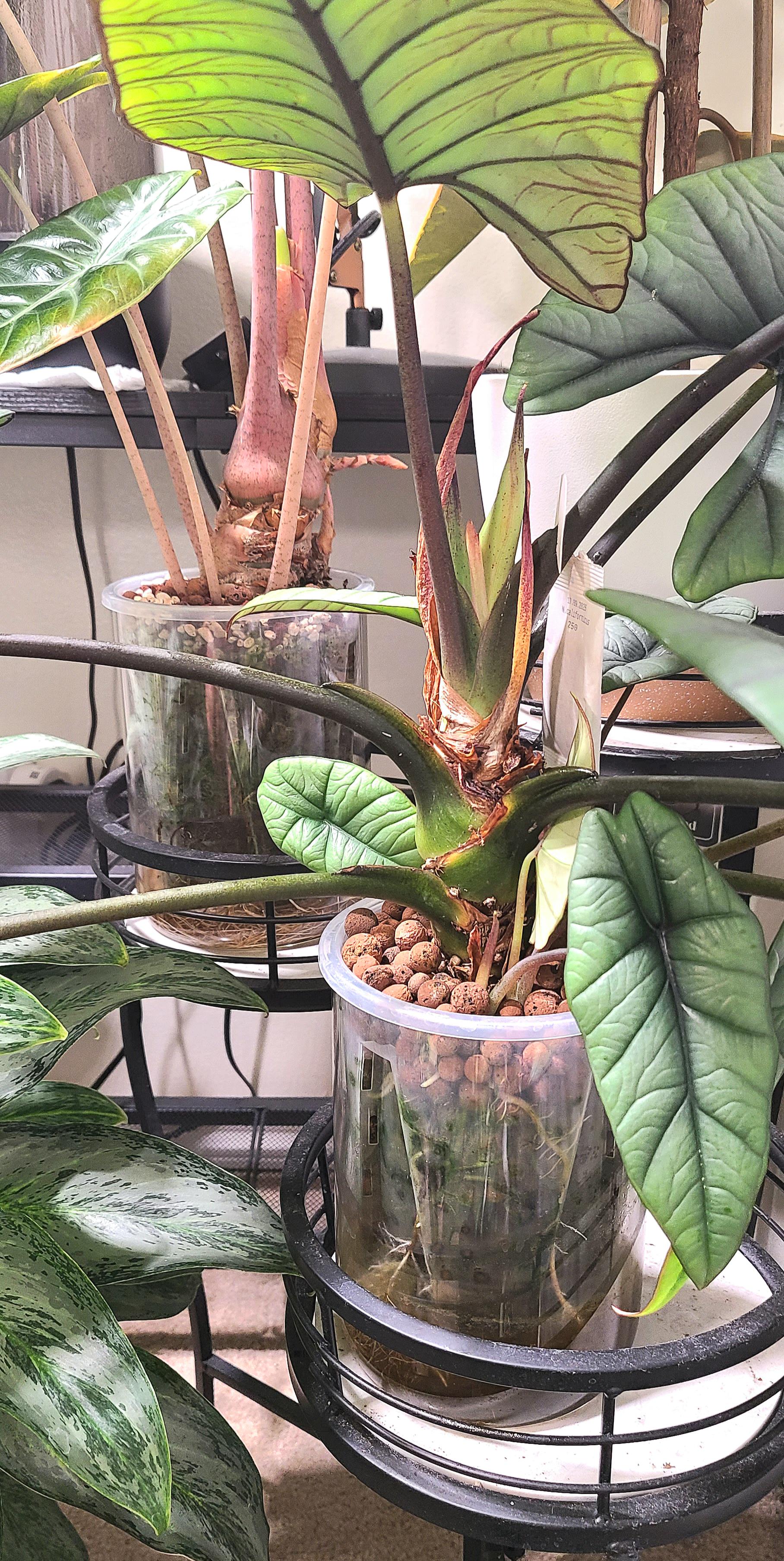
I've been doing semi-hydro for some of my plants for about two years now, and I just wanted to share my pros and cons vs soil.
Pros
- A fair amount of growth and in some cases, a large amount such as with syngoniums.
- No fungus gnats.
- I know instantly if a plant needs water because I use clear outer pots.
- I can monitor root growth.
- Cost effective because LECA and pon can be sterilized and reused.
Cons
- Not easy to find inner and outer pot combos although I've gotten lucky.
- Transitioning plants that came in soil to semi-hydro shocks plants more than just keeping them in soil.
- More nutrients are needed to make up for plants not being in nutrient-rich soil. I use General Hydroponics Flora Series, which is process when mixing, and I supplement with CalMag and silica.
- Higher maintenance than my plants in soil, which are all in self-watering pots (very low maintenence). I prefer to flush pots, and I have to clean out algae from the glass outer pots, which is my own fault for using them, but I like being able to see the water level at a glance.
- Repotting is a much bigger hassle than with soil. Sometimes it's hard to get plants out of their pots, especially if a large amount of roots have grown through the drain holes. I've lost a lot of roots pulling plants out. And separating dead roots from used LECA or pon is tedious.
Overall, semi-hydro has its ups and downs. I'm not going to stop putting plants in SH, but I will probably limit the number of SH plants I have.
It would be interesting to hear if anyone realized a pro or con after using semi-hydro for a while.

