r/Presidents • u/saucey_dawg0023 • 6h ago
Misc. George W Bush is the only president who gained seats in both the House and Senate in the 2002 midterm elections.

48
Upvotes
r/Presidents • u/saucey_dawg0023 • 6h ago
r/Presidents • u/RopeGloomy4303 • 1d ago

So I’ve been reading Obama’s A Promised Land and felt taken aback by his, for lack of a better term, very personal and psychological description McConell.
“Short, owlish, with a smooth Kentucky accent, McConnell seemed an unlikely Republican leader. He showed no aptitude for schmoozing, backslapping, or rousing oratory. As far as anyone could tell, he had no close friends even in his own caucus, nor did he appear to have any strong convictions beyond an almost religious opposition to any version of campaign finance reform. Joe told me of one run-in he'd had on the Senate floor after the Republican leader blocked a bill Joe was sponsoring; when Joe tried to explain the bill's merits, McConnell raised his hand like a traffic cop and said, "You must be under the mistaken impression that I care." But what McConnell lacked in charisma or interest in policy he more than made up for in discipline, shrewdness, and shamelessness- all of which he employed in the single-minded and dispassionate pursuit of power.”
Now I’m aware that there are deep ideological differences between the two, not to mention obvious tensions during the course of their careers, but still this feels sharply personal. “No close friends”? I’m curious by how accurate people view this description.
r/Presidents • u/RopeGloomy4303 • 20h ago

r/Presidents • u/Awkward-Evidence-215 • 8h ago

After Obama nominated Merrick Garland, the GOP-controlled Senate not only did not vote to confirm him, but refused to even consider his nomination. This was based on the Thurmond rule (formerly supported by Joe Biden), the idea that a party in power should not nominate a justice during an election year because the will of the people has not yet been determined.
After the GOP made its intentions clear, some argued that by refusing to even consider the nomination the Senate had essentially tacitly consented to it, and Obama therefore had the authority to unilaterally place him on the court.
Should Obama have done so?
r/Presidents • u/Far_Practice_6923 • 14h ago

r/Presidents • u/APoliticalDrone2012 • 17h ago

r/Presidents • u/CompetitivePenalty59 • 1h ago

One of the most fascinating things about Herbert Hoover is how much of American political history his life encompasses. Hoover personally knew Theodore Roosevelt, served under Woodrow Wilson, Warren Harding and Calvin Coolidge, was the political rival of Franklin Roosevelt, became a close friend of Harry Truman, worked under Eisenhower, and lived long enough to discuss the Cuban Missile Crisis with John F. Kennedy. He also knew Richard Nixon well before he became president and came close to meeting Ronald Reagan.
⠀
To put this into perspective, Hoover had personal interactions with presidents whose presidencies collectively spanned much of the 20th century. When Hoover was born, Ulysses S. Grant was president. When he died, Lyndon Johnson was president, and the political movement that would eventually bring Ronald Reagan to power was beginning to emerge.
⠀
What makes his relationships particularly interesting, however, is how little some of them had to do with ideological alignment. Hoover had a much warmer relationship with some Democratic presidents than he did with his fellow Republicans. One Democratic president whom he had previously been friends with became his greatest political enemy, while another Democratic president helped rehabilitate his reputation and became one of his closest friends.
⠀
What is also fascinating is how ideologically different Hoover actually was from the libertarian caricature often associated with him. Hoover was someone who came to prominence during the Progressive Era, admired Theodore Roosevelt and Woodrow Wilson, and frequently disagreed with Calvin Coolidge's philosophy of governance. This makes his presidency and subsequent opposition to the New Deal and modern American liberalism all the more fascinating.
⠀
This was a man who had firsthand exposure to multiple eras of American political history: the Progressive Era and World War I, the Roaring Twenties, the Great Depression and World War II, the early Cold War, and the Kennedy and Johnson years.
⠀
THEODORE ROOSEVELT
⠀
Hoover spent much of Theodore Roosevelt's presidency overseas working as a mining engineer. The two didn't meet until late 1916, when Roosevelt invited Hoover to his home in Oyster Bay to discuss World War I and Hoover's humanitarian efforts in Belgium.
⠀
Despite their differing priorities during the war, with Roosevelt advocating American intervention and Hoover primarily concerned with providing food to European civilians, Roosevelt was very supportive of Hoover's humanitarian work.
⠀
When Hoover met with Roosevelt again in January 1917 to discuss financing Belgian relief, Roosevelt recognized the importance of the work Hoover was doing and expressed his support without Hoover having to persuade him.
⠀
Unfortunately, there wasn't much opportunity for the relationship to develop further, as Roosevelt died in January 1919.
⠀
What I find more interesting is the extent to which Hoover admired Roosevelt's conception of the presidency. Hoover had supported Roosevelt's Progressive Party campaign in 1912, and when he became president in 1929, he envisioned himself as an activist president in the tradition of Theodore Roosevelt and Woodrow Wilson.
⠀
This is somewhat ironic considering Hoover is now remembered as a president who was unwilling to intervene in the economy. While Hoover was certainly opposed to many of the forms of government intervention that would later characterize the New Deal, he wasn't ideologically identical to the more limited-government conservatism of Calvin Coolidge.
⠀
On October 26, 1929, Hoover delivered a speech celebrating Theodore Roosevelt's character and accomplishments. The stock market crash was already underway, and just three days later, Black Tuesday would further intensify the financial collapse that fundamentally changed the trajectory of his presidency.
⠀
WILLIAM HOWARD TAFT
⠀
Hoover's relationship with Taft was considerably less extensive, but Taft almost played an important role in Hoover's entry into American public life.
⠀
By 1910, Hoover had become wealthy through his career as a mining engineer and was increasingly interested in public service. Some of his friends recommended him to Taft as a potential director of the newly established Bureau of Mines. Taft ultimately selected Joseph Holmes instead.
⠀
Their paths crossed again in 1921 when Warren Harding appointed Hoover secretary of commerce and nominated Taft to become chief justice of the Supreme Court.
⠀
Perhaps the most interesting interaction between the two occurred on March 4, 1929, when Taft administered the presidential oath to Hoover. Taft remains the only former president to have administered the presidential oath of office to another president, having done so for both Coolidge and Hoover.
⠀
When Taft resigned from the Supreme Court due to his deteriorating health in 1930, Hoover praised the extent of his public service. Following Taft's death, Hoover specifically recognized the variety of positions in which Taft had served his country.
⠀
There doesn't appear to have been a particularly close personal relationship between the two, but Hoover clearly respected Taft and his contributions to American government.
⠀
WOODROW WILSON
⠀
Woodrow Wilson was arguably one of the most consequential figures in Hoover's life.
⠀
Hoover first met Wilson in 1915. At the time, Hoover's negotiations with foreign governments to provide humanitarian assistance to Belgium had raised questions about whether he was violating the Logan Act. Wilson recognized the humanitarian importance of Hoover's work and publicly supported his efforts.
⠀
When the United States entered World War I in 1917, Wilson appointed Hoover to lead the United States Food Administration. Hoover agreed to take the position on the condition that he would have considerable autonomy in administering the program. Wilson granted him that autonomy.
⠀
Hoover subsequently joined Wilson's delegation at the Paris Peace Conference and became heavily involved in European relief efforts following the war.
⠀
It's interesting that Hoover's rise to national prominence occurred under a Democratic president. Before Hoover became associated with Republican conservatism, he was primarily known as a humanitarian and an extremely capable administrator whose political affiliation wasn't necessarily the most important thing about him.
⠀
This period was arguably the high point of Hoover's public life. His humanitarian efforts helped feed millions of people and made him one of the most celebrated humanitarians in American history.
⠀
Hoover also shared some of Wilson's underlying political beliefs, particularly his emphasis on economic competition, individual opportunity and progressive reform. Wilson's willingness to entrust Hoover with an immense amount of responsibility also contributed to Hoover's admiration for him.
⠀
However, their relationship deteriorated during the 1920 presidential election when Hoover became involved in Republican politics. The two never fully reconciled before Wilson's death in 1924.
⠀
Despite this, Hoover retained a considerable amount of admiration for Wilson.
⠀
In 1958, more than three decades after Wilson's death, Hoover published an entire book about him titled The Ordeal of Woodrow Wilson. Hoover portrayed Wilson sympathetically as a man who had attempted to establish a more just and sustainable international peace but whose efforts had been undermined by competing national interests and European power politics.
⠀
There is also an interesting parallel between the lives of Wilson and Hoover. Both experienced tremendous rises to national prominence, had ambitious visions for their presidencies and experienced devastating political disappointments toward the end of their administrations.
⠀
I think it's particularly interesting that Hoover, who became one of the most prominent conservative critics of the Democratic Party, dedicated an entire book to defending the legacy of a Democratic president.
⠀
This wouldn't be the last time Hoover developed a deep appreciation for a president with whom he had significant ideological differences.
⠀
WARREN G. HARDING
⠀
Hoover appears to have had a much more positive opinion of Warren Harding than Harding's historical reputation would suggest.
⠀
The two first met in 1917 when Harding was a senator from Ohio. Harding offered to assist Hoover in his work with the Food Administration, something Hoover appreciated.
⠀
Hoover supported Harding's presidential campaign in 1920. Following his election, Harding offered Hoover the choice of becoming secretary of agriculture, commerce or the interior. Hoover chose commerce.
⠀
Under Harding, Hoover was given an immense amount of freedom to expand the responsibilities of the Commerce Department. The two corresponded extensively about issues such as unemployment, housing, industrial disputes, foreign loans and infrastructure.
⠀
Many of the issues Hoover advised Harding on weren't even within the responsibilities of the Commerce Department. This gives some indication of how much confidence Harding had in Hoover's administrative abilities.
⠀
Hoover also accompanied Harding on his trip to Alaska and the western United States in 1923 and was present at the hotel in San Francisco where Harding died.
⠀
Hoover continued to defend Harding after the corruption scandals of his administration became widely known.
⠀
Hoover largely viewed Harding as a well-intentioned man who had placed his trust in the wrong people. At the dedication of Harding's memorial in 1931, Hoover described him as having been betrayed by people whom he trusted.
⠀
I don't think this necessarily absolves Harding of responsibility for the corruption that occurred under his administration. A president is still responsible to some extent for the people he appoints. However, it does provide some insight into how differently Hoover perceived Harding as a person compared to how Harding is remembered by the general public.
⠀
For Hoover, Harding was the president who gave him an opportunity to become one of the most influential figures in American domestic policy during the 1920s.
⠀
CALVIN COOLIDGE
⠀
Hoover's relationship with Calvin Coolidge wasn't nearly as warm as his relationship with Harding.
⠀
Despite the fact that Harding, Coolidge and Hoover are often grouped together as the three conservative Republican presidents of the 1920s, there were significant differences in their conception of government.
⠀
Hoover believed that the federal government could play a constructive role in economic development, coordinating industries and addressing social problems without necessarily replacing private enterprise. Coolidge believed in a considerably more limited role for the federal government.
⠀
Many of the principles that would later characterize Hoover's opposition to the New Deal were already present in his 1922 book, American Individualism. Hoover believed in private enterprise, individual initiative and equality of opportunity, but he also believed the government had a constructive role to play in preventing economic abuses and facilitating cooperation. His progressivism was much more rooted in administrative efficiency and voluntary cooperation than in the centralization of federal authority.
⠀
Coolidge was also somewhat skeptical of Hoover's political ambitions and sarcastically referred to him as "Wonder Boy." He reportedly once remarked:
⠀
"That man has offered me unsolicited advice every day for six years, all of it bad."
⠀
Nevertheless, Coolidge recognized Hoover's administrative abilities and continued to rely on him as secretary of commerce. Hoover was involved in the development of policies concerning the automobile industry, aviation, radio, coal and railroads.
⠀
When the Mississippi River flooded in 1927, Coolidge placed Hoover in charge of coordinating the relief effort. Hoover's work further increased his popularity and contributed to his reputation as someone who was particularly effective at managing crises.
⠀
However, Coolidge wasn't particularly enthusiastic about Hoover succeeding him as president. When Hoover sought Coolidge's endorsement in 1928, the endorsement he received was relatively lukewarm.
⠀
Despite their differences, the transition between the two administrations was cordial, and Hoover continued to express respect for Coolidge following his presidency.
⠀
I think their relationship is important because it demonstrates how misleading it can be to categorize all the Republican presidents of the 1920s as adherents of the exact same economic philosophy.
⠀
Hoover's disagreements with Coolidge over the role of government also provide some context for why Hoover responded to the Great Depression more aggressively than his reputation might suggest, even if his response ultimately proved inadequate.
⠀
FRANKLIN D. ROOSEVELT
⠀
Of all Hoover's relationships with other presidents, his relationship with FDR underwent arguably the most dramatic transformation.
⠀
The two initially became acquainted during the Wilson administration, when Roosevelt was assistant secretary of the Navy and Hoover was managing the Food Administration.
⠀
In January 1920, Roosevelt wrote to their mutual friend Hugh Gibson about Hoover:
⠀
"He is certainly a wonder and I wish we could make him President of the United States. There could not be a better one."
⠀
It's incredible to think that the man who would eventually defeat Hoover in one of the most consequential presidential elections in American history had once enthusiastically supported the idea of Hoover becoming president.
⠀
When Roosevelt became the Democratic vice-presidential nominee in 1920, Hoover congratulated him despite their different political affiliations. Their relationship remained cordial throughout much of the 1920s.
⠀
This changed as Roosevelt emerged as Hoover's political opponent in 1932.
⠀
Interestingly, Hoover initially believed Roosevelt would be a relatively weak candidate. He underestimated Roosevelt's political abilities and believed that his weaknesses would become apparent during the campaign.
⠀
He was obviously very wrong.
⠀
As the campaign progressed, Hoover increasingly viewed Roosevelt's proposed policies as a fundamental threat to the American political and economic system.
⠀
However, it was the period between the election and Roosevelt's inauguration that seems to have made their relationship particularly bitter.
⠀
The economy continued to deteriorate following the 1932 election, and Hoover attempted to get Roosevelt to cooperate with him in addressing the worsening banking crisis. Roosevelt was unwilling to commit himself to Hoover's proposed policies before taking office.
⠀
Hoover interpreted this as Roosevelt prioritizing his political interests over the interests of the country.
⠀
I think there are two ways of looking at this. From Hoover's perspective, the country was experiencing an economic catastrophe that required immediate action, regardless of who was going to be president. From Roosevelt's perspective, he had just been elected on a mandate to pursue a different set of policies and had no constitutional authority to implement those policies until his inauguration. FDR was also reluctant to tie himself to the policies of an administration that the American electorate had just overwhelmingly rejected.
⠀
Regardless of who bears more responsibility for the failed transition, it effectively destroyed whatever remained of their friendship.
⠀
Hoover spent much of the remainder of his life criticizing Roosevelt. He believed the New Deal represented an excessive expansion of government power and a threat to individual liberty.
⠀
This raises an interesting question about the extent to which Hoover's ideology actually changed. How could someone who admired Theodore Roosevelt and Woodrow Wilson be so vehemently opposed to Franklin Roosevelt?
⠀
Interestingly, Hoover never entirely abandoned his belief in progressive reform. In a speech in October 1938, even while criticizing the New Deal, Hoover stated:
⠀
"Constant reform directed to prevent business abuses is a necessity of a progressive nation."
⠀
He even acknowledged that the New Deal deserved credit for reforms that constructively addressed such abuses. Hoover also recognized addressing poverty, inadequate housing, child labor, poor working conditions and the needs of the elderly as legitimate functions of government.
⠀
His opposition to FDR was therefore not necessarily rooted in a rejection of the objectives of progressive reform, but rather in his opposition to the methods Roosevelt employed and the extent to which he centralized political and economic authority. Hoover was also particularly critical of Roosevelt's attempt to expand the Supreme Court in 1937.
⠀
Many of Hoover's fundamental political beliefs remained relatively consistent, but the New Deal expanded the responsibilities of the federal government to an extent that was unprecedented in peacetime America.
⠀
However, it would be misleading to suggest that FDR's policies were entirely incompatible with the progressivism of Theodore Roosevelt, whose 1912 Progressive Party platform advocated social insurance, minimum wages for women and stronger labor protections. Some of FDR's accomplishments were effectively the realization of policies that earlier progressives had advocated but had been unable to implement.
⠀
Hoover represented a different strand of progressivism, and his opposition to the New Deal increasingly became the defining feature of his political identity.
⠀
Their disagreements also extended into foreign policy. Hoover was opposed to American intervention in World War II prior to Pearl Harbor and was highly critical of Roosevelt's wartime diplomacy with the Soviet Union.
⠀
His criticisms of Roosevelt's foreign policy were eventually published posthumously in 2011 in a book titled Freedom Betrayed.
⠀
There is some irony in Hoover's opposition to Roosevelt's foreign policy considering his admiration for Woodrow Wilson. FDR's efforts to establish the United Nations were in some respects a continuation of Wilson's vision for a postwar international order. Wilson had also overseen American intervention in a European war and an immense expansion of federal authority during wartime.
⠀
However, Hoover's admiration for Wilson didn't necessarily mean that he agreed with all of Wilson's decisions. Hoover was particularly opposed to what he regarded as Roosevelt's excessive concessions to the Soviet Union and the circumstances under which the United States became increasingly involved in World War II.
⠀
Nevertheless, Hoover supported the American war effort following Pearl Harbor, and when Roosevelt died in April 1945, Hoover sent his condolences to Eleanor Roosevelt.
⠀
What makes their relationship so interesting isn't simply the fact that Hoover despised Roosevelt's politics. It's the extent to which the two had previously admired and respected one another.
⠀
While their ideological differences were certainly genuine, I don't think the personal resentment Hoover developed toward Roosevelt can be entirely separated from his subsequent political opposition to him.
⠀
The Great Depression not only fundamentally changed American politics but also transformed the personal relationship between these two men.
⠀
HARRY S. TRUMAN
⠀
Hoover's relationship with Truman is probably my favorite of all his relationships with other presidents.
⠀
For twelve years after leaving office, Hoover had been largely excluded from significant roles in the federal government. The Democrats had successfully made Hoover a symbol of the Great Depression, and Roosevelt had little interest in bringing his predecessor back into public service.
⠀
This changed almost immediately after Truman became president.
⠀
Hoover offered his assistance to Truman following Roosevelt's death. Truman took him up on the offer and invited him to the White House in May 1945.
⠀
The two discussed the food situation in Europe, the demobilization of the American military, the Soviet Union and the ongoing war with Japan. Truman was impressed by Hoover's understanding of these issues.
⠀
In 1946, Truman appointed Hoover to help coordinate efforts to address the food shortages that had emerged following World War II.
⠀
Hoover, who was already in his 70s, traveled extensively around the world to assess the situation and help prevent famine.
⠀
Truman also appointed Hoover to lead a commission tasked with reorganizing the executive branch of the federal government in 1947. The commission sought to eliminate unnecessary duplication and improve the efficiency of government operations.
⠀
It's interesting that Truman, who was ideologically much more liberal than Hoover on domestic policy, was willing to recognize that Hoover possessed administrative abilities that could benefit the country.
⠀
Truman's own political party had spent years portraying Hoover as a symbol of Republican failure. Yet Truman was willing to look beyond that reputation because he recognized Hoover's talents and understood how useful they could be to the country.
⠀
However, their relationship wasn't without its problems.
⠀
During the 1948 presidential campaign, Truman repeatedly attacked Hoover's presidential record. Hoover was understandably hurt by this, particularly considering how much time he had spent assisting Truman's administration.
⠀
The two also had significant differences in their approach to Cold War foreign policy, with Hoover being considerably more skeptical of extensive American military commitments overseas.
⠀
Nevertheless, their friendship strengthened after Truman left office.
⠀
Hoover attended the dedication of Truman's presidential library in 1957, and Truman attended the dedication of Hoover's presidential library in 1962.
⠀
That year, Hoover wrote to Truman:
⠀
"Yours has been a friendship which has reached deeper into my life than you know."
⠀
Truman gave Hoover the opportunity to do something that had been largely denied to him throughout the Roosevelt presidency: serve his country again.
⠀
Truman didn't have to agree with Hoover's political ideology or even defend his presidential record to recognize his value as a public servant.
⠀
Considering how bitter Hoover's relationship with Roosevelt had become, it's remarkable that Roosevelt's final vice president would eventually become such an important figure in Hoover's life.
⠀
DWIGHT D. EISENHOWER
⠀
One would assume that Hoover would have been happier working with a Republican president after twenty years of Democratic control of the White House.
⠀
However, Hoover's relationship with Eisenhower was considerably more complicated than his relationship with Truman.
⠀
Hoover had supported Senator Robert Taft for the Republican presidential nomination in 1952. Taft represented a more conservative faction of the Republican Party, which was skeptical of the direction American domestic and foreign policy had taken under Roosevelt and Truman.
⠀
Eisenhower represented a more moderate and internationalist faction of the Republican Party. He was considerably more supportive of American involvement in international alliances such as NATO.
⠀
While Hoover was strongly anti-communist, he was far from a conventional Cold War hawk. He was particularly skeptical of extensive American military commitments overseas and favored a defensive strategy that placed greater emphasis on American naval, air and economic strength rather than the deployment of large numbers of American ground forces abroad.
⠀
Hoover's evolution on foreign policy is arguably more complicated than his evolution on domestic policy. While he had admired Wilson's efforts to establish international peace, he had already expressed reservations about American involvement in European political affairs as early as 1919.
⠀
Hoover wasn't opposed to international cooperation, something his entire humanitarian career was predicated on. What he became increasingly skeptical of was the extent to which international cooperation involved military intervention and long-term American military commitments overseas.
⠀
Despite Hoover's preference for Taft, he ultimately supported Eisenhower in the general election.
⠀
Eisenhower subsequently appointed Hoover to lead a second commission on government reorganization. However, Hoover became frustrated by what he perceived as insufficient support from Eisenhower for the commission's recommendations.
⠀
Ironically, Hoover appears to have received more effective cooperation on government reorganization from Truman than from Eisenhower.
⠀
While the two maintained a professional relationship, their correspondence doesn't appear to have had the same degree of personal warmth as Hoover's correspondence with Truman.
⠀
I think this is one of the more interesting aspects of Hoover's post-presidency. His closest presidential friendship was with a Democrat, while his relationship with the first Republican president since his own presidency was much more distant.
⠀
JOHN F. KENNEDY
⠀
Hoover's relationship with JFK was also considerably warmer than I would have expected.
⠀
Hoover had been a longtime friend of Kennedy's father, Joseph Kennedy. The two had worked together on the first Hoover Commission, and Hoover became acquainted with the Kennedy children through this relationship.
⠀
Robert Kennedy would even go on to work for the second Hoover Commission.
⠀
When JFK underwent spinal surgery in 1954, Hoover sent him a letter expressing his concern and wishing him a speedy recovery.
⠀
One of the things Hoover wrote was:
⠀
"It doesn't matter much what the politics of good men are."
⠀
Jacqueline Kennedy responded to Hoover personally and explained how much the letter meant to her husband, who held Hoover in very high regard.
⠀
Jacqueline also attended a luncheon with Hoover in 1956 and subsequently wrote to him expressing her gratitude and the admiration that she and JFK had for him.
⠀
Despite his friendship with the Kennedys, Hoover supported Richard Nixon in the 1960 presidential election.
⠀
However, his political opposition to JFK didn't prevent the two from maintaining a cordial relationship during Kennedy's presidency.
⠀
Perhaps the most fascinating interaction between them occurred on October 28, 1962, when Kennedy personally called Hoover to discuss the resolution of the Cuban Missile Crisis. A recording of their conversation still exists.
⠀
Think about how much history that encompasses. The same man who had spoken to Theodore Roosevelt about World War I was now speaking to John F. Kennedy about a crisis involving the potential outbreak of nuclear war.
⠀
Following Kennedy's assassination in 1963, Hoover wrote to Jacqueline Kennedy expressing his condolences and recognizing Kennedy's sacrifice for his country.
⠀
Jacqueline continued to maintain contact with Hoover following her husband's death and expressed concern about Hoover's own deteriorating health.
⠀
While Hoover's relationship with JFK wasn't nearly as consequential as his relationships with Wilson or Truman, I think the correspondence between Hoover and the Kennedy family provides a particularly interesting insight into Hoover as a person.
⠀
LYNDON B. JOHNSON
⠀
Hoover lived through only eleven months of Lyndon Johnson's presidency, but the two maintained a respectful relationship.
⠀
Following Kennedy's assassination, Hoover was among the former public officials who offered Johnson their assistance.
⠀
Despite their ideological differences, the two had some interesting similarities. Both had grown up under relatively modest circumstances, devoted much of their lives to public service and had a considerable interest in alleviating poverty.
⠀
Obviously, their views on how to accomplish this differed considerably. Hoover placed much more emphasis on voluntary cooperation and private organizations, whereas Johnson believed the federal government had a much more direct responsibility to address poverty.
⠀
Nevertheless, Johnson held Hoover's humanitarian accomplishments in high regard.
⠀
On August 6, 1964, Johnson issued a presidential proclamation formally recognizing Hoover's 90th birthday. He praised Hoover's contributions to humanitarian relief, public service and government efficiency.
⠀
Johnson also ordered that the American flag be flown over the White House on Hoover's birthday and subsequently presented to him.
⠀
Despite the cordial relationship between the two, Hoover supported Republican Barry Goldwater in the 1964 presidential election. As was the case with JFK, Hoover's willingness to assist and respect a Democratic president didn't necessarily translate into support for his political agenda.
⠀
When Hoover died on October 20, 1964, Johnson spoke about the assistance and advice Hoover had offered him following Kennedy's assassination and how much it had meant to him during that period.
⠀
There isn't nearly as much documentation of Hoover's personal opinion of Johnson as there is of his opinion of some of the earlier presidents. However, it's clear that Hoover was willing to offer his assistance to Johnson despite their political differences.
⠀
In many ways, his relationship with Johnson was a continuation of the role Hoover had developed for himself under Truman, Eisenhower and Kennedy.
⠀
RICHARD NIXON
⠀
While Hoover never lived to see Richard Nixon become president, he had a substantial relationship with him during his earlier political career.
⠀
The two had a number of interesting similarities. Both came from Quaker backgrounds, had significant connections to California and were prominent figures within the Republican Party.
⠀
Hoover was particularly supportive of Nixon's role in the investigation of Alger Hiss. Following Hiss's conviction for perjury in 1950, Hoover sent Nixon a congratulatory telegram praising his persistence in the investigation.
⠀
When Nixon's political career was threatened by allegations surrounding his political expense fund in 1952, Hoover came to his defense.
⠀
Hoover subsequently supported Nixon's presidential campaign in 1960 and spoke at the Republican National Convention where Nixon was nominated.
⠀
Interestingly, Hoover was also one of the people who advised Nixon against running for governor of California following his defeat to Kennedy.
⠀
Both Hoover and Douglas MacArthur believed Nixon should instead return to Congress, where he could continue to have an influence on national and international affairs.
⠀
Nixon didn't take their advice and ultimately lost the 1962 California gubernatorial election.
⠀
Following Hoover's death, Nixon delivered a speech at the Hoover Presidential Library in 1965 in which he defended Hoover's character and criticized the extent to which partisan politics had distorted the public's perception of him.
⠀
Nixon believed that the image of Hoover as a cold and indifferent reactionary was fundamentally at odds with the humanitarian he had personally known.
⠀
There is some irony in this considering Nixon himself would eventually leave office with a deeply damaged reputation and spend much of his post-presidency attempting to rehabilitate his historical legacy.
⠀
Unfortunately, Hoover died four years before Nixon was elected president. It would have been fascinating to see how their relationship would have developed had Hoover lived through Nixon's presidency.
⠀
GERALD FORD
⠀
There isn't a whole lot of information available about Hoover's relationship with Gerald Ford.
⠀
Ford entered Congress in 1949, meaning his political career overlapped with the final fifteen years of Hoover's life.
⠀
According to the Herbert Hoover Presidential Library, Hoover had brief contact with Ford.
⠀
However, I wasn't able to find much documentation regarding the nature of their interactions or what Hoover specifically thought of him.
⠀
While they belonged to the same political party, I don't think that alone is sufficient to draw any conclusions about their personal relationship or how Hoover perceived Ford politically.
⠀
RONALD REAGAN
⠀
Perhaps the most surprising connection I came across while researching Hoover's relationships with other presidents was his connection to Ronald Reagan.
⠀
In November 1960, shortly after Richard Nixon lost the presidential election, Hoover received a letter from his friend Clarence Budington Kelland.
⠀
Kelland told Hoover about a conservative actor in Hollywood named Ronald Reagan who had become a particularly effective spokesperson for conservative political ideas.
⠀
Reagan had apparently wanted to meet Hoover for some time and was planning to visit New York in January 1961.
⠀
Hoover's secretary subsequently wrote to Reagan informing him that Hoover would be happy to meet him.
⠀
Unfortunately, according to the Hoover Presidential Library, there is no evidence that the proposed meeting ever took place.
⠀
It would have been fascinating to see a conversation between these two men.
⠀
Hoover had entered national politics during the Progressive Era, witnessed the emergence of the New Deal political order, and spent decades criticizing the expansion of the federal government. Reagan would eventually become the president most closely associated with the conservative reaction to that political order.
⠀
There isn't enough evidence to determine what Hoover thought of Reagan, but the fact that Reagan had actively sought a meeting with him is interesting in itself.
⠀
In 1992, nearly three decades after Hoover's death, Reagan participated in the rededication of the Hoover Presidential Museum.
⠀
CONCLUSION
⠀
I think one of the most unfortunate aspects of Herbert Hoover's historical reputation is how much of his life is reduced to the four years he spent as president.
⠀
This isn't to say that Hoover shouldn't be criticized for his handling of the Great Depression. However, when you look at the entirety of his public life, there is a considerably more complicated figure than the one most Americans are familiar with.
⠀
He was someone who admired Theodore Roosevelt and Woodrow Wilson, was given an immense amount of responsibility under Warren Harding, disagreed with Calvin Coolidge over the role of government, became the bitter political enemy of a man who had once wanted him to become president, and eventually developed a close friendship with another Democratic president.
⠀
He also maintained his relevance in American politics for more than three decades after leaving office.
⠀
Hoover was personally closer to Truman than to Eisenhower. He admired Wilson despite spending much of his later life opposing the Democratic Party. He was fond of the Kennedy family despite campaigning for Kennedy's opponent.
⠀
None of this means Hoover was free of partisanship. His relationship with FDR demonstrates that he was certainly capable of harboring an immense amount of political resentment.
⠀
However, his other relationships demonstrate that he was also capable of separating his political disagreements with someone from his appreciation of them as a person.
⠀
I also think Hoover's ideological evolution was as much a consequence of how American politics changed around him as it was a consequence of changes in his own political beliefs. While Hoover became more conservative in his rhetoric and political priorities and increasingly skeptical of American military commitments overseas, many of his fundamental beliefs remained relatively consistent.
⠀
He never entirely abandoned the belief that government could play a constructive role in society. However, his conception of what that role should be increasingly differed from the conception of government that emerged under FDR and was subsequently embraced by much of the Democratic Party and even some Republicans.
⠀
The same political philosophy that had distinguished Hoover from the more conservative Republicans of the 1920s would eventually make him one of the most prominent conservative critics of the political order that emerged under FDR.
⠀
Regardless of what one thinks of Hoover's presidency, I think his life outside of the presidency is one of the most fascinating among American presidents.
⠀
Very few individuals had the opportunity to personally interact with so many consequential figures across so many different eras of American history.
⠀
The fact that Hoover could discuss World War I with Theodore Roosevelt in 1916 and the Cuban Missile Crisis with John F. Kennedy in 1962 is something I find absolutely incredible.
r/Presidents • u/Character-Bid-162 • 13h ago
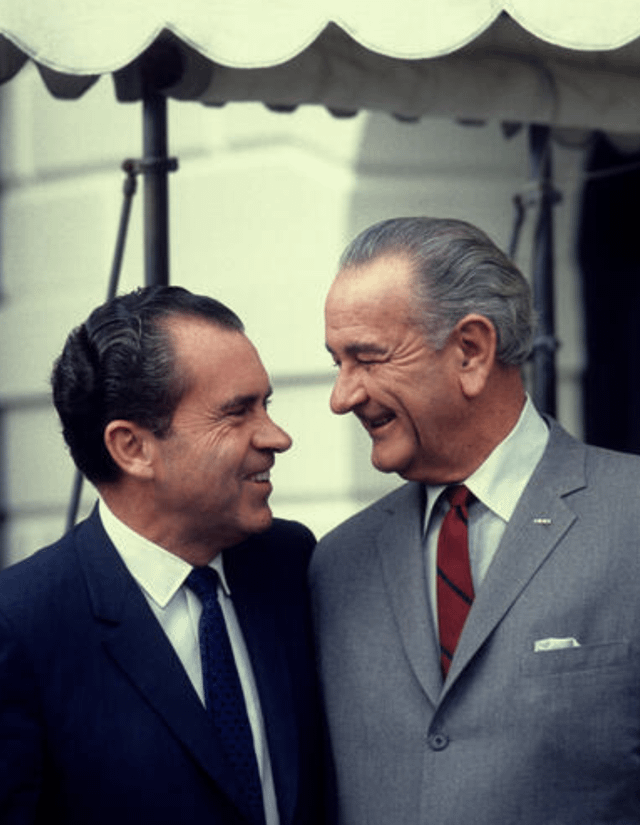
r/Presidents • u/Confident_Range3376 • 1h ago

I guess what I'm asking is, "Would Nixon have survived if networks like Fox News, OAN and Newsmax (as well as sites like Breitbart) existed during Watergate?"
r/Presidents • u/Doc_Jury1020 • 5h ago

Congratulations to u/Aarntson for suggesting twentieth nineteenth winning song with "The Winner Takes it All" for Rutherford Hayes and thank you for everyone who participated. Now I am asking, what is a random song that somehow fits James Garfield?
George Washington: "Yankee Doodle"
John Adams: "The Addams Family Theme"
Thomas Jefferson: "Brown Sugar"
James Madison: "Hello Dolly"
James Monroe: "I Feel Good"
John Quincy Adams: "Tubthumping"
Andrew Jackson: "Savages"
Martin Van Buren: "Hocus Pocus"
William Henry Harrison: "30 Days"
John Tyler: "The Bonnie Blue Flag" and "Union Dixie"
James Polk: "Don't Fence Me In"
Zachary Taylor: "Life is Just a Bowl of Cherries"
Millard Fillmore: "Hot for Teacher"
Franklin Pierce: "Fade to Black"
James Buchanan: "Lazy Song"
Abraham Lincoln: "The Battle Hymn of the Republic"
Andrew Johnson: "Dance of the Knights"
Ulysses S. Grant: "The Night They Drove Old Dixie Down"
Rutherford Hayes: "The Winner Takes it All"
r/Presidents • u/Salem1690s • 20h ago

r/Presidents • u/invisiblescarecrow • 16h ago

So sorry for the super late post, but today is Thanksgiving and all, happy Thanksgiving.
Johnson won last time pretty easily.
Most upvotes wins and a president can only he chosen once.
r/Presidents • u/RandoDude124 • 4h ago

IMHO, the best speech he gave.
r/Presidents • u/Jolly_Job_9852 • 1h ago

Out of all the Christmas carols that Americans sing, only a handful were written in America. Arguably, the most famous is "O Little Town of Bethlehem" by Phillip Brooks. Brooks was a pastor at Church of the Holy Trinity in Philadelphia, Pennsylvania. The inspiration for this song literally came to him in a dream and he hastily wrote down the lyrics. This is rather early for a Christmas post but it's a little bit of history that takes place during Johnson's tenure in office
r/Presidents
•
u/herequeerandgreat
•
23h ago


r/Presidents • u/WoodpeckerVast2772 • 15h ago
r/Presidents • u/SignalRelease4562 • 2h ago

Rules:
Pick a President you think does not fit Santa Claus's Personalities or Qualities and have the most upvotes will be eliminated.
Current Placements:
30th Place: Bill Clinton
31st Place: Grover Cleveland
32nd Place: James K. Polk
33rd Place: James Madison
34th Place: Woodrow Wilson
35th Place: James Buchanan
36th Place: Richard Nixon
37th Place: Calvin Coolidge
38th Place: Andrew Jackson
39th Place: William Henry Harrison
40th Place: Franklin Pierce
41st Place: Andrew Johnson
42nd Place: Lyndon B. Johnson
43rd Place: John Tyler (Worst US President Santa Claus)
r/Presidents • u/SignificantStyle4958 • 12h ago

r/Presidents • u/Repulsive-Finger-954 • 18h ago

r/Presidents • u/Salem1690s • 20h ago

r/Presidents • u/Mysterious_Row4827 • 20h ago

Happy Thanksgiving everyone! What’s everyone’s favorite picture of a President/Vice President/etc. enjoying Thanksgiving? I’ll start with this picture of Walter Mondale.
r/Presidents • u/Honest_Picture_6960 • 1d ago

r/Presidents • u/expiredexecutive • 1d ago

I’m spending the holiday with my roommate’s family but I found some time to paint this little portrait. I hope all of you lovely folk feel loved today. I’m so thankful for all of your support with my art!

