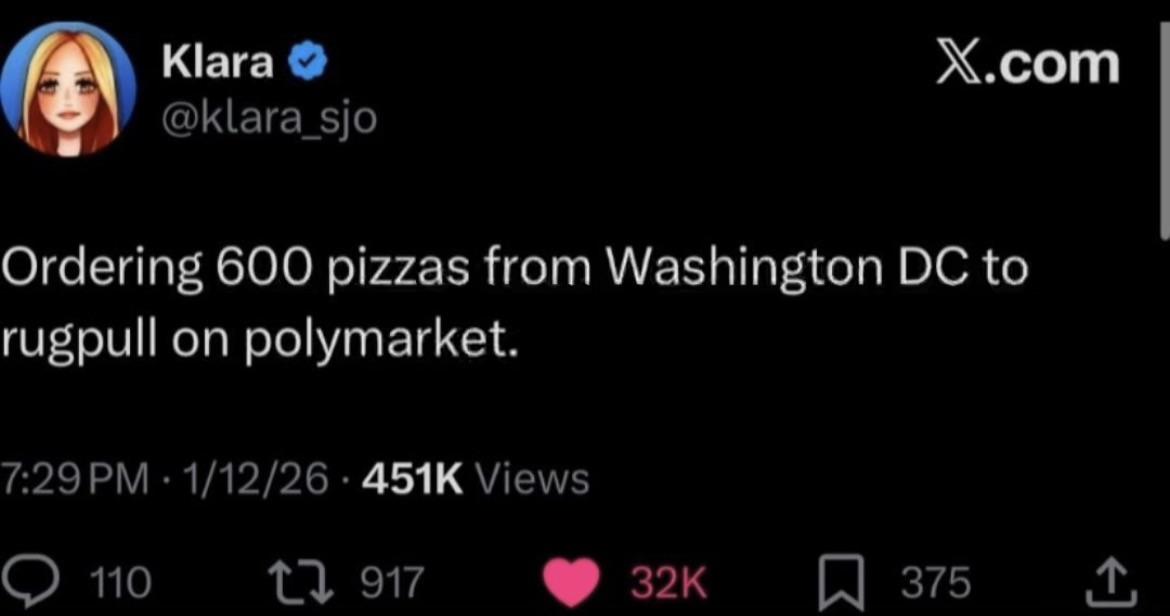
This is the story of "willo2", the top holder of YES on "MicroStrategy sells Bitcoin by May 31st"
Polymarket had a market for whether Michael Saylor's Strategy would sell Bitcoin this year, and broke that down by certain dates.
May 31st 2026 June 30th 2026 December 31st 2026
There were also two markets in 2025 that had resolved NO due to no sales occurring.
The exact wording of the rules:
"This market will resolve to "Yes" if MicroStrategy sells any of its Bitcoin by 11:59 PM ET on the date specified in the title. Otherwise, this market will resolve to "No"...
The primary resolution source for this market will be information from MSTR and on-chain data, however a consensus of credible reporting will also be used."
A trader began betting a few days earlier when Strategy first deposited $30M of BTC into Coinbase Prime.
He went through all the on-chain data, checked past wallets and transfers. The picture was clear — they had never done this before. So he placed a few YES bets totaling $5K.
The market was still open on June 1st (Monday) when Strategy's 8-K was due to come out.
Clearly, the 8-K was required to know whether Strategy had sold, and those filings were always issued on a Monday.
It came out that they had, in fact, sold 32 BTC. For the first time in over 3 years.
The market instantly moved to 80c.
He decided to continue betting because the rules specified a SALE within the timeframe, and the 8-K that Strategy had just issued legally confirmed that they had done exactly that.
Objectively, this was a true statement:
MicroStrategy SOLD BTC before May 31st.
However, the market didn't resolve. He was uneasy, but after thinking it through, concluded that as a trader, he had a duty to place maximum size on what appeared to be a mispriced market.
He reread the rules. SALE before May 31st. He reread the 8-K. MicroStrategy SOLD Bitcoin. The market was still open and trading.
So he jammed.
Later, Polymarket added a clarification.
"No information from MSTR, on-chain data, or consensus of credible reporting confirmed that MicroStrategy sold Bitcoin within the market's timeframe.
Confirmation achieved outside of the market's time frame does not qualify."
This was simply not part of the original rules.
It was not written on the market, it did not make sense, and most importantly, Polymarket didn't appear to believe it themselves.
Why? Because if that interpretation were correct, the market would have closed on May 31st. It didn't.
In fact — and this is where things became questionable — Polymarket specifically waited until the 8-K was filed before resolving the market.
Their "sharps" could fill six-figure positions against people betting on what appeared to be a confirmed outcome, then a new rule could be introduced afterward, leaving newer participants on the losing side.
It was a simple, straightforward, and dirty trick.
From this trader's perspective, it amounted to clear insider abuse by a major crypto platform.
Prosecutors allege Van Dyke was involved in the planning and execution of the unprecedented military action in the early hours of January 3, when US soldiers extracted Maduro and his wife from the presidential palace in Caracas under heavy fire.
Authorities allege Van Dyke used his knowledge of the classified operation to place bets on Polymarket in the days and hours leading up to the operation. Van Dyke allegedly placed $32,000 in bets on US involvement in Venezuela, including that Maduro would be “out” of Venezuela by the end of January. After the successful raid, Van Dyke’s bet paid off. He made over $400,000 in profits.
Van Dyke allegedly transferred the windfall to a foreign cryptocurrency vault before moving them into a newly created online brokerage account. After news reports flagged the wildly successful bet, the indictment alleges, Van Dyke asked Polymarket to delete his account.
He was photographed just after the operation on “what appears to be the deck of a ship at sea, at sunrise wearing U.S. military fatigues, and carrying a rifle, standing alongside three other individuals wearing U.S. military fatigues,” according to the indictment.
Van Dyke was arrested Thursday night and charged with unlawful use of confidential government information for personal gain, theft of nonpublic government information, commodities fraud, wire fraud, and making an unlawful monetary transaction. Friday, Van Dyke made his first appearance in federal court in North Carolina and was released on $250,000 bond.
The Maduro bet is one of several suspicious trades that have attracted attention. Lawmakers and media reports have highlighted several huge trades in the oil futures market that preceded announcement of key developments in the US-Iran conflict.
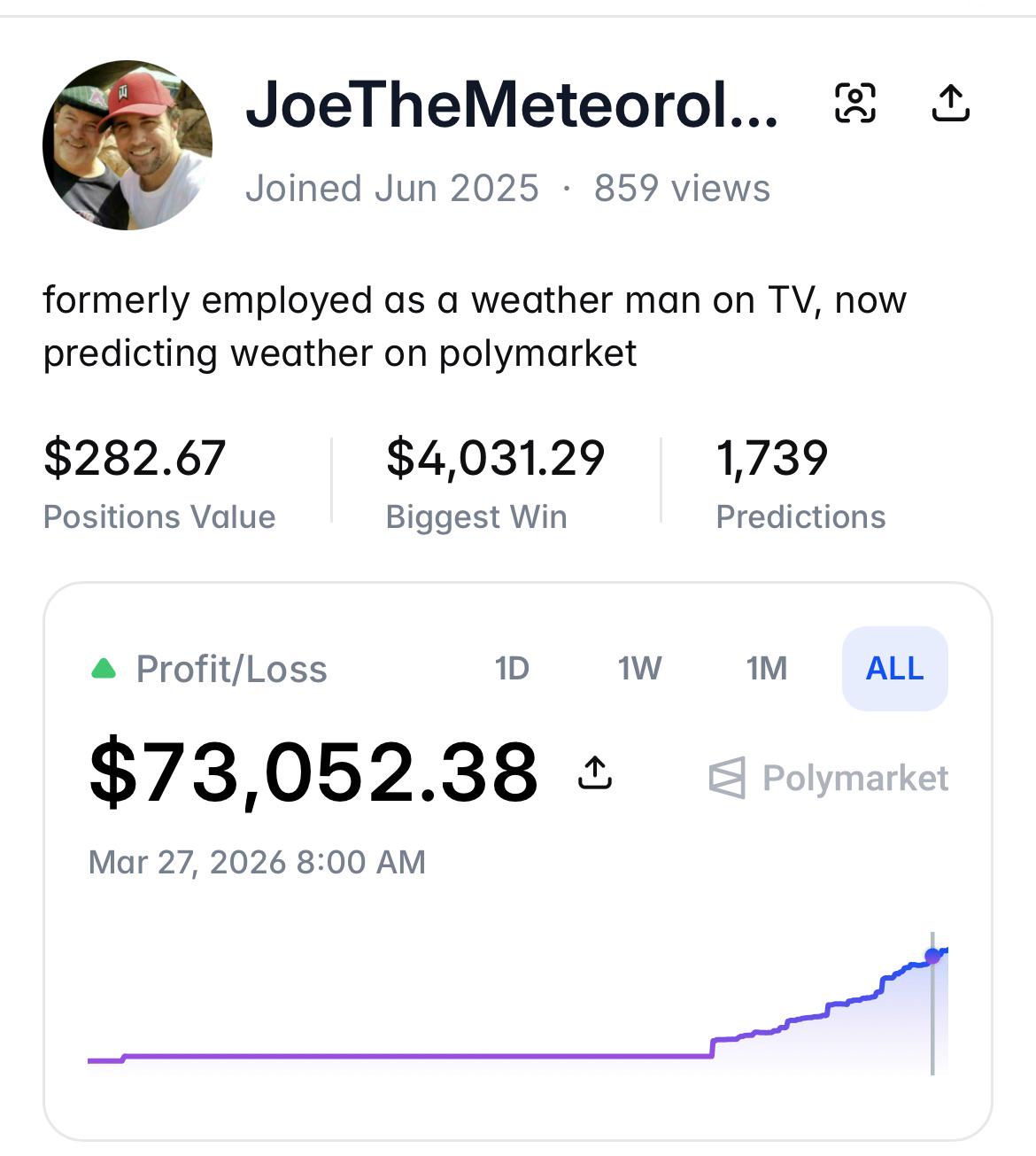
The Trader Who Turned $100 into $4,923 by Betting on Temperature
He has 2,068 predictions with $19,839 in total winnings, and almost all of his profit come from weather markets.
This trader basically treats Prediction Markets like a daily weather station, placing small, precise bets that almost never miss.
His strategy is stupidly simple: > Buys YES only 5–15¢ > Buys NO at 40–55¢ > Never risks >$1 per position > Cycles through dozens of micro-weather markets every day
That’s how he turned weather markets into a nearly 100% win-rate machine.
His best hits show exactly how crazy weather markets can be: > $119 → $4,923 (+4,033%) > $109→ $949 (+769%) > $33 → $536 (+1,499%) > $4 → $499 (+12,035%)
Do you think weather markets stay this mispriced forever?
Wallets are stars that glow by PnL — green for profitable, red for underwater, brightness scales with volume. Same-funder wallets get pulled toward each other, so any shared-funder cluster shows up as one bright knot.
I can include the link but afraid reddit will delete my post lol
What you can actually do from in there:
See how money and position shifted over time
Click on a planet to see Market info
Planets ring gold or cyan when sharp money disagrees with the current price.
Pulsing red beacons mark markets that just took fresh insider alert / suspicious activity hits.
If a wallet moves up it voted yes , if it moved down it voted no etc.
It's in Beta version would love to hear your thoughts and ideas.
A few months ago, a trader named willo2 posted about losing around $500K on Polymarket after what he believed was a post-hoc change to the rules of a Bitcoin prediction market.
The market asked whether MicroStrategy (MSTR) would sell any Bitcoin before May 31st.
He found evidence suggesting MSTR had sold Bitcoin, and after MSTR's SEC filing confirmed that 32 BTC had been sold during the relevant period, he increased his YES position.
The original rules said the market would resolve YES if MSTR sold any Bitcoin by 11:59 PM ET on May 31st.
But after the filing came out, Polymarket added a clarification saying that confirmation received after the market's timeframe would not qualify.
That left the trader with a massive losing position despite the filing confirming that the sale itself had happened in May.
TL;DR of the original story:
A trader bet heavily that MSTR sold Bitcoin before May 31st. MSTR later filed an SEC report confirming that it had sold 32 BTC during that period. Polymarket then relied on an interpretation that required the sale to be confirmed before the market deadline, resulting in the market not paying out as the trader expected. The trader claims the rules were changed or clarified after the fact and is now taking the dispute to court.
Polymarket has now filed a 24-page motion attempting to dismiss the lawsuit brought over the dispute.
Here's the first line of Polymarket's response:
“Disregarding the false allegations in the Complaint”.
That immediately raises a few questions.
Are they saying MSTR never sold Bitcoin?
Are they saying Polymarket never changed or clarified the rules after the fact?
Or are they saying Polymarket never represented that users who correctly predicted an outcome would be paid?
What's interesting is that Polymarket apparently doesn't spend the rest of the filing addressing those allegations directly.
Instead, the core argument is:
The user agreed to Polymarket's Terms of Service by trading on the platform.
And those Terms of Service say users can't take Polymarket to court.
That's essentially the argument they spend 24 pages making.
Polymarket markets itself as a “truth engine” where users who correctly predict an outcome get paid.
But this case raises a much bigger question:
What happens if the platform can determine what counts as “correct” after the event?
The trader's argument is essentially that this is exactly what happened here.
And when he challenged the decision, Polymarket's response starts with:
“Disregarding the false allegations in the Complaint”.
The full court filing is available here for anyone who wants to read it themselves:
Whatever happens next, this case could become an interesting test of how prediction-market platforms handle ambiguous rules, post-market information, and disputes over payouts.
And considering the amount of money involved, this is probably far from the last chapter of the story.
Posted this on the Kalshi sub as well. Big blow and an expensive lesson on how there are no guarantees, even when it’s at 98%. Cash out when you can. Yes, before you say it, I know I’m an idiot. But I’m moving on. Done with sports gambling forever. Goodbye!
Here is everything you need to automate and make your trading easier:
This is the largest dataset with over 107GB of real trading data, based on more than 1.1 billion trades, analyzed by 5 professors from Shanghai University.
2. A working backtesting simulator that lets you test your own ideas and strategies on real historical markets to see your potential Pnl and possible risks.
3. This tool analyzes the real trading behavior of any trader, finds repeated patterns in his trades, shows which strategies he uses, and how you can adapt them to your own trading.
5. A weather bot from a Chinese dev that can analyze multiple sources in real time, like forecasts, airport data, and aviation observations (METAR + SPECI) to generate a detailed weather report for any specific city and day.
6. This bot comes with 118+ ready-to-use automated strategies and tools for trading on prediction markets, including arbitrage between Polymarket and Kalshi, price latency, Mean Reversion, and more.
8. A trading dashboard where multiple AI agents analyze a selected market from different angles (checking news, price behavior, technical indicators, and possible risks) to help you make better decisions.
9. This tool lets you search for information about any historical market, price, or trader across different prediction market platforms inside one dashboard.
One of the strangest prediction-market settlement disputes I have seen has now turned into a $170,000 lawsuit.
The underlying trade happened in March. The fresh development is that the bettor is now taking Polymarket to court over the unpaid position.
Polymarket had opened a contract asking whether Donald Trump would say “Ayatollah” or “Khamenei” between March 9 and March 15.
The written market rules said a publicly accessible verbal mention recorded on audio or video would count.
The rules explained how plurals, possessives and compound words would be treated.
They did not explicitly say that Trump had to pronounce the name perfectly.
A bettor named Jesús Manuel Gonzalez Hernandez says he spent approximately $300 buying 170,000 YES shares.
If the market resolved YES, those shares would have paid $170,000.
Then, during a March 15 press gaggle aboard Air Force One, the published transcript records Trump saying:
“They showed about 250,000 people in a square saying how much they love Khamenei.”
The transcript records Trump using Khamenei again a few minutes later.
Despite that, the contract resolved NO.
The 170,000 YES shares paid $0.
According to the report on the lawsuit, the explanation for the NO resolution was that Trump may have mispronounced the name or may have been referring to Ruhollah Khomeini, the former Iranian leader who died in 1989, rather than Khamenei.
Hernandez’s lawyers argue that the written rules never required exact pronunciation and never specified which person named Khamenei had to be referenced.
They also argue that interpreting Trump’s comment as a reference to Khomeini makes little sense in the context of what he was discussing.
Polymarket declined to comment on the pending lawsuit. No court has ruled on whether Hernandez is entitled to the money.
To me, the bigger issue is not even this particular bet.
It is whether a prediction market can use a pronunciation distinction to decide a six-figure payout when no pronunciation standard appeared in the rules before people traded.