r/Poker_Theory • u/BariWins33 • Aug 22 '25
Poker Flow Chart for Beginners

285
Upvotes
I created this flow chart to teach a friend of mine how to play Hold'em. Anyone have suggestions to improve it?
r/Poker_Theory • u/BariWins33 • Aug 22 '25
I created this flow chart to teach a friend of mine how to play Hold'em. Anyone have suggestions to improve it?
r/Poker_Theory • u/Kipkrokantschnitzell • Feb 11 '25
I used to play professionally about 10 years ago, made a lot of money doing it. These days, I don't have the time anymore.
However, I watched my son play some online poker and it frustrated me. He plays like an degenerate gambler.
I've seen him 3bet hands like pocket Jacks. He almost never limps, as if one blind isn't enough of a gamble for him. He keeps raising AK preflop as if it's any better then a drawing hand. He plays all kinds of 8 high holdings and justifies it be talking about "implied odds", whatever that is supposed to mean.
He even tries to get pocket aces in preflop.... Kid wants to wager his entire stack without even knowing what the board will look like. Classic case of overplaying a big pair obviously.
Anyway, how do I make him see he should stop treating poker as a gambling game? I am really worried he is just going to keep losing, instead of earning some money by playing small ball poker and only betting the nuts.
r/Poker_Theory • u/Vidyabro • Nov 22 '23

r/Poker_Theory • u/Swimming_Design152 • May 16 '24

Played poker for a couple hundred hours but just recently getting into GTO. A lot of these range charts for calling / raising 3bets show A5s as one of the best hands to bluff with. I get that it’s better than aces with middle kicker due to straight potential, but how is it so much better than something like A4s? I’ve even seen a chart that said to call with A5s but fold ATs. Just seems like a hand that would have roughly the same strength as all other AXs with wheel potential.
r/Poker_Theory • u/David_Slaughter • Jul 23 '23
It's obvious to anyone that sufficiently understands math and game theory, that understanding GTO strategy in poker is extremely important to becoming a better player.
But it seems there is a lack of information/learning resources out there to actually learn this stuff. So far all I can find is solvers locked behind super expensive paywalls, or books that just bombard with a million range charts, which would be impossible to memorise for every specific situation.
I'm looking for learning resources where I can learn PATTERNS in certain scenarios. Which I can then adapt to my games, that will inevitably be slightly different, but close to these patterns.
I just can't find anything out there. The best thing I have found is GTO Wizard, but last time I checked that out I was doing some hand drills in a specific scenario. It tells me if I get my decision wrong or right, but it doesn't say WHY. So hence I don't actually learn anything.
How are you learning GTO? What does Stephen Chidwick's laboratory look like?
r/Poker_Theory • u/DyslexicHobo • Nov 10 '23
It seems like developing a bot to play with a solver would be pretty trivial for someone to do since there's money to be made. Is it well-known whether or not poker bots are rampant? Are most online poker sites just a bunch of bots playing against each other?
r/Poker_Theory • u/Matsunosuperfan • Sep 12 '25
Recently I have been extremely profitable and I think it's mostly down to one simple change in my approach: I stopped using so much theory and started just exploiting the crap out of everyone.
The regs in my game have a lot of leaks and I have stopped trying to be balanced against them. I just lean on the leaks and it is working almost too well. I may be building bad habits lol.
The number of times in the past two weeks that I have won a pot by check-minraising the flop OOP HU against the PFR is crazy. People are just massively over cbetting and don't know what to do against aggression. Lots of other spots like this but I won't bore you with the details.
Point is I think unless we are playing in a really tough pool, I think we could all be exploiting way harder bc our opponents are really predictable, have trouble shifting gears on the fly, and it's basically a sin not to take advantage of this!
r/Poker_Theory • u/tombos21 • Sep 05 '25
If you strip it to first principles, every edge in poker is an edge in information. Information Asymmetry drives positional advantage, polarization, indifference, board coverage, exploits, etc. Yes we almost never talk about it explicitly.
Positional Advantage = More Information.
Why is position valuable? Because you act on more information. While OOP must commit to an action immediately, IP gets to update their beliefs after seeing villain's action. IP is acting on a finer information partition, and this is inherently where the edge comes from. This forces strategic concessions, e.g. OOP will often range-check to minimize IPs information edge.
Polarization = Turning Villain's Hand Face Up When you rep nuts or nothing, every bluff-catcher in the defenders range is effectively the ~same hand. The polarized player knows with certainty if they are ahead/behind, depolarized player is guessing.
Indifference = engineered uncertainty Call just enough to make bluffing uncertain. Bluff just enough to make calling uncertain. The goal isn’t “balance” for its own sake, it’s to deny your opponent a reliable signal.
Exploits = harvested info edges
It's not just esoteric GTO concepts. Every exploit can be reframed as leveraging information advantage. Is your opponent underbluffing in this line? That's an information advantage. Does the population tend to check back this river too much? That's an information advantage. Exploits are just asymmetries in who has the better signal.
Board coverage = deny telegraphs on runouts
Board coverage is the trait of being able to represent the nuts on most runouts. If someone is obviously strong on some runouts and obviously weak on others, they're easy to exploit. A player with poor board coverage essentially has their hand strength given away by community cards.
Lookalike principle = blur blocker tells
Lookalike/mirror principle: Solvers minimize blocker weaknesses by making value hands and bluffs “look alike” (sharing blockers). This is just a fine-grained way of minimizing your opponent's information advantage (making it harder to use their blockers against you)
Bottom line
Are you starting to notice a common theme? Every edge in poker is an edge in information. That's where win rate comes from at the deepest level.
Are there any other poker concepts you think can be better understood through this lens?
r/Poker_Theory • u/neverfoldingAK • 10d ago
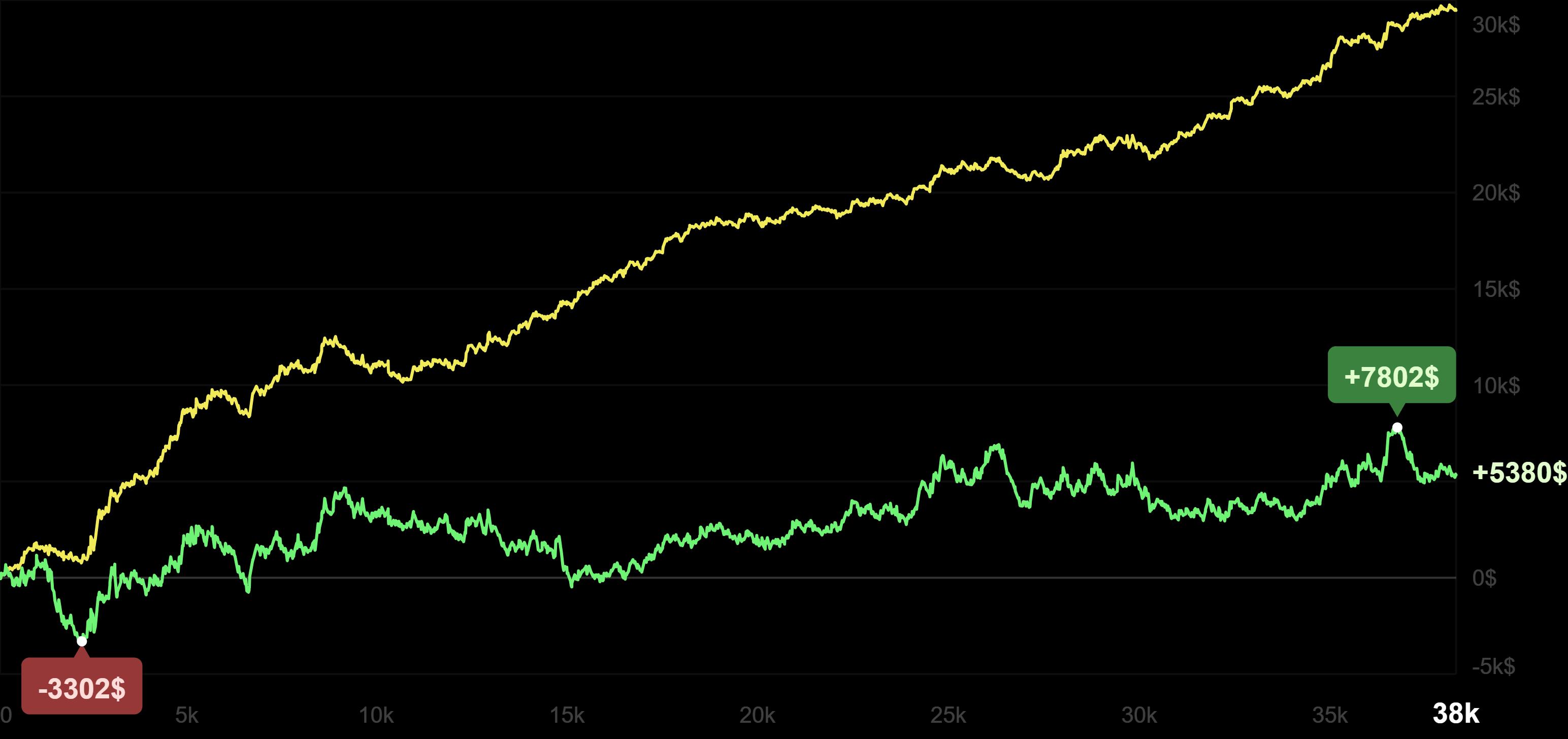
Played in the $100 6k GTD daily won it for $2.3k lost $1,000 right after then took the $1300 remaining to 10/20. And made 7500 thank you magoo. Here's the final hand
Ps. I'm done for awhile to stressful
r/Poker_Theory • u/Independent-Cloud-22 • Jul 02 '24
It was a long journey friends, but after 30 years I am finally profitable. I made $3.28 last week. What a game!
r/Poker_Theory • u/tombos21 • Oct 10 '25
How many players actually win at poker?
I've put together a chart showing player pool win rates for 6-Max NLHE cash games, from NL10 up to NL500 over tracked sites:

(you can explore the full interactive version here)
Notice how many more winners there are at NL500? That's because the rake is lower. Reminder that your biggest villain is the house. If you're playing full time, do whatever you can to escape the low-stakes rake trap.
As we all know, win rates are noisy as hell. A player's "true" win rate takes a huge sample size to converge. If I were to simply filter out low-volume players, it would bias the data towards stronger regs.
To get a more realistic picture, I've applied a Bayesian adjustment. In simple terms, this method reins in the crazy results from small sample sizes by gently pulling a player's observed win rate toward the population average (which is negative, thanks to rake). The more hands a player has in the database, the more we trust their results, and the less their win rate gets adjusted. This helps correct for luck.
(For the stats nerds: the prior mean is set to the stake's rake, with a standard deviation between players of 8 bb/100)
Definitions:
Winners: Players with a win rate >0 bb/100 after rake.
Pre-Rake Winners: Players who would be winning if we ignore rake.
Table 1: Bayesian-Adjusted
Now remember, the Bayesian win rates are pessimistic by design. Bayes pulls winners with small sample sizes down into the negatives (towards rake), so winners here need a good volume AND good results.
| Stake | Winners | Pre-Rake Winners | Rake (bb/100) |
|---|---|---|---|
| NL10 | 7.5% | 53.2% | -9.1 |
| NL25 | 8.6% | 42.0% | -7.4 |
| NL100 | 9.0% | 43.2% | -7.3 |
| NL200 | 12.8% | 43.8% | -6.0 |
| NL500 | 20.1% | 51.1% | -3.8 |
Table 2: Raw Win Rates
This is the raw data without any corrections applied. I only filtered out players with less than 100 hands.
| Stake | Winners | Pre-Rake Winners | Rake (bb/100) |
|---|---|---|---|
| NL10 | 25.8% | 35.4% | -9.1 |
| NL25 | 22.5% | 30.3% | -7.4 |
| NL100 | 28.8% | 31.8% | -7.3 |
| NL200 | 25.4% | 30.7% | -6 |
| NL500 | 30.4% | 34.1% | -3.8 |
In short: about 25-30% of players are winning at poker. Far fewer of them are proven winners over a decent sample. But to be fair, that's not necessarily because they can't win; they simply haven't put in the volume to prove it.
This is the part I find fascinating. If you look at the 'Pre-Rake Winners' in either table, you see a U-shape. The highest percentage of pre-rake winners are at the very bottom (NL10) and the top (NL500), while the middle stakes (NL25-NL200) seem to be a tougher grind.
My theory:
As you move up, two things happen simultaneously:
Competition gets tougher
Rake gets lower
As you move up from NL10 -> NL200 you tend to get tougher competition without a big discount on the rake, so the game gets harder. But once you break through that NL500 barrier the game gets easier because all of a sudden you get a huge discount on the rake, and the competition isn't *that* much tougher between NL200 and NL500.
Now to be clear, the "break point" depends on the operator. You can look up the approximate rake by stake in bb/100 using this free resource:

r/Poker_Theory • u/tombos21 • Nov 02 '25
I've been working on an experiment recently that I think will fundamentally change the way you look at GTO.
A few days ago, I posed this question to the community: "Does Playing a Less Exploitable Strategy Give You an Edge?" The just of it was, if two players are both making mixing mistakes, will the less exploitable one have the edge on average?
Tbh I wasn't certain what the correct answer was, so I set out to find it. In doing so, I discovered something that reframed the way I see poker.
Let's define a "Bad Reg" as a player who perfectly finds every pure move but just randomizes every mixed decision. They are the ultimate button-clicker.
Pure action - GTO always takes one action (e.g. always calls this hand)
Mixed actions - GTO mixes between actions (e.g. call 30%, fold 70%)
First, we need a baseline. We'll use a standard CO vs. BB single-raised pot, 100bb cash.
Here are the baseline GTO EVs:
| Player | GTO EV (bb) |
|---|---|
| OOP | 1.608 |
| IP | 3.432 |
| Rake | 0.060 |

Now the fun begins. Let's round OOP's GTO strategy to the nearest 1/2 frequency. So for every decision point in their strategy, from flop to river:
Low frequency actions become 0%
Mid-frequency actions become 50%
High frequency actions become 100%
This is the definition of the "Bad Reg" strategy. They are playing randomly when mixed, but the pure actions stay the same.
Here's an example of what that looks like:

Important note: Do not re-solve after rounding. The point measure the original GTO strategy vs this newly rounded strategy. After rounding I simply click "calculate results" to see the EVs of this new matchup:
| Player | GTO vs GTO | Rounded OOP vs GTO IP |
|---|---|---|
| OOP | 1.61 | 1.61 |
| IP | 3.43 | 3.43 |
| Rake | 0.06 | 0.06 |
Results: The EVs are identical (technically the EVs shifted by 0.004 bb, but that's just solver noise; goes away if you solve to higher accuracy).

This was not a surprise to me, in fact it's an expected result from the laws of indifference, something I've written about before. In short, Nash implies that every mixed action should have the same EV, otherwise it's not at equilibrium.
Since rounding only changed the frequencies of indifferent decisions, OOP doesn't lose any EV. This is the classic "mixing mistake" (exploitable, but 0 EV loss vs. GTO) vs. a "pure mistake" (playing an action GTO never takes, which does lose EV vs GTO).
In other words, the "bad reg" loses nothing vs GTO.
Up to this point, nothing is new. Pros and game theorists have known this for ages.
Okay, so what happens if we round both player's strategies? This is where it gets weird.
Now we have two rounded strategies facing each other. Crucially, the mixed actions are no longer indifferent. Facing GTO, some hand had the same EV regardless if it bet or checked. Facing bad reg, one of those actions has higher EV. The indifference argument no longer applies.
Both players are making a ton of mistakes, so one player should "accidentally" exploit the other just by random chance, right?
Nope.
| Player | GTO EV (bb) | Rounded OOP vs GTO IP | Rounded OOP vs Rounded IP |
|---|---|---|---|
| OOP | 1.61 | 1.61 | 1.61 |
| IP | 3.43 | 3.43 | 3.43 |
| Rake | 0.06 | 0.06 | 0.06 |
Result: The EV remains exactly the same as the GTO baseline.

I've run this experiment on a dozen different spots, in different formations and SPRs, varying levels of complexity, and the EVs stay locked to the GTO baseline.
This is very suspicious to me. Like, I would have expected mixing errors to somewhat cancel out just due to luck, but not this precisely. The mixing errors cancel out to like ~1/1000th of a big blind. Smaller than I can reliably measure. And the further down I solve my baseline, the smaller the error becomes.
What in the F***? Why? How? How are two semi-random strategies just by chance arriving at the exact GTO vs GTO EVs? It is completely counterintuitive to me that this should be the case.
We already know from Experiment 1 that a GTO player doesn't beat the Bad Reg:
[GTO vs Bad Reg] EV = [GTO vs GTO] EV
The real blackpill is what Experiment 2 showed:
[Bad Reg vs Bad Reg] EV = [GTO vs GTO] EV
That's the truly novel part. Unbiased mixing mistakes precisely cancel out in the aggregate.
No, but it shows that GTO mixing is 100% defensive.
The only reason to mix is to reduce exploitability. Our "Bad Reg" strategy is wildly exploitable (~15% of the pot in this case). An exploitative opponent will destroy this strategy. But even then, there are ways to reduce exploitability that don't require mixing.
Caveat 1: In reality, most opponents don't make unbiased mixing errors. They lean some direction (e.g. over-folding, over-calling, over-aggressing, etc). When mixing mistakes are biased, they presumably won't cancel out in the aggregate.
Caveat 2 (The Counter-Example): This "error canceling" effect isn't a universal law. I built a simple polarized river toy game (1 value, 3 bluffs, 1/2 pot shove behind), and rounding both strategies does change the EV. In a simple, asymmetrical toy game, the errors don't cancel out. But in the full game with millions of decision points, the they seem to wash out perfectly.
I've been calling this player a "Bad Reg," but this is actually a very high-level strategy lol. This is someone who loses no EV against a GTO trainer. This is a player who:
Finds every single pure action correctly.
Knows exactly what actions to mix between.
So, your first goal should be to become the Bad Reg. If you can get your baseline to that level, you're already playing at a very high level. Then you can focus on exploitation.
Level 1: Master the Pures. "This hand always bets here", "This hand always folds here". These pure actions are the load-bearing walls of your strategy. When you study solvers, focus on finding the pure actions first.
Level 2: Master the Classification. Forget the frequencies for now. Just learn to identify: "Okay, this hand is a mix between calling and folding" or "This one is a mix between checking and betting small". Everything else is noise.
Level 3: Exploit. Once your baseline is prepped, you can start deviating to exploit your opponents. Lean your mixtures in certain directions to exploit the pool and player-specific tendencies.
r/Poker_Theory • u/tombos21 • Sep 04 '25
I've spent a lot of time analyzing what causes a solver to bet more often in certain spots. Here's what I found:
Range vs range equity is a very weak predictor of GTO c-betting frequencies (R²≈0.24). If I told you your range has e.g. 54% equity, could you confidently say how often to bet? Probably not.
R² = 1 → perfect correlation
R² = 0 → no correlation
Here is every strategically distinct flop, graphed by the range equity OTF vs c-betting frequency. I ran this analysis for two separate formations, BTN vs BB SRP and SB vs CO 3BP.


Expected value (EV) correlates better with c-bet% (R²≈0.5), but it's still noisy. Betting is not the only way to make money in poker.
Crucially, EV and strategy are not independent. Does higher EV drive higher betting frequency, or the other way round?


A stronger metric is Equity Realization (EQR = EV/EQ). In my tests it correlates with c-bet% (upwards of R²≈0.7). It is curious that this outperforms both.
My interpretation: How well you convert equity into chips largely reflects how freely you can attack your opponent.


Here's the kicker though. None of these things actually "drives betting frequency". These are correlations, not causations.
The actual incentives that drive frontloading aggression are more nuanced and can't be fully measured by something as coarse as range EQR.
All the metrics are range vs range, not hand vs hand.
EQ = equity (how often player would win if both players check down)
EV = expected value (expected winnings, given all the posftlop variables), as a percentage of the pot
EQR = EV/EQ
r/Poker_Theory • u/trent6991 • May 23 '25

UTG opens 3.5x, SB flats, I am quite deep so 3B to 16BB. Both positions call.
I then go with a pretty standard half pot bet (I think) and rather surprisingly, this happens...
Crying call or easy fold?
Info I had, the player to my right I've never seen before. They were also deep. The UTG Id previously labelled as a recreational
I'll share the run out later... It was interesting to say the least
r/Poker_Theory • u/savantpoker • Jul 20 '25
I’ve been digging deep into SRP spots where BTN cbets and BB check-raises, especially on low flops (e.g. 742r, 963r). This is one of the most misunderstood lines in the game, and according to my research, one where most players, even solid regs, lose EV by folding too much.
The Default Advice is Wrong: Most people think “If BB check-raises and keeps barreling, they’re probably under-bluffing. Just fold.”
And at first glance, it makes sense. The XR-B-B line looks scary: usually all the chips go in by the river. Most regs assume this is always under-bluffed. But when you actually look at the mass data (MDA), you'll see that low boards are over-bluffed, even by your average passive reg.
It makes sense from a solver perspective as well. On low boards, BB has many draws and overcards. These make for intuitive check-raises, but actually XR at a low frequency. Here, I've highlighted BB's bluffs on 8♥️6♦️5♦️:

And most regs over-bluff on the turn and on the river as well. Again, the story becomes much clearer when you see just how little they're allowed to bluff on each street. For example, here's solver's river bluffing strategy:

When players over-bluff on prior streets, even just a little bit, they'll be massive unbalanced on the river due to the compounding nature of the mistake. The XR-B-B is a very low frequency line, so even small mess-ups on each street have massive consequences for bluff-catching.
That's why even your average, passive reg over-bluffs here!
The Exploit: Don't be afraid to bluff-catch on low boards. If you have a weak pair: you can often call. In one node-locked example, a weak pair (A5 on the board above) gained 17bb in EV. That's huge for a hand most players throw away!
But: Don't call with weak hands on the flop. Data shows most regs over-barrel on the turn in XR-B, so anything that can't call against a turn bet should be thrown out on the flop.
What do you think? Does this line up with how you play, or what you see in-game? Esp. interested in what live players think!
TL;DR: Most regs over-fold against flop check-raises and barrels on low boards in SRPs. Fear is costing them money. On low boards, even the average passive reg over-barrels according to mass data because it's so easy to mess up the right bluffing frequency as BB.
r/Poker_Theory • u/RunGoodPlaya • Dec 23 '19
Something that has been weighing on me recently, as well as many newcomers to threads here and other other forums like 2+2 is the lack of empathy, understanding and kindness towards other people in most threads.
Are we not here to learn and grow as players, while finding a little comeaderie meantime?
I'm so tired of snappy wannabe comedians, self-entitled spoiled "know-it-alls" who act like they have everything figured out...here's the thing: No one does.
So before you shitpost your comebacks, snips, and putdowns remember YOU were a newbie once. Most of all, remember you're a human being like everyone else here.
If you can't contain negativity and use that energy for good, you arent much of a poker player to begin with. It's a game about people, not creeps who overestimate their skills at a game or at life in general.
Be kind, compassionate and encourage new players. Remember how we all 'paid to learn'? Those new players are part of our hourly rate, so dont run them off so soon.
This game is about give and take, not take and take more. That's not sustainable, and neither is ruining the game for aspiring players.
r/Poker_Theory • u/sucks2bey0u • Aug 02 '24

Why would 65s be a call and not 98s? Is it because villain would be blocking more of our draws in their range? Sorry I’m new genuinely looking to learn.
r/Poker_Theory • u/[deleted] • Aug 01 '22
r/Poker_Theory • u/KaramazovFootman • Sep 18 '25
Just a friendly shout-out to everyone here. It's generally a really friendly crowd, which isn't exactly what might be expected.
I started watching old poker videos on the TeeVee back during covid days becaue there was nothing else to do. Eventually signed up for a PokerStars account playing fake money. Learned the flow of the game and the basic rules. Like literal the lowest of low stakes. Fifteen thousand free chips every four hours
But I started following this sub, and most of the time, I guess, the convo goes over my head -- like the lingo eludes me. But I'm not the slowest learner so some of it sinks in
Anyway I'm in the middle of a long business trip, in a foreign country, and one of my counterparts on the project sez, "well we've got a weekly poker game, maybe you'd like to join no?"
Cleaned those fuckers out. You guys would be proud of the fish's evolution.
r/Poker_Theory • u/keuwai • Feb 17 '22
Preflop is the most common street, so it pays to put some thought into it instead of using the same sizes as everyone else. Here are some tips for choosing a good RFI size:
1. Big sizes maximise value the times we get called by the BB
As the aggressor, we have an equity advantage on most boards. This is especially true vs the BB, who is calling a weak and wide range. A big RFI size (such as 3x) magnifies our edge, bloating the pot in a situation where we have the upper hand.
2. Small sizes save us money the times we get 3bet
A big part of our raising range is 0 EV against a 3bet—especially if the 3bettor is in position. A smaller RFI size (such as a minraise) saves us money the times this happens.
Consequently, our RFI size depends on the ratio of 3bets to calls that we expect to face. In small stakes live games for example, we can afford to make huge raises (often >5bb) because the player pool is calling too wide, and not 3betting enough. The ratio of 3bets to calls is low, so our priority is to make the pot as big as possible the times we get called.
3. Position matters
Contrary to popular belief, we actually raise smaller from early position, despite the fact that our range is tighter. Watch this short video to find out why:
The Magic RFI Size (2mins)

r/Poker_Theory • u/Actual_Goose9984 • May 20 '23
I’m trying to get into the game, and I want to learn it, but there seems to be just too much to learn and I’d like to hear how you all would approach the game if you were beginning today. What would your first weeks look like? Your first moths?
What would you read? What apps would you use?
How would you study?
r/Poker_Theory • u/Huntersa47 • Mar 05 '25

Why is AQs always a call here when you are in HJ facing a 3bet from BN, SB or BB? Whereas other suited pairs are 4bet sometimes?
r/Poker_Theory • u/kmanifold • Aug 26 '26

Pre: 3-bet by pocket 9s, KJo jams all-in, two all in callers.
Person A flopped a straight.
Person B flopped a set.
Person C had top pair and a straight draw.
Person B turns quad 9s.
Person A rivers straight flush.
$300 bounty tournament tonight at MGMNH 🤣