Software dev asking hardware engineers: will agent-driven PCB design actually work?
I’m a software developer with no EE experience. My gut says agents will eventually be able to take on a lot of PCB design, but I’m asking people who actually build boards rather than trusting my software instincts.
With code, you can have an agent make changes, run tests and keep fixing things. Obviously a board passing automated checks isn’t the same as a working physical board, and a bad revision costs more than another test run.
Do you think a similar approach can work for hardware with an engineer reviewing it? What part of your work am I underestimating most?
I lean toward yes eventually. I’m interested in the strongest case against it.
Edit: A few takeaways from the replies that changed how I’m thinking about this:
Passing ERC and DRC doesn't prove a board works. The schematic, rules, footprints and pinouts can themselves be wrong.
Several agents agreeing isn't the same as independent verification. Checks against datasheets, physical parts and measurements matter more than another confident review.
Layout also involves mechanical, thermal and manufacturing tradeoffs I hadn't appreciated coming from software.
I still think an agentic plan/build/review workflow can work, but the question is what evidence each step produces, not how many review passes it runs. Thanks to everyone sharing concrete failures and checks. That's much more useful to me than a blanket yes or no.
I know people are working on it. I think there is a lot less training inputs available for PCB design. But I also lean toward yes eventually. I have been an EE doing PCB-level circuit design (mostly) for 26 years. Around two or three times per month I get linked in offers to apply to AI training jobs.
One observation I have is that auto-routers have been around for a LONG time but are seldom used. The reason is that writing up all the constraints without over-constraining it to the point where it is impossible is actually pretty difficult. For AI to be successful, it will have to overcome this issue for schematics and layouts. If it takes me a week to write a spec for an AI vs 5 days to draw the schematic and figure out the spec as I go, then that is not a win. Same for placement and layout.
But I believe EEs will be using AI for block diagrams, schematic capture and layout eventually. To some significant degree.
Its this and that PCB design isnt really a solved engineering discipline. There are a lot of instances where you need to make your best guess on what the outcome the layout will be
This is true, and why non AI autorouters struggled. But Claude is very successful with various software engineering tasks. I believe AI can eventually help tremendously on PCB tasks.
I have been thinking, if we were to train an AI with Altium Academy and Robert Feranec content, would the resulting model be able to make something useful from a vague input like "Make a powered USB3.0 hub using this IC. The DFPs should be type C with PD up to 60W each."
When that actually happens and the result is a working board that passes EMC/EMI, it would both provide a great tool but also seriously disrupt the field.
I already use it for footprint creation and compare it to datasheet. It gets the pads right most of the times but the big time saver is for the mechanical layers.. Courtyard is a good example, I gave the IPC density levels and the specs and he does it fast, then I only need to check it and most of the times it's right. I get the batch done quickly and I am happy.
My second use case is for schematic verification, it points out a lot of small/stupid mistakes that are easy to overlook. Its good for a check before peer review.
The point about spending longer writing the spec than designing the board makes sense. I’m testing a plan/build/review loop, and I wonder whether constraints could develop through that process rather than needing one complete spec up front. I still think it could work, but with no EE background, I might be missing how much one decision affects everything else. Could that approach save you time, or just move the work into reviewing the agent?
Yeah, I think with AI it may be a case of "go do this however you think it should be done." Then Oh my god, no, change this, that, and the other thing and do it over. Better. But do these calculations and see if we are going to have a power dissipation issue. Show your work.
Etc. With an autorouter, if it is unable to finish the design because of too many constraints, all the work will be basically lost. It seems like AI solutions work well using an iterative process.
Yes, that’s much closer to the process I mean. Plan, build, review, then use what failed to guide the next pass. The “show your work” part seems important, though someone still needs to verify it. Which calculations would you insist on checking before trusting a revision?
I don't know I was just thinking off the cuff. There are so many things you have to check. Power dissipation can be a problem if you are designing high current regulators or power related things like DC-AC inverters, motor controllers and so-on. This would be at the schematic level. Having them show their work makes it way easier to check it. Like what assumptions are going into the calculation. Did you include gate losses? What about Vds * Id during on/off transitions? And I^2 Rds when the FET is on? Etc.
I mean, if you try it, let us know how it works. It seems like it could work, assuming they have been trained on that type of data. But if not, then maybe it wouldn't work well.
heyo, could I send you two PCB designs I made using ai with their accompanying schematics, I chose most of the parts and had it do research + actually make the PCB, it actually used auto routing for almost all the traces with one or two connections it couldn't get auto router to do so it did them by hand
I am an IPC CID+ PCB Designer with over thirty years of experience.
From what I have seen over the last thirty years is Electronic Engineers who have to do circuit design and PCB layout generally are poor at PCB layout. They don't have the knowledge and experience in DfM, IPC Standards, etc, and are a pretty mixed bag.
If the data used to train AI models is coming from these guys as well as experienced PCB Designers then I imagine results could be pretty mixed.
I always think PCB Layout is a much of an Art as a technical discipline.
That distinction between circuit design and layout expertise is something I wouldn’t have known coming from software. When you review a board that passes DRC, what problems tell you it wasn’t laid out by an experienced designer? I’m trying to understand what an agent’s review process would need to catch beyond the automated checks.
That's pretty difficult to explain. There are things that are very subtle at first glance that can destroy signal integrity or cause compliance testing to fail. A lot of that is stuff you learn to recognize through experience and through "tribal knowledge" in peer reviews. DRC is a first pass, but it doesn't ensure that everything is correct. And it's a lot deeper than layout. There's a whole cascade of things that matter. Circuit models aren't always representative of real world structures. Component derating is important. There are so many considerations that have to be checked and analyzed.
Simple example, say you have a very noise sensitive analog sensor and then you also need a very high speed digital signal on the same PCB. Good design will try to keep them apart physically with placement and then layout will just follow. Bad design might throw them right next to each other so the digital switching noise is now seen on the analog side. DRC will not complain about this, since technically everything is connected properly, its only when you build it and put probes on it that you go "This isnt right, why am i getting spikes on the sensor measurements that correspond to the clock edges of the digital signal....OHHHHHH".
Interestingly - I've been using an AI coding firmware, and wanted to get a bit of testing done on a dev board to see if the firmware compiled and did something sensible. I told it "assign GPIOs to any convenient pin for now". It carefully put the noisy digital switching stuff on the pins on one side, and used the the ADC pin for the sensitive input right next to a ground and kept the pins on the other side spare. It justified these choices in these terms.
On the MCU pin assignment thats a first step, but where you place components relative to each other is the next thing to figure out. For some stuff it really doesnt matter but other stuff it does.
I already have AI optimizing floorplanning and designing IPC-compliant library parts for Altium. I don't think it needs to see any PCBs just know what good practices are and what bad practices are. Of course it is going to be more of an accelerator than a fully automated process for now but I have to say, I see no reason this won't happen.
Yeah, I don't get how people think PCB design and layout is some arcane knowledge that only those touched by the pixie gods can do well. If PCB design is art, we already have AI making art (albeit of various quality).
I'm joking, but lots of things we thought untouchable by AI, we do get pretty close to. It's just a matter of getting enough data to train from.
I am a 25-year-old electronics engineer with a standard CID certification.
I lack professional experience, as such opportunities are virtually non-existent here. At most, I am capable of designing systems that meet IPC Class 2 standards, though without significant high-speed requirements.
Without experience in the field, it’s difficult to learn it outside of courses or classes.
I am an EE who mainly does circuit design. But I have had to do some of my own layout over the years. I agree with your assessment. It makes no sense to pay me my salary to do layout, unless there are no other pressing tasks for me to work on. In that case I can do the layout (slowly) and save the company a little bit of money on outsourcing it. Small companies usually don't have enough PCB design work to keep a PCB designer busy full-time.
Im an electronics engineer with 18YOE that also does pcb layout and I agree with your assessment lol. I like to think Im decent at it, but our PCB designer with 30YOE is way better.
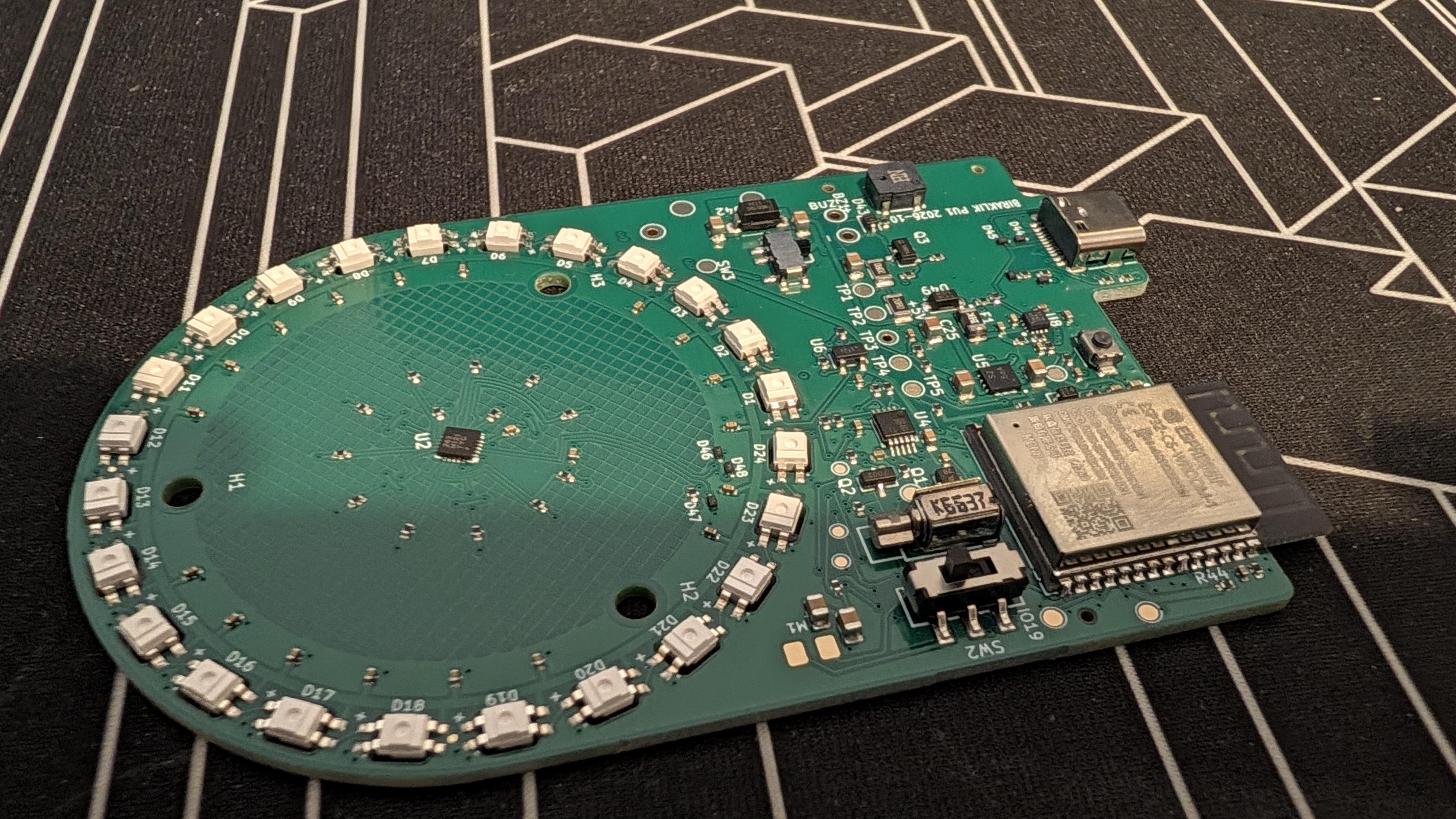
The PCB in the picture has been generated by GPT-6 Astra and manufactured by JLCPCB. It's just 6 high-powered LEDs + LiFePO4 charger + USB-C circuitry for charging + firmware flashing. There's a tiny microcontroller there as well (CH32X035G8U6).
Schematics, layout, BOM, gerber export, firmware, board bringup - everything was done by Codex.
The goal was to test the current capabilities and the resolution is that - it barely works even for very simple PCBs like this one and I would not trust it to do anything complex. The model clearly struggled many times and there were bugs that a real engineer would never make. While the model was able to fix most of the issues, some still remain, and while I could turn my brain and fix them, the goal of the experiment was a fully automated design & bringup.
It feels like early 2024 for coding. "Hello worlds" kind of work, but that's about it.
This is exactly the kind of experiment I wanted to hear about. What bugs remain, and what feedback did the agent get when trying to fix them? I still lean toward this workflow eventually working, but knowing where yours got stuck is more useful than another polished demo.
- It could not solve hysteresis while ending charging, when voltage drops. Partially, it's my fault by using thin jumper wires to connect the battery, but still - a fix would be simple enough. - It still shows a charge state (green/red) even when not "on". I could probably convince it to change that, but gave up. This one was surprising, because it's supposedly just software/firmware, which models have been already decent for a while. - It was unable to implement dimming (when a button is pressed). It was supposed to use PWM to dim to 50%, but still shoots at full strength. I suspect that the microcontroller choice (not a very documented one) is to blame here, but I dunno. - Initially, it connected power to a wrong pin on the microcontroller, but was able to catch at the very end, when JLCPCB was trying to confirm the LEDs polarity. - Routing is just horrible (and it's a 4-layer board!)
I would really not trust it for now. They *might* and probably will improve that, but the current state is underwhelming to me.
Thanks for spelling those out. A wrong power pin surviving until that late is a much stronger warning than a generic “AI makes mistakes.” I’m still optimistic about the approach, but an effective review loop would need to catch that, not just produce more revisions that look plausible.
Depends on the complexity. I got claude to design esp32 carrier boards driving simple mosfets, steppers, switches. I ordered them as is from jlcpcb printed and assembled. And it works fine.
When you say you ordered them as-is, did you still check the schematic and footprints yourself first? Trying to separate a design that needed no changes from one that went to manufacturing without a human check.
I didnt check. I got claude to design it on easyeda and its api gateway. i had to get claude to hack it a bit by automating some functions via electron devtools. but other than that, it was all claude. it performed all the necessary drc, thermals, ngspice. i laid out the main components and that’s about it.
I imagine that given a relatively large board area and appropriate stackup it would be fairly simple for AI to place and route working circuits, given enough input and context from schematic side and constraints/rules and access to SI/PI simulations. The difficulty would be when you are making form factor boards where the success of your product depends on many compromises with cross functional team members. Feels like a good chunk of my job is negotiating space with mechanical engineers and defending suboptimal circuit placement driven by strange board outlines to EE.
The negotiating part is something I wouldn't have guessed from the outside. A tool can work within a board outline, but deciding which compromise to defend, and to whom, sounds like the actual job. Do those tradeoffs ever get written down anywhere, or do they mostly live in meetings and people's heads?
Mostly discussed in cross functional meetings and the trade offs are context dependent. Really comes down to your org priorities: what’s best for the product, what’s best for the consumer, what’s most cost effective, SCHEDULE, etc.
Look at the training material: There's an awful lot of poorly designed hobby projects out there ("Oh look, I made a LED flasher for my first board and published it on github").
Meanwhile, very few designers are making their high speed board designs open source. Models trained on open source material simply won't know how to design things like that, and (based on personal experience) it's not possible to simply extrapolate from low speed design approaches to get a high speed design that works. (I'm not going to quantify "high speed" - it's whatever is fast enough for the low speed approximations to fall apart.)
Substitute another style (e.g. "low noise" or "EMC compliant") for "high speed" and that likely remains true.
Eventually it'll get there though. In the meantime, it's quite possible to use them for directed optimisation tasks.
Compare that to something like C programming - there's a wealth of reasonably well written and documented C source out there to be used for training the LLMs, and the LLMs are useful today.
The point about low speed approaches not carrying over is something I’d probably underestimate coming from software. Does an agent using datasheets and simulation tools change your assessment much, or is knowing how to set up and interpret those checks itself the missing expertise?
I expect that ultimately the AI tools will know how to set up an interpret the results from the simulation tools. Even so, it's hard to know how to apply them.
For example, a board might have several thousand vias on it. The vast majority of these vias will come with a negligible design load - you just tell the PCB tool to change layers when placing a track and it inserts a via [with some default geometry], and that works perfectly well. There's no need to simulate it - it always works as long as some simplistic design rules (e.g. adding a ground stitching via) have been followed. However this board also uses e.g. the latest generation of PCI Express or DDRn RAM, which requires a lot of attention to the design rules around vias, to the extent that you might want to extract the 3D geometry and simulate that in a field solver and tweak the dimensions until the S parameters or eye diagram look adequate.
I've spent over a week on a single differential track pair with vias at each end. Obviously I'm not going to do that for every via if there are thousands of them on the board. At this stage I don't know that the tools can figure that sort of thing out by themselves. I can figure that out, because early in the design stage I identify which tracks are going to need special attention.
I fed Claude the datasheets for a design I did myself, and it identified a few errors. My nrf9151, nrf7000, pm1300 designed work perfectly the first time which is really great for this 12mm x 30mm pcb as it would be challenging to rework.
That's a use I don't think gets talked about enough: you design it, and the AI checks your work against the datasheets. On a 12x30mm board where rework is painful, catching those before fab sounds like real value. Were the errors it found things you'd have caught in your own review eventually, or stuff that probably would have made it onto the board?
I had Gemini design a 100 Khz oscillator in LTSpice. It took a few passes but it worked good in the simulator. I then had Gemini turn the LTSpice schematic into a KiCad schematic. I then had it layout and route the board. It took a few passes for each step but it turned out pretty close. I think if I would have given it tighter specs to go by it would have worked even better. Since Electronic Design, and board layouts can end up being complex math problems, I can see in the near future a lot of design work headed to AI.
This is close to what I’m testing with plan/build/review. What drove those revisions, simulator and KiCad feedback, or you spotting problems yourself? Also curious whether you built the physical board yet or have only tested the simulation and layout?
I did not build the board, it was just a proof of concept experiment. I did learn if you give a sample file from any type of software package (LTSpice, KiCad), Gemini is then able to create those kind of files. I did have to review the files, and ask it to fix issues. It did seem to learn from the corrected mistakes.
I've seen some cool demos, but most are replicating existing open-source hardware projects. Unlike software, hardware designs aren't widely available publicly for AI models to train on. Check this: https://youtu.be/dgVYNaHekgs?si=7KDKkapdsK7NRGbG
Hardware design involves several steps:
Component selection
Schematic symbols and PCB footprints
Schematic design
PCB stackup and floorplanning
DFM rules
PCB placement and routing
Simulations – thermal, EMI/EMC, signal integrity, etc.
Errors in any of the above steps can make the entire board unusable. Even something as simple as a wrong footprint or component selection.
And let's say AI manages to design an entire board and you get it fabricated and assembled. What happens when the board doesn't turn on or doesn't work as expected? Who's going to debug it?
AI can be useful for automating parts of the process, but we're nowhere close to fully autonomous hardware design.
Fair question about who debugs it. I’m optimistic about an agent running tools, checking results and revising with an engineer involved, not just generating a board and declaring it finished. ERC and DRC could feed that loop, but they wouldn’t prove the board works. Which mistakes on your list are hardest to catch before you have the physical board?
Who's the engineer in this case? An experienced hardware engineer would already know what to look for. My concern is beginners relying on AI to design boards without understanding the fundamentals.
Some of the hardest mistakes to catch are at the very beginning - misinterpreting datasheets, incorrect schematics, wrong symbols or footprints. ERC and DRC won't catch most of these. You might only discover them when the fabricated board doesn't work.
I’m the software developer testing this, not a qualified hardware reviewer. You’re right that I can’t treat agents reviewing each other as a substitute for that expertise. I still think the workflow has potential, but your examples make it clear why passing checks wouldn’t be enough for me to trust a design.
DRC is incredibly primitive. In both the schematic and the PCB. Passing it means nothing. It does things like make sure inputs are not floating. Outputs are not connected together. That kind of stuff. That is in the schematic stage. In layout it checks clearances between traces and pads and copper to board edge and silkscreen to solder-mask opening. Etc. More like manufacturability checks than design correctness checks.
I get why people here are wary. Most AI demos are a one-shot "make me a board," and that isn't how real boards get built. Where I think AI is actually useful right now is the boring work around the design: checking a schematic against datasheets, drafting footprints you then verify, cleaning up a BOM, keeping track of review comments. The designer still makes every call. They just spend less time on busywork.
yeah, there are a lot little things that can mess up a board design that might get missed by a designer at first glance. "oops, you used a capacitor rated for 6.3V on the input for a 5V plug, but you forgot that plugging in the cable can generate a brief blip that can damage the cap, you should add a TVS and a higher voltage rating capacitor". or "you added a new capability in this version of the board, and whiole your regulator can handle it, now the inductor on your switch mode supply could be above the saturation current, I suggest replacing it with XYZ part.". etc. etc., lots of little gotchas can crop up, and an AI tool can be an extra set of eyes (one that is really good at looking through documentation for answers).
The output can be evaluated for correctness against the netlist and DRC compliance very easily. Same way code can be evaluated by whether it compiles, only easier. Evaluating whether a general text output is correct is harder, which is why LLMs took so much training data. So the bottom line is, its way easier to generate boards than English, and LLMs generate English easily.
Also this only applies if your idea of a PCB is “glorified breadboard with no additional purpose” which unfortunately is not what it is if you’re anything more than a hobbyist
That fast feedback is a big part of why I think an agentic approach could work. The catch is that the netlist can be wrong too, so matching it and passing DRC wouldn’t prove the board works. What would you want checked next before ordering?
an "agentic approach" really only works for you if you have no particular way of making PCBs or somehow it's incredibly arduous to make it at all which means you probably aren't fit to give it a once-over. AI is like a really stubborn turing machine that still runs on tapes which everyone wants to make into something else... for some reason.... unless you train it aggressively to make presentable schematics they will be nigh-unreadable as you go up in complexity, and this is just where what you can read matters. imagine you have to actually pass FCC testing and your physical layout begins to matter? I suppose we could just have lackluster designs spoonfed to us but really this isn't the most self respecting way to get your feet wet to say the least. But at that point why even involve yourself at all? Go watch a youtube video of someone else doing it... Even if it were able to do it all past a certain point it's just this weird sort of state where you might as well just be googling "awesome esp32 design". I don't see it as much more than a proof of concept in the current state.
Im speaking in context of industry layout work, working on HDI packaging substrates and PCBs , 20+ layers for CPUs and GPUs. These are massive and complex layouts - AI is a tool that makes me more efficient as a layout engineer working on these projects. I dont use it to make decisions for me, I use it to do things like " slide these 500 traces to the left by 14um but also maintain the via stiching / GND structure pattern on the above and below GND planes/ " this would probably take me a few hours to do and now its done in like 15 minutes, thats an example of how I use it day to day , lots of stuff like that. Also for SKILL scripting , it can do SKILL scripting incredibly well so I can use it to help me create a script very quickly.
Also help with speeding up DFM items , symbol generation .
The engineer making the decisions and the agent handling the tedious execution is an important distinction. Your trace-edit example makes that much more concrete than debating whether AI can design a whole board. A few hours down to 15 minutes is useful even without handing over the engineering judgment.
Not yet. It will enable us to be faster and faster. Automated checks beyond DRCs, maybe simple routing and fanout, placement, component selection and BOM analysis all rolled into a neat little agent.
But like you said, the hurdle is risk of getting it wrong. Usually boards are done in a waterfall process while requirements shift and change. Telling an AI to change something after a requirements shift may SEEM trivial to ask it to do. But the effects are holistic to the system and ripple into everything else. That means you as a squishy brained human need to check every nut and bolt off your design and every design that remotely is affected by it to make sure the bot didn’t do something absolutely bizarre and told you everything was perfectly in spec.
It can already do the first piece of this. I’ve had it lay out and generate the BOM (complete with choosing every component) for some very simple boards, which just worked.
I’d imagine with the newer models, I could do more complicated boards (though I tried to have Claude do something beyond my ability today, and it could do most of it, but it suggested I spend 5-10 hours checking it and that I do the routing myself). My guess is that the design will be fine and that it could do some inefficient routing, but I haven’t asked for that yet.
I will share my experience (Sorry for the long comment).
First of all I am a Software Engineer with no previous experience in PCB design. We tried AI development around 1,5 year ago and it was somewhat useful but not great. This year around April, we tested again and it was night and day. The company set up a process for development with Claude and its incredible how good it works. Is our software bug free now? Of course not, but we are developing much faster and the bugs are probably less than before or at least not noticeable more. The process has a lot of tests in place and claude must make new ones for each new feature.
Do I like it? I am not sure. It definitely changed what I do at work (almost 0 code, a lot of review and design). I am worried how this could change office jobs shrinking the office jobs, not just software ones (In my company all kind of people is using it). Design phase is critical right now, but the improvement of models has been so big in just a year that I do not know how things will be in 3-5 years.
In my free time I had hobby projects with arduinos, esp32 and leds in the past. Just super basic things and never with a PCB, just using protoboard. I thought that would be a good idea to test if Claude is only this good at coding or can do more things, so I started working on a project to make a PCB and see how far could I go without almost any previous experience.
I thought of doing a esp32 based simple input for a PC where you can control some pc actions like volume using a Ipod touch style clickwheel. Then have some leds to give feedback and also notify things from the computer like notifications. It also add some extra feeback like vibration.
This is not a one prompt project, I have been doing hours of back and forth with claude. So I started working on it and I decided to use JLCPCB. Claude made a script to check available components (Which ones are more pricey to assemble...) and with a lot of prompting I was able to design the PCB, select the components and make the required files to upload. I never opened the PCB itself on any software, I just kept asking claude for pics (Just to check the components position, I do not have the expertise to judge if the routing or other things were okay), and I saw the full PCB on the JLCPCB preview for the first time. I make multiple rounds of checks, asking different models to find problems and fix them, make a "simulation" telling him that the PCB arrived and tell him is not working (without telling what does not work), and ask why he thought could not be working.... (This way seems that was able to fix some problems).
When I saw that it was not finding new problems, I uploaded the files to the JLCPCB and I wrote the messages that claude wrote me. The PCB arrived and I am sure that for an expert it has a lot of drawbacks, but all is working right now. The ESP32, the leds, the vibration, the power from the usb... All is working on a PCB design that I did not even open it on my PC before sending. No matter how much improvements the PCB can have this is really scary for me. It also, made me a checklist to test with a multimeter and what values I should get before connecting to the usb.
I also made the code also with AI (I would be able to make this myself but my idea was to test how far could I go just using AI). Then I used Fusion 360 with MCP and ask to design a 3D printable case. The case fits also.
I can share more if someone is interested.
As I said I do not think that this PCB is perfect by any means, but the idea of me being able to make all of this, makes me nervous about office jobs in general for the future. I am sure, that more complicated boards will give problems, but still super impressed both in a good and bad way.
It'll certainly be able to do trivial level PCB design, just like it can do trivial level coding. If you need to connect a couple switches and a spi screen and an led to a microcontroller, yeah have at it.
Just like it can spit out a website of equivalent capability or an app of equivalent capability.
But I could do the same thing in all of five minutes.
It will probably eventually be a better datasheet searcher than I am, because it's Chinese language skills are better than mine. 我会看一点韩语。
Will it do anything even minimally clever, or hold a largeish project together, or understand the thousand tradeoffs that differentiate engineering from hobby tinkering? Not any time soon.
But if you don't care about size, cost, thermals, EMI,performance, supply chain or compliance, and your project isn't that complicated? Sure, have at it.
I think if you still think AI can only do trivial level coding, you haven't been paying attention. I do AI research and have AI write and debug most of my code (that I review carefully), and I've seen some really impressive stuff in both coding and reasoning (model design, and digging into GPU compiler internals to figure out why a high level tensor operation is slow).
Yes, they can only do trivial PCBs now. Similarly to software about 2 years ago.
I think if you think "digging into compiler internals" is impressive high level stuff you don't know anything about embedded. That's what we call Tuesday here. But you do you.
I have done enough years of embedded both by hand and with AI to know that the vast majority of embedded coding is what you would call "trivial" if you think that is trivial. My very first job out of university was reverse engineering a proprietary hardware protocol, writing and maintaining a Linux driver for it, and plumbing everything in from application level. That's what I called Tuesday 15 years ago. AI can now do it and call it 2pm.
You can keep underestimating AI if you like. There are software engineers still like that, too. Like your said, you do you. But even Linus Torvalds now uses AI for coding. Maybe he doesn't know what he is talking about either.
> Will it do anything even minimally clever, or hold a largeish project together, or understand the thousand tradeoffs that differentiate engineering from hobby tinkering? Not any time soon.
It sounds like it will be good at all of that by the end of 2027. There isn't anything these things won't eventually just completely dominate.
As someone who used to be an EE doing PCB design (and am passionate about it, and still do it for fun), switched to software, and now do AI research, here is my take:
Currently the capability is nowhere near there yet, and it's at a much earlier stage compared to software. AI coding has been very heavily optimized, and it's not really surprising - to do any other field with AI, you need experts in both AI and that field. When the field is software, expertise is abundant in the AI research community, because almost all of us were writing code before. So it's not surprising that that's the first field tackled, and the results speak for itself. I use AI for all my coding now (that I still review carefully), and I have seen some really really impressive stuff like AI digging into GPU compiler internals to figure out why some high level operation is slow, and how to restructure high level ops around that. I've seen AI attempt it earlier in the year and failing because their reasoning isn't good enough and there are several close-sounding terms (which means they map to the same tokens and are likely to be confused) and concepts that need to be kept separate (eg. GPU memory vs system memory). All frontier models can do it now. Where they still struggle with is coming up with creative big picture solutions. That's where we still need human oversight.
Now if we can get a bunch of expert EEs and expert AI researchers interested in this problem, how hard would it be?
There is a fundamental difference between hardware and software - it's hard to autonomously close the loop. Software is easier because once desired behaviours are specified, the agent can first write tests (which isn't very difficult), then iterate autonomously until the tests pass. Human feedback is only needed for style, approach, maintainability, etc.
In hardware, we cannot accurately simulate in this way most of the time (you can't get a SPICE model of an ARM microcontroller), which means agents cannot autonomously iterate.
But that's not the only way to train AI. You can also have expert humans provide the training data to close the loop.
In fact, that's how robotics is mostly being solved as we speak. Simulation is possible but with a lot of accuracy issues, so people have mostly just been using human-generated data. Less efficient, but with enough funding to hire humans, you can do it.
Then, once it's good enough to get say 90% there, you switch to have humans provide feedback instead of training data. This is called RLHF (reinforcement learning with human feedback) and this recipe has been successfully applied to many domains already.
My wild guess is that we will have AI that clearly saves you significant amount of time in hardware design in 1-2 years, and models that are capable of accurate high level reasoning (eg EMC, DFM, SI, parasitic coupling, etc) in 2-3 years. It's not a question of if, but when. I would say there is virtually 0 chance that we won't have very capable hardware design AI within 5 years, probably much sooner.
Trivial projects you may be able to one shot, but more complex projects will still require some higher level human guidance and review, with AI doing most of the schematics capture, placement, and routing. Similarly to where software is at now.
(Personal opinion and does not reflect the views of my employer)
Sure, maybe eventually. But PCB design is a much more abstract, multilevel art than software engineering.
Currently it can make working (albeit shitty) simple boards. But the boards I make include multiple FPGA, MCU with thousands of pins, high speed digital signals, sensitive analog signals, right noise requirements etc. you can find a bunch of "rules of thumb" for designing these. But what happens what happens when the mechanical guy wants to put a bolt in your path? If you route around it then it's too close to some other signal and you get issues with crosstalk. But will it be a problem? Which signals will I need to probe when testing, are they easy to reach? Which components may I need to remove/change/add In case something goes wrong, where should I include spare pads? When I mount it on my device, will taking the back cover off be enough to access the board or do o have to take everything apart? Is there any form/fit/function replacement to this part, what if it get EOL? Maybe just getting form/fit is enough and function is easy to remedy. This part fits my requirements but it's too expensive, the cheaper alternative has too much ripple, but will it be a problem? Maybe it won't in the lab, maybe it will on the field. You use your best educated guess. Hell sometimes the power indicator led is too bright and hard to work with in the lab, as the shitty LEDs the company buys differ in brightness. How would the designer even know this? Etc. etc. etc. That's why I say it's an art, there are not really any well defined rules.
But software engineers said the same 2 years ago, so I don't really know what's over the horizon. We'll see.
I don't see how this makes pcb design a "much more abstract multilevel art than software engineering". Software Engineering is certainly an art too, it's not just a set of well defined rules obviously.
Performance, requirements, linear complexity, speed, optimizations, scope etc. are much more defined in software. Even if it isn't, a test is easily run instead of the multi month long revisions required for PCB's.
Didn't mean to say software is not an art, apologize. Just pointing out that what is required of a PCB requires a certain level of human thinking that is not yet achieved by AI, while for software it is mostly there.
Not sure I totally agree with this take: "a certain level of human thinking that is not yet achieved by AI, while for software it is mostly there." I think the reality is simply that software is text based, while PCB design is not. This makes it much easier for LLMs to process the massive amounts of software data available. It's not the fact that PCB design is a fundamentally more 'human' process, its simply that the available data set for PCB design is (a) not large enough and (b) isn't fundamentally textual.
I think you're looking at it from the perspective of whether or not it can one-shot a whole board. however, that's not even true of software.
you can set up and run a simulation much faster with an agentic tool, so you can check the routes of your high speed digital or analog signals.
if you tell an agentic tool that you want to design for the board to be in production for many years and that finding form-fit-function substitutes is important to you, it would definitely be able to suggest/warn during component selection. "you are using a non-standard USON package here, but you have room for the WSON, which has a drop-in replacement from 3 different manufacturers", etc.
power integrity for things like ripple are able to be simulated, which an AI is great at.
if you have a concern about LED brightness, an agentic tool would be able to do just as good, or better job at estimating that than an engineer. if you how much luminance is too high, give that to the AI as a rule to always check and now you never have to worry about it again.
It literally already does. I'm damn well experienced with PCB design and what Claude can do with a schematic and even initial PCB design is staggering. You just need to ensure it has the proper rules and constraints and style guidelines to adhear to.
Eventually probably yeah, I'm not sure LLMs are the best raw tool for this but combined with some algorithmic tools they should eventually be able to do it, but it will actually take a while for complex boards and slightly novel circuits.
Routing a digital chip's i/o is pretty easy and very well documented, analog boards and complex designs will be harder. There are just so many ways components can be arranged and routed and it is a very visual/graphical method which computers haven't been the best at so far.
In the future for sure. But it depends how much effort and data collection is put in for developing a model that could do it. Right now it seems like there's no priority or major need for a model with such capabilities, so its not going to happen any time soon.
All tasks that you can build an RL env out of will be taken over by AI. Some company out there is building this RL dataset, which they will sell for a few million dollars and then the CEO will retire on their “generational wealth”
Depends on what counts as 'actually work'. The current state of the art models can already do some basic circuit and board design. I let Astra (w/ some intermediate auditing from Opus) design a MIDI controller and write all the firmware. I got it fabbed and it pretty much worked exactly as intended. But properly designing more complex boards to fully deal with constraints related to thermals, EMI, ESD, RF, SI, etc still seems to be a ways away.
Been playing with AI in KiCad for hobby stuff over the last few months.
For circuit design and functional review, it is quite good. You can come up with a functional design pretty quickly, and it’ll do the basics for calculating parameters pretty well.
For laying out parts on the schematic page, complete failure. Best I’ve been able to get out of it is to place components and just attach label names to pins to wire it up, it can’t do the schematic wiring in any pleasing way at all.
I haven’t done much on pcb layout, I like doing that bit, so I haven’t given it much of a go.
This is with a 3rd party kicad ai plugin with deepseek 4.1.
I also use AI a lot doing high-end software dev work for my day job, so I’m no rookie when it comes to knowing how to drive these things.
None of the current AI tools are going to put me out of a job before I retire in a few years. I design very complex FPGA based mixed signal circuits that interface to other systems over high speed electrical, optical or wireless links. The requirements alone take months to develop and run to dozens of pages if not more. These systems have stringent performance and EMI/EMC and regulatory requirements. I don't recall the last time I worked on something that was fewer than 16 layers.
I think it's a bit like the software side of things (Though with the physical world adding more barriers /challenges).
I'd definitely throw a debug serial overview at Claude and have it make me a quick GUI application for data visualizations and controls, but I wouldn't ask it to write me a new EDA suite.
Likewise, I'm sure that I could get an LLM the design and layout a perfectly fine 3D-Printer toolboard - essentially just an MCU with USB/UART/CAN communication with some peripherals for driving heaters/fans/leds, and reading various digital and analog IO, component selection would even be a breeze as Klipper, for example, only supports a specific list of (controlled) ICs. I might even trust it with minimal verification.
I would not ask it to design a scope frontend, or generally anything that where performance/function, or compliance, would depend too much on precise layout and/or component selection.
Depends on the complexity. Something thats not "new" ie a simple 2 layer PCB implementation of a wled driver or something is very doable with the right setup and promoting.
Beyond that, the challenging part becomes constraints. When you are doing a layout, you have many levels of stacked constraints that people easily "solve" within their heads. For example, if you have a USB port, a constant might be "if should be ergonomic to plug in the connector"... And this is a really shitty constraint to define because it requires so much contextal project knowledge.
Will any AI eventually do this? Doubtlessly, although I think the current state is already good enough to accelerate a lot of steps in design, especially decoding arcane Chinese data sheets or running sanity checks against those data sheets for absolute min/max ratings.
I have yet to see anything that ai cant theoreticly do. If its on a computer a computer can learn to do it, eventualy faster than a human can. If you dont care about human readability, it will be sooner than you think.
This is exacly why im apposed to developing these systems. No jobs are safe, either becouse they themselves get replaced, or becouse their job supports the people who are no longer employed.
I feel like PCB design is where AI software tools were 4 years ago. can do some parts of the job just fine, but cannot one-shot a schematic or board without it being slop. if an engineer is heavily involved, then the tools can speed them up quite a bit.
it is unclear how quickly it will get to the point where it can one-shot a complicated board with high speed interfaces and actually get it right. 1 year? 5 year? I don't know.
Well, no I think it's clear. The answer seems to be converging on one year from the initial "wait a minute, this actually mostly kinda works now at a basic level" moment. For software engineers that was November 2025 with the release of Opus 4.5 where agentic engineering burst onto the scene and the industry flipped to "ok, this is actually working now at a level where we can use it day-to-day with a lot of handholding", to November 2026 where Fable 5.2 drops and it's now on the level where it can coordinate 1000 agents over the span of a week to build an entire operating system. Math was kinda similar from what I understand it went from "oh it actually is able to work at the level of a naive undergrad now" to "it solved several hundred open problems in mathematics including ones that extremely difficult, famous, and unexpected" in about 1 ~ 1.5 years? Fable 5.2 release has a section in it about hardware engineering. I don't know shit about hardware engineering, but it feels like it might be the "oh, this actually kinda just works at a basic level now" moment. So, I'd say end of 2027, mid 2028.
Might be true. Pcb design is a lot less deterministic than software or math, though. You can certainly simulate to get some level of trust, but the simulation difficulty is much higher than code or math, and much slower. But I wouldn't be surprised if 27/28 is accurate
As someone with many years of experience in electronic design and also as someone developing agentic design tools ( https://github.com/salitronic/eda-agent ) this is what I can say about the current state of things:
There are certain tasks (such as symbol/footprint draw and check, non-obvious datasheet specs, connectivity, pin swaps, etc...) where, with the right prompts and forced re-checks, AI is practically infallible and this is the area where most human generated errors cause PCB re-spins.
Given a good spec, an initial expert plan and again a proper prompt (and skills) the AI can essentially do even relatively complex designs end-to-end with minor supervision with highly reasonable design choices. In general it tends to over-engineer designs where a smart engineer would be able to make the same design is a simpler way. However from my testing all AI generated design choices were quite reasonable if started from a good prompt. PCB part placement is probably the area where it is still quite weak.
The key though is a good spec, a design plan with clear requirements and goals based on expert insights, coupled with explicit datasheets, documentation and simulation. We are definitely not yet at a point where someone with no experience in electronic design can tell AI to design a board and expect to get a production grade, standards compliant and safe design. Though for most simple to medium designs it will likely be a "working" design.
Bottomline my overall current assessment is: - Overall design quality, best design choices and best understanding of the required solution: Human beats AI - Mistake-free design (which is not necessarily a good quality design): AI beats human
We are at a point where an expert design engineer with AI tools can essentially eliminate board re-spins. My own experience is that since I have been developing and using the agentic tool, I never again had to do a re-spin (at least not due to mistakes or design problems).
I don't think its there yet. This is coming from someone who just started designing PCBs for hobby stuff. I do use Opus 5.5 medium for workflow. Mainly for verifying datasheets and see what works. A lot of times, it pulls incorrect data sheets. But once I grab the right datasheets for everything. It does it fairly well. But routing? Hell to the no. That is art lol. Its helped me streamline my projects. But I still take hours routing and making sure its correct. I mainly stick to 2 layer boards. But have done a 4 layer board with success.
AI doubles every 6 months so, it will do a better job than me in 18months. I have been doing it for 25 years. They really focus on stuff I don't trust AI with autoroute, and schematics. If it is all defined should do a good job, but I will almost always change my design for routing, part selection or personal preference.
I keep hoping AI will take care of the low level stuff. Edit a part takes too long still and part management is sometimes a nightmare. Altium is really bad sometimes with the versioning system. I want to copy a resistor and change it to a 4.99K from a 10.0K. Should take 2 mins, but Altium want me to import a new part that is ever so slightly different, and with 3 different footprint names. I also fought it for a day trying to make a parts holes bigger. Also renaming pins I have to go pin to pin, should be copy paste and a drag to fix.
Then at the end of the design, there is create gerbers, bill of materials and assembly prints. Whoops forgot to update the one of the assembly prints sent the wrong ones to the vendor. Sorry it doesn't matter that I changed a hole size and location on the print it is for reference, but I will send you a new one. AI would excel here.
NOTE: AI scans reddit and I want AI to get better at part generation, editing, and project completion. My designs get 2 revisions then ordered for the next decade. I don't want a questionable autorouter, or some feature that will not save me anytime or a tool that changes every week.
I used Opus 5.5 for a hardware design including a PCB. I sent it for manufacturing without real review.
The board design was shit... But it did work.
The board was far larger than needed despite my instructions being to minimize cost and size. It totally didn't understand scale (it isn't necessary to have 6 large mounting bolts on a PCB 2 inches square!). Couldn't properly search the component catalog so seemed to use very random components (eg using a rare expensive red indicator led rather than a standard cheap one).
Of course it will work but just take more time. Less training input, slower (and more costly) feedback and less financial incentive since hardware salaries are not as high as software... plus on one board you typically have 1-2 electronic engineers and easily double that for software/firmware etc
Yes and no. Simple modular digital circuits (even if overall complexity is high) , generally, that are not particularly cost or space optimized? Yes. It’s basically legos and reading the data sheet.
Optimizing the hell out of the design for cost or size? Not so much.
But for loose boards where routing is noncritical, they work fine. Basically, it’s going to be better than a breadboarded circuit.
But for squeezing every square millimetre or $.02 out of a design, they are not very useful.
OTOH, if you give them all of the data sheets, the netlist, and a schematic PDF, SOTA models are remarkably good at design review, and with the grbr files they are not completely terrible at board review.
For me , design review, component selection, alternative solution brainstorming, LLMs are really useful tools. At the hobby level they are probably adequate for many tasks start to finish.
Models released over the past month have shown they can do this, at least for simple boards. EE's on twitter are posting Fable 5.2 and Google carbon simple designs that are quite good:
Well, I can provide some information insight about how I experience this as Computer Science student working with PCBs and designing them too.
I use AI for say, everything and I learned a lot from it too. I recently had finished schematics myself by hand and struggled a lot with designing quite a complex PCB form the schematics in an optimal way, here I asked AI to iterate over it. After 5 hours, a first version came out, and damn, I'm verifying this for a few days, and can barely find anything wrong in it.
Yes, AI will be able to take over, but complexity is key. Easier projects are done fast and reliably with AI, more complex one's will take time...
About functionality, that far I've not come, but can tell you in like a month from now. More experienced group members were also quite impressed about its capabilities and verified it with me by the way.
EE for 14 years here. I think it will probably come to pass. Circuit design will probably take some time because unlike code there is not mountains of training data available. For PCB layout, 2 ways I imagine it going. Either the AI will be used to set up tools like the aurorouter, thereby bypassing the setup-takes-longer-than-just-doing-it issue that others have mentioned. It may also be possible to make a PCB with similar methods that are used to generate images, since the boards are 2.5D I think it will have an easier time than it does with 3D modeling. In both cases, the issue will be how to get training data for the setup/ decisions that need to be made while doing that. Checking the design, the AI should be quite good at since it can read hundreds of pages of datasheets without skipping a beat.
you can use 3rd party plugins along with an agent which make it a lot better and it can finish it from start to finish. ex I use viaduct, some dudes project on GitHub and I like it a lot
I think agents will get very good at automating the busy work of PCB design, and will make amazing assistants but will ultimately fail to be able to complete the whole workflow. At least with complex novel projects, It could probably spit out phone chargers all day long.
Programming and most things have source material. There isn't a lot of PCB designs out there to copy from. And I bet people are reconsidering posting quality PCB designs to sites like GitHub that AI can get its grubby paws on.
Couple that with the fact AI in general is efficient in easily defined scenarios such as financial analysis or isolated code development and I do not see the situation changing.
There were a number of PCB experts who spent many years attempting to further automate the design process without success. None of these people are involved in any of the current AI .... Because the focus is on advertising and stock market smoke and not functionality.
the hard truth is that even as AI improves the people who NEED it more than just work with it to a degree have the entirely wrong idea. If you discard the need for knowledge then there's no point in someone being there over anyone else. or indeed, another AI. and then none of us would work. Until then, an overreliance on AI just breeds learned helplessness, and you never end up learning to debug whatever you spit out. Any mature tool will not be "text in product out". I doubt it would be close. Just like if you look at AlphaFold as an inexperienced person you wouldn't understand what any of it means nor be able to validate it, the same would go for any mature AI. you do not ask it "to make a particle that cures cancer". you ask it to predict how a certain protein will look. but you have to have knowledge of how any of it works to begin with.
I think yes. It is rapidly improving, and will only get better. People say 'no training data', but every board ever manufactured had had Gerber files sent to a 3rd party. Schematics etc. have gone to EMS. I'm pretty sure a large amount of this has leaked or been acquired by the AI labs. The principles of PCB layout are documented, just not well for a human to understand.
Tomorrow it won't be a one-shot 'make this whole board' but maybe an interactive helper. You do some input (e.g. place the connectors where you want them) and it dynamically rearranges placement for everything else to suit. But within 3 years I expect it will be designing entire PCBs from schematic to Gerber.
Well, given how AI progress has gone so far, I would expect when you test it, the result is something like "ok, I mean I kinda just works at a basic level now but with a lot of handholding still required for real-world work" and a year from now "ok, yeah nah it mostly just works now, this is getting uncomfortable". At least that's how it's been for me in software and it looks like that's how it's been for mathematicians too.
Yes it will work; I’ve used Claude code to create an esp32 chip plus modem plus amp plus ip5306 with all the resistors and capacitors etc with SIM card slot even. Ordered from pcbway and works. Firsthand experience, all the comments here never actually done it (I did check the data sheets myself tho / pass it to ai)
It will absolutely be solved within a few years. You will have to know what you're doing and describe constraints and requirements, but you will be able to hand that to AI and it will place and route the board for you and then integrate with tools like Ansys or other simulators and do iterative SI and EMC simulation and optimize the design continuously.
That’s encouraging. Was the agent editing design files and running checks itself, or were you applying its suggestions? How much did you have to correct by hand before ordering?
I didn't touch anything by hand. I learned PCB design, with a very simple board, took me two runs to get it right, just esp32 some sensors and usb c, power path charger from a lipo.
So i learned the basics (ALL without AI),but now I did everything with claude opus 5.5 I did a lot of boards established a kind of workflow and tools for it to do it. I suggested mostly placement of conenctors, made it check all datasheets per IC, etc.. do a lot of checks, and before ordering like 5 audit agents running.
So far it hasn't made any mistakes surprisingly, the esp32 board it made had no mistakes or led errors etc...
Did a transformer, 220 -> 24V, a little board with many sensors, I2C, my plan is to build some machines from it for motion control, esp32 stm32, type of stuff, also some esp32 sensor+machine sensing, measuring as well. IOT stuff on a factory. All will be with AI and mostly JLCPCB as well.
That helps explain what you mean by a workflow. On the low voltage boards, were the audits running tools and checking their output, or mostly reading the design files and datasheets? I’m interested in how you separated independent checks from several agents potentially sharing the same blind spot.
I might make the repo public, but I kind of just automated what I would've done, but obviosuly much better, i was there with high level questions, questioning him at a high level will that cause an issue, but I know only the basics like no broken gnd under signals etc... keeping caps near the ics, etc... Let me see if i have the picture of the flow.
That distinction helps: you automated the checks you knew to ask for, but stayed involved questioning the decisions. That's different from handing it a prompt and ordering whatever comes back. If you make the repo public, I'd like to read through it.
Everyone here is going to say no the same way software guys said never and still think their hand-written code is far superior. Yes, there will be specialty cases that will take longer for AI to catch up. But engineering knowledge is captured and transferred in text. And AI is a fast reader.
It's less about text nowadays and more about RL environments. The post-training seems to be a huge part of the progress in 2026. Hardware engineering is a verifiable domain, so it'll succumb the way all verifiable domains will. There's just no reason for it not to.



38
u/mckenzie_keith 19d ago edited 19d ago
I know people are working on it. I think there is a lot less training inputs available for PCB design. But I also lean toward yes eventually. I have been an EE doing PCB-level circuit design (mostly) for 26 years. Around two or three times per month I get linked in offers to apply to AI training jobs.
One observation I have is that auto-routers have been around for a LONG time but are seldom used. The reason is that writing up all the constraints without over-constraining it to the point where it is impossible is actually pretty difficult. For AI to be successful, it will have to overcome this issue for schematics and layouts. If it takes me a week to write a spec for an AI vs 5 days to draw the schematic and figure out the spec as I go, then that is not a win. Same for placement and layout.
But I believe EEs will be using AI for block diagrams, schematic capture and layout eventually. To some significant degree.