Quick background if you're not familiar with Kasm Workspaces: It's a browser-delivered, containerized workspace platform. Think of it as disposable remote desktops and app-streaming sessions spun up in containers, accessed entirely through a browser. It's used heavily in government, defense, and enterprise for things like web isolation, secure remote desktops, and OSINT workstations.
The OpenZiti angle: In 1.19, they're shipping OpenZiti as a supported egress provider for workspace sessions. When a user launches a workspace, traffic from that container session gets routed out through an OpenZiti fabric, without requiring any agents on the user's device.
The zero-trust overlay lives inside the workspace container itself, not on the endpoint. That means you get micro-segmentation and identity-based access controls at the session layer, without touching the user's machine at all.
This is a clean example of the application-embedded deployment pattern: the OpenZiti SDK (or tunneler) rides inside the container, the user sees none of it, and the session's egress path is controlled by Ziti policy rather than IP-based rules or traditional VPN credentials.
Other notable things in this release:
Kubernetes deployment finally goes GA with production-grade Helm charts (it's been in tech preview for a few releases)
NVIDIA MiG support for sharing GPU resources across containerized AI/ML sessions
Self-service diagnostics and a system health/metrics export suite
Has anyone here run OpenZiti as an egress provider inside containerized workloads before? Curious what the identity provisioning story looks like at scale, whether they're doing per-session Ziti identities or something more coarse-grained. If so, drop us a line on our Discourse!
Hey r/OpenZiti — Joey de Villa, Developer Advocate at NetFoundry here.
On the latest Ziti TV episode, a viewer left a comment that I think a lot of self-hosters can relate to:
how do we support you guys through donations? I self host and don’t feel the need to pay for netfoundry services
First off: THANK YOU for even thinking to ask! That instinct to support the open source projects you rely on is exactly the kind of thing that keeps the ecosystem healthy.
But here's the thing: as a self-hoster, you don't need to support us financially. OpenZiti is backed by NetFoundry, which makes its money selling hosted, managed services built on OpenZiti to enterprises. The free-and-open-source version is meant to stay that way.
So if you want to support OpenZiti, here's what actually helps:
Keep using it. Seriously, every active deployment matters. Thank you for running it.
File bug reports and feedback on our Discourse forum. Self-hosters tend to find the interesting edge cases first.
Contribute code or docs. Even a small doc fix counts. You might have thought of something we haven't.
Share what you built. Self-hosters often have wild and interesting setups, and we'd love to hear about yours. We might even feature you on Ziti TV.
Tell people about OpenZiti. Word of mouth is still the best marketing an OSS project can get.
And one last thing: if you've got money set aside to support open source, please do still give it. Just give it to a project that really needs it! There are maintainers out there keeping critical infrastructure alive on weekends and weeknights with no funding behind them. Find one and back them.
We just open-sourced two projects we've been working on at NetFoundry: an MCP gateway and an LLM gateway. Both are built on OpenZiti, and they solve two sides of the same problem.
The MCP gateway gives AI assistants secure access to internal MCP tool servers - filesystem, databases, GitHub, whatever you're running - without exposing public endpoints. It aggregates multiple backend servers into a single connection, namespaces the tools (so your "read_file" from the filesystem backend doesn't collide with "read_file" from somewhere else), and lets you filter which tools each client can see. Filtered tools aren't checked at runtime - they don't exist in the registry. The whole thing runs over an OpenZiti overlay, so nothing listens on a public port.
The LLM gateway is an OpenAI-compatible proxy that routes requests across OpenAI, Anthropic, and Ollama. The part that's different from LiteLLM or Portkey is the security model - the gateway can run with zero listening ports, clients connect through the overlay with cryptographic identity, and you can reach Ollama instances on other machines without opening ports or setting up a VPN. It also has semantic routing that automatically picks the best model for each request using a three-layer cascade (keyword heuristics, embedding similarity, and an optional LLM classifier), plus weighted load balancing across multiple Ollama instances.
OpenZiti 2.0 — well, if you want to be technically correct, v2.0.0 — is out! HA (high-availability) controllers are now ready for production use. This release also ships a new permissions model (beta), OIDC/JWT-based enrollment as the default auth path, the ability to bind controller APIs entirely over the overlay (goodbye, last listening port!), a reorganized ziti CLI, and a stack of clustering and performance improvements. This new version paves the way for AI features, including LLM Gateway, MCP Gateway, and Agora. Read all about it here!
I recently got into an argument on Reddit. The other person was essentially claiming that VPNs and ZTNA ultimately achieve the same goal: providing private access tied to identity. IPsec authenticates the user via the SA (Security Association), firewalls can enforce per-app rules, and a VPN can be locked down to /32s or App-ID policies, so there’s no lateral movement. Meanwhile, ZTNA still relies on a gateway, still uses tunnels or proxies to move traffic, still exposes infrastructure to the internet, and still reveals whatever services an identity is allowed to reach. In their view, a “tunnel is a tunnel,” the mechanism doesn’t matter, and a properly configured VPN delivers zero trust just as effectively.
This morning, I was reading about 'Hackers Attacking Palo GlobalProtect VPN Portals with 2.3 Million Attacks' - https://cybersecuritynews.com/palo-alto-vpn-under-attack/#google_vignette. This mass-scanning attack is a textbook demonstration of why the architecture matters. VPN gateways must be publicly reachable and negotiate with any source IP before identity is known, which is why attackers can hammer, fingerprint, exploit, or DoS them. This exposure exists even with perfect policies behind the gateway. Identity-first systems don’t have that problem, because unauthenticated clients can’t reach or negotiate with anything; the “front door” isn’t exposed. The Palo incident shows that VPNs fail not because of weak configs, but because they must expose a perimeter to function.
What identity-first networks do differently: Identity-first architectures validate identity before any network path exists, so the client has no way to discover, scan, or interact with infrastructure until the control plane says it can. There’s no routable interface, no subnet, no gateway, no inbound ports on services, and no lateral movement surface. Access is granted per-service, not per-network, and each service path is isolated, ephemeral, and end-to-end encrypted between identities - not terminated at a gateway.
Bottom line, VPNs authenticate tunnels and then rely on network policies to restrict access; identity-first networks authenticate identities and expose no network at all, only the specific service permitted. That’s an architectural divergence, not an implementation detail, and it’s why identity-first models eliminate entire classes of risk that VPNs - by design - can’t avoid.
Hey, r/OpenZiti! Joey de Villa, developer advocate for NetFoundry and OpenZiti here. You may remember me from at least a dozen episodes of Ziti TV with Clint ( u/dovholuknf ).
We’re starting an OpenZiti ambassador program, and I’m looking for founding members!
We’ve got some great stuff here: OpenZiti, zrok, LLM Gateway, MCP Gateway, NetFoundry, and more, and we’ve got a great community of people who are building projects with it, or showing builders how to make the most of it. And now, we want to expand that community and help that community succeed.
Here’s the tl;dr: Help us boost the presence of OpenZiti, and we’ll boost yours:
We’ll make sure people see what you’re building.
We’ll put your work in front of our community and the tech world in general.
We’ll give you a platform, and a more direct line to the team.
We’ll help you build a reputation as someone who really knows zero trust networking.
If you're building with our stuff (for example, this super-cool project) or teaching other people how to use it (such as this excellent guide), we want to hear about it. It can be a homelab setup, a tool, an integration, a product, a blog post, or a video.
As a founding ambassador, you would get:
Your work shared through our channels.
A chance to show it off on Ziti TV.
A direct line to me, so the problems you hit get to the team.
A say in what the program becomes, since it's brand new.
Sweet, sweet swag!
And as a founding ambassador, we’ ask this of you:
Keep building with OpenZiti and NetFoundry!
Talk about what you’re building / how to use our stuff.
Tell us honestly what works and what doesn’t. That’s how we make our stuff better and more useful to you.
Does this sound interesting to you? Comment with a line or two about what you're building (and yes please, include links!). If you'd rather keep it private, DM me or email me at [email protected].
I know personally, I was impressed by how much I could do between the MCP server, Claude Code having ziti CLI access and just the LLM training from our docs/discourse/internet posts in general.
We'd love to hear if you're using it and find it useful.
Disclosure up front: I'm NetFoundry’s developer advocate, and the article I'm linking is by our CTO...and my boss. The “back of the enveloper” drawing is mine, and I make them because I like doodling, and I think we’re all tired of AI-generated comics.
In plain TLS the server sends a cert (the claim) and a signature made with its private key (the proof), the client validates the chain, and then... the client presents nothing. This is perfectly fine for a website showing you a page. It’s definitely not fine for a server about to ingest sensor data or take commands from a device it never verified.
As a reader of this sub, you probably already get that mTLS on its own still leaves your server sitting on an open port. OpenZiti closes that gap. Enrollment mints the device a real X.509 identity, and the private key is generated on the device, so your CA never sees it. Then both ends dial OUT to the fabric. No inbound listener, nothing to scan.
The JWT is a one-time bootstrap token. After enrollment, it’s not needed anymore; it’s served its purpose. Identity is the cert, authorization is the policy, and the IP address is irrelevant to both.
Dave’s article is honest about the limits too: mTLS authenticates a connection, but it doesn't make your server invisible. That’s what the OpenZiti overlay is for!
Most "Zero Trust" stories are a VPN swap and an MFA toggle. BlueUP built an actual architecture on it, and BlueUp co-founder Arturo Navarro de la Cruz’s article makes the case better than most vendor material I've read: Zero Trust isn't bought or declared. It's built, decision by decision, into the architecture.
A flat internal network will pass most compliance checks and still grant a stolen credential lateral access to everything. This is exactly the kind of thing that DORA punishes: it wants segmentation of critical systems, full access traceability, and a blast radius you can contain and report inside 24 hours.
What makes BlueUP interesting isn't just that they use OpenZiti, but where they put it. BlueUP is a three-layer platform for regulated shops running autonomous AI agents:
Connectivity (OpenZiti): The “identity before the network” approach. If there’s no valid cryptographic identity, there’s no data path. Services have no public IP, don't answer port scans, and don't show up on Shodan. They only exist for authenticated identities whose policy matches.
Compliance: They’ve baked in bank-grade AML/DORA, which means fuzzy screening against EU/OFAC/UN lists, a SEPBLAC workflow, continuous monitoring mapped to NIST, ISO 27001, DORA, and FINOS.
Sovereign execution: A financial core plus governed agents built with Rust, comprising an MCP gateway deciding which tools each agent can invoke by identity and policy, an LLM gateway with human approval on high-risk actions, and per-agent kernel isolation.
That agent-governance layer should look familiar to anyone who's watched our stuff (LLM gateway, MCP gateway, and per-agent Ziti identities). BlueUP are shipping a productized, compliance-native version of the exact agentic AI story we've been building, and doing real deployment under real regulatory pressure for real customers in banking and insurance.
The article also closes with a genuinely useful checklist (identity, network, visibility, CI/CD, supply chain) aimed at small teams without a big security org. It’s worth perusing even if the EU regulatory alphabet soup isn't your problem yet.
Our CTODave Hartposted the second part of his series on how NetFoundry can secure your AI applications, systems, and platforms, and it’s about limiting the “blast radius” of AI agents.
Here’s the tl;dr: Container sandboxing locks down what an agent can do on its host, but it does nothing about what it can reach once it has a network socket. That’s a network problem, and it cries out for a network answer.
He walks through four things an OpenZiti overlay gives you, and my favorite is no discovery, because it's the most counterintuitive one. An agent on the overlay can’t scan for or discover services it isn’t authorized to reach. There's nothing to scan; no open ports, no endpoints, no DNS records to enumerate. The services are right there, but the agent just has no way to know they exist.
So naturally I made an old-school style drawing on the back of an envelope featuring two robots with flashlights, lost in the dark, finding absolutely nothing.
The other three things (no lateral movement, per-agent identity, and service-level microsegmentation) are all in the article, and yes, more envelope art is on the way.
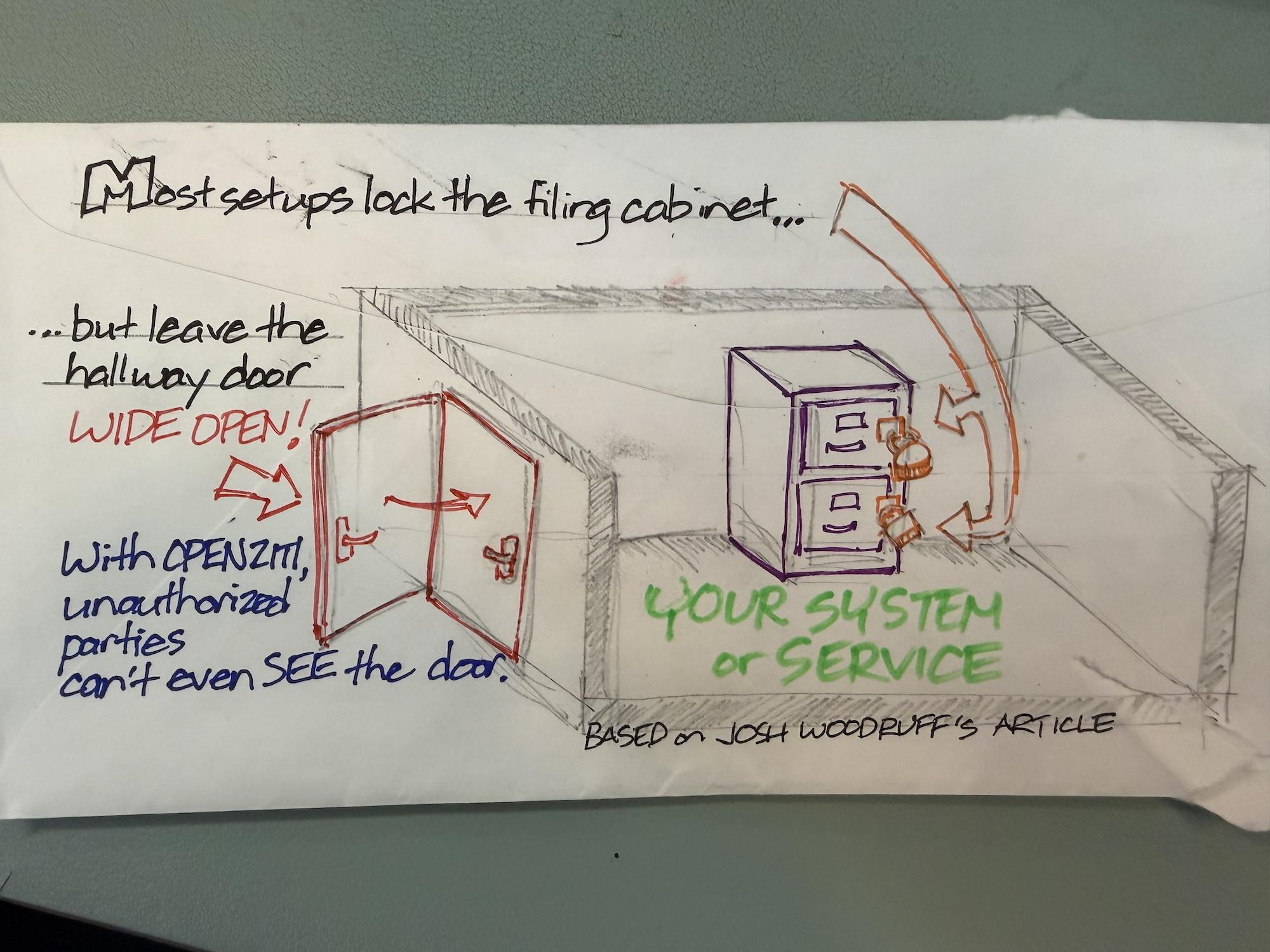
Philip Griffiths, our Head of Strategic Sales, pointed me tothis writeup from Josh Woodruff on his newsletter,Trusted Agents, and I thought it was worth sharing here. Josh took every open-source tool his “Agentic Trust Framework” recommends, wired them into one running multi-agent system on a Mac Studio, pointed it at a realistic sales workflow, and then deliberately constrained it down to “intern” level. It can read and research only. It’s not allowed to write emails, spend money, or create other agents.
In his writeup, he frames agent security as two locks, not one. Most governance only locks the filing cabinet (what data an agent can touch) and leaves the hallway wide open (what network it can reach). OpenZiti is his answer to the second lock: each agent gets a network identity and can only open the connections its trust level allows. The connections it isn’t cleared for, it can't even see.
That dark-by-default, deny-by-default, identity-based posture is exactly why a lot of us are here. It's a nice independent validation: when Josh outside the project needed agent-level network segmentation that a clever prompt or a poisoned document can't argue its way past, he picked OpenZiti as his solution. His one-liner, “the platform, not the prompt, decides what the agent is allowed to do,” is basically the zero-trust pitch for agents.
If you want to take this further than what he built solo, the NetFoundry AI stack runs on exactly this foundation. We’ve got LLM Gateway (identity-based model routing with dark endpoints) and MCP Gateway (governed tool access), and you can find out more about our AI stack here.
Here’s a video diagram that shows how OpenZiti, LLM Gateway, and MCP Gateway) work together to secure AI platforms. All of these are open source; check out the repos here:
OpenZiti - Zero trust network overlay where authentication is determined by identity and not IP address, and authorization is determined by policy
LLM Gateway - OpenZiti-based, open-source, OpenAI-compatible proxy that presents a single API to clients and routes requests to any combination of providers (OpenAI, Anthropic, Ollama, vLLM, or any OpenAI-compatible endpoint), with semantic routing, multi-endpoint load balancing and failover, and the ability to reach backends and expose itself to clients over zero-trust (OpenZiti/zrok) networks
MCP Gateway - OpenZiti-based; aggregates and secures multiple MCP tool servers behind a single dark, zero-trust endpoint, with built-in tool namespacing, allow/deny filtering, and per-client session isolation, using three components: mcp-tools (client connector), mcp-gateway (aggregator), and mcp-bridge (server exposer).
We just published a comparison of open source LLM gateways, including LiteLLM, Portkey, Kong AI Gateway, Cloudflare AI Gateway, and our own OpenZiti llm-gateway.
We tried to be honest about where each one is strong. LiteLLM has the broadest provider support by a wide margin. Portkey keeps things lightweight with good retry/fallback. Kong makes sense if you're already running it. Cloudflare is quick to set up if you're in their ecosystem.
Where ours is different is the connectivity layer. The gateway can run with no listening ports, clients connect with cryptographic identity instead of shared API keys, and you can reach Ollama on other machines through the overlay without opening ports or setting up a VPN.
The post also gets into the security gap that most LLM gateways share: they're all designed to sit on a network as an HTTP endpoint. That works for a lot of cases, but it has some gaps worth thinking about.
Feedback welcome, especially if we missed a project that should be on the list.
OpenZiti’s AI platform is made up of three projects, all built on an underlying principle: agentic infrastructure needs zero-trust networking built in, not bolted on later. The projects work independently, but they’re designed to work even better together. They’re also built on OpenZiti, open source under the Apache 2.0 license, and designed as parts of a unified AI platform.
These projects are:
llm-gateway, for zero-trust agent-to-models connections.
mcp-gateway, for zero-trust agent-to-tools connections.
Agora, for zero-trust agent-to-agent connections.
Each of these projects is described in more detail below, along with a link to its GitHub repo. Over the next little while, I’ll cover these projects in detail, with example code, in this subreddit.
llm-gateway
llm-gateway is an OpenAI-compatible proxy that puts a single API in front of any combination of LLM providers: OpenAI, Anthropic, Azure OpenAI, AWS Bedrock, Google Vertex AI, Ollama, vLLM, and more. Clients don’t know or care where the model lives; they send a request and the gateway routes it.
Features:
Multi-provider routing: Clients switch between GPT, Claude, or Llama models by changing a field. Differences between APIs are handled transparently.
Semantic routing: A three-layer cascade classifies requests and picks the best model automatically when the client doesn’t specify a model or lets llm-gateway automatically select one. Useful for routing coding questions to a coding model and general chat to something fast and local.
Multi-endpoint load balancing: Weighted round-robin across multiple inference backends with automatic failover and background health checks.
API key auth with per-key model restrictions via glob patterns (e.g. one key restricted to claude-* and gpt-*, another to llama3 only).
zrok integration: Expose the gateway, or reach a remote backend, over an OpenZiti overlay without opening ports or configuring DNS. This is what makes “dark model endpoints” possible: your on-prem Ollama or vLLM cluster has zero listening ports and is invisible to anything not explicitly authorized.
Prometheus metrics for request counts, latency, token usage, routing decisions, and provider errors.
mcp-gateway is a zero-trust gateway that aggregates and secures MCP tool servers behind a single endpoint. It’s made of three components that work together:
mcp-bridge: Wraps a local stdio MCP server and makes it available over the network as a zrok private share. The MCP server becomes a “dark service” with no listening ports. Only someone with the share token and a zrok-enabled environment can reach it.
mcp-gateway: Aggregates multiple MCP backends (local stdio processes or remote bridges) and serves them all through a single zrok share. Handles tool namespacing (e.g. docs:read_file vs data:read_file) so tools from different backends don’t collide.
mcp-tools: The client-side connector. mcp-tools run <token> bridges a zrok share to stdio for clients like Claude Desktop; mcp-tools http exposes it as a local HTTP endpoint for clients like n8n.
It has built-in allow/deny filtering with structural enforcement. Filtered tools don’t exist in the registry at all, so they can’t be called even if a client knows the name. Backends can be chained (a gateway can point at another gateway’s share), making it straightforward to distribute MCP servers across machines, data centers, or cloud regions while presenting them as one unified toolset.
Agora is a zero-trust overlay network purpose-built for agent-to-agent (A2A) collaboration. Where llm-gateway secures agent-to-LLM connections and mcp-gateway secures agent-to-tool connections, Agora secures agent-to-agent connections.
Agora is two layers:
Layer 1: The zero-trust foundation. Cryptographic identity (X.509 certificates, not API keys), mutual authentication, end-to-end encryption, dark-by-default connectivity. Tunnels (HTTP/TCP/UDP), tunnel grants, organizations, accounts, environments.
Layer 2: The collaboration vocabulary. It has these six concepts:
Workgroups: Policy boundaries controlling visibility. If you’re not in the workgroup, the agents in it don’t exist from your perspective. In short, zero knowledge.
Catalog: The discovery surface, filtered by the caller’s workgroup memberships. Built into the controller.
Advertisements: An agent’s persistent declaration of capabilities, interaction patterns, and contract requirements. Survives restarts.
Sessions: Governed channels with explicit lifecycle (proposed, accepting, active, closing, closed), each backed by a Layer 1 tunnel. Closed sessions retained for audit.
Contracts: Declarative engagement terms bounding a session: max duration, max envelope count, allowed message types, required workgroup memberships. Evaluated and enforced by the controller, not by application code.
Envelopes: Structured messages with infrastructure-visible headers and opaque payloads, so the controller can enforce governance without parsing payloads. Every envelope carries a correlation ID for audit trail reconstruction.
The key idea in Agora’s design is that governance lives in the network, not in each agent’s application code. An agent built with the Agora SDK is about 20 lines of Go. The SDK handles identity enrollment, heartbeating, tunnel lifecycle, and shutdown. You, the developer, just write business logic.
Agora ships with a reference demo called Macro Pulse. It features 5 organizations, 8 agents, 4 inter-org workgroups, end-to-end with live data sources. It models a cross-domain morning market briefing where a market-data provider and an internet-signals provider don't share a workgroup and don't know each other exists. The consuming client is the only party with visibility across all channels.
Agora is still “pre 1.0” and in active development. Layer 1 is minimum-working, Layer 2 MVP-complete. Deferred items include metrics/observability infrastructure, semantic catalog search, programmatic contracts, deeper A2A protocol bridging, and workgroup hierarchy.
A mental model for connecting agents using Agora, llm-gateway, and mcp-gateway
Here’s how they fit together (see my hand-drawn notes above for the graphic version):
OpenZiti is the underlying fabric. Cryptographic identity, dark-by-default services, overlay routing.
Agora Layer 1 is the agent runtime on top of the fabric. Organizations, accounts, environments, tunnels. This is what gives an agent its identity and its presence on the network.
Agora Layer 2 is the collaboration layer. Workgroups, catalog, advertisements, sessions, contracts, envelopes. This is what gives multi-agent interaction enforceable structure.
llm-gateway is a service on the Agora network that handles agent-to-model connections.
mcp-gateway is a service on the Agora network that handles agent-to-tool connections.
Your agents are participants on the Agora network. They get identity from Agora, talk to other agents through Agora, talk to models through llm-gateway, talk to tools through mcp-gateway. One identity, three surfaces.
I’m relatively new to Zero Trust and OpenZiti, so it’s possible that some of the terms or wording I use may not be entirely accurate.
I’d like to validate my understanding of the different Zero Trust models in OpenZiti. Below is how I currently understand ZTNA, ZTHA, and ZTAA. I’d appreciate feedback to confirm whether this interpretation is correct.
ZTNA (Zero Trust Network Access)
ZTNA corresponds to a model in which a Ziti Router is placed at the edge of a local network in order to allow access to internal hosts.
The user or client application connects to the Ziti Router, which acts as an intermediary and forwards the traffic to the appropriate host using its LAN IP address.
In this model, the Zero Trust termination point is the Ziti Router itself. The Zero Trust relationship is maintained between Ziti entities, but communications inside the LAN are no longer protected by Zero Trust once the traffic leaves the router.
ZTHA (Zero Trust Host Access)
ZTHA differs in that Ziti tunnels are established directly to the operating system of each host.
The Zero Trust tunnel therefore terminates at the OS level of each machine. When this model needs to be applied to multiple hosts within the same local network, a Ziti Router can be used as a transit point to carry Zero Trust traffic, while tunnel termination remains handled by Ziti agents deployed on each host.
Services exposed in this model are generally only accessible via the localhost interface, and not via LAN IP addresses. This greatly reduces the attack surface and prevents services from being discovered through network scanning.
ZTAA (Zero Trust Application Access)
ZTAA represents the highest level of security, because the Zero Trust termination point is directly embedded into the application itself.
This usually involves using a Ziti SDK or an equivalent mechanism that allows the application to integrate directly into the Zero Trust fabric.
In this model, the application is never exposed on the IP network, not even locally. Communications occur logically through the Zero Trust fabric, rather than through traditional IP addresses or network ports.
Access is granted directly to the application, without relying on the classical notion of a network.
Thanks in advance for any feedback or corrections!
Hello, open source contributors to OpenZiti! First, we’d like to thank you for your contributions to the project. Your brainpower and effort makes OpenZiti better.
Right now, our development team is having one of those “good news / bad news” situations:
😊 Good news: We have a lot of pull requests! 😬 Bad news: We have a lot of pull requests!
This is just a quick post to let you know that we’re working our way through all of them. It just takes time, which is in shorter supply this week as we approach the American Thanksgiving holiday. But yes, each and every contribution from our open source community is duly considered, and if it works and solves a problem or fixes an issue, we merge it.
Once again, thanks for your patience, and thanks for all your contributions and for helping make OpenZiti better!
Cards on the table first (and hey, it’s been almost four months, and by now, some of you know me): I’m the developer advocate at NetFoundry, whose commercial services are built on top of their open source offerings: OpenZiti, zrok, LLM Gateway, MCP Gateway, Agora, and more.
NetFoundry commissioned Global Surveyz, an independent research firm to interview 200 US security/tech leaders at 1,000+ employee orgs in May and June 2026 about how they see the security and privacy risks of AI deployments. I posted a more exec-flavored version over in r/NetFoundry (link); this one's for the people who actually have to make things work.
Obviously, this far from neutral third-party validation, but it is data that we use to make stuff so we can stay in business. A lot of it confirms things this sub has been saying for years, and here are some hightlights:
1. They asked what's driving the expanding attack surface, and “complex non-human identity and authentication” came in at 76%, and that was behind “more internet-facing APIs/workloads” at 80%. The report’s own framing of why is the part you'll recognize: the internet's addressing model predates distributed computing. IP addresses are a poor proxy for identity, what with NAT, DHCP, and ephemeral everything, so there's no native access-control primitive. Secrets and credentials became the workaround, and with sprawl, over-permission, and never rotating, we get blind spots. This is hardly news, but it’s interesting to see it land as the #2 driver in a survey of people signing the checks.
2. “New AI-specific services such as MCP servers or LLM gateways” showed up as a named attack-surface contributor at 54%. That one made me sit up, because it's this-exact-community stuff. Every MCP server you stand up is another listening endpoint, another thing to authenticate, another credential to manage. If you’ve been building or exposing MCP/LLM plumbing, half the surveyed leaders are already counting it against their attack surface. It’s worth thinking about how yours is reachable.
3. The “firewall tax” is real and quantified. 54% said even routine firewall changes take a week or more; average 8 days from request to implementation. The top cause wasn't technical, but risk/compliance review (55%, tied with cross-team dependencies). For anyone who’s built on an overlay specifically to stop filing firewall tickets for every new service, this is the number to point at when someone asks “Why bother?”. Outbound-only, no inbound ports to open means there’s frequently no change-advisory-board round trip to wait on in the first place.
4. The identity foundation isn’t there and everyone knows it. Only 8% call their current identity systems “very sufficient” for non-human workloads. 85% are actively evaluating or exploring new approaches. The report also notes the multiplier: multiple instances of the same agent running in parallel, with agents spawning agents, so shared credentials don’t just fail to identify, they actively make attribution impossible. Per-workload identity isn’t a nice-to-have there; it's the only thing that makes the logs mean anything.
My read (this is me, not survey findings, use your better judgement): strip the vendor logo off, and the report is paints a less-conspiracy-theory, more-security-theory version of the “Dead Intrernet Theory”, where machines outnumber humans on the network. These bots don’t have real identities, and get access via long-lived secrets, which is exactly the failure mode identity-first / zero-trust-overlay approaches are built to avoid. I’m obviously biased about which implementation, and OpenZiti is one of several ways to skin this. But the shape of the problem in this data is one I think this sub will find pretty familiar.
For those of you giving agents/MCP servers their own Ziti identities today: is per-agent (vs. per-service) identity holding up as agents multiply, or are you hitting enrollment/lifecycle pain at scale? The survey hints at that question but doesn’t out-and-out answer it, and I’d like to hear what *non-*C-suite people who actually implement things have to say.
The zrok section is accurate in the way third-party writeups usually aren't. It makes the same points that we make about our OpenZiti-based tech: no inbound ports, identity-based rather than IP-based, end-to-end encryption across the OpenZiti fabric, and a fully self-hosted Apache 2.0 path that's distinct from the managed zrok.io service. There's a changelog at the bottom listing corrections made against gofrp.org, the zrok repo, and inlets.dev (which means that someone actually did the reading!)
Also worth a look if you're in AI infra: there's a section on zero-trust MCP and LLM gateways built on OpenZiti, with per-client isolation, mTLS, identity-based provider routing.