r/OldPersian • • Oct 12 '18

Studying Old Persian together?

11 Upvotes

The idea came up elsewhere to study Prods Oktor Skjærvø's freely available "An Introduction to Old Persian":

https://sites.fas.harvard.edu/~iranian/OldPersian/index.html

Suggestions:

- Print out the whole 192 pages

- Work through the lesson individually

- Discuss in posts lesson by lesson and review exercises together


r/OldPersian • • Feb 04 '19

New trilingual inscription discovered near tomb of Persian king Darius

Thumbnail
archaeologynewsnetwork.blogspot.com
10 Upvotes

r/OldPersian • • Jun 15 '20

[Unknown > English] An old graveyard in NYC.

Post image
9 Upvotes

r/OldPersian • • Oct 04 '24

Schools that teach Old Persian (and Avestan and Middle Persian)

7 Upvotes

Like the title, what schools teach the languages, besides Oxford? Harvard had pdfs for Old Persian and Avestan (young and old), but it doesn't seem like either Harvard or even UChicago teach it, compared to Akkadian or Sumerian.

I think the sidebar needs updating. The Harvard link as is doesn't work.


r/OldPersian • • Jan 22 '22

Old Persian characters used for effect in TV show What We Do in the Shadows

Post image
7 Upvotes

r/OldPersian • • May 24 '26

Origin of logograms

6 Upvotes

I've been wondering about the OP logograms 𐏈 Auramazdā, 𐏋 xšāyaθiya, 𐏌 dahyāuš, 𐏎 baga, 𐏏 būmiš. These don't appear to be derived from the syllabic signs. I don't think they come from Akkadian or Hittite (but I'm not at all confident about that). Is there any literature out there that explains or presents a hypothesis about their origin? They could, of course, be completely randomly composed.


r/OldPersian • • Apr 22 '26

Ancient Persian: A Linguistic History (Van Bladel 2026)

Thumbnail
cambridge.org
6 Upvotes

r/OldPersian • • Mar 24 '23

a friend sent me this and im confused can someonr translate it?

Post image
6 Upvotes

r/OldPersian • • Oct 17 '18

Old Persian script flashcards

Thumbnail quizlet.com
6 Upvotes

r/OldPersian • • Oct 16 '18

Typing Old Persian

6 Upvotes

Try this: https://www.lexilogos.com/keyboard/persian_old.htm

On my Mac, I can see the characters properly using Firefox or Safari but not for Chrome.


r/OldPersian • • Oct 16 '18

Lesson 1

6 Upvotes

Welcome u/s09y5b and u/Stryker450 to the Lesson 1 discussion. I printed the PDF out for ~$20 and stuck it in a notebook and started reading it tonight. Trying to come up with a format for encouraging discussion, perhaps we can take turns writing something like this up for each lesson.

Lesson Description: A short description of the time period when and place where Old Persian was spoken. Its place in the Indo-European language family Indo-Iranian branch and relation to Avestan, Median, and Rigvedic Sanskrit. Its writing system history and theories of origin. Its evolution from a spoken language, to inscriptional language, to Middle Persian (Pahlavi), and ultimately to New Persian. Description of the cuneiform writing system and its peculiarities.

Summary of key points: Characters can represent syllables of type <CV>, <C>, <V>, but in the case of <ra> sometimes representing [ər]. There is some "pronunciation" ambiguity forming words, especially regarding how vowels work together. Special characters "logograms" represent whole words. Much regarding pronunciation (unwritten letters, stress, ambiguous sequences) is derived from linguistic theory or comparison with related forms in other languages.

Exercises: Reading practice. To learn character recognition, I wrote the syllable on top of each letter, especially for numbers 2, 3, 4, 5. I tried then to reason out the pronunciation. There's obviously quite a bit more to these rules, and no way to guess at missing consonants and muted vowels.

Questions/Observations: Slow going learning the characters, many feel similar. POS recommends pronouncing ç as [s] even though evidence shows this to be more something like [sr] or [θr], is this just for the sake of simplicity? I'm noticing some similarities in vocab with modern Persian equivalents, e.g. vazạrka -> bozorg and puça -> pesar.


r/OldPersian • • Sep 11 '24

How do I write the name "Khosrow" in cuneiform?

5 Upvotes

Hi! I have a personal project and I would like your help: how would you spell the name "Khosrow" in Old Persian?

First things first, I know it is only written in Avestan (𐬵𐬀𐬊𐬯𐬭𐬀𐬎𐬎𐬀𐬢𐬵𐬀) and Middle Persian (𐭧𐭥𐭮𐭫𐭥𐭣𐭩), as the oldest attestation is in Avestan and four individuals bearing this name were Sasanian Emperors.

The only clue I was able to find on the internet was the Old Iranian reconstruction as "Huçrávah" or "Huçravā".

The Proto-Iranian term is reconstructed as *Hhucráwah (*Hhu- ("good") + *crávah ("fame")) and the Proto-Indo-Iranian term as *Hsućráwas (*Hsu- ("good") + *ćráwas ("fame")). Further reconstruction points to Proto-Indo-European *h₁su- ("good") and *ḱléwos ("fame").

I've experimented and narrowed it down to three possible outcomes: either 𐎧𐏂𐎼𐎺 (x(u)-ç-ra-va), 𐏃𐏂𐎼𐎺 (h(u)-ç-ra-va), or 𐎢𐏂𐎼𐎺 (u-ç-ra-va). The third option is based on Old Persian 𐎢- (u- /⁠<h>u-⁠/), descendant of *Hsu-. Unfortunately, there is no Southwestern Iranian descendant reconstructed for *ćráwas, as the Persian word سروب (sarub) was inherited from Avestan 𐬯𐬭𐬀𐬎𐬎𐬀 (srauua = "word").

More info on how Proto-Iranian developed into Old Persian can be found here.

Thank you in advance for your suggestions!


r/OldPersian • • Sep 06 '24

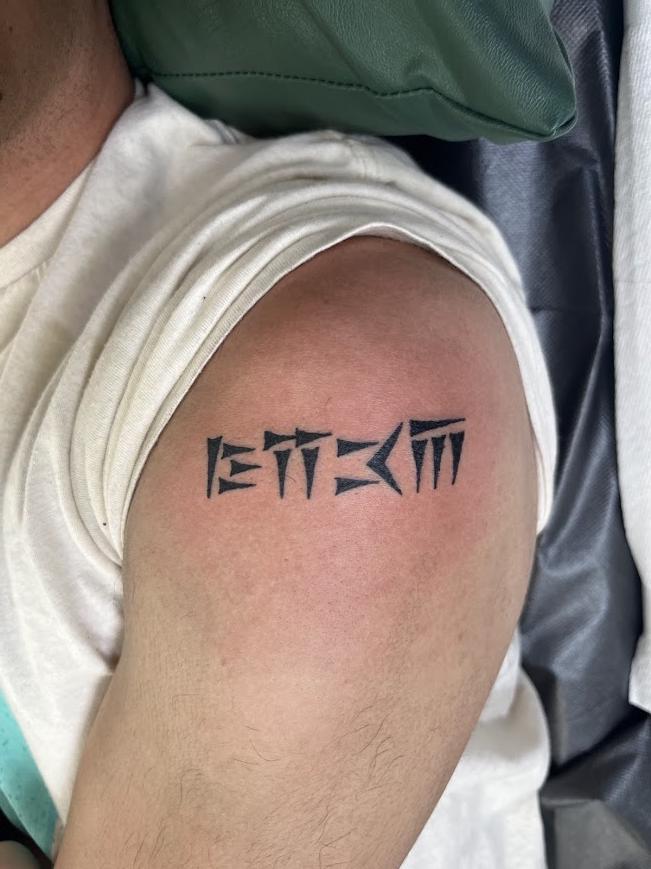
I got my name (Sina/سینا/𐎿𐎡𐎴𐎠)in Old Persian tattooed on my arm earlier this year!

Post image
5 Upvotes

r/OldPersian • • Aug 03 '24

Old Persian Translator

5 Upvotes

Hi all,

In the past few hours, I have been working on a LingoJam translator for Old Persian. I have added a few basic words, mainly using the Old Persian Visual Dictionary and the University of Texas' website to help me.

I am by no means trying to self-promote, I just wanted to share my work, in the hopes of getting feedback. Anyways, here it is:

https://lingojam.com/OldPersianTranslator%28EXPERIMENTAL%29


r/OldPersian • • Sep 25 '21

Help with translation: Hey guys, i got gifted an incense holder from Iran and it has what appears an old Persian writing on it. I tried to translate it by myself, but I couldnt make sense of what it says

Thumbnail
gallery
5 Upvotes

r/OldPersian • • Oct 31 '19

Phonetics of the old Persian language

5 Upvotes

Old Persian Transliteration Transcription (normalization) bg <ba-ga> baga kar <ka-a-ra> kāra mam <ma-a-ma> mām Jiymn <ji-i-ya-ma-na> jiyamna Vƒiya <vi-θa-i-ya-a> viθiyā (viθiyā) ptiy <pa-ta-i-ya> patiy Jv <ji-va> jiva (jīva) ˚u¸uπ <ku-u-ru-u-ša> Kuruš su©ud <sa-u-gu-u-da> Suguda su©d <sa-u-gu-da> Suguda (Suguda) zur <za-u-ra> zura (zūra) bdk <ba-da-ka> bandaka (bandaka)

PHONOLOGY. PRONUNCIATION.

The simple vowels may be pronounced as in German or Spanish, rather than as in English: a as in Germ. Mann, Span. gato, Eng. must i as in Germ. ist, Span. chico, Eng. beat (but short) u as in Germ. und, Span. uno, Eng. put ai as in Germ. Kaiser, Span. baile, Eng. lie au as in Germ. Haus, Span. causa, Eng. how The long vowels ā, ī, ū are pronounced like the short ones, only longer. The combination ạr should probably be pronounced [ǝr] (as in English courageous, French ferais). Similarly, hạ should be pronounced [hǝ], or possibly [hi]. The consonants p, t, k, may be pronounced either without aspiration as in the Romance languages (e.g., Spanish) or with aspiration as in the Germanic languages (English, German, etc.) or in Persian, as we do not know how they were pronounced in Old Persian. Old Persian s is always pronounced [s] as in sing, never [z] as in zero, for which Old Persian uses z.

PHONOLOGY. STRESS

. We do not know the rules for Old Persian stress, but some rules may be formulated from comparison with other Iranian languages and Indic. In words of two, three, or four syllables, the heavy syllable closest to the end of the word, not counting the last syllable, probably took the stress. Here “heavy syllable” = a syllable with a long vowel or a diphthong or a short vowel followed by more than one consonant (or an unwritten n or h + cons.) and “light syllable” = syllable with a short vowel followed by only one consonant: kā´ra, Višt´āspa, ām´ātā, Auramazd´āha, kāsakáina vaz´ạrka, Auramázdā, Ariyārámna fr´ābara, duvit´āparanam mártiya, víspazanā We have no way of knowing whether words with a closed final syllable ( = a final syllable with a final consonant) could be stressed on the last syllable, for instance, Kurauš: Kúrauš or Kuráuš, and dahạyauš: dáhạyauš or dahạyáuš. In words with several short syllables the stress moved toward the beginning of the word: bága, návama, but we do not know how far it was allowed to go and so, for instance, where the stress lay in hamaranakara and other words with four or more short syllables, e.g.: ákunavam or akúnavam, hámaranakara or hamáranakàra (à = secondary stress), úšhamaranakara or ušhamáranakara. It is also possible, even probable, that new rules for stress developed in the Old Persian period, as Middle Persian forms show that in some word patterns the stress moved to the second-to-last syllable (penult, or last syllable if the final vowel had already been lost) also when it was light: naváma > *nowóm4 (the new stress may represent a generalization of the stress of the genitive-dative: naváhạyā). In cases where a short vowel developed, as in xšāyaθiya, which is from *xšāyaθya, Haxāmanišiya < *Haxāmanišya, or θanuvaniya < *θanvanya, the position of the stress is a matter of conjecture. These words may have been stressed either xšāyáθiya < *xšāyáθya, Haxāmaníšiya < *Haxāmaníšya, and θanuvániya, or xš´āyaθiya, Hax´āmanišiya, and θánuvàniya, according to the above rule (cf. Middle and New Persian šāh < xš´āyaθiya?). We also do not know whether the stress shifted position in the genitivedative forms such as kārahạya ~ kāráhạya (< *kārahya). Note also the case of marīka- < *mariyaka- (cf. Av. mairiia-, OInd. márya-, maryaká-). The probable development is *máriyaka > márīka > mar´īka, but it may also have been *maríyaka > mar´īka.

SCRIPT. SPECIAL CONVENTIONS.

<ha> = hạ: The sign <ha> was frequently used alone in positions where we (for historical reasons) would expect <ha-i>. Such a use of <ha> is indicated by transcribing it as hạ. Most often this occurs in the combination <Ca-ha-ya> -ahạya- instead of <Ca-ha-i-ya> -ahiya- < *-ahya-. The spelling <Ca-ha-i-ya> -ahiya- is found in the inscriptions of Xerxes. Examples of hạ in other positions: hạzānam “the tongue,” hạštataiy “it stands.” Examples of hi: Hinduš “India” (actually Sindh), Hinduya- “Indian.” <u-> = hu- or hū-: Original initial hu- or hū- is written <u(v)-> hu- or hū- in Old Persian, see the vocabulary. <ra> = ạr: The sign <ra> was also used to spell ṛ, the Indo-Iranian so-called “vocalic r,” that is, an r used as a vowel (CṛC; similar to American pronunciation of er in perhaps [pṛhæps]). Such a use of ra is indicated here by writing ạr, for instance vazạrka-, cf. New Persian bozorg, with ạr > or, as opposed to martiya-, Persian mard, with ar > AR. Except when initial (e.g., Ạršāma), vocalic r is always preceded by a <Ca> sign, never <Ci> or <Cu>.

NOUNS AND ADJECTIVES. THE NOMINAL SYSTEM.

Nouns (substantives) can be 1. proper names (e.g., Dārayavahu-, Vištāspa-) or 2. common nouns (appellatives, e.g., xšāyaθiya- “king,” puça- “son”). Many adjectives can be used as nouns as well, e.g., Pārsa- “a Persian, Persian” (e.g., army), or “Persia.” There is no definite or indefinite article. Sometimes the numeral “one,” 1, aiva-, is used in the meaning of “a single” or “a certain (one).” See also on the “specifying” or “delimiting” function of relative clauses. Nouns, adjectives, and pronouns can be of three genders (masculine = masc., feminine = fem., neuter = neut.). There are three numbers (singular, dual, plural) and six cases (nominative, vocative, accusative, genitive-dative, instrumental-ablative, locative). Nouns and adjectives are classed in vocalic and consonantic declensions, called a-stems, n-stems, etc. Vowel-declension nouns have a vowel before the ending (a, ā, i, ī, u, ū, ai, au), while consonant-declension nouns have a consonant before the ending (most common: n, r, h, but also p, t, nt, d, θ). The stem vowel a of the a-declensions is often referred to as the “thematic vowel” and the a-declensions as “thematic declensions” vs. “athematic” declensions. The same terminology is used for verbs.

NOUNS. GENDER

. The gender of a noun can sometimes be deduced from its grammatical form. Thus, a-stems are either masculine or neuter, while almost all ā-stems are feminine. The i- and u-stems, as well as consonant stems can be either masculine, neuter, or feminine. The gender of each word should therefore be learned together with the word itself. In the vocabularies masculine nouns of all declensions and feminine nouns of the ā-declension will be unmarked, while all other nouns will be marked as feminine (fem.) or neuter (neut.)


r/OldPersian • • Jun 17 '19

Layman's question: what can be learned in Old Persian?

Thumbnail self.linguistics
5 Upvotes

r/OldPersian • • Oct 20 '18

Lesson 2 : Old Persian

5 Upvotes

Hello u/s09y5b and u/eagle_flower, and welcome to discussion for Old Persian, Lesson 2. I'm continuing with the structure of the previous lesson, adding whatever that is introduced in the lesson.

Lesson Description: The lesson introduces the reader to some differences between spoken and written Old Persian, the nominative singular case, and the grammatical gender of different words based on their stems. The lesson also includes the syntax of simple sentences in Old Persian using the nominative case and the word order.

Summary of Key Points: Various classifications of nouns, pronouns and adjectives are discussed, based on genders, numbers, cases and vocalic and consonantic declensions. Readers are taught how to identify the grammatical gender of words based on their form, for example, a-stems are generallly masculine or neuter, while ā-stems are almost always feminine. The nominative singular case and its declensions based on the grammatical gender are discussed, along with a brief mention of the genitive case, which is more extensively covered in lesson 5.

Exercises: I had a few issues in the exercises, I'm listing mine in the post but we'll continue the discussion in the comments. The answers I'm not sure about are-

2.A. iii) iyam pastiš uta taxma uta *h*u-θanuvaniya uta *h*uv-arštika

Translation- This soldier is brave and both a good archer and a good spear thrower.

vi) arštika amiy *h*uv-arštika uta pastiš uta asa-bāra

Translation- This spear thrower is a good spear thrower both on foot and on horseback.

I'm concerned about the translations as I've fit the use of 'uta' to make the most sense in English.

2.B. 7) There was a man. He was a foot soldier.

I found no word for 'there' in the chapter. I checked the dictionary and found the word 'āvada', but I'm not sure if it can be used here.

Observations: I got through the lesson relying on the provided examples in the syntax, especially when translating from English to Old Persian. Otherwise, the lesson was straightforward enough. The presence of the grammatical gender sets Old Persian apart from its modern-day form, although I'm not sure when the gender disappeared from the language.


r/OldPersian • • May 24 '23

Text originally from an old leather sheet

Post image
4 Upvotes

Could someone help me translating what it said on the picture? Or find someone who could? The picture is a copy of an old piece of leather sheet found in Northern Iraq and is supposed to be a map. DM me for more info


r/OldPersian • • Jun 14 '21

Did old persian actually have a syllabic r (r̩) ?

4 Upvotes

What evidence do we have to suggest this or otherwise?


r/OldPersian • • Jun 06 '20

Where can I find names of people during the Achaemenid empire?

Thumbnail self.iran
4 Upvotes

r/OldPersian • • Oct 29 '18

Pronunciation of ç and v

4 Upvotes

Is ç supposed to be pronounced as t͡s, s, θ or something else? V is supposed to be pronounced as a W right?


r/OldPersian • • Aug 21 '26

Help with this plaque

Post image
3 Upvotes

r/OldPersian • • Jan 22 '26

Can someone translate this?

Post image
3 Upvotes