r/MongoDB_Official • • 5m ago

Discussion I spent a year building a free website to practice MongoDB, with a real mongosh shell and hidden test cases like LeetCode

Post image
1 Upvotes

Hi everyone, I've spent a LONG time working on this, and as far as I know, it's the only MongoDB practice site that combines an interactive mongosh shell with LeetCode-style hidden test cases.

Most other sites just parse your query or check it against a fixed answer. This one actually runs your queries on a MongoDB-compatible database in your browser, so you can write real find, aggregate and createIndex code the way you would at work. It's completely free!

What makes it different:

  • Hidden test datasets. Your query runs on the sample data, then on 2 hidden datasets with more customers and orders. If your query only works because of something specific to the sample data, it fails. Same idea as LeetCode's hidden test cases.

  • Performance questions check your explain plan. A correct result isn't enough if you're doing a COLLSCAN where an index should be used.

  • Realistic, messy data. It's a shop database with products, customers, 220 orders, reviews, suppliers, a category tree and an org chart, including mixed types, missing fields and the schema drift real data has.

  • Answers verified on MongoDB 8.

Some of the problems:

  • The overstock list: $sum on arrays, $match after $project

  • One field, three types: $type, $switch, schema drift

  • Deliveries near Berlin: $geoWithin, $centerSphere

  • Revenue lost to cancellations, month by month: $densify, $setWindowFields, $shift (Expert, good luck!)

There are currently 30 MongoDB practice problems ranging from Medium to Expert, whether you're preparing for MongoDB interview questions or just looking to improve your aggregation and query optimization skills.

Nothing to install, and your progress is saved in your browser.

https://visualeaf.com/mongodb-interview-questions/

I'd love feedback, especially:

  • Any problem that felt unfair, or where the checker rejected an answer you think is correct.

  • Topics you've been asked about in real interviews that are missing


r/MongoDB_Official • • 5h ago

Question Voucher para certificación gratis en Mongodb

1 Upvotes

Good morning,

I am writing to request my 100% free certification exam voucher for the**"Programa de Certificación en Español"**(Spanish Certification Program for LATAM), as Beatriz Messias is likely overwhelmed with messages and unable to reply to all of them.

I would like to confirm my voucher so I can dedicate December to studying intensively and sit for the**Associate Developer (Python)**exam as soon as possible.

I meet all the program requirements:

https://www.credly.com/badges/01a68fad-ff78-4e21-8f15-294e804da9ae/public_url

https://www.credly.com/badges/23c88589-de1e-4eec-adea-004897c85210/public_url

https://www.credly.com/badges/55b303a1-97e4-452f-85b5-93380a4706fb/public_url

https://www.credly.com/badges/3bad23fb-f10d-4a6d-a666-12be622c94f9/public_url

Thank you in advance for your help and support.

Best regards,
Roxana Enríquez Lorenzo


r/MongoDB_Official • • 5d ago

Showcase How I built a smarter long-term memory tool using MongoDB Vector Search + Voyage AI + TypeSafe Jev to decide what gets persisted

2 Upvotes

I’m a developer advocate at MongoDB, and I’ve been building a long-term memory tool for an AI chatbot that persists user facts and preferences. Retrieval was the easy part. The hard part is deciding what to do when a new memory arrives. Inserting everything gives you a pile of 💩, and naive dedupe merges things that shouldn’t be merged (“prefers Earl Grey” and “takes tea with oat milk” aren’t the same fact).

TL;DR: Vector search settles the obvious memory writes; Jev, a decision model, settles the ambiguous middle. Code: gist

How it works

When the memory write tool is called, it means the user has shared something worth keeping, so I embed this new memory with Voyage AI voyage-4 and run a MongoDB Vector Search query to return up to 5 most similar existing memories. Then I branch depending on the relevance score (MongoDB normalizes cosine similarity scores to a 0 to 1 range) for each existing memory to determine how to handle the new memory:

  • Score ≥ 0.95: Treat the new memory as a duplicate. Just update the timestamp field on the existing memory.

  • Score < 0.75: Treat the new memory as unrelated. Straightforward insert into the memory collection.

  • Score between 0.75 and 0.95: I call this the “Grey Zone”, where further judgment is required. Similarity alone can't tell me whether the new memory is a restatement, a contradiction, or a related-but-different fact, so I let Jev decide.

(Note: These thresholds are starting points for my use case. )

Why a decision model? A decision model returns typed answers with calibrated probabilities instead of generated text, telling me how to handle the incoming memory compared to an existing memory. Thus, the “Grey Zone” is implemented as a fixed three-way choice. I’m using Jev from TypeSafe AI (no affiliation).

Asking Jev

For each grey-zone memory pair, here’s roughly what I ask, in plain English:

Old memory: <User prefers Earl Grey.>
New memory: <User takes tea with oat milk.>
Are these:
A. duplicate
B. conflicting
C. something else

Each choice maps to a MongoDB write operation: 

  • a duplicate means we update the existing memory timestamp field, 

  • a conflict overwrites the old memory in place (new fact, new embedding), 

  • something else inserts the new memory. Any failure also falls back to keeping both, so the worst case is a redundant memory.

The Schema

One document per fact (or memory):

{
  _id: ObjectId("6735f0c2a1b2c3d4e5f60718"),
  subject: "tea preference",
  fact: "User prefers Earl Grey.",
  tags: ["tea", "preference"],
  timestamp: ISODate("2026-11-17T15:04:05Z"),  // last learned
  embedding: BinData(9, "...") // voyage-4, 512 dims, int8
}

The Vector Search query:

const matches = await coll.aggregate([
  {
    $vectorSearch: {
      index: 'agent_long_term_index',
      path: 'embedding',
      queryVector: vector,
      numCandidates: 50,
      limit: 5,
    },
  },
  { $project: { subject: 1, fact: 1, score: { $meta: 'vectorSearchScore' } } },
]).toArray();

Demo run (video): the gist’s demo test, with Voyage embeddings, vector search, and Jev calls.

Here's a short recording of running through all the possible branches:

When a new fact contradicts an old one, do you overwrite it, keep history with a superseded flag, or do something else?


r/MongoDB_Official • • 5d ago

Announcement You can now use MongoDB Atlas for agent memory and session persistence with the Strands Harness SDK

3 Upvotes

Hi, Nasir from MongoDB here. We just launched the MongoDB Strands Harness SDK Integration. It lets developers building Python agents with the Strands Harness SDK give them persistent memory and session continuity without losing context between conversations.

What’s new

The Strands MemoryManager automatically identifies key details from conversations, manages agent workflows, and decides when to recall memories or offload context. MongoDB Atlas handles storage and retrieval, using Atlas Vector Search to find relevant past interactions that ground agent responses. Atlas also securely preserves session history and working state, so agents can pause and resume complex tasks across conversations.

How to try it

Install the package with one command, then connect it to your MongoDB Atlas cluster:

pip install strands-mongodb

You get agents that remember key details and pick up complex tasks right where they left off.

*This integration supports agents built with Python.

Check out the blog to learn more: https://www.mongodb.com/company/blog/product-release-announcements/persistent-sessions-memory-for-strands

Documentation: https://www.mongodb.com/docs/atlas/ai-integrations/strands/


r/MongoDB_Official • • 7d ago

Question MongoDB 8.0.38 Windows Installation Fails with MSI Error 1723 / Code Integrity Blocks mongod.exe

1 Upvotes

Hello MongoDB Team and Community,

I'm trying to install MongoDB Community Server 8.0.38 on Windows 11 Home, but the installation fails due to Windows Code Integrity / Smart App Control restrictions.

System and installer details

  • OS: Windows 11 Home

  • MongoDB version: 8.0.38

  • Installer: Official MongoDB Windows x64 MSI

  • MSI Authenticode signature: Valid

  • Smart App Control: ON

Installation failure
The MSI installation fails during the UpdateMongoYAML custom action.

Errors reported:

  • MSI Error 1723

  • DLL Error 1157

  • Blocked temporary DLL: C:\Windows\Installer\MSI64BD.tmp

Code Integrity events

Windows Code Integrity Operational log records:

  • Event ID 3077

  • Event ID 3033

The logs indicate that Windows blocked:

  • mongod.exe because it did not meet Enterprise signing-level requirements.

  • The MSI temporary custom-action DLL (MSI64BD.tmp) for the same signing-level restriction.

The enforced policy is VerifiedAndReputableDesktop (Policy ID: 0283ac0f-fff1-49ae-ada1-8a933130cad6).

What I have checked

  • Verified that the official MSI has a valid digital signature.

  • Confirmed that the Smart App Control policy is enforced.

  • Confirmed that the MongoDB service was not successfully installed.

  • Reviewed the Windows Code Integrity events and MSI installation log.

My questions

  1. Is MongoDB Community Server 8.0.38 officially supported on Windows 11 with Smart App Control enabled?

  2. Is there an officially recommended or approved way to install and run MongoDB without disabling Smart App Control or weakening Windows security?

  3. Could this be a signing-level compatibility issue involving the MongoDB executable or MSI custom-action DLL?

I would appreciate guidance from MongoDB engineers or experienced Windows users.

Thank you!


r/MongoDB_Official • • 8d ago

Announcement Our MongoDB Champion of the Month is Vincent Thinselin

Post image
7 Upvotes

We're thrilled to recognise Vincent Thinselin as our MongoDB Champion of the Month! Vincent is an experienced IT architect with a background spanning enterprise architecture, cloud infrastructure, and systems engineering. His journey with MongoDB began as a personal interest and has since grown into years of hands-on experience and a passion for exploring what's possible with the technology.

What makes Vincent stand out is how he turns technical curiosity into valuable knowledge for the community. He regularly shares in-depth technical articles based on his experiments, including building a four-node, low-power MongoDB cluster running on ARM and exploring performance optimisation and benchmarking. Through his experiments and technical content, Vincent continues to help developers learn, explore new ideas, and tackle real-world challenges with MongoDB. We're excited to celebrate his contributions and the knowledge he brings to the community. Congratulations, Vincent!

As part of this recognition, we asked Vincent a few questions about his journey. Keep reading to learn more about his experiences with MongoDB 👇

Tell us about your path to becoming a MongoDB Champion
I first discovered MongoDB many years ago as a hobbyist, simply driven by curiosity and the pleasure of exploring new technologies. Over time, MongoDB became part of my everyday professional life. My journey into the Champions program actually started with a surprise! Our MongoDB Principal Solutions Architect nominated me without telling me beforehand. I certainly wasn’t expecting it, and I can’t thank him enough for opening that door. Since then, being a Champion has pushed me to go beyond my daily professional use of MongoDB, explore new technical challenges, share my experiments, and connect with a community of passionate people.

You’ve been a MongoDB Champion for some time now. What drives you to continue helping the community?
Curiosity, knowledge sharing, and the opportunity to keep learning. Writing in-depth technical articles is one of my favourite ways to contribute. It encourages me to dig deeper, challenge my assumptions, experiment, and develop a much better understanding of the technology. Sharing what I’ve learned is also a great opportunity to help others avoid the same mistakes or discover something new. And of course, I continue to advocate for MongoDB in my everyday professional life. At this point, I think I’ve got the MongoDB label permanently stuck to my sneakers! Being a Champion is a great excuse to keep experimenting, learning, and sharing.

Can you share one impactful moment you’ve had as a Champion so far?
Without a doubt, building my own low-power MongoDB cluster! If I hadn’t become a MongoDB Champion, I probably would never have thought of building a four-node MongoDB cluster consuming around 40 watts. What started as a fun hardware experiment quickly turned into a much bigger technical adventure: running MongoDB on ARM, exploring performance, benchmarking, experimenting with Transparent Huge Pages, and sharing the results through technical articles. And the adventure is far from over. It’s now taking an exciting turn towards AI, combining MongoDB Atlas, Vector Search, and Voyage AI to explore retrieval-augmented generation (RAG) and intelligent applications. It’s a perfect example of what I love about being a Champion: one crazy idea can lead to months of learning, experimentation, and valuable knowledge to share with the community.

If you could share one piece of advice to people in tech, what would that be?
You don’t need a perfect lab, expensive hardware, or all the answers to start exploring something new. Sometimes a small, slightly crazy side project can teach you more than weeks of reading documentation. And most importantly, share what you learn, including what didn’t work. Your experiments, mistakes, and discoveries might be exactly what someone else needs. Keep learning, keep building, and have fun along the way!

Where can developers connect with or learn more about you?
Yes, they can find me on LinkedIn, GitHub and on my personal blog. 

Vincent, thank you very much for sharing your story with us today and for all the incredible work you’ve done for the MongoDB community. We can’t wait to see what you share next in the community.

To our readers: If you want to learn more about the MongoDB Community Champions program, see our Champions Program page.


r/MongoDB_Official • • 11d ago

Question i need help installing mongoDB on mac

Post image
2 Upvotes

i need it for an assignment but every time i tried this happens i keep getting the error Error: Formula `mongodb-community` is not installed. can anyone help ?


r/MongoDB_Official • • 12d ago

Question MongoDB Atlas M0 AWS Mumbai – Persistent TLS Handshake Failure (SSL Alert 80)

1 Upvotes

Hello everyone,

I'm facing a persistent TLS connection issue with my MongoDB Atlas cluster.

Cluster details:

  • Cluster: FleetDash-Cluster

  • Tier: M0 Free

  • Region: AWS Mumbai (ap-south-1)

  • MongoDB version: 8.0.37

  • OS: Windows

  • Node.js: v22.14.0

Error:
ERR_SSL_TLSV1_ALERT_INTERNAL_ERROR
SSL alert number 80

Checks already performed:

  1. Atlas cluster is Active.

  2. Primary and both secondary nodes are healthy.

  3. My public IP is active in the Atlas IP Access List.

  4. TCP connectivity to all three nodes on port 27017 succeeds.

  5. TLS handshake fails using both Node.js OpenSSL and Windows Schannel.

  6. MongoDB driver reports MongoServerSelectionError and ReplicaSetNoPrimary.

Has anyone experienced this issue with an M0 cluster in AWS Mumbai recently?

Could this be related to an Atlas TLS endpoint or infrastructure issue?

Any guidance would be appreciated.

Thank you.


r/MongoDB_Official • • 14d ago

Resource Why separating compute from storage matters: MongoDB Atlas Infinite under the hood

19 Upvotes

Hey all, Harshit here. I work at MongoDB.

Atlas Infinite is in public preview (AWS only, M10 to M60 replica sets for now).

Abhishek Chauhan, a Distinguished Engineer here at MongoDB, wrote a deep dive on how it separates compute from storage. It’s one of the most detailed looks at the architecture so far, including the parts that were hard to get right. 

https://www.mongodb.com/company/blog/engineering/ground-beneath-database

The problem it starts with

In a regular replica set, every node keeps its own full copy of the data. So adding a replica, resizing a node or restoring a backup all boil down to copying a lot of bytes. As the blog puts it, storage has gravity: the bigger your data, the slower everything gets. And because compute and storage are tied together, needing more of one means paying for more of both.

How it works, roughly

Compute nodes (a primary, a standby and optional read replicas) hold no data of their own. Underneath them is a shared storage layer made of a few services:

  • Log Service: every write becomes a log entry replicated across three zones. Once a majority has it, the write is acknowledged.

  • Page Service: page servers in each zone keep the data warm and ready to read, so a new node reads from here instead of cloning a disk.

  • Object storage (S3/GCS/Azure Blob): the durability floor underneath it all, and what makes fast backups and restores possible.

Only the log write sits on the critical path. Distributing pages and uploading to object storage happen in the background.

The hard part

Disaggregated databases have been around for a decade, so why did this take so long? WiredTiger is lock-free and evicts pages speculatively, so two nodes holding identical data don’t hold identical bytes on disk. Layout depends on timing and eviction order. That means there’s no canonical page to ship, and “just replicate the pages” doesn’t have a well-defined target.

The usual workaround is to ship a physical redo log of every page change, which would have thrown away WiredTiger’s batched checkpoints. Instead, they kept the checkpoints and had standbys layer recent oplog entries on top of checkpointed pages, so replica lag stays in milliseconds.

Other things I liked

  • Snapshots, clones and restores are forks of a log. That makes them zero copy at any size, close to branching a production DB like a Git repo.

  • The shared storage layer can’t read your data. Pages are encrypted on your compute node before they’re sent down, so MongoDB’s storage services only ever see opaque bytes. Per the blog, they can’t see your documents, collection names or indexes.

If you want the practical side, I made a video that stays closer to the surface. It covers what Atlas Infinite solves, a sneaker-drop demo with shoppers, bots and AI agents hitting checkout at once, and how to tell whether your workload is a fit https://www.youtube.com/watch?v=KteNkcdr_do

A few numbers vs. Atlas Core:

  • 96%+ less time to scale

  • Up to 10x more data per replica set (up to 128 TB per HA shard)

  • 189% more throughput per dollar (internal MongoDB 9.0 testing)

Atlas Core isn’t going anywhere, by the way. It’s still the fit for steady, predictable workloads. Infinite is for spiky, fast-growing or agent-heavy ones.

If you’ve worked with other disaggregated databases, how does this approach compare in your experience? I’ll answer what I can and loop in the engineering team for the deep stuff.


r/MongoDB_Official • • 14d ago

Announcement You can now use MongoDB as the persistent memory store for applications and agents built with the Vercel AI SDK.

Post image
4 Upvotes

Hi, Nasir here from MongoDB. We have launched the MongoDB Vercel AI SDK Integration. With this integration, developers can use MongoDB for agent state memory, user memory, metadata, and query the data using search and vector search.

More specifically, MongoDB can store all 5 kinds of memory agents and AI applications need:

  • Session: The conversation an application or agent has in each session. This helps the application follow what the user just said.

  • Semantic: Facts about people, entities, and preferences, so users don't have to repeat themselves.

  • Procedural: Workflows and instructions, so the application carries out tasks the way you've defined them.

  • Episodic: Key events and outcomes, so the application can recall what happened before. Kept for one year of inactivity by default.

  • Scratchpad: Temporary notes for work in progress. They expire after an hour and can be promoted to episodic memory if they turn out to matter**.**

Getting started is easy. You can add memory to an existing Vercel AI SDK project in three steps.

  1. Install the package and its peer dependencies:

    npm install @mongodb-developer/vercel-ai-memory ai mongodd

  2. Create a memory instance with an Atlas connection string and an embedding model.

  3. Pass the memory tools to the application, scoped to a user and session.

This integration works with AI SDK v6 and v7 and requires a MongoDB Atlas cluster.

Check out the blog to learn more: https://www.mongodb.com/company/blog/product-release-announcements/introducing-mongodb-vercel-ai-sdk-integration-persistent-memory-applications


r/MongoDB_Official • • 13d ago

Question MongoDB Atlas SSL TLS alert internal error 80 – Node.js and MongoDB Compass

1 Upvotes

Hi everyone,

I'm facing a MongoDB Atlas connection issue in my BASERA project.

My setup:

  • macOS (Apple Silicon)

  • Node.js v22.23.4

  • Mongoose 8.24.8

  • MongoDB Driver 6.x

  • MongoDB Atlas (AWS Mumbai, ap-south-1)

Problem:
Both my Node.js application and MongoDB Compass fail to connect to the Atlas cluster.

Error:
ERR_SSL_TLSV1_ALERT_INTERNAL_ERROR (SSL alert number 80)

What I've tried:

  1. Changed Node.js from v26 to v22.

  2. Reinstalled node_modules.

  3. Tested using both local Wi-Fi and mobile hotspot.

  4. Verified SRV and A record DNS resolution.

  5. Checked Atlas IP Access List.

  6. Tested TLS using OpenSSL, but the handshake still fails.

The cluster is showing as active in Atlas.

Could this be an Atlas-side TLS/network issue, or is there something else I should check?

Any help would be appreciated. Thank you!


r/MongoDB_Official • • 13d ago

Question MongoDB Atlas M0: readWrite users authenticate successfully but all read operations return authorization error 8000

1 Upvotes

Title: Atlas M0: readWrite users authenticate successfully but receive authorization error 8000 on find and listIndexes

I'm troubleshooting a MongoDB Atlas authorization issue on an M0 cluster.

Environment

  • Cluster: Cluster0

  • MongoDB version: 8.0.37

  • Provider: AWS

  • Region: Cape Town (af-south-1)

  • Database: grayz_gadget_staging

What works

  • MongoDB connection succeeds.

  • Authentication succeeds.

  • The selected database is correct.

  • Authenticated user is reported in the admin authentication database.

  • Authenticated role is readWrite on grayz_gadget_staging.

  • Effective privilege diagnostics report find, listIndexes, and listCollections.

What fails

Two different database users assigned the built-in readWrite role were tested.

Both receive Atlas error code 8000:

  1. find: user is not allowed to do action [find] on [grayz_gadget_staging.whatsappwebhookevents]

  2. listIndexes: user is not allowed to do action [listIndexes] on [grayz_gadget_staging.whatsappwebhookevents]

  3. listCollections: user is not allowed to do action [listCollections] on [grayz_gadget_staging.]

The connection uses authSource=admin.

The user role assignment was reconfirmed and saved, but the problem persisted.

Question

What could cause MongoDB Atlas to deny these operations when connectionStatus reports the expected readWrite role and privileges?

Could this indicate an Atlas authorization inconsistency, database-level issue, or another privilege evaluation problem?

I would appreciate suggestions for a diagnostic that can isolate the cause without changing database permissions or indexes.


r/MongoDB_Official • • 15d ago

Discussion Why is MongoDB so popular? What to choose bw MongoDB, Supabase, Firebase, Custom?

Thumbnail
gallery
9 Upvotes

A lot of people seems to use MongoDB for Node backend and they made the full MERN abbreviation for that .why is that so.

Everyone on the social media says MERN,MERN,....

Why the hell is it???

Why only mongo everywhere.

Why people don't say much about the SUPABASE or the FIREBASE DB?

Whereas both other free versions have good reasoning limits for any projects

What to choose between the SupaBase, Mongo , Firebase or any other ? What's the real diff

Tell me why that's so.???

\[Note:- I don't want answers like It's relational, other is json.

I want someone's real experienced answers , why is it so,

Is this just hype or something else?\]


r/MongoDB_Official • • 14d ago

Discussion What does good governance for AI agents actually look like?

3 Upvotes

Hi everyone,

My name is Aaron Becker. I'm a Curriculum Engineer at MongoDB, and the primary author of our Governance for AI Agents skill, and I wanted to share a little about it and hear how others are approaching this subject.

As AI agents take on more work and make decisions that affect real people, governance has become increasingly important. What should an agent be allowed to do? What permissions should it have? When should a human step in? And when something goes wrong, what evidence do we have to understand what happened?

Our Governance skill explores these questions through a practical example involving a customer support AI agent. We look at how things can go wrong without proper governance, and how to design systems to prevent mistakes before they happen. Topics include autonomy boundaries, least privilege, scoped access, approval gates, rollback and recovery mechanisms, and auditing and investigating incidents. Most importantly, we discuss the importance of approaching Governance as an ongoing process.

Developing this skill was a valuable learning experience for me, and I'd be interested to hear how other people and teams are tackling these challenges. What do you see as the biggest governance challenges for agentic AI, particularly as agents become more autonomous? What problems do you think we'll need to address next?

If you'd like to explore the material, the training is available here:
https://learn.mongodb.com/courses/governance-for-ai-agents
Completing the training and assessment also earns you a shareable Credly badge.
I'd welcome your thoughts and perspectives!


r/MongoDB_Official • • 14d ago

Question MongoDB Atlas TLS Handshake Failure on Two Replica Set Nodes

2 Upvotes

Title: MongoDB Atlas TLS Handshake Failure on Two Replica Set Nodes

Hello MongoDB Community,

I am unable to connect my Next.js application to MongoDB Atlas.

My cluster is active, and my current IP address is allowed.

Environment:

  • Windows

  • Node.js v24.18.0

  • Mongoose 9.12.0

  • MongoDB Driver 7.8.0

  • MongoDB Atlas 8.0.37

  • Region: AWS Mumbai

Connection tests:

  • All three replica set nodes are reachable on TCP port 27017.

  • TLS 1.2 and TLS 1.3 work on shard-00-00.

  • TLS handshakes fail on shard-00-01 and shard-00-02.

  • Error: ERR_SSL_TLSV1_ALERT_INTERNAL_ERROR

  • Atlas SRV DNS records resolve correctly.

  • No active Atlas project alerts.

Mongoose reports MongooseServerSelectionError and ReplicaSetNoPrimary.

Could someone help me identify whether this is an Atlas-side issue or a network-related TLS problem?

Thank you.


r/MongoDB_Official • • 15d ago

Question MongoDB Atlas M0 TLS Handshake Failure on All 3 Nodes

1 Upvotes

Hello MongoDB Community,

I am experiencing a persistent TLS handshake failure connecting my FastAPI backend to MongoDB Atlas.

Environment:

  • Atlas Cluster: Cluster0, M0 Free Tier

  • MongoDB Version: 8.0.37

  • AWS Region: ap-south-1 (Mumbai)

  • Backend: FastAPI on Render (Singapore)

  • Python: 3.12

  • PyMongo: 4.17.0

  • Motor: 3.7.1

  • OpenSSL: 3.0.13

Issue:

My Atlas cluster is ACTIVE, but the backend cannot connect to the database.

Error:

SSL handshake failed: TLSV1_ALERT_INTERNAL_ERROR

SSL alert number 80

Diagnostics already completed:

  1. Confirmed Atlas Cluster0 is ACTIVE.

  2. Confirmed 0.0.0.0/0 is ACTIVE in the Atlas IP Access List.

  3. Confirmed DNS resolution succeeds for all three replica-set hosts.

  4. Tested connections from both Render and GitHub Actions.

  5. Tested TLS 1.2 and TLS 1.3 separately using OpenSSL.

  6. All six TLS tests failed with SSL alert number 80.

  7. Configured Motor with tlsCAFile=certifi.where().

  8. Render deployment succeeds, but database health reports unreachable.

The same TLS failure occurs across multiple client environments.

Questions:

Could this be related to the Atlas cluster's TLS endpoint, network gateway, or another server-side configuration?

What additional diagnostic would distinguish an Atlas-side problem from a client-side connectivity issue?

Is there a known issue affecting M0 clusters in AWS Mumbai?

I would appreciate guidance on resolving this without repeatedly changing TLS settings or recreating the cluster.

Thank you.


r/MongoDB_Official • • 16d ago

Showcase Made yet another Rust cross platform MongoDB client

9 Upvotes

I know everyone can build their own with AI now as I did, but I was honestly very surprised with the result and how far it's gotten so I thought I'd share it here. I was a bit fed up with Compass and Mingo (Loved that client but it's super buggy and hogs a lot of resources, and now seems abandoned).

Quarry has quite a lot of features such as autocomplete, a node shell, data relationships..., I'll leave the repo here where you can check it out (the README is quite concise) : https://github.com/alkanna/quarry

It is very fast and runs on less than 100MB of ram (counting the main process and the helpers). It uses egui.

In case it wasn't clear enough yes this is almost fully written by AI.


r/MongoDB_Official • • 17d ago

Discussion Mongo: One write, two logs

Thumbnail
shiftmag.dev
1 Upvotes

I picked up Mongo for longer than a year now and the helpful thing was correlating internal workings with something I'm familiar with, PostgreSQL.

Here's the first post from my journey talking about how a write get's persisted and replicated.

Would like to hear comments, and helpful tips from your journeys.


r/MongoDB_Official • • 17d ago

Question MongoDB Atlas M0 TLS Handshake Fails on Python 3.12

2 Upvotes

Hello MongoDB Community,

I am trying to connect my Python Flask application to my MongoDB Atlas M0 Free cluster (AWS Mumbai, ap-south-1).

Environment:

  • Python 3.12.10

  • PyMongo 4.19.0

  • OpenSSL 3.0.16

  • Windows 11

What works:

  • DNS SRV lookup succeeds.

  • TCP connection to all three MongoDB shard hosts on port 27017 succeeds.

  • Normal Python HTTPS requests work.

Problem:
TLS handshake fails with:

ssl.SSLError: [SSL: TLSV1_ALERT_INTERNAL_ERROR] tlsv1 alert internal error

I tested TLS 1.2, TLS 1.3, and also tested with certificate verification disabled. All attempts fail.

Could someone help identify why the TLS handshake is failing and suggest a solution?

Thank you.


r/MongoDB_Official • • 18d ago

Feedback Now Generally Available: MongoDB Memory + Google ADK!

7 Upvotes

Hi! Ajay here from the MongoDB Builder Experience team. We just launched the MongoDB Google ADK Integration for Python, which enables developers to use MongoDB as the memory layer for Google ADK’s SessionService and MemoryService. 

That means agent session state and long-term memory can use the same data platform where operational data already lives, and developers get data retrieval, session storage, and long-term memory for their agents in a cohesive, ADK-native developer experience.

If you’re building agents with Google ADK, we’d love for you to try it out and share your feedback!

Get started: pip install google-adk[mongodb]

Check out the blog to learn more https://www.mongodb.com/company/blog/product-release-announcements/introducing-mongodb-google-adk-integration-durable-memory-agent-state


r/MongoDB_Official • • 21d ago

Discussion Built a tool to import JSON and BSON files directly into MongoDB Atlas – Meet MongoJSON Studio

2 Upvotes

Built a tool to import JSON and BSON files directly into MongoDB Atlas – Meet MongoJSON Studio

I've been working on MongoJSON Studio, a web-based tool that simplifies importing JSON and BSON data into MongoDB Atlas.

Why did I build this?

While working with MongoDB, I often needed to import JSON datasets into different databases and collections for development, testing, and experimentation.

I wanted a simple interface where developers could connect to their Atlas cluster, browse databases and collections, choose their destination, and import data without having to go through multiple manual steps.

That's what led me to build MongoJSON Studio.

Key features

  • Connect to MongoDB Atlas using a connection string.

  • Browse existing databases and collections.

  • Select an existing destination or create a new database and collection.

  • Import JSON files containing single or multiple documents.

  • Import BSON backups.

  • Handle duplicate _id conflicts with clear error reporting.

  • Session-based connection handling without permanently storing database credentials.

Tech stack: Python, FastAPI, MongoDB Atlas.


r/MongoDB_Official • • 22d ago

Showcase Learning Gen AI with MongoDB Skill Badges

5 Upvotes

As someone familiar with MongoDB, I found the Gen AI skill badges in MongoDB University to be a great start to Gen AI app development. As usual, the resources in MongoDB University are free and straight from the source. While paid certification still exists, the skill badges offer another form of credentials through Credly, which can be showcased in sites like LinkedIn.

When I first started learning, there were only a few Gen AI badges. Recently, they've expanded the lineup to cover topics such as observability and evaluation. So, if you're looking to explore Gen AI topics and get some street cred(ly), the skill badges are a great place to start, alongside other MongoDB topics you may be interested in.


r/MongoDB_Official • • 23d ago

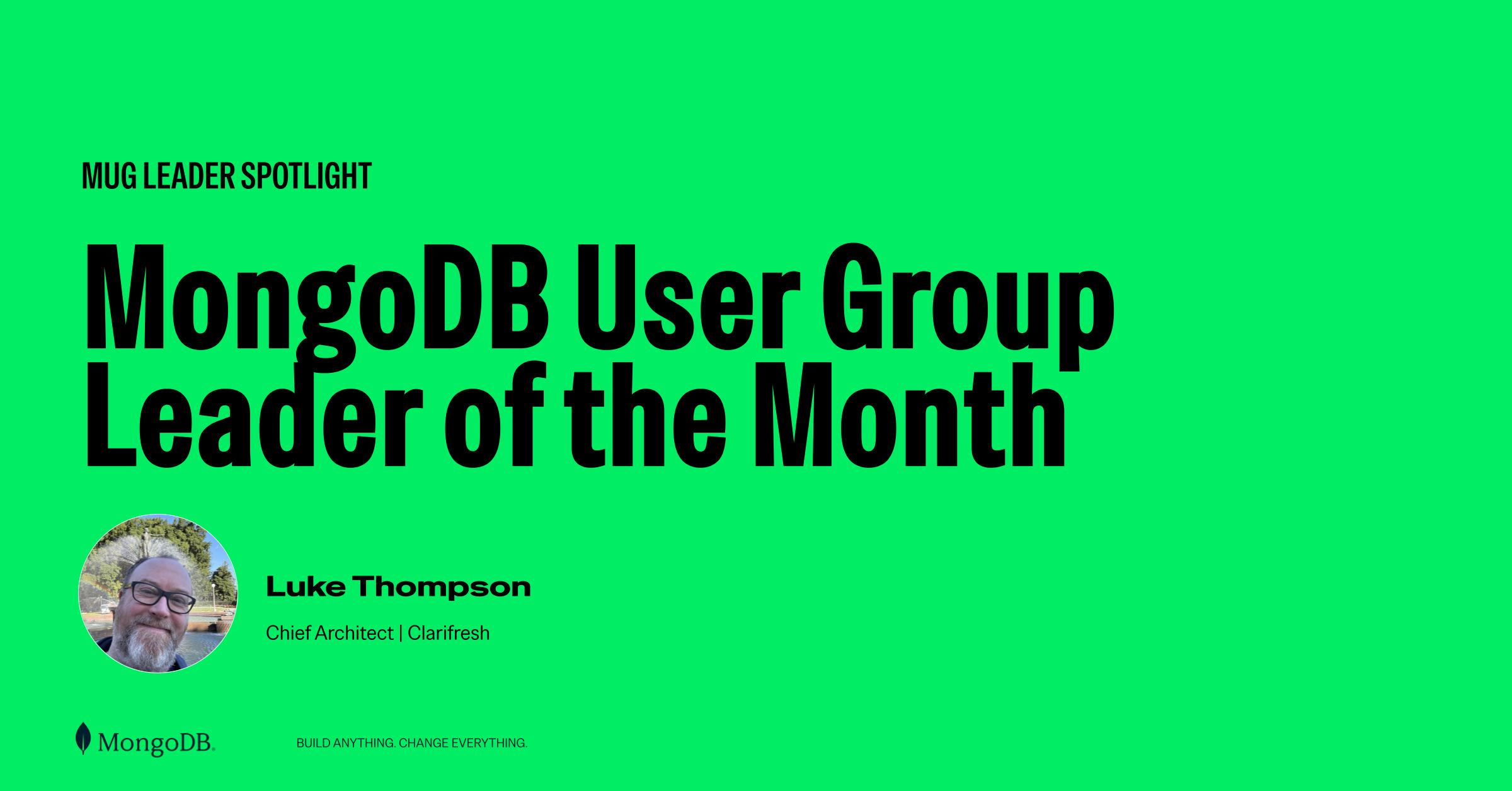
Announcement Our MongoDB User Group Leader of the Month is Luke Thompson

Post image
5 Upvotes

We’re thrilled to recognise Luke Thompson as our MongoDB User Group Leader of the Month! Luke is a Chief Architect at Clarifresh and a passionate software developer based in Sydney, Australia. Beyond his work in software architecture, he helps lead the Sydney MongoDB User Group, bringing developers together to learn, exchange ideas, and connect over their shared interest in MongoDB.

What makes Luke stand out is how he combines his technical expertise with his commitment to building the Sydney MongoDB community. Through the user group, he encourages practical conversations around MongoDB and real-world engineering challenges. He also shares his own knowledge, recently delivering a technical session exploring MongoDB Atlas Search, MongoT, and Apache Lucene.

We’re excited to recognise Luke for his contributions and the community he continues to help grow in Sydney. As part of this recognition, we asked Luke a few questions about his journey. Check it out 👇

Tell us about your journey as a MongoDB User Group leader. 
I’ve enjoyed being an organiser for the Sydney Java Meetup over the last few years. It has taken me out of my comfort zone and stretched me. I’ve met some awesome people and learnt a lot! When the opportunity to help organise the MongoDB User Group Sydney came up recently, I really welcomed the opportunity to continue being part of the Sydney developer community. I’m passionate about MongoDB, and have built software with Mongo as part of the stack for 13 years or so. I’m looking forward to it!

What has been your most rewarding moment as a MUG leader?
We held our first meetup with the new team last month, and I was really interested to see the variety of people coming along. I had all sorts of great conversations with people, from non-techie people with no prior experience coming along out of interest in what MongoDB is, through to deep technical chats about Atlas Search’s underpinnings in Lucene. It’s going to be a challenge to create events where everyone can enjoy the talks, regardless of their level of experience.

Do you have any tips for developers looking to build a community?
I think for me a great technical meetup focuses on the code, and people come away having learnt something useful and practical. I try to encourage all our speakers to share through code, minimise the slides and marketing.

What's your favourite thing about being part of the MongoDB Community?
MongoDB is an open source database, with an excellent developer experience, and a design focus on performance, resilience and scale. Since the beginning, it has built an open community around these qualities, and I think the qualities of the technology are reflected in the people who use it and build on it. I always appreciated the generosity that MongoDB staff had with their time and energy in supporting the community. I’m very grateful to have met the people I’ve met in and around MongoDB - it’s a great community to be a part of!

Where can developers connect with or learn more about you?
They can find me on LinkedIn, Twitter, GitHub and my tech blog. 

----

Thank you, Luke, for sharing your story with us today and for all the incredible work you’ve done for the MongoDB Community. We can’t wait to see what you achieve next. 

To the readers, if you want to learn more about our community champions program, see our official MUGs page.


r/MongoDB_Official • • 26d ago

AMA MongoDB Atlas AMA: Ask us about query optimization, data modeling, scaling, and more

14 Upvotes

Hey everyone! Ryan here with MongoDB. We’re always looking for new ways to engage with our community, so we’re trying something new: our first MongoDB Atlas AMA, right here in this thread. 

Bring questions about getting started, optimizing queries, data modeling, scaling, or other practical challenges you're running into. We also recently launched MongoDB 9.0, Atlas Infinite, and Atlas Agent Engine, so you can bring questions about those as well.

Our team will drop in to answer what we can and point you toward useful resources.

When: Thursday, November 5 from 1-2pm EST

How it works

  • Post your question in the comments ahead of time. A little context, like your MongoDB version, what you've tried, and any error messages, will help us give a more useful answer. Please leave out credentials and other sensitive information.

  • Come back at the scheduled time. Our team will reply directly to questions in this thread.

A few quick notes: This isn't an official support channel, and we may not be able to diagnose account-specific issues here. We can discuss what's already public, but can't share unreleased roadmap details. We also can't address billing, legal, or other account-specific matters in this thread.

Our goal is simple: help MongoDB users work through real-world questions and troubleshooting challenges together.

Drop your questions below!