I was a fan for a long time. Feel for the guy w the loss of his son, etc. BUT, lately he has been spewing Q anon and Trump nonsense and seems to just be escalating it lately. His latest videos are about 1/3 missing 411, 2/3 resentment and cherry picked hatred directed at his pick of the week. Topics include nonsense about immigrants being criminals, the borders being completely opened up (literally), the list goes on and on and on. I pointed a couple of facts that he stated that were in fact incorrect (bc they were about a town I happen to live in near the border of Texas/Mexico, he deleted my comments, every single time. I wasn't being hateful or angry I was just telling him that he was incorrect and posting the links to prove it. Deleted. I get that he's going through stuff I truly do, but that is no excuse to start repeating Q anon misinformation that is easily debunked. And if he's so sure he's right, why does he delete anyone who challenges him in any way? Sadly, after being a long time fan, with an interest in his cases, I feel he can no longer be trusted as a reliably honest person who attempts to tell the truth, bc I now know for 100% fact that he-at least in the case of some specific political/science/geography issues-straight up lies and deletes anyone attempting to correct him. If he is willing to lie about stuff like that, deny his own misdemeanor charity-fraud charges (which didn't bother me that he had them, just that he is now denying they ever happened), what else might he be willing to lie about? I'm actually really sad about this bc I wanted to like the guy and I trusted that he was at least well meaning before. Anyone else notice this latest trend of randomly direct anger and blame towards (either not true, or REALLY minor issues) issues and making them seem bigger than they are?
We never really get know Aaron Hedges in the Missing 411 documentary (or in the book) and there must a be reason for this. In the documentary David Paulides interviews one of Aaron Hedges' friends (DC), but the two hunters, Mrs. Hedges and Aaron's brother do not appear in the movie. Is Paulides not interested in their accounts? Would their statements possibly contradict the official Missing 411 narrative?
This OP contains personal information about Aaron Hedges and it is very important to remember we are all humans who need to be treated with respect. Millions of people go through daily struggles that affect their decision-making, mental health and physical health.
I strongly feel Missing 411 has dehumanized Aaron Hedges by not showing Aaron's human sides.
Missing 411 Facts
David Paulides: "Would you describe that he had good common sense?"
CB: "Yeah, Aaron had good common sense. Aaron wasn't a dummy... I mean, someone that comes up here every other weekend, always hunts up here, has stashes up here. He knows the area like the back of his hand."
Deconstruction
In the documentary David Paulides talks to a friend (CB) and the only question Paulides asks is if Aaron had good common sense.
The answer is: yes.
So what is it David Paulides is withholding?
The answer is: a lot.
[Friend 1]
As I have already mentioned the two friends did not think Aaron Hedges would survive because Aaron was "not in his right state of mind". During the interview both friends also said Aaron did not seem to be in a good physical condition.
In the evening of September 10th (the day the hunting trip ended) the two friends were interviewed by Park County officials and it is noted [Friend 1] "went on to explain that Hedges had a serious drinking problem and was supposedly taking meds to stop having cravings to drink.". It is also noted [Friend 1] "stated that he had known Hedges for ten years and that he thought Hedges was 'screwing up' at home" by drinking too much.
[Friend 1] confirmed that Aaron Hedges had been drinking during the trip, but he did not know if Aaron had any alcohol on his person. According to [Friend 1] Hedges "had been acting 'strangely' and was agitated and confrontational almost from the time they arrived at the trailhead". [Friend 1] also told Park County officials that Aaron "was a chronic alcoholic and sought assistance from a physician to help curb his drinking".
[Friend 2]
[Friend 2] was interviewed by a detective and a Corporal on March 5th, 2015. [Friend 2] told them Aaron Hedges' "usual drinking pattern consisted of at least a pint of Jack Daniels a day". The detective noted: "He [Friend 2] described the 'out of it' behaviour exhibited by Hedges the day they left for the mountains and said Aaron drank alcohol on the way to the trailhead". So both [Friend 1] and [Friend 2] describe the same scenario: Aaron was agitated and in a bad mood from the start. [Friend 1] even said Aaron had a belligerent attitude.
The detective continues: "Knowing that Hedges was on medication to curb his alcohol cravings but continued to drink anyway and observing the behaviour by Hedges, [Friend 2], said in retrospect, he wishes he would have forbidden Hedges to go on the trip.".
[Friend 2] noticed Aaron Hedges did not have a large amount of alcohol with him. The detective made the following comment: "Based on the amount of alcohol that Hedges brought him, which was much less than he would consume on a 5 to 7 day hunting trip, [Friend 2] theorized that Hedges intended to to dry out and attempt to get his life together on the hunting trip. He also theorized that Hedges' intent all along was to get to the cache and go through his withdrawal process alone, but he never made it there.".
Mrs. Hedges
When Mrs. Hedges' was interviewed she told law enforcement Aaron "had been agitated and unstable on his feet recently and she believed this was due to his recent prescription". The fact is Mrs. Hedges did not want Aaron to go on the hunting trip, but she was not able to change his mind. The detective noted: "[Mrs. Hedges] stated that because of the negative side effects she had seen in her husband Aaron, which included short temperedness and physical unbalance, she did not want him to go on the hunting trip. She re-stated Aaron's alcoholism and subsequent efforts to convince him not to go on the trip but she said his mind was made up and he went anyway.".
Mrs. Hedges also relayed Aaron Hedges was familiar with the area and that he had been there three or four times in the past year.
Aaron's brother
Aaron Hedges' brother was also interviewed and he worried Aaron was suicidal. The detective noted: "He [the brother] said it was a spur of the moment trip for Aaron. [The brother] stated that he was told by [Friend 1] that Aaron had not been very nice to his wife lately. ... [The brother] also told me that he had heard lately that Aaron was drinking a lot lately and was losing his friends and family. According to [the brother], he was concerned Aaron may be suicidal.".
Analysis
It is unfortunately very obvious there is more to this tragic story than what is presented in the documentary and in the book. Aaron Hedges' addiction affected him both mentally and physically and it affected his decision-making. Aaron was falling apart so to speak.
Mrs. Hedges did not want him to go on the trip and Aaron's brother thought Aaron was suicidal. [Friend 2] believed Aaron saw the hunting trip as a way to go through his withdrawal in seclusion, but we will never be able to confirm this. The two friends maintain Aaron wanted to spend some time alone and this will be discussed in the next OP.
If you were unaware of Paulides career as a police officer in San Jose, here's some information for you.
In the early 1980s, Paulides spent a lot of time and many of the tax payer's quarters in adult book stores, entrapping gay men for solicitation.
According to an article in the Bay Area Reporter on April 28, 1983,
" David Treadwell, active activist in San Jose, reports some happy news — sort of. It seems that Officer Paulides of the San Jose Police Department’s Street Crimes Unit has left the force to join the FBI. According to Treadwell, Officer Paulides was often referred to as the “king of the bookstore detail” due to the number of arrests he made. "
“Paulides, more than any other officer in that detail, took a particular delight in his work. He often spent much of his time in the movie arcade section of the adult bookstores,” says Treadwell. “Much of that time he would spend pumping quarters into the movie machines (our tax money). When he saw what he assumed to be a Gay male he would try to make eye contact. He knew all of the body language that Gay men use when they are cruising,” Treadwell reports. “His actions did not stop there. After engaging the Gay man in conversation he would often ask if that person had a place to go. Paulides would indicate that he could not go to his place. Many of these conversations were lengthy, lasting for several minutes. Arrests were made after the men would agree to go to Paulides’ car. With the announcement that Paulides would be joining the FBI,” surmises Treadwell, “the motivation is becoming clearer. Paulides, who testified in court that he had made over 100 bookstore arrests in a seven month period, had a conviction rate of almost 100%,” says Treadwell. "
At this time, it was reported he was leaving the Street Crimes Unit to join the FBI.
For whatever reasons, this did not happen and he remained with the San Jose police force, eventually being promoted to the city's elite swat team, MERGE (Mobile Emergency Response Gear and Equipment) . However, by the 1987 he and his unit were accused of police brutality against blacks.
Headlines from the local newspaper, The Mercury News from early 1987 tell the story.
ASSAULT SUSPECT SAYS S.J. POLICE BEAT HIM - January 9,1987
BLACKS SAY THEY ARE VICTIMIZED - January 9, 1987
S.J. POLICE BEAT SUSPECT, WITNESSES SAY - February 9, 1987
However, the DA's office didn't believe there was enough evidence for a conviction.
NO CHARGES IN ALLEGED BRUTALITY - POLICE SAY INTERNAL PROBE CONTINUES IN MERGE UNIT - May 15th 1987
This article says that the DA's office says that internal investigations were continuing.
I believe it was this incident which led from him being demoted as a street cop to a court liaison, prior to being charged for false solicitation which ended his police career in San Jose.
EDIT: My initial upload of the images failed, so I am including this link. Sort AZ for chronological order. Trick-Total (trick-total) — ImgBB
I will deconstruct the entire (almost at least) Dennis Martin case as it is presented in Eastern United States (2011) over a number of OPs. This first OP pertains to how David Paulides presents the moment Dennis Martin went missing. How accurate is his version?
CANAM Account
Researcher David Paulides writes (EUS, p 137): "As both Martin clans were sitting on a grassy spot just to the southwest of the Anthony Creek Trailhead, the William Martín boys and the two other young Martin boys were playing in the field and sneaking up to the adults. It was a great atmosphere for the children to enjoy a national park setting. At one point, the boys decided to split up and play hide and seek. Dennis was last seen in the Tennessee side of the field, fifty feet from where Clyde and William were sitting. After three to five minutes of not seeing Dennis, Mr. Martin became concerned and began calling out loud for his boy, but there was no answer. Clyde Martin saw his son's concern and got up and started to join the search. It was approximately 3:30 p.m., and William Martin's life was about to change forever. During the next several hours, the Martins, rangers, volunteer searchers, and various other volunteers covered every trail in the immediate area. They searched behind every plant and tree on the field. Dennis Martin had vanished.".
Deconstruction
CANAM statements
Deconstruction
As both Martin clans were sitting on a grassy spot just to the southwest of the Anthony Creek Trailhead, the William Martin boys and the two other young Martin boys were playing in the field and sneaking up to the adults. At one point, the boys decided to split up and play hide and seek. Dennis was last seen in the Tennessee side of the field, fifty feet from where Clyde and William were sitting.
The Chronological Narrative (an official government document) states: "According to Douglas Martin, the boys decided to sneak up and surprise the adults. Douglas and the two other boys went south and then west and came upon the adults while Dennis went northwest, as it were and intended to come upon the adults from a north to south direction. The time the boys parted was the last time Dennis was seen. The adults reported that they saw the boys split up, so in effect, he was last seen on the Tennessee side of the Spence Field.". Kingsport Times (16 June, 1969) states: "Dennis and his older brother, hoping to sneak up upon their father and surprise him at a camper's shelter just inside the woods, became separated after plunging into the thick tangle of forest underbrush, home of black bears, wild hogs and snakes.". Please note that David Paulides does not mention how unforgiving the forest is in EUS.
After three to five minutes of not seeing Dennis, Mr. Martin became concerned and began calling out loud for his boy, but there was no answer.
This claim is correct. The Incident Report (an official government document) states: "Mr. Martin stated that between 3-5 minutes after last seeing Dennis he became concerned and began calling for the boy.".
It was approximately 3:30 p.m., and William Martin's life was about to change forever.
Dennis Martin did not go missing at 3:30 pm, he went missing a whole hour later - at 4:30 pm. The Incident Report says 4:30 pm and the Chronological Narrative document also says 4:30 pm. What is David Paulides' source Dennis Martin went missing at 3:30 pm and why does not he not tell his readers about the information in the Incident Report and in the Chronological Narrative? The earlier Dennis Martin went missing the better it is from a Missing 411 perspective (as we shall see later on). The fact is the whole Missing 411 narrative falls apart if Dennis Martin went missing at 4:30 pm and not at 3:30. More on this in future OPs. Is this the reason David Paulides claims Dennis Martin went missing at 3:30 pm?
During the next several hours, the Martins, rangers, volunteer searchers, and various other volunteers covered every trail in the immediate area.
This claim misleading. It took the Martin family four hours to contact park rangers, they did so at 8:28 pm according to the Incident Report and to the Chronological Narrative. William Martin did not look for Dennis in the immediate area per se, the Incident Report states. "He [William Martin] quickly went west on the AT as far as Little Bald (Approximately 1 mile) and returned thinking Dennis might be back to the others. He then went west again on the AT to Russell Field, 2.S miles, and returned to Spence Field.". The report continues: "Mr. Clyde Martin, Grandfather, came down Anthony Creek trail to Cades Cove and informed rangers around 8:30 p.m.". The real search and rescue operation began at 5 am the following morning. Family members and a limited number of rangers were looking for Dennis Martin that first evening, but they were hampered by inclement weather.
They searched behind every plant and tree on the field. Dennis Martin had vanished.
What is the source for this claim? According to newspaper articles the forest was thick with heavy underbrush. The Tennessean (20 Jun, 1969) states: "So thick is the green growth of trees that a squirrel could go from Gatlinburg to Cherokee, N.C. some 30 miles over the mountain, without ever having to touch ground. It's just about as thick as any jungle and that is one reason Green Beret troops, many of whom have fought in the jungles of Vietnam, have joined in the search.". There is no way every plant and tree was checked the first evening Dennis Martin was missing so why does David Paulides make this claim?
Analysis
David Paulides focuses a lot on the field/meadow in EUS (p 136-137) writing things like:
"On June 14, they hiked to Spence Field and spent the day playing in the meadow."
"The field is grassy and runs in an east to west direction..."
"...another family met them in the meadow and asked whether they could join their boys in playtime..."
"As both Martin clans were sitting on a grassy spot..."
"...the two other young Martin boys were playing in the field and sneaking up to the adults..."
"Dennis was last seen on the Tennessee side of the field"
Newspapers on the other hand focused on the wild, unforgiving and untamed forest. During the search The Atlanta Constitution (22 Jun, 1969) wrote: "Observers say some of the land has never been touched by humans", The Tennessean compares it to a jungle and so on. Park rangers were notified four hours after Dennis went missing and valuable time was unfortunately lost, David Paulides makes it seem like every plant and tree was searched during the first evening, but this is an impossibility. Paulides says Dennis Martin went missing at 3:30 pm and does not even mention the correct time (4:30 pm).
It is also not mentioned in EUS Dennis Martin went missing because his brother "suggested the youngster take a short cut" (The Greenville News - 16 Jun, 1969). Asheville Citizen Times - 17 June, 1969 states: "Rangers said the older brother, Douglas, 9, told Dennis to take a short cut and jump out and surprise the others. The boy left the trail and has not been seen since.". Is there a specific reason David Paulides focuses on the relatively harmless meadow and not on the dangerous jungle-like forest?
Yesterday David Paulides talked about seven-year-old Annie Fredericks who went missing and perished in the Pennsylvanian wilderness in 1891. A very tragic event for her family.
The argument
Annie's remains were found seven miles from her home and in the video David Paulides uses one of his standard M411 arguments. Paulides talks about an 1891 headline that says "CHILD HAD WANDERED FAR" and then makes the following statement: "Eh, yeah. I would say that! Seven miles, I don't believe it! Search and rescue manuals say that 95 % of the time a child of seven years old will be found in a radius of 4.5 miles or less. She is seven miles away and uphill. Don't think so!".
Theproblem
If 95 % of missing seven-year-olds are found within a 4.5-mile radius you still have 5 % who are found outside of this 4.5-mile radius (or not found at all). This means rescuers expect to find some children outside of this radius. Finding a seven-year-old who travelled 10-15 miles is usually more difficult than finding a seven-year-old who only travelled two miles. If a child is not found we do not know how far they travelled, this means the stats are incomplete regarding how far children walk.
A seven-year-old walking seven miles is not evidence there is there is a Missing 411 abductor in the first place and many children are capable of walking considerable distances.
Number of missing seven-year-olds
Number of found seven-year-olds found within the 4.5-mile radius
Number of missing seven-year-olds who are not found within the 4.5-mile radius
100
95
5
200
190
10
500
475
25
1000
950
50
Other CANAM claims
Newspapers and people at the time felt Annie starved to death or was eaten by bears. David Paulides delivers his usual arguments from personal incredulity and says: "They did not know what caused her death, but one thing that is completely garbage: starving to death. I don't believe it! There was a lot things to eat out there.". The thing is no seven-year-old will survive for an extended period of time alone unsheltered in the wilderness without access to proper food and water. Paulides also says: "I think there was a lot for her to eat, I think she could have survived a long period of time". Missing 411 "research" boils down to Paulides believing or disbelieving things, not Paulides collecting evidence and confirming things.
David Paulides also talks about non-human technology in the 1800s (36:57).
Questions
Why does David Paulides use the 4.5-mile radius argument when the SAR manuals he refers to confirm many children will be found outside of the radius?
If David Paulides thinks Annie had a lot to eat then why does he think it is odd she walked seven miles? If Annie managed to survive for "a long period of time" by eating "a lot of things" she had a long period of time to walk those seven miles. Right?
In 2019 content creator David Paulides released his documentary Missing 411: The Hunted. The documentary has 3400+ five star reviews on Amazon, which is impressive. Paulides had several years to research the case, so the dates presented in the documentary have to be correct.
Right?
Date #1
CORRECT
The documentary briefly shows this Sweet Grass County missing person poster and it says Aaron Hedges went missing on September 7th (which corresponds to the official narrative). The Sweet Grass County produced this poster and not the Missing 411 crew, so maybe that is the reason the poster is correct.
Date #2
INCORRECT
Just a few seconds later the Missing 411 crew claims Aaron Hedges went missing on September 5th. What is up that? Did they not read the Sweet Grass County missing person poster they just showed their viewers? Apparently not.
Date #3
INCORRECT
No, no, no. The hunting trip began on September 5th, not on September 3rd.
Date #4
INCORRECT
Again, the Missing 411 crew claims the hunting trip started on September 3rd. The crew also thinks September 3rd was on a Thursday. It was not, it was on a Wednesday, The hunting trip started on a Friday.
Date #5
INCORRECT
No, the hunting trip did not last for a week. It lasted from Friday (September 5th) to Wednesday (September 10th).
Date #6
INCORRECT
September 3rd, 2014, was on a Wednesday and not on a Thursday. The hunting trip started on September 5h (on a Friday).
Date #7
INCORRECT
Yes, this is wrong too. Next.
Date #8
INCORRECT
According to the official narrative Aaron Hedges left his two friends on September 7th (a Sunday).
Date #9
INCORRECT
Also wrong. September 6th, 2014, was on a Saturday.
Date #10
INCORRECT
September 7th was on a Sunday, not on a Monday. The storm did not start on September 7th, it started on September10th. A Park County Corporal notes: "I assumed Incident Command at approximately 0700 hours on Thursday, September 11th, 2014. ... Due to a significant weather event which brought 1-2 feet of snow and very cold temperatures the previous evening, neither horse team was able to complete their search assignment.".
This is a major key point, so it will be deconstructed in a future OP.
Date #11
INCORRECT
The two friends did not call for help on September 7th as we have already learned. September 7th was on a Sunday first of all (and the day Aaron left his friends), the two friends called Mrs Hedges on September 10th (which was on a Wednesday) and asked her if Aaron was alive. Mrs Hedges called Park County dispatch at approximately 18:23 on September 10th.
Date #12
INCORRECT
September 9th was on a Tuesday, not on a Wednesday. Aaron Hedges' boots were not found on September 9th, no-one was looking for Aaron then. Authorities were notified on September 10th and Aaron's boots were found on September 17th. A Park County Corporal notes: "At approximately 1300 hours SAR command was advised the teams had located several items of interest near the campsite. ... Due to recent snow storms in the area it was not possible to the determine the age of the fires. Also found in this area were a blue, rubber Camelback (sic) brand water bladder partially filled with liquid, an MSR water purifier pump, several small pieces of a cigarette carton with the edges burned - one of the pieces had the word 'Spirit' on it, and a pair of Wolverine brand camouflage gortex (sic) hunting boots -- size 10.".
Date #13
CORRECT
This date is actually correct, the search was scaled back on September 22nd. A Park County Corporal notes: "Monday, September 22nd, 2014, at approximately 1300 hours, joint task force administrators from Park and Sweet Grass counties and SAR managers met to discuss the continued search operations for missing person Aaron Hedges. Based on the large number of resources already utilized in search operations relative to the lack of definitive clues in addition to the high level of risk to searchers, the decision was made to scale back search efforts pending additional leads in the case.".
Date #14
INCORRECT
This date is wrong too. Powell Tribune (July 2nd, 2015) states: "About 2 or 3 miles from his daughter’s and son-in-law’s home, Beslanowitch found a bow, backpack, field gear and a hunting license with Hedges’ name on it. He made the find around 3 p.m. June 19, about 30-40 miles north of Big Timber, Montana.".
Date #14
INCORRECT
The documentary claims Aaron Hedges' remains were found on August 8th, 2016. This is however not the case. A Park County detective has noted: "On Friday August 5th, 2016 I received a call from Sweet Grass County Undersheriff Alan Ronnaberg (sic) regarding the finding of a human skull. The skull was located by a ranch worker in the vicinity of where Aaron Hedges's backpack and handgun were found."
If Sweet Grass County contacted Park County on August 5th the remains were certainly not found August 8th.
According to [Friend 1] and [Friend 2] the three hunters spent the first night (September 5th -> September 6th) on the Trespass Creek trail and the second night (September 6th -> September 7th) was spent at Campfire Lake. The two friends told investigators Aaron Hedges left for a cache near Sunlight Lake in the morning of September 7th and that same day [Friend 2] shot and killed an elk. The elk was retrieved on September 8th.
At approximately 4:30 pm on September 7th [Friend 1] called Aaron Hedges and told him they had shot an elk, but Aaron did not return to the two friends and this was the last time anyone spoke to him. The next OP (part 4) will go into why Aaron left... and why he never came back.
In part 2 Bigfoot researcher David Paulides claimed the two friends were diligent in their search for Aaron Hedges even though they did not look for him and even though they never contacted authorities. It was very important for authorities to quickly learn where Aaron and his friends had camped as this would hopefully increase the chances of finding Aaron - before it was too late.
Time was of the essence.
Missing 411 Fact - #5
David Paulides writes (Hunters, p. 153): "They [the two friends] went out elk hunting and thought they'd see him that night. They did kill an elk and brought it back to camp.".
Deconstruction
Where was the elk killed?
Authorities found an elk carcass to the west of Dead Horse during their search for Aaron Hedges. The elk that was found matched the description of the elk that was killed by the two friends. David Paulides does not tell his audience this, but the elk was killed on private property (Section 17). A sergeant who interviewed the two hunters noted: "At this time it appears [Friend 1] and [Friend 2] have been deceptive in their description of where they shot the elk. This may be due to the fact that the elk might have been harvested on private property.".
The sergeant also noted: "Also during the search two arrows, matching the description given by [Friend 2], were found at the Sunlight Lake cache, which is 8 to 8.5 miles away on trail.". Why is this problematic? The sergeant continues: "This does not match the description of where, [Friend 1] and [Friend 2] stated the three were reportedly together, and we have been unable to locate any of these arrows at the other alleged camps. We have also not been able to locate either of the other two camps where they stated they stayed with Hedges.".
Where did the two friends and Aaron Hedges spend the first two nights?
According to [Friend 1] the trio made camp on the Trespass Creek trail on September 5th (the first night). Then they arrived at Campfire Lake in the afternoon of September 6th and they spent the night there.
Law enforcement asked to see photos of the hunt and of the elk, but [Friend 2] only showed them one photo. This photo depicted him packing the elk skull cap and horns on his pack and the sergeant noted the photo was not taken at the kill site. Investigators were interested in the two friends' cell phones and GPS coordinates. [Friend 1] said their phones were in airplane mode during the hunt in order to save on batteries. The sergeant lamented the fact the rest of the photos were not shared as he felt their timestamps and GPS coordinates would make it easier for them to locate Aaron Hedges.
[Friend 1] allowed investigators to read one text message from Aaron Hedges, but investigators theorised there were texts they did not read.
Investigators were allowed to look at [Friend 1's] GPS unit, but no waypoints were found. The sergeant noted: "It seemed odd that they would not mark waypoints, as they were hunting a checker boarded area with numerous privately owned sections in the area.". None of this is mentioned in the Missing 411 book and documentary. The sergeant continues: "Also when asked to show us where they had camped and where they had harvested the elk, they were vague and unclear. This is concerning as both [Friend 1] and [Friend 2] claim to know this area well.".
Investigators were troubled and the sergeant noted: "Evidence from the investigation indicates that both [Friend 1's] and [Friend 2's] phones and GPS units are important evidence in locating the whereabouts of Hedges.".
Refuted by a witness
A witness later came forward and this witness claimed he saw the trio on the trail. The sergeant noted: "The witness statements directly refute the location of where Hedges, [Friend 1] and [Friend 2] camped the first night". The sergeant noted: "It appears [Friend 1] and [Friend 2] are actively withholding information or giving misinformation regarding their exact whereabouts during the hunting trip.".
Summary
It should be clear by now there is much more to the Aaron Hedges story than what is presented by content creator David Paulides. In the next OP it will be discussed why Aaron Hedges decided to leave his two friends.
Major points:
[Friend 1] and [Friend 2] claim they spent the first night (with Aaron Hedges) on the Trespass Creek trail (September 5th).
[Friend 1] and [Friend 2] claim they spent the second night (with Aaron Hedges) at Campfire Lake (September 6th).
Investigators say they were unable to find these supposed camp sites.
The elk was shot by [Friend 2] on private property (September 7th).
The elk was retrieved the following day (September 8th).
Investigators say the two friends were deceptive in their description of where the elk was shot.
[Friend 2] only showed investigators one photo of the killed elk.
The photo of the elk was not taken at the kill site.
The phones were in airplane mode during the hunting trip.
Investigators were unable to retrieve GPS coordinates and waypoints.
The two friends were very vague and unclear, according to investigators.
Investigators found this concerning, since Aaron Hedges was still missing.
A witness statement "directly refutes" the location where the two friends and Aaron Hedges camped the first night.
Investigators felt the two friends actively withheld information and gave misinformation regarding their exact whereabouts during the hunting trip.
Aaron Hedges disappeared during a hunting trip in the Crazy Mountains in Montana. He was last seen on September 7th, 2014, and his remains were found on August 8th, 2016.
With him on the hunting trip were two friends here referred to as [Friend 1] and [Friend 2]. The three hunters began their trip on September 5th and the two other hunters returned from the mountains on September 10th. Aaron left his two friends on the morning of September 7h, his destination was a cache near Sunlight Lake.
Bigfoot researcher David Paulides wrote about Aaron Hedges in his 2016 book Missing 411 - Hunters. Paulides also covered the Hedges case in his 2019 documentary Missing 411 - The Hunted. Missing 411 believers often see the Hedges case as a quintessential Missing 411 case because they think it is so hard to explain. We have to remember Aaron Hedges was human being and it is therefore important to treat him (and a his life) with respect and to fairly present this sad case. Paulides calls the Hedges case "a story you will never forget" (Hunters, p. 152) and he also says some aspects of this case left him "dumbfounded" Hunters, p. 152).
Authorities did everything they could in order to locate Aaron Hedges, but search and rescue operations were in vain. This is the first of several OPs deconstructing the Aaron Hedges case which means you will not get the full story in this OP, only parts of it.
Missing 411 Fact - #1
David Paulides writes (Hunters, p. 154): "On Wednesday the hunters made it out of the mountains and called Aaron's wife and reported him as missing. She in turn called the sheriff, who began to formulate search-and-rescue plans.".
This statement by David Paulides is... correct. Even though Aaron Hedges was last seen in the morning of September 7th his two friends never contacted law enforcement, instead they called Aaron's wife on September 10th and told her Aaron was not with them. At approximately 6:23 pm on September 10th Mrs. Hedges called dispatch and reported Aaron missing.
Missing 411 Fact - #2
David Paulides writes (Hunters, p. 153): "The two friends looked for Aaron throughout the day and night Tuesday. They could not locate their friend and decided they needed to summon assistance.".
David Paulides claims that the two friends looked for Aaron on September 9th, but this is not the case. A sergeant who interviewed the two hunters noted: "They spent most of the next day (Tuesday 9th) traveling with the animals to their original camp at the head of Trespass Creek, near to and on the other side of the pass to Campfire Lake. They spent the night there and then spent the day (Wednesday 10th) traveling to the trailhead at Cottonwood.".
Nowhere is it stated the two friends looked for Aaron on September 9th.
Missing 411 Fact - #3
David Paulides writes (Hunters, p. 153): "His friends didn't think much about it because they knew he had supplies, was very experienced, and was heavily armed.".
Aaron Hedges was last seen in the morning of September 7th and David Paulides says his friends did not think much about it on September 8th because he had supplies, was very experienced and heavily armed. This claim is however contradicted by several statements made by the two friends (most of these statements will be presented in future OPs).
Aaron was an experienced hunter in the sense that this was not his first hunting trip, but that does not necessarily mean Aaron was experienced enough to survive by himself in the Crazy Mountains in snowy conditions. When [Friend 1] called Aaron Hedges' wife on September 10th he asked her if Aaron was still alive.
Yes, he asked her if Aaron was alive.
We know this because the sergeant who interviewed him made the following statement: "After getting cell service, [Friend 1] said he also called Hedges' wife and asked if Hedges was alive.".
During an interview on September 12th the two friends explained that they thought "Hedges was probably deceased". The sergeant asked them why they felt this way and they answered that Aaron was not "in his right state of mind" and the sergeant notes the two friends "did not feel he had the skills to survive in the area" in inclement weather.
This refutes the Missing 411 claim the two friends "did not think much about it", they were clearly doubtful whether Aaron was still alive. The two friends talked about Aaron's state of mind, but what did they mean by this? David Paulides never talks about Aaron's state of mind in his book or in his documentary. More on this subject in a future OP.
Missing 411 Fact - #4
David Paulides writes (Hunters, p. 154): "The sheriff's spokesman said that they believed that Aaron's friends did search for him and were diligent in that effort.".
David Paulides gives his readers the impression the two friends where diligent in their search for Aaron and this is simply not the case.
The fact is Aaron's friends did not search for him at all. During the investigation the sergeant noted: "In short, Hedges, [Friend 1] and [Friend 2] went into the Crazy Mountains to hunt elk on September 5th and [Friend 1] and [Friend 2] returned on September 10th without Hedges. During our first interview [Friend 1] and [Friend 2] advised us they had not went looking for Hedges. This was clarified during the second interview with [Friend 1].".
This was the same sergeant who found it odd [Friend 1] called Mrs. Hedges on September 10th and asked her if Aaron was alive. The sergeant stated: "It should be noted that neither [Friend 1] nor [Friend 2] indicated they looked for Hedges at all while they were in the area. It also is odd that they would call and ask Hedges' wife if he was alive and then ask her to call SAR.". [Friend 1] stated they did not look for Aaron because they thought Aaron "may have already gone back out the way they came and be ahead of them". [Friend 1] became emotional at this point and said he felt they made a mistake. They tried calling Aaron, but the there was no reception.
A corporal talked to the two friends on September 11th and he told them to stay out of the search area, an instruction the two hunters decided to ignore. [Friend 1] and [Friend 2] went back to the Sunlight Trailhead where they talked to a deputy and a second corporal. The two friends told the deputy and the second corporal that they were going to Sunlight Lake where they had an old cache (the same cache Aaron left for on September 7th). The deputy tried to discourage them from going because he did not want them to complicate the search effort, the deputy also pointed out the weather was bad.
Aaron's friends spent the night at the Sunlight Lake cache and returned to the trailhead the following morning. In a later interview with law enforcement the two hunters stated Aaron had not made it to the Sunlight Lake cache.
Addendum
It is important to note the two friends are not suspects in this case. [Friend 1] was seen as extremely forthcoming and cooperative and he did not appear to be deceptive in any of his answers. He even handed over his phone to investigators. Friend [2] was initially less talkative, but he sat down with a detective in March of 2015 and told him his version of events.
The sergeant stated: "At this time the evidence at hand and the interviews I have conducted with [Friend 1] and [Friend 2], lead me to believe there was no foul play on the part of either [Friend 1] or [Friend 2] in Hedges' disappearance.".
In the next OP more Missing 411 claims will be deconstructed and we will learn more about Aaron Hedges and what transpired between him and his two friends during the hunting trip.
Summary
The hunt started on September 5th, Aaron was last seen on September 7th and the hunt ended on September 10th.
The two hunters never reported Aaron missing.
Mrs. Hedges called dispatch and reported Aaron missing (September 10th).
David Paulides claims the two hunters looked for Aaron "throughout the day and night Tuesday" (September 9th), but this is not correct. They did not look him.
David Paulides claims the two hunters were not worried because Aaron had supplies, was experienced and heavily armed (September 8th). One of the hunters called Aaron's wife and asked her if Aaron was alive (September 10th), which shows they were worried.
The two hunters did not think Aaron would survive due to his state of mind and due to his lack of skills and they thought Aaron was most likely deceased (September 12th). Paulides never talks about Aaron's state of mind in his book or in his documentary.
David Paulides claims the two hunters diligently searched for Aaron, but this is incorrect. They never searched for him.
A sergeant found it odd the two hunters did not report Aaron missing, this is not mentioned by David Paulides.
The same sergeant found it odd the two hunters called Mrs. Hedges on September 10th and asked her if Aaron was still alive. This is not mentioned by David Paulides.
A corporal advised the two hunters to stay out of the search area (September 11th).
The two hunters decided to ignore the corporal's advice.
A deputy and another corporal told the two hunters not to go to the Sunlight Lake cache, because they feared the two hunters would complicate the search effort and because the weather was bad (September 11th).
The two hunters spent the night at the Sunlight Lake cache (September 11th) and stated Aaron had not been to the cache.
It is not believed foul play caused Aaron's disappearance.
David Paulides writes (Hunters, p. 152): "This is one story you will never forget. It is a story that took me several weeks to wrap my mind around.".
Deconstruction
David Paulides claims it took him several weeks to wrap his mind around the Aaron Hedges case, but I strongly believe Paulides does not understand the case to this day. Once you have enough facts (not Missing 411 facts) this case is not that hard to understand.
Missing 411 Fact - #2
David Paulides writes (Hunters, p. 152): "When I originally researched it, I thought there was some type of unusual foul play at work. After I slept on it for several nights, conducted more research, and understood the distances related to the evidence, I was dumbfounded.".
Deconstruction
David Paulides admits he was dumbfounded when he "understood the distances related to the evidence".
So what distances are we dealing with here?
The narrative the two friends present is dodgy at best and investigators found them deceptive, this unfortunately means we are not able to construct a definitive timeline of events. According to [Friend 1] Aaron Hedges left the Campfire Lake camp early in the morning of September 7th. At about 4:30 pm [Friend 1] said he spoke to Aaron Hedges on the radio (Garmin Rino) and [Friend 1] claims Aaron said he could not find the Sunlight Lake Trail fork. Please note investigators were unable to find any evidence that suggested the trio had spent a night at Campfire Lake.
Aaron Hedges was familiar with the area and he had been there many times before. The Sunlight Lake cache had a wood stove, a wall tent, food and other things Aaron needed (because Aaron had supposedly lost his sleeping bag in a mule wreck). The two friends claimed Aaron Hedges could not find the Sunlight Lake Trail fork and according to them Aaron "had gone numerous miles too far".
We have some reasons to believe this statement is incorrect.
[Friend 2] told investigators Aaron Hedges was unprepared for the hunt. Aaron had put a new sight on his bow the day before the trip and according to [Friend 2] Aaron "could not even hit a hay bail (sic) at 10 yards". [Friend 2] told investigators Aaron was trying to sight his bow "at one of the camps below Campfire Lake and was shooting into rocks and blowing up arrows". [Friend 2] described what Aaron's arrows looked like (they had a gold tip with 4 inch green and white fletching). Arrows matching this description were found at the Sunlight Lake cache - the very location the two friends said Aaron Hedges could not find.
A sergeant noted: "This does not match the description of where, [Friend 1] and [Friend 2] stated the three were reportedly together, and we have unable to locate any of these arrows at the other alleged camps. We have also not been able to locate either of the other two camps where they stated they stayed with Hedges.".
On September 11th (on the first day of the search) the two friends went to the Sunlight Lake cache even though deputies told them not to. Why did they go to the cache? Why did they tell investigators Aaron Hedges had not been there when his arrows were found there?
If the trio spent a night at the Sunlight Lake cache the narrative Aaron Hedges could not find the fork is wrong. The way I see it there is no evidence Aaron Hedges was lost during the trip.
[Friend 1] told investigators that Aaron Hedges said "that it felt he had hiked for seven miles" on September 7th. This means Aaron on September 7th was in the vicinity of the location where his boots were found. The distance between the Sunlight Lake Trail fork and the boots is about three miles, the distance between Sunlight Lake and the boots is about seven miles and the distance between Campfire Lake and boots is also about seven miles.
Investigators were only allowed to read one text written by Aaron Hedges. On September 9th Aaron sent [Friend 1] a text that said "I will call U tonight", this text was sent at 8:35 pm. This shows Aaron was still alive at this point and this also means Aaron had at least three days to find the fork - a fork that was only three miles up the trail.
Missing the fork is hard since it is close to where the North Fork Sweet Grass Creek meets the Sweet Grass Creek.
During the search rescuers found Aaron Hedges' Wolverine GORE-TEX boots. At the same location searchers also found two small campfires obscured by the snow (it started snowing in the evening of September 10th), an MSR water purifier pump and a Camelbak water bladder partially filled with liquid. Investigators described the campsite as "a relatively protected area approximately 75 yards in diameter a short distance off the main hiking trail".
Investigators believe Aaron Hedges left this campsite before it started snowing, but more on the boots and the snow in a future OP. As noted rescuers found two campfires. Does this indicate Aaron Hedges spent two days and/or nights there?
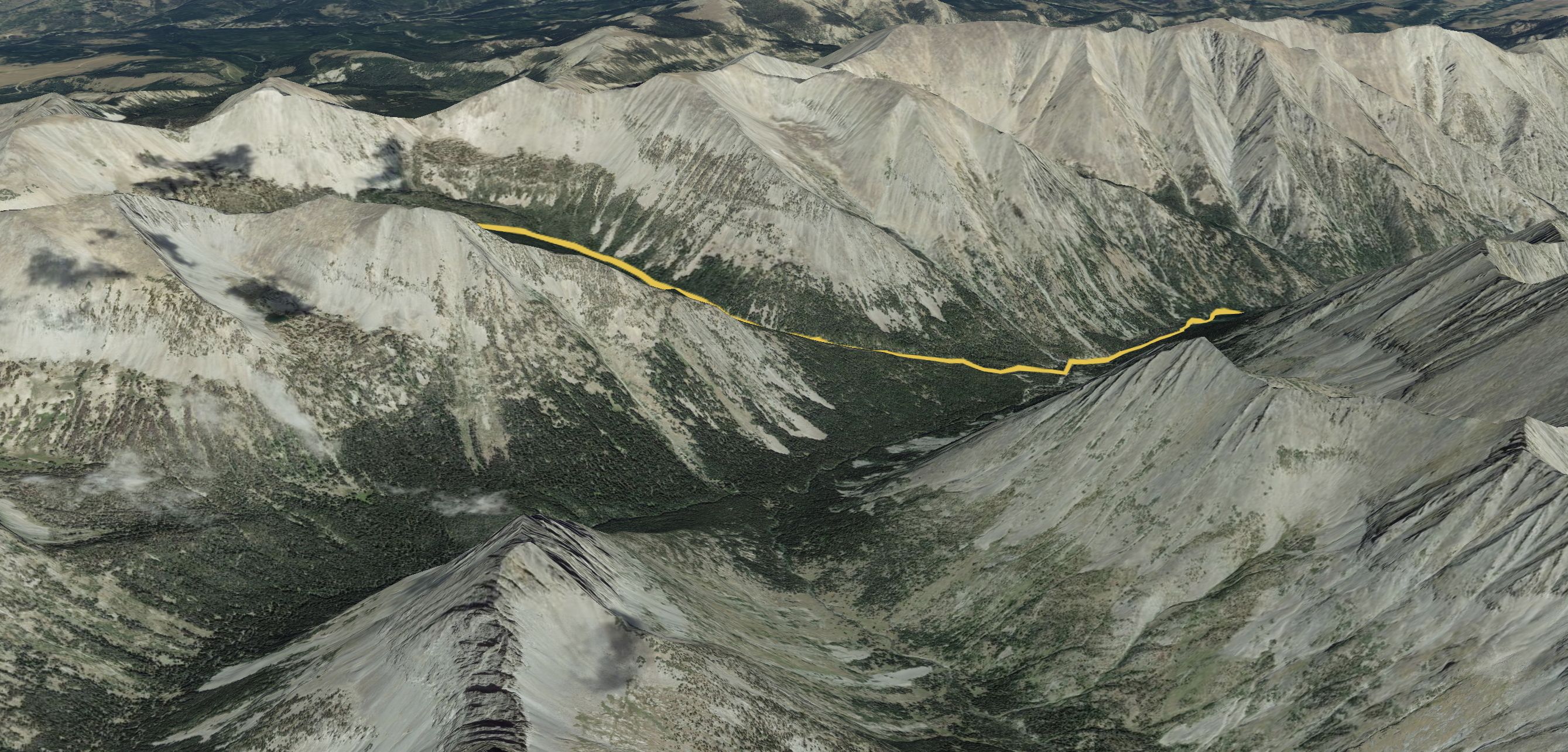
The distance between the boots and the blue marker labeled "Houses" is about three miles (regular miles, not air miles). The distance to the location where Aaron Hedges' remains were found is about six miles (regular miles, not air miles).
Missing 411 Fact - #3
David Paulides writes (Hunters, p. 152): "In the four books I had written about missing people, there were extreme examples of the phenomenal distances people allegedly traveled."
Deconstruction
Nothing indicates Aaron Hedges walked a phenomenal distance. It is claimed Aaron Hedges walked seven miles on September 7th. If this is the case Aaron had at least three days to walk the additional six miles, hardly a phenomenal feat.
The two friends were deceptive which means we are not able to construct a perfect timeline. Claiming someone walked a phenomenal distance based on flawed data is... flawed thinking.
One could argue Aaron Hedges was not really lost in the first place. The campsite where his boots were found was close to the fork and close to a farm. Aaron followed the Sweet Grass Trail so he could have turned around at any time if he truly was lost.
Missing 411 Fact - #4
David Paulides writes (Hunters, p. 152): "I have no idea how the people traveled those distances, and I make no claim of what may have happened. In the story you are about to read, again distances come into play."
Deconstruction
Aaron Hedges most likely walked the entire distance, there is no evidence to the contrary.
Missing 411 Fact - #5
David Paulides writes (Hunters, p. 157): "Remember, nobody walks air miles in the mountains. In the Crazy Mountains, you can easily double that mileage.".
Deconstruction
No, you cannot easily double the mileage in the Crazy Mountains. If Aaron Hedges followed the Sweet Grass Creek Trail the distance is fixed. The distance between the fork and the boots is three regular miles, not three air-miles. The distance between the boots and the remains is six regular miles, not six air miles and so on.
The Next OP
The next OP will discuss the boots, hypothermia and the snow storm.
Summary
The two friends claim Aaron Hedges left the Campfire Lake campsite in the morning of September 7th.
Investigators found no evidence the three hunters had camped at Campfire Lake.
[Friend 1] claims Aaron Hedges could not find the Sunlight Lake Trail fork on September 7th.
There is no tangible evidence Aaron Hedges was lost.
[Friend 1] claims Aaron Hedges said he had walked for seven miles on September 7th.
[Friend 2] said Aaron Hedges practiced his bow and new sight at Campfire Lake, but investigators did not find Aaron's arrows there.
Investigators found Aarons Hedges' arrows at Sunlight Lake, the very location the two friends said Aaron could not find.
An Aaron Hedges campsite was located about three miles from the fork.
Aaron Hedges sent [Friend 1] a text message on September 9th at 8:25 pm.
The fork was close to where two rivers meet and therefore hard(er) to miss.
On the way to the Sweet Grass Ranch property (where Aaron Hedges perished) he passed a farm.
This farm was about 2.75 miles from Aaron Hedges' campsite.
Aaron Hedges could have turned around (or kept going) if he was lost.
Investigators believe Aaron Hedges left his campsite before it started snowing on September 10th.
There is not evidence Aaron Hedges walked a "phenomenal distance".
You cannot easily double the mileage if you follow a fixed trail.
The Langer case is a fairly famous case because it happened in the so-called Bennington Triangle. Langer, her husband (Max) and her cousin (Elsner) were staying at a cabin during the time of her disappearance. Langer and Elsner left their camp to hunt pheasants, while Max remained at the camp because his poor eyesight prevented him from hunting (The North Adams Transcript - 30 Oct, 1950). According to Elsner Langer fell into a brook about 150 yards from the cabin and since her clothes got wet she decided to go back to the camp. Langer never returned to Elsner and when Elsner came back to the camp at about 4.45 pm he realised Langer was not there and authorities were contacted.
Two fishermen found Langer's decomposing body six months later about three miles from the place she was last seen "close beside a deep, water-filled hole at the foot of a steep bank over which grass and underbrush hung in a treacherous fringe" (The North Adams Transcript - 14 May, 1951).
CANAM excerpt:
David Paulides writes (EUS, p 275-276): The woman was 150 yards away from a cabin that she had owned for fourteen years. There is no way she was lost. This woman knew exactly where she was going. Something very bad happened to her. The key to this and many other cases highlighted in this book is the location of the body. Freida (sic) was found in a swampy area in high weeds, a description very similar to many other locations where bodies in this book have been found. You cannot convince me that people seek out swamps to walk into and die. It makes no sense! Freída (sic) knew this area as well as Kory Kelly new northern Minnesota when he disappeared, Kelly was found in almost an identical area as Freida (sic). If a predator wanted to take a person into an area where they wouldn't be seen and a person wouldn't walk up on them, a swamp with high reeds would be ideal.
CANAM statements
Deconstruction
"The woman was 150 yards away from a cabin that she had owned for fourteen years. There is no way she was lost."
This statement is an argument from personal incredulity, there is no way another person can conclude Langer was not lost. It is true Langer was 150 yards from the cabin when she was last seen, but it is misleading to claim there is no way she was lost. Why is it misleading to claim there is no way Langer was lost? Because she had been suffering from blackouts as the results of a brain tumor surgery five years earlier (The North Adams Transcript - 30 Oct, 1950). The North Adams Transcript (14 May, 1951) states: “In Mr. John’s opinion, the ill-fated Mrs. Langer either lost her way and was overtaken by darkness while seeking a shorter route through the woods she knew well, or was stricken by one of the mental seizures to which she had been subject since a brain operation five years ago, and wandered aimlessly through the night to her death.”. Mr. John is State’s Attorney Edward A. John of Brattleboro. So, yes, there is a way Langer was lost. Why is Langer's brain tumor surgery not mentioned by David Paulides in EUS?
"This woman knew exactly where she was going."
This is yet again an argument from personal incredulity. David Paulides “knows” Langer knew exactly where she was going, but it is of course impossible for Paulides to know this - especially since Langer had a known history of brain surgery complications (seizures and blackouts).
"Something very bad happened to her."
Yes, she died.
"The key to this and many other cases highlighted in this book is the location of the body Freida (sic) was found in a swampy area in high weeds, a description very similar to many other locations where bodies in this book have been found."
David Paulides claims the key is the location where Langer went missing, but ignores her medical background. Paulides has not solved a single case so how does he know what the keys are? There are no indications the Langer case 1) is connected to other cases or 2) explains other cases. The North Adams Transcript (14 May, 1951) states: “Both Mr. Langer and Mr. Elsner, who were at the camp Saturday but who knew nothing of the grim climax until roused from sleep by the returning party shortly after midnight, also felt certain that a recurrence of Mrs. Langer’s old ailment had sent her to her death.”. This means the medical examiner, the district attorney, the husband and the cousin all agree Langer's medical conditions most likely caused her death. Why does not Paulides relay this 1951 consensus view?
"You cannot convince me that people seek out swamps to walk into and die. It makes no sense!"
This is a straw man argument (people seek out swamps to walk into and die) + an argument from personal incredulity (It makes no sense!). No-one has claimed Langer sought out a swamp to walk into and die. Accidental drowning is a more likely scenario according to investigators who based their conclusion on the available evidence.
"If a predator wanted to take a person into an area where they wouldn't be seen and a person wouldn't walk up on them, a swamp with high reeds would be ideal."
There is no predator in the source material, the predator character is invented by David Paulides. The Missing 411 framework needs an abductor so if there is no abductor Paulides' only option is to invent one.
The official view is that Langer's body "remained hidden in the pit until it was floated free and lodged on the bank by high water" in the spring of 1951 (The North Adams Transcript - 14 May, 1951). The skull was intact, no bones were broken and "there was nothing to indicate that Mrs. Langer had met her death in any other fashion" (The North Adams Transcript - 14 May, 1951). Officials concluded Langer "fell down that bank and drowned in the hole on the dark and rainy night of her disappearance" (The North Adams Transcript - 14 May, 1951).
Barofsky (1892)
Six years old, went missing in New Jersey
The young Barofsky boy was missing for four days in the summer of 1892. When rescuers found him crying in a swamp the boy was suffering from exposure and hunger. Barofsky was taken to a doctor who felt the boy would probably not survive.
CANAM account (EUS, p 277-278):
David Paulides quotes an article published in the Weekly Herald (08 Jul, 1892): "The child was found hanging over a bush. There was at least two feet of water surrounding it. The bushes within the child’s reach had been gnawed and eaten and the clothes were torn from the little one, while blood streamed from the wounds and gashes on its body and legs. The skin and flesh on its legs were torn off, its hands badly lacerated and shrunken.".
This paragraph leads David Paulides to make the following statements (EUS, p 278): "All readers need to now reread the statement made in the article. The boy was found ‘Hanging over a bush.’. I doubt he thrust himself onto the bush to hang there. I doubt he placed himself in the middle of the swamp. It almost appears to me as though the boy was being carried through the swamp thickets being ripped and scratched. As searchers got closer, the boy was placed safely on top of a bush, and the suspect escaped.".
There is one article David Paulides does not refer to and it was published in the St. Louis Post-Dispatch (03 Jul, 1892). This article (please see the image below) gives us a better picture of what happened to the youngling.
CANAM statements
Deconstruction
"All readers need to now reread the statement made in the article. The boy was found 'Hanging over a bush'."
This quote is correct, but vague and misleading. As we have already seen the St. Louis Post-Dispatch (03 Jul, 1892) offers a clearer description of what the scene looked like: “Late in the afternoon a cry was heard coming from the interior of a clump of bushes. Penetrating into this one of the searchers was rewarded by discovering the missing boybending over and clinging to a small bush*, which stood in the centre of a little pool of water nearly two feet deep.”*. So the boy was bending over a small bush, he was not hanging from a bush.
"I doubt he thrust himself onto the bush to hang there."
This is an argument from personal incredulity and an example of David Paulides reading too much into an article. No 1892 sources suggest Barofsky thrust himself onto the bush to hang there. St. Louis Post-Dispatch states the boy was bending over and clinging to a small bush. The boy was standing on the ground, he was not thrust and he was not hanging from the bush.
"I doubt he placed himself in the middle of the swamp."
This is an argument from personal incredulity. David Paulides' personal inability to imagine a certain scenario does not mean it did not happen. When you are lost you are lost and some people who are lost end up in swamps.
"It almost appears to me as though the boy was being carried through the swamp thickets being ripped and scratched."
David Paulides' inability to understand why Barofsky was found in a swamp is not evidence the boy was abducted by someone (or something). The source material does not say Barofsky was carried, this is a Paulides invention.
"As searchers got closer, the boy was placed safely on top of a bush…"
David Paulides continues the storyline he just concocted. Please note not even the article Paulides refers to says Barofsky was placed on top of a bush, the article says "the child was found hanging over a bush". So why does Paulides claim the boy was safely placed on top of a bush when it is not true? The boy was standing on the ground bending over a small bush, which is evidence no predator placed the boy safely on top of bush. Should Missing 411 research focus more on what the source material actually says and less on imagined scenarios?
" …and the suspect escaped."
David Paulides decides to thicken the plot, now his invented suspect escapes. It is an interesting approach, but it is not research.
Earl Sommerville (1957)
48 years old, went missing in Minnesota
Hunter Earl Sommerville went missing in northern Minnesota, near the Canadian border, in November of 1957. Sommerville had left the Clayton Peterson lumber camp near Loman to hunt grouse. When he failed to return a search was initiated. The 48-year-old hunter had a dog with him at the time of his disappearance.
David Paulides writes: “Somerville (sic) left the camp and headed into a swampy area to hunt grouse. He was never found. Authorities from the United States and Canada searched the border area; and they had assistance from employees of the Minnesota and Ontario paper companies. Temperatures in the area of the search at night got down into the twenties. Searchers felt that Somerville (sic) could survive a few days because of his experience in the woods.” (EUS, p 38).
David Paulides decides to tell his readers Earl Sommerville was never found, but this is incorrect. He was found alive three days later. St. Cloud Times (06 Nov, 1957) states: “A lumber camp worker, missing since Sunday in muskeg wilderness 40 miles southwest of here where he had gone to hunt grouse,was found shortly after 8 a.m. today. He was reported in good condition. … Several cars carrying searchers parked along a woods truck trail, about 18 miles southwest of Loman, Minn., started honking horns. Somerville’s shouts were then heard. He was found about a half mile from the trail near the Black river. … Searchers said he was in good condition, and apparently none the worse for three nights in the wilderness.”.
The missing hunter said he saw planes overhead several times, but since he was in heavy growth he was not seen and he was unable to get to a clearing in time. Sommerville for some reason failed to tell his rescuers he is a Missing 411 victim.
Kathy Thomas and Sarah Dixon (1956)
Three and seven/eight years old, went missing in Colorado
These two young girls went missing during a storm. Kathy was found a couple of hours later not far from her house and Sarah was found the following day some miles away.
CANAM statements
Deconstruction
"On June 5, 1956, at 11:30 a.m., Sarah and Kathy were outside the Thomas residence when a severe thunderstorm hit the mountains. … A June 6 article in the Deseret News had the following statement about finding Kathy: "Two hours later (1:30 p.m.), Kathy was found 300 yards from the Thomas home…”.
This newspaper quote is correct. Please keep these times in mind for later.
"Searchers knew that Sarah didn't know the area and were surprised she'd leave her friend, but they were also puzzled why Kathy couldn't explain where her friend went."
Kathy (three years old) was found “hysterical but unharmed” (Messenger-Inquirer - 08 Jun, 1956) by rescuers two hours after she went missing. I found no sources that support David Paulides' claim rescuers were puzzled that Kathy could not tell where Sarah had gone. Why would they be puzzled? Kathy was three years old and hysterical. An Associated Press article published in Palladium-Item (06 Jun, 1956) states: "Kathy didn’t provide any indication where Sarah was. She only sobbed and pointed toward the mountains.". I also could not find any sources that said rescuers were surprised Kathy was left by herself, The article in Messenger-Inquirer states: "Sarah’s parents said she may have been frightened and confused by a thunderstorm. They said she is ‘high strung and nervous’.". The parents' statement is unfortunately not mentioned in EUS.
"Sarah did not make any statements about where she had been or what had happened during her disappearance."
This statement by David Paulides is one hundred per cent... incorrect. The Messenger-Inquirer (08 Jun, 1956) explains what happened: "When a thunderstorm came up Sarah told the younger girl to stay where she was while she went back to the cabin for coats. She took the wrong direction and wandered into a timber.". Salt Lake Tribune (07 Jun, 1956) even quotes Sarah: "‘I would walk a while and then I would sit down and rest a while, and sometimes I would sleep,’ Sarah said. ‘Then I would walk again and all the time I was calling for my Mommy and Daddy’.". Why does Paulides make the claim Sarah did not make any statements when it simply is not true and why does he omit Sarah went back to the house to get some coats? Where is the supposed Missing 411 abductor in all of this? Nowhere to be found.
It seems unusual that two small girls would separate-one was found three hundred yards from home and another was found five to six miles from that same location-especially for a three-year-old.
No, this is not “unusual” (whatever that means). The girls got separated when Sarah made the decision to get some coats, this is clearly stated in numerous articles. If you do not know why the girls got separated then how can you claim “it seems unusual” they got separated? You can't. David Paulides also claims Sarah was three years old, but she was not three years old - she was seven years old (Salt Lake Tribune - 07 Jun, 1956) or eight years old (Deseret News - 06 Jun, 1956). There are even pictures of her, she looks nothing like a three-year-old.
Children are usually scared in thunderstorms, but the behavior of each of these two girls defies common sense.
What evidence is there that the girls were not afraid of the thunderstorm? It started raining and Sarah decided to get some coats. How does this defy common sense? Coats are often worn in inclement weather. Kathy was found hysterical, how does being hysterical during a thunderstorm defy common sense?
Bloodhounds didn't find the girls, and the weather during the disappearance was atrocious.
The girls went missing because of the thunderstorm and because of decisions made by Sarah. David Paulides gives his EUS-readers the impression more than one bloodhound was used, but this is not the case. Tucson Citizen (06 - Jun, 1956) states: "Sheriff Carl Enlow said the one bloodhound available to searchers was hampered last night by fresh rain and the fact so many persons had tramped the area. The dog, owned by Rancher Roy Thomas of Golden, managed to pick up the girl’s scent several times, but just as frequently the trail was lost.".
How did three-year-old Sarah manage to get five to six miles from the point she was last seen in total darkness?
Again, Sarah was not three years old - she was seven or eight years old. David Paulides claims Sarah managed to get five to six miles from the point she was last seen “in total darkness”. It is a little bit hard to understand why Paulides wrote that sentence, because in NAaB (p 406) he acknowledges Sarah and Kathy went missing at 11.30 am (forenoon). The sun is in its highest position at noon (even in Colorado) and the girls went missing in June when days are long and nights are short. If Sarah wandered the entire distance in total darkness it means she must have started walking around 10 pm and this was clearly not the case. David Paulides refers to an article in Hutchinson News Herald that says Sarah was found five to six miles away and it is correct the article says this, but different articles say different things. Spokane Chronicle (06 Jun, 1956) states she was found “three miles east of the cabin where the Dixon family is vacationing”. Deseret News (06 Jun, 1956) says she “wandered into a ranch house two miles from where she disappeared shortly before noon Tuesday in the midst of a thunderstorm”. Chicago Tribune (07 Jun, 1956) states she “reappeared three miles from where she had set out for a walk from the mountain cabin to which she and her parents, Mr. and Mrs. Carl Dixon of Brownsburg, Ind., had come for a vacation”. Please note the article in Hutchinson News Herald Paulides quotes states Sarah is eight years old, so we know for sure Paulides has read an article where it says Sarah was not three years old.
Alfred Bishop (1926)
28 years old, went missing in Vermont
The 28-year old Vermont hunter Alfred Bishop went missing on November 3 of 1926. In the morning of November 4 Bishop's body was found by his brother-in-law Morris S. Gallagher in the snow beside an abandoned road. Bishop’s rifle, coat and gloves were found in the area. State Attorney Robert R. Twitchell of Woodstock initiated an investigation and an autopsy was performed.
David Paulides quotes an article published by Lewiston Daily (04 Nov, 1926): ‘Bishop’s body was found beside an abandoned road in the woods near the summer camp of Attorney General John G. Sargent. There were evidences of a terrific struggle in the snow, which was beaten down a distance of 60 paces about the body. Strewn about in different directions were Bishop’s rifle, coat and gloves.’.
David Paulides then writes (EUS; p 265): "Alfred's body was sent for autopsy. The Bridgeport Telegram had an article on November 6 that described the autopsy result: ‘An autopsy was performed today on the body of Alfred Bishop of Felchville and failed to dispel the mystery of the young man's death during a hunting trip Wednesday. No external marks of violence were disclosed by the autopsy’. Later in the same article it had this describing the area where Alfred was found: ‘The snow had been trampled over a considerable area and there was every evidence of' a terrific struggle’.".
This sounds like an enigma, but less than a week later the mystery was solved (yes, this case was solved in 1926). So who attacked Bishop that fateful November night 95 years ago? The answer is: no-one. Vermont Journal (12 Nov, 1926) states: "The absence of bloodstains has puzzled the state’s attorney who declared that if it were not for the lack of them he would be inclined to believe Bishop had been the victim of murderous attack. An autopsy decided thatdilation of the heart caused the death.".
Several newspapers reported on the autopsy findings. Express and Standard (12 Nov, 1926) states: "An autopsy was performed by Dr. Kent, state pathologist, of Burlington, who was satisfied that death was caused by acute dilation of the heart, but beyond that he made no statement.".
Springfield Reporter (18 Nov, 1926) states: "The death of Alfred J. Bishop, 28, of Reading, whose body was found beside an abandoned road near the summer camp of Attorney General John G. Sargent, two weeks ago,was caused by heart failure, it was discovered by officials who investigated in an effort to find if there had been found play connected with his sudden demise.".
Even though David Paulides mentions the autopsy he does not tell his readers what the cause of death is. Unless the Missing 411 predator caused Bishop’s heart dilation this is not a Missing 411 case.
Discussions
Should David Paulides have mentioned Frieda Langer's brain surgery and history of blackouts?
Why does David Paulides promote the idea a predator (who managed to escape) safely placed Barofsky on top of a bush when Barofsky was bending over a small bush and there is no evidence a predator was present in the first place?
How can Earl Sommerville be a Missing 411 victim without even remembering it?
Why doesn't David Paulides mention the real reason Sarah Dixon went missing and why does he claim she made no statements after she was found?
How did the Missing 411 predator cause Alfred Bishop's heart dilation without leaving any evidence behind?
Bow hunter Aaron Hedges (38 years old) went missing during a hunting trip in Montana in 2014 and his remains were found two years later in 2016. The Hedges case has taken on almost mythological proportions amongst various content creators and their respective fan bases.
Missing 411 Facts
The Missing 411 facts below are taken from the book Missing 411: Hunters (p. 152-157). The book was published in 2015, before Aaron Hedges had been found. The case was also covered in the 2019 documentary Missing 411 - The Hunted. Aaron Hedges' two friends do not participate in the documentary, they are barely referred to and we do not even get to know Aaron Hedges the person. Glaring plot holes are ignored and information that is vital to the case is not presented in the book and in the movie. What is the reason for this?
Please let us know in the comments section if there are other Missing 411 facts you want to see covered. The Aaron Hedges case will be deconstructed over a series of OPs since the topic is quite extensive and the first OP will be published later this week. The OPs will contain more information than what is found in the Missing 411 book and documentary. It is not an easy case to cover and it is very important to treat Aaron Hedges with the respect he deserves.
Missing 411 Fact - #1
"This is one story you will never forget. It is a story that took me several weeks to wrap my mind around."
Missing 411 Fact - #2
"When I originally researched it, I thought there was some type of unusual foul play at work. After I slept on it for several nights, conducted more research, and understood the distances related to the evidence, I was dumbfounded."
Missing 411 Fact - #3
"In the four books I had written about missing people, there were extreme examples of the phenomenal distances people allegedly traveled."
Missing 411 Fact - #4
"I have no idea how the people traveled those distances, and I make no claim of what may have happened. In the story you are about to read, again distances come into play."
Missing 411 Fact - #5
"As you read about hunting cases, you will start to see that bow hunters have a high mortality rate comparatively in this book and have the highest rate of not being found. If they are found, the stories are almost beyond understanding. This story is about a bow hunter."
Missing 411 Fact - #6
"The location of this case is twenty miles north of Billings, Montana, in the Crazy Mountains. Yes, the name of the range is the Crazy Mountains. I've discussed in the past books that people disappear in areas with names that are strange. The most common name I found for disappearance dealt with geographical locations with the word Devil in the name - thus, Missing 411: Devil's in the Detail."
Missing 411 Fact - #7
"Three hunters were carrying radios for communication purposes. On September 7, 2014, Aaron somehow got separated from the other two hunters. It was never made clear how this happened."
Missing 411 Fact - #8
"In the late afternoon, he called his friends and stated that he'd missed the trail back to their location and was instead going on to Sunlight Lake. He knew the location because they had hunted it last year and kept a stash of supplies in the mountains surrounding the lake. ... The friends didn't think much of it and said that they'd see him that night. He never arrived."
Missing 411 Fact - #9
"The sheriff's spokesman said that they believed that Aaron's friends did search for him and were diligent in that effort."
Missing 411 Fact - #10
"In past books I have documented multiple incidents where victims removed their shoe. Sometimes the removal happened very quickly after they vanished, much too fast for hypothermia to be the explanation."
Missing 411 Fact - #11
"In a few instances, the victims also removed clothing, except they were too young to ever taken their clothing off and their parents demanded to know how it had happened."
Missing 411 Fact - #12
"The statement made by SAR that Aaron could not have traveled far after removing his shoes was logical, but after reading my books, you will quickly find that logic doesn't come into play in these stories."
Missing 411 Fact - #13
"If Aaron were moving through any open areas, he'd look like a snow plow from the air moving through fresh snow. Nothing along the lines of tracks was ever found."
Missing 411 Fact - #14
"At this point any concern about Aaron suffering from hypothermia and taking off his boots doesn't add up. He had clothing, lots of clothing that would've kept him warm."
Missing 411 Fact - #15
"...he would've made a cross-country hike for fifteen miles in deep snow. He didn't have skis or snowshoes, and he would've been off trail. Oh, don't forget: he had to have done this in bare feet."
Missing 411 Fact - #16
"The location where Aaron's bow and backpack were found was two miles from the ranch house. There had been an extensive search in the area where the items were found, and Aaron wasn't there. Searchers were completely in disbelief. It was beyond comprehension how he could've made it from the creek to the location where his items were found without boots."
Missing 411 Fact - #17
Point to point I have it at 13 miles. Remember, nobody walks air miles in the mountains. In the Crazy Mountains, you could easily double that mileage."
C. H. Bordwell was picking berries in northern Minnesota when he got lost.
Missing 411 Facts
David Paulides writes (EUS, p. 14): "A search was conducted of the area where Bordwell was last seen, and he was not located. Again, a healthy person disappears, is never found, and the search is terminated. I want all readers to take a breath here and realisethis is a human life that was completely lost. Bordwell wasn’t lost in the middle of the Atlantic Ocean. He was eighteen miles from his house. How does this happen?”.
Deconstruction
Yes, how does this happen?
St. Cloud Times (02 Aug, 1944) explains what happened: “C. H. Bordwell, musical director of Keewatin schools, was back at his home today, after being missing for 48 hours.He was found yesterdayafternoon by Ernest and John Schutte, mine workers who operate a store here. Bordwell disappeared Sunday while picking berries. In the 48 hours he was missing he had traveled less than four miles from the placehe was last seenin the little swamp country.”.
Being lost took its toll on the musical director. Globe-Gazette (02 Aug, 1944) states: “Searchers found Bordwellsitting in mud and water in the Little Swamp country south of Hibbing, completely exhausted, disheveled and torn from 2 days and night of wandering in the woods. Bordwell told his rescuers he had been trying to follow the railroad tracks by listening for the engine whistles but was stopped by the heavy undergrowth.”.
Analysis
David Paulides claims the search was terminated and I wonder what Paulides' source is? Did he find a newspaper article that says the search was terminated? Where does this information come from?
In a way David Paulides is right: the search was terminated... when Bordwell was found by Ernest and John Schutte. Credit where credit is due.
This is yet another "unexplained" Missing 411 case that was explained and solved decades ago. Please note Bordwell says he was stopped by heavy undergrowth, not by the Missing 411 monster.
In May of 1950 Jackie Copeland (two and a half years old) went missing in Pennsylvania during a family picnic on an oil well property. Copelands' father was an oil worker and during the picnic Copeland managed to "escape" his father, mother and four older sisters. The family spent a couple of hours looking for the young boy before contacting local law enforcement. Hundreds of searchers looked for Copeland and he was found alive the next morning when he had been missing for seventeen hours.
Content creator David Paulides covers this case in Eastern United States (2011) and in a recent blogpost published by The Observer Magazine the following claim is made: "There are plenty of ad hominem attacks against Paulides, but the accuracy of his reporting, along with a refusal to decode the mystery, leave his haters with few avenues from which to attack.".
The blogpost also says: "Cases like that of 2-year-old Jackie Copeland (1950) out of Pennsylvania hark back to this notion. He went missing from a well-attended company picnic, only to be found the next morning in the middle of 'impassable swamps.' He steadfastly claimed that he wandered away from his parentsin pursuit of a creaturethat had been 'peering at him from behind a big tree.' He also told of encountering a “throbbing giant” during his night in the forest, reminding us that perception and reality can be extremely unreliable under stressful conditions.".
The Observer Magazine gets its information from David Paulides, but is it really correct Jackie Copeland steadfastly claimed he wandered away from his parents in a pursuit of a creature who had been peering at him from behind a big tree?
It is time to read some original sources and deconstruct some Missing 411 facts.
Missing 411 Facts
Missing 411 Facts (EUS, p. 200-201)
Deconstruction
"The area is completely surrounded by what many newspaper articles called "impassable swamps.”
David Paulides claims that many newspaper articles claim that the area was completely surrounded by impassable swamps, but he fails to quote any newspaper articles that actually make this claim. Why is that? Some articles mention there are marshes and swamps in the area, but no articles make the claim the boy was found in an impassible swamp. The truth is Copeland was not found in a marsh/swamp, he was found next to an oil pump house located in a hollow at the edge of a dry forest. The oil pump house is mentioned in EUS and it appears researcher David Paulides thinks this oil pump house is located in an impassable swamp, but if that is the case then how do oil workers access the oil pump house? We are never told. The person who found Copeland (oil field worker Leroy Bevier) was interviewed by The News-Herald (16 May, 1950) and he stated: "I quieted him down by telling him I would take him onan automobile ride. We had a big time and he quieted right down. Then I wrapped him up warm in a heavy coat I luckily had along, and we set out. I thought he would be cold, from being out all night, but he was feverish.The hollowwhere the plant is often gets colder than other places, and a heavy damp dew was falling that night". The main question here is how do you drive a car through an impassible swamp? In the same article Bevier outlines a likely scenario: "He [Jackie Copeland] must have come down thelease roadfrom theTightpinch road. It will be mystery to me always how he came down that road acrossthe open fieldwithout being seen. The plant is justat the edge of the woods, about three-quarters of a milefrom the lease house where the Copelands were.". The article also states: "At 7:30 p.m. Deputy Sheriff Tracy Miller of Franklin took two bloodhounds there. They picked up what seemed to be a warm trail, but becausethe woods were so drythey lost it. ... There were no deep holes on the lease andno water to speak of. In fact, there seems to be no place the child could be, unless he had crawled under the leaves and gone to sleep. Los Angeles Evening Citizen (15 May, 1950) states: "There areno streamsin the area, but most of the ground is covered with heavy growth". The article also states 500 searchers "spent the night tramping woods and fields". So no, Copeland was not found in an impassible swamp - he was found in a dry forest and there was (not surprisingly) a road leading up to the oil pump house.
"As Mr. Bevier and a crew of searchers were walking through the swamps, he accidentally saw Jackie looking around the side of a tree, almost peering."
This is not correct and David Paulides once again fails to provide a source. Oil field worker Leroy Bevier was by himself when he spotted Copeland next to the oil pump house and he was not walking through a swamp - this is a pure Paulides invention. How was Bevier able to walk through the swamp if it was impassible to begin with? We are never told. The Daily American (16 May, 1950) states: "Then, about 9 o'clock, an oil field worker dropped out of the group of searchers to go to a nearby pump house to make some adjustments in the machinery. He [Leroy Bevier] saw something peering at him from behind a big tree. When he approached, the creature scampered into the brush. It was a badly frightened, oil-smeared little Jackie.".
"Jackie was found over two miles from the picnic and across swamps that were deemed impassable by search coordinators."
No, no search coordinators deemed the swamps impassable because Copeland was not found in a swamp - this is a Missing 411 lie not backed up by any sources. Leroy Bevier stated Copeland was found three quarters of a mile from where the picnic was (The News-Herald- 15 May, 1950). Some other articles say one mile.
"The press wanted to hear how the boy got to his location in the swamp, what he had to drink and how he kept warm."
No, no sources say the press wanted to hear how the boy got to his location in the swamp. Journalists (and everyone else) knew Copeland was found in a hollow at edge of a dry forest, not in a swamp. Copeland did not have anything to drink and he did not keep warm, he was damp and feverish when he was found.
"Jackie first was asked why he left the picnic and here is his quote: 'He saw something peering at him behind a big tree. When he approached, the creature scampered into the brush'. Jackie didn't explain anything more about leaving the picnic at that point."
This is incorrect, toddler Copeland did not say any of this so where does this quote come from? It turns out it is not a quote at all. The Daily American (16 May, 1950) states (as we have already seen): "Then, about 9 o'clock, an oil field worker dropped out of the group of searchers to go to a nearby pump house to make some adjustments in the machinery. He [Leroy Bevier] saw something peering at him from behind a big tree. When he approached, the creature scampered into the brush. It was a frightened, oil-smeared little Jackie.". So David Paulides takes some random lines from an article where an AP journalist describes how Leroy Bevier found Copeland and claims it is a Copeland quote - it is not. Please note Paulides decided to omit the last line that explains that the creature was Copeland: "It was a badly frightened, oil-smeared little Jackie.". Villagers, there are no excuses.
"The article later explained more of what Jackie stated: '[He] recounted in child talk his adventure in awful blackness by a great throbbing giant and a tall friendly tree and wild animals howling in the distance and the unfamiliar shouts of strangers prowling nearby.'."
What does Copeland mean by all of this? This is my best guess: awful blackness = the dark night, great throbbing giant = the oil pump house with its machinery, a tall friendly tree = Copeland spent the night by this tree, wild animals howling in the distance = SAR dogs or wild animals and unfamiliar shouts of strangers prowling nearby = rescuers looking for Copeland.
"Jackie Copeland's explanation of what occurred to him could be a very sobering narrative of what might possibly be occurring with the plethora of missing children outlined in thus book from the Pennsylvania area."
A sobering reminder? Contemporary sources state Copeland wandered off during the picnic so in a sense David Paulides is correct - many children wander off when they are not properly supervised by their parents or by other family members. Paulides completely misunderstands/misrepresents this case and it is telling he thinks his distorted version of events explains how other Pennsylvanian children go missing when none of them speak of awful blackness, great throbbing giants, tall friendly trees and so on. Where is the logic here?
"How Jackie was able to sleep under conditions he described is a true mystery, yet many young children are found by searchers in a groggy and semiconscious state."
This is another common Missing 411 misrepresentation. I have looked into every single EUS and NAaB case where David Paulides claims the child was groggy or semiconscious and these children were simply tired, sleepy, exhausted, suffering from environmental exposure, starving, dehydrated and so on. The imagined Missing 411 abductor does not make children groggy and semiconscious (if that is the idea).
"The question I pose to each and every reader what was the 'creature'' peering at him from behind a tree?"
There was no creature, Copeland was the "creature". Why is written text so hard for Missing 411 researchers to understand?
"I think it is ironic that Jackie mimicked the behavior of the creature when he was approached by a searcher."
Copeland did not mimic any behaviour, this is yet another Missing 411 lie. Copeland simply got scared when a stranger (Leroy Bevier) approached him, that's all. Copeland did not leave the picnic because he saw a creature, this is a scenario invented by Missing 411 researchers decades after the fact. There is much more to say, but I am almost lost for words.
"How could a two-year-old boy traverse impassable swamps without the aid of some type of mammal?"
A mammal? Villagers dogmatically claim content creator David Paulides never speculates or offers any theories, but here Paulides invokes "some type of mammal". A mammal for which there is... no evidence. How many contemporary sources talk about this mammal? Zero. If the assistance of some type of mammal is needed then why does not Leroy Bevier and others talk about this elusive mammal? Because Copeland was not found in impassible swamp and because there never was a mammal, that is why.
"The description Jackie gave of his incident is something that we all should ponder and attempt to understand."
Yes, I agree. Researcher David Paulides should definitely attempt to understand this very simple and straightforward case, especially since it is not hard to understand.
Summary
The Missing 411 version of the 1950 Jackie Copeland case is comedy gold, almost every claim is wrong and many Missing 411 facts are simply made up. How on earth did Leroy Bevier manage to access the oil pump house if it was located in the middle of an impassable swamp? What do villagers think? David Paulides actively ignores every single sentence that explains what really happen in strange attempt to make the case mysterious and he then implies "some type of mammal" is responsible for the disappearance.
Copeland never said he saw a creature behind a tree, the AP article describes how Leroy Bevier found Copleand. When researchers have to invent quotes to manipulate a gullible audience then something is really wrong.
Abraham Lincoln Ramsey was a three-year-old boy who went missing in March of 1919. The Nashville Banner (19 Mar, 1919) describes the moments that led up to the disappearance: "This little boy, said to be a most extraordinarily bright child, undertook to follow his sister to a country store on Tuesday morning, March 11. Having followed half a mile down the road he was finally turned back by toward home by his sister who persuaded him to go back to his mother.". The article (found below) then describes how Abraham took the wrong turn and got lost. Searchers found his footprints and followed them for five miles through a valley and up a mountain top.
Missing 411 Fact - #1
David Paulides writes (EUS; p. 157): "In 1919 there were no formal search and rescue teams. There were no official responses to such a loss, and John Ramsay (sic) was probably concerned that if law enforcement did start to look around, they might find some stills.".
Deconstruction
David Paulides claims Mr. Ramsey was a moonshiner, but no articles support this claim. Paulides gets this idea from a 1998 book called Unsolved Disappearances in the Great Smoky Mountains by Juanitta Baldwin and Ester Grubb. The fact is hundreds of locals looked for the boy and no 1919 articles mention any stills. Paulides seems to imply law enforcement was unaware Abraham was missing even though hundreds of locals were looking for him. Makes little sense... Paulides also claims John valued stills more than he valued his own son. Based on what sources?
Unsolved Disappearances in the Great Smoky Mountains reads like fiction because it is 95 % fiction and it has very little to do with the real Abraham Lincoln Ramsey case. The boy in the book is not even called Abraham Lincoln Ramsey, but Abe Carroll Ramsey. Were the boy's names changed for legal reasons? David Paulides says he read three 1919 articles, but why does he not realise the names are not the same?
The authors of the book reassure their readers the book probably does not contain any mistakes... by implying it probably contains mistakes (p. 3): "Although all available sources have been researched to produce complete and accurate information, the copyright holder assumes no responsibility for errors, inaccuracies, omissions, or any inconsistency. Anything interpreted as a slight is absolutely unintentional.”.
Sounds promising, right?
Missing 411 Fact - #2
David Paulides writes (EUS; p. 157): "There were many stories and theories about what happened to Abe, but nothing was solid, and there was no evidence supporting any specific theory.".
Deconstruction
No, there were not many "stories and theories" about what happened to Abraham (not Abe). Searchers realised Abraham was lost somewhere in the Smoky Mountains, but some hoped Abraham had made his way to "some other community and finally reached somebody's home who has not heard of the search for the child" (Nashville Banner - 19 Mar, 1919).
David Paulides claims nothing solid was found and that there was no evidence supporting any specific theory, but this is not correct. Abraham Lincoln Ramsey was found about two weeks after he went missing. Abraham's body was "found in a hollow log in a dense forest about three miles from his home" (The Tennessean - 27 Mar, 1919). Polk County News (03 Apr, 1919) states: "It is thought the child became lost and crawled into the log where it died from exhaustion and starvation.".
The book outlines three fictitious and preposterous scenarios (that never happened), but David Paulides does not understand these scenarios were all invented by Baldwin and Grubb - he thinks they are real.
The authors do not call them theories, but tales. As in fairytales.
Here are some excerpts:
Tale 1
“On the day Abe 'wandered away' there were several barrels of mash fermenting at the still. The barrels were buried in the ground and camouflaged with brush to hide them from rogues and 'the law.' When the moonshiners came to check on the mash they found Abe in a barrel of mash. He had fallen into the barrel and drowned. Horrified, and terrified, they made a pact to carry this secret with them to their graves.”
Tale 2
“Abe 'wandered up' the mountain where John and several other moonshiners were at work. They heard limbs cracking and at first assumed it was a wild animal. When the sounds continued, it sounded like 'the law' trying to slip up to make a raid. A yell went out for the password or signal. When there was no response two or three men fired their rifles, then went to investigate. Little Abe Ramsey lay mortally wounded. Horrified, and terrified, they carried him out of the woods. He died within minutes.”
Tale 3
“The third tale is perhaps the most heart wrenching of all. It is identical to the second one, except that John Ramsey fired the fatal shot.”
Original sources
Missing 411 Fact - #3
David Paulides writes (EUS; p. 157): "John did love Abe a lot. John talked to almost everyone about his son's disappearance and it was obvious that the disappearance haunted him for decades!".
Deconstruction
What articles state John (the father) talked to almost everyone about his son's disappearance? No articles state this. The boy was found after about two weeks.
Missing 411 Fact - #4
David Paulides writes (EUS; p. 157): "I do find one aspect of this disappearance as being unusual and not consistent with the normal behavior of a family guard dog, and that was the behavior of Motley.".
Deconstruction
It would be great if David Paulides could explain what 1919 articles he is referring to, if you read the articles from 1919 you quickly realise there is no family guard dog. The guard dog (Motley) is a Baldwin/Grubb invention.
In their book Baldwin and Grubb come up with a completely new storyline:
“Motley heard dogs barking on the mountain and streaked off to investigate.
...
“Abe ran to the clothesline, trying to catch the clothes flapping like kites in the brisk March wind. Mary Jane took an arm load of clothes into the house. 'Abe,' she called from the porch, 'come here.'
There was no answer, and Abe was nowhere in sight. She felt something was wrong. After a quick look inside to be certain he had not gone into the back room, she circled the house, looked in the privy, and under the house. No sign of Abe.
Motley was whimpering under the porch. She bent down and saw he had been in a fight.”
None of this took place, we all know Abraham went missing when his sister (who was on her way to the country store) told him to return to the house. Abe did not run into a clothesline and go missing.
Missing 411 Fact - #5
David Paulides writes (EUS; p. 157): "I also find it unusual that the behavior of the dog and the other dogs barking coincided with Abe's disappearance.".
Deconstruction
There were no dogs, so their "unusual" behaviour does not coincide with Abraham's disappearance.
Missing 411 Fact - #5
David Paulides writes (EUS; p. 157): "Big family dogs are not afraid of bears. Bears are afraid of dogs. This wasn't a bear that took on a group of dogs and caused Motley to run and hide under the house.".
Deconstruction
Now David Paulides is bringing bears into picture. Because he is a Bigfoot researcher? The Motley event never took place though, so what is the point of pointing out it was not a bear? "It was not a bear" is a reoccurring theme in Eastern United States by the way.
Missing 411 Fact - #6
David Paulides writes (EUS; p. 157): "Whatever caused Motley's injuries and the disruption of the other dogs on the mountain was probably somehow related to the disappearance of Abe.".
Deconstruction
This is so wrong, I am honestly speechless (writeless).
So whatever caused the imaginary guard dog's injuries is also somehow related to Abraham's disappearance? Great Missing 411 research.
Missing 411 Fact - #7
David Paulides writes (EUS; p. 157): "Unsolved Disappearances in the Great Smoky Mountains by Juanitta Baldwin and Ester Grubb is another book I have used as a source.".
Deconstruction
In Eastern United States (p. 155) David Paulides calls Unsolved Disappearances in the Great Smoky Mountains an "excellent book". The book is not excellent, it is a work of fiction and it takes about ten seconds to realise it is a work of fiction.
These paragraphs say it all:
“John Ramsey lettered signs with a tar mixture on wood offering a $100 reward for information to help him find his lost child. He nailed them to trees along every trail and road for miles around. No one ever tried to claim the reward.
...
John did resume work at the mill, and eventually he worked at other stills. However, for the rest of his life he was considered to be ‘poorly.’ He talked about Abe to anyone who would listen, trying to convince them he had been kidnapped. He asked every person from another location with whom he came in contact to look for him.”
Pulpwood cutter John Long went missing in Minnesota on April 10th, 1963, about 25 miles northwest of Ely. Rescuers from nearby Duluth initiated a search for the 58-year-old man.
Missing 411 Facts
Researcher David Paulides states some Missing 411 facts (EUS, page 38):
"John Long was a logger working at the Tomaro Timber Company near Echo Trail. On April 10, 1963, John was going to take a hike along the Moose River to watch spawning fish. He took his .22-caliber rifle with him for protection. When John failed to return by the following day, fellow workers went to the river and searched, but they couldn't find him. The workers returned to their camp and notified law enforcement.
The local sheriff organized a four-day ground search of the river area and also had planes fly the Moose River. Searchers couldn't locate John."
Deconstruction
David Paulides claims searchers could not locate John Long, but John Long was found alive after 12 days. An Associated Press article published in the St. Cloud Times (23 Apr, 1963) states: ”After being lost 12 days in the wilderness country 33 miles north of Ely, John Long was brought back to civilization Monday. Long, a pulpwood cutter, appeared none the worse for his experience and refused to come into Ely for a medical checkup. Instead he was returned to the Tomaro Lumber Co. camp where he last was seen on April 10, by the two beaver trappers who found him.”.
The experienced John Long was able to start a fire and keep it going. He shot a duck with his 0.22 rifle and he trapped muskrats with a snare he found in the area. The article says Long “confessed to being a bit cold when four inches of snow fell one night.”. Long eventually ran into beaver trappers William Richards and John Kostnich who “left him some food, continued north to the end of their line and picked the lost man up on their way back Monday”.
John Long unfortunately forgot to tell his rescuers and journalists he is a Missing 411 victim.
David Paulides' not so great Harold Sherman evidence
A quick note: this is part 3. Part 2 is currently being written and it will be published shortly.
In his book Eastern United States (2011) researcher David Paulides creates a narrative where "a dark figured man running along a ridgeline [was] carrying something on his shoulder" (EUS, p 145). It is implied by Paulides this something was the missing Dennis Martin. David Paulides attempts to support his scenario by appealing to a letter written by self-proclaimed psychic Harold Sherman. Sherman claimed he "saw" someone carrying something.
David Paulides writes (EUS, p 141-142):
"On July 17, 1969 the NPS received a letter from the ESP Research Associates in Little Rock, Arkansas. Harold Sherman, the president of the organization, authored the letter. Mr. Sherman had some notoriety at the time for authoring several books and being accurate on his premonitions. The following letter was in the pages of documents sent from the FOIA request.
Mr. Sherman wrote an extensive letter that defined an area where Dennis may be located. The last three paragraphs of the letter are very discomforting:
'I am impelled to ask you if you know whether or not there have been, or are, any questionable characters in this region. Camping out in the wild in this area? Like hermits, squatters? Such an individual may not be connected with the boy's disappearance at all, but I feel that a sex maniac, so called, does exist in the vicinity and could have trailed the boy.
I hesitate to write anymore as my conscious mind is trying to reject such a feeling. I see something red and something being carried ur dragged. Are there any caves in the vicinity? A stream may even run through it, or part of it.
I am always tormented when impressions come to my conscious mind trying to tell me that they couldn't possibly be true, but I get a feeling of sudden panic on the part of Dennis. What happened to him occurred suddenly, unexpectedly, and he could not, or did not cry out. He seems to be struck down by something, the area is rugged.'"
David Paulides then writes: "As a reminder, Dennis was wearing a red shirt, and there are mines in the area where Harold Key and his family made their observation.".
Deconstruction
One very obvious problem with this David Paulides supported Harold Sherman "premonition" is that it is... not a premonition at all. Paulides says the NPS received the premonition on July 17, but Dennis Martin went missing on June 14. If Sherman truly had psychic powers then why did he not predict the Dennis Martin disappearance before Dennis Martin went missing? Big question mark. Predicting an event one month after it happened is not a prediction, it is a postdiction masqueraded as a prediction.
There is a vital detail David Paulides is omitting in his book (yes, we have seen it before). According to a FOIA document Harold Sherman claimed Dennis Martin would be found. The FOIA document states:
"Harold Sherman, Los Angeles, Calif.:
He will be found 2½ miles to left of where last seen by father or brother. Fell off steep place. Hung up in bushes."
But Dennis Martin was never found which means:
Harold Sherman was wrong
David Paulides misrepresents the content of Harold Sherman's letter
Harold Sherman said he saw "something red". David Paulides reminds his readers Dennis Martin was wearing a red t-shirt, but Sherman never said "red t-shirt" - just that he saw something red. It was widely known though Dennis Martin was wearing a red t-shirt as this was reported by countless newspapers. So Sherman seeing something red (a red t-shirt for example) is not evidence he has psychic capabilities, just that he has access to newspapers.
David Paulides lauds the Harold Sherman premonition, but the government was less thrilled. A FOIA document states: "Many hours were spent to no avail in the Martin search checking out visions of 'seers'".
Analysis
As we have seen Harold Sherman's "prediction" (penned a month after Dennis Martin went missing) is not a prediction and it cannot be used to support the David Paulides idea a dark figure carried something on his shoulder. We have no reasons to believe Harold Sherman has any psychic powers to begin with so what he says pertaining to the Dennis Martin case is not very relevant. Sherman claimed Dennis would be found, so we know he was wrong.
Sherman being wrong is unfortunately not mentioned by David Paulides who attempts to convince his readers Sherman's premonitions are accurate (EUS, p 141).
Twelve-year-old boy scout Michael Auberry (who is suffering from attention-deficit disorder) went missing in the Great Smoky Mountains national park in 2007.
CBS News states:
"Michael vanished after lunch with his fellow Scouts and troop leaders on Saturday. His father said the adults and the other boys on the trip told him Michael had slept late but nothing appeared to have been wrong.
'Nothing was going on. He was in good spirits', Auberry said. 'He ate lunch, chatting with the boys. He was walking around with I think some Pringles and a mess kit. The next moment, sounds like a blink of the eye, he was gone.'.
Michael Auberry was found alive after four days.
Missin 411 Facts
Missing 411 Facts (EUS, p. 108-109)
Deconstruction
"In a very strange turn of events, the FBI arrived at the SAR center and stated that they were monitoring the search for Michael. The FBI does not participate on searches for missing people, ever."
No, it is not strange for the FBI to cooperate with other government agencies when a child goes missing and no sources claim they showed up unannounced. Content creator David Paulides is probably the only one who does not understand why the FBI assists local and federal agencies: their goal is to find the person who is missing. CBS News (20 Mar, 2007) states: “The FBI was among the agencies on the scene, and a missing persons alert notifying area law enforcement had been issued as a precaution in case the boy had left the search area, White said. ‘We still do not have any indication of foul play or that this young man has been abducted,’ White said. … Authorities said the boy probably wandered into the woods to explore.”. When a child goes missing various agencies work together, it is not rocket science.
"They are only involved when a crime has occurred, and that crime must usually cross slate lines for their jurisdiction to be activated."
Not surprisingly David Paulides is wrong here. The FBI has an FAQ that says: "Q: If a child is missing and possibly kidnapped, but no interstate transportation is known, will the FBI begin an investigation? A: Yes. The FBI will initiate a kidnapping investigation involving a missing child ‘of tender years,’ even though there is no known interstate aspect. ‘Tender years’ is generally defined as a child 12 years or younger.”. Michael Auberry was 12 years old and no-one knew at the time if Auberry had been kidnapped or not.
"l find it highly unusual that an FBI agent would be monitoring this case at this early stage unless they knew something that the press hadn't been told. Perhaps the FBI is quietly monitoring this area."
How can David Paulides know the FBI knew something no-one else knew? He cannot, it goes without saying. Next.
"Three days after Michael disappeared, searchers were approximately one mile from where he was last seen and saw the boy near a creek. A March 21, 2007 article in the Washington Post said that searchers found the boy disoriented but able to talk with searchers."
When Michael Auberry was found he explained how he went missing. Spoiler alert: he was not abducted by the Missing 411 abductor. The Charlotte Observer (21 Mar, 2007) states: “Michael Auberry just wanted to see his family and friends Saturday afternoon when he wandered away from his Boy Scout troop’s campsite in Western North Carolina’s rugged mountains.”. The articles also states: "'He was homesick’, said Kent Auberry, Michael’s father. ‘He started walking and thought he’d hitchhike home’.". CNN (21 Mar, 2007) confirms this scenario: "He said he got homesick because some of his closest friends had not gone on the camping trip, so he planned to walk to a highway and hitchhike to his home in Greensboro, North Carolina.".
"A March 21 Fox News story stated the following: 'Auberry (Father) said Michael still hasn't been able to tell them the whole story of what happened to him. He's not aware of how many days he was out there.'"
As we have already seen boy scout Michael Auberry was homesick and he decided to hitchhike home. David Paulides does not mention Auberry's homesickness and his decision to leave the other boy scouts, instead he portrays this case as a mystery. Why is the reason Auberry went missing not presented in Eastern United States?
"The idea that local law enforcement got the FBI involved and then made an area-wide alert tells me that someone somewhere had concerns that weren't expressed lo the press."
David Paulides misguided laser focus on the FBI is quite entertaining. What happened to the "David Paulides only presents facts, not personal speculations" mantra?
"When children are lost in the woods, they are usually really lost."
OK? Stats would be appreciated. How many children are lost and how many children are "really lost"? How are these terms defined? Well, they are not.
"This is one of the few times in which an SAR in the Great Smoky Mountains area was successful in finding a young person alive."
Stats are important when doing real research, but not when doing Missing 411 research and that is the reason David Paulides never presents adequate stats. What can be asserted without evidence can be dismissed without evidence. Citizen Times (2015) states: "While the number of incidents averages around 100 each year, the cost of search and rescue incidents can vary widely from year to year depending on the type of incident. A search that takes days will be more expensive. Most people hurt or missing in the Smokies are found within 24 hours.". So it appears Great Smoky Mountains rescuers are quite successful after all.
"This is another case in which Michael should be politely but intensely interviewed to understand al! of the facets behind his disappearance."
Intensely interviewed? Michael Auberry was interviewed when he was found and we already know why he went missing. What facets of the disappearance does David Paulides not understand? Everyone else understands the facets of this case.
"An understanding of what happened to Michael may help searchers in this area the next time a person goes missing."
Sure, and searchers already know what happened to Michael Auberry: he was homesick.
"To completely understand what happened to Michael, he may need to go through hypnosis."
Why? Michael Auberry has already explained that he was homesick, that he missed his friends and that he intended to hitchhike home. It is safe to say the Michael Auberry case is yet another Missing 411 failure.
Summary
Michael Auberry made the decision to leave his fellow boy scouts and that is the sole reason he went missing. Auberry's father explained to the press that the boy was homesick and meant to hitchhike home, but this information is unfortunately nowhere to be found in Missing 411 - Eastern United States. The goal of real research is to understand what happened, but the goal of Missing 411 research is not to understand what happened.
David Paulides once again fails to understand why the FBI cooperates with other government agencies when a child goes missing: they want to find the missing child. The FBI is not hunting the imagined Missing 411 abductor. David Paulides gives his villagers the impression Michael Auberry was not able to remember what happened, but this is very incorrect. David Paulides wants the boy to go through hypnosis, but we can safely conclude no hypnosis is needed.
Paulides unfortunately turned this easy-to-understand missing persons case into a campfire story.
Rebecca Henderson, Pamela Davis and Christie Davis (1973)
68, 3 and 2 years old, went missing in Florida on July 28 (1973)
Introduction
In the summer of 1973 a female trio went missing during/after a trip to a local grocery store in Ocala: great-grandmother Rebecca Henderson and great-grandchildren Pamela Davis and Christie Davis. Henderson was found wandering dazed and confused in snake-infested woods (she was unable to tell law enforcement what happened) and Pamela was found about a mile from Henderson. Christie was unfortunately never found.
Deconstruction
CANAM statements (NAaB, p 197-198)
Deconstruction
"Rebecca Henderson was the great-grandmother of Christie and Pam (age three) Davis when they decided to take a walk to the store in Ocala."
This is correct.
"The walk wasn't long, but it did border some very wild swamp and forested areas. Sometime during that walk on July 28, 1973, all three ladies got lost, and they got very lost."
This statement is somewhat correct.
"At the height of the search, two thousand people were on the ground and in the air looking for the trio."
This is correct.
"An August 6, 1973, article in the Playground Daily News had an interview with Marion County Sheriff Don Moreland. Sheriff'Moreland stated, "The woman and the girl had walked about 20 miles before they were found." Other law enforcement officers stated that the area was teaming with rattlesnakes, and it's amazing that none of the ladies were bit."
This quote is correct. A United Press International article published by several newspapers made the claim Sheriff Moreland said Rebecca Henderson and Pamela Davis had walked 20 miles, so it is not wrong of David Paulides to refer to it. The problem is this article is incorrect, Henderson and Davis did not walk 20 miles (something that was already well-understood when the article was published). So how did they end up where they ended up? The answer is they went there by car and the name of the driver is Carmon Cotton "who stopped to pick them up and drove them to Martel, a small community about 15 miles from Ocala" (The Miami Herald - 04 Aug, 1973). According to that very article Sheriff "Moreland said Mrs Cotton let them out of the car and they began walking down a road after the grand-grandmother assured her she knew where she was going.". The article continues: "Moreland said the elderly woman has been unable to remember anything about the incident because of her advanced senility.". The Miami News (06 Aug, 1973) confirms this scenario: "Somehow the great-grandmother, whom the police describe as senile, gave the wrong directions to a motorist who left the trio off miles from their home.". A year later The Orlando Sentinel (28 Jul, 1974) stated: "The story, later pieced together by investigators, revealed a confused grandmother who took her two great grandchildren with her to a neighborhood grocery store near their home. The grandmother became disoriented and accepted a ride to the desolate area off State Road 200, where she was asked to be let out.".
"The sheriff also stated that Mrs. Henderson was very confused and disoriented, and she couldn't supply information about how they became lost or what they 'did for the last day. Pam was also questioned and couldn't remember anything of value."
As the quotes above clearly show the Police described Henderson as senile and her senility was the reason she was disoriented and got lost. David Paulides does not mention Henderson's senility in NAaB, probably because he needs to find a way to make the case mysterious (even though it is not).
"Any ideas that a sixty-eight-year-old great-grandmother and a three-year-old girl can walk twenty miles in twenty-four hours in Florida's heat and humidity in July seems ludicrous to me."
I agree and they did not walk 20 miles and no-one else thinks they walked 20 miles (except for David Paulides). Numerous articles state Carmon Cotton picked them up in her car, you cannot miss it when researching the case. Unless you actively decide to miss it that is.
"You can surmise that something happened in the swamps/woods that caused Mrs. Henderson and Pam to become separated and start hallucinating."
No, we cannot surmise something happened in the swamps/woods. The swamps/woods did not cause Henderson's senility, her senility is the reason she ended up lost in the swamps/woods in the first place. Please note I have found no articles that say Henderson was hallucinating so this seems to be a David Paulides invention (unless he is able to present a source, so far he has not).
"I don't believe that any great-grandmother would leave her granddaughter voluntarily while they were lost."
Again, Henderson was senile so what David Paulides thinks is not relevant since he does not even acknowledge her senility.
"Many of the people chronicled in the "Missing 411" books who are recovered after being lost cannot remember how they got lost or where they were."
How many? What is the actual number? I have looked into hundreds of cases and very few missing persons are unable to remember what happened. David Paulides' statement is a clear exaggeration and something I will write an OP on in the future.
Analysis
This case is not very mysterious, no cases are mysterious once you have enough information.
A senile elderly woman was unable to find her way home from the local store in Ocala, accepted a ride from a stranger and ended up 15 miles from Ocala. This lead to the unfortunate death of Christie Davis who was never found. It has been known for decades Carmon Cotton was the driver who picked them up. David Paulides attempts to make this case seem mysterious by omitting Carmon Cotton, instead he pretends the elderly woman and the two young children walked 20 miles in Florida summer heat. They did not.
Paulides also decides to omit Henderson's advanced senility, instead he claims something in the woods/swamps caused Henderson to hallucinate.
The latest CANAM YouTube video is shock full of flawed research (to say the least), will the next YouTube video fare better or will it just be more of the same?
Beverley Ann Bradley (1953)
Two years old, went missing in Michigan in 1953 (May 20th) and she was found alive on a road one mile from her home. David Paulides says SAR did not find anything the first days which is correct. Paulides says: "The first 38 hours they found nothing and they were stunned. 49th hour... the Coast Guard helicopter found her on an old abandoned logging road laying in the middle of the road with her clothes piled next to her. She was naked. ... Her shoes were clean and her clothes were dry even though it had rained every day that she was missing. So, yeah, the canines looking for her, can't pick up a scent. The sheriff said said that she did not go through that swamp alone... And a lot of times in these cases law enforcement always comes to that conclusion that a kidnapping occurred. I think they were right, but not in the conventional sense.". Then David Paulides asks the hard-hitting question: "So how did she get from point to point?".
Let's answer this question to the best of our ability. According to the girl's mother the girl was "carried away in a car" and the sheriff said the mother said Beverley Ann was "taken in a car to a house" (The Paducah Sun - 24 May, 1953). This is not mentioned in the CANAM video for reasons unknown. Was Bigfoot or a UFO driving the car? Probably not.
Kenneth Scott (1958)
Four years old, went missing in 1958 (Sep 28th) and he was found dead. David Paulides often talks about kids walking "impossible" distances and this case is one of those cases. In the CANAM video David Paulides says: "Searchers stated he walked 15 miles in two days. Wow! Through swamps and bogs, there is no four-year-old boy that is going to walk 15 miles in two days. That is not happening, I don't think I could do it. The presumption was that he died of hypothermia.". David Paulides then lists some of his usual profile points: point of separation, rain and weather, water was all around him and canines could not pick up a scent.
Since I have already written about this case we already know in what way Paulides distorts this case. Paulides refers to an article published in Milwaukee Sentinel (3 Oct, 1958) that says Kenneth wandered found 15 miles, but other newspaper articles refute this claim.
Lansing State Journal (02 Oct, 1958) states Scott "was founda milefrom where he wandered into the woods.".
2) Ironwood Daily Globe (02 Oct, 1958) states: "Hunt by 1,500 EndsOne MileFrom Camp" and "...was found todaya milefrom where he wandered into the woods.".
3) Marshfield News Herald (03 Oct, 1958) states: "Kenneth's lightly clad body was spotted by an Air Force helicopter abouttwo milesfrom the hunting camp from which he disappeared Sunday.".
4) Petoskey News-Review (02 Oct, 1958) states: "The pilot landed to recover the body from a spot about1½ milessoutheast of the hunting camp from which Kenneth wandered away.".
Why does David Paulides omit Kenneth's body was found 1-2 miles from the camp? Also please note Paulides seems to reject the hypothermia verdict by saying "presumably".
Robert Lapine (1948)
16 years old, went missing in Michigan in 1948 (Nov 19th) and he was never found. The "lightly clad" (Detroit Free Press - 22 Nov, 1948) sixteen-year-old deer hunter was "trapped by a raging blizzard" (The Gazette - 21 Nov, 1948) and law enforcement felt his chances of survival were very slim. David Paulides says "... and right about when the search starts it started to storm, rain, snow, brutal. ... When you think about all of the aspects of this case namely he was hunting in a watery boggy area, weather continued off and on all through the search and they had brought canines in, bloodhounds into the search, they did not pick up a scent. He was never found.".
It is interesting David Paulides claims "there are as many as eleven hundred searchers at one time and the search went on for weeks". According to Detroit Free Press (22 Nov, 1948) the search and rescue party only consisted of fifty searchers - a staggering difference of 1050 searchers. Paulides unfortunately never tells us what his source is, but maybe a villager can find the source.
David Paulides unfortunately fails to present any evidence that supports the Missing 411 hypothesis, the body was never found so we cannot reconstruct what happened. Lapine was lightly clad and a blizzard ravaged the area so what is the most likely cause of death? Environmental exposure or an invisible forest troll?
It is worth noting ten hunters were shot to death that year (The Sheboygan Press - 30 Nov, 1948), even though contemporary newspaper articles do not suggest Lapine was shot.
Robert Beilby (1909)
68 years old, went missing in Michigan in 1909 (Nov 16th) and he was found (even though David Paulides does not seem to realise this). Beilby was a hunter who failed to return one day.
David Paulides explains why this case is a Missing 411 case and he says: "Point of separation, water, hunter, weather, in a cluster area. It did snow heavily immediately after Robert disappeared.". Then Paulides manages to find some connections lost on most people: "A couple of similarities: both these people were named Robert and both of the disappeared in a fairly close proximity to one another. Both of them were hunting alone and that is a number one item on the cases I write about in 'Missing 411 - Hunters' is that point of separation, something happens.". Villagers who were hoping for Missing 411 evidence are probably disappointed because David Paulides never presents any. Two hunters named Robert (who go missing almost half a century apart) is not evidence a Missing 411 monster abducted them. Does David Paulides suggest the Missing 411 monster keeps tracks of everyone's name? How is this done?
It appears David Paulides does not know Beilby's remains were found two years later, but according to Lansing State Journal (13 Nov, 1911) this is very much the case.
John Stivers (52 years old) went missing in California
CANAM account
Researcher David Paulides talks about the Stivers case here.
David Paulides (who has investigated this case from a distance) finds (or invents rather) a potential mystery almost right away: "Well, the weird thing is this van is parked right next to a pond and there aren't a lot of ponds in the area which is kinda weird.". So what is weird exactly? That a van is parked next to a pond or that there are not a lot of ponds in the area? This is weird how?
David Paulides continues: "He did not run away, that just does not make any sense to me." This is an argument from personal incredulity (something Paulides is famous for), Paulides inability to understand a scenario does not mean it did not happen. Paulides then talks about water and some other people who went missing before concluding "Something strange is going on in Tuolumne County, something really strange.".
Original source
Union Democrat (10 Sep, 2021) states: John Stivers, owner of the Lake Tulloch Campground in Jamestown who went missing for a month under mysterious circumstances, is in fragile condition, but safe, his wife told The Union Democrat on Wednesday.
"Right now we're getting him healthy, then we have to heal as a family," Michele Stivers said. "It's probably going to be a long road, but we're all in it together and, when you love somebody, that's what you do."
John Stivers, 52, of Copperopolis, went missing on Aug. 2 when his 15-person-passenger van was located on Campo Seco Road between Sonora and Jamestown. His disappearance sparked a widespread community search to locate him until he was physically contacted at 6:15 p.m. Saturday, according to the Tuolumne County Sheriff's Office.
Many of the circumstances regarding the nature of his disappearance and subsequent location were not released by the Sheriff's Office out of respect for the family.
...
Michele Stivers said she was working with GoFundMe to determine if donations could be reimbursed for those who wanted their money back. Any leftover money from people who did not want their money back, would be donated tosuicide preventionandmental health, she said.
Charles Warner was an elk hunter who went missing in a rugged part of Oregon in 1953, near the Washington border. David Paulides uses the word unusual to describe the case. Why is it unusual? Because Charles Warner "walked into the wilderness from his vehicle" (NAaB, p. 14). Yes, that is truly cutting-edge research.
Paulides writes (NAaB, pages 14-15): Considering that Charles walked into the wilderness from his vehicle and was not camped in the woods makes this case unusual.Mr. Warner was limited in the distance from the roadway he could travel, based on the confirmed observation made by his hunting partner. The search parameters were set in a region near the hunter's vehicle. He should have been found.
Deconstruction
David Paulides claims the organized search was terminated on November 29 and that Charles Warner was not found, but Warner's body was found on November 28 (the day before Paulides says the search was called off).
The Bend Bulletin (30 Nov, 1953) states: Warner’s body was found Saturday slumped under a tree. Searchers reported he apparently suffered a heart attack. Seventy-five to 100 men, refusing to give up the search, combed the Odessa Springs area near Tollgate in a last-ditch effort to find Warner, missing since Nov. 21. Sixty of the searchers were from Sisters. For the second time, members of the search party Friday voted to call of (sic) the hunt, but fellow townsmen from Sisters refused to quit and renewed the search Saturday. William M. Curtis, state fire warden from La Grande, who directed the hunt, was discoverer of Warner’s body.
So not only did search efforts not end, it was also determined Charles Warner had died from a heart attack.
Warner’s body was found less than a mile from a highway. William M. Curtis (who found the body) said that he and another rescuer had been within 300 yards of the body once or twice during the week, but bear tracks made them leave that specific area. La Grande Observer (30 Nov, 1953) states: Coroner Norm Daniels was contacted by radio from the scene and gave permission to bring the body to the road where he was picked up. Curtis estimated that Warner died sometime Monday. He said there was no evidence of panic but that the hunter simply wore himself out. The last snowfall in the area was last Sunday and Warner was not covered nor was his gun which lay beside him.
Charles Warner was laid to rest in the first week of December and once more it is stated Warner died from a heart attack. The Bend Bulletin (04 Dec, 1953) states: Funeral services for Charles O. Warner, 40-year-old Sisters man who died on a hunting trip in the LaGrande country, were held Thursday at the Niswonger-Winslow chapel. Burial was to be today, in Roseburg. Mr. Warner was the object of a wide-spread search, after he became separated from a companion while hunting elk. The body was found last Saturday, and it was determined that he had suffered a heart attack.
Questions
Why does David Paulides claim Charles Warner was not found?
Where is the evidence the Missing 411 monster abducted Charles Warner?
Does David Paulides realize it does not matter how close a missing person is to a road if that person is already dead from a heart attack?
Just a friendly hello from a newcomer. I’ve been fascinated by the paranormal my whole life, and got really into the Missing 411 cases several years ago. I consider myself a rational person, and though I am open to phenomena that is presently unexplainable, I always look for the most reasonable explanation and believe that what we don’t understand today will eventually be explained with scientific advancements. I’m particularly peeved by conmen and frauds who discredit any possibility of serious investigation into strange cases, and finding out how much of a liar David Paulides has been is a real eye opener.
I was listening to some compilations of Missing 411 stories last night to fall asleep to, and it started nagging at me. I finally decided to do my own research on it, something I’d wanted to do for years but never got around to (because, life). The big red flag was when I tried to research the Eldridge Albright story. I could find a deceased person of that name, from that general location and timeframe, but nothing that said this person had disappeared as a child. No news stories, nothing. But the case held vague similarities to other actual cases, as if all these stories were put into a blender, with the “weird” elements hyped up and attributed to some random deceased person. I’m not 100% certain this is the case, of course, but that was what tipped the scales for me. If this case couldn’t be verified, then what else was hearsay?
Long story short, I ended up here. I’m happy to see healthy skeptics and good researchers have a thriving place on this Sub. I look forward to reading your posts! Thanks for the good work.
Earlier today a displeased villager commented on one of my Aaron Hedges OPs and that comment says:
"You didn't even mention that all the dates are wrong in missing 411 the hunted.
Oldunkown? you are fucking Useless at this.....With people in the world as dumb as you its no surprise Pualides writes these ridiculous books and manages to sell them...."
Seven-year-old Willie Dave Piatote went missing in Washington in 1932 when he was picking huckleberries with his mother.
It is safe to say David Paulides are baffled by huckleberry cases and berries are seen as a so-called profile point (EUS, p. xv): "The fact that berries and berry bushes play a continuous role in many disappearances is overwhelming. People disappear and are found in the middle of berry bushes. They go missing while they are picking berries, and some are found eating berries. The association between some missing people and berries cannot be denied.".
When discussing profile points in North America and Beyond David Paulides writes (NAaB, p. x): "Berries are inextricably related somehow with the disappearance.". So in addition to the Piatote case in Eastern United States I decided to look into North America and Beyond missing persons cases where Paulides claims huckleberries play a role.
Age
Year
Missing 411 Facts
Unnamed child
1
1909
"The other odd coincidence in this case that has been found in many other cases is the activity of the adult picking berries, specifically huckleberries. I understand that berries are an important food source for many animals in the region, but it's hard to comprehend what is the triggering mechanism that causes the children to permanently vanish." (NAaB, p. 13)
Eva Hall
13
1932
"The most dangerous berries to pick are, without a doubt, huckleberries. I have no understanding why huckleberries represent the most dangerous berry, but people picking these berries who disappear are rarely found." (NAaB, p. 342)
Gunnar Peterson
65
1950
"The people who disappear huckleberry picking are some of the most difficult cases, and I have no idea why." (NAaB, p. 240)
The Willie Dave Piatote Case (1932)
Missing 411 Facts (EUS, p. 11-12)
Deconstruction
“The women heard the boy scream two times, and they he came alarmed. Both women immediately searched for Wesley and couldn’t find a trace of him. Within two days fifty men on horseback were looking for Wesley and could not locate the boy.”
David Paulides says the boy screamed twice and this information comes from The Spokesman-Review (07 Aug, 1932). The article states: "The mother did not miss him until she heard him scream twice". This article conflicts with another The Spokesman-Review article (06 Aug, 1932) where it is stated: "The woman said that at noon she missed her son, about five minutes after he had been at her side. Calling to him she heard him respond several times.". So according to this version of events 1) the mother became alarmed 2) when she noticed Piatote was missing so 3) she called out to him and 4) he responded several times.
“There are similarities with this case [Piatote's] and the disappearance of Jimmy Duffy. Duffy's disappearance near Wenatchee Lake was in the same general vicinity as this case, and both children disappeared in desolate locations."
David Paulides here fails to understand that correlation and causation are two different things. Two-year-old Jimmy Duffy went missing in 1973 (more than forty years after Piotate went missing) when he was out camping with his family. Jimmy’s parents say Jimmy and his sister were sleeping in a camper when the parents heard a scream, they found the camper door open and Jimmy gone. Jimmy was never found and Chelan County Undersheriff Ruben said “I’m 99 per cent sure he is not here” (The Daily Chronicle- 26 Oct, 1973). NamUs states Jimmy had a very frail build. There is no evidence this case and the Piatote case are connected.
"Both children made a loud sound or scream before they disappeared and were never found.”
As we have already seen we are not able to conclude that Piatote made a loud scream before he disappeared. David Paulides also claims the seven-year-old boy was not found, but this is incorrect. The Bellingham Herald (06 Aug, 1932) states: "Willie Dave Piatote, a 7-year old Indian boy, was found safe after a three-day search in the wilds of Strawberry mountain, where he had been lost while his family were picking huckleberries. He said he was awful thirsty.". The Los Angeles Times (08 Aug, 1932) confirms the boy was found and it states: ”After a three-day search in the wilds of Strawberry Mountain, posse-men today found Willie Dave Piatote, 7-year-old Indian boy, safe but thirsty. Willie slipped from his mother’s side as he picked huckleberries. He was headed toward civilization when the searchers came upon him. He said he ate wild berries but could find nothing to drink.”.
How many are not found?
According to David Paulides people who pick huckleberries and go missing are rarely found, but is this really the case?
Book
Age
Status
Willie Dave Piatote
EUS
7
Found alive
Emma Steffy
EUS
75
Found alive (voluntary disappearance)
David Feif
EUS
85
No information
Rose Jewett
EUS
95
Not found
Richard "Rickie" Craig
EUS
5
Found alive
Evangeline Lorimer
EUS
21
Found alive (voluntary disappearance)
Gunnar Peterson
NAaB
65
Found alive
Unnamed child
NAaB
1
Animal attack, taken by a bear
Richard Hatke
NAaB
2
Found alive
Eva Hall
NAaB
13
Found alive
How dangerous are huckleberries if David Paulides is only able to present one or two cases where a huckleberry-picker went missing and was not found alive?
Summary
Willie Dave Piatote is yet another Missing FoundOneOne-victim. Researcher David Paulides claims the boy was not found, but he was found after three days. There is no evidence this case is connected to the 1973 Jimmy Duffy case in any way, shape or form.
The unnamed child (1909) is an animal attack victim, he/she was taken by a black bear (which means this is not a Missing 411 case). Researcher David Paulides says that "it's hard to comprehend what is the triggering mechanism that causes the children to permanently vanish", but in this case the bear is the triggering mechanism. When a child is eaten by a bear the child is permanently gone, is that really hard to understand?
When talking about Eva Hall's disappearance (1932) researcher David Paulides says that "huckleberries represent the most dangerous berry" and that "people picking these berries who disappear are rarely found", but Eva was found alive a few days later. Paulides claims Eva was not found, which makes her a Missing FoundOneOne-victim. There is no evidence ”dangerous" huckleberries harmed her in any way.
Gunnar Peterson (1952) was found alive so he survived his huckleberry ordeal. Peterson spent his nights in a cabin and he never spoke of any Missing 411 abductor when he was rescued. Peterson fell over a log which resulted in a blackout and the blackout caused his disappearance.
David Paulides thinks it is odd "some [missing persons] are found eating berries", but maybe they are found eating berries because they do not want to starve to death. Maybe.
Most people who go missing while picking huckleberries are found alive, contrary to popular Missing 411 beliefs.