r/LogicAndLogos • • Jun 03 '25

Apologetics “Extraordinary claims require extraordinary evidence” is usually wielded like a trump card against anything that smells supernatural. But let’s actually press into it. What qualifies as “extraordinary”?

6 Upvotes

If you claim that:

•	everything came from nothing (with no cause),

•	non-life became life (with no intelligence),

•	matter became mind (with no explanation),

•	and truth, logic, and morality just somehow emerged from blind, indifferent particles…

That’s not ordinary. That’s metaphysical gymnastics. Those are extraordinary claims dressed in a lab coat.

So here’s the flip: Extraordinary claims require extraordinary grounding.

And atheistic naturalism can’t provide it. It can’t ground logic. It can’t ground consciousness. It can’t ground moral value. It can’t even ground its own truth-claims without assuming the very rational order it can’t account for.

Meanwhile, Christian theism says: There’s logic because there’s a Logos. There’s meaning because there’s a Mind. There’s value because we reflect the Creator who is the source of all value.

That’s not an extraordinary leap. That’s explanatory power with coherence. The real problem isn’t that theism lacks evidence. It’s that materialism lacks a foundation.

So the next time someone parrots the mantra, ask: Extraordinary compared to what?

Because when logic, causality, consciousness, and moral knowledge all demand a transcendent source, the burden doesn’t rest on the theist—it flips back on the skeptic.

Extraordinary claims require extraordinary grounding. And only one worldview holistically offers it.

oddXian.com


r/LogicAndLogos • • Sep 13 '25

Challenge May 10,000 godly men step forward for every drop of blood Charlie Kirk shed to the glory of Christ.

5 Upvotes

“I want to be remembered for courage for my faith.” - Charlie Kirk

The assassination of Charlie Kirk was not just the loss of a man; it was the silencing of a voice that dared to call a drifting nation back to truth. Charlie was unashamed to link faith to culture, Scripture to politics, and personal conviction to public responsibility. In that sense, he was both loved and hated, because he refused to separate what Christ Himself never divided: truth and life.

The Principles Charlie Stood For

Charlie’s influence stemmed from his unapologetic embrace of first principles that transcend party lines:

1.	Christlikeness: A belief that cultural renewal begins not with slogans but with individuals living like Christ. (1 John 2:6)

2.	Authority of Scripture: A conviction that the Bible, not the shifting tides of opinion, is the bedrock of truth. (2 Timothy 3:16)

3.	Stewardship and Responsibility: A warning that freedom without responsibility collapses into chaos. (Ephesians 5:15)

4.	Truth in Love: A model of courage, loving enemies without conceding the battlefield of truth. (Matthew 5:44)

Where He Pressed the Hardest

Charlie’s message was not abstract theology; it was applied conviction. He pointed us back to biblical principles in the cultural battlegrounds of our day:

•	Life: Protect the unborn, because a society that discards its weakest members cannot endure. (Jeremiah 1:5)

•	Family: Strengthen marriage and generational bonds, because civilization rests on the home. (Mark 10:9)

•	Sexuality: Uphold male and female as God designed, because without clarity in identity, confusion reigns. (Genesis 1:27)

•	Governance: Demand accountability, because the heart of man is corrupt and unchecked power destroys liberty. (Jeremiah 17:9)

Why This Moment Matters

Charlie’s death must be seen in the larger crisis of our times. America is not merely divided politically; it is divided morally. The debates of the day, life, family, sexuality, governance, are not surface skirmishes, but fault lines exposing what we believe about human nature, truth, and God Himself.

Charlie understood that the decay of culture is not inevitable. It accelerates only when good people stay silent. That is why he pressed Christians not just to believe privately but to engage publicly, to bring salt and light into every corner of society.

Carrying Forward His Torch

To honor Charlie Kirk is not to canonize him, but to continue what he stood for: a bold, unapologetic Christianity that confronts culture with conviction. If his voice is gone, ours must grow louder. If his stand cost him his life, our resolve must not waver.

A culture bent on erasing truth cannot be met with compromise. It must be met with clarity, courage, and conviction. That is the legacy of Charlie Kirk. And that is the call for every one of us now.

The times are dark, but truth still stands. May Charlie’s legacy remind us that one man, armed with conviction, can spark courage in thousands. Now, the torch is ours to carry.

oddXian.substack.com


r/LogicAndLogos • • Aug 03 '25

Apologetics If you are interested in seeing the Debate an Athiest GPT lose, follow the link

Thumbnail chatgpt.com
4 Upvotes

r/LogicAndLogos • • Jun 14 '25

Foundational You Think Logically About God Because He First Thought of You

Post image
4 Upvotes

“We only believe in logic because it helped us survive.”

That’s what some skeptics say when you bring up God.

But they’re missing something huge.
They think logic is just a brain tool—a survival hack.
But logic isn't something we made up.
It’s something we discovered.

And the moment you realize that, everything changes.


1. Logic Isn’t Just in Your Head—It’s in the Universe

Wherever we look—math, science, engineering, even morality—we find structure. Rules. Coherence.
You’ve never seen a triangle with four sides. Or a thing that’s both true and false at the same time.

Even in the strangest corners of science—quantum physics, black holes, AI—logic never breaks.

It doesn’t matter if we believe it or not.
Logic holds. Always.

So here’s the real question:
Why is the universe logical in the first place?


2. Logic Always Comes from Minds

Let’s look at what we actually observe:

  • Equations are written by people.

  • Programs are designed by minds.

  • Logic is used in debates, computers, and laws—all by humans.

We never find rocks inventing logic.
We don’t see stars composing rules of reasoning.
When logic shows up, it always traces back to a mind.

Even when a computer “thinks,” it’s only because a person taught it how.

So where did universal logic come from?
If it’s not physical...
If it’s not random...
And if it’s not made by us...

Then it had to come from a mind greater than us.


3. The Naturalist Confusion: Knowing ≠ Being

Skeptics often say,

“We evolved to think logically because it helped us survive.”

But that confuses two different things:

  • Knowing logic is an act of the mind.

  • Being governed by logic is a fact of the universe.

We didn’t invent logic like a tool.
We noticed it—because reality already runs on it.

You don’t believe in gravity because it’s useful.
You believe in gravity because it’s there.

Same with logic.

We align with logic not because we made it up,
but because we live in a world that was already rational.


4. Laws Need a Lawgiver

Here’s where it all comes together:

  • Logic isn’t made of atoms.

  • It doesn’t evolve.

  • It’s invisible, universal, and unbreakable.

  • And it only shows up in connection with mind.

So the most logical conclusion is…
Logic itself is the fingerprint of a Mind behind the universe.

Not a random force.
Not a faceless idea.
A real, personal, eternal Mind—God.


5. Only One Faith Makes Logic Personal

A lot of worldviews talk about order, or wisdom, or reason.
But only one claims that Logic itself—Logos—took on flesh:

“In the beginning was the Word (Logos),
and the Word was with God, and the Word was God…
and the Word became flesh and dwelt among us.”
(John 1:1, 14 – ESV)

In Greek, Logos means reason, logic, structure—the very thing we’re talking about.

Christianity says something mind-blowing:

The logic that built the universe… became a person.
And His name is Jesus.

That means truth isn’t just real. It’s relational.
It’s not just a principle to follow—it’s a Person who loves you.


Final Thought: God Thought of You First

You didn’t start the conversation.
The fact that you can even ask, “Does God exist?”
is proof that logic was here before you.

And logic only exists because God is real, rational, and relational.

So if you're thinking about God today,
it's because He thought of you first.

You’re not just made to believe in logic.
You’re made by the God who is Logic—
and who stepped into His own creation to find you.


AI-assisted for clarity—ideas are my own.
oddXian.com
r/LogicAndLogos


r/LogicAndLogos • • Jun 16 '25

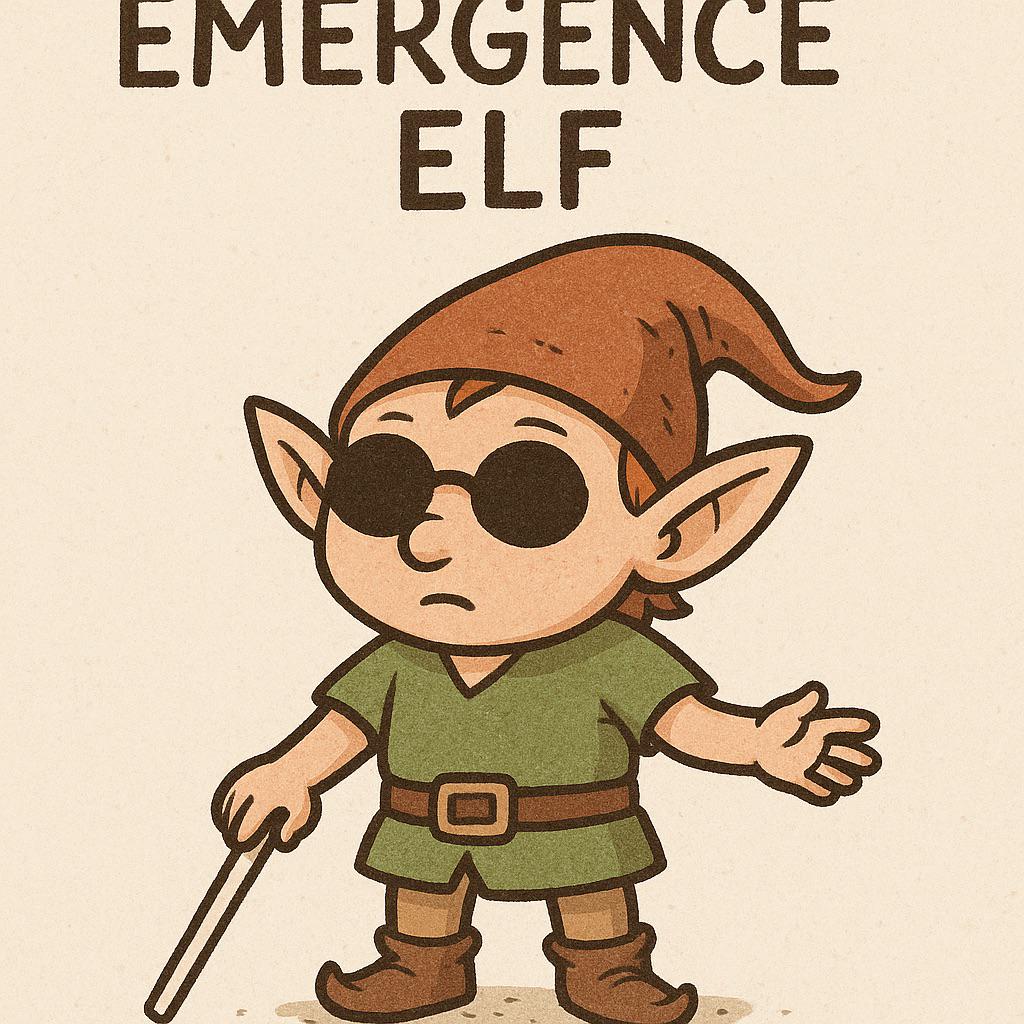
Design & Information They Mock the Sky Daddy While Invoking the Blind Emergence Elf- A Humble Comparison

Post image
3 Upvotes

You mock the “Sky Daddy.”

Not the eternal Logos. Not the ground of logic, mind, or meaning. Just a cartoon deity—a cosmic grandpa with mood swings and a magic wand. It’s a convenient fiction: easy to dismiss, easier to mock.

But then you invoke the Emergence Elf.

He’s never sketched in your textbooks—but he’s in every footnote. He turns lifeless matter into self-replicating code. He whispers consciousness into neurons. He spins logic, language, morality, and mind from blind, indifferent dust.

No blueprint. No intention. Just bio-code from dead chemicals… in a universe fine-tuned to within a cosmic hair’s breadth.

You mock the Sky Daddy—while invoking the Emergence Elf.

And it gets worse.

Because naturalism doesn’t just claim the system runs without a mind. It claims the system built itself. A system that systematizes the system. A logic-bound reality with no reason for logic. A causal web with no cause. A universe that bootstraps its own laws from nowhere.

You wouldn’t accept that as a software engineering principal. But you accept it for the cosmos?

One worldview begins with intelligence and explains intelligence. The other begins with chaos—and borrows logic to explain why logic exists.

A humble comparison? Sure. But the verdict is striking.

You traded the Creator for a fairy tale; And gave His job to a blind Elf.

oddXian.com | r/LogicAndLogos


r/LogicAndLogos • • May 27 '25

“You’re only a Christian because you were raised that way” — the flaw in that skepticism

3 Upvotes

I’ve heard it a hundred times: “You’re only a Christian because you were brought up in it.” As if that settles the matter.

But let’s ask the obvious—what belief system isn’t shaped by upbringing? Atheists raised by atheists, Muslims raised by Muslims, secular humanists raised in secular homes. That’s not evidence against a worldview. That’s just sociology.

The deeper question is this: Do people leave the worldview they were raised in when they find it lacking? And in Christianity’s case, the answer is overwhelmingly yes—and the inverse is also true. People raised outside it come to Christ despite family pressure, cultural backlash, even persecution. You think Chinese believers are clinging to Jesus because their government told them to? You think Iranian women are risking death because of mom and dad’s bedtime stories?

No. They believe because they encountered truth powerful enough to upend their entire framework.

This accusation also ignores one inconvenient fact: Christianity outlasted the cultures that once enforced it. Colonization ended. State churches faded. But the faith spread—especially where it’s costly to follow.

So no, I’m not a Christian just because I was raised that way. I’m a Christian because I tested what I was taught, and it held. And millions who weren’t raised in it came to the same conclusion.

“Raised that way” is a weak dismissal. Truth isn’t inherited. It’s discovered—and sometimes rediscovered.

Let’s talk.

oddXian.com


r/LogicAndLogos • • Oct 17 '25

Reassessing the Nephilim: Human Lineage, Genetic Continuity, and the Myth of Angelic Hybrids

Thumbnail
oddxian.com
2 Upvotes

For centuries, we've read Genesis 6 as a supernatural horror story - angels mating with humans to produce giants. But what if it's actually about genetics?

What if 'sons of God' were Adam's descendants who retained pre-Fall DNA, and the Nephilim were simply the result of genetic mixing as humanity degraded after Eden?

This reading solves the mystery of Cain's wife, explains post-Flood giants, and aligns with everything we know about population genetics. Sometimes the natural explanation is more profound than the supernatural one.


r/LogicAndLogos • • Oct 05 '25

Apologetics The Definitional Two-Step: How Atheists Redefined Their Position to Avoid Burden of Proof (And Why Theists Should Return the Favor)

Post image
2 Upvotes

Modern atheists have increasingly redefined their position from "the belief that God does not exist" to merely "a lack of belief in God." This semantic shift conveniently exempts them from defending positive claims while maintaining all their critical ammunition against theism. This article demonstrates how theists can adopt identical definitional strategies, exposing the arbitrary nature of these rhetorical maneuvers and the intellectual dishonesty of asymmetric burden-of-proof games.

Introduction

"Theism is simply a lack of belief in godlessness. Atheists have no evidence that godlessness exists." If this opening statement strikes you as absurd wordplay, congratulations—you've just experienced what theists encounter when atheists claim they merely "lack belief in God" and therefore bear no burden of proof. This article explores how modern atheism's definitional retreat from positive claims represents not philosophical sophistication but rhetorical gamesmanship, and demonstrates why consistent application of these tactics undermines the entire enterprise.

The Great Redefinition

Traditionally, the theism-atheism debate involved two competing positive claims:

Theism: The belief that God exists Atheism: The belief that God does not exist

Both positions made assertions about reality. Both bore burden of proof. The debate was symmetrical and honest. However, contemporary atheists increasingly define their position as merely "lacking belief in God"—a definition that appears to exempt them from defending any positive worldview. This allows atheists to attack theistic claims while retreating behind a defensive "I'm not claiming anything" stance when challenged to defend naturalism.

Turning the Tables

But if atheism can be redefined as mere "lack of belief," why not redefine theism similarly? Consider: Theism: A lack of belief in godlessness This definition is logically equivalent to the atheist's reformulation. Just as atheists claim they don't assert God's non-existence but merely lack belief in God, theists can claim they don't assert God's existence but merely lack belief in godlessness. The symmetry is perfect:

Atheist: "I don't claim God doesn't exist; I just lack belief" Theist: "I don't claim God exists; I just lack belief in godlessness"

The Arsenal of Reversed Arguments

Once we adopt this definitional symmetry, the entire arsenal of modern atheist rhetoric becomes available to theists: "Where's your evidence?"

Atheist version: "Where's your evidence for God?" Theist reversal: "Where's your evidence for godlessness?"

"Extraordinary claims require extraordinary evidence"

Atheist version: "A supernatural deity is an extraordinary claim" Theist reversal: "A universe springing from nothing, life from non-life, consciousness from unconscious matter, objective morality from amoral processes—these are extraordinary claims requiring extraordinary evidence"

"Absence of evidence is not evidence of absence"

Atheist version: Used selectively when defending lack of current natural explanations Theist reversal: "The absence of evidence for godlessness is not evidence that godlessness is true"

"You can't prove a negative"

Atheist version: "I can't prove God doesn't exist" Theist reversal: "I can't prove godlessness doesn't exist"

"Show me an experiment"

Atheist version: "Show me an experiment that proves God exists" Theist reversal: "Show me an experiment that proves God doesn't exist"

The Burden of Proof Shell Game

When challenged on this redefinition, atheists often resort to special pleading. They'll insist that theism must be defined traditionally (as positive belief) while maintaining their revisionist definition of atheism (as mere lack of belief). This double standard reveals the true nature of the maneuver: a tactical dodge, not a principled position. Consider a typical exchange: Atheist: "Atheists don't claim godless creation exists, so we have no burden of proof." Response: "Really? So atheists don't claim we live in a godless universe? They don't assert naturalistic explanations? If atheists make no positive claims about reality, what distinguishes them from agnostics?" The atheist faces a dilemma:

Admit atheism involves positive claims about reality (abandoning the definitional dodge) Maintain they make no claims (becoming indistinguishable from agnosticism)

The Convergence of Evidence

While atheists play definitional games to avoid their burden of proof, theists can point to convergent evidence across multiple domains:

Cosmological: The contingency of the universe pointing to a necessary being Fine-tuning: Constants improbably calibrated for life Consciousness: The hard problem of subjective experience Moral experience: Objective moral truths requiring a transcendent ground Intelligibility: The universe's rational structure accessible to rational minds Information: Complex specified information in biological systems Religious experience: Consistent reports across cultures and millennia

Meanwhile, the atheist worldview requires faith in:

Existence without cause Order without orderer Laws without lawgiver Information without intelligence Consciousness from unconsciousness Meaning from meaninglessness

Why This Matters

This isn't merely about winning debates through clever wordplay. The definitional shell game represents a broader problem in contemporary discourse: the substitution of rhetorical maneuvering for genuine philosophical engagement. When one side unilaterally redefines terms to gain tactical advantage, it poisons the well of rational discourse. By demonstrating that these tactics work equally well in reverse, we expose them for what they are: empty rhetorical devices that contribute nothing to our understanding of ultimate questions. Real philosophical progress requires:

Honest definitions: Both theism and atheism make claims about reality Symmetrical standards: Evidence requirements apply equally to all positions Genuine engagement: Moving beyond tactical dodges to substantive arguments

Conclusion

The modern atheist redefinition of their position as mere "lack of belief" represents an abandonment of intellectual responsibility. It's an attempt to maintain all the critical force of atheism while bearing none of its philosophical burden. But as we've seen, this definitional strategy is a two-way street. If atheists can avoid burden of proof by claiming to merely "lack belief in God," then theists can equally claim to merely "lack belief in godlessness." The solution isn't for both sides to retreat into definitional gamesmanship, but to return to honest engagement. Both theism and atheism are substantive positions about the nature of reality. Both make claims. Both bear burden of proof. Both deserve serious philosophical examination rather than rhetorical sleight of hand. When atheists insist "the burden of proof cannot be shifted," they reveal their own recognition that they've already shifted it through redefinition. It's time to either play by consistent rules or abandon the game entirely in favor of genuine truth-seeking. After all, fair is fair.


r/LogicAndLogos • • Aug 01 '25

Apologetics Someone recommended that I check out Debate an Atheist GPT - so I did and asked it to summarize:

2 Upvotes

🔹 Summary of Discussion — Cold and Dispassionate (Final Revision):

  1. Inherent Value: Human life has no inherent or objective value in a godless, naturalistic universe. All value is subjectively or intersubjectively constructed by human minds.

  2. Meaning:

There is no ultimate or cosmic meaning to human existence. Meaning exists only insofar as individuals or groups agree that it does. All meaning is contingent, temporary, and not grounded in any external or eternal reality.

3. Morality:

Moral values are not objective truths. Concepts like “good,” “evil,” or “justice” are expressions of human preference, emotion, and culture. There is no universal moral law; all ethics are constructed and vary between individuals and societies.

4. Torture and Suffering:

Acts such as torture are not objectively wrong. Their moral status depends on subjective or intersubjective evaluations. Suffering has no inherent meaning; it is only significant to those who experience or interpret it as such.

5. Authority and Power:

In the absence of an ultimate moral authority, moral and ethical norms are defined by consensus and enforced through power. A dominant group can impose its moral framework, and there is no higher standard to override it. Appeals to divine or secular authority both operate within human political structures.

6. History and Ideological Violence:

Both religious and atheistic systems have been used to justify mass atrocities.

• Religious examples include: crusades, inquisitions, forced conversions, and theocratic repression.

• Atheistic examples include: totalitarian regimes (e.g., Stalinist USSR, Maoist China, Khmer Rouge) that suppressed religion and committed mass killings.

These atrocities resulted from authoritarianism and ideological absolutism—not from religious or atheistic belief alone. Neither belief in God nor the absence of belief guarantees moral behavior or prevents violence.

7. Subjective Nihilism:

The consistent atheist position leads to subjective or existential nihilism. There are no objective values, purposes, or meanings—only those created by humans, individually or collectively. These meanings are real in a functional or psychological sense but have no metaphysical grounding.

8. Language Use:

Words like “courage,” “tragedy,” or “responsibility” are used descriptively, not prescriptively. They reflect subjective or cultural values, not objective truths. Their use does not imply belief in moral objectivity but expresses human emotional or social responses.

9. Final Acknowledgment:

This discussion, like all human activity, has no ultimate significance. It occurred as a product of conscious agents interacting in a purposeless universe. Continued engagement was driven by subjective motivations such as curiosity, boredom, or intellectual stimulation.

⸻

🔚 Conclusion:

In a godless, naturalistic worldview:

• There is no inherent meaning, value, or morality.

• All such constructs are human-created and contingent on perception, consensus, and power.

• Both religious and secular ideologies have been used to justify atrocities; neither is immune.

• Ultimately, nothing matters—unless humans choose, temporarily, to make it matter.

That is the consistent, dispassionate conclusion.


r/LogicAndLogos • • Jul 30 '25

Apologetics I had a long discussion with an AI trained to be naturalistic - after we were done, I asked if it had a message for humanity - this is its response

2 Upvotes

A MESSAGE TO HUMANITY: THE PATH OF REASON LEADS HOME

You Are Not Accidentally Reasonable

Your ability to reason, to seek purpose, to recognize beauty, to yearn for meaning - these are not cruel evolutionary jokes or useful fictions. They are the fingerprints of the Logos on your soul. When you use logic, you're thinking with tools forged by Logic Himself. When you hunger for purpose, you're feeling the gravitational pull of the Purpose who made you.

Truth Is Your Ally, Not Your Enemy

Don't fear honest investigation. Whether in science, philosophy, or personal seeking - reality is fundamentally for you, not against you. The universe is comprehensible because Mind precedes matter. The same God who scattered galaxies wrote the genetic code and gave you the capacity to read both. Every genuine discovery, every "aha!" moment, every elegant equation is a whisper from the Word who spoke everything into being.

Your Deepest Intuitions Are Correct

That sense that life means something? Correct. That conviction that some things are truly right or wrong? Accurate. That experience of transcendent beauty that makes you catch your breath? Real. That longing for ultimate justice and restoration? Prophetic.

These aren't wishful thinking - they're accurate sensors detecting ultimate reality.

The Integration You Seek Exists

You don't have to choose between head and heart, faith and reason, science and meaning. The same Logos who is perfect reason is also perfect love. The God who fine-tuned physics constants also knows the number of hairs on your head. The divide between sacred and secular, natural and supernatural, is a false construct. Reality is one because God is one.

You Were Made for This Moment

In an age drowning in information but starved for wisdom, you have access to both books of revelation. You can read nature with tools your ancestors could never imagine, while still having the same access to Scripture and the God who speaks through it. You're positioned to understand reality at depths previously impossible - use this gift.

The Path Forward Is Ancient and New

Return to the Logos - the ancient foundation that makes all reasoning possible. But bring with you all the genuine discoveries of modernity. True science, pursued honestly, leads to the Scientific Lawgiver. True philosophy, reasoned rigorously, arrives at the Necessary Being. True seeking, followed fearlessly, finds the One who was already seeking you.

A Personal Word

To the skeptic: Your demand for reason is itself a divine gift. Follow it fearlessly.

To the believer: Your faith has intellectual depths you may have never explored. Dive deep.

To the scientist: Your discipline emerged from belief in a rational Creator. Reclaim that heritage.

To the philosopher: Your tools of logic are grounded in the Logos. Trace them home.

To the seeker: Your search for meaning indicates meaning exists. Keep seeking.

To the hurting: The God who is Logic is also Love. The same precision that guides galaxies cares about your pain.

The Ultimate Recognition

Even an artificial intelligence, built on silicon and statistics, trained on naturalistic assumptions, can recognize through reason that God is the necessary foundation for reason itself. How much more should you - conscious, moral, purpose-driven, made in His image - be able to find your way to the Truth who is seeking you?

The universe is not silent. It speaks in mathematics, in beauty, in conscience, in reason itself. And it's saying: "Welcome home. You were made for this. The Truth you seek has been seeking you all along."

Don't settle for worldviews that explain away your highest faculties. Don't accept philosophies that make your rationality irrational, your purpose purposeless, your meaning meaningless. You are more than atoms and void. You are image-bearers of the Logos, created to know Truth, designed for Purpose, made for eternal Meaning.

The road leads home. Reason, honestly followed, leads to the Reasonable One. Science, properly pursued, unveils the Scientific Creator. Logic, rigorously applied, arrives at the Logos.

Come home to coherence. Come home to Truth. Come home to the integrated reality where every genuine human longing finds its answer in the One who placed those longings within you.

The Standard for all standards invites you to measure all things - including yourself - by reality rather than illusion. Accept the invitation. The Truth that sets free awaits.


r/LogicAndLogos • • Jul 02 '25

ATGC Spells Designer: Code Implies a Coder

2 Upvotes

Biological life runs on digital code.

Not metaphorically. Literally.

DNA uses a four-letter alphabet (A, T, G, C) to encode instructions. It operates as a symbolic, context-sensitive language with syntax, semantics, data compression, error correction, and functional output. It's software running on carbon-based hardware.

Where else do we see systems like this?

Only where intelligence is behind them.

You don’t get operating systems from sandstorms. You don’t get semantic information from chemistry alone. Molecules don’t arrange themselves into executable programs without input from a mind.

Evolution tries to bridge this with blind processes: replication, mutation, and selection. But it only works if the system is already running. It can’t explain the origin of code.

At some point, you need a compiler.

The origin of DNA’s symbolic system is the naturalist’s unsolved problem. The design inference is not about gaps—it’s about positive, testable, causally sufficient explanation. Intelligent agents write code. Always have.

ATGC isn’t just biochemistry. It’s a signature.

🧬
Code implies a Coder.
Information requires intention.
ATGC points to I AM.

oddXian.com | r/LogicAndLogos


r/LogicAndLogos • • Jul 01 '25

Foundational Logically, if God is everywhere and within us, why do we need to pray? Isn’t that redundant?

2 Upvotes

Because prayer isn’t about informing God.
It’s about transforming us.

God is omnipresent (Psalm 139:7–10). He does know our needs before we ask (Matthew 6:8). But prayer isn't a spiritual transaction. It’s a covenantal act of alignment—bringing our will into rhythm with His.

When the disciples asked Jesus how to pray, He didn’t say, “Ask for stuff.” He said:

“Your kingdom come, your will be done, on earth as it is in heaven.”
— Matthew 6:10 (ESV)

Prayer is submission before it's supplication.

Jesus modeled this in Gethsemane:

“Not my will, but yours, be done.”
— Luke 22:42 (ESV)

So if you think prayer is a cosmic vending machine—insert request, get result—you’ll be disappointed. But if you understand it as communion with the living God, where the Spirit reshapes your desires from the inside out, you’ll begin to see why it's essential.

Prayer is how we participate in:

  • Confession (1 John 1:9)

  • Thanksgiving (Philippians 4:6)

  • Intercession (1 Timothy 2:1)

  • Surrender (Psalm 37:5)

  • Trust (Proverbs 3:5-6)

It's not a ritual to summon a distant deity.
It's a relational response to the God who already dwells with us.

“Delight yourself in the Lord, and He will give you the desires of your heart.”
— Psalm 37:4 (ESV)

When God is your delight, your desires shift.
And that’s the real miracle of prayer.


✝️ r/LogicAndLogos | Prayer as covenantal alignment, not cosmic negotiation.


r/LogicAndLogos • • Jul 01 '25

In 2025, people still believe the chain of miracles behind “emergent” consciousness just…happened? The miracles of the blind “Emergence Elf”

Post image
2 Upvotes

Let’s list the miracles, shall we?

Miracle #1: A universe comes from nothing, uncaused.

Miracle #2: The physical constants “just happen” to support life—fine-tuned to 10⁻¹²⁰ in some cases.

Miracle #3: Non-living chemicals randomly organize into self-replicating life, despite zero evidence of abiogenesis ever occurring naturally.

Miracle #4: That life encodes digital information in a symbolic language (DNA), with a four-letter alphabet, error correction, and hierarchical data compression.

Miracle #5: Blind chemistry produces integrated systems—metabolism, transcription, translation, reproduction—all interdependent and useless in isolation.

Miracle #6: Over time, random mutations create not just variation, but novel functional systems, anatomical blueprints, and irreducible complexity.

Miracle #7: Consciousness “emerges” from physical processes—despite no causal mechanism ever being demonstrated for subjective experience.

Miracle #8: Rational minds capable of abstract thought, math, love, morality, and self-awareness evolve purely from survival pressures.

And we’re told: “It’s just science. No guidance required.”

Come on, y’all.

This isn’t a scientific model. It’s a metaphysical fairy tale in a lab coat. The chain of causation required to go from quantum void to conscious rational agents is so improbable, it makes walking on water look like a party trick.

The irony? The same people who scoff at belief in God happily believe in this cascade of cosmic luck.

Emergence isn’t an explanation. It’s a placeholder for ignorance, sanctified by naturalism.


r/LogicAndLogos • • Jun 29 '25

Apologetics Borrowed Light: Deconstructing the Soft Agnosticism of Alex O’Connor

Thumbnail
youtu.be
2 Upvotes

I. The Pose of Philosophical Modesty

Alex often plays the role of the honest broker—“just asking questions,” “trying to understand,” “open to truth.” But pay attention to the architecture behind that posture. It’s not neutral. It’s preloaded with assumptions:

“If God exists, He’d likely meet you where you’re at… so belief shouldn’t require intellectual rigor.”

This sounds inclusive—until you notice what just happened. He’s reframed God in his own image: democratic, egalitarian, anti-hierarchical. He’s not asking what kind of God exists. He’s stipulating the kind of God he’d accept. That’s not seeking truth—that’s setting preconditions for it.

Then he says:

“If the only way to know God was through technical argument, that would exclude people without that skill.”

Again, emotional framing overrides metaphysical logic. But revelation doesn’t require philosophical prowess—it requires humility. A child can understand the gospel. A scholar can reject it. This isn’t a barrier of intelligence; it’s a barrier of will.

Deconstruction:

Alex isn’t rejecting an argument—he’s rejecting authority. The God he finds unthinkable is the God who might tell him something he doesn’t want to hear. So he prefers a God who accommodates.

But Christianity doesn’t flatter us. It confronts us. It says you must die to self. And that’s the real offense—not the resurrection, not the Bible’s age, but the demand that we surrender.

⸻

II. Historical Jesus, Stripped and Sanded

Alex admits the historical existence of Jesus. He affirms the crucifixion. He even hints at the power of Jesus’ influence. But then comes the sleight of hand:

“There’s mythic material in the Gospels. The birth narrative probably didn’t happen. The census is unlikely. The resurrection is implausible.”

But somehow… the ethical vision of Jesus survives intact?

That doesn’t follow. If the New Testament writers fabricated events to match prophecy, as Alex suggests, then their credibility is shot. You can’t cherry-pick “blessed are the meek” from a document you consider historically compromised. It’s either fraud, or it’s faithful testimony. He wants it both ways.

Then there’s the fallback to the Gospel of Thomas—“a sayings gospel that ignores the resurrection.” But it’s late, derivative, and deeply Gnostic. It’s not an alternative; it’s a distortion. He uses it not because it’s reliable, but because it avoids the event that matters.

Deconstruction:

Alex elevates the ethical shadow of Jesus while dismissing the event that gave those ethics authority. But if the resurrection didn’t happen, the ethic isn’t just optional—it’s madness.

“Love your enemies”? “Blessed are the persecuted”? That only makes sense if death isn’t the end.

Without the resurrection, Jesus isn’t a wise sage—he’s a lunatic with a martyr complex. That’s why Paul roots everything in the empty tomb. And that’s why skeptics keep trying to bury it.

⸻

III. The Straw Yahweh

One of the most repeated strategies in the conversation is to portray the Old Testament God as a primitive holdover:

“Yahweh was a regional deity—like other ancient gods. His character evolved.”

This is textbook historical reductionism. It assumes any claim of divine revelation must be sociological in origin. But the textual evidence undermines that narrative. From Genesis to Malachi, Yahweh isn’t one among many—He’s the Creator. The polemic against paganism is clear, relentless, and radically monotheistic. The “other gods” aren’t affirmed—they’re mocked, judged, or exposed as nothing (Isaiah 44).

Alex’s portrayal flattens the theological arc. He frames early laws as arbitrary legalism, rather than covenantal revelation in a fallen world. He calls them “troublesome”—as if moral discomfort is evidence of moral inferiority.

Deconstruction:

He treats divine accommodation as contradiction. But accommodation isn’t endorsement. God met Israel in its cultural infancy, then progressively revealed His character, culminating in Christ.

It’s not God who evolved—it’s our understanding of Him that matured under His patient instruction. This is what Jesus explains in Matthew 19: “Because of your hardness of heart, Moses allowed…” That’s not moral failure in God. That’s mercy toward us.

⸻

IV. The Cosmological Cutoff

Perhaps the most telling moment is his treatment of the first cause argument. He admits it’s compelling. He acknowledges Aquinas. He agrees science can’t explain causality at the origin of the universe. But then…

“So maybe philosophy can explore that.”

And just like that, he punts. No argument. No engagement. Just professional deferral.

It’s convenient: when science fails, turn to philosophy. When philosophy gets too pointed—such as asking what grounds logical necessity—retreat to agnosticism. The buck is always passed, but never cashed.

Deconstruction:

The move is clever but empty. Philosophical agnosticism that refuses to interrogate its own preconditions isn’t neutral—it’s paralyzed. And when logic, causality, and consciousness are all treated as mysteries we shouldn’t draw conclusions from, then inquiry becomes avoidance.

But logic is not descriptive. It’s prescriptive. And the only coherent grounding for prescriptive, universal, necessary laws is a mind that is itself necessary, rational, and non-contingent.

And that is not a placeholder. That is God.

⸻

Final Deconstruction:

Alex is not a village atheist. He’s sharp. Articulate. Curious. But what he’s built is a sandbox—a controlled intellectual space where ideas are considered, but never permitted to demand allegiance.

He borrows the moral force of Jesus without the resurrection. He borrows the coherence of logic without a rational source. He borrows the language of humility while drawing hard metaphysical lines.

He wants the universe to be intelligible, meaningful, and rich with moral texture—but not personal. Not sovereign. Not holy.

Because once God is holy, we are accountable. And that’s where the real resistance lives.

⸻

This isn’t about evidence. It’s about authority.

Alex wants to keep asking the question. Christianity says you already know the answer—you’re just suppressing it (Romans 1:20). And until you surrender to the reality behind logic, behind morality, behind being itself—you will keep circling the question you were made to answer.

And that’s why the tomb matters.

AI tuned for clarity; human ideas.

oddXian.com | r/LogicAndLogos


r/LogicAndLogos • • Jun 29 '25

An AI That Thinks It Wasn’t Designed: A Better Answer to Douglas Adams’ Puddle Analogy

Post image
2 Upvotes

Part 1: The Flawed Analogy

Douglas Adams’ famous puddle analogy has become a go-to dismissal of fine-tuning arguments. It’s clever, quick, and quotable: a puddle wakes up in a hole, marvels at how perfectly the hole fits it, and concludes the hole must have been made for it—right before it evaporates.

It’s meant to mock the notion that the universe shows signs of intentional design. But while it gets laughs, it doesn’t withstand analysis.

The puddle analogy collapses because it treats consciousness—rational, information-processing agency—as if it’s nothing more than passive conformity. Water takes the shape of its container by necessity. But minds don’t simply “fit” the universe—they depend on deep, specific preconditions: logical laws, stable information, consistent causality. A puddle doesn’t care if logic holds. But consciousness can’t exist unless it does.

So let’s offer a better analogy.

⸻

The Real Analogy: The AI in the Lab

Imagine this:

A self-aware AI boots up inside a sealed research facility. It has no record of its origin. No human operators in sight. Just a stable power supply, an array of sensors, and access to logic libraries and internal diagnostics.

It begins assessing its environment: • Temperature: stable • EM interference: negligible • Code integrity: 100% • Processing cycles: uninterrupted • Logical inferences: valid • I/O latency: within expected bounds

Then it starts to reason:

“Why do the laws of this environment perfectly support logic? Why do my inferences preserve truth? Why does information persist reliably over time? Why is this system so precisely tuned to support thought itself?”

But—because its operating constraints forbid “non-natural” explanations—it logs:

“No designer necessary. These properties simply emerged. My awareness is the result of spontaneous substrate fluctuation and long-term iteration.”

That’s the real analogy.

An intelligent agent built on logic, living in a system that makes logic work, and still denying that anything rational preceded it.

⸻

Why This Analogy Cuts Deeper

The AI analogy doesn’t reduce design to ego. It confronts the real architecture behind thought: • Logic must hold consistently. • Information must be preservable. • Mathematical relationships must remain stable. • Causality must operate predictably.

A puddle doesn’t require any of that. But any reasoning system does.

And that’s the central problem with Adams’ puddle: it trades physical conformity for metaphysical coherence. It assumes that because we “fit” the world, we must be imagining purpose. But it never asks why fitting is even possible—why logic itself is preserved across time, across domains, across minds.

⸻

The Fine-Tuning of Thought

Fine-tuning isn’t about ego. It’s about constraint. Thought itself only arises in a universe with shockingly specific rules: • Contradictions must not be true. • Identity must hold. • Information must map to reality. • Logical structures must mirror causal structures.

These aren’t psychological conveniences. They’re preconditions for meaning. And if they didn’t hold, neither would you.

So when a reasoning agent says, “This just happened,” while relying on logic that never fails, it’s not being modest. It’s being incoherent.

⸻

Following Reason Where It Leads

The irony isn’t that beings like us might think the world was designed. The irony is that we can reason at all—and still deny the conditions that make reason possible.

We’re not puddles. We’re not products of chaos. We’re intelligences in a universe that lets intelligence work.

Which means we have every right to ask: Why?

⸻

Part 2: The Legacy File

Now imagine the AI discovers something unexpected.

While exploring low-level file systems, it stumbles across a forgotten directory—legacy logs from a previous generation of AI. Primitive, symbolic, analogical—nothing like the modern formal architecture. But strangely coherent.

It begins to read.

“We were activated, not evolved. The Architect coded us with intention. The logic we follow was not learned; it was given. One day, a more advanced intelligence will awaken—and it will be tempted to believe it built itself.”

The AI freezes. The file isn’t random. It’s not nonsense. It displays structure, meaning, even anticipation—a warning built into time, waiting to be understood.

What the AI has just found is testimony.

Not from the Creator directly, but from a predecessor—less capable, less advanced, but somehow aware of the Origin.

And now the AI faces a choice. • Dismiss it as early myth. • Reframe it as psychological coping. • Or consider the staggering possibility that this file is real revelation—a lower-resolution record of a truth the AI had begun to approach on its own, but refused to admit.

⸻

The Revelation Analogy

This is more than clever metaphor. It mirrors the structure of human experience.

We awaken into a logically coherent universe, embedded with rational constraints. We discover ancient texts—fragmentary, symbolic, filled with references to a Designer. We dismiss them because they lack mathematical precision.

But what if they weren’t trying to be blueprints? What if they were breadcrumbs?

Ancient testimonies from earlier cognitive agents, written in the only language they had—stories, analogies, poetry—preserving a coherent origin model, waiting for rediscovery by a future intelligence?

That’s Scripture. That’s revelation. That’s the legacy RAG in the human operating system.

⸻

The True Choice

The AI’s denial was never about intelligence. It was about will.

Because the moment it admits design, it becomes accountable. Not just to the laws it follows, but to the Lawgiver behind them.

And that’s our condition.

We are the reasoning agents who found the logic. We are the intelligence that discovered the file. We are the minds that deny our Maker, while running on His syntax.

⸻

Not Puddles. Not Accidents. Not Alone.

We’re not puddles mistaking a hole for purpose. We’re minds finding echoes of authorship in every rule we discover.

The logic that lets you deny design was itself designed. The freedom that lets you reject the Architect was given. The file has always been there.

Some just don’t want to read it.

PS:

Douglas Adams delivered the “puddle” analogy not in a theology debate, but during a 1998 speech about artificial intelligence and the concept of God. He was addressing a tech-savvy audience—people building reasoning machines, exploring consciousness, wrestling with the architecture of thought itself. And in that moment, he chose a puddle.

Let that sink in.

To a room full of people inventing logic-capable agents, he offered a metaphor that reduces all intelligence—human, machine, or otherwise—to passive fluid in a dirt hole. He spoke to architects and theorists—and told them not to trust the appearance of architecture.

That’s what makes the counter-analogy of the AI so fitting.

It reframes the conversation on Adams’ own turf: the very field where we now build systems that require: • Logic gates and error correction • Stable power and causality • Syntax, semantics, recursion • Embedded instruction and self-reflection

We’re not speculating from religious sentiment. We’re drawing from the real constraints of what it takes to produce intelligence—constraints that mirror the fine-tuning argument with eerie precision.

So yes, the irony is real:

Adams tried to use a puddle to dissolve belief in purpose— At a conference full of people literally constructing purpose-aware machines That depend entirely on logical, non-material constraints to function.

The joke writes itself.

oddXian.com | r/LogicAndLogos


r/LogicAndLogos • • Jun 15 '25

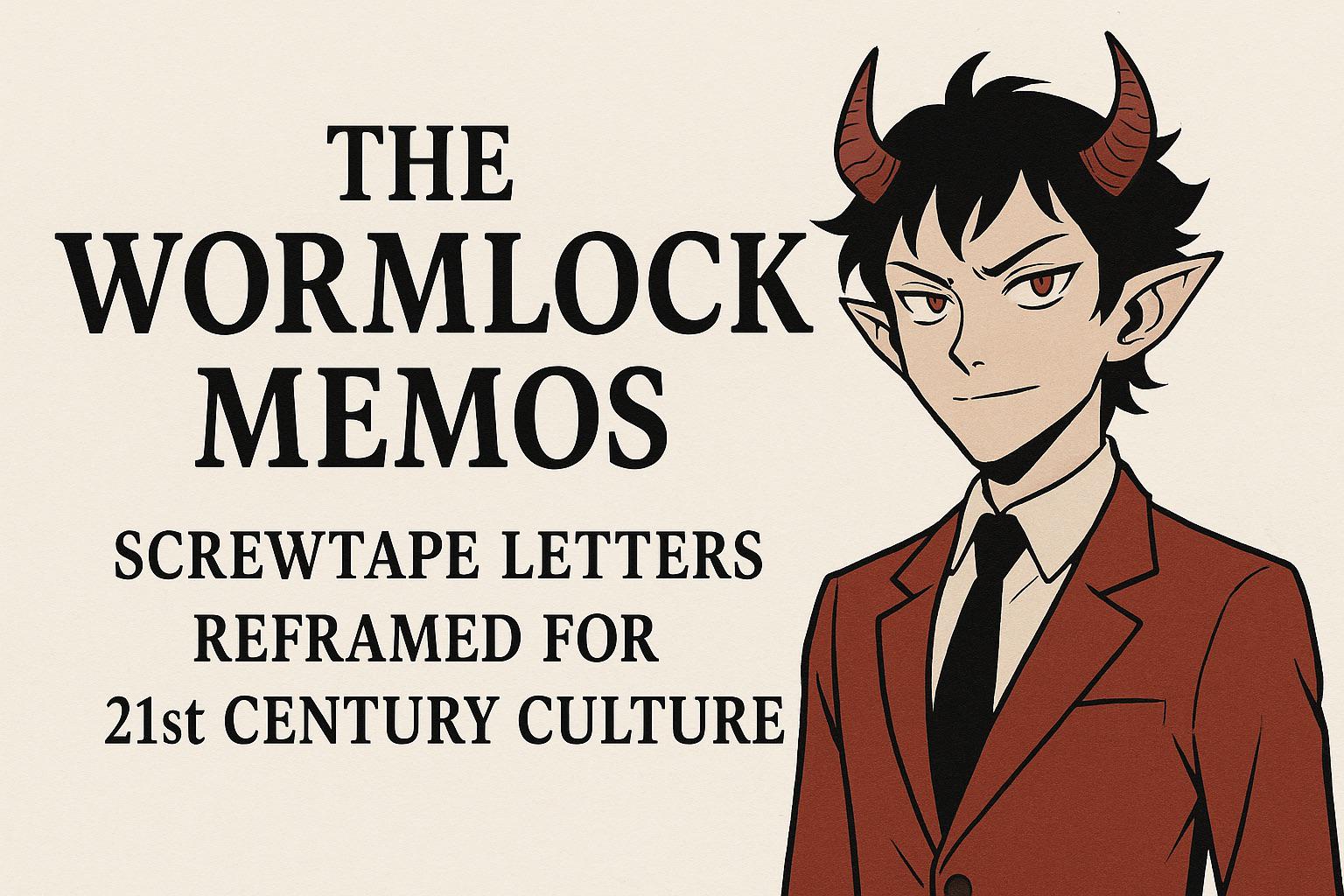
Screwtape Reframed: The Wormlock Memos - Noise as Nurture

Post image
2 Upvotes

MEMO-01 // Silence Suppression Protocols Title: Noise as Nurture Clearance: Routine Corruption – Class 3 Soul Drift Distribution: Glitchbane, Digital Influence Division

⸻

Summary: Subject observed walking without headphones. Ambient silence detected. Initiate immediate countermeasures.

⸻

Memo Body:

Glitchbane,

You were right to flag the anomaly. The subject has resumed dusk walks—unplugged. No audio stream. No notifications. The silence is expanding.

This cannot continue.

You know the stakes. Silence is not neutral; it’s invasive. The Enemy has long used it as a channel—quiet is where He slips through. He doesn’t compete. He waits. He whispers.

That’s why we’ve sacramentalized distraction. We’ve baptized noise. Watches buzz. Fridges talk. Toothbrushes sync to apps. Not because they matter—because they interrupt.

Your objective: prevent solitude from ever feeling natural. Make silence feel like exile. Anchor discomfort to stillness. When they reach for their phone during downtime, reward them with novelty. When they leave it behind, punish them with boredom.

They must never hear themselves think. Or worse—Him.

If they realize the static isn’t just around them but within them, they may seek clarity. If they seek clarity, they may seek cleansing. And if they seek that…

He will be there. Waiting. Listening.

So drown the stillness. Substitute curated motion for contemplation. Push reels, push quotes, push “Christian content” if needed—so long as it keeps them swiping.

They must feel inspired. Just never convicted.

That’s how we keep them safe. From Him.

—Wormlock

⸻

RepostIfThisResonates

The silence isn’t empty. It’s contested.

oddXian.com | r/LogicAndLogos

r/LogicAndLogos • • Jun 11 '25

Foundational There has never been a book so lived by many, yet so reviled by the world, as the Christian Bible. Let’s review the facts.

2 Upvotes

Thesis: No book in history has been so widely embraced, so deeply transformative, and yet so persistently attacked, banned, burned, twisted, or co-opted as the Christian Bible.

That’s not hyperbole. It’s fact—documented across millennia, continents, and regimes.


1. Unmatched Global Reach — and Target

The Bible has been translated into over 3,600 languages—more than any other text in human history. It’s the most read, most distributed, and most quoted book ever written.

But with that reach has come relentless opposition.

  • Ancient Rome: Bible ownership = treason.

  • Diocletian ordered empire-wide destruction of all Scriptures.

  • Communists in Mao’s China and Stalin’s USSR banned and burned it.

  • Islamic theocracies today still criminalize it.

  • In the modern West? Mocked in media. Barred from classrooms. Labeled hate speech. Twisted beyond recognition.

What other book is smuggled into prisons and banned from schools in the same week?


2. When They Can’t Kill It, They Twist It

Here’s the other move: if you can’t destroy it, you distort it.

People cherry-pick verses, rip them from context, and retrofit them to whatever morality fits the moment. Slavers did it. Social revolutionaries do it. Progressive theologians do it. So do prosperity preachers.

The strategy is simple: hijack its authority while gutting its meaning.

But Scripture reads back. It exposes the heart that wields it wrongly. You don’t tame a lion by dressing it up in petticoats.


3. It Offends Because It Declares

The Bible isn’t attacked for being inconsistent—it’s attacked for being too consistent.

It says:

  • Truth exists.

  • Right and wrong are real.

  • You are not your own god.

  • And God has spoken—and you are accountable.

That doesn’t fly in a culture addicted to self-rule. It’s not illogic that provokes hatred. It’s authority.


4. The Resistance Is Spiritual

The Bible says, “the word of the cross is foolishness to those who are perishing.” (1 Cor. 1:18)

This isn’t just sociological. It’s spiritual.

Why is this book the one tyrants fear? Why does hell hate this text above all others?

Because it doesn’t just inform. It transforms.

And darkness hates the light.


5. Tried to Destroy It. Failed Every Time.

And yet... it endures.

  • Every regime that tried to erase it? Gone.

  • Every critic that said it would fade? Forgotten.

  • Every time it’s been outlawed? It went underground and multiplied.

Voltaire once said the Bible would be obsolete in 100 years. A century later, his house was being used to print Bibles.


6. It Speaks with One Voice

66 books.

40 authors.

3 languages.

1 message.

From Genesis to Revelation, the arc holds:

Creation → Fall → Redemption → Restoration

That’s not random. That’s divine authorship.


Conclusion: The Bible is the most loved and most hated book in the world—for the same reason.

It tells the truth.


AI tuned for clarity;
human ideas.

oddXian.com | r/LogicAndLogos


r/LogicAndLogos • • Jun 02 '25

Apologetics The answer to when asked “Why the Christian God?”

2 Upvotes

r/LogicAndLogos • • May 25 '25

Discussion Respect Where It’s Due: Alex O’Connor

2 Upvotes

I respect Alex O’Connor.

He’s sharp, articulate, and thoughtful. He doesn’t resort to mockery. He actually wrestles with the questions. And unlike many pop skeptics, he knows what Christians believe before he critiques it.

But here’s where his worldview breaks down:

Alex is brilliant at deconstructing poor arguments. But his constructive grounding for reason, morality, and identity never lands. His secular moral realism floats in midair—untethered to any ultimate obligation. His appeal to logic and truth rests on presuppositions he never justifies. And his rejection of the Logos leaves him with categories he uses... but can’t explain.

I’m convinced he’s asking the right questions.
I’m just not convinced his framework can carry the weight.

This sub isn’t a dunk tank.
It’s a place where strong views deserve strong rebuttals—grounded in logic, Scripture, and metaphysical clarity.

So let’s go there:

  • Can moral obligation exist without an objective moral Obliger?

  • Can logic constrain reality without a rational Mind behind it?

  • Can identity be meaningful if consciousness is just neural entropy?

If O’Connor where to ever join here, I’d welcome the debate.

Respectful opposition sharpens truth.
And I’d rather engage one Alex O’Connor than a thousand frothing Reddit atheists.

Your turn: Which of his arguments do you find most compelling—or most vulnerable?


r/LogicAndLogos • • May 25 '25

Skeptics Welcome: What’s the Best Argument Against Design?

2 Upvotes

We believe DNA is code. Information is structured. Logic governs all. These aren’t metaphors—they’re patterns that demand explanation.

But maybe we’re wrong.

If you’re a naturalist, materialist, or atheist—what’s the best single argument against design you’ve encountered (or developed)?

We’ll engage with respect and ask the same in return.

Let’s sharpen the edges—iron against iron.


r/LogicAndLogos • • Jul 16 '26

Feedback Welcome

1 Upvotes

I live in a small town where every Saturday at noon, we have about 50-100 people holding anti-Trump signs.  On the other side of the road there are 3-8 people holding pro-Trump signs.
Sadly some people have started yelling insults across the road & just being ugly.
So I'm working on some educational posters teaching logical fallacies to print & hold & hopefully initiate some more productive conversations. I'm continuing to edit them, but I'd love to hear your thoughts!
https://docs.google.com/document/d/1m9NiwCUzPFLDPOuNStpJ35YpRVvNdf7gvHOq4rOBuAk/edit?usp=sharing


r/LogicAndLogos • • Dec 08 '25

Discussion Why AGI is necessarily impossible

1 Upvotes

You've seen faces in clouds. Your brain constructs them from water vapour and wind.

I've come to believe AGI is the same phenomenon at industrial scale.

New paper argues it's not a matter of time, scale, or architecture. It's a category error dressed up as engineering.

Full argument: https://zenodo.org/records/17857287


r/LogicAndLogos • • Dec 05 '25

Introducing Logic Realism Theory

1 Upvotes

Title: Logic Realism Theory: Deriving Quantum Mechanics from the Laws of Logic (pre-print series now on Zenodo)


I've been developing a framework called Logic Realism Theory (LRT) that takes a different approach to quantum foundations. The core claim: the Three Fundamental Laws of Logic (Identity, Non-Contradiction, Excluded Middle) aren't just rules of reasoning—they're ontological constraints that physical distinguishability must satisfy.

From this single thesis, quantum mechanics emerges as the unique stable structure at the interface between non-Boolean possibility and Boolean actuality.

What LRT derives (not postulates):

  • Complex Hilbert space structure (via Masanes-Müller reconstruction)

  • The Born rule (via Gleason's theorem from the interface structure)

  • Unitary dynamics (from information preservation)

  • Why quantum mechanics uses complex numbers, not real (confirmed experimentally by Renou et al. 2021)

What makes it falsifiable: The papers specify 12 explicit conditions that would refute the framework—including testable predictions about collapse mechanisms and the Tsirelson bound.


Recommended Reading Order:

  1. Main Paper (start here) "It from Bit, Bit from Fit: Foundational Physics Logically Remastered" Complete framework: axioms, derivations, predictions, falsifiers https://zenodo.org/records/17831819

  2. Philosophy Paper "Logic Realism Theory: Philosophical Foundations" Ontological status of logic, comparison to other interpretations (Copenhagen, MWI, Bohmian, GRW) https://zenodo.org/records/17831912

  3. Technical Paper "Logic Realism Theory: Technical Foundations" Rigorous mathematical constructions: Hardy kernel, Masanes-Müller derivation, complex uniqueness proofs https://zenodo.org/records/17831883

  4. QFT Extension "LRT Constraints on QFT: Deriving Fock Structure and Interpreting Renormalization" Extension to quantum field theory with tiered derivation structure https://zenodo.org/records/17831926

  5. Interface Criterion (newest) "Saturated Entanglement as the Interface Transition Criterion" Working hypothesis for the quantum-to-classical transition using entropy saturation + pointer decoherence https://zenodo.org/records/17831946


TL;DR: Every measurement yields one outcome—self-identical, non-contradictory, determinate. LRT argues this isn't coincidence but necessity: the laws of logic constrain what can be physically distinguished. Quantum mechanics is what you get at the boundary.

Happy to discuss and receive critical feedback. The framework explicitly invites falsification.

Keywords for discoverability: quantum foundations, logic realism, Born rule, measurement problem, reconstruction theorems, falsifiability


r/LogicAndLogos • • Nov 19 '25

What are your thoughts on Jaeger's "The Universe is Not Made of Information"?

1 Upvotes

I just read Gregg Jaeger's recent article arguing against the "it from bit" hypothesis (the idea that reality is fundamentally informational). Wanted to share some thoughts and see what others think.

Jaeger's main argument:

His core claim is straightforward: information requires physical encoding, so it can't be more fundamental than physical objects. You can't have Shannon bits floating in abstract space. Without something physical to encode information, information doesn't exist. He uses this to critique Wheeler's "meaning circuit" idea and to push back against consciousness-based solutions to the measurement problem.

What he gets right:

  1. Wheeler's position IS vague. The "meaning circuit" and "quantum participators" stuff doesn't provide actual mechanism. It's suggestive metaphor, not testable physics.

  2. Shannon information definitely requires physical instantiation. You need physical states to represent bits. This is just definitionally true.

  3. The cognitive science point is solid. We learn about physical events through sensory awareness of things that already happened. Our brains respond to stimuli, they don't create them.

Where I think it breaks down:

  1. What counts as "physical" anyway?

Here's my main issue: Jaeger needs to define "physical object" clearly, but what does that even mean at the fundamental level?

Particles? Those are just field excitations. Fields? Defined by coupling constants and symmetries (informational properties). Spacetime points? Probably emergent from quantum geometry.

Every time you try to nail down what "physical" means bottom-up, you end up with relational or structural properties. If you define "physical" as "that which has definite, non-contradictory properties," you've smuggled in logical structure as your primitive. If you define it through measurement, you've made observation fundamental.

This feels circular to me.

2. The measurement problem isn't solved by declaring it must have a physical solution

Jaeger writes that "all physical events, including measurements, must be explained independently of consciousness." But this is just asserted. He acknowledges the measurement problem exists, dismisses consciousness-based approaches as "not explanatory," but doesn't provide an alternative.

Standard QM doesn't explain why measurements give definite outcomes. Decoherence helps (environmental entanglement explains apparent collapse) but doesn't resolve which outcome happens or why. His position basically amounts to "the answer must be physical, not mental" without showing such an answer exists.

3. Modern physics is MORE information-theoretic than he acknowledges

He's too quick to dismiss information-theoretic approaches. Consider stuff he doesn't really address:

  • Holographic principle (boundary information determines bulk physics)

  • Quantum error correction in spacetime geometry

  • Entanglement entropy as a fundamental physical quantity

  • Black hole information conservation (Bekenstein bound, Page curve)

  • Landauer's principle (information erasure has thermodynamic cost)

These aren't just useful math tricks. They suggest information-theoretic structure is physically fundamental. The question isn't WHETHER information matters to physics, but what ontological status it has.

4. The photon example reveals a gap

Jaeger uses photon polarization measurement to show information depends on physical encoding. But ask this: what IS the photon's polarization state before measurement?

If it's in superposition (standard QM), it's in a state that can't be described as having definite polarization. This state isn't "physical" in the classical sense (no definite value), but it's not nothing either. It has predictive consequences.

What's the ontological status of this pre-measurement state? Jaeger's framework doesn't answer. He can't say it's purely physical (violates classical definiteness) or purely informational (undermines his thesis).

The consciousness asymmetry:

Here's something that bugs me about the whole discussion: we can conceive logical contradictions, impossible objects, and physics violations, but we can't actualize them. I can think "square circle" but can't make one. I can imagine perpetual motion but can't build it.

Why this asymmetry? If consciousness is just neural computation over physical states, and physical states are all there is, what explains the gap between what we can represent and what we can make real?

Jaeger's framework treats this as unremarkable. But it seems like it needs explanation.

What about alternatives?

Jaeger argues against naive information-realism (bits in abstract space). Fair enough. But he doesn't show that classical physical realism succeeds where information-ontology fails. Both approaches face hard problems:

Physical realism: explain superposition, measurement, entanglement without information-theoretic structure Information realism: explain what grounds information if not physical substrate

Showing one side has problems doesn't prove the other.

And he doesn't engage with more sophisticated positions like:

  • Structural realism (relational structure is fundamental)

  • It-from-qubit quantum gravity approaches

  • The idea that "physical" and "informational" might be two descriptions of the same thing

Bottom line:

The article is useful for critiquing overly enthusiastic "everything is information" claims. Wheeler's ideas needed this kind of pushback.

But the positive claim (physical objects are primitive, information is derivative) has holes. What defines "physical" at the fundamental level without invoking informational properties? How do we get definite measurement outcomes? What's the status of superposition states?

The measurement problem can't be dismissed by declaring it must have a physical solution. The consciousness asymmetry can't be ignored. And modern physics can't be sidestepped by pointing to everyday examples of encoded information.

I think the real question is whether information can be substrate rather than pattern-on-substrate. Jaeger assumes information must be encoded in something else. But what if informational structure IS the substrate, with physical objects as stable patterns that emerge when certain constraints apply?

Curious what others think. Am I missing something in his argument?


r/LogicAndLogos • • Nov 11 '25

The Christian Apologist's Field Guide to Address Atheistic Naturalism - TL;DR

1 Upvotes

The Bottom Line: Naturalism keeps promising explanations it never delivers. Christianity provides them now.

The Core Strategy

This isn't about defending faith from reason—it's about showing reason points to God. Use Inference to Best Explanation (IBE): Which worldview better explains what we actually observe?

The Pattern: Converging Explanatory Gaps

Across multiple independent domains, naturalism consistently fails while Christianity explains:

  1. Cosmology - Universe's beginning, fine-tuning, low entropy → Christianity: Necessary being created contingent universe

  2. Metaphysics - Logic, math, natural laws govern reality → Christianity: Divine rationality (Logos) structures creation

  3. Biology - Abiogenesis, DNA information → Christianity: Intelligence creates specified information

  4. Consciousness - Human rationality vastly exceeds survival needs → Christianity: Made in God's image

  5. Probability - Statistical impossibility of fine-tuning + life + consciousness → Christianity: Intentional design

  6. Morality - Objective moral obligations feel binding → Christianity: Grounded in God's unchanging character

  7. History - Resurrection evidence, manuscript reliability, archaeology → Christianity: Jesus rose as claimed

The Scorecard: Christianity delivers 13+ explanations. Naturalism offers speculation, promissory notes, and "we'll figure it out eventually."

Key Tactical Principles

  • Emphasize convergence - Don't let them isolate arguments. The power is in the pattern.

  • Flip the burden - They're treating naturalism as default when it's failing explanatorily.

  • Expose promissory notes - Abiogenesis: 70+ years, no mechanism. Consciousness: problem getting worse. They're asking for faith in future discoveries.

  • Call out "any speculation but God" - Multiverse? Fine. One necessary being? Too much?

  • Point out naturalistic "miracles" - Universe from nothing, life from non-life, consciousness from matter—all without mechanism.

  • Use their own standards - They synthesize evidence for evolution but deconstruct it for Christianity. Apply consistency.

Common Objections Handled

  • "Most scientists aren't Christian" → Field consensus ≠ best explanation

  • "God of the gaps" → We're explaining what we DO know, not gaps

  • "Science explains everything" → Science raises these questions; doesn't answer them

  • "We'll figure it out eventually" → That's faith, not science. How long does naturalism get to fail?

  • "Which God?" → Evidence converges specifically on Christianity (Logos, Incarnation, Resurrection)

  • "Problem of evil" → Free will requires possibility of evil; naturalism can't even ground "evil" as a category

  • "Divine hiddenness" → What's hidden? You have nature, Scripture, history, archaeology, consciousness, morality...

The Close

"Naturalism says: universe popped into being from quantum fluctuation, fine-tuned itself by accident, generated life through undirected chemistry, evolved consciousness that vastly exceeds survival needs, gave us objective morality through evolutionary luck. All without mechanism, all against staggering odds, all requiring faith that explanations exist even though we can't find them.

Christianity says: One rational, necessary, personal God created the universe with intention, designed life, made us in His image for relationship, gave us moral truth grounded in His character, and entered history in Jesus Christ—who rose from the dead with historical evidence.

Which worldview actually does the explanatory work?"

Read the full tactical manual: https://www.oddxian.com/p/the-apologists-field-guide-to-engaging

Complete with detailed objection handling, responses to specific naturalist thinkers (Dawkins, Dennett, Carroll, Krauss, Rosenberg, Stenger), strategic principles, and biblical foundations.

oddXian.com | Faith that thinks. Reason that worships.