r/Integrals • u/EmphasisOk8767 • Jul 03 '26
Atlas of Mathematics

1
Upvotes
r/Integrals • u/mumsson2009 • Feb 15 '26
r/Integrals • u/GloomyChapter2152 • Jan 10 '26
Hi everyone,
I’m Aarav, a student deeply passionate about mathematics - especially integration and problem-solving at an Olympiad / contest level (SMO, AMC, AIME-style).
Over the past year, I’ve been writing a textbook titled The Art of Integration, which focuses on non-routine integrals and techniques that are rarely taught in school, but appear frequently in advanced problem solving.
Clever u-substitutions that don’t look obvious at first glance
Structural manipulation and pattern recognition
Advanced but elementary techniques (no measure theory, no complex analysis)
Methods inspired by Integration Bees, Olympiads, and mathematical folklore
Variants and generalisations to deepen intuition, not just compute answers
This is not a formula dump or a standard calculus text.
The emphasis is on how to think when facing a difficult integral.
I also run Weekly Integration Problems to encourage discussion and multiple-solution thinking.
Alongside the book, I maintain a GitHub repository containing the details of the book. Check it out -> https://github.com/AaravAI/the-art-of-integration
Happy integrating ✨
— Aarav
Note: I understand that promotions may not always be permitted. My intention here isn’t advertising, but to share the beauty and creativity of integral calculus. I genuinely believe many in the mathematics community would enjoy and appreciate this exploration.
r/Integrals • u/Just-Rooster3073 • Dec 30 '25
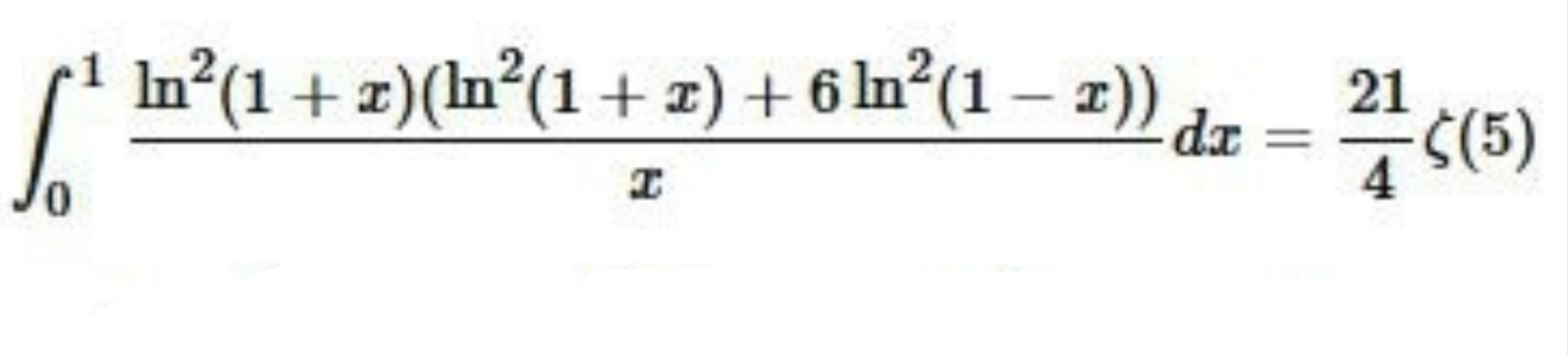
Can anyone give a proof ?
r/Integrals • u/Original-Issue2034 • Oct 23 '25

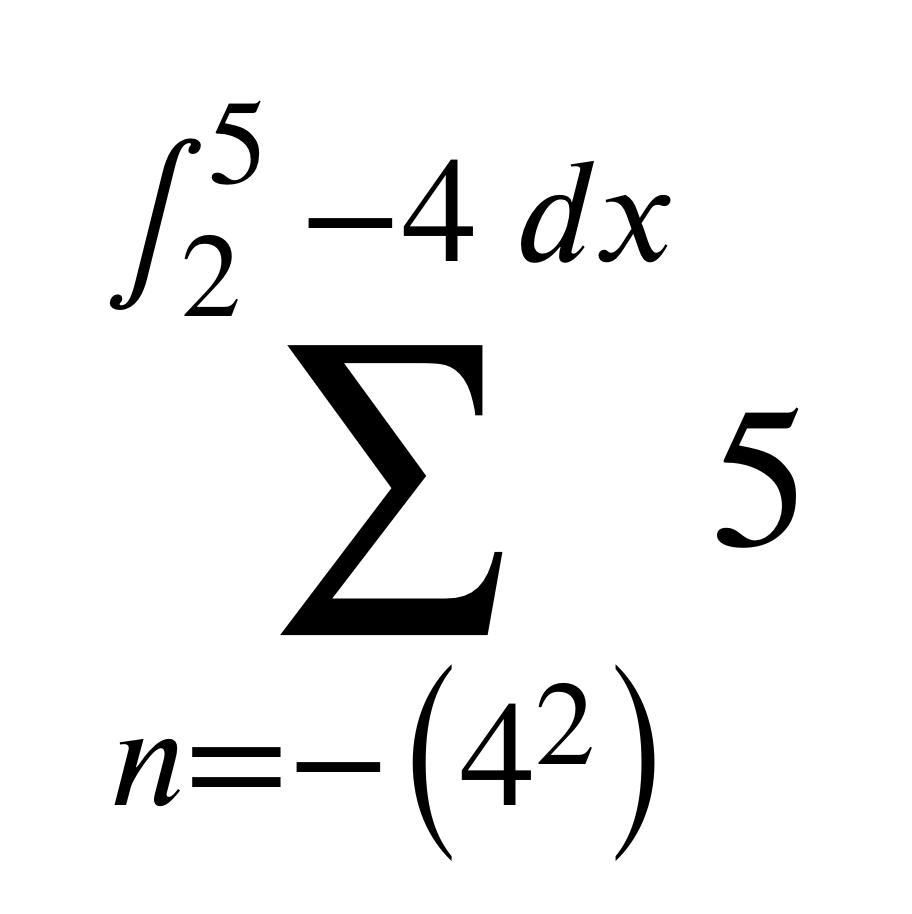
Go to https://www.reddit.com/r/Integrals/comments/1nyxusm/i_challenge_yall_to_solve_this/ to solve this thing yourself.
Spoilers ahead!
So, for the lower bound, -(4^2) is -16.
Now, for the upper bound, use the integrals rule and do -4 * 5 - -4 * 2 = -12.
To solve the sum, it’s the number of terms between -16 and -12, inclusive, which is 5, then multiply it by 5. 5*5 is 25.
The answer is: 25
r/Integrals • u/MathPhysicsEngineer • Aug 30 '25

r/Integrals • u/MathPhysicsEngineer • Jul 27 '25

r/Integrals • u/-_scheherezade-- • Mar 13 '25

For context they asked this in a high school test and the answer they provided was π/2
r/Integrals • u/SilverHedgeBoi • Jan 27 '25
r/Integrals • u/Deer_lookout86 • Dec 27 '24
So I'm trying to learn Euler's substitution and I just came across a discrepancy I don't know what to make of. In this video I tried to follow along and the representation of x in terms of t for me just changed the terms around so that it was x=(1-t^2)/(2t-1), whereas the video went with x=(t^2-1)/(1-2t). We got different answers. Is this an error on someone's part or just something this method struggles with?

r/Integrals • u/MathPhysicsEngineer • Dec 07 '24

r/Integrals • u/MathPhysicsEngineer • Dec 07 '24

r/Integrals • u/SilverHedgeBoi • Oct 14 '24

r/Integrals • u/[deleted] • Oct 06 '24

First post on this sub. Going to attempt question d again tomorrow. First slide is fine. I just want to show that I am solving it different ways. The second slide contains an incorrect answer. Its supposed to be 1/8sec8θ-1/3sec3θ+1/4sec4θ+c. I did something wrong in the work and I will decipher it I am sure but any suggestions on where my logic went wrong would be appreciated! Thank you.
r/Integrals • u/Sad_Laugh_8540 • Sep 27 '24
r/Integrals • u/Forsaken-Ball-7852 • Sep 21 '24

I've tried a lot of sites but the answer differs from site to site , it should be simple ,when you use substitution but I think I'm missing a step, help is you see this post, and if you can solve it I will appreciate that. Have a nice day.
r/Integrals • u/Sad_Laugh_8540 • Sep 19 '24
Explanation of how to solve an definite integral - IB Question - https://www.youtube.com/watch?v=sa8Zw22elV0&t=16s
r/Integrals • u/Kolyaster • Jun 16 '24
Calculate the double integral ∬A (x² + y³) dx dy extended over the triangle T with vertices (0,0), (2,0), (4,2).
r/Integrals • u/amkuborn • Dec 05 '23
Hi there, I am looking for some help in a research project. Fundamentally, we are trying to estimate the average visual field radius based on the visual field's area. Is this a form of a polar integral, which would mean the radius could be approximated by the area?
In addition, I am trying to work through also converting the standard deviation of an area to a radii if anyone would help me with this!
Thank you for any help!
r/Integrals • u/Duke404nina • Nov 29 '23
Integral of (x+1) using u-sub: (1+x)2 / 2 manual integration: (2x+x2) / 2 Both answers are equivalents?