r/ImaginarySolarSystems • u/OuterPlanets • 7h ago
Hard Sci-Fi Every planet of Okott!
gallery
44
Upvotes
r/ImaginarySolarSystems • u/ExtensionGarage3308 • 11h ago

r/ImaginarySolarSystems • u/KaiSnepUwU • 19h ago

r/ImaginarySolarSystems
•
u/whereisthei
•
6d ago

r/ImaginarySolarSystems • u/soulstarvoid • 7d ago

r/ImaginarySolarSystems • u/Just-a-Town2014 • 8d ago

I really want ideas for names
r/ImaginarySolarSystems • u/Summertimeinthe509 • 9d ago

This is post #1 of a series where various subreddits will be assembling a solar system. And I thought there was no better place to start than here!
The Rules:
-Each sub gets one "day" with the solar system, before it moves to another sub to give them a turn, if I run out of subs before the system is done, I will start back at the beginning of my list.
-The top 3 most upvoted comments get added, please be as detailed as possible with your submissions, I will be giving the whole system lore at the end so the more details, the better.
-Try to be realistic, we can stretch it a little but I'd very much like to stay in the realm of plausibility.
-Your submission may only include one object, no more, no less. Whether it be a moon, planet, comet, asteroid, star or whatever.
-This system is not supposed to be in the early stages of it's life, you can recommend stuff like red giant stars, ancient planets, etc.
-And finally, since this is day 1, we do not have a star yet. If none of the top 3 suggestions have a star, I'll add one myself.
Have fun! (I'm relatively new to this sub so if posts like this aren't allowed, I will take it down and start elsewhere.)
r/ImaginarySolarSystems • u/Common-Swimmer-5105 • 9d ago
GRAPE COLOURED VINES?
While the foliage of most other worlds is green, Venus is covered in plants with vibrant purples and reds. These hues are an ancient remnant of the world's terraforming. The first organisms in the Venusian oceans and on its landmasses were reddish-purple algae and fungi that paved the way for later plants. These later greenish plants quickly adapted and formed a symbiotic relationship with the reddish organisms, where the red ones underwent photosynthesis while the green ones provided structural support.
AIR-N'T YOU GLAD?
Venus's atmosphere is almost identical to Earth's, being predominantly composed of nitrogen, oxygen, argon, and carbon dioxide. However, the gaseous envelope is actually less dense than Earth's because Venus is very hot and has a slightly lower gravitational pull. This causes the gases to be held less tightly to the surface, resulting in lower atmospheric pressure.
LIKE A BLANKET & A SWEATER!
In ancient times, Venus was a hellish world covered in a hyper-thick atmosphere of carbon dioxide and nitrogen. This atmosphere trapped so much heat that it baked the surface and created an environment hot enough to melt some metals. At its peak, this atmosphere was ninety-two times more massive than Earth's.
THE ENDLESS MONSOON
Being so warm, Venus is covered in both tropical and temperate rainforests. The only ice on the planet can be found atop its highest peaks. With such dense vegetation, the world is packed with biodiversity. Over two trillion species call Venus home, including various human species.
IDENTICAL TWINS?
Venus is often called Earth's twin sister. This is due to many factors, such as their comparable habitability, similar size, and shared possession of moons. However, the physical properties of the planets are not the only things they have in common. They also host the second highest number of species of 6.
DANCE LIKE NOBODY'S WATCHING!
For some unknown reason, Venus spins in the opposite direction from the other planets and rotates incredibly slowly. It is believed that this was the result of a cascade of catastrophes. A large moon or planetoid may have crashed into Venus, causing its rotation to reverse. Later, when Venus developed its hyper-thick atmosphere, solar tidal forces gradually slowed its rotation even further, leaving the planet spinning both backwards and slowly.
WHAT A WEIRD BABY!
Venus's moon is very unusual. It is composed of a thin shell of calcite surrounding a layer of insulation and a core made of dry ice. It is thought that this moon was built from Venus's ancient atmosphere, with the carbon dioxide being sequestered into a rocky shell that contains and insulates the dry-ice core, preventing it from sublimating away.
DO YOU LIKE TIRAMISU?
Venus has the same internal layering as Earth: a large iron core, a rocky mantle, and a thin crust. However, it lacks two major features: a magnetic field and tectonic plates. Both of these were created artificially. Orbiting magnetic satellites deflect charged particles from the Sun, while the crust has been deliberately fractured at key locations to allow heat and energy to escape. These artificial fault lines function as tectonic plates, preventing the planet from erupting catastrophically with magma.
YEAR LONG SUMMER!
While Venus has an axial tilt of 177 degrees, it experiences almost no seasons because this tilt effectively functions as only 3 degrees due to its reversed rotation. Combined with its nearly circular orbit and tropical climate, this means that Venus's environment remains relatively constant throughout the year, staying warm and wet during its entire journey around the Sun. The greatest change comes from which region lies directly beneath the Sun, creating a very different kind of seasonal cycle from that experienced on Earth.
HOMO LOTRALIS?
H. lotralis lives along the coast and around the sea, primarily feeding on fish, eels, and other aquatic animals. Spending so much time in the water has given them a pale complexion, streamlined bodies, and sparse body hair. These humans are believed to be an evolutionary offshoot of H. silvaticus that adapted to a predominantly carnivorous lifestyle. They are also the northernmost of the known human species.
HOMO VALLENSIS?
H. vallensis lives inland within the sparse jungles of western Aphrodite Continent. Their diet consists primarily of fruit, insects, leaves, and small animals. The forest floor is relatively open, while a tall, dense canopy stretches overhead, where most H. vallensis spend their lives. Females often descend from the trees to forage and scavenge on the ground, while males generally remain in the canopy gathering food among the branches.
HOMO SILVATICUS?
H. silvaticus lives along the shores, foraging for clams, slugs, snails, and edible shoreline plants. Because they frequently swim to reach deeper feeding grounds, they possess long, powerful legs well-suited for treading water and only a thin covering of body hair. Their noses are flattened to reduce the amount of water entering their nostrils while swimming. They also have long fingers and sharp nails that help them pry open shells and reach into crevices to obtain food. Despite their small ranges, they’re one of the most populous species on Venus.
HOMO INSULARIS?
H. insularis inhabits islands and is one of the few migratory human species. They travel seasonally between northern and southern regions, following large schools of fish and hunting sharks, dolphins, and other marine animals. They possess large, pointed skulls that appear to serve no practical purpose beyond display and social signaling. Their bodies are covered with specialized hair that helps ward off parasites common in the dense jungles of their homeland. H. insularis is also one of the few human species to have rediscovered technologies beyond simple stone tools. They have developed primitive boats constructed from large raft-plants, allowing them to travel between islands.
HOMO URBANUS?
H. urbanus is the species most similar to ancient humans. They possess reddish skin, thought to result from their heavily plant-based diet. Their bodies are covered in thick hair that protects them from insects and parasites in the dense jungles they inhabit. Although much of their diet consists of plants, they also hunt small animals ranging from lizards to wild cats. They make extensive use of simple wooden tools, particularly heavy clubs, to strike prey, making them effective hunters.
HOMO MONTANUS?
H. montanus inhabits the cooler mountain regions. In their windy, temperate environment, they have developed thick insulating body hair reminiscent of that found in ancient humans. Their diet consists largely of roots, tubers, nuts, and other underground plant foods. To support this lifestyle, they possess enormous hands adapted for rapidly digging through soil, pulling up tubers, and cracking hard nuts. Their feet are protected by thick skin and dense hair, forming a kind of natural footwear that allows them to traverse rough terrain with ease.
KNOTS AND CROSSES!
While there are six primary human species, interbreeding between them is still common. Hybrids between the different species remain fully viable and fertile. As a result, the human populations of Venus form a gradient, ranging from the pale sea-dwellers to the dark-haired mountain climbers. Humans are naturally able to mix, seemingly having little genetic variation for a group of species so old.
JURASSIC PARK?
While humans are mammals, Venus is predominantly populated by reptiles. Large lizards and snakes are perfectly adapted to the planet's hot, humid rainforests. These reptiles are a common source of prey for humans, but they are also among humanity's most dangerous predators. Snakes particularly are the biggest natural predators of humans on Venus.
UNDER THE SEA!
Venus lacks deep oceans, with the greatest ocean depth reaching only four kilometers below sea level. This is roughly equal to the average depth of Earth's oceans. These shallow seas provide ideal conditions for massive schools of fish, extensive coral reefs, and countless other forms of aquatic life. As a result, Venus is an exceptionally suitable world for marine animals, including pottery dolphins.
SPOTS OF PURPLE IN A SEA OF BLUE?
As a result of its terraforming, Venus is covered in vast archipelagos containing thousands of islands. These islands serve as hotspots of biodiversity, allowing species that cannot easily cross open water to evolve in isolation. At the same time, many island chains form natural bridges between Venus's few small continents, enabling some plants and animals to spread and colonize new landmasses. In this way, despite its fragmented geography, Venus remains biologically interconnected.
MIRROR MIRROR ON THE... MOON?
Due to the orbital moon's artificial day-night cycle, Venus experiences two additional times of day beyond the ordinary cycle created by the Sun and lunar mirrors. These are known as dual-day, when the entire planet is illuminated, and dual-night, when the whole world is shrouded in darkness. This effect is produced by enormous parabolic mirrors attached to the moon. These structures are larger than the planet itself, yet thinner than a human hair, and are supported by vast frameworks. By reflecting and blocking sunlight, they regulate the artificial day-night cycle experienced across Venus. The moon itself would naturally be vulnerable to orbital drift. The pressure of sunlight could gradually push it outward from Sol, while gravitational interactions could eventually draw it closer to Venus. However, this problem is easily solved through the use of electric propulsion systems attached to the moon. These engines continuously make small orbital corrections through hyper-fast emission of Carbon Dioxide, preventing the moon from straying from its predetermined orbit.
r/ImaginarySolarSystems • u/soulstarvoid • 12d ago

Ask any questions!
r/ImaginarySolarSystems • u/DustWorlds • 13d ago

Mass: 1.13 Earths
Surface gravity at equator: 1.07 Gees
Atmospheric pressure: 3.27 Atm
Atmospheric composition (excluding particulate matter): 66% nitrogen, 17% oxygen, 14% carbon dioxide, 3% other gasses.
Average surface temperature: 55 degrees Celsius. (7 at poles, 78 at equator)
Axial tilt: 1.8 degrees
Magnetic field strength relative to Earth's: 0.83%
Rotation period: 11.8 hours
Orbital period: 10.5 months
Ocean composition: Water
Average water salinity: 46%, varies from lake to lake.
Feronia is home to a rudimentary biosphere consisting of salt-tolerant microbes and simple multicellular colonial organisms not too unlike Ediacaran biota back on Earth so long ago. The presence of these microbes color the seas and lakes a deep brownish red color. In addition, the atmosphere is heavy with dust and other such particulate matter, and despite the aridity, enough single-celled algae-like organisms are present in the atmosphere to give it a slight greenish tinge.
Feronia is also remarkably salty, with a salt content (both oceanic and geologic) far greater than what is present on Earth. While the world is geologically active to a degree, it is far less active than Earth. Much of the world's surface is heavily eroded and very old, with the entire planet not having a single mountain over five kilometers tall.
The planet was first visited by probe on August 13th, 1959, with the first robotic lander arriving on February 28th, 1971. The first manned flyby of Feronia was on July 9th, 1993, with the first manned landing happening on June 18th, 2021.
The early history of Feronia differs from that of the other inner planets due to the fact that this world may not have experienced a giant impact. This is evidenced from its axial tilt still being almost perfectly vertical.
Approximately three billion years ago, the world was likely covered by a global water ocean, though the world was soon subjected to a runaway greenhouse effect similar to Venus, though likely with a far less thick atmosphere due to less volcanic activity. Then, around 900 million years ago, Feronia went through an abrupt and intense phase of cooling, with evidence for glaciation as far down as 45 degrees north and 30 degrees south. At this point the world had lost the majority of its water, with what remained mostly being trapped in ice. Evidence for glaciation stops around 700 million years ago, with a resulting sea cover a little above what it is now. For the past 700 million years, the world has remained largely stagnant, though with a slowly declining sea cover. This declining sea cover has caused much of the world's lowlands to be saturated with salt.
One of the leading theories as to what caused Feronia's ice age is that a large asteroid or comet was broken up in orbit around the planet, with the dust blotting out much of the sun and leading to colder conditions. However, no definitive physical evidence for this has been found.
Feronia appears to be slowly heating back up again over the course of hundreds of millions of years, and could possibly re-enter a runaway greenhouse effect, albeit a weaker one, in as little as 300 million years.
The ultimate fate of Feronia is a lot more dramatic, however. It is believed that its orbit may destabilize over the course of one or more billion years, eventually drifting close enough to Earth that the worlds will have some sort of close interaction. Three scenarios are likely. The first of which is that Feronia will be thrown closer to the sun and Earth will be thrown farther away, and possibly ejected. The second is the inverse of the first. The third is that Feronia and Earth may collide with each other. It is likely that the biospheres of both worlds will be either dead or nearly dead by when this occurs.
r/ImaginarySolarSystems • u/gotita_de_fuego • 13d ago
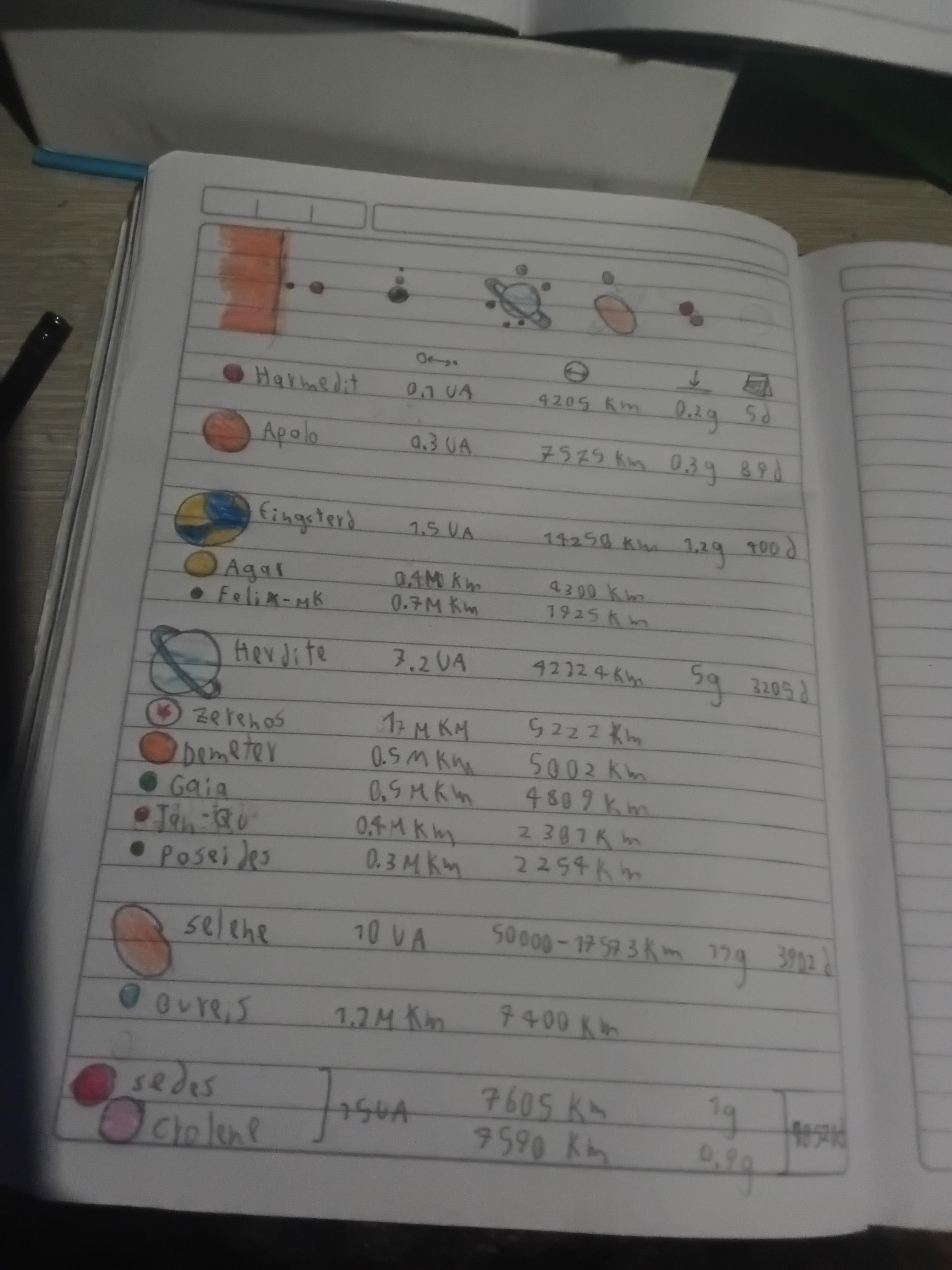
Primero que todo, les pido de todo corazon perdon por la calidad mala. Segundo, anoche no pude dormir y me puse ha hacer este sistema planetario.
Aqui dejo los datos por si alguien no los logra ver:
--- Hermedit:
Dist: 0.1UA
Tamaño: 4205km
Gravedad: 0.2g
Año: 5d
Lunad: 0
--- Apolo:
Dist: 0.3UA
Tamaño: 7575km
Gravedad: 0.3g
Año: 89d
Lunas: 0
--- Eingsterd:
Dist: 1.5UA
Tamaño: 14250km
Gravedad: 1.2g
Año: 400d
Lunas: 2
- Agar:
Dist: 0.4M km
Tamaño: 4300km
- Apolo:
Dist: 0.7M km
Tamaño: 1925km
--- Herdite:
Dist: 7.2UA
Tamaño: 42324km
Gravedad: 5g
Año: 3205d
Lunas: 5
- Zerenos:
Dist: 1M km
Tamaño: 5222km
- Apolo:
Dist: 0.5M km
Tamaño: 5002km
- Gaia:
Dist: 0.5M km
Tamaño: 4809km
- Jan Qu:
Dist: 0.4M km
Tamaño: 2301km
- Poseides:
Dist: 0.3M km
Tamaño: 2254km
--- Selene:
Dist: 10UA
Tamaño: 50000km - 17573km
Gravedad: 15g
Año: 3902d
Lunas: 1
- Oureis:
Dist: 1.2M km
Tamaño: 7400km
--- Sistema binario:
Datos compartidos:
-Dist: 15UA
-Año: 10520d
Datos individuales:
- Sedes:
Tamaño: 7605km
Gravedad: 1g
- Crolene:
Tamaño: 7590km
Gravedad: 0.9g
r/ImaginarySolarSystems • u/Common-Swimmer-5105 • 14d ago

r/ImaginarySolarSystems • u/Soppie2406 • 14d ago

Welcome or welcome back to Way Beyond Us, my alternate solar system project.
Icarus - Despite being smaller than most dwarf planets, it is considered a planet under IAU definition. It's dayside is perpetually molten sue to the extreme temperatures it experiences.
Vulcan - The smallest of the planets, being smaller than basically every dwarf planet we know of.
Mercury - Mercury orbits the Sun in a 3:2 spin-orbit resonance. Despite not being tidally locked, it still has extreme temperature differences between it's day and night side.
Minerva - The closest planet to Earth in terms of size. It has many small microbes living in its upper atmosphere that were discovered in 2015.
Vesta - The first of the three "habitable" planets, it used to be teeming with life 400 million years ago, today only microbes, plants and very small multicellular animals exist on it. Ruins of an ancient civilization are still found all throughout the solar system.
Rheasilvia - The binary partner of Vesta, considered a moon for the longest time until the 1998 IAU definition of a planet. Rheasilvia has a very thin atmosphere composed of nitrogen.
Earth - The place where humanity evolved, it has the highest biodiversity of any object in the solar system. Modern humans first emerged in Africa 300,000 years ago and now we're among the planets; how far we've come.
Venus - The largest of the inner planets. Despite it being covered in ice it's home to an intelligent lifeform, the Apollans. Venus is largely inaccessable for the public due to its vast biosphere being at risk of contamination.
Mars - Mars is often called "the red planet" due to oxidation of oxygen within the rocks on the surface. It has small puddles filled with microbial life at the lowest points of its surface. It is home to some of the most iconic landmarks in the solar system, such as the largest canyon, valles marineris.
r/ImaginarySolarSystems • u/JadeTheVessel • 14d ago

Star System I like that I found in SpaceEngine. Mostly follows a naming convention (Pareun B moons I have yet to do). Nasen is habitable to so that's nice. I'm not sure if this sub allows SpaceEngine but this is procedurally generated which that doesn't break rules (if this sort of post isnt allowed i can make changes to allow it idk its my first time here) Not every moon is shown.
r/ImaginarySolarSystems • u/AntOutrageous5137 • 15d ago

Moto is our first planet, and it is very similar to mercury except Moto is 25% larger than mercury.
Zeloo is the most similar to earth in this system, it can be compared to earth during the time of Pangea as there is only one singular supercontinent and the rest of the planet is covered in water, there is intelligent life on this world and the next planet on our list will have a very crucial part in their religion.
Elysium is the only gas giant in the system, it has a nice blue color and many of the inhabitants of Zeloo call it the eye of God, many believe that after you die, you are sent there where you live forever in peace.
Well, this is the Dalla system and I hope you like it
r/ImaginarySolarSystems • u/the-mexican-horse-h • 15d ago

r/ImaginarySolarSystems
•
u/Only__Karlos
•
15d ago


Just found out this sub exists and wanted to share the star system that my soft realism fantasy sci-fi story takes place in. It's an alternate universe with magic and technology, and this is the alternate solar system, with planets and moons named after the greek (olympian) gods rather than roman gods.
There is lore for each but honestly it's a bit unbalanced at this point, planets like Athena and Poseidon are far more developed lorewise than Demeter or the major moons of the gas giants. Aphrodite is the homeworld where humans, dwarves, elves, etc, live and the only world with complex multicellular life.
Getting this question out of the way, why call the star Olympus instead of Helios, the god of the Sun? Because I think Olympus is a cooler name for the star at the center of it all, because then I can call the planets Olympians and it works. My rule of cool defeats your Sun god and turns him into a tiny lava world getting deepfried in solar radiation.
"Why not name the homeworld Gaia?" Because it's the Olympus systems where the names are after the Olympian gods, I'm not gonna throw a Titan into the mix (looking at you URANUS with your special greek name in a latin system privilege).
Anyway I'm gonna come back here later and add all the lore in a bit, just wanted to share the collage (I think that's the English word) of planets I made (none of them were drawn/made by me except Aphrodite).
----------------
Helios: the first and closest planet to Olympus, Helios is a tidally-locked black-and-red lava world inspired by Mustafar (Star Wars). It has an orbit and day length of just 18 days. Its sun-facing side is where all the lava is, while the other side is much colder and in perpetual darkness. It has a very cracked terminator line as well, with deep dark canyons who have never gotten any sunlight.
Hermes: the second planet of Olympus, Hermes is a brown cratered world inspired by Mercury and Pluto. It's commonly refered to as Helios' cool-headed brother (there are some changes from our greek mythology to this setting's mythology, the Thalassan religion).
Athena: the third planet of Olympus, shrouded by a rich, deep purple atmosphere and permanent auroras that early astronomers imagined to be the signature of vast forests or endless fields of enchanted alien flora. For a long time it was sen as a very beautiful but cool and mysterious planet, many wondering what was hidden beneath the surface. Turns out, a lot of volcanic activity, and the atmosphere is very deadly. It's really a toxic hothouse world, like a Super-Venus.
Aphrodite: Home is where the heart is! Aphrodite is a supercontinent world larger Earth and the only planet with complex multicellular life in the system, home of the humans, elves, dwarves, among other humanoids and fantasy creatures. It has two major moons, Selene and Eros, and one capture asteroid Eos. Unknown to nearly everyone in the setting, Selene was not formed with Aphrodite, nor is it a normal moon. It's more like a demigod, it's a sentient living being made of magic. Think something like Ego (Guardians of the Galaxy) or Mogo (Green Lantern).
Poseidon: If there's water there's life, right? Wrong! Poseidon is an ocean world (>85% water) with no life at all, because it's missing many other elements needed for life to form. It does have one large continent, a superswell called Atlantis, and island chains spread around the world. But it's not even liveable by humans, since the atmosphere is thick and doesn't have enough oxygen to breathe. This was very disappointing to find out since many in Aphrodite thought Poseidon was a tropical paradise planet, filled with fish and beaches and palm trees. But it's just barren everywhere, and quite stormy as well.
Hephaestus: (mispelled it in the image) This is like Mars but like, not Mars. It's "let me copy your homework, Mars". There's not much to it (since I'm not super interested in writing for it yet), but it does have 3 asteroid moons instead of 2. That's a plus, literally.
Demeter: A dwarf planet in the Gaia Belt, Demeter is a frozen world with a lot of water, an equatorial ridge, a thin ring made of asteroid debris and the deepest canyon in the entire system. It's inspired mainly by Dres since it was my first sucessful interplanetary mission in KSP and I always thought it was an underrated planet.
Ares: The first gas giant, Ares is a red behemoth just outside the Gaia Belt, and it almost destroyed all the rocky planets in the process of becoming a Hot Jupiter, but it was stopped by Zeus (which is a bit larger but much more massive than it). It has four major moons like Jupiter and a thin dust ring as well.
Zeus: The second gas giant, the king of the planets, massive enough to form a barycenter with Olympus itself. It's blue and has the most violent storms in the system, with 5 major moons and 3 large minor moons.
Hera: The planet with the most beautiful rings, it's a Super-Saturn with two major moons and 4 large minor moons. Hebe is a Titan analogue, also inspired by Tekto (KSP).
Apollo: It's your standard Uranus analogue planet.
Artemis: Neptune analogue, inspired by Neidon (KSP). Can you tell I like colorful planets, specially purple ones?
Dionysus-Hestia: Pluto and Charon analogue.
Hades: Planet Nine analogue, it's a mini Neptune with a coal black atmosphere. Its moon Persephone is inspired by Earth during the ice age, though it's not habitable.
r/ImaginarySolarSystems • u/nip_dip • 19d ago
r/ImaginarySolarSystems • u/whereisthei • 21d ago

(Please note: Crusader 6 was a massive failure, and couldn’t even make it off the ground.)
r/ImaginarySolarSystems • u/Motor-Worth6864 • 26d ago
r/ImaginarySolarSystems • u/SomeonesInTheCorner • 26d ago

Think of this as a preview. Version 1. I will publish part 2 at a later date.
*version
r/ImaginarySolarSystems • u/whereisthei • 27d ago

r/ImaginarySolarSystems • u/JWitherstorm99 • Oct 23 '26

Here are the last few days of work compiled. Sorry for the bad handwriting. Also, if you have any questions or ideas, tell me. I am very open.

