r/HomeworkHelp • u/Ok_Campaign_2654 Secondary School Student • Nov 18 '24
:Accept-icon: Answered [Primary school math] Why are these different?
13
u/Bascna Nov 18 '24 edited Nov 18 '24
You'll get universal agreement that
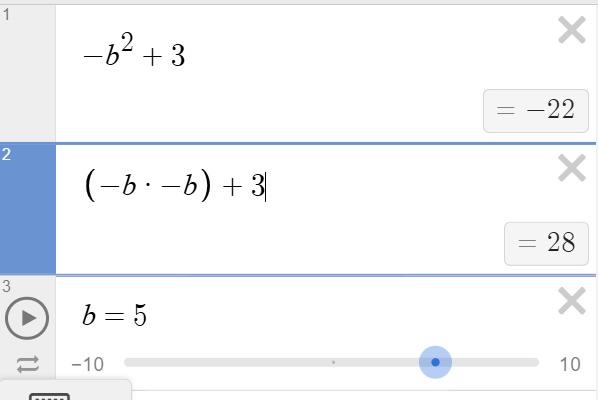
(-5•-5) + 3 =
(25) + 3 =
28.
But there are two different programming conventions for how to interpret the notation -52.
Desmos and all of the current physical calculator models that I'm aware of use the same convention as textbooks that squaring the 5 comes before applying the negative sign. (More formally, we say that the binary exponentiation operator has precedence over the unary minus operator.)
So
-52 =
-(52) =
-(5•5) =
-(25) =
-25.
Therefore
-52 + 3 =
-(52) + 3 =
-(5•5) + 3 =
-(25) + 3 =
-22.
But...
when I first started teaching, many of my students had calculators that applied the negative sign before evaluating the exponent. (In this case, the unary minus operator has precedence over the binary exponentiation operator.)
So on their calculators...
-52 =
(-5)2 =
(-5)(-5) =
25
and thus
-52 + 3 =
(-5)2 + 3 =
(-5)(-5) + 3 =
25 + 3 =
28.
That convention was in line with a common programming design principle that unary operators (those that only have one operand like factorials or absolute values), should have precedence over binary operators (those that have two operands like addition, multiplication, or exponentiation).
Over the following decades calculator companies have converged on that first order of operations for the unary minus operator and exponentiation. This is probably both because that convention is in line with textbooks and because it makes some common notational manipulations on the machines a bit simpler.
You'll still find some holdouts, though — most prominently, in spreadsheet programs.
Microsoft Excel was originally written using this second convention and to maintain compatibility with older spreadsheets it still uses that convention today.
Because Excel is the most popular spreadsheet software, other companies adopted the same convention so that they will be compatible with Excel.
So in Microsoft Excel, Apple Numbers, and Google Sheets
-52 + 3 =
(-5)2 + 3 =
(-5)(-5) + 3 =
25 + 3 =
28.
So be careful when using a spreadsheet or an older calculator model.
6
u/JanetInSC1234 🤑 Tutor Nov 18 '24
-b2 is actually -(b2)
You square it first, then you write the negative.
3
u/BigBongShlong Nov 19 '24
Great answers here.
What I tell my students “computers can be quite stupid. We have to be VERY CLEAR what we want.”
When in doubt, add parentheses as needed.
2
u/AdInevitable4203 👋 a fellow Redditor Nov 18 '24
The equations can be written as -(b * b) + 3 -b*-b + 3
2
u/No_Leek9954 Pre-University Student Nov 18 '24
Honey u sure that’s primary school math?? 😭
I mean it kinda looks like middle school 7th..ish math tbh!!
1
u/ZellHall University Student (Belgium) Nov 18 '24
In one case, the -1 is squared, but not in the second one -b² = (-1)*(b²) (-b)²=(-b)(-b)=(-1)²(b²)=b²
1
u/thinkingplant_9584 👋 a fellow Redditor Nov 18 '24
Value of b is 5 In first case you have to solve for -(b²)+3 = -(25)+3= -22 In second case you have to solve for (-b .-b) + 3 = (-5 .-5)+3 = 28.
1
u/Busy_Donut6073 🤑 Tutor Nov 18 '24
-b^2 + 3 is different from (-b*-b) + 3 because of the grouping
-b^2 means you're taking b^2 and finding its opposite
(-b*-b) is like saying -b multiplied by -b, which would be (-b)^2
Note how in the second example, the - sign and b are both in parentheses so the exponent of 2 "belongs" to both of them. When I was explaining this to a student of mine a few weeks back I used the analogy of parentheses acting like a hug. 2 "wants" the negative sign and b in (-b)^2
If we used parentheses for -b^2 it would look like -(b)^2 because the 2 is only connected to b
1
u/modus_erudio 👋 a fellow Redditor Nov 18 '24
It is how Desmos and most calculators interpret them. The first one is squared before the negative is applied whereas the second one the negative is multiplied twice resulting in a positive value.
1
1
u/Zealousideal_Key2169 Secondary School Student Nov 19 '24 edited Jan 03 '26
door offer abounding modern cake test lavish plant live versed
This post was mass deleted and anonymized with Redact
1
1
1
u/Tegu86 Nov 18 '24
Alright (-b*-b) Is equivalent to (-1b-1b) This can be simplified to (-1-1bb) -1*-1=1 and bb =b2 Now you have (1b2) which is 25 Add 3 and you get 28 This is different from -b2+3 because the equation is technically (-1*b2) +3
0
0
u/selene_666 👋 a fellow Redditor Nov 18 '24
Order of operations. Exponents happen before subtraction, so -5^2 is -25.
-5
u/Embarrassed-Green898 👋 a fellow Redditor Nov 18 '24
PEMDAS / BEDMAS
1
u/elPrimeraPison University/College Student Nov 19 '24
The problem isnt with order of operations nor mnemonic, but with how its written.
Is it negative 1 times b squared, or negative b squared. So (-1)(b)(b) or (1)(-b)(-b).
0
u/Embarrassed-Green898 👋 a fellow Redditor Nov 19 '24
They need to understand minus b squared is -1 times b squared .. hence it is the order of operation. You cant apply multiply before exponent.
They misunderstood this and used parenthesis thiking about that misconception.
1
u/elPrimeraPison University/College Student Nov 20 '24
not all the time......... it just depends on who wrote it and the context
48
u/Infused_Divinity University/College Student Nov 18 '24
In the top one, it’s essentially -1 * b2 whereas the second one is (-1 *b)2 . Essentially, you multiply b2 by -1 in the first, but in the second the -1 is squared so it’s positive 1, and anything times positive one is itself. Hope that clarifies