r/HabitCard • • 7h ago

Insights Habit Formation Psychology

3 Upvotes

Sleep, nutrition, and stress levels play an important role in habit formation because they influence your brain's ability to manage energy, motivation, and self-control. When you get enough sleep, your brain is better prepared to make decisions, resist distractions, and follow planned routines. Poor sleep can reduce concentration and increase impulsive behaviour, making even simple habits like exercising, reading, or waking up early feel more difficult.

Nutrition also affects how consistently you maintain your habits. Your brain and body need adequate nutrients and regular meals to function well. When you skip meals or rely heavily on unhealthy food, changes in energy and mood can make it harder to stay focused and motivated. Maintaining balanced meals and drinking enough water can support the physical and mental energy needed to follow your daily routines.

Stress can make habit formation more challenging because it consumes mental resources and makes people more likely to depend on familiar behaviours. During stressful periods, you may skip exercise, avoid studying, or return to unhealthy habits because they require less immediate effort. This is why it is important to build routines that remain manageable even on difficult days. Reducing a habit to a smaller version, such as walking for five minutes instead of thirty, can help you maintain consistency without adding more pressure.

r/HabitCard • • 13h ago

Quote Habit Quote Of The Day: Ordinary Task Appreciation Exercise

Post image
2 Upvotes

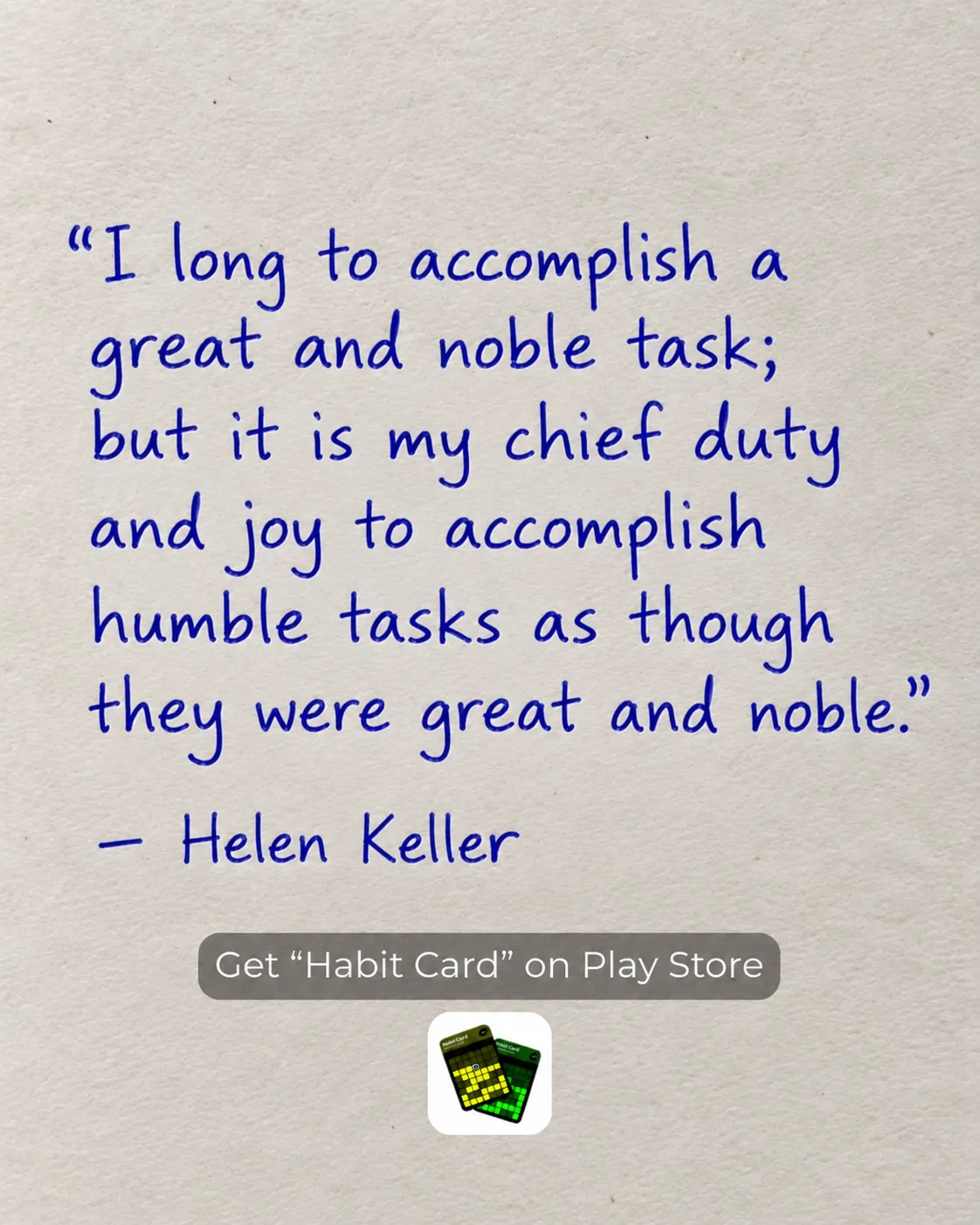
We often give our greatest attention to activities that promise visible achievements. Learning a new skill, reaching a fitness goal, or completing an important project feels exciting. Meanwhile, ordinary responsibilities such as practising, organising, preparing, and maintaining a routine can seem less important. Yet these everyday activities often determine whether our larger ambitions become part of our actual lives. Helen Keller's words offer a valuable reminder that even humble tasks deserve genuine attention and care.

The interesting part of Keller's original statement is that she describes these ordinary responsibilities as both her duty and joy. This is a useful perspective for habit formation. A reading habit does not become meaningful only when you finish a hundred books. Its value also exists in the ordinary evenings when you sit down and read a few pages. Similarly, learning an instrument involves repeating familiar exercises, correcting mistakes, and practising even when there is nothing particularly exciting about the session. These small activities are not interruptions to progress. They are part of progress itself.

Try an Ordinary Task Appreciation Exercise for the next seven days. Choose one recurring habit that you sometimes perform carelessly because it feels routine. Decide what completing it with care would look like. For example, if you practise piano for 15 minutes, spend those minutes correcting one difficult passage instead of simply playing familiar songs. If you read every evening, give the book your full attention rather than rushing through the pages. Keep the activity manageable, but make the quality of your attention intentional. Notice how this changes your experience of the routine.

You do not have to wait for an extraordinary opportunity to make progress. Treat the ordinary opportunities already present in your day with care. The quality of your daily life is influenced not only by what you accomplish occasionally, but also by how you approach the things you do regularly.


r/HabitCard • • 20h ago

Habit Tip Of The Day

Post image
6 Upvotes

Even after you close your laptop for the evening, your mind often stays stuck at your desk. You find yourself replaying an awkward meeting during dinner, mentally drafting an email in the shower, or checking work messages late at night. Without a clear boundary between work and rest, your evening feels fragmented and your recovery suffers.

In organizational psychology, Dr. Sabine Sonnentag's research on psychological detachment shows that mentally disconnecting from work during off-hours is essential for preventing burnout and restoring energy. When you stop working abruptly without wrapping up loose ends, your brain keeps those unfinished tasks active in working memory. A short shutdown ritual acts as a clear psychological boundary, signaling to your nervous system that the workday is safely captured and officially complete.

How to build a five-minute workday shutdown ritual:

=======================

- Do one final scan of your inbox and calendar so no urgent surprises linger in the back of your mind.

- Capture any remaining tasks or stray thoughts in a notebook or task list for tomorrow.

- Close all browser tabs, shut down your system, and physically put your work gear out of sight.

- End with a consistent physical cue, such as changing into comfortable clothes, washing your face, or stepping outside for a short walk.

A deliberate closing ritual protects your evenings from low-grade work anxiety. When you allow your brain to fully switch off at the end of the day, you sleep better, enjoy your personal time more deeply, and return to work the next morning with restored energy.


r/HabitCard • • 1d ago

Tip Habit Tip Of The Day: Hot-Cold Empathy Gap

Post image
2 Upvotes

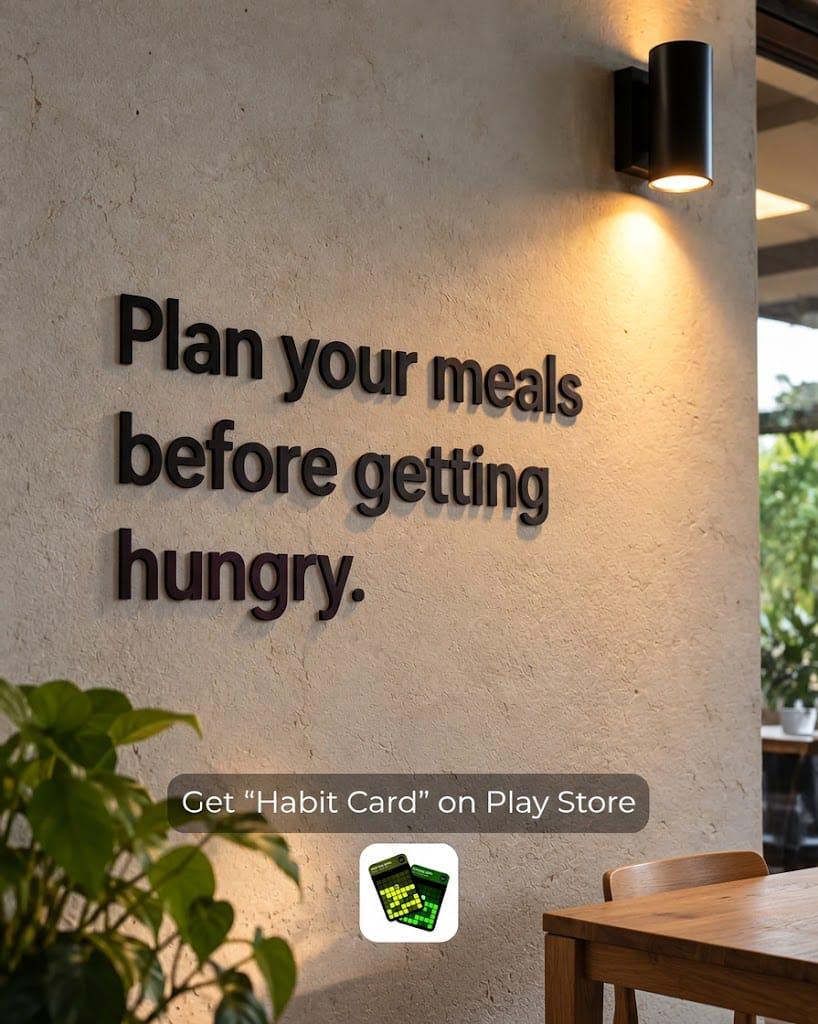
Most unhealthy food choices do not happen because you lack nutrition knowledge. They happen because you wait until you are starving and exhausted to decide what to eat. When your stomach is empty after a long day of work, cooking a balanced meal feels overwhelming, so you default to fast takeout or convenient snacks.

In behavioral economics, this predictable pattern is known as the Hot-Cold Empathy Gap, researched extensively by George Loewenstein at Carnegie Mellon University. When you are in a calm, satisfied state, your prefrontal cortex easily prioritizes long-term health goals. However, once you enter a visceral state of acute hunger and low blood sugar, your brain shifts into immediate survival mode and heavily discounts future consequences. Pre-committing to your meals while you are calm removes that late-day negotiation completely.

How to make pre-planned eating an effortless daily habit:

=======================

- Decide tomorrow's breakfast, lunch and dinner right after finishing dinner tonight, while you are completely full.

- Keep a short list of three quick, reliable 15-minute meals so deciding never feels like a chore.

- Do tiny prep steps in advance, such as thawing ingredients, washing vegetables, or packing your lunch container the night before.

- Use a simple anchor: "Right after I clear the dinner table, I will choose and set out tomorrow's meals."

When you decide what to eat before hunger strikes, healthy eating stops relying on willpower. You reduce evening decision fatigue and stay consistent with your nutrition goals even on your busiest days.


r/HabitCard • • 2d ago

Insights Habit Formation Psychology

6 Upvotes

Morning and evening routines help create structure in daily life. From a habit formation perspective, routines work because they reduce the need to make repeated decisions. When you follow a similar sequence of actions every morning, your brain gradually begins to associate waking up with those activities. Over time, actions such as drinking water, making your bed, reading, or exercising can become more automatic because they are connected to familiar cues.

Your morning routine influences how you begin the day. Starting with intentional activities instead of immediately checking social media or reacting to notifications can help you direct your attention towards what matters. For example, spending the first 10 minutes stretching, planning your priorities, or reading a few pages can create a positive starting point. The goal is not to fill your morning with many activities, but to choose a few that support the kind of day you want to have.

Your evening routine is equally important because it prepares both your mind and environment for the next day. Simple actions such as putting your phone away, preparing your clothes, reviewing your progress, and deciding your first task for tomorrow can reduce stress and make healthy habits easier to follow. For example, someone who wants to exercise every morning can place their workout clothes near the bed before sleeping. This small preparation removes friction and makes the desired behaviour easier to begin.

The most effective routines are simple, realistic, and flexible enough to survive busy days. You do not need a perfect morning or evening schedule to benefit from them. Start with one or two meaningful actions and repeat them consistently. Over time, these routines become reliable signals that guide your behaviour. A good morning routine helps you start the day with intention, while a good evening routine helps you finish it with preparation. Together, they create a daily structure that makes positive habits easier to maintain.


r/HabitCard • • 2d ago

Quote Habit Quote Of The Day: One-Habit Focus Cycle

Post image
1 Upvotes

Have you ever tried to change several things about your daily routine at once? You decide to exercise, read regularly, wake up earlier, learn a new skill, and reduce screen time. For the first few days, everything seems manageable. But gradually, keeping track of all these commitments becomes exhausting, and some habits begin to disappear. Often, the problem is not a lack of discipline. It is that we are trying to give too many new behaviours our attention at the same time.

Charlotte Mason's advice offers a thoughtful alternative: concentrate on establishing one new habit while maintaining the habits you have already developed. This is particularly useful because a new behaviour initially requires conscious effort and repeated attention. Once it becomes more familiar, it may demand less deliberate decision-making. Instead of constantly dividing your attention between several new routines, you can give one behaviour enough consistency to develop before introducing another.

Try a One-Habit Focus Cycle. Choose one behaviour that would make a meaningful difference in your daily life. For example, if you want to develop a reading habit, commit to reading five pages after breakfast every day. For the next two weeks, make this your main habit-building priority. Keep a simple record of completion and observe whether you are finding it easier to begin. Continue maintaining any existing routines, but avoid adding several new commitments during this period. At the end, review your consistency and decide whether you are ready to introduce another habit. Two weeks is a review point, not a deadline for automatic habit formation.


r/HabitCard • • 2d ago

Tip Habit Tip Of The Day

Post image
11 Upvotes

Every time your phone buzzes with a flash sale, a breaking news headline, or a social media like, your attention snaps away from what you were doing. Even if you ignore the banner after a two-second glance, your train of thought is already broken, and returning to deep focus feels surprisingly difficult.

In cognitive science and behavioral economics, this happens because non-human notifications operate on a variable-ratio reward schedule. Each unpredictable ping triggers a quick spike of dopamine, conditioning your brain to crave constant micro-interruptions. Research led by Dr. Gloria Mark at the University of California, Irvine found that after a single external interruption, it takes an average of 23 minutes to fully regain deep concentration. Most of those interruptions do not come from real people who need you. They come from automated software algorithms competing for your time.

How to reclaim your focus with a five-minute notification audit:

======================

- Open your phone's notification settings and turn off alerts for every news app, shopping app, game, and social media platform.

- Keep notifications enabled only for direct human communication, such as phone calls, text messages from real people, and essential calendar reminders.

- Disable red badge numbers on your app icons so your brain is not visually pulled to clear unread counts.

- Apply a simple rule whenever you install a new app: "Before I open this app for the second time, I will turn off its push notifications."

Silencing automated alerts does not mean disconnecting from the people who matter. It simply removes dozens of artificial distractions from your day, protecting your focus, lowering daily stress, and letting you check apps on your own schedule instead of theirs.


r/HabitCard • • 3d ago

Insights Habit Formation Psychology: Intrinsic motivation

2 Upvotes

Personal values give our actions a deeper sense of purpose. A person who values good health may find it easier to exercise regularly because staying active reflects something important to them. Similarly, someone who values learning may naturally make time for reading or developing new skills. When a habit supports something we genuinely care about, it feels less like an obligation and more like a meaningful choice.

In habit formation psychology, this connection is closely related to intrinsic motivation. Intrinsic motivation comes from personal interest, satisfaction, or a sense of meaning rather than external rewards or pressure. When we practise a habit because it reflects our values, we become less dependent on temporary motivation, praise, or rewards. For example, reading because you genuinely value knowledge can be more sustainable than reading simply to complete a daily target.

One practical way to build value-based habits is to ask yourself why a particular behaviour matters to you. If you value family, you might develop a habit of spending quality time with your loved ones every evening. If you value personal growth, you might dedicate fifteen minutes each day to learning something new. Connect each habit to a value that matters in your life, then make the action small enough to practise consistently. This makes the habit feel personally relevant rather than randomly added to your routine.


r/HabitCard • • 3d ago

Quote Habit Quote Of The Day

Post image
7 Upvotes

Many people abandon a new habit because they begin at a level that is difficult to maintain. Someone who wants to become physically stronger might immediately plan an intense workout, while a beginner learning piano may try to practise for an hour every day. When the initial excitement fades, these ambitious routines become difficult to sustain. Epictetus's advice offers a more practical approach: develop your ability through manageable challenges before attempting more demanding ones. His original discussion in Discourses, Book I, Chapter 18, uses the idea of practising with small difficulties before facing greater ones.

In habit formation, this connects with Progressive Practice. The idea is to establish a behaviour at a manageable level, repeat it, and gradually increase its difficulty as your ability and consistency improve. Starting small is not about limiting your potential. It is about creating a reliable foundation. A 2024 systematic review of 20 studies involving 2,601 participants found that repetition, frequency, and modest, attainable goals are important considerations in developing health-related habits.

Try a practical exercise called the One-Step Progression Method. Choose one habit and divide it into manageable levels. For example, if you want to learn piano, begin with five minutes of practice after breakfast, focusing on one chord transition. Once you can complete this routine comfortably and consistently, introduce another chord transition or extend the practice slightly. Increase only one aspect at a time, such as duration or difficulty. If the new level becomes difficult to maintain, return to the previous level temporarily rather than abandoning the routine.

The important distinction is that small beginnings should eventually lead to greater challenges. Repeating an easy activity forever may maintain a routine, but it may not develop the skill you ultimately want. Allow your practice to grow alongside your ability. Give yourself enough repetition to establish consistency, then introduce the next reasonable challenge. Do not demand advanced performance from a beginner. Build the foundation through small practices, and gradually give yourself opportunities to do more.


r/HabitCard • • 3d ago

Insights Habit Tip Of The Day: Urge surfing

Post image
6 Upvotes

When a sudden craving strikes, whether it is reaching for sugary snacks, opening a distracting app, or making an impulse purchase, it often feels like the urge will only grow stronger until you give in. Because of that urgency, saying no forever feels exhausting, so you surrender within seconds.

In behavioral psychology, this is addressed through a technique called urge surfing, developed by Dr. Alan Marlatt at the University of Washington. Research shows that most acute cravings behave like ocean waves. They rise rapidly, reach a temporary peak, and naturally subside within 10 to 15 minutes if you do not feed them. When you tell yourself to wait ten minutes instead of saying no permanently, you remove the feeling of deprivation and give your prefrontal cortex enough time to override the impulsive limbic system.

How to practice the ten-minute pause when an impulse hits:

=======================

- Acknowledge the urge without fighting it: silently tell yourself, "I can still have this if I want it, after ten minutes."

- Set a simple ten-minute timer on your watch or desk clock so the wait has a clear endpoint.

- Shift your attention to a neutral, low-effort action, like drinking a glass of water, walking to another room, or answering one quick message.

- Re-evaluate once the timer rings: if you still genuinely want it, you can make a calm, deliberate choice rather than an automatic reaction.

Most cravings lose their grip long before the ten minutes are up. Each time you ride out an urge without acting on it, you weaken the old neural loop and strengthen your ability to pause before reacting.


r/HabitCard • • 4d ago

Insights Habit Formation Psychology

5 Upvotes

Identity-based habits focus on the kind of person you want to become, rather than just the results you want to achieve. For example, instead of saying, "I want to read 10 books this year," tell yourself, "I am a person who reads every day." This small change in perspective gives your habits a deeper purpose. You are no longer working towards a temporary goal; you are building a lifestyle that reflects the person you want to be.

Every time you perform a habit, you reinforce your identity through your actions. Reading five pages, going for a walk, or choosing healthy food may seem like small achievements, but each action provides evidence that you are becoming that kind of person. In habit psychology, this is closely connected to the idea of self-perception, where people develop beliefs about themselves partly by observing their own behaviour.

To put this into practice, choose an identity that matters to you and connect it with small daily actions. If you want to become a disciplined person, start by completing one important task every morning. If you want to become physically active, take a short walk every day. Make the actions small enough to repeat consistently. You do not need to prove your new identity through dramatic changes; you build it through repeated behaviour.

Remember that missing a day does not erase the identity you are developing. Sustainable habits are built through long-term consistency, not perfect performance. Instead of judging yourself for occasional failures, focus on returning to your actions. The more frequently your behaviour reflects the person you want to become, the stronger that identity becomes. Don't just focus on what you want to achieve; focus on who you want to become.


r/HabitCard • • 4d ago

Quote Habit Quote Of The Day: Proof-of-Action Exercise

Post image
8 Upvotes

There is a difference between wanting to change your life and actually changing your daily behaviour. Many people have meaningful goals: becoming healthier, learning a new skill, reading more books, or improving their professional abilities. They spend time thinking about these goals, making plans, and imagining the results. But progress begins when those intentions become visible actions. Benjamin Franklin's famous observation reminds us that what we actually do matters more than what we repeatedly promise ourselves.

In habit psychology, this relates to the Intention-Behaviour Gap. Having a clear intention does not automatically produce consistent behaviour. For example, deciding to exercise regularly is different from completing today's workout. A habit develops through repeated performance of a behaviour in a reasonably consistent context. Every completed session provides another opportunity to strengthen that pattern. The goal is not simply to become better at planning, but to make your plans translate into everyday actions.

Try a technique called the Proof-of-Action Exercise. Choose one habit you want to develop and define a small, observable action for each day. Instead of writing "I will improve my English," write "I will read one English article for 10 minutes after breakfast." Once completed, record what you actually did, not what you intended to do. At the end of each week, review your records. Notice where you followed through and what prevented you from acting on difficult days. This turns your habit tracker into a record of real behaviour rather than a collection of promises.

There is research supporting the value of this approach. A meta-analysis examining 138 studies involving nearly 20,000 participants found that interventions encouraging people to monitor their progress improved goal attainment. The effects were stronger when progress was physically recorded. This does not mean tracking alone guarantees success, but it can help you stay aware of the difference between intention and action. Your goals describe the person you want to become. Your repeated actions show the direction you are actually moving towards.


r/HabitCard • • 4d ago

Tip Habit Tip Of The Day: Attention Restoration Theory

Post image
7 Upvotes

When your concentration crashes halfway through a workday, the common instinct is to stay glued to your chair and scroll social media or pour another coffee. Yet staring at a smaller screen during a break does not rest your mind. You return to your desk feeling just as mentally foggy as before.

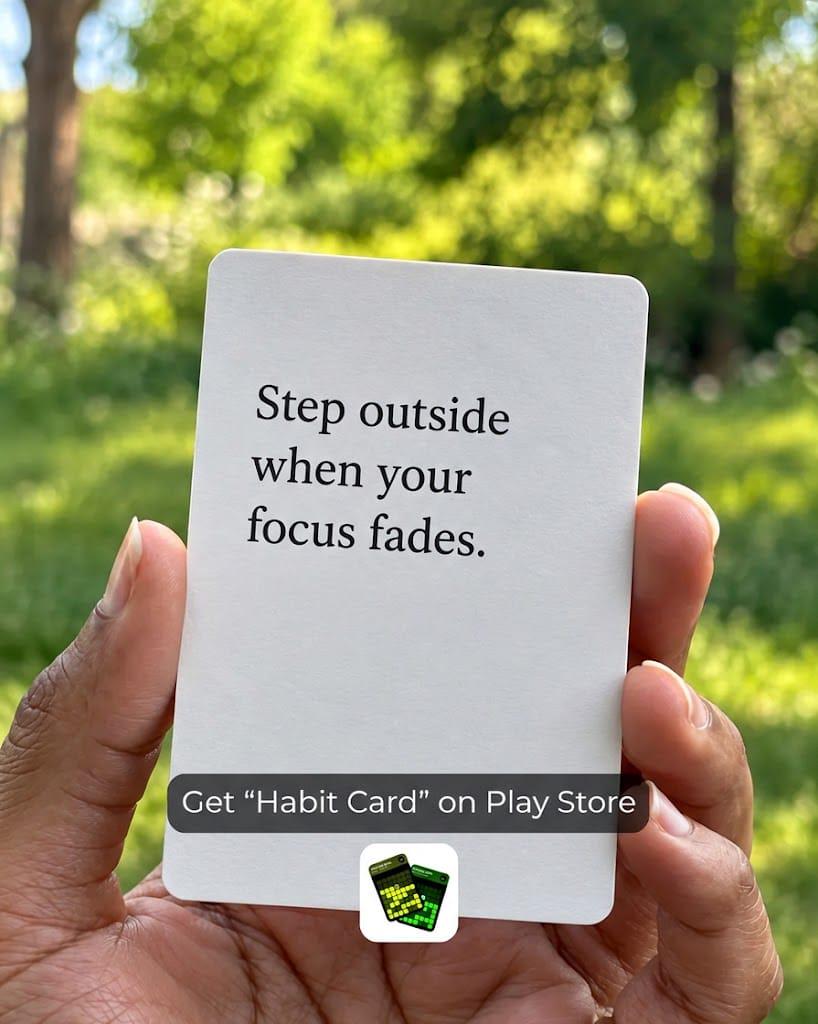
In environmental psychology, this is explained by Attention Restoration Theory, developed by researchers Rachel and Stephen Kaplan. Focused analytical work relies heavily on directed attention, a finite prefrontal cortex resource that fatigues after sustained effort. Natural outdoor settings provide what psychologists call soft fascination. Gently moving leaves, natural daylight, and open horizons engage your involuntary attention without demanding mental effort, giving your executive focus circuits space to recharge.

How to turn a five-minute outdoor reset into an effortless daily habit:

=======================

- Leave your phone at your desk so your mind is not pulled back into notifications or feeds.

- Step onto a balcony, courtyard, or quiet sidewalk for five to ten minutes between deep work blocks.

- Keep your eyes on distant trees, clouds, or the horizon to relax both your visual muscles and your nervous system.

A brief walk in nature is not wasted time away from work. It is biological maintenance for your attention span. Stepping outside when your focus fades restores mental clarity, reduces stress hormones, and helps you finish your afternoon with steady energy.


r/HabitCard • • 5d ago

Insights Habit Formation Psychology

3 Upvotes

Keystone habits are small but powerful behaviors that create positive changes in several areas of life. They act as a foundation for other habits because improving one important routine can influence your decisions, motivation, and daily behavior. For example, regular exercise may not only improve physical health but also encourage better eating habits, better sleep, and greater self-discipline.

The reason keystone habits are effective is that they create a sense of progress and personal control. When you successfully maintain one meaningful habit, you begin to see yourself as someone who can make positive changes. This shift in self-perception can influence other choices throughout the day. Instead of relying entirely on motivation, you gradually develop confidence in your ability to follow through on commitments.

To apply this in daily life, identify one habit that could positively influence several areas of your routine. For example, waking up at a consistent time can create an opportunity for morning exercise, reading or preparing a healthy breakfast. You do not need to introduce all these habits immediately. Focus on maintaining the first routine and allow the improvements to develop naturally.

Remember that you do not need to change your entire life at once. Sometimes, one well-chosen habit can become the starting point for meaningful transformation. Rather than tracking dozens of behaviors, identify the habit that makes other positive behaviors easier to maintain. Build consistency around it, and let its positive influence spread into other areas of your life.


r/HabitCard • • 5d ago

Quote Habit Quote Of The Day: Daily Time Audit

Post image
17 Upvotes

A person's long-term direction is often shaped by ordinary decisions that seem insignificant at the time. Spending ten minutes reading, practising a skill, or going for a walk may not feel like a major achievement. Equally, spending those same ten minutes scrolling through social media can seem harmless. However, when these small choices become repeated parts of everyday life, they influence how we use our time and what receives our attention.

Annie Dillard's observation offers an important perspective on habit formation: our lives are not shaped only by major milestones, but also by the ordinary activities that fill our days. A person who wants to become a better writer, for example, needs more than the occasional productive weekend. Regularly protecting a small period for writing creates opportunities to develop the skill. The same principle applies to reading, exercise, learning, and personal development.

Try a Daily Time Audit for the next three days. At the end of each day, write down how you spent your free time in broad categories. Identify one activity that supports the person you want to become and one activity that regularly takes time away from that priority. Instead of trying to change your entire schedule, replace just 15 minutes of the second activity with the first. For example, replace 15 minutes of evening scrolling with reading or practising a skill.

The purpose is not to make every minute productive. Rest, entertainment, and unplanned time are also important. The goal is to become more intentional about the routines that repeatedly occupy your attention. When you gradually change how you spend ordinary days, you create a different pattern for your future. Do not underestimate the influence of what you repeatedly choose to do today.


r/HabitCard • • 5d ago

Tip Habit Tip Of The Day: Behavioral Activation

Post image
4 Upvotes

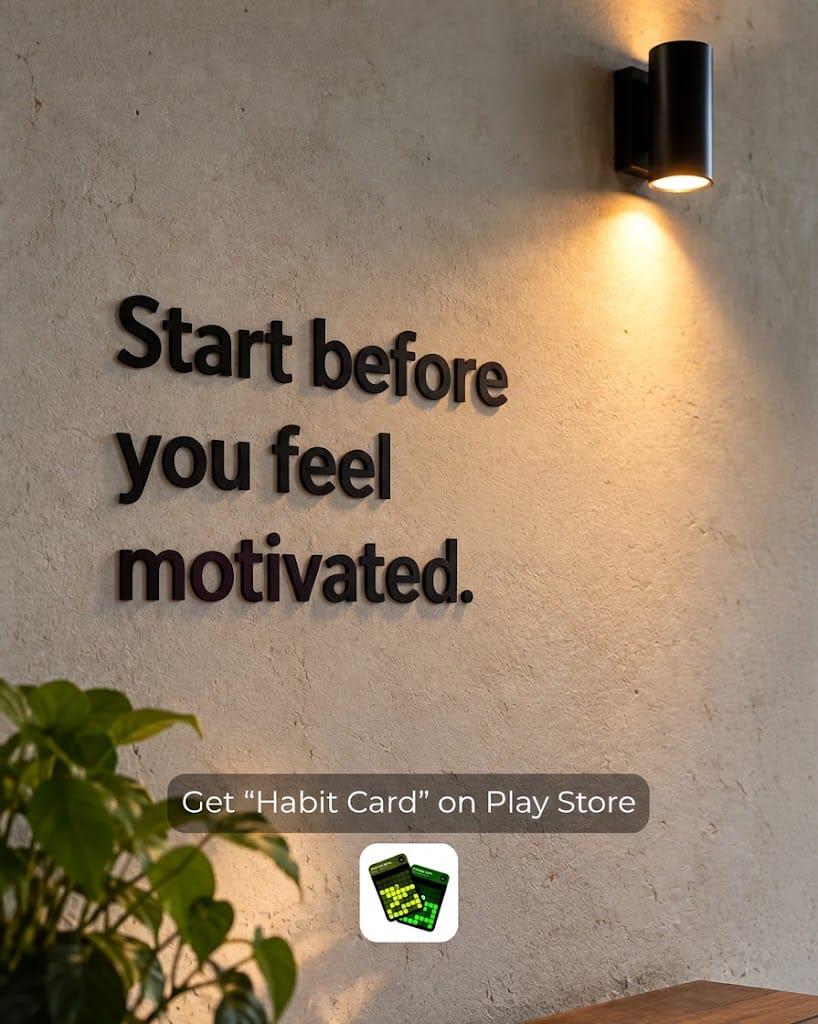
Most people wait for a wave of inspiration before starting a workout, opening a textbook, or tackling a tough project. When you feel tired or uninspired, it feels logical to wait until your mood improves. Yet waiting to feel ready is one of the most common reasons good habits never get off the ground.

In behavioral psychology and neuroscience, this is explained by Behavioral Activation. Motivation rarely precedes action. Instead, action is what generates motivation. When you anticipate an effortful task, your brain's threat-detection system triggers mild avoidance to conserve energy. However, the moment you take the very first physical step, your prefrontal cortex engages, dopamine begins rising in anticipation of progress, and that initial resistance fades within minutes.

How to build the habit of starting without waiting for motivation:

=======================

- Separate your feelings from your actions: acknowledge that you do not feel like doing it, and start anyway.

- Give yourself a low-pressure five-minute rule: commit to doing the habit for just five minutes, with full permission to stop afterward if you still want to.

- Focus only on the physical first step, like putting on your running shoes or opening the blank document.

Consistency is built on the days when motivation is completely absent. When you train yourself to begin before you feel ready, you stop depending on unpredictable moods and turn discipline into a reliable daily reflex.


r/HabitCard • • 6d ago

Insights Habit Formation Psychology

3 Upvotes

Cravings provide the motivation that drives us to repeat certain behaviours. A habit is not formed simply because we perform an action repeatedly. Over time, our brain begins to associate specific situations with an expected reward. This expectation creates a craving, which encourages us to perform the behaviour again. For example, seeing your phone light up may create an urge to check it because your brain anticipates an interesting update.

In the habit loop, cravings act as the motivational force between a cue and a response. A cue reminds the brain of a possible reward, and the craving creates the desire to experience it. The behaviour that follows provides an opportunity to satisfy that desire. For example, someone who feels stressed may crave the comfort of eating something sweet. If eating sweets temporarily improves their mood, the brain may learn to repeat this behaviour whenever similar feelings arise.

We can make positive behaviours more appealing by connecting them with something enjoyable. For example, listen to your favourite music while exercising, enjoy a relaxing cup of tea after reading, or create a comfortable environment for journaling. These positive associations can make the desired behaviour more attractive and increase the likelihood of repeating it.

It is equally important to understand that not every craving needs to be acted upon. When an unwanted urge appears, pause and observe it instead of responding automatically. You can delay the response, change your environment, or choose an alternative behaviour that satisfies the underlying need in a healthier way. Over time, this helps you develop greater control over your responses.


r/HabitCard • • 6d ago

Quote Habit Quote Of The Day

Post image
4 Upvotes

This insightful observation by Frank Outlaw highlights the chain reaction that connects our inner mindset to our outward daily behavior. Every habit and routine begins as a recurring thought or mental narrative before finding expression in what we say and how we act. Becoming aware of this progression gives us an earlier, more effective point of leverage for lasting self-improvement.

To apply this practically in your daily life, start by paying closer attention to the subtle self-talk and assumptions that shape your day. If you catch yourself saying "I never have time" or "I always miss this routine," reframe that language toward constructive, action-oriented statements such as "I can set aside ten focused minutes today." Shifting your internal dialogue and spoken commitments helps align your choices with your long-term goals.

Furthermore, bridge the gap between intention and execution by turning your stated priorities into small, concrete actions right away. Instead of letting good ideas remain abstract thoughts or casual remarks, pair each positive commitment with a clear daily cue and a simple first step. Consistent follow-through transforms conscious choices into reliable habits over time.

Ultimately, staying mindful of how your daily actions unfold is key to sustaining growth. Using a habit tracker like 'Habit Card' helps keep your daily routines visible and intentional, ensuring your everyday actions consistently reflect the standards you want to uphold.


r/HabitCard • • 6d ago

Tip Habit Tip Of The Day: Context dependent cueing and stimulus control

Post image
3 Upvotes

When you work from your bed, scroll social media at your study desk, and eat dinner in front of your laptop, your brain loses track of what each environment means. Instead of shifting smoothly into focus or rest, you end up feeling wired when you want to sleep and distracted when you want to work.

In behavioral psychology, this comes down to context dependent cueing and stimulus control. Your brain automatically builds strong associative links between a physical location and the habits you repeatedly perform there. When a single space is tied to conflicting behaviors, those environmental cues cancel each other out. Dedicating one specific spot to one primary activity trains your nervous system to enter the right mental state almost immediately upon arrival.

How to apply spatial conditioning:

=======================

- Keep your bed strictly for sleep and rest. Never answer work emails or watch reels under the covers.

- Reserve your desk solely for focused work or study. If you need a break or want to browse your phone, move to the other side/chair.

- Create a dedicated reading or meditation corner, even if it is just a specific cushion or armchair by a window.

You do not need a large home to separate your habits by space. Even in a single room, assigning a distinct chair, corner, or side of a table to one clear purpose turns your surroundings into an automatic trigger for better focus and deeper rest.


r/HabitCard • • 7d ago

Insights Habit Formation Psychology

1 Upvotes

Motivation gives us the initial desire to change, but it is not a reliable source of long-term action. It often comes from excitement, inspiration, or a strong desire to achieve a goal. However, motivation naturally fluctuates depending on our mood, energy, workload, and circumstances. For example, you might feel excited about exercising every morning when you start a fitness journey, but that excitement may decrease after a few days. This does not mean you have lost your ability to change. It simply means that motivation alone cannot sustain a habit.

Consistency becomes important when the initial excitement fades. Repeating a behaviour in a familiar situation gradually strengthens the connection between a cue and an action. For example, going for a short walk after breakfast every day helps your brain associate breakfast with walking. Over time, you may need less conscious effort to begin because the behaviour becomes more familiar and automatic. This is how a repeated action can gradually develop into a habit.

One practical way to build consistency is to make the behaviour small enough to perform even on difficult days. Instead of committing to reading 30 pages daily, start with two pages. Instead of exercising for an hour, begin with five minutes. The goal is not to achieve an impressive result every day, but to maintain the behaviour regularly. You can increase the effort as the routine becomes more established. Having a minimum version of your habit also makes it easier to continue when life gets busy.

Remember that consistency does not mean never missing a day. Unexpected situations, illness, and personal responsibilities can interrupt even well-established routines. What matters is how quickly you return to the behaviour. Rather than treating one missed day as failure, focus on resuming your routine at the next available opportunity. Motivation may help you take the first step, but repeated action, realistic expectations, and the ability to restart are what help a habit become part of your everyday life.


r/HabitCard • • 7d ago

Quote Habit Quote Of The Day: Attention Residue

Post image
16 Upvotes

Most people think concentration is something they either have or lack. When we struggle to focus, we often blame our lack of discipline. But attention is also shaped by what we repeatedly practise and the conditions in which we work. Charlotte Mason's observation offers an interesting perspective: the ability to direct our attention is something that can be cultivated, rather than something we should expect to happen automatically.

This becomes particularly relevant in a world where we constantly switch between messages, social media, work, and personal tasks. Psychologists have identified a phenomenon called Attention Residue. When we move from one unfinished task to another, part of our attention can remain occupied with the previous task. This can interfere with our ability to concentrate on what comes next.

One useful technique is called a Ready-to-Resume Plan. Before leaving a task, take a moment to write down exactly where you stopped and what your next action should be. For example, if you interrupt your reading session, write: "I finished page 24. Next, I will read the section about habit formation." When you return, you have a clear starting point instead of spending time remembering where you left off.

Try practising this with one important activity every day. Give it a dedicated period without unnecessary interruptions, and use a short restart note whenever you need to step away. Over time, you are not just building a routine around the activity; you are also practising how to direct and recover your attention. Sometimes improving a habit is not about doing more. It is about learning to give your attention fully to what you are already doing.


r/HabitCard • • 7d ago

Tip Habit Tip Of The Day

Post image
7 Upvotes

When you try to build a new habit completely in private, breaking a promise to yourself carries no immediate external cost. On tired or stressful days, it is easy to silently negotiate with yourself, skip the routine, and tell no one. Relying solely on internal willpower leaves you vulnerable whenever motivation dips.

In behavioral psychology, social accountability changes the stakes of consistency. Research led by Dr. Gail Matthews at Dominican University found that people who wrote down their goals and shared weekly progress updates with a supportive friend were significantly more likely to succeed than those who kept their commitments private. Humans are deeply wired for social connection and reliability. Knowing that one trusted person will ask how your week went adds gentle, positive friction against quitting.

How to build an effortless accountability loop:

========================

- Choose one reliable friend, sibling, or coworker who is also working on a personal goal.

- Keep it simple and low-pressure: agree to send a quick two-line update or a screenshot of your habit tracker every Sunday evening.

- Focus on encouragement rather than judgment, celebrating consistency and troubleshooting obstacles together.

You do not need a large audience or public social media announcements to stay consistent. Having just one trusted person in your corner turns a lonely uphill climb into a shared routine, dramatically increasing your odds of sticking with your habits long term.


r/HabitCard • • 8d ago

Insights Habit Formation Psychology

3 Upvotes

Tracking habits can be helpful, but trying to monitor too many habits at once can create unnecessary mental pressure. Every habit requires attention, effort, and a moment to record progress. When your tracker becomes filled with too many daily commitments, checking off tasks can start feeling like another responsibility rather than a tool for personal growth.

From a psychological perspective, this can increase cognitive load. Your brain has limited attention and self-regulation resources, and managing multiple behaviour changes simultaneously can make it harder to stay consistent. Instead of focusing on performing each habit, you may spend more time worrying about unfinished tasks and broken streaks. This can gradually reduce motivation and make the entire tracking process feel overwhelming.

A more effective approach is to prioritise a small number of meaningful habits. For example, if you want to improve your health, reading, and productivity, start with one habit that has the greatest immediate value. Give yourself enough time to make it part of your daily routine before introducing another. This allows you to direct your attention towards building a behaviour rather than managing a long checklist.

Remember, the purpose of a habit tracker is to support behaviour change, not to create more work. A simple tracker that helps you consistently practise two meaningful habits is often more valuable than a complicated tracker filled with ten habits you struggle to maintain. Focus on building habits one at a time, and let your tracker remain a helpful guide rather than another daily obligation.


r/HabitCard • • 8d ago

Quote Missed-Habit Review

Post image
4 Upvotes

Missing a planned habit session often triggers an unhelpful reaction: we blame ourselves and promise to try harder tomorrow. But what if a missed session could tell us something useful about how our routine is designed? Perhaps the timing was unrealistic, the environment was distracting, or an unexpected responsibility got in the way. John Dewey's observation invites us to treat these moments as opportunities for investigation rather than personal verdicts. In How We Think, he explains how reflective thinking turns an unsuccessful attempt into information that can guide the next attempt.

Try a simple technique called a Missed-Habit Review. Whenever you fail to complete a planned habit, spend one minute answering three questions: What happened just before I missed it? What made the action difficult? What is one adjustment I can test next time? For example, if you repeatedly skip evening reading because you feel exhausted after dinner, try moving your reading session to an earlier part of the day. Change one factor rather than redesigning your entire routine. This helps you identify the actual obstacle instead of repeatedly relying on willpower.

There is also research supporting the value of recording and reviewing progress. A 2016 meta-analysis by Harkin and colleagues examined 138 studies involving 19,951 participants. It found that interventions encouraging progress monitoring improved goal attainment, with stronger effects when progress was physically recorded. This does not mean every setback automatically produces learning; the useful part is deliberately examining what happened and deciding what to adjust.


r/HabitCard • • 8d ago

Tip Habit Tip Of The Day

Post image
13 Upvotes

Most habits do not fail overnight. They fade quietly through small, unnoticed compromises. You skip a workout because of a late meeting, stay up an hour past your bedtime on Thursday, and before you realize it, three weeks have passed without touching your routine. Without a regular moment to pause and look at the data, your brain relies on optimism rather than reality.

In behavioral psychology, Control Theory explains that lasting self-regulation requires a closed feedback loop. You act, you measure the outcome, and you compare your actual behavior against your goal. A weekly review provides that essential course correction. When you inspect your habit tracker once a week, you catch small friction points early, like a missing cue or an unrealistic schedule, before a temporary slip becomes a permanent quit.

How to run a 10-minute weekly habit review:

=======================

- Pick a consistent anchor, such as Sunday evening with a cup of tea or Friday afternoon before closing your laptop.

- Look at your habit grid for the past seven days and notice which habits felt effortless and which ones felt like a struggle.

- Ask one practical question for every missed day: what got in the way, and how can I lower the friction next week?

- Adjust your environment or scale the habit down if needed, rather than blaming your willpower.

A ten-minute weekly check-in keeps your habits aligned with your real life as your schedule changes.