r/GraphTheory • u/Brother2And • Dec 31 '18
Brand new to graph theory. Does anyone have some free time to help explain?

0
Upvotes
r/GraphTheory • u/Brother2And • Dec 31 '18
r/GraphTheory • u/ThoughtsFromAi • Aug 02 '26
I am seeking independent graph-theoretic review of two candidate exact values in C₄-versus-star Ramsey theory:
**R(C₄,K₁,₃₉) = 46**
**R(C₄,K₁,₅₁) = 59**
These results have **not** been peer-reviewed or formally verified in a proof assistant. Please treat them as candidate proofs, not established theorems. I would particularly appreciate identification of the earliest invalid step, unstated assumption, or failed exact computation.
Write
f(n) = R(C₄,K₁,ₙ).
The 2026 *Small Ramsey Numbers* survey, DS1.18, lists f(39) ∈ {46,47}; it is the only undetermined value in that table for n ≤ 41. Boza’s June 2026 paper lists f(51) ∈ {59,60}. I searched for later resolutions through July 2026 and found none, although that is not a guarantee of novelty.
Survey: https://www.combinatorics.org/ojs/index.php/eljc/article/download/DS1/pdf/0
Boza: https://arxiv.org/abs/2409.12770
## Common reduction
A red/blue coloring of K_N with no red C₄ and no blue K₁,ₙ is equivalent to a C₄-free graph G on N vertices with
δ(G) ≥ N − n,
where G consists of the red edges. Consequently,
f(n) = min{N : no C₄-free graph on N vertices has δ ≥ N−n}.
For v ∈ V(G), let:
- d(v) be its degree;
- m_v be the number of edges inside N(v), equivalently the number of triangles containing v;
- f_v be the number of vertices at distance at least 3 from v.
Because G is C₄-free, N(v) induces a matching, and the sets of vertices reached from distinct neighbors of v outside N[v] are disjoint. Counting vertices by distance from v gives the identity
Σ_{u∈N(v)} d(u) = |V(G)| − 1 + 2m_v − f_v. (1)
This identity forces regularity in both cases.
## Candidate result 1: f(39) = 46
The known lower bound is realized by a C₄-free graph on 45 vertices with minimum degree 6, obtained by deleting 12 vertices from the Erdős–Rényi polarity graph ER₇. An explicit edge list is included with the reproducibility materials and is checked directly. Thus f(39) ≥ 46.
It remains to exclude a C₄-free graph G on 46 vertices with δ ≥ 7. Suppose one exists.
### Step 1: forced local structure
Let d = d(v). From (1), using 2m_v ≤ d and f_v ≥ 0,
7d ≤ Σ_{u∈N(v)} d(u) ≤ 45 + d.
Therefore d ≤ 7.5, and δ ≥ 7 forces every vertex to have degree 7.
Substituting regularity into (1) gives
49 = 45 + 2m_v − f_v,
so
f_v = 2m_v − 4,
and m_v ∈ {2,3}.
The following parity lemma excludes m_v = 2.
**Parity lemma.** If k is odd and G is k-regular and C₄-free, a vertex v cannot simultaneously satisfy f_v = 0 and m_v ≥ 1.
To see this, suppose u₁ and u₂ form an edge inside N(v). For each u_i ∈ N(v), let
S_i = N(u_i) \ N[v].
Since f_v = 0, the S_i partition the vertices at distance 2 from v. Take x ∈ S₁. It has exactly k−1 neighbors at distance 2 from v, at most one in each S_i, and none in S₂: an edge from x to y ∈ S₂ would create the 4-cycle u₁-x-y-u₂-u₁. Hence x must have exactly one neighbor in S₁. This holds for every x ∈ S₁, so G[S₁] is a perfect matching. But |S₁| = k−2 is odd, a contradiction.
Here m_v = 2 would imply f_v = 0, so it is impossible. Therefore every vertex has
m_v = 3 and f_v = 2. (2)
In particular, G consists locally of three triangle edges and one triangle-free edge at each vertex. The triangle-free edges form a perfect matching.
### Step 2: the deficiency graph and spectral support
Let A be the adjacency matrix of G. Define the deficiency graph D on the same vertex set by joining distinct vertices having no common neighbor in G.
Equation (2) makes D cubic. Entrywise common-neighbor counting gives
A² = 6I + J − D. (3)
Since G is regular, A commutes with J and therefore with D. On the all-ones vector, A has eigenvalue 7. On its orthogonal complement, simultaneous eigenvalues θ of A and μ of D satisfy
θ² = 6 − μ.
Because D is cubic, μ ∈ [−3,3], hence every nonprincipal eigenvalue θ of A satisfies
|θ| ∈ [√3,3]. (4)
Let M_j be the j-th power sum of the 45 nonprincipal eigenvalues. Direct trace calculations give
M₁ = −7,
M₂ = 273,
M₃ = −67,
M₄ = 1785.
The fifth moment supplies the decisive constraint. Write P = 6I−D. From (3), using PJ = 3J,
A⁴ = P² + 52J,
A⁵ = AP² + 364J.
There are 23 triangle-free edges, so tr(AD) = 46. A trace expansion then gives
M₅ = tr(AD²) − 615.
For each vertex w, let F_w be its two vertices at distance 3. For an edge uv,
N_D(u) ∩ N_D(v) = F_u ∩ F_v.
Summing over edges and reversing the order of summation shows
tr(AD²) = 2κ,
where κ is the number of vertices w whose two distance-3 vertices are adjacent. Therefore 0 ≤ κ ≤ 46 and
−615 ≤ M₅ ≤ −523. (5)
### Step 3: an exact polynomial certificate
Let N₊ be the number of positive nonprincipal eigenvalues. Consider
p(x) = 423x⁵/200000 + 19x⁴/15625 − 8719x³/200000
− 4087x²/250000 + 390143x/1000000
+ 277973/500000,
and
q(x) = 11x⁵/5000 − 203x⁴/250000 − 45053x³/1000000
+ 5561x²/500000 + 98979x/250000
+ 114939/250000.
Exact real-root isolation and evaluation in ℚ(√3) establish
p(x) ≥ 1 on [√3,3], p(x) ≥ 0 on [−3,−√3],
q(x) ≤ 1 on [√3,3], q(x) ≤ 0 on [−3,−√3]. (6)
The tight endpoint margins are positive:
p(√3)−1 ≈ 3.68×10⁻⁵,
p(−3) = 10⁻⁶,
1−q(3) = 10⁻⁶,
−q(−√3) ≈ 1.25×10⁻⁴.
The exact verifier uses the algebraic endpoints ±√3; replacing √3 by a slightly smaller rational number, such as 1.73, incorrectly rejects the certificate.
Using (4), (6), the four exact moments, and the two endpoints in (5), summing p and q over the spectrum yields
4234009/200000 ≤ N₊ ≤ 4361769/200000,
or
21.170045 ≤ N₊ ≤ 21.808845.
There is no integer in this interval, but N₊ counts eigenvalues and must be an integer. This contradiction excludes G. Together with the 45-vertex witness,
R(C₄,K₁,₃₉) = 46.
There is also an independent exhaustive SAT corroboration covering 144 canonical cases. It is not load-bearing for the proof above. No DRAT certificates are included, and no completed cross-solver result is claimed.
## Candidate result 2: f(51) = 59
The lower bound is realized by a C₄-free graph on 58 vertices with minimum degree 7, obtained from the polarity graph ER₈ of PG(2,8). Its explicit edge list is checked directly. Thus f(51) ≥ 59.
It remains to exclude a C₄-free graph G on 59 vertices with δ ≥ 8. Suppose one exists.
### Step 1: regularity and a cycle deficiency graph
From (1),
8d(v) ≤ 58 + d(v),
so d(v) ≤ 58/7 < 8.3. Hence G is 8-regular.
Equation (1) now gives
f_v = 2m_v − 6.
Again let D join pairs with no common neighbor in G. Its degree at v is
deg_D(v) = f_v + (8−2m_v) = 2.
Thus D is a disjoint union of cycles covering all 59 vertices, and
A² = 7I + J − D. (7)
As before, A and D commute and can be diagonalized simultaneously. On the orthogonal complement of the all-ones vector,
θ² = 7 − μ, (8)
where θ is an eigenvalue of A and μ is an eigenvalue of D. A cycle of length ℓ has eigenvalues
μ = 2cos(2πj/ℓ),
so μ ∈ [−2,2] and θ² ∈ [5,9].
### Step 2: Galois sign balance
Because A is an integer matrix, its characteristic polynomial is in ℤ[x], and its eigenvalues form a Galois-stable multiset.
If θ is rational, then it is a rational algebraic integer and hence an integer. Since θ² ∈ [5,9], the only possibilities are
θ = ±3,
corresponding to μ = −2.
If μ is rational but θ is irrational, then x²−(7−μ) is irreducible over ℚ, so +θ and −θ occur with equal multiplicity and contribute zero to the trace.
Now suppose μ is irrational, with conjugates μ₁,...,μ_r. If 7−μ is not a square in ℚ(μ), then the minimal polynomial of θ = √(7−μ) is
Π_i [x² − (7−μ_i)].
Its roots occur in ± pairs, again with equal multiplicity, and contribute zero to the trace.
The only escape is that 7−μ might be a square in ℚ(μ). If
7−μ = α²,
then taking field norms forces
ψ_d(7) = Norm(α)²
to be a perfect-square integer. Here ψ_d is the minimal polynomial of 2cos(2π/d), for an order d dividing some cycle length and therefore d ≤ 59.
These integers can be generated exactly. If V₀(x)=2, V₁(x)=x and
V_d(x) = xV_{d−1}(x) − V_{d−2}(x),
then
Π_{j=0}^{d−1} [x−2cos(2πj/d)] = V_d(x)−2.
At x=7 this equals 5·F[2d]², where F[r] denotes the r-th Fibonacci number, and Möbius inversion recovers every ψ_d(7). An exact integer scan for every relevant irrational order 3 ≤ d ≤ 59 finds that none of the ψ_d(7) are perfect squares. Some sample values are
ψ₅(7)=55,
ψ₇(7)=377,
ψ₈(7)=47,
ψ₁₃(7)=F[26]=233·521.
Therefore the escape case never occurs.
### Step 3: the trace contradiction
The principal eigenvalue of A is 8, while tr(A)=0, so the sum of the nonprincipal eigenvalues is −8. Every irrational contribution cancels in ± pairs. If a and b are the multiplicities of +3 and −3, respectively, the trace must therefore satisfy
3(a−b) = −8,
which is impossible. Thus no such graph G exists. Together with the 58-vertex witness,
R(C₄,K₁,₅₁) = 59.
This second proof uses no SAT solver, linear programming, or floating-point computation. Its finite computational component is the exact perfect-square scan described above.
## Verification status and disclosure
The complete repository contains the proof manuscripts, explicit lower-bound witnesses, exact polynomial certificates, SAT encoding and log, and seven verifier suites. Three verifier implementations were written independently in a separate GPT-5.6 session. Running the full verification command reproduces all claimed exact computations.
This is not Lean verification, and software agreement is not a substitute for human mathematical review.
The work was developed using Claude and GPT-5.6 under my direction. Claude developed much of the structure theory, the Galois/Fibonacci argument, witnesses, and verification harness. GPT-5.6 identified the decisive fifth-moment constraint for the first result and independently derived and checked several computations. Multiple incorrect intermediate ideas were found and discarded during adversarial cross-checking. I am the repository owner and author of record and accept responsibility for the posted claims.
Reproducibility materials:
https://github.com/zach7036/c4-star-ramsey
If you find a possible gap, please identify the earliest questionable displayed equation or inference. Detailed reports can also be filed as GitHub issues.
r/GraphTheory • u/kvmeena12 • Oct 30 '24
I am thinking that there are some kinds games (like Sanke game ) . I made a game using Java . But I am feeling like nothing I have done in this game because this allready exit in better version. So I want to make it Little advance using voice controller for all the things like left, right and stop. I know this is possible but how apply this I don't know. can anyone help me to do this thing.
r/GraphTheory • u/wutisgraphtheory • Jan 07 '16
what is graph theory? i have to do a presentation on it
r/GraphTheory • u/No-Round9460 • Dec 16 '25
Every graph that cannot be properly four-colored has no planar embedding.
r/GraphTheory • u/lapidario_ • Jul 06 '26
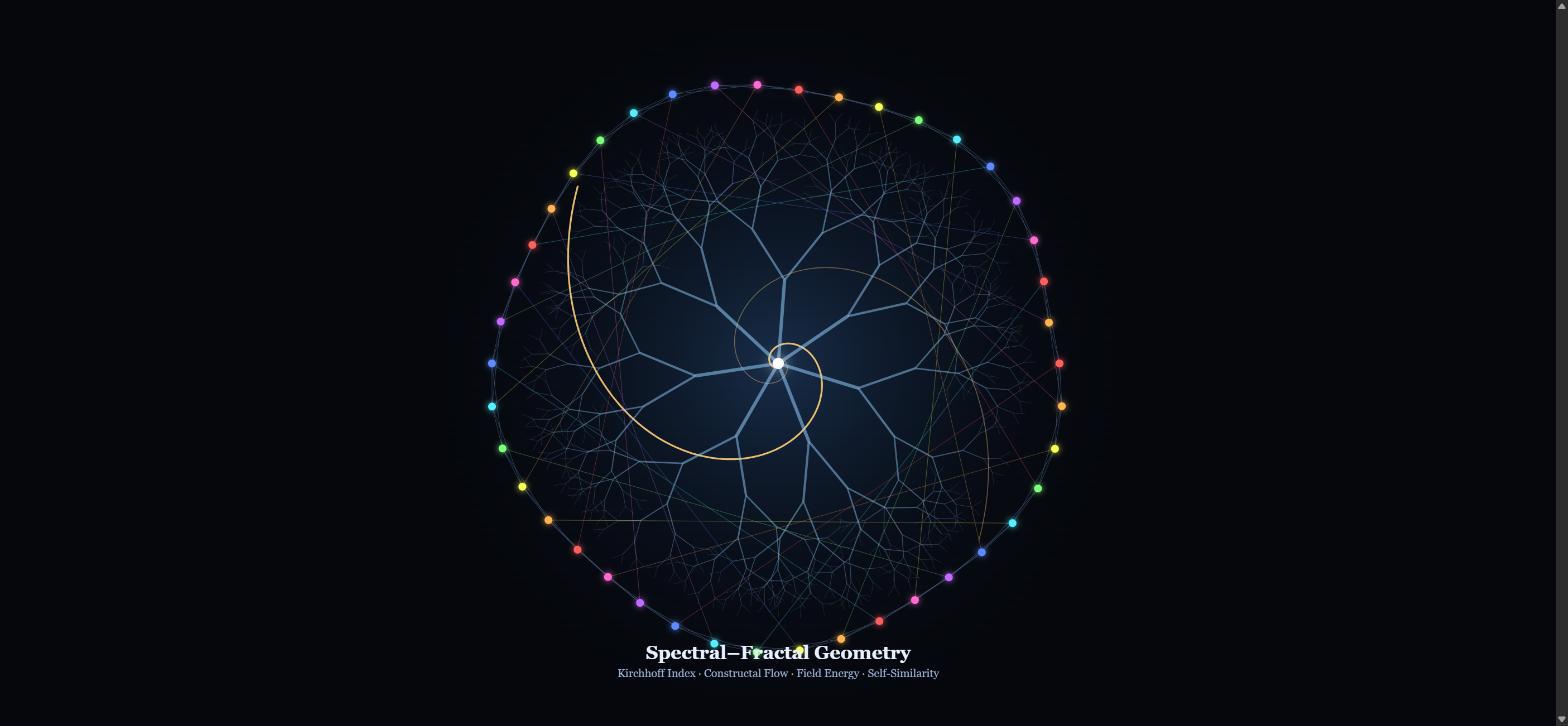
Been working through an idea for a while and finally wrote it up. Short version: the Kirchhoff index of a weighted graph (sum of effective resistances over all pairs) can be treated as a functional that tracks how a network's flow architecture reorganizes itself, in the spirit of Bejan's Constructal Law from thermodynamics. If you set up a weight evolution law where edges strengthen along low resistance paths, K(G,w) decreases monotonically, and that decrease turns out to be equivalent to a minimum energy condition, similar to how the trace of a Green's function behaves for the electromagnetic Laplacian.
The part I'd most like feedback on: for spectrally self similar (fractal) graphs, K seems to scale as |V|^(2/d_s), with d_s the spectral dimension, and that exponent is strictly smaller than what you get in the plain Euclidean/regular grid case. I turned this into a general conjecture for iterated function systems, but I'm not a graph theorist by training so I'd really appreciate someone poking at whether this scaling argument actually holds water, or if there's a cleaner way to see it.
Attached a rough diagram of how I've been visualizing it, weighted network on the outside, flow architecture branching from the center, self similar spiral over the top.
Full write-up is on SSRN: https://papers.ssrn.com/sol3/papers.cfm?abstract_id=6915119
Happy to be told I'm wrong, or that this is already known under a different name. Mostly just want to know where the weak points are.
r/GraphTheory • u/zhangyuxiao12345678 • Jul 12 '22
Title.
r/GraphTheory • u/GoetzKluge • Jun 02 '16

r/GraphTheory • u/[deleted] • Feb 09 '23
I have recently started learning graph theory, I am a post-grad physics student and I have taken graph theory as an online course and I am facing problems in them..can anyone suggest some explainer videos for help?..or be kind enough to solve a few different types of questions, so that I get to understand about how to solve related questions?
please help
r/GraphTheory • u/Alternative-Dare4690 • Mar 16 '25
Let us say i have three questions which can be scored as (0,1), (0,1) and (0,1,3). And i have 4 people who answered this question. Now this is a bipartite graph because of this . I am trying to prove that this graph is disconnected using this proof.
Does this make sense and is correct according to you?
r/GraphTheory • u/Secret_Bad4969 • Dec 11 '25
I want to study it but with real case studios, and real exercises, i'm an engineer, so i'd like to have enough theory but with programming and real case use in the world, i still didn't find a source to do it, it's all super theoretical
I like algorithms, i just don't want to waste a year of proofs just to create a color solution sudoku, i'd like a more applied approach
Help me out; i just want to solve sudokus with pretty diagrams to get laid
r/GraphTheory • u/Brown_Paper_Bag1 • Dec 22 '25

My instructor says to make adjacency matrices but I struggle A TON with mapping the vertices properly. How do i do that when degree sequences are same everywhere and there are no graphical clues? Also how do I check for existence of circuits properly for the invariances?
Like one thing i noticed first was outer circuits are of different lengths but my book says these two graphs are isomorphic
r/GraphTheory • u/graph_t • Apr 21 '25
r/GraphTheory • u/yagizhandag • Jun 15 '25
hi graph theorist, i need help for my final exam. i need to solve following question but i dont understand what it means by saying discovery number. when i search bfs and dfs online, generally google's algorithm shows data structure related content. can you suggest me a book that explains how to find minimum spanning tree using bfs and dfs algo using discovery number method?

r/GraphTheory • u/daoneil • Mar 10 '19
I'm working on my dissertation and I need to conduct a Turing test. Please click the following link take a brief survey that presents five pairs of evolving networks. After each pair there is a question about which network is real and a drop-down list provides the options Top or Bottom. If you can find a couple of minutes to complete the survey, I would really appreciate it. Thanks.
r/GraphTheory • u/kidze • Feb 20 '19
Let G = (V,E,w) be a directed graph with positive edge weight function w. Give an efficient algorithm to find a collection of vertex-disjoint cycles in G whose total edge weight is maximum.
Many thanks!
r/GraphTheory • u/adambio • Jan 26 '26

r/GraphTheory • u/QuantumOdysseyGame • Jun 19 '26

Hi
If you are interested in a highly intuitive visual method that faithfully describes all universal quantum computing and physics behind, (including how time behaves) this is for you. I am the Dev behind Quantum Odyssey (AMA! I love taking qs) - worked on it for about 10 years (3.5 in phd), the goal was to make a super immersive space for anyone to learn quantum computing through zachlike (open-ended) logic puzzles and compete on leaderboards and lots of community made content on finding the most optimal quantum algorithms. The game has a unique set of visuals (that was actually my PhD research) capable to represent any sort of quantum dynamics for any number of qubits and this is pretty much what makes it now possible for anybody 15yo+ to actually learn quantum logic without having to worry at all about the mathematics behind.
This is a game super different than what you'd normally expect in a programming/ logic puzzle game, so try it with an open mind.
Boolean Logic – bits, operators (NAND, OR, XOR, AND…), and classical arithmetic (adders). Learn how these can combine to build anything classical. You will learn to port these to a quantum computer.
Quantum Logic – qubits, the math behind them (linear algebra, SU(2), complex numbers), all Turing-complete gates (beyond Clifford set), and make tensors to evolve systems. Freely combine or create your own gates to build anything you can imagine using polar or complex numbers.
Quantum Phenomena – storing and retrieving information in the X, Y, Z bases; superposition (pure and mixed states), interference, entanglement, the no-cloning rule, reversibility, and how the measurement basis changes what you see.
Core Quantum Tricks – phase kickback, amplitude amplification, storing information in phase and retrieving it through interference, build custom gates and tensors, and define any entanglement scenario. (Control logic is handled separately from other gates.)
Famous Quantum Algorithms – explore Deutsch–Jozsa, Grover’s search, quantum Fourier transforms, Bernstein–Vazirani, and more.
Build & See Quantum Algorithms in Action – instead of just writing/ reading equations, make & watch algorithms unfold step by step so they become clear, visual, and unforgettable. Quantum Odyssey is built to grow into a full universal quantum computing learning platform. If a universal quantum computer can do it, I aim to bring it into the game!
Streams to watch:
khan academy style tutorials on qm/qc: https://www.youtube.com/@MackAttackx
Physics teacher wholesome stream with over 500hs in https://www.twitch.tv/beardhero
r/GraphTheory • u/Longjumping-Life-964 • Jul 30 '24
f you know how to solve it, please tell me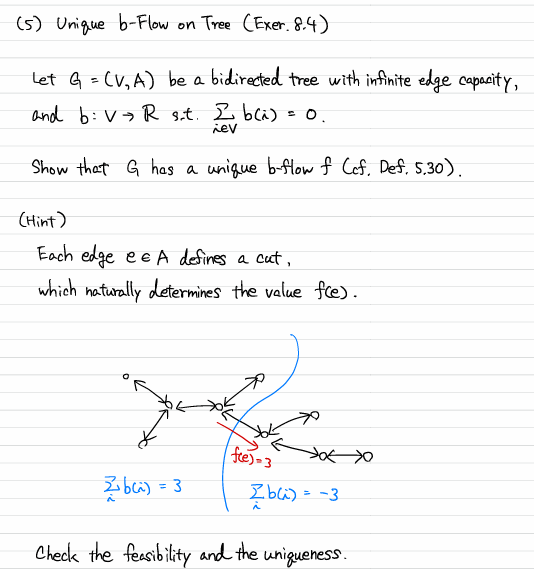


r/GraphTheory • u/dim_goud • Jan 08 '26
Hey all,
My colleague Robert Boulos and me experimented in storing nodes, edges and embeddings in Xano database which is an sql db and not a relational database.
Tomorrow, Friday, January 9th at 1pm est time, we run a public conversation sharing our learnings, what works, and what needs to be done to make them work.
Feel free to join the conversation and bring your experiences and personal learnings
Here is the link to join: https://luma.com/9s2tp2uq
r/GraphTheory • u/[deleted] • May 02 '23

I took graph theory and combinatorics a while back and enjoyed it… and I made a game that at least gestures at some basic content: Nucleo!
Imagine Pac-Man, with some bad guys following graph edges, some following edges of the dual graph, some moving based on the angles between edges… let me know if you like it! The levels are simple and the bad guys show up in various patterns. Nucleo in the App Store
r/GraphTheory • u/Several_Ad_7643 • Apr 15 '25
Hey guys I am trying to make a set of programs that can calculate diffent types of isochrones for a large graph ( ex. country road network ) . So far I have found 4 kind of isochrones: convex hull based, concave hull based, the link offset and the grid spatial interpolation ( still don't understand well this one ). I am wondering how can I optimally calculate an isochrone for each node on the graph, and how can I add a new node and optimize the calculation of the isochrone of that new node.
Also, if someone has any recommendation on a book or article(s) to read I would highly appreciate them.
r/GraphTheory • u/R3dmayn • Nov 16 '23
Hi, I need to make a graph of some data related to risks, some of which the value is 0 (as it should be). I'm having trouble in representing those data in the graph, it needs to be shown that those risks didn't happen in the last 5 years. Is there another way of showing it on a graph instead of a flat line along the axis ? Thank you.