r/Germanlearning • u/Monkai_final_boss • Dec 31 '25
I am sure there is an explanation.

5.5k
Upvotes
I immediately thought of this meme once I learned these words
r/Germanlearning • u/Monkai_final_boss • Dec 31 '25
I immediately thought of this meme once I learned these words
r/Germanlearning • u/LowRenzoFreshkobar • Dec 24 '25

r/Germanlearning • u/Monkai_final_boss • Jun 29 '26

r/Germanlearning • u/Monkai_final_boss • Jun 21 '26

https://youtu.be/LReQ8cWfo7U?si=4cSsNJEVhJwyG0h3
Full video if anyone interested.
r/Germanlearning • u/YourDailyGerman • Jan 14 '26
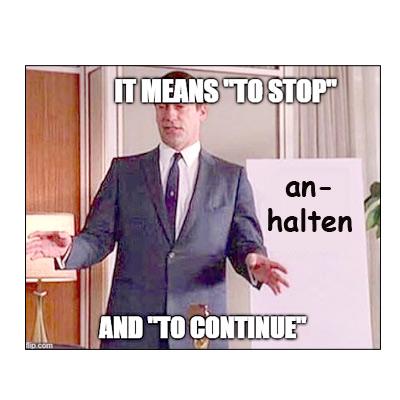
When you look in a dictionary, you'll see "to stop" and "to continue" among the possible translations.
Which seems super duper contradictory, but it actually isn't.
The core idea of "halten" is "being/keeping steady" or "not changing".
That can of course be about bringing a vehicle to stop (anhalten).
But it can also be about a state or process not changing.
- Ich halte an.
- I stop.
- Das schlechte Wetter hält an.
- The bad weather continues.
You can also see it as the bad weather "stopping" and staying around. Which for you means it continues.
r/Germanlearning • u/MerchMania • Dec 04 '25
I’m learning german vocabulary through famous movie quotes.
In this case it's a famous quote from Kung Fu Panda (2008)
Since I’m already familiar with
1. the lines in english (or in my native language) and
2. with the scenes themselves
it’s easy to remember the same lines in german.
I only need to
1. listen tot he german dubbed clips for a few times
2. take notes using my DQN system
D: Dictionary
Q: Quote
N: Notes
This is how my note taking system looks <- (It's a reddit post)
What’ve experienced that
1. I can easily remember the quotes in german after rewatching the scenes for a few times.
2. I can quote the lines in german, remembering the meaning of each of the words.
If you fint this post useful, feel free to join my journe of learning german language. In the subreddit: r/GermanWithQuotes
r/Germanlearning • u/Chance_Acadia_8148 • Sep 25 '25
r/Germanlearning • u/pivall • Apr 27 '26
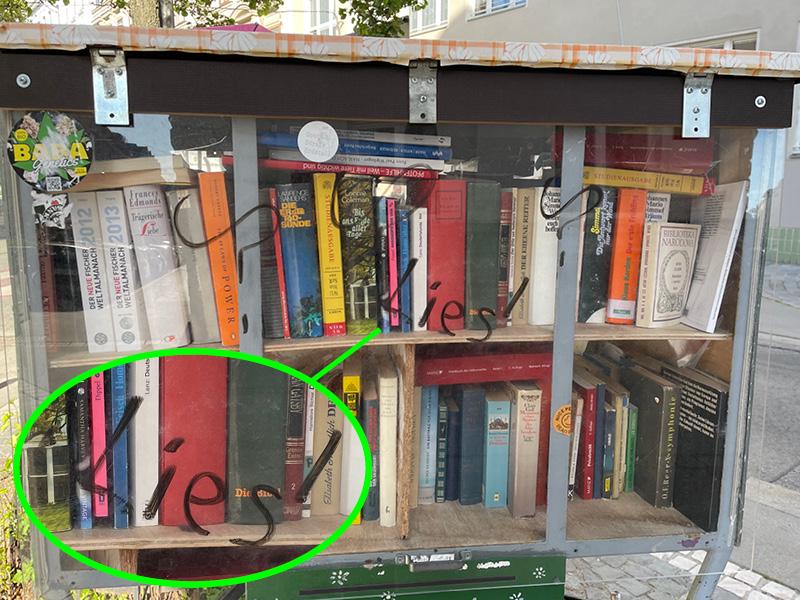
Proof that knowing multiple languages can really be an advantage: An English speaker would read “Lies!” here (public bookcase in Vienna). Kinda like an angry rant from a conspiracy theorist. In German, however, “Lies!” is the imperative form of the verb “to read.” Quite a big difference.
r/Germanlearning
•
u/Monkai_final_boss
•
Jun 08 '26

r/Germanlearning • u/YourDailyGerman • Jul 30 '25
r/Germanlearning • u/YourDailyGerman • Feb 27 '26
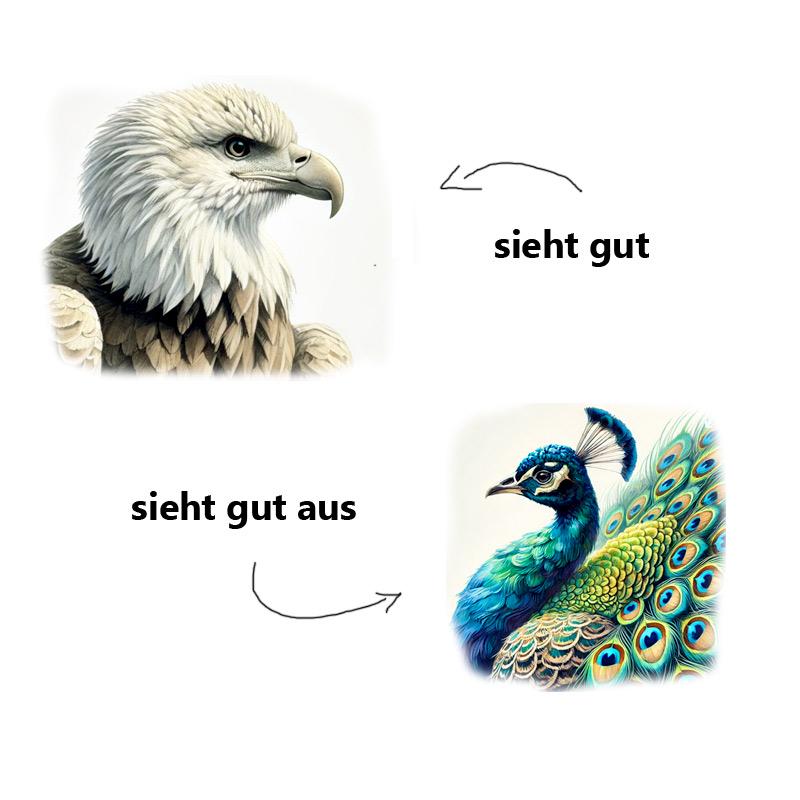
"sehen" means "to see" and "aussehen" means "to look".
But ONLY "to look" in the sense of one's appearance, not "to look" in a sense of looking somewhere.
Learners often forget the "aus" when they talk about how someone or something looks.
- Du siehst sehr gut.
This means that you have good eye vision.
So make sure to always add the "aus" at the end :)
If you want a more detailed look, check out my lesson on the topic:
r/Germanlearning • u/Monkai_final_boss • Jan 01 '26

r/Germanlearning • u/Ok_Membership2402 • Sep 15 '25

bin echt wie ein Muttersprachler /j #Witz
r/Germanlearning
•
u/YourDailyGerman
•
Jan 19 '26

"nur" and "erst" can both translate to "only", but they're not the same and mixing them up does sound quite strange.
"nur" expresses that something is "not much" or it means "exclusively".
"erst" expresses that something is "not much yet". There is "implied progression" and that's a key component of "erst".
The most common way learners use this wrong is by using "nur" for time.
- It's only 12 o'clock.
- Es ist nur 12.... WRONG
Time always progresses, so the right word here is "erst".
- Es ist erst 12.
r/Germanlearning • u/YourDailyGerman • Jan 16 '26

"become" is about "turning into, evolving"
"bekommen" is about receiving.
They seem to have nothing to do with each other, but they do have a common theme:
- "reaching a target"
The difference is who is "moving".
When you "become", YOU go to the target.
When you "bekommen", the target goes to you.
The English verb "to get" still has the two-way meaning.
- I'm getting tired.
- I'm getting there.
- I'm getting a present.
r/Germanlearning • u/LowRenzoFreshkobar • Jan 05 '26

r/Germanlearning • u/RevolutionaryLove134 • 23d ago

Here are results from about 5,000 native and non-native speakers who took the BRAVE receptive vocabulary test in German. What we can see:
Learning German requires learning a lot of words. The numbers look scary: intermediate learners usually know around 20,000-30,000 words, advanced - 40,000-60,000 words, native speakers - often more than 80,000. However, it is receptive, not productive vocabulary, so it does not mean one needs to use all those words. Also, many words are related, so learning some gives understanding of others for free. For example, frei, Freiheit, befreien, and freiwillig are all counted as independent words in the test (following how they are counted in DWDS).
Even at the same proficiency level, people can have vastly different vocabulary sizes, literally by a factor of two. The same is true for native speakers, where variation can be even larger depending on age, education, and how well-read a person is.
Some upper-intermediate learners start to enter native territory, but it is mostly C1/C2 who reach it comfortably. The composition of their vocabularies is no doubt different, but this test can’t capture that.
A few things to keep in mind when interpreting the data. This is not a representative sample of the German-speaking population: there is a strong self-selection bias (people who care enough to take a test of their vocabulary). Most likely A1-level vocabulary sizes here are higher than average (true beginners can’t even take a test with a German interface). The A1-C2 levels are self-reported. Native speaker vocabulary is also likely higher than it would be in a representative sample.
The BRAVE test behind the data asks users whether they know individual words, one by one, adapting each question based on the previous responses. Around 40 questions are usually enough to find a user’s level with fairly high precision. Then the test uses word frequencies based data from several corpora (DWDS, DeReWo, and OpenSubtitles) to estimate the probability that the user knows each word in a reference lexicon (140,000 words total).
Disclaimer: I am a developer of the BRAVE test. I collected the data and prepared the visualization.
r/Germanlearning • u/Monkai_final_boss • Jan 11 '26
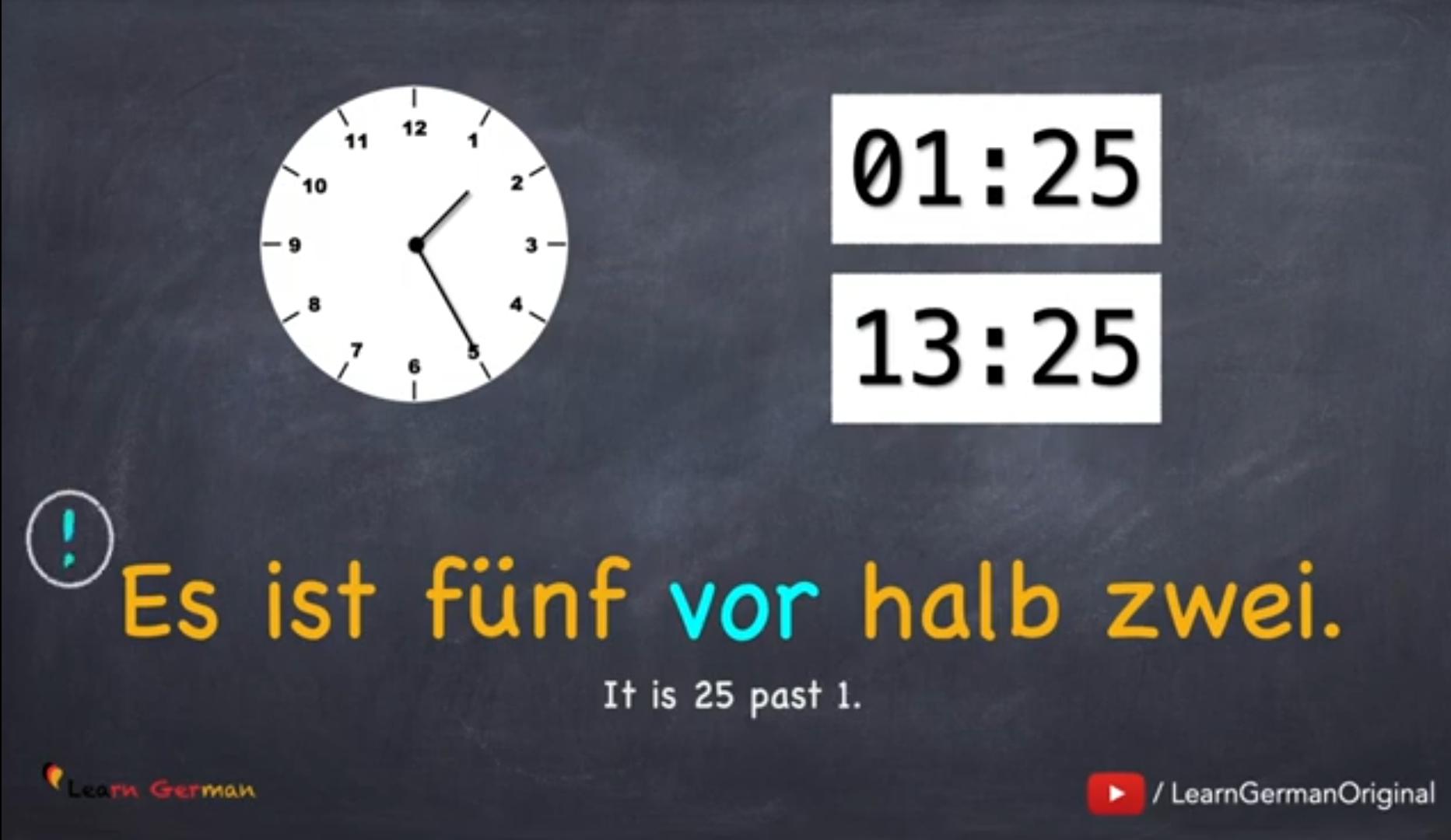
If someone asked me what's the time (wie spät ist es?) I will just say it's one twenty five (fünfundzwanzig eins)
My brain would take a long time to process and say something it's 5 to half to 2