r/GLPGrad • • Jul 28 '26 Bravo

The GLP-1 graduation guide, updated with all your feedback. Thank you all so much!

335 Upvotes

Hi all, huge thanks to everyone who commented on the first draft of the GLP graduation guide I shared. I said I'd wait to post a final version until I'd worked through the feedback, and I think this is a much better guide because of it. I've tried to credit the ideas below without putting words in anyone's mouth, so if I've misrepresented something you said, please correct me.

Quick disclosure again since it came up last time: I used AI to help organize and format this. I'm not a strong writer and it helped me structure everything I'd read and everything you all added. All the substance is from this sub, not generated from nowhere.

One thing a few of you raised that I want to say up front: this is still anecdotal, not data. A couple of you (thank you u/matsie, u/curiousbato) suggested the sub should think about collecting this more rigorously, maybe even a proper crowdsourced study. I'd genuinely like to help with that if people are serious about it. This guide isn't a replacement for that, it's just what's out there right now, organised.

Coming off GLP-1s: A maintenance guide built from this sub

Most of the clinical data says regain is common after stopping. But the people here who've kept it off all seem to agree on one thing. The medication was never the plan, it was the runway. The habits you build while on it are what carry you after.

A note before you start: graduating fully isn't the only valid outcome. A few people in the comments pointed out that staying on a low maintenance dose indefinitely, or coming off the "weight loss goal" mindset while staying on medication for its other benefits, is a legitimate path too, especially given some newer long term data on maintenance dosing. If your habits aren't fully locked in yet, staying on a lower dose while you keep building them isn't failure, it's just a different pace.

The core idea: build the habits now, not later

This is the most repeated point in every long term success post here. The people who did well used their time on the medication to lock in behaviors, cooking at home, hitting a protein target, walking daily, lifting weights, until those things stopped feeling like effort and just became what they do. Your default behavior is what runs the show on the days you're tired or stressed. If it isn't already solid, willpower alone probably won't save you post taper.

Part 1: How people actually tapered

There's no single right way. A few different approaches have worked for people here.

Gradual dose reduction plus a calorie increase in step. Step down a dose level roughly every month, while deliberately adding 100 to 200 calories a week, weighted toward protein. Several people said this blunted the rebound hunger spike almost entirely. One commenter went even slower, dropping by 0.5mg every other week, and said the small steps made a real difference.

Spacing out the shots. Same dose, longer intervals, before dropping a dose level and repeating. Feels like a slow off ramp instead of a hard stop. One caution from the comments worth taking seriously: spacing shots out too far can mean the medication actually clears your system between doses, so you're effectively coming off and then re-dosing from scratch each time, rather than tapering smoothly. Anecdotally, something like 10 days of spacing seemed fine to people, while stretching to 2 to 4 weeks between doses was where it started causing problems. This is a good one to run past your prescriber rather than freelancing.

Cold turkey. Plenty of long term successful grads just stopped outright, often from a low dose already. It worked fine for them, but expect the rebound hunger phase to hit harder than with a slow taper.

A few other things people mentioned: some built in a 5 lb buffer below goal weight before stopping, since some regain in week one (often water) is pretty close to universal. Others said it helped to mentally prepare for a bit of inflammation related weight gain in the first couple of months of tapering, so it doesn't feel like a crisis when the scale ticks up. And more than one person credited having a doctor actually involved in building the taper schedule with them.

Part 2: Red flags, when to actually call your doctor

A few graduates flagged that this needed its own section, so here it is. Most of what happens as you taper is uncomfortable but normal (see the Hunger Games section below). But some things are worth flagging to your doctor directly rather than pushing through:

  • Gastric motility issues (severe or ongoing digestive changes) that show up some time after stopping, not just right away

  • Persistent nausea, vomiting, or reflux that doesn't settle

  • Rapid, significant regain that's happening despite genuinely following your plan, not just normal fluctuation

  • Any of the disordered eating warning signs covered in Part 7 below

This isn't a complete medical list, just what came up from people's actual experience here. If anything feels off, it costs nothing to check in with your doctor.

Part 3: What to expect, the "Hunger Games" phase

This has an unofficial name here for a reason.

Timing: usually kicks in 3 to 6 weeks after your last dose, roughly when the drug fully clears your system. A few people felt it as early as week 2.

Duration: most described 4 to 6 weeks before it eased up.

Why it happens: when the drug clears, leptin (satiety) drops and ghrelin (appetite) rises. That's a real hormonal shift, not a willpower failure, and it does seem to level out for most people who pushed through it.

What helped, according to the comments:

  • Having low calorie, high volume food ready before it hits (celery, cucumber, popcorn, watermelon, sugar free jelly)

  • Reaching for a protein shake the moment hunger spikes, before it turns into snacking. A couple of people said this bought them time to figure out if they were actually hungry or just riding the wave

  • Staying properly hydrated. Dehydration can genuinely mimic hunger signals, and water itself helps with fullness

  • Prioritizing sleep. Poor sleep messes with the same hunger hormones (leptin and ghrelin) that the taper is already disrupting, so it stacks the deck against you

  • Not panicking at a few lbs gained, since that's usually glycogen and water, not fat

  • For some people, certain foods just aren't safe to "moderate" once the medication's buffer is gone. A few commenters said they had to remove specific trigger foods (heavily processed, sugary, or fried foods came up most) entirely rather than try to eat them in small amounts, treating it a bit like quitting smoking. More than one person said the cravings, and even the taste for those foods, genuinely faded once they were fully off the menu for a while

Part 4: The nutrition pattern that kept people's weight off

Different exact diets show up here (whole foods, higher protein/lower carb, calorie counted "eat anything in budget," intermittent fasting), but a few things kept repeating no matter the approach.

Protein, non negotiable. Numbers ranged from about 100g a day up to 180 to 230g depending on size and activity. The logic is that it's what keeps you from white knuckling hunger once the drug's suppression is gone.

Fiber and volume eating. Probably the single most cited technique on this sub. Build meals that are physically large, high in water and fiber, instead of calorie dense. Big salads, recipes bulked up with vegetables, raw veggie snacks.

Don't skip fat. Several people went too low fat and stayed hungry despite hitting protein and fiber. Adding a spoon of nut butter or some avocado was what actually satisfied them. Satiety triggers are individual, so if you're still hungry after protein and fiber, try fat before just adding more food generally.

Whole foods as the default, not a rule. Most successful grads still eat treats and takeout. The pattern is home cooked as the default and processed or restaurant food as the occasional exception, not the norm.

Be honest with your tracking. This came up strongly in the comments: a lot of "I'm eating the same and still gaining" situations don't hold up once someone actually logs everything carefully. It's less about honesty as a character trait and more that it's genuinely hard to eyeball portions accurately, especially with any history of obesity or a long time spent eating past fullness cues. If the scale isn't matching what you think you're eating, a short stretch of careful, precise tracking (weighing food, logging everything) usually tells you more than guessing does.

Part 5: Reverse dieting and diet breaks

This section split opinion in the comments, so here's a more balanced version than the first draft.

Reverse dieting is borrowed from bodybuilding: instead of jumping straight to normal eating once you stop, raise your calories back to maintenance gradually, commonly around 50 to 100 calories a week, weighted toward protein, rather than all at once. Some people here found it helped smooth out the transition. Others pushed back and said the evidence that it does anything metabolically beyond what a normal, careful calorie increase would do is thin, so don't treat it as essential, more as one option that worked for some people.

Diet breaks are a related but distinct idea with more research behind it: planned periods of eating at maintenance calories (not weight loss deficit) for a week or two, roughly every 8 to 12 weeks, rather than staying in a deficit continuously. This comes from research outside the GLP-1 world (the MATADOR study is the one that got mentioned), but the logic applies here too, especially if you're still trying to lose a bit more weight on a low dose or in early maintenance and finding yourself exhausted or running low on energy for daily life and exercise. If that's you, a genuine maintenance break rather than pushing through a deficit indefinitely is worth considering.

Part 6: Strength training deserves its own section

A few people said this got buried as a subpoint last time, and they're right, it's too important for that.

Building and keeping lean muscle mass is one of the most consistently cited factors in long term success here, and not just for how it looks. Muscle is a major site of glucose disposal, so more muscle means better blood sugar control and less metabolic pressure to regain. A few people credited it with letting them come off blood pressure or insulin sensitizing medications too, on top of the GLP-1 itself.

Practical notes from people who built this from scratch: start small and build gradually, you don't need a personal trainer (though it can help with form on things like deadlifts if you're new), and free apps plus YouTube videos were enough for most people to get going safely. I personally love Caroline Girvan's workouts, which can be found on Youtube. Her Iron program is a great place to start!

Part 7: Walking and cardio

Walking and daily steps might be the sleeper factor here. One long term grad made a strong case that a high daily step count (10 to 20k) matters more for weight specifically than structured workouts, since it doesn't spike hunger the way high intensity training can and it adds up across the whole day.

Cardio matters most for long term heart and general health, even if it's not the biggest lever for the scale specifically.

Part 8: The part the medication doesn't solve

This might be the most repeated hard lesson here. The drug suppresses the urge, but it doesn't rewire your relationship with food or stress. More than one long term grad described a quiet stress eating drift months into maintenance, not a dramatic binge, just weeks of choices driven by emotion instead of intention, and noted that without the drug's chemical brake, catching that is entirely on your own coping skills.

One of the most detailed comments on the last draft laid out a real toolkit for this, so I'm including it close to how it was written: if emotional overeating was a big part of your weight problem, it's worth deliberately building ways to regulate stress and emotion that don't involve food, and finding as many of these as you can. Things people mentioned: therapy, books or podcasts about emotional eating, journaling, deep breathing, meditation, mindfulness, time in nature, exercise, hobbies, reaching out to loved ones, and general stress management.

A few other things that seemed to help:

  • Naming what your actual pattern is (stress coping, grazing vs real bingeing, restriction anxiety) since the fix is different depending on which one it is

  • Professional support where possible. More than one person specifically credited a therapist as instrumental, not optional

  • "Don't let a bad moment become a bad day, don't let a bad day become a bad week." This exact framing came up independently from multiple people

  • Keeping planned treats in the plan rather than going for total restriction

  • Building your own internal coping ability, not just external support. A few people made the point that having people around you is great, but you also need to be able to steady yourself from the inside, since you won't always have someone else there in the moment

A serious caution, in this sub's own words: one detailed post here described developing a real eating disorder after stopping. Not because the med caused it directly, but because rapid loss, appetite suppression normalizing restriction, and fear of regain all came together, in someone with zero prior ED history. If you notice constant body checking, compulsive exercise with no rest days, intentional restriction for the first time, or any binge/purge pattern as you taper, that's worth bringing to a doctor or therapist, not white knuckling alone. Anxiety about regain is normal. It's when that anxiety starts driving those specific behaviors that it's worth addressing head on.

Rough timeline

  • On meds, pre taper: your habit building window. Lock in protein, meal structure, exercise, and a tracking method now while it's easier to do

  • Tapering: step down dose or space out shots (carefully, see Part 1), keep habits steady, increase calories in step if you're reverse tapering, expect some early inflammation related weight gain

  • 0 to 3 weeks post last dose: often deceptively easy

  • 3 to 6 weeks post last dose: rebound hunger typically hits. Expect it, lean on volume eating, hydration, sleep, and distraction

  • 6 to 11 weeks post last dose: for most people, hunger settles to a normal, predictable level

  • Months 3 to 12+: ongoing maintenance. Weigh ins, a trigger threshold, strength training, diet breaks if needed, staying alert to stress eating drift

  • 1+ years off: long term grads describe this as a fully embedded lifestyle at this point. Still needs attention, but it doesn't feel like a fight anymore

Quick reference checklist

  • Protein target hit daily, before the taper even starts

  • Volume eating as your default strategy, with specific trigger foods removed rather than "moderated" if needed

  • A tracking method chosen on purpose, weighed and logged honestly, not defaulted into nothing or into guessing

  • Strength training 2 to 3x a week, building over months

  • Daily walking, high step count

  • Hydration and sleep treated as hunger management tools, not afterthoughts

  • Frequent weigh ins with a small, clear trigger point

  • A taper plan discussed with your prescriber, including how shots are spaced, not an unplanned stop

  • A real toolkit for emotional eating, not just willpower

  • A support system, and the ability to self-soothe when that support isn't there in the moment

  • Room for planned treats, not total restriction

  • Patience with the hunger phase as something temporary and hormonal, not a verdict on whether this will work

  • Permission to stay on a low maintenance dose if that's what you need, graduating isn't a race

Where this came from

This guide is built from posts and comments across r/GLPGrad, paraphrased rather than quoted directly, plus everyone's feedback on the first draft. Some of the original threads, for anyone who wants to read the source material directly:

Thanks again to everyone who commented on the first draft, especially u/Character_Quail_5574, u/quadgoals_, u/JoyKil01, u/Tammie621, u/Im4Bordeaux, u/Usual-Lycophyte, @-indigo-violet-, u/curiousbato, u/matsie, u/Temporary-Bank3627, and u/jaydefit for the specific additions. If I've missed your point or gotten something wrong, please say so, this is still a living document.

r/GLPGrad • • 6h ago

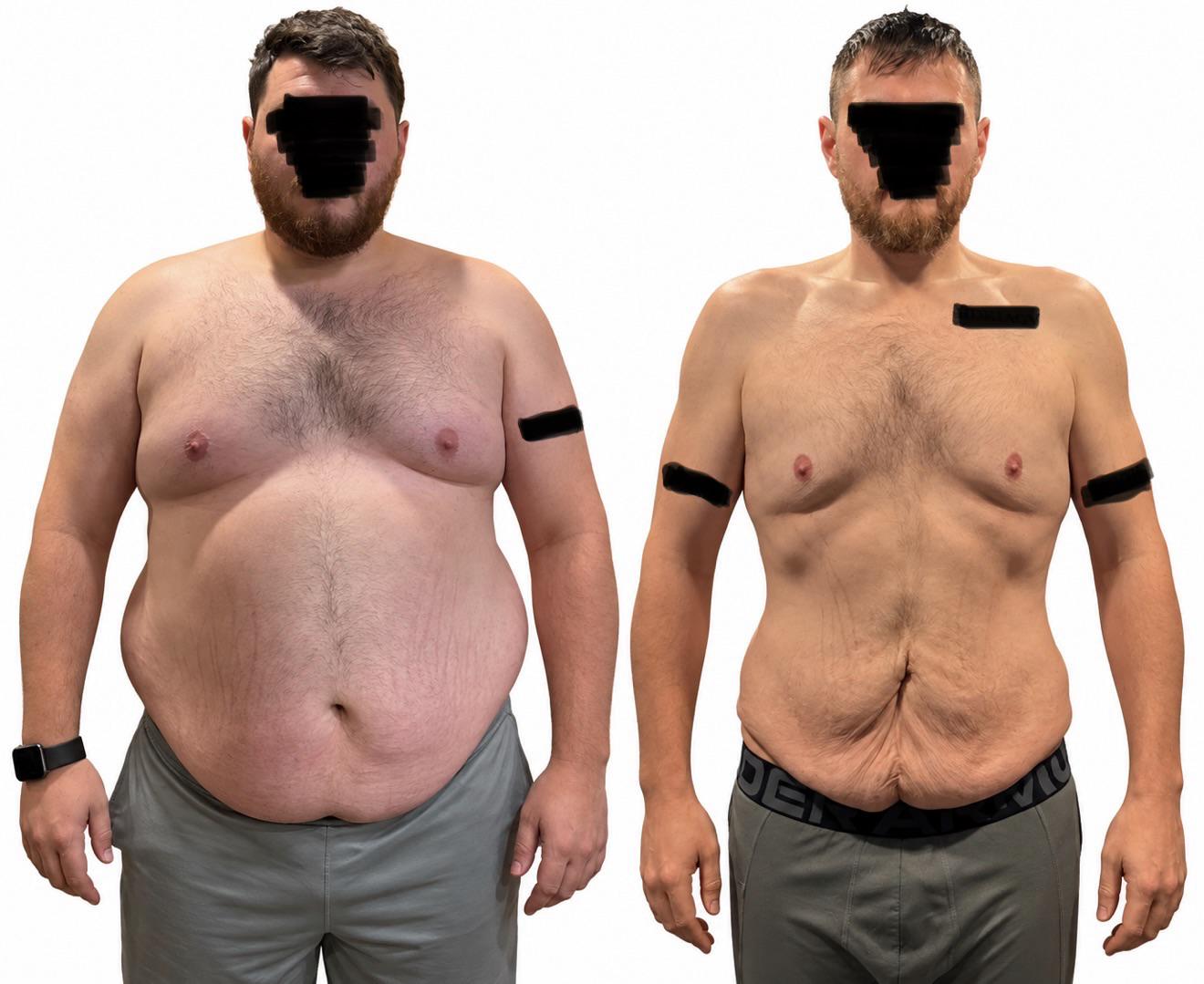
Seeking Advice 18 Months 130 lbs. Tips to maximize progress?

Post image
17 Upvotes

With the help of compounded semaglutide from a local clinic, Ive gone from 280lbs (310 was my lifetime max) to 175 lbs. I look and feel a million times better but as I finish tapering off of semaglutide Im becoming more lost on where to go from here. I lift weights moderately 3 times a week, and usually average about 120 grams of protein daily, but my loose skin,stretch marks, and lack of progress on muscle development is kind of disheartening lately.

I started tapering semaglutide by lowering the dose and extending to every two weeks about 3 months ago because I was really struggling to eat enough calories and Protien. When I was fully on the meds I would struggle to get about 75g of protien and 1600 calories. Now I can easily break 100g (usually more). But still trying to get closer to 150-170g and closer to 1800 calories even though I know that’s still not enough calories.

I see lots of before and after pictures where guys have way more muscle definition after similar weight loss. I know everyone’s different but the goal was never to be skinny/fat - the goal is to be healthy.

Anyone have suggestions on how to mitigate the loose skin and help with the strength training?


r/GLPGrad • • 2h ago

Seeking Advice Halp

2 Upvotes

I posted this in the wrong subreddit and it did not go well lol. So trying this here!

I (35F) was on zepbound for about a year. Highest dose was 5mg/0.5ml. I have lost about 40lb and I want to try losing the last 15-20lbs on my own. I stopped the medication and I can definitely feel the food noise coming back. I have also noticed my night sweats have returned.
Would love to hear about people successfully coming off the medication and any tips yall might have to continue either way the weight loss and keep it off.
I’m about 185-190lb and I’d like to get down to 170lb.


r/GLPGrad • • 2h ago

Cost effective maintenance? Zep to Foundayo?

2 Upvotes

Hey everyone! I’m currently a year and a half in on Zep. I’ve lost 75lbs and I’m overall happy and ready to start maintenance. I’ve had to pay out of pocket this whole time and this $450 a month is finally getting to be a bit much. I’m considering talking to my doctor about trying Foundayo for maintenance but concerned it won’t be enough for me since Zep is a dual agonist and Foundayo is not. Has anyone successfully switched from Zep to Foundayo? Im currently taking my shot every two weeks as i start this phase but open to all suggestions for maintenance that will also be easier on the wallet. Thanks! 🙏


r/GLPGrad • • 1h ago

Stomach issues after stopping

0 Upvotes

Persistent nausea and reflux 3 months after stopping compounded tirzepatide. Has anyone been through this?

I took compounded tirzepatide for 9 months in total and stopped about 3 months ago. I went through something similar when I came off GLP-1s back in April, with nausea and that "slowed stomach" feeling, but that went away around the 2 month mark. This time it hasn't gone away and I’m almost at the 3 month mark. I have constant, unpredictable nausea and acid reflux, and I sometimes will wake up nauseous around 1am even though I sleep upright. I thought certain foods were the trigger, so I cut out junk food, added sugars, and high-fat foods. Even on days when I eat only plain white rice, toast, and turkey, I can still end up nauseous. I've had an upper GI barium swallow and an abdominal ultrasound, and both came back normal. I tested negative for H. pylori in September. I tried pantoprazole for 5 days but stopped because I felt sicker after eating, though I know that wasn't a long enough trial. I'm seeing a GI doctor and plan to ask about a gastric emptying study and an upper endoscopy. In the meantime I'm taking a small dose of Zofran about every other day. I'm also on Prozac for depression and anxiety, so I'm trying to learn about prokinetics like domperidone and metoclopramide and which would be safest with my medications. Honestly, I'm exhausted from planning every meal around nausea and being afraid to eat. Has anyone had lingering GI problems after stopping a GLP-1? How long did it take to resolve, and what finally helped you?

Anyways, I know this is long- I’m here to chat if anyone has questions or needs to talk ❤️


r/GLPGrad • • 2h ago

Seeking Advice Forced Graduate

1 Upvotes

Hi all,
I had to stop my GLP-1 40 days ago because my insurance no longer covers it. For background I was on it to help with my sluggish weight loss with PCOS. I was on it for roughly 4 years on only lost around 40 pounds the first year and maintained it. No crazy weight loss, I was on 2mg. I had no bloating or water retention. Since I have come off Ozempic I have had a TON of bloating and water retention. I can feel it in my calves and see it in my face. I was just wondering if anyone else was experiencing this. Yes, my appetite has gone up, but I have edema now, and it’s freaking me out. Also, I have no history of heart failure my labs are good.


r/GLPGrad • • 22h ago

Success Story Going cold turkey

Post image
9 Upvotes

About a month ago I took my lost shot of 15mg. Due to financial reasons, I decided to stop tapering and learn from my habits to control. Im up for the challenge. The lowest I went was 67kg. Now im hovering between 68-69kg. However, i kept my calories to minimum around 1300-1400 calories. I want to test, to see how my body responds and carefully increase my calorie intake. The plan is for the body readjust instead of going crazy on calories. I still fear that I might go to my old self. That fear kept me controlled myself. I initially started 100kg. Now I feel better than ever.

I workout 3 times a week. Eat almost same food everyday. During drug I used to eat more because of the drug, sometimes take out. But I completely stopped eating since then. Im trying to understand that good nutrition matters more and currently in progress of building muscle. If anyone is worried, yes it does get challenging. I do get hungry more. But it’s a food noise. I just think that instead of eating anything I find. I would eat the same healthy food I learned to make instead. Sometimes I would eat the things I like, but I never exceed 1500-1600 calories. Sometimes they would go 1700 calories. I hope to keep that routine.

If you are deciding to go cold turkey. It is possible.


r/GLPGrad • • 1d ago

What to do next?

Thumbnail reddit.com
2 Upvotes

r/GLPGrad • • 2d ago

What do you tell curious people?

Post image
122 Upvotes

r/GLPGrad • • 2d ago

Seeking Advice Anxiety while decreasing your dose?

10 Upvotes

Hey yall! I am currently decreasing my GLP-1 dose. I only ever made it to 7.5 and I’m now back at 5 with plans to slowly decrease.

Both myself and my partner have been experiencing increased anxiety since dropping down the dose. Is this something most people have experienced?

I’d like to add that I have also recently changed my lamictal dose to increase and I don’t know if the change in how my body is metabolizing things is messing with that as well.


r/GLPGrad • • 2d ago

Seeking Advice afraid of stopping

18 Upvotes

I wanted to make this post because I don't really know how to explain this feeling to people who haven't experienced it. I'm 21M, and I've spent most of my teenage years being overweight/obese. At my heaviest, I was around 367 lbs. I started losing weight when I was around 19, and now I'm down to roughly 200–207 lbs. I've lost over 160 lbs, and while I'm obviously happy about how far I've come, I think I've developed a really unhealthy fear of gaining the weight back. It's weird because I'm finally getting to experience things I feel like I missed out on when I was younger. Feeling more confident, going out, meeting people, being comfortable with myself and just feeling like a normal young adult. But now there's this constant fear that I'll somehow lose all of that and end up being the person I used to be. Even a few days of overeating or seeing the scale jump makes me panic. I know some of it is water weight and normal fluctuations, but mentally it's so hard to separate that from the possibility of actually regaining. I've spent so long trying to get here that the thought of going backwards genuinely scares me. I also don't really know how to approach maintenance because I've been in weight-loss mode for so long that eating more feels almost wrong. Part of me just wants to enjoy being 21 without constantly thinking about food, calories and my weight, but another part of me is terrified of letting go of the control I've had for the past two years. I guess I'm wondering if anyone else who lost a significant amount of weight at a young age has experienced this. Does the fear eventually get better? How did you learn to live normally again without constantly worrying about becoming your old self


r/GLPGrad • • 1d ago

HAIRLOSS ON GLP1!! Any of you who had this horrible side effect. Please tell me your experience. How long did you shed? Did you stop shedding? Are you guys seeing regrowth? Does the hair come back? I’m suffering day in and day out. Please tell me what you guys did!

Post image
0 Upvotes

r/GLPGrad • • 2d ago

Success stories getting off a GLP1 and adding in supplements

Thumbnail reddit.com
0 Upvotes

r/GLPGrad • • 2d ago

Fear of Allergic Reaction

0 Upvotes

I have been on tirzepatide since May 2024. Started on compounded, and sprinkled a few mounjaro pens in when able. I’ve lost 101 lbs - 36F 5’3 SW:241 CW:140 GW:? - and I’m glad. Was still losing on 15mg, but went to 14 mg for a week to finish a vial, then to 12.75 for a week because I’d been unable to eat.

I have never had any thought about going off “forever” - I’ve always had a plan to taper down, and eventually microdose to maintain. However, from day 1 I’ve been afraid of having a sever allergic reaction - specifically anaphylaxis - and I set a timer on my phone for 10 minutes, 30 minutes, and 1 hour after my injection. Two weeks ago, I started a new vial from Hallandale; I started on Hallandale and never had issues. For whatever reason, I got myself SO worked up about the allergy situation that I had what was possibly the worst panic attack of my life. It was truly scary, and of course, panic attack symptoms can mimic allergic reaction symptoms….it was not good. Now, I’ve been ruminating nonstop, and unfortunately googled/read on Reddit accounts of people who have had no only anaphylaxis from tirzepatide, but who have had delayed onset allergic reactions a few days after their injections…some of them people who’ve been on the drug for a while!

I don’t have a history of allergies necessarily, but in 2023 I did have full-body hives that lasted for 4 days…twice, about 3 months apart. And no cause was ever found. I’m pretty traumatized from it!

Anyway, I skipped last week’s injection because I was too scared to do it. This week….I’m still terrified. And, I’m up about 3 lbs.

Has anyone experienced anything like this? I just don’t know what to do. I’ve thought about doing a 5 mg injection (I’m ready to move to maintenance), but like…that doesn’t ease my fears.

I’m just really at a loss for what to do. Side note: yes, I have OCD. Yes, this is currently my spiral. No, I don’t know how to break it - or I wouldn’t be reaching out to you fine folks!

TLDR; been on tirzepatide 30 months and suddenly am too scared to take it. Looking for advice to maintain weight loss without the drug, or how to push through the fear of anaphylaxis.


r/GLPGrad • • 2d ago

Does the feeling cold ever get better?

Thumbnail reddit.com
0 Upvotes

r/GLPGrad • • 3d ago

Not a grad, more like a quitter for now

7 Upvotes

I started Zepbound in February 2025. I was nervous about starting it, but decided to give it a try. I stayed on 2.5 mg for approximately a year 6months, then increased to 5 mg for about 4 months.
My numbers:
Starting weight (SW): 200 lbs
Goal weight (GW): 155 lbs
Current weight: 165 lbs
Total weight loss: 35–40 lbs
I actually came within 3 lbs of my goal weight (158)on 2.5 mg. It held for about a month. Eventually, I could tell 2.5 wasn’t working as well anymore. The food noise started creeping back in, I was experiencing more bloating, and I gained about 8 lbs. That’s when I decided to increase to 5 mg.
The thing is, I only lost 4 lbs or so on 5 mg in 4+months. I got down to around 162–164 and just stopped moving. I don’t want to keep increasing my dose. A few weeks ago I had to stop Zep for a minor surgery. It’s been about 3 weeks now, and I haven’t started back up.
Pros:
My mind/brain isn’t constantly busy.
Sleeping wonderfully.
My critical thinking seems improved.
Joints aren’t hurting (yet!).
No constipation.
No food noise (yet!).

Cons:
Bloating.
Runny nose.
Horrible gas.
Heartburn.

Something I didn’t realize until I stopped: My sleep quality while on Zep really wasn’t that great. My mind was busy. Songs just on repeat in my head constantly. The 2nd week after I stopped, I had what I can only describe as a mildly narcoleptic feeling, lol. I didn’t realize how much I needed my brain to just shut down and rest. It has been SO nice to let everything finally turn off and actually get some good sleep!

So here’s my question for those who have been on Zepbound longer or have taken breaks: Has anyone stopped for a couple of months, then gone back on and been successful at losing those last few pounds? I’d love to hear your experiences.
It’s a horrible time of year to take a break with the holidays coming, but honestly, I don’t care. I’m enjoying how I’m feeling at the moment, Zep will be there if I want to start back up.


r/GLPGrad • • 3d ago

Seeking Advice Non GLP1 alternatives to Mounjaro due to pancreatitis

8 Upvotes

I had a very good results with Mounjaro going down from 110 kg to 88 kg in 11 month. However, due to side effectI cannot take anyGLP 1 based medication anymore. I got pancreatytis and was admitted to hospital on Sunday and the doctors could not find any cause of it so Mounjaro is the only candidate left. So no more GLP 1.

My problem is that before Mounjaro I felt constant hunger and needed to eat a lot before I feel full and feeling full did not last long. So my weight always went up and I could only slow down how fast is it going up.

Because I am not allowed GLP 1 anymore I am considering Contrave as an alternative or any other option that could help me. I am ok with slower pace of weight loss. My main goal is to not get back 22 kg that I lost.

And slowly keep loosing weigh with combination of better diet and some exercise. I just need assistance to manage hunger.

Feeling sad because for the first time in my life I could controll my weight and I am not allowed to use the tool that was helping me so much.

Does anyone have anybexperience with alternatives?


r/GLPGrad • • 3d ago

Moving up a dose

Thumbnail reddit.com
0 Upvotes

r/GLPGrad • • 3d ago

Constipation after Reta

1 Upvotes

Did anyone experience severe constipation 4+ months after getting off of grey market Reta?


r/GLPGrad • • 4d ago

Thank you All

23 Upvotes

Just wanted to thank everyone here for posting updates.

I'm just about to finish up and I've got an exit plan in place, but of course I see so much about gaining all the weight back etc, it's so positive to come on here and see success stories.

Thank you.


r/GLPGrad • • 3d ago

What cooking / grocery habits helped you maintain once you stopped the GLP1?

12 Upvotes

Lost around 60lbs (230 -> 170) on tirz, started May 2025. Gonna start tapering off the med, aiming to be on 5mg for next 2 months, then 2.5mg for 2 months after that, before stopping.

I've mostly been living on protein shakes and one real meal a day, usually something I'd order from Uber Eats. That won't be sustainable once I stop, so I'm trying to build a normal cooking and grocery routine before the hunger comes back.

Basically trying to lock in good habits over the next 4 months.

What are your tips for protein-forward, fiber-forward, ideally low effort / fast meals to cook? Ideally one pan since I don't like washing dishes. I don't have an oven or air fryer but do have a stove, pans, rice cooker, microwave, and utensils and knives. I also work like 12 hours a day so need stuff that will taste good, is healthy (high protein, veggies, etc.), but not take hours to make.

Aiming to spend like, max $800 a month on groceries for 2 people (but the lower the better ofc).

What do your grocery lists look like? How often and when do you cook? How do you stop it from getting boring? Favorite one-pan or one-pot meals?

How did your appetite / cravings change, and what helped manage the food noise?

I've been lifting for the last year, around 3x a week, and I do HIIT a couple times a week too. So high protein / high fiber is a must imo


r/GLPGrad • • 3d ago

Seeking Advice Loss of appetite

0 Upvotes

Hi there. Did anyone else completely lose interest in food? I had a traumatic glp stop and they say the hunger noise comes back, I’m having the opposite I can barely eat, I force myself to when i go out with family so they don’t worry but I’m eating less than 600?calories a day and get pain in my stomach and bloating when I try to eat (like to the point I get tired and have to lie down, and I mean like after eating one hard boiled egg) I’m about to put myself back on ensure because although I have weight to lose (139 pounds at 5 feet) I recognize this is unhealthy. I walk everywhere to help my heart but I just have little to no hunger.


r/GLPGrad • • 3d ago

Seeking Advice Diarrhea

1 Upvotes

I’m 29 years old two years postpartum I was unable to lose weight for the last couple of years so I started Zepbound. I started slowly. I did 2 1/2 mg over six weeks and then when I updated to the 5 mg I had uncontrollable water diarrhea. I missed over a week of work over the course of a month and a half. I also did six weeks of the 5 mg I was hospitalized twice with like just diarrhea and vomiting and severe dehydration and really bad abdominal pain both times my labs and my CT scan came back negative for pancreatitis. My doctor said that the side effects were just side effects and I decided on my own to stop because I’m just so sick. I can’t get out of bed. I’m shitting nonstop. My butthole hurts like it’s just awful for the past week and a half so my last dose was on 11/14. The week after I didn’t take my shot I started to feel a little bit better energy levels returned appetite starter to return and I started to feel better and then this week I was even better yesterday. I thought I was constipated, so I drank a little bit of extra water and I tried to do an extra walk and then this morning I woke up overnight. I had really really really bad acid reflux to the point that like I felt like I was gonna throw up from the heartburn it was so bad and I had really bad sulfur burps again which I haven’t had since I stopped taking the medication and now I have watery diarrhea again like it’s literally just straight water. I called my doctor and she said that I could still be lasting side effects from the GLP one, but I’m about a week and a half since I’ve taken it and I don’t know why it would go away and then all the sudden come back so I don’t know this is normal. I don’t know what’s going on I literally wish I never started this medication. I’ve never felt like this in my whole life. I feel like dog shit every single day.


r/GLPGrad • • 4d ago

Seeking Advice Post-Wegovy weight gain

9 Upvotes

Hi everyone,
Ok so I’m starting wegovy soon but I’m worried about the weight gain after coming off it. I’d much rather lose 10kg permanently than lose 20kg but it not at all being long term.

I was thinking of going up in dose from 0.25 - 2.5mg and then going down to 1, 0.5, 0.25mg when coming off. Does anyone have any experience of easing off it. Btw, im a 195lb F

Thanks