r/ForensicPathology • • Jun 14 '20

Interested in a career in forensics or forensic pathology? Start here!

337 Upvotes

Welcome to r/ForensicPathology

We often get posts from interested high-school/university/medical students, or from those interested in changing careers, about how to start pursuing a career in forensics.

Hopefully, this can help.

First, you should know there is a difference between "forensics" (a broad field of study) and "forensic pathology" (a subspecialized form of medicine).

If you are interested in a career in forensics but do not want to become a forensic pathologist specifically, there are lots of options! I highly recommend looking at and joining the https://www.reddit.com/r/forensics/ community for further guidance!

Note: The terms "forensic pathologist" and "medical examiner" are functionally synonymous in most states, but ''forensic pathologist" is the title earned by completing the education, and "medical examiner" is the title earned by holding the job that the education qualifies you for. The term "coroner" is not synonymous with "forensic pathologist" nor "medical examiner." For further information on the problematic coroner system, here's a good place to start:

https://www.ncbi.nlm.nih.gov/books/NBK221913/

A "forensic pathologist" is someone who has completed:

  • Medical-school pre-requisite education: usually a 4-year degree, with specific class requirements depending on the specific medical school that you're applying to- check the website of the medical schools you are interested in attending for more information on specific requirements.

  • Medical school education: In the US, this is a 4-year curriculum which includes 2 mandatory tests from the USMLE. The medical school curriculum is variable, but the final outcome is that you earn a doctorate of medicine (either MD or DO) and are eligible for post-graduate training. (For further information, google "medical school curriculum" and "medical school pre-requisites").

  • Residency in (at least) anatomic pathology: Following medical school graduation, you will do paid work wherein you are still learning, but you bear the title of "doctor." At the end of this training, you will become eligible to take the board examination for (at least) anatomic pathology. (For further information, google "anatomic pathology residency," "AP/CP residency," "AP-only residency," "AP/NP residency," and "list of pathology residencies").

  • Fellowship in (at least) forensic pathology: Following residency graduation and becoming eligible to take the anatomic pathology board exam, you start another year of paid work wherein you are still learning, but now it is specifically in the field of forensic pathology. Following this year of focused training, you will become eligible to take the board examination for forensic pathology. After you take/pass this board examination, you will officially be a "forensic pathologist."

If you then use your credentials to be hired at a medical examiner's office, you will be a "Medical Examiner."

Now - there are exceptions to this process (if you've already completed medical school in a different country you won't have to repeat it in the USA) but none of the exceptions will decrease the amount of time that the education requires.

So - what does a medical examiner actually do?

Well, the short version is - post-mortem death investigation including, but not limited to, autopsies.

More specifically: Medical examiner responsibilities are really variable depending on the office that you work in.

Almost every medical examiner bears the full responsibility for the interpretation and description of the gross ("gross" in this context just means without the use of a microscope) and microscopic appearance of the external body and internal organs. Additionally, you will certify deaths (i.e., make death certificates) that are deemed sudden or suspicious to determine both a cause and manner of death. As with so many jobs, this will mean a significant amount of paperwork. You will also be responsible for the interpretation of the many tests which may be ordered (e.g., toxicology testing performed at a forensic toxicology laboratory will result in a numeric readout - which you will then interpret and choose how to incorporate into the whole story).

Some of the more common things that you might be responsible for doing include:

  • Assisting in scene investigation

  • Reviewing the medical chart for relevant medical information

  • Performing the evisceration during autopsies (meaning, use specific techniques to safely and efficiently remove the organs from the body for the purpose of further evaluation)

  • Choosing which portions of which organs require microscopic evaluation, and carefully removing those to be turned into "slides" to look at under the microscope for further evaluation

  • Choosing which cases require post-mortem imaging (X-rays are most common), and subsequently interpreting the images

It is also important to note that there are lots of people involved in a competent death investigation, and many of the responsibilities in the overall case are best managed by members of the team that are not the forensic pathologist.

Broadly, you should think of Medical Examiners as the people who (usually) have the final word in stating both a "cause" and "manner" of death.

Regarding death certificates (from https://jamanetwork.com/journals/jama/fullarticle/2767262 ), the emphasis is mine.

A US death certificate typically has 4 separate lines (part I) and is divided into sections: proximate cause, immediate cause, and mechanism. The proximate (underlying) cause is defined as the etiologically specific disease that in a natural and continuous sequence, uninterrupted by an efficient intervening cause, produced the fatality and without which the death would not have occurred. This must be included for it to be a competent death certificate. The cause of death statement may include an immediate cause (eg, bronchopneumonia), but it is only required to include the proximate (underlying) cause. The contributing conditions section (part II) is for diseases that contribute to death but do not cause the disease listed in part I.

The "manner" of death is the determination of the forensic pathologist as to whether they believe the death to be natural, accidental, homicide, or suicide. Note: In some jurisdictions of the United States, there is another manner of death called "therapeutic complication." Finally, if an answer cannot be made with any degree of certainty, it is possible to list "undetermined."

Here are a few "must-read" links for further information on the field of forensic pathology:

https://www.thename.org/ - The National Association of Medical Examiners (based in the USA, but actually does include an international community of medical examiners)

https://explorehealthcareers.org/career/forensic-science/forensic-pathologist/ - A fundamental breakdown of what the career is, what the requirements are, and where to start.

Are you looking for more personal guidance, regarding your unique situation?

Please feel encouraged to send a direct message to one of the moderators for personal discussion. We are busy, but are happy to answer your questions as our schedule allows! Please - for the sake of a productive discussion - read the information provided above and in the linked resources first!

Thank you for your interest and welcome to our community!

I hope that this brief description of what a forensic pathologist is, and what they do, is helpful!

/u/ErikHandberg

Erik Handberg, MD

EDIT for 2024

Frequently Asked Questions:

*What should I major in?*

Major in something that you feel you can be successful in academically. A 4.0 GPA in History is a lot more likely to get you into medical school than a 2.9 GPA in double major bio-engineering/molecular genetics.

You will learn how to be a doctor during medical school. If they thought it was truly necessary for you to know - they would make it a prerequisite class (and even those are questionable in their true necessity).

You will learn how to be a pathologist during residency. All pathologists can attest that when new interns start you expect to train them from the ground up - "what kind of cell is this?" "what do those do?" etc

You will learn how to be a forensic pathologist during fellowship, and beyond. If we couldn't train you to do the job properly with the only the requirements we have set - we would change the requirements.

*What college should I go to?*

Whichever one you are most likely to be academically successful in (see above). If you can get a 4.0 anywhere, then I recommend going wherever you have the most emotional support (the road is rough). If emotional support is equal, then go wherever is cheapest (trust me and my $3,000 per month student loan payments).

*How do I know if I can stomach the field?*

You will find out during the process. The long, long process will teach you a lot about what you like and don't like - and you will have lots of opportunities to branch out if you find something you prefer.

Focus on where you are at and the immediate next step. In high school, focus on learning how to navigate life as an adult and how to succeed in college. In college, focus on getting *excellent* grades and getting into medical school (this is the hardest part by far - at least in terms of frustration and lack of help).

When you are a pre-med and when you are a medical student *your goal is to become an excellent physician*. Do not aim to become a forensic pathologist yet - you need to be a great student before you can be a great medical student, and a great medical student before you can become a great physician, and then an excellent physician/anatomic pathologist, and *then* you can learn to be a great forensic pathologist.

The road is long and it is so frustrating to be at the beginning of the marathon looking down the road and seeing nothing but more road... focus on pacing, do the best you can at every step, and the end will come. And you will be a *much* better physician when you get there.

*What is the lifestyle like?*

Short answer: Great, for medicine.

Being a doctor is hard, very time consuming (especially during training), and generally not the way to "get rich" like it was in the 70s/80s. Most doctors aren't financially struggling - but if you are trying to get wealthy, especially ASAP, medicine is not the easiest or surest way to do it.

Pathology is still an excellent choice and most of my non-forensic colleagues are very happy with their choice. Forensic pathology is also still an excellent choice and our surveys show that we are consistently pretty happy compared to most fields in medicine.

Most pathologists work standard business hours with small adjustments for being "on-call" which is typically not demanding. I don't know many pathologists that find their work schedule is not amenable to having a family.

The field is welcome of diversity, hovers around 50% female, and still has the same difficulties that exist in all places(diversity of opinions and political beliefs, workforce filled with real people with real people problems like depression, alcoholism, racism, sexism, anger, etc.) but I don't believe it to be any different than other groups.

*Am I too old to do this? I am ____.*

If you start medical school when you are 22 then you will finish training at 30 years old at the earliest. You can practice for 40 years and retire at 70.

If you start medical school when you are 42 then you will finish training when you are 50 at the earliest. You can practice for 20 years and retire at 70.

Most people consider a "full career" around 20 years. So, what are you really asking here?

Will you feel "old" when you are there? Probably. Based on the fact you asked the question you probably will notice that you are older than your colleagues and they will notice too.

Will you be "capable" of doing the work? Probably. Assuming that you have no precluding disabilities (true regardless of age) and are willing to make the same lifestyle sacrifices that are required of everyone (many sleepless nights, missed time with family and friends, excessive stress, demanding work environments).

*Can I shadow a forensic pathologist / watch an autopsy /etc*

Maybe. That is up to the office that you ask.

Some offices are lenient, but generally speaking - think of it the same way that you would think of a heart surgery. If you contact a heart surgeon and say "I am a highschool student and think hearts and blood are cool - can I come watch a surgery?" they will probably say no.

If you contact a heart surgeon and say "I am a pre-medical college student and part of the cardiothoracic surgery interest group within our school, I have a 4.0 GPA and currently volunteer 10 hours per week at the local hospital where they informed me you are the lead cardiothoracic surgeon in the department, and was hoping you could advise me on ways to get more exposure to the field or any potential shadowing opportunities. I would like to better understand the reality of the practice" then you are more likely to get a positive response.

I strongly recommend you getting experience with a family practice doctor or pediatrician before (or at least in addition to) forensic pathology. You need to get into medical school and become a physician before you become a pathologist, and before you become a forensic pathologist. You need to spend a minimum of 4 years of your life learning living-person medicine first, and the same thought applies at least obliquely while doing anatomic pathology - you need to be confident about those as well.


r/ForensicPathology • • May 09 '25

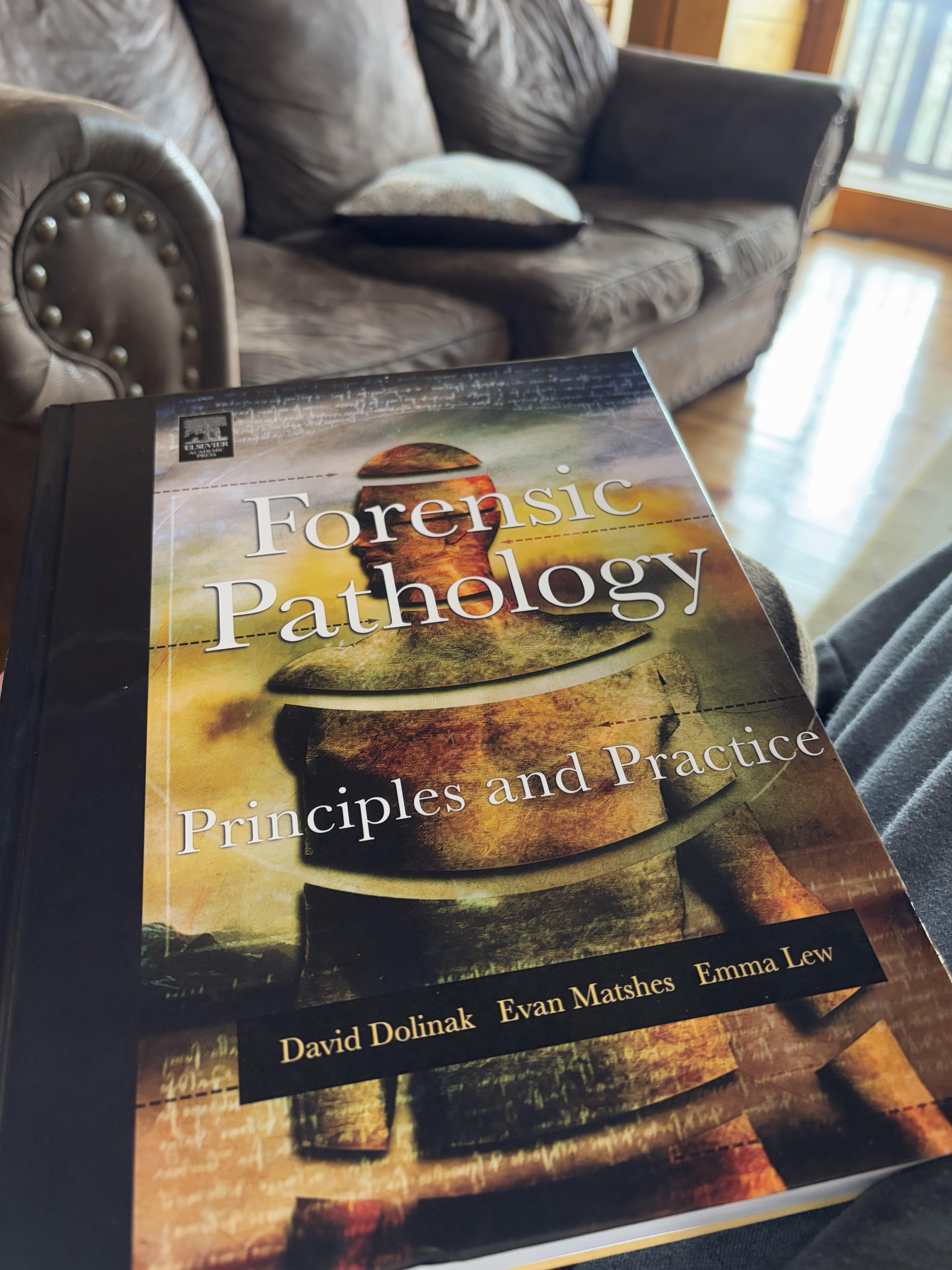
1st book on Forensic Pathology

Post image
219 Upvotes

Just completed this book, I think this might be the starting step towards a special journey. If there is anything that is a must read/watch, sign me up!


r/ForensicPathology • • Oct 28 '25

I’m “taking a seat” from “actual” doctors

147 Upvotes

Basically just a rant. Today I was flying home from Boston, where I met a woman. We were getting along pretty well, and it somehow came up that I just got into medical school (woohoo!). She mentioned that her kids are/were in medical school, and asked me what field I want to go into. When I answered forensic pathology, she immediately went “oh no.” 😭 Word-for-word she said “Well you shouldn’t take a seat from people who actually want to practice medicine.” Girl what??? I understand that not everyone knows FPs have to go to med school, but that felt like a really judgmental thing to say to a stranger.

Do y’all have any experience with this - FP not being perceived as “actual” medicine?


r/ForensicPathology • • Jun 23 '24

Smell of death

144 Upvotes

Might be a weird question. Listening to my podcasts about homicide investigations and hearing the detectives and crime scene investigators talking about the smell of decomposing bodies has me wondering what it smells like. Is there anything that can accurately compare to it?


r/ForensicPathology • • Nov 10 '24

My 18year old son’s autopsy came back, and I’m still so shattered and confused

133 Upvotes

My 18 year old son was a healthy active teen. He played football, wrestling and track throughout high school. He also was an avid gym bro. He was graduating high school in December and had signed up to be a Marine shortly after. On Oct 5 he crossed the finish line of a half marathon where we all were cheering him on and recording his triumph. Shortly after he crossed the finish line he collapsed. They started CPR and 911 was called. He was rushed to the hospital but they could not get his heart to beat again. He was gone. Since he was so young and healthy an autopsy was ordered. The coroner called and said he got the results back. My son died from a Pontine Hemorrhage due to Cerebral Vascular Malformation. The coroner couldn’t tell me if he was born with this, if it developed from an injury or? He couldn’t say if the race had anything to do with it. He really didn’t have a whole lot of info except what the report said. I guess I was just curious if anyone had any knowledge of this cause of death. Is it rare? Any info would help my shattered mom heart. Thank you


r/ForensicPathology • • Sep 24 '25

Thoughts on Jeffery Epstien’s autopsy photos? NSFW

119 Upvotes

This is going to be kind of weird to explain but does anyone else find something extremely off about them? To me they don’t look like him at all and here’s why:

1: Jeffrey Epstein's official cause of death was suicide by hanging & In a suicidal hanging the rope drags up the neck and attached itself to the individual and rides up the neck until it can't. Jeffery Epstein's autopsy (ref photo1) shows a clear homicide and a struggle to free himself near his esophagus.

-Neck fractures are uncommon in young to middle-aged hangings but become more common with age, especially involving the hyoid bone. (The official autopsy (by New York City’s Chief Medical Examiner, Dr. Barbara Sampson) found fractures in his hyoid bone and thyroid cartilage.)

2: In his autopsy photos they also show him laying on his back where we can see his ear and to me it just does not match up.

  • In his Mugshots the helix looks smooth and rounded, and curved evenly. In his autopsy photos the helix looks flatter and slightly collapsed, especially at the top.

  • In his mugshots the tragus sticks out more distinctly, and the antitragus is clearly separated. In his autopsy photos the tragus looks less pronounced, and the fold is harder to see.

-his earlobes appear sort of “detached” in his mugshot but in “his” autopsy photos they’re clearly attached.

3: the official cause of death was suicide by hanging, but Dr. Michael Baden (a forensic pathologist) hired by Epstein’s brother, argued that the neck fractures looked more like manual strangulation than suicide.

  • I have nothing to back this one up I just wanted to include it

So I’ve “argued” this topic with others as well and the response I get is that he was postmortem which would cause this disfiguration but here is my rebuttal to that:

  • Cartilage (the ear’s structural framework) does NOT change after death, soft tissue DOES . His clearly does in the autopsy photos

  • The tragus or antitragus are shaped differently cartilage cannot magically change after death

  • The ear canal placement relative to the jawline does not match.

  • Epstein’s autopsy showed three fractures: the hyoid bone and both sides of the thyroid cartilage. Fractures are more common in older men (he was 66), but usually it’s one bone, not three. And In a typical low-drop hanging (exactly like tying a sheet to a bunk), you usually don’t see as many fractures as he had This is also why Dr. Michael Baden said the injuries were “more consistent with strangulation.”

  • In many hangings, there’s petechiae (tiny red hemorrhages in the eyes/eyelids) due to venous obstruction & reports about Epstein’s autopsy don’t highlight this clearly so this ofc doesn’t prove it was a homicide, but it adds to doubts.

This is all just my own speculation but I’d love to hear what others think about it. If I’ve included ANY misinformation please correct me. For those who have not seen his autopsy photos & would like to reference them, they are linked here

https://postimg.cc/gallery/MKTQDhv

edit- a lot more people have been viewing this since the recent DOJ release and if anyones interested in knowing more about it I made this doc - https://drive.google.com/drive/folders/1o-ZZyPvR9nHPPYqns92LrjhQNbFR39Jp?usp=share_link


r/ForensicPathology • • Aug 20 '25

On the lighter side: I built a model

Thumbnail
gallery
115 Upvotes

I dabble in the lego-hobby and built a somewhat ok model of our autopsyroom setup. Thought I'd share here 😀


r/ForensicPathology • • Jan 03 '25

Causes of death in London in 1632

Post image
98 Upvotes

r/ForensicPathology • • Dec 27 '24

My favorite Christmas present.

Post image
95 Upvotes

Thank you to the community for your recommendations.


r/ForensicPathology • • Jun 25 '26

Help me understand how / why my brother died

Thumbnail
gallery
93 Upvotes

Update: I would like to express my profound gratitude to all who cared and made an effort to share their knowledge and expertise to answer my questions. The response from the community went wildly beyond anything I'd expected. It's a devastating journey but the kindness of strangers is making it somewhat less unbearable. Thank you <3

Apologies as it might be disturbing. I’m trying to figure out how/why our brother died. We received the report attached just this week. Sadly, he was a long-time alcoholic but the report states he wasn’t intoxicated at the time of passing. Could it be alcohol withdrawal syndrome that killed him? The body weight was quite low, could it be partly due to the decomposition process? Also, considering the description of the body, what might be the estimation regarding the date of death? The last activity which we managed to trace on a laptop was on 20 February 2026, and the body was discovered in the flat as late as on 28 March 2026, and this is what is stated as the date of death on the report. The flat was actually a very small studio, no more than 25 square metres, with just one small window, but I don’t know if it was closed at the time of the discovery, most probably it was. Unfortunately, we had regrettably little contact in the past months and this is making the whole situation even worse. As part of the grieving process and in order to stay as sane as I can, I’m trying to form an image of my brother’s last days / hours, no matter how explicit that might be. I just need to know. Did he suffer a lot? Surprisingly, the police didn’t inform us about the bottles, we only found out about them from the report. Initially we thought it might have been a brain stroke / haemorrhage as we have some related family history but it seems the report rules this out. I’d appreciate any conclusions/speculations regarding the cause and the circumstances of the death that can be formed based on the report.


r/ForensicPathology • • Aug 14 '25

12,000 members

Post image
86 Upvotes

Another awesome benchmark for this community.

As with previous benchmarks, I want to tell everyone here how impressed I am with the impact this community has had in spreading information and awareness of our field, and the level of kindness, curiosity, consideration, and professionalism this community has maintained!

Thank you for being a group that I’m genuinely proud to be part of and for being a tremendous resource to me, and to everyone online who is seeking information from/about forensic pathology.

Happy 12,000!


r/ForensicPathology • • Nov 07 '25

Help me understand my sister's autopsy

Thumbnail
gallery
84 Upvotes

We were told it was an accident. Took place in another city and couldn't get access to the footage. I'm not doubting it's an accident, just wanted to know what happened and how it could've happened.


r/ForensicPathology • • Oct 12 '25

Suicide by hanging question

80 Upvotes

My sister died a while back, it was ruled a suicide via hanging...and I'm wondering if anyone can help answer some questions...

I discovered her, she was 19 years old. she was suspended using a fabric robe belt, it was tied around her neck multiple times with multiple knots and suspending from a small support beam in the ceiling (not the actually joist) Her feet were not touching the ground, they hovered maybe 2-3 inches above the floor. Her time of death is somewhere between 815 am-915 am. I found her at 345 pm and she was pronounced dead at the hospital at 414pm

She was cut down and 911 was called pretty immediately after I found her. She was clearly dead and was heavy and very cold. It was hard to get the robe belt off her neck due to all the knots ....nevertheless I'm assuming her young age was a factor but life saving efforts were attempted by the paramedics who arrived and transported her to the hospital, where she was very quickly pronounced dead.

Question is, why was there no lividity found in her her legs or feet? Her autopsy said:

"Levidity was posterior in distribution"

I understand she wasn't there for the 8-12 hours, but she was still hanging for hours before being moved, wouldn't there been some signs of that? Why is it only in her back?

Next question: The autopsy report also said "No underlying brusining was seen in the neck musculature and the neck structures in tact."

Shouldn't there be some hemorrhaging is it normal for a hanging death to have no underlying brusing, especially after being in the position so long.

I'm guessing she would have had to tie one end to the ceiling and then begin wrapping the other ND around d her neck multiple ties and using lots of knots. She wouldn't have been tall enough to reach the ceiling so she would have had to use a chair to tie the one end up and then stay on the chair while wrapping her neck and stepping off... is my assumption.. shouldn't there be more evidence of a suicide in the autopsy report?

Also the report said history of depression but my mom is unclear where that came from as she never told them that (they didn't even speak to her or myself) she was never hospitalized or diagnosed with depression, can the medical examination make that declaration when she has never been treated for depression...I'm unsure where he would have got that from..

Anwyas thanks so much for any insight it's really appreciated


r/ForensicPathology • • Mar 03 '24

Out with the old, in with the new in LA.

Thumbnail
gallery
79 Upvotes

r/ForensicPathology • • Dec 02 '24

Death smell in the living

72 Upvotes

OK, I feel like I’m going crazy. My brother was found dead in October after about 4-5 days in there. We even had to hire a company to do bio remediation stuff. The smell is something I will never forget and it permeated everything. I’m just saying that I KNOW that smell. I dog sit for my mother-in-law and this morning when she brought her pup over she smelled like that!!!! I know it was her. I smelled it as soon as she walked in and I stepped away from her because I thought maybe I was just going crazy, but I still just wanted to get away from it. Then when she left, I hugged her and it smelled like it on her or her clothes or something! It was not the dog. It was definitely her. And definitely that smell. I was just around her yesterday and she always smells totally normal and clean and nice and her house is clean. Why in the world would a living person smell like that? Especially if she is normally clean and it just happened very suddenly. She has never smelled that way before EVER. Is it even possible for a living person to smell that way and if so, why??? How? She just left like 30 minutes ago and I am absolutely freaking out. 


r/ForensicPathology • • Jun 06 '24

Most shocking revelations you’ve come across during autopsy?

68 Upvotes

As the title says, what are the most shocking revelations or shocking things you’ve come across during autopsy?


r/ForensicPathology • • Jan 24 '23

4,000 members!

Post image
66 Upvotes

r/ForensicPathology • • Oct 19 '23

Came upon this picture online and thought we could have a little fun. Explain your answer.

Post image
63 Upvotes

r/ForensicPathology • • Apr 08 '23

Can anyone review my mom's autopsy report and give me some input please?

Thumbnail
gallery
63 Upvotes

r/ForensicPathology • • Sep 08 '23

It's hard to explain to people why I want to go into forensic pathology.

60 Upvotes

I'm about to graduate high school from a college-prep program, and I plan on going to college for biomedical studies (and then med school.) For a few years now, ever since I found out what a forensic pathologist was, it's been my dream job. However, whenever I try to explain why it's my dream job, people always think I'm an unstable creep.. I have a passion for science, but also especially for human anatomy. I regularly watch every human autopsy and surgery video I can find online, the human body is just so insanely interesting. I'd love to be able to dissect all sorts of bodies with all different kinds of stories, I think there's a beauty in death that many people are unable to appreciate. I also love the variety of the job. No two bodies are alike, and I know I would be having to do legal work too. But my first hurdle is getting through my first years of college... Does anyone have any similar experiences or advice? I don't really know anybody who can relate to my aspirations nor understand why I'm so passionate about medicine. I was so happy when I found this subreddit!


r/ForensicPathology • • Feb 06 '26

11,000 weekly visitors.

Post image
59 Upvotes

r/ForensicPathology • • Jul 21 '22

Our Forensic Pathology subreddit just hit 3,000 members!

Post image
53 Upvotes

r/ForensicPathology • • Jul 12 '26

Suicide by Antifreeze

50 Upvotes

Someone in our town decided to take his life by driving into the forest and drinking antifreeze. It took him 5 days to die, and not even close relatives were allowed to view his body.

I can't imagine the immense suffering. If anyone can tell me what may have happened day by day, hour by hour to that poor man, it may give me some kind of realistic closure. I know it will be graphic. But I want to know exactly what that dear man went through; what was happening to his body day by day. It's not out of morbid curiosity. It comes from a form of empathy for what he suffered through physically.

If anyone could weigh in psychologically, that would be helpful too. I know he once said to his partner that if he chose to go, please don't let anyone stop him.

He was happy and normal days before he drove off. I've heard of this.

But why antifreeze? Why? It's not like it was the only thing available in the moment. He was a clever, educated man. He specifically chose that way to go. He planned this.

Any insight, no matter how awful, would be greatly appreciated. I'm not satisfied with pouring glitter over the grim truth.

Thank you 🙏🏻❤️

Look after yourselves 🌷


r/ForensicPathology • • Jun 17 '22

medical examinier from graz

Post image
50 Upvotes