r/FootFunction
•
u/Lonely-Ad4462
•
Jun 04 '24
r/FootFunction • u/GoNorthYoungMan • Jan 01 '21
Happy New Year! Is 2021 the year to begin improving your feet? It takes time to create change, but the results can be very rewarding. It's always AMA around here, but maybe this comparison will get you thinking about something new.
r/FootFunction • u/Doll_Lover_ • Jan 30 '26
September 2024 vs January 2026
As you can see, my feet have been completely transformed! I had my left foot operated on March 13, 2025 and the right one on July 10th, 2025. I have to say, the difference is staggering and my feet feel so so much better. Sure, they aren’t perfect but compared to before? They’re pretty good now.
r/FootFunction
•
u/Eastern_Hour7988
•
Mar 11 '26
Bunion exercise progress
For 6 months I've been doing every bunion exercise I could come up with to improve my foot mechanics. I wanted to share the results, small gains but im really proud. I post this image to give hope to people that struggle with bunions and self image of their feet. This photo is in resting position.
Regarding the exercises...
Disclaimers:
This worked for me, I'm not saying this will work on everyone but I don't think it will harm people, if I did I wouldn't be sharing this.
English is not my native language, so if there's something you don't understand send me a private message and I will happily answer.
There's some people here that are saying I don't have bunions, I was told by 3 different doctors that I do, but just to be 1000% sure, I will get an x ray and once I get it I will post it here.
Im not claiming to be a doctor, but this helped me. Thats a fact and you can see it in the picture.
When it comes to repetitions I just started by doing 10 sets and gradually increased them. Do what feels right to your feet, but it should never be painful.
IF YOU'RE INTERESTED IN ACQUIRING A DETAILED VIDEO WHERE I DO EVERY EXERCISE COVERING UP TO THE 6TH MONTH, SEND ME A PRIVATE MESSAGE.
______________
BUNION EXERCISES
(After 2 months the exercises will be different)
1. Using your hand, grab the big toe and make circles,
first clockwise and then counter clockwise, then do
the same with your index, middle, ring and pinky
toes. Start with your right foot and then move to the
left one.
2. Using your hand, grab your big toe and point it
upwards while grabbing the other toes and point
them downwards. Start with your right foot and then
move to the left one.
3. Then do the opposite, grab your big toe and point it
downwards while grabbing the other toes and point
them upwards.
4. In a sitting position, use an elastic band and put it
around both big toes and separate your feet as
much as you can so the big toes remain in an
abducted position. Both feet should
always be on the ground.
5. In a sitting position, place your feet on the ground
and manually splay each toe. Stay like that for a while.
6. Stand up and manually splay each toe. You can do
some push ups.
7. Stand up in one feet, manually splaying the toes as
much as you can and remain in balance. Then do
the same with the other foot.
8. Do calf rises, manually splaying the toes as much as
you can.
9. Then try to do some sets where you remain in
position 2 of the calve rises. Remain in
balance. Always splaying the toes.
10. Do wall calf stretching splaying each toe.
11. Sit on the bed, and using your hands help the right
big toe abduct. Concentrate to form mind/muscle
connection. Repeat several times and then do the
left big toe.
12. Finally, try abducting the right big toe without using
your hands (it might take several sessions to
accomplish this), then do the left one. You may
notice the big toe twitching, this is a good sign. The
important thing is that you don’t give up.
______________
It's really important that you be mindful and concentrate with every exercise because it's all about making that new mind/muscle connection. In time you should definitely feel that "burn" that signals dormant muscles are waking up and working*.* It's also about developing a new relationship with your feet. In the past I didn't like my own, most of the time I wore socks because I didn't want to see them. Now it's different. Like I said, I feel like I learned to walk properly in my 30's.
I will post one final update in 6 months.
r/FootFunction • u/shukrarising • Feb 24 '21
Knights... Zero drop and flexible, who knew?
r/FootFunction • u/GoNorthYoungMan • Nov 24 '19
Working on your feet? First thing: make sure your hips have the right type of capacity to support strong feet by learning to control movement in your hip capsule.
r/FootFunction • u/GoNorthYoungMan • May 27 '19
Make stronger feet. Check out these exercise examples for complete beginners with immobile and/or flat feet, all the way up to those with already strong feet looking to find improvements.
r/FootFunction • u/Ordinary_Pirate5263 • Jul 14 '24
12 year old boy’s foot
12 year dealing with some pain. He plays sports and is pretty advanced for his age. But should we be concerned about this? His foot has grown two sizes in the last year or so, is it from growth spurt?
r/FootFunction • u/silenceredirectshere • Feb 06 '22
About 4 months worth of actively tracking my progress (forgot to take photos of the actual beginning). I'm not doing as much as I could be doing, but my feet feel better already regardless.
r/FootFunction • u/GoNorthYoungMan • Apr 27 '23
If strengthening, resting, and stretching haven't solved your foot/gait goals - maybe the problem is something else? Join my new community called Articular Health to get guided sequences to help assess & improve your feet & gait, and you won't have to figure it out by yourself.
tldr: I've just launched a membership community called Articular Health where you can follow self-guided sequences to assess and improve the way you express movement for the fundamental aspects of gait. If you've been finding it tricky to interpret or improve your feet/gait, this structured information can help to reach your goals. The intent of Articular Health is not to replace the other things you do, but to improve the basics of your movement quality, so you can get more out of those other things.
First off, thank you all for supporting /r/FootFunction - its been an amazing experience to help connect so many people, all focused on sharing their experience towards improving the health and capability of feet & gait. If you've not already seen it, you can read more about my story, see a before/after foot pic, and learn why I created this forum following recovery from a serious midfoot injury known as a lisfranc.
Over the past few years, I've met many people from around the world, completed thousands of assessments, and coordinated personalized programming to help solve for a wide range of foot and gait complaints. I've also noticed gaps in movement that repeat over and over, which mirror the things that limited my recovery for years. Especially for those who feel stuck, who have been to endless doctor and therapy visits, or have had inconsistent diagnoses.
And in virtually every case, the problem is not simply a lack of strength, or a lack of rest. Quite the contrary, as most people I evaluate have been putting in effort for their feet, ankles, knees and hips - but that still hasn't resolved their symptoms.
This is the case because strengthening efforts will tend to strengthen and further entrench the movement strategy you are currently using - even if that strategy is not great or incomplete. Resting can feel nice because you're not asking much of your body, but that also won't change how you can express movement that is currently missing. Plus, if you're primarily focused on your feet and not also the hips and ankles, it can be hard or impossible to make persistent change.
Instead, it takes specific active inputs to adapt how you control movement, to fill those gaps. I created Articular Health because I have not seen these type of inputs, which helped me to walk and run again, available online.
The structured sequences in Articular Health can teach you how to improve movement for the fundamental aspects of gait, where I typically see limitations like:
Hip rotation is not well expressed, or is controlled with an alternative strategy (learn why hip rotation is important)
Ankle rotation is not well expressed, particularly for the sides of the ankle for heel inversion/eversion (learn why ankle rotation is important)
Big toe flexion/extension is not well expressed (learn why big toe mobility is important)
There's a range of motion that is more passive than active, which is not useful, and cannot be strengthened until it becomes active (learn more)
There's an articular control strategy thats missing something (learn more about this for ankle/heel inversion)
A common compensation where the foot squeezes instead of flexes, which I see contributing to a wide variety of symptoms including metatarsalgia, capsulitis, neuromas, bunions, sesamoiditis and more
As you begin to identify and solve for these things, you can get more benefit from the activities and strengthening you're already doing, because you'll be adding new ability to utilize.
Within Articular Health I've created guided sequences to help you understand in detail how you control movement, and programming to confirm that you are able to demonstrate the most crucial aspects of articular health, and particularly to re-acquire those elements which may be missing.
As a member, you'll get access to assessment and programming sequences with summary worksheets to begin establishing your daily routine. For the fastest progression you choose to add 1:1 coaching with personalized programming. Or you can choose self-guided options and get help via chat or office hours, to refine your setups/routine to guide you forward. If you get stuck or need help, I can assist with alternative or customized setups.
Learn more about whats inside Articular Health (6 stages of guided programming sequences, and dozens of self-assessments covering hip rotation, ankle rotation, big toe flexion/extension, knee rotation, and midfoot pronation/supination)
See more general info from the Articular Health public feed
View the different types of membership (self guided, ongoing 1:1 coaching, or self-guided with 1-time coaching)
If you are interested in improving the fundamentals of gait there's no reason to keep guessing what to do, or hope that passive options or rest will solve a problem related to poorly controlled movement.
Thanks for your support, and I hope you'll join me at Articular Health to further understand and progress your foot journey!
Please let me know if you have any questions and I can try to help.
r/FootFunction • u/GoNorthYoungMan • Jun 15 '21
"If anything, their feet were more perfect than the others. There is no occupation more strenuous for the feet than trotting a rickshaw on hard pavement for many hours each day yet these men do it without pain or pathology." [SHULMAN, 1949]
r/FootFunction • u/GoNorthYoungMan • May 19 '20
Learn about 2nd toe capsulitis (metatarsalgia, ball of foot pain) and how your footwear may contribute to the problem with an elevated heel, toe kick, and narrow toebox.
r/FootFunction • u/GoNorthYoungMan • Apr 27 '23
General info & resources for understanding & improving foot function
Welcome to /r/FootFunction - here are some resources that you may find helpful!
(this is a new resource compilation, and still a work in progress)
Note that the information in this forum is for informational purposes, is not medical advice, and that you should always be cleared by your medical provider before trying any new exercise program.
If you begin working to improve your feet with any program, I'd suggest that you always work in your pain free ranges of motion only, and start exploring anything new with gentle, slow movement and low intensity - and only increase your effort once you're comfortable with how you respond.
You can read about my story here, see a before/after foot pic, and learn why I created this forum following recovery from a serious midfoot injury known as a lisfranc.
Since that time as I've been coaching foot function, I've realized that most people with foot complaints poorly express the fundamentals of gait, specifically hip rotation, ankle rotation, and big toe flexion/extension - even if they are quite strong or active.
In my experience, without these movement qualities as the foundation in foot function, its very likely that we can end up strengthening compensations, or movement strategies, that are not great, or incomplete.
There are plenty of people stronger than you with the same foot complaints you have, and plenty of people weaker than you with no complaints - so the common theme I see is that our articular health - which is the way we can or cannot express movement - determines our foot comfort and capability more than anything else.
This is the basis for the articular concepts I teach and believe in, and which I've found mostly absent in the clinical world. Note: not every resource you'll find in this post or forum uses that same point of view, and there are certainly a variety of ways to make things feel nicer.
Here are the limitations I see most commonly:
Hip rotation is not well expressed, or is controlled with an alternative strategy (learn why hip rotation is important)
Ankle rotation is not well expressed, particularly for the sides of the ankle for heel inversion/eversion (learn why ankle rotation is important)
Big toe flexion/extension is not well expressed (learn why big toe mobility is important)
There's a range of motion that is more passive than active, which is not useful, and cannot be strengthened until it becomes active (learn more)
There's an articular control strategy thats missing something (learn more about this for ankle/heel inversion)
A common compensation where the foot squeezes instead of flexes, which I see contributing to a wide variety of symptoms including metatarsalgia, capsulitis, neuromas, bunions, sesamoiditis and more
One of the best things you can do to support foot health is to understand how well you can express hip internal and external rotation. Here's a great series of hip capsule CARs setups to explore that from Ian Markow.
You may also want to review this video for intrinsic foot strengthening from Dr. Andreo Spina with exercise examples for complete beginners with immobile and/or flat feet, all the way up to those with already strong feet looking to find improvements. (while it doesn't help identify the right starting point for each person, it can help with some ideas to add into your routine)
Online resources for foot programming:
Articular Health (this one is my community with assessments/programming)
Other:
1949 study of > 5,000 individuals who have never worn modern shoes
Learn about /r/barefootrunning
Learn about /r/barefoot lifestyle
Anya's Reviews of barefoot/minimal shoes
r/FootFunction • u/irrelevant_character • Mar 09 '26
Toes up to everyone working on their feet in 2026
Girlfriend absolutely hates me doing thumbs up with my feet
r/FootFunction • u/no_longer-fun • Aug 13 '26
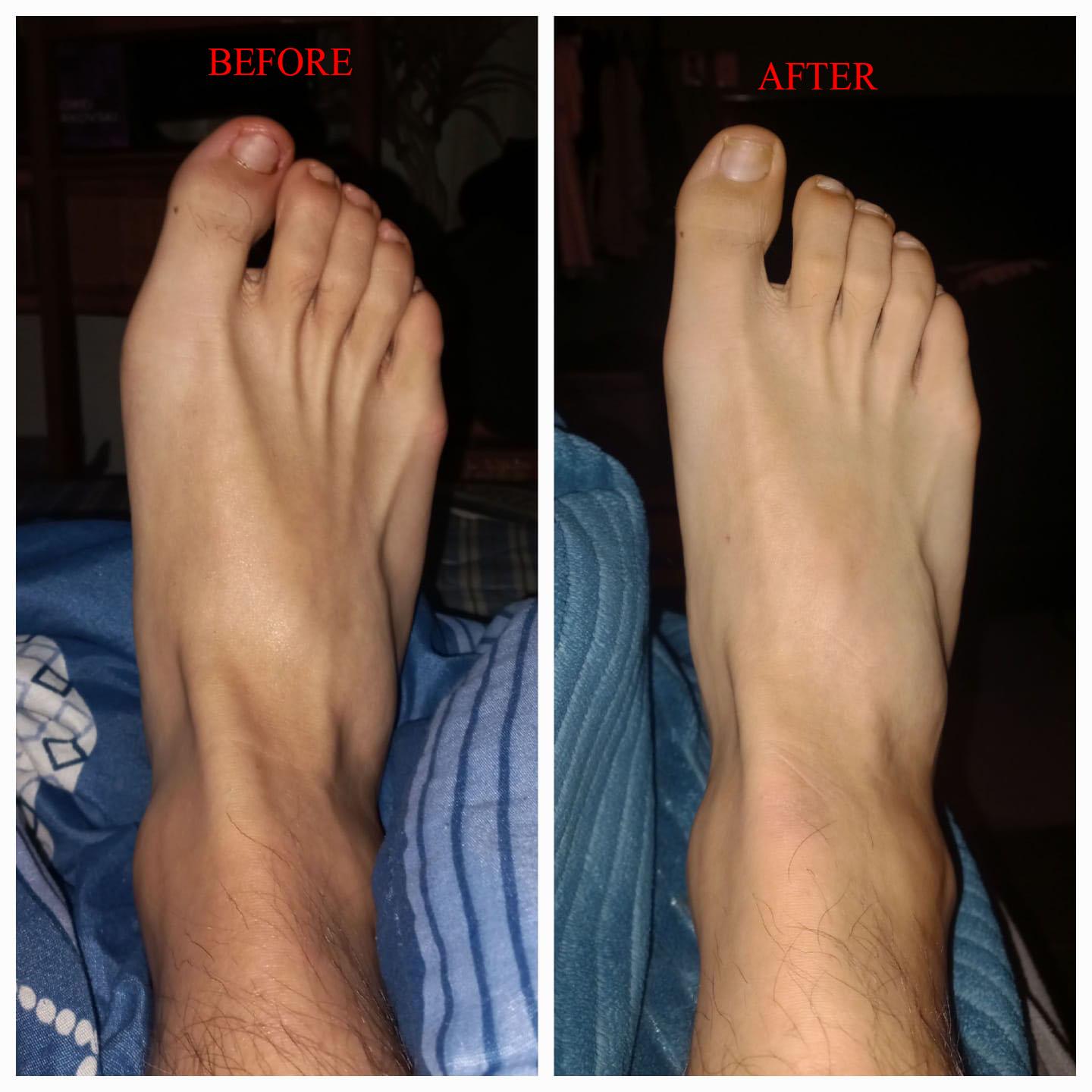
Foot strengthening
Both photos are with the foot standing in the floor.
before -> may 2026
after -> august 2026
You will not correct your feet unless your whole body is working in harmony.
I tried several times toe spacers, bunion fixers, toe specific exercises, etc. With no results. It was until I linked the dots between my bad postures (when sitting, standing, walking and even sleeping) and muscular imbalances (my right glute it was basically nonexistent).
One of the main changes that I suggest if you really want to progress its about your shoes. Your feet are actively working almost all the time that your awake so a shoe that allows a correct position of your feet will be contributing to the strengthen and alignment. You can start with a flat sandals to get around your house but you should get a barefoot shoes for your every day activities. I started using barefoot shoes around 13-15 months ago but I fully committed to the barefoot shoes like 3 months ago.
Toe spacers and bunion fixers I think are better to wear only when your are working out (For working out focus on single leg exercises) or at least walking. Wearing it when you are resting it will just cause pain and in my case I saw no benefit.
r/FootFunction • u/Waynedevvv • 16d ago
Feet exercise routine that fix my feet just 7 days (no exaggeration)
Disclaimer I have flat feet for 30 years. Not severe flat feet so I don’t feel pain at all. My symptoms are all toes stick together, visually flat arch, can’t lift any of my toe, feet and legs fatigue after 10 minutes of standing/walking/running.
I tired many things like customized insole, toe separators but never really trained my feet.
Then I decided to really commit to feet training after seeing lots of tutorials on YouTube and TikTok. Then I came across this routine. I stopped overthink and just keep doing it for seven days.
And man, the result is shocking, no kidding. I suddenly can lift my big toe up and really feel my feet muscle and my arch working. I couldn’t believe it. It really is that easy. 20 minutes a day and that’s it.
Some tips I figured:
- don’t overthink. There’s tons of exercises and equipment so it’s easily to be overwhelmed them ended up doing nothing. So just don’t overthink and take my routine and just do it for 7 days straight trust me.
- don’t get put off after the first two days because it will be hard. You will find out you can’t spread your toes but don’t worry just keep trying your muscles are working even if you don’t see it yet.
- it’s all about mental. when exercising don’t multitask. You are trying to control the muscles you never know how to use to it’s all about the brain. Use your brain to control the muscles. It’s hard but it will work.
- you won’t feel much progress in the first 3 days but once you notice you will already be lifting your toes.
Again im not severe condition but still quite bad flat feet. So if your situation is really bad or if you feel pain, dont take my advise and listen to your doctors. But for most people with just flat feet, please give it a go, just stick to it for 7 days and you will thank me later.
Only shoe left foot cus my right foot is ugly. Routine is in the photos. If you don’t have the equipment you DONT need it. Just do it without. Don’t overthink.
Please do them and if it helps come back and drop a comment to help others out cus it changed my life.
r/FootFunction • u/GoNorthYoungMan • Jan 07 '21
Re-created shoes from 5,300-year-old Ötzi the Iceman | "...a 12-mile hike at 10,000 feet. The result? “The perfect shoes for winter,” He walked barefoot...., wearing no socks in a temperature of 21F/-6C, but even in those harsh conditions, the shoes kept him warm, with not a single frozen toe."
r/FootFunction • u/karrebearrs • Mar 11 '22
Hey r/Footfunction! I’m a student working with CODE Footwear, a start-up that uses 3-D printing to make custom, minimalist shoes. They currently have two prototypes (see photos). We’d love some feedback – would you buy either type –If so, for how much? If not, why not? Do you have any questions?
r/FootFunction • u/gothsappho • Jan 05 '24
pain on the outside of ankle/lower leg when walking?
i've recently been trying to walk a lot more frequently, and i'm finding myself more regularly confronting an issue i've had for years. often when i walk, especially if i walk quickly or uphill, i get pretty intense pain on the outside of my lower leg, a little above my ankle. it happens sometimes on one leg and sometimes on both. it tends to come on quickly, often within 10 or 15 minutes of starting to walk. it progressively worsens if i keep walking on it, but the pain usually fades relatively quickly when i sit only to come back when i walk again.
i've recently started wearing barefoot shoes to walk most of the time. i feel like they help sometimes but i still get this pain. this has happened for years and often deters me from long walks just because it hurts so much. any idea what's going on and how i can help alleviate it?
UPDATE:
it seems that many people have had the same issue and have found my post! i wish i could say i've found 100% answers and investigated medically/through PT, but it's not financially feasible for me right now. i do want to pursue that in the future. but i have seen some marginal improvement, so i wanted to share some of the things that i've done that i think are helping:
walking more frequently in quality sneakers has helped some. just working those muscles without pain has made it easier to do
i've realized that my calves and lower legs are incredibly tight. when i pay close attention, this pain is usually preceded by calf soreness. so i've been trying to use tools to release the muscles and fascia in my lower legs. i've been using a graston tool on my ankles and upper calves, and i got a rollga foam roller to help work and release my soleus muscle. it's super tender but working on it feels so good
similiarly, i suspect i have plantar fasciitis and have been trying to work on my feet. i roll them out, but i'm also recently trying to work on my toe mobility too
i've been working out and strengthening all the muscles in my legs. i was not in good shape for a long time, and working with a trainer has helped me overall with strengthening everything. it's been great for my overall health, and i think it is contributing to improvement
i haven't solved the problem entirely, but i feel like i finally am moving toward freedom from this or at least minimzing it
r/FootFunction • u/ackaylita • Dec 10 '23
weird blister/sore between toes
hi, I do a lot of walking for work and I’ve recently taken up running and now my toe looks like this. My pinky toe seems to curl inward into my other toe and create this weird blister. I just haven’t seen anything like it before and wonder if anyone has advice besides wrapping a bandaid around it? thanks
also i wear hokas to run and keds at work if that makes a difference
r/FootFunction • u/GoNorthYoungMan • Nov 16 '20
Metatarsal massage | A great 1st step in creating your daily routine. Increasing space in the foot can be helpful for plantar fasciitis, capsulitis or other types of metatarsalgia, initializing midfoot rotation and more (2.5 mins)
r/FootFunction • u/GoNorthYoungMan • Mar 05 '22
Thinking about starting a podiatry cheat sheet for things like sesamoiditis, metatarsalgia, capsulitis, plantar tears and so on to help educate about the articular role with these conditions, and encourage conversation with their providers people not seeing resolution.
I often see the same few articular limitations for these things, and maybe having a list someplace can help educate people with the situation where their current programming has not been effective.
Metatarsalgia is imho a cop out. It's basically your auto mechanic saying your have engine-itis. It just means you have pain in the front part of the foot at the metatarsal heads, but doesn't say ANYTHING about more specifically where thats located, or why. A more specific diagnosis would be helpful because it would allow for a specific adaptation goal, rather than just accommodating an uncomfortable situation generally.
Diagnoses that would be better are things like:
3rd/4th toes can't show any ROM into flexion (which means the toes can't pull down to stabilize so you're just relying on the metatarsal heads to do so, hoping that the foot can contract into short foot to support itself which probably isn't happening)
2nd/3rd toes have passive ROM into extension, but zero active control (so the toes are being pushed all that way without any ability to manage the load; and the toes would start tightening up to guard that. maybe a precursor to capsulitis)
Ankle does not exhibit any ability to control itself into plantar flexion using the heel/calf to initiate the movement (which means the front of the foot is pushing down instead of having the energy managed by the calf)
Anything more specific about a single joints ability/lack of ability to do something would go a lot further here
Sesamoiditis is inflammation of the big toe sesamoids. In every case I've seen there is either a) no range of motion into big toe flexion or b) plenty range of motion but its all passive with near zero active control. I don't know why there's such a focus on managing the pain only, without regard to also understanding what the big toe can actually do or not and changing that. There's usually an ankle/midfoot component here too which initiated the problem, though getting control over big toe flexion is usually the piece that makes it feel nicer, and adding something upstream is what keeps it feeling better. I'd also say that plantar fasciitis symptoms running from the big toe to the heel seem to be a risk factor for sesamoiditis - in that if that big toe is not moving up/down enough, instead of the load being managed through that articulation it will tend to go through the ball of the big toe instead. And thats not a great long term plan.
Capsulitis - in the early stages it can feel like a pebble in your shoe. In my experience this is a toe that can't well express much ROM in any direction, so the joint tightens up to guard it chronically. (could be no ROM overall, or plenty of ROM but mostly passive) So when you walk it asks it to move and inflames it with every step. Sometimes its from a hyper-extension/hyper-flexion event, so initiated by an injury that causes it to freeze up, and then there's no attempt to specifically getting it moving again. Left like that for awhile, it can become more of a plantar tear situation, as the lack of joint articulation forces the tissue in the sole of the foot to be squished between ground and the joint and causing another problem there. Wearing stiff soled shoes and progressively re-acquiring expected ROM in very small doses of very light effort seems to be the right sequence here, we're talking 1% efforts at first.
There also seems to be a common lack of distinction between capsulitis symptoms (at the joint) and mortons neuroma symptoms (usually in between the joints) - and while I'm sure sometimes its hard to make that distinction at first in practice, I think it would be better to acknowledge that than just claim one or the other without regard to other articular status.
Rather than simply going to provider after provider, or trying accommodation after accommodation hoping for the best, I think there's a place for this type of info for those of us who have had lack of success through typical clinical programming and want to put some effort into adapting themselves.
In my view, part of it is understanding in higher detail about the nature of the problem, and part of it is finding someone who can take the detail and know what to do - my goal is to try and connect the dots by educating people about their foot such that they can try to locate someone to help resolve THAT SPECIFIC THING as the root cause for their complaint.
Thanks for reading, I hope this may create some new lines of thinking for anyone exploring solutions for these types of foot complaints. Please let me know any feedback, and I hope you have a great day!
r/FootFunction
•
u/Waynedevvv
•
Oct 13 '26
I spent 9 years doing the WRONG things and 1 year FINALLY fixing my flat feet. Here's everything i learned. (LONG ARTICLE)
a little about me:
30 years old now
realised i have flat feet 10 years ago
realised my flat feet were causing me problems 10 years ago
tried many different things (insoles, supportive shoes, etc.) that didn't really work (well, they seemed to work at the time, but didn't fix the underlying problem, and things eventually got even worse)
finally found the right method about a year ago and fixed my problems at the root
i didn't know i had flat feet until i realised that not everyone feels tired after standing for 5 minutes, walking for 10 minutes, or has knee pain after running for 10 minutes. i thought it was normal until i saw people who could walk and run for hours without any problems.
that's when i started looking into fixing my flat feet.
10 years ago, there wasn't much information online, so it was really hard to find proper guidance on how to treat flat feet. i ended up going to a specialised foot clinic for advice. the doctor recommended a few pairs of customised insoles (which were extremely expensive) and some supportive shoes.
it was great in the beginning. with the insoles and shoes, i could walk further and run longer. i still had some pain in random places, like my lower back after longer runs, but hey, it was already a huge improvement. the insoles gave my arches more support so they wouldn't collapse as much as before.
I thought i had fixed my flat feet.
After a few years, there was a week when i went travelling and forgot to bring my insoles and supportive shoes. i went for some walks and runs without them, and that's when i realised, im screwed.
My flat feet were now even worse than before. the tiredness after walking and pain after running were worse than i remembered. i'd been relying entirely on the support all these years, which gave me the false impression that my flat feet were fixed.
I then visited another specialist and had a more advanced assessment, where the specialist drew lines on my feet and ankles to check their alignment, arch angles, and more. (i didn't have any of this done during my first assessment years ago). highly recommended.
Then the specialist gave me some really good, life-changing advice. i followed the guidance, and it genuinely changed how my feet felt and functioned. so if you only take away one thing from my experience, this is it:
FOOT EXERCISE is the most important thing that helped me "fix" my flat feet
Insoles and supportive shoes are FINE if you need something to ease the pain or discomfort, depending on how bad your flat feet are. but DON'T rely on them as your only solution. If you're on a trip and need to go for a long walk, that's totally fine. But don't forget to train your feet too. Support can make walking more comfortable, but it doesn't necessarily build the strength your feet need. i wish i'd understood this much earlier.
Barefoot shoes are worth trying for everyday wear, but make the transition gradually. Even normal shoes are fine.
So the key to healthy feet, at least in my experience, is foot exercise. The goal is to have strong calves, strong ankles and strong feet. It's not necessarily about having "high" arches, because some people are naturally born with flat feet and might never develop high arches physically. in fact, many pro athletes have relatively flat feet, but strong muscles and good foot function can make a huge difference to the problems flat feet can cause.
Feet training is not difficult, but it takes time. The difficult part is being consistent for months. It takes months of training to build up strength and improve how your feet function. but the good news is, you can start noticing improvements within weeks. for me, it took about 6 weeks to start seeing some improvements. And that's with only 15 minutes a day.
There are tons of videos on instagram, tiktok and youtube teaching foot exercises. however, there are literally hundreds of exercises out there, and it can get overwhelming. so here are my tips to get you started:
dont overthink it. you dont need to learn 30 exercises. find 5 simple exercises, such as calf raises, toe stretches, etc., and just stick to those.
you dont need to buy anything if you dont want to. people are selling incline boards, resistance bands, yoga blocks, etc. they can be useful but aren't a must. one thing i'd recommend trying is a toe separator (especially if you have bunions). it can help with toe positioning during exercises. you can easily find them on Amazon.
10–15 minutes a day is enough to get started. consistency is key.
here are some good videos to get you started: https://www.instagram.com/r.a_movement/reel/DWf26i3k3cF/, https://www.instagram.com/p/DajZsrpgcpm/, https://www.instagram.com/p/DY2TQUMyNOT/
if you want something easier to follow, there are also apps with follow-along videos and progress tracking. i personally use https://apps.apple.com/us/app/arch-flat-feet-trainer/id6755728858?see-all=reviews&platform=iphone, but there are others too. just search "flat feet" in the app store.
If there's only one thing to take away from my personal experience: TRAIN YOUR FEET 10 MINUTES A DAY!