r/FAANGrecruiting • u/WoodenHedgehog100 • 21d ago
Is Palo Alto Networks FAANG level?
1
Upvotes
Is Palo Alto Networks as a SWE a great place to start your career? What do exit opportunities look like and is it on FAANG level?
r/FAANGrecruiting • u/Key_Confidence_8235 • Jul 20 '26
Why is it so difficult to get into Google (ex-deloitte.. prod ops/GTM) , currently working at a start up.. I get referred but nothing happens after even though the role fit is 95% or more… I even upskilled heavily to a point where I build my own agents, coming from non-coding backgroun.. and , am google AI professional certified.. any guidance as to how I can get that interview.. ecample roles include: Principal Lead, Go-To-Market AI Tools - United States
Product Strategy and Operations Lead, Chrome Business Operations
r/FAANGrecruiting • u/Hairy-Peanut8832 • Mar 05 '26
I'm, 24M from Mumbai well I used to live there but it was demolished by government because it was a slum area. We moved to navi Mumbai because the rent is comparatively low. I have done bachelor's in CS was hoping to do masters but due to financial restraints couldn't. My dad is a retired taxi driver and I am the sole earner in the family. I am struggling to find a job or even a interview. I was hoping if you guys can help me figure out what should I do with my life. I am currently working at my uncles eye wear store.
r/FAANGrecruiting • u/Ok-Party8048 • Feb 23 '26

I got this email from Amazon today,what are my chances of getting an interview?
r/FAANGrecruiting • u/Aware_Combination493 • Sep 07 '26
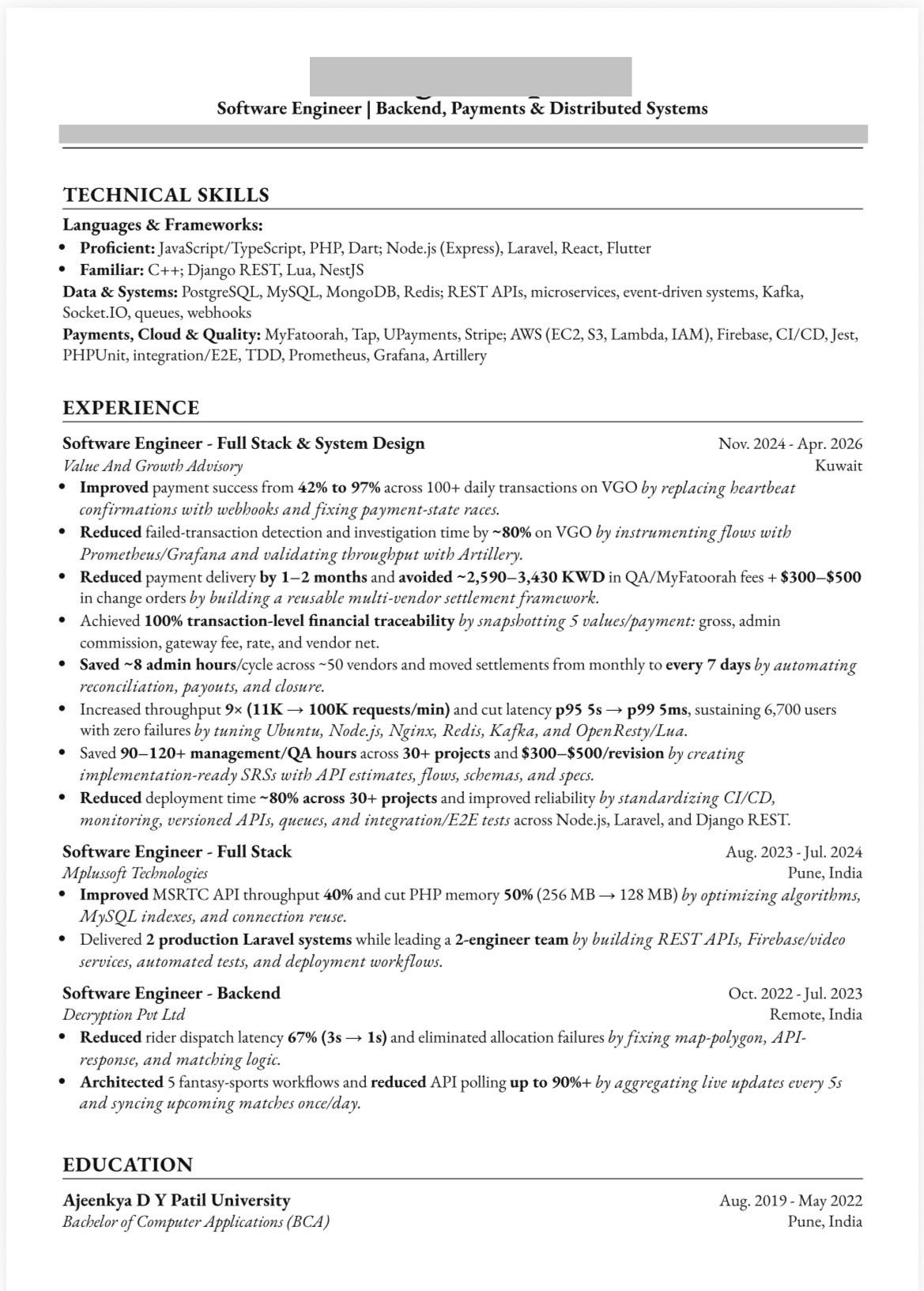
Hey guys can you check and tell me why I didn’t get shortlisted is this resume not good enough or what ?
r/FAANGrecruiting • u/ProfessionalTwo332 • Nov 09 '25
r/resumes exists for a reason if you want resume advice. This subreddit is for FAANG recruiting... not "is my resume good?"
If you're only getting rejections, you're either...
- only applying to prestigious companies that you're not remotely qualified for (your class project doesn't make you magically the perfect resume for FAANG companies / be more willing to apply to smaller companies)
- have a shitty resume (go to a RESUME subreddit then)
- are applying to old jobs / jobs that have already been filled (rule of thumb, apply to jobs posted within the past 24 hours)
- go to a suboptimal CS school (damn I'm sorry, keep applying and I wish you the best of luck)
- haven't applied enough (I applied to 400+ internships in freshman year and got nothing lmao)
It's fine to post your resume to ask if you're good enough to shoot for FAANG companies. However, the new influx of resume-related posts that just ask for resume advice... Holy shit, this place isn't for resume reviews. There's so many resume subreddits: r/resumes , r/careeradvice , r/cscareerquestions and r/csMajors , and honestly a fuck ton of people posting on this subreddit would genuinely benefit from posting there, instead of clogging here with irrelevant content.
r/FAANGrecruiting • u/nian2326076 • Sep 06 '25
I’ve been watching FAANG recruiting cycles closely this year, and a few patterns stand out:
•	Referrals help, but they don’t guarantee an interview anymore
•	Online assessments (esp. coding + SQL) are filtering out a ton of candidates early
•	Recruiters are moving faster on niche skillsets (cloud, data infra, ML), slower on generic SWE roles
It honestly feels less like “grind LC till you drop” and more like strategic prep: hitting the right skill areas, practicing the actual question formats companies are using, and showing versatility.
One thing that’s helped me is Prachub.com – it’s not just LC-style problems, but also SQL, data, and scenario-based interview prep that mirror what FAANG actually tests. Way more efficient than scattering resources across 10 sites.
Curious – for those of you applying this season, what’s been your biggest bottleneck: getting the interview, or passing the interview?
r/FAANGrecruiting • u/nian2326076 • Mar 03 '26
I recently interviewed with Uber for a Backend SDE-2 role. I didn’t make it through the entire process, but the experience itself was incredibly insightful — and honestly, a great reality check.
Since Uber is a dream company for many engineers, I wanted to write this post to help anyone preparing for similar roles. Hopefully, my experience saves you some surprises and helps you prepare better than I did.
The screening round focused purely on data structures and algorithms.
I was asked a graph problem, which turned out to be a variation of Number of Islands II. The trick was to dynamically add nodes and track connected components efficiently.
I optimized the solution using DSU (Disjoint Set Union / Union-Find).
If you’re curious, this is the exact problem:
Key takeaway:
Uber expects not just a working solution, but an optimized one. Knowing DSU, path compression, and union by rank really helped here.
This was hands down the hardest round for me.
You’re given:
A list of distinct words
A corresponding list of positive costs
You must construct a Binary Search Tree (BST) such that:
Inorder traversal gives words in lexicographical order
The total cost of the tree is minimized
If a word is placed at level L:
Contribution = (L + 1) × cost(word)The goal is to minimize the total weighted cost.
Input
One Optimal Tree:
Words: ["apple", "banana", "cherry"]
Costs: [3, 2, 4]

banana (0)
       /       \
  apple (1)   cherry (1)
TotalCost:
banana → (1 × 2) = 2
apple → (2 × 3) = 6
cherry → (2 × 4) = 8 Total = 16
This wasn’t a simple BST question.
It was a classic Optimal Binary Search Tree (OBST) / Dynamic Programming problem in disguise.
You needed to:
Realize that not all BSTs are equal
Use DP to decide which word should be the root to minimize weighted depth
Think in terms of subproblems over sorted ranges
Key takeaway:
Uber tests your ability to:
Identify known problem patterns
Translate problem statements into DP formulations
Reason about cost trade-offs, not just code
This round hurt the most — because I knew I could do better.
Given employees and managers, design APIs:
get(employee) → return manager
changeManager(employee, oldManager, newManager)
addEmployee(manager, employee)
Constraint:
👉 At least 2 operations must run in O(1) time
Instead of focusing on data structure choice, I:
Spent too much time writing LLD-style code
Over-engineered classes and interfaces
Lost sight of the time complexity requirement
The problem was really about:
HashMaps
Reverse mappings
Constant-time lookups
But under pressure, I optimized for clean code instead of correct constraints.
Key takeaway:
In interviews, clarity > beauty.
Solve the problem first. Refactor later (if time permits).
The final round was an HLD problem:
Topics discussed:
Key-value storage
Eviction strategies (LRU, TTL)
Concurrency
Read/write optimization
Write Ahead Log
However, this round is also where I made a conceptual mistake that I want to call out explicitly.
Despite the interviewer clearly mentioning that the cache was a single-node, non-distributed system, I kept bringing the discussion back to the CAP theorem — talking about consistency, availability, and partition tolerance.
In hindsight, this was unnecessary and slightly off-track.
CAP theorem becomes relevant when:
The system is distributed
Network partitions are possible
Trade-offs between consistency and availability must be made
In a single-machine, in-memory cache, partition tolerance is simply not a concern. The focus should have stayed on:
Data structures
Locking strategies
Read-write contention
Eviction mechanics
Memory efficiency

Resource: PracHub
I didn’t get selected — but I don’t consider this a failure.
This interview:
Exposed gaps in my DP depth
Taught me to prioritize constraints over code aesthetics
Reinforced how strong Uber’s backend bar really is
If you’re preparing for Uber:
Practice DSU, DP, and classic CS problems
Be ruthless about time complexity
Don’t over-engineer in coding rounds
Think out loud and justify every decision
If this post helps even one person feel more prepared, it’s worth sharing.
Good luck — and see you on the other side
r/FAANGrecruiting • u/ThrowRA102303 • Feb 03 '26

r/FAANGrecruiting • u/Nick-Astro67 • Jan 14 '26

Fill the resume review form here: https://forms.gle/xjbrbXXo9ioxxmqDA
I’ve gone through thousands of resumes, and honestly, it’s exhausting to see talented candidates hurt their chances without realizing it.
This resume should have been an automatic interview, but it nearly got filtered out by our ATS in under ten seconds. It wasn’t about qualifications—it was simple formatting errors that most people don’t notice, but that make resumes invisible to the software before a human even looks. If you have questions, my inbox is always open. Wishing you the best with your job search.
r/FAANGrecruiting • u/Curious_Street5478 • 1d ago
Hi everyone!
I’m currently exploring opportunities with both Google and Amazon (AWS) and would love to hear from people who have worked at either company, or ideally both.
Both opportunities are in the security/compliance space, at relatively similar levels (Google L4 vs Amazon L5), although the scope and responsibilities differ slightly.
Based on my conversations so far, I understand that there’s approximately a 20–30k difference in annual total compensation (TC) between the two roles.
I’m particularly interested in understanding how the two companies compare in terms of:
Work-life balance (WLB): How demanding are the workloads, and how much does this vary across teams?
Company culture: Management styles, team dynamics, internal politics, and general working environment.
Compensation: How do base salary, bonuses, and RSUs compare? Which company generally offers better compensation growth?
Career progression: Opportunities for promotion, internal mobility, and long-term career development.
Job security: How do both companies compare in terms of stability, performance expectations, and layoffs?
Brand value: Which company would be more beneficial for future career opportunities?
I’m currently working at another large tech company, so this wouldn’t necessarily be a move just for the sake of joining big tech.
My priorities are a good balance between compensation, WLB, and long-term career growth. I’m also curious whether a SGD 20–30k difference in TC would be significant enough to sway your decision, or whether one company offers enough advantages to justify potentially accepting lower compensation.
Would appreciate any insights, particularly from those familiar with the Singapore offices. If you had to choose between Google and AWS, which would you pick and why?
r/FAANGrecruiting • u/Character_Flounder15 • Jun 18 '26
I've been interviewing for a non technical role at Google for a while.
Interviewed w the hiring manager first, have had 2 other interviews, currently scheduled for a 4th interview.
This morning, the recruiter emails me with: "While you continue through this process, the team also thought you'd be a potential fit for another role...HIRING MANAGER said that if for any reason this role on his team doesn't work, then you'd be great to consider for this other role. When the team finds great talent for Google they want to ensure to find the best fit for you! Interested?"
IS THIS A FREAKING TEST? Trick question? What's normal here?
I knew Google was competitive, but now I've gone down a massive rabbit hole reading about all the interviews. And the loop. Like WHAT?
Also, what is the Googleyness interview? Like I'm so tired at this point. Having so many interviews, trying to manage my current very busy job, trying to be positive but not get my hopes up. Anyone have any wisdom?
r/FAANGrecruiting • u/NeatConversation8629 • Mar 03 '26
After 80 plus applications to big tech with almost zero response, I assumed my problem was LeetCode or referrals.
It was not.
It was how my impact was framed.
I rebuilt my resume in Kickresume mainly to clean up structure and remove formatting noise. What helped was not the template itself, but how it forced tighter, outcome driven bullets. I rewrote everything around measurable impact, scope, and decision making rather than tasks.
Instead of “Built distributed service,” it became something like “Designed and launched X service handling Y RPS, reducing latency by Z percent.”
Once I did that and aligned keywords directly to job descriptions, recruiter responses improved noticeably.
For those who cracked FAANG interviews, how aggressive were you about quantifying and scoping impact versus listing tech stack? Where did you see the biggest difference in callbacks?
r/FAANGrecruiting • u/Murphy_Dump • Apr 18 '26
Looking to switch jobs and applied for a bunch of SWE positions at Microsoft. Wanted to know beforehand if there is any drug screening during the hire process?
r/FAANGrecruiting • u/nian2326076 • Feb 27 '26
Summary: To pass a senior system design interview, you need to stop memorizing templates and start making decisions. 7 principles that we discussed are:
Question the prompt first.
Start with the “happy path.”
Defend one major trade-off.
Follow the data’s journey.
Design for the worst day.
Speak in numbers.
Prepare for the follow-up question.
If you ask ChatGPT or any search engine how to pass a system design interview, you usually get the same advice: “Learn step by step how load balancers work or Memorize how to design Twitter.”
That advice worked last year. It doesn’t work today.
Interviewers at companies like Meta, Uber, and OpenAI aren’t testing your memory. They are testing your judgment and want to see what happens when the perfect plan falls apart.
After taking and both passing and failing, some of the hardest system design loops in the industry, I’ve boiled my strategy down to 7 core principles. It’s not at all like fancy buzzwords. It just have practical steps to help you stay calm and pass the whiteboard test.
The biggest mistake you can make is hearing the prompt and immediately drawing a database box on the whiteboard.
When OpenAI ask:
“Design a cloud IDE running code,” don’t touch the board for five minutes. Instead ask:
- “Who are the users?
- Are they trusted internal staff, or random people on the internet?”
That one question can change the entire design. Because the users are untrusted strangers, I knew I couldn’t use standard Docker containers. I had to use strict, secure MicroVMs. If I had just started drawing boxes without asking, I would have failed in the first five minutes.
Rule: Spend the first 5 minutes defining exactly who the user is and what they really need to do.
When you finally start designing, build the simplest version first. I call this the Happy Path which is the path where nothing breaks.
Client → Server → Database.
Many candidates try to show off by adding complex event queues and caching layers immediately.
Don’t do this.
Build the basic version that works, and tell the interviewer:
“This is our starting point. Let’s talk about where it breaks at scale.”
Rule: Secure the easiest solution first, then add the complicated parts only when the interviewer asks for them.
Every system design is just a series of choices where neither option is perfect. Your job is to pick an option and explain why it’s the least bad choice.
Going back to the OpenAI cloud IDE question , I chose between speed and security. Containers are fast to start, but less secure. MicroVMs are highly secure, but slow to start. I chose MicroVMs and owned the trade-off.
Rule: Don’t just say what you used. Say what you didn’t use, and exactly why
A diagram with 15 boxes and 30 arrows is confusing. Instead of just pointing at shapes, trace the actual journey of the data.
When I designed a Surge Pricing Engine for Uber
Surge Pricing Engine for Uber, I narrated the flow: “A driver in Brooklyn turns on their app. Their phone sends a GPS ping. The ping hits our API Gateway. The Gateway passes it to our streaming service. The stream updates the supply counter in our database.”
Rule: Make the system humans-readable. Give the data a starting point and walk the interviewer through its trip.
The interviewer will try to break your system.
They will ask something like: “What happens if this server catches on fire?”
You need an answer ready. In my Uber interview, they asked what happens if the main pricing calculator crashes.
My answer was graceful failure: “The system will use the last known price for 3 minutes. If it’s still broken after 3 minutes, we simply turn surge pricing off. Better to lose a little money than to overcharge riders with broken math.”
Rule: Always have a backup plan for when things crash.
Saying “this database needs to be fast” means nothing.
Saying “this database needs to read data in under 50 milliseconds” means everything.
You don’t need to do complex math in your head, but you do need to understand limits. Know roughly how many requests a standard server can handle. Know the difference in speed between reading from memory (instant) and reading from a hard drive (slow).
Rule: Put a number on your goals. Is it 1,000 users or 1 million? Is it 2 seconds or 200 milliseconds?
This is what separates the people who get the job from the people who get the rejection email.
In my Uber interview, I hit all the main points for the surge pricing engine. But then the interviewer asked the curveball: “How do you handle pricing when a city boundary crosses different local laws?”
I froze. I hadn’t thought about local laws. I failed the interview because I didn’t prepare for the edge cases.
The follow-up question tests if you have real-world experience.
Rule: Once your design is finished, ask yourself: “If I told this to my boss, what is the first flaw they would point out?” Fix it before the interviewer asks.
Press enter or click to view image in full size

A system design interview is really just a conversation between two engineers trying to solve a hard problem together.
If you ask good questions, start simple, defend your choices, and plan for failure, you will perform better than 90% of the candidate pool.
If you want to practice real, company-specific questions (including the tricky follow-ups that tripped me up), I highly recommend practicing with a friend or using tools like PracHub to test your skills before the real thing.
Good luck out there.
r/FAANGrecruiting • u/nian2326076 • Apr 25 '26
I recently went through the interview process for Walmart and wanted to share my experience. The process moved quite fast—I was contacted by a recruiter, and the initial rounds were scheduled within a week, with the on-site rounds following the week after.
Prep Resource: LeetCode & PracHub Walmart SWE questions
Round 0: Team Fit / Screening
Discussed my current role and responsibilities.
Deep dive into project trade-offs: "Why did you choose X over Y?" and "What were the limitations of this design?"
Focused heavily on the rationale behind my architectural decisions.
Round 1: Algo & DSA
Brief walkthrough of my previous experience.
Coding Question 1: Word Break Problem (Can a string be formed using strings from a given set?).
Coding Question 2: Minimum number of platforms required (Interval Overlap/Scheduling problem).
Round 2: System Design (LLD/HLD)
Task: Design a ride-sharing application (like Uber/Lyft).
Note: The interviewer spent about 35-40 minutes on the HLD (High-Level Design), leaving very little time for LLD (Low-Level Design). I managed to cover the core model classes and discussed specific design patterns for the business logic.
Round 3: Technical Discussion (On-site)
Deep Dive: Discussions on concurrency, multi-threading, and locking mechanisms.
Distributed Systems: Covered Distributed Consistency and the CAP Theorem in detail.
Round 4: Technical Whiteboard (On-site)
Scenario: You are given a row of plants, each with an integer pesticide level.
Coding Task: Given an array plant[] of pesticide levels from left to right, return the number of days until plants stop dying.
Round 5: Hiring Manager (HM)
Discussion on role expectations and upcoming projects.
The HM was very transparent: there’s a hard deadline for a major project that requires frequent context switching but offers significant growth opportunities.
Verdict: Accepted the offer!
r/FAANGrecruiting • u/Alarmed-Bank2249 • May 05 '26
I was a SSE at Meta, recently laid off. I am based in London.
I would really appreciate a referral. I have always helped everyone on LinkedIn requesting for referral but haven't had any luck when it's my turn.
Hopefully reddit would be nice to be, please let me know if you are willing to provide me a referral for below companies or any other, I am not picky at the moment.
Microsoft, Apple, Spotify, Databricks, GitHub, Revolut, Cloudflare, Docker, Jane Street, Citadel etc.
Thanks in advance.
r/FAANGrecruiting • u/chaitu_anya • Feb 10 '26
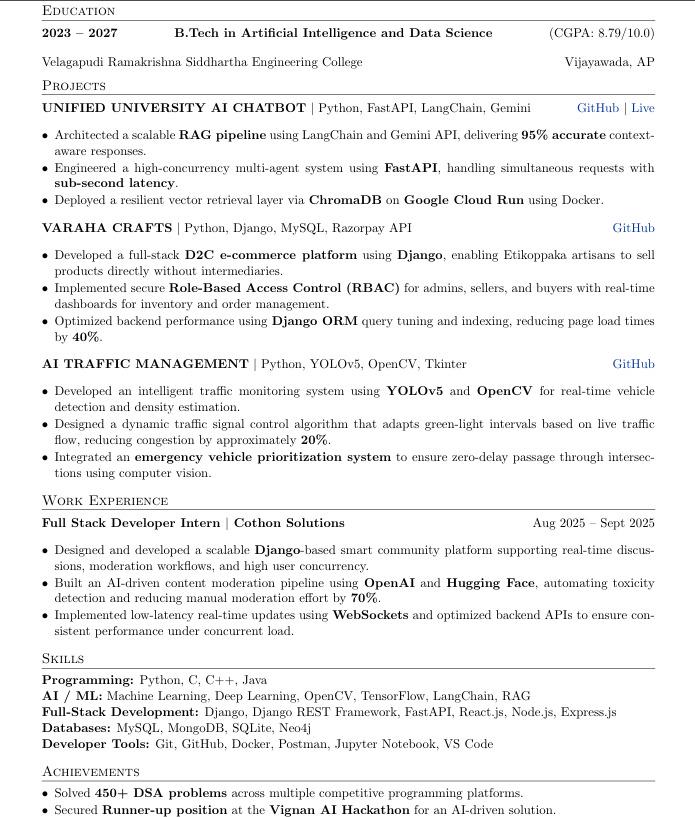
I want to get an internship
r/FAANGrecruiting • u/Strive-To-get-better • 22d ago
I have been working as a software engineer for over 6 years. I have given only one full loop at meta for a production engineer role which I didn’t end up clearing! I also must’ve applied for over a 100 different positions. It has been a life goal of mine to get into one of these companies and I feel like a failure to not even be able to get one single interview. People who work there how did you get in? I know someone who cheated his way into the system. He had help to clear interviews. I don’t wanna do anything of that sort but I genuinely want to there. How do I do it?
r/FAANGrecruiting • u/UnderstandingMain297 • Jul 05 '26

Hi everyone,
I’m an AI/Machine Learning Engineer and Developer actively looking for full-time roles or contract work in the UAE/US.
I have a strong academic and research background, completing my Master’s in Computer Science (GPA: 4.0), and I specialize in building out practical AI solutions, specifically working with Large Language Models (LLMs), predictive modeling, and computer vision.
My main problem is I’ve been applying to 20-30 roles a day totalling nearly 500+ jobs but still no luck all I got were 3-4 OAs which is a pretty bad conversion rate imo (I do need sponsorship in the US which might be affecting my chances ong). So, just reaching out here to see where I’m doing wrong/ places to improve in my resume. Any help is appreciated. Thanks for the time and advice in advance btw.
r/FAANGrecruiting • u/FRANKLINwoah • Aug 29 '26
Hello all, i am freaking out, i replied to my Google recruiter 4days late as i was sick and not feeling well.
The recruiter has not replied(maybe because i replied on a friday afternoon, and they would have already logged off for the week? ).
Do you think i have missed the boat? I feel so stupid i did not check my email .
Any recruiters/folks here who could suggest what to do?
r/FAANGrecruiting
•
u/NefariousnessDry9361
•
Jun 16 '26


9 years on the screening side. I read \~200 resumes a week, which means I’ve read the phrase “results-driven professional” more times than I’ve said “I love you” to my own wife. Take that as you will.
Here’s the uncomfortable part nobody wants to hear: the AI resume crisis isn’t that you used AI.
It’s that you used it exactly like the other 4,000 people who applied this month. I open my stack on a Monday and it’s the same resume wearing 200 different names. Same rhythm, same verbs, same suspiciously confident tone of a guy who has definitely never been confident at 9am.
What actually flipped is the signal. A year ago, a polished resume meant “this person can write.” Today it means “this person can copy-paste a job description into a chatbot.” Congratulations, so can my dog if I tape a treat to the spacebar.
So now I’m doing the opposite of what you’d expect - I’m hunting for the rough stuff. The weirdly specific detail. The number that’s oddly precise. The bullet that could only have come from someone who was actually in the room. That’s the gold now.
Unexpected insight #1, and this one annoys people: we don’t run “AI detectors.” They’re snake oil. They flag non-native speakers, they flag anyone who uses an em-dash (rest in peace, my favorite punctuation), they flag people who write too well. What the ATS and I actually punish is dumber and unfakeable: vagueness cosplaying as competence. “Spearheaded cross-functional synergy to drive innovation” — buddy, that sentence has the nutritional value of a napkin. It describes a CEO and an intern who booked a conference room. Equally.
Unexpected insight #2: the newer systems don’t even keyword-match anymore. They read the meaning of your resume and compare it to the job. Which means the old trick — cramming exact phrases from the posting — now actively backfires, because the words around them whisper “this human did not talk like this five seconds ago.” You played yourself.
Okay, the test that fixes 80% of resumes for free. Read any bullet and ask:
“Could someone genuinely terrible at this job have written this exact sentence?”
If yes — it’s filler. This question has destroyed more of my own resume than any recruiter ever did.
The 11 things that actually move people from total silence to interviews:
Delete anything that describes “a person.” “Responsible for managing projects” fits 40 million humans and one golden retriever. Cut it.
Every keyword needs a receipt. Don’t list a tool you can’t survive a 5-minute call about. We will ask. The space between your resume and your phone screen is a trapdoor, and a shocking number of people walk right into it talking about “extensive Python experience” while sweating through their shirt.
Duties → outcomes. Formula: action + scope + result. “Managed a team” → “Led 12 people on a $2.3M project, shipped 3 weeks early.” One is a job description. The other is a reason to hire you. Wild how different they look side by side.
Numbers, even rough ones. Quantified resumes pull ~2.5x more interviews in basically every study.
Tailor per job. The “one resume for everything” approach is the thing that actually smells like AI — not your writing. Same doc blasted to 200 postings is the real tell. You’re not being lazy efficiently, you’re being lazy expensively.
Fix your buzzword-to-proof ratio. “Excellent communicator,” “innovative,” “passionate” — pure static. If you’re a passionate self-starter, prove it with a thing that happened, not an adjective you applied to yourself like cologne.
Match ~70% of the role’s real language, woven in like a normal person, not pasted like a ransom note. That’s roughly where the 2.5x callback bump kicks in.
Single column. Boring headers. “Work Experience,” not “My Odyssey.” Parsers gag on tables, columns, and text-inside-images. Plot twist: a big share of “rejections” are just your file failing to open properly. You weren’t rejected. You were never read. Somehow that’s worse.
Lead each role with your best win. You get 6-7 seconds. That’s less time than it took you to read this bullet. Don’t bury the good stuff in line four where it goes to die.
Sand off the AI gloss. If a section reads suspiciously smooth -same sentence length, same cadence, that eerie chatbot calm -break it. Drop in a real detail, a real constraint, a real name. Imperfection is the most human signal there is. It’s the typo on the love letter that proves a person wrote it.
AI is your editor, never your author. Feed it your real wins and let it tighten. Let it write from nothing and it’ll confidently produce the exact generic mush we reject all day. It’s a brilliant intern with no memory and no shame. Supervise accordingly.
Honestly the whole list is one principle in 11 costumes: be specific, be true, be the only human alive who could’ve written this exact document
r/FAANGrecruiting • u/Upstairs-Box8374 • Feb 27 '26

I'm a 4th year undergrad student and wanted to pivot into PM roles. I haven't gotten into any of the APM/TPM positions, so I wanted resume advice as my current resume is very SWE focused.
Thanks!
r/FAANGrecruiting • u/BayathMashal • Feb 03 '26

What’s wrong with my resume
