r/EncapsulatedLanguage • u/Devono_knabo • Jun 24 '20
Logo 3.0 I did some shapes there are 5 shapes it goes from left to right top to bottom what's your favorite

3
Upvotes
r/EncapsulatedLanguage • u/Devono_knabo • Jun 24 '20
r/EncapsulatedLanguage • u/ArmoredFarmer • Jul 24 '20
the goal for this number proposal is to create a simple and effective system for numbers while maintaining as many patterns as possible without adding new phonemes.
| # | Phonemes |
|---|---|
| 0 | /pi/ |
| 1 | /biː/ |
| 2 | /fi/ |
| 3 | /ve/ |
| 4 | /teː/ |
| 5 | /de/ |
| 6 | /su/ |
| 7 | /zuː/ |
| 8 | /ku/ |
| 9 | /ga/ |
| 10 | /xaː/ |
| 11 | /ɣa/ |
Ive put many patterns onto this system labials take the first 4 numbers equaling 1/3 of all of the numbers then alveolars the next 4 and velars the last 4, plosives take the first 2 of the consonant categories half of 1/3 getting us to 1/6 and fricatives take the last 2. Unvoiced consonants are even and voiced are odd. Vowels break the numbers into 3s each being a quarter of the whole system the middle of each group of 3 is a long vowel, front vowels occupy the first 6 numbers, 1/2 and back vowels the last 6. This link explains the patterns: https://docs.google.com/spreadsheets/d/1PVGz79gMJiKe1fcL2v_XDJ-KGuYJjVbnFv2aDhD7Bso/edit#gid=0
To compose larger numbers you can sequence these words ending the whole number with a /n/ coda so that when multiple different numbers are next to each other you can tell when one ends and another begins. (e.i.: 5368 /devesukun/)
r/EncapsulatedLanguage • u/ActingAustralia • Jul 25 '20
Edit: I've changed the images based on a suggestion provided by /u/Zinkobe5
Hi all,
I’ve decided to submit my own proposal for the numbers. My proposal takes the best of u/Flamerate1 and u/ArmoredFarmer. I know Flamerate hasn’t finished submitting his formal proposal so it might be quite divergent from this.
The problem
I’ve noticed that the other proposals are based around mapping the numbers to the phonology in interesting ways, compactness and encapsulating odds and evens. I feel like this really isn’t going far enough.
The solution
Over the years, I developed a picture system in my head for numbers. Basically, I assigned specific images to numbers 1 - 10 to help with long number memorisation. This has allowed me to memorise long numbers in short term memory.
For example,
number 1 is assigned to the image of a sun
number 2 is assigned to the image of a dog.
If I wanted to memorise the number 1010110 in short terms memory I would simply make up a stupid story in my head from their images.
An example in this case is, “the sun shone down on the dog who barked at the sun. The sun then got angry at the dog. The dog barked and the dog barked at the sun.”
I have now effectively memorised that number. I will probably still remember that story in my head for hours to come. However, it only works if I have mentally memorised images to match numbers.
Therefore, I propose we build such a system into our language. Every single number must mean both a number and an everyday object. The child would therefore instinctively have an image assigned to every number and it would be very easy to teach them to access this system.
I’m proposing “12” have a special word just for itself as it seems a bit odd not to have a specific word for this number in our system. I’ve noticed the other proposals didn’t propose this.
Odds and evens / 2x multiplication
Long vowels are Odd / 2x multiplication
Short vowels are Even
Half
Any number that ends with a “n” is equal to 6 or more. This helps children identify the halfway point. Considering that we’re using a Base-12 system, I think this is important as they can’t easily rely on their fingers to pick it out when learning.
Quarters
The first quarter uses ‘u’
The second quarter uses ‘o’
The third quarter uses ‘i’
The fourth quarter uses ‘e’
'0' is a unique number so it just uses 'a'
This helps the child easily identify quarters and know what quarter a number belongs to.
Initial Consonants
They have no specific meaning beyond ensuring that each word is as different as possible to each other word in sequence. I’ve also used some of these to make some number words sound similar to their English counterparts for ease of learnability. Namely, the words for ‘2’ and ‘9’ and ‘10’ although a few others might also help.
Image words
The words I’ve chosen for images are for the body part starting from the palm, moving up the arm, to the chest, then face. This may conflict with future word-building when developing methods of encapsulation for biology, but in that case we can always come back and just officialise different words to share the same pronunciation as their numbers. The shared words should simply be interesting enough that a child or native speaker can create funny stories from them to memorise long chains of numbers.
| Number | Homophone image word | Pronunciation |
|---|---|---|
| 0 | Palm | a |
| 1 | Thumb | ru |
| 2 | Index finger | tu: |
| 3 | Middle finger | ku |
| 4 | Ring finger | fo: |
| 5 | Little finger | mo |
| 6 | Lower arm | vo: |
| 7 | Upper arm | sin |
| 8 | Chest | zi:n |
| 9 | Mouth | nin |
| 10 | Nose | te:n |
| 11 | Left eye | zen |
| 12 | Right eye | ge:n |
So, with this system the word '12' and 'Right eye' are both /ge:n/
Larger numbers
This system is designed for small numbers. For large numbers like 1,000,000,000 we might want to develop a system where we can literally say “1 pushed 9 to the left”. I’ll leave developing that idea up to the math gurus!
Let me know if you believe this system can be improved upon.
r/EncapsulatedLanguage • u/AceGravity12 • Oct 08 '20
current state:
/l/ is <l>
/j/ is <j>
/w/ is <w>
Proposed state:
/l/, /j/, and /w/ are all unwritten
Reason:
These three approximates only exist as vowel glides, and therefore never need to be written.
r/EncapsulatedLanguage • u/Mazmen • Jul 22 '20
I rethought the last proposal, so I hope this modification don't hurt your heart anymore :). I tried to maintain the logic of the number of lines for numbers 1,2,3 and their multiplus, and the grouping 3x4.
I realized that the vote for officialization was open. I do not believe that this new proposal will be accepted or contribute more with something. But I still considered that I should present it. Just because I think the numbers 123 are better on vertical geometric lines.

Regardless this, I also consider the proposal being voted very good.
r/EncapsulatedLanguage • u/nadelis_ju • Sep 09 '20
This is a small proposal to shift one of the vowel values for the purposes of optimization.
The Encapsulated Language has 6 vowel values /i/, /y/, /u/, /e/, /o/, and /a/ alongside their long versions.
The vowel /y/ is shifted to /ɨ/ alongside it's long version.
The vowels /i/ and /y/ are acoustically very close to each other, making them susceptible to vowel mergers. shifting /y/ to /ɨ/ creates an evenly spaced vowel space. This better optimizes the system for the listener by making them easier to distinguish.
The proposed vowel space has a nice symmetry where /i/, /u/, and /a/ are corners of a triangle while /ɨ/, /e/, and /o/ are between those corners. /e/ between /i/ and /a/, /o/ between /u/ and /a/, and /ɨ/ between /i/ and /u/.
This proposal doesn't propose any change to romanization. The vowel /ɨ/ would still be spelled as y in the romanization.
r/EncapsulatedLanguage • u/the_gaffer16 • Jul 19 '20
As shown by a poll a while back, it appears that the majority of this community prefers the SOV system over the SVO. In response I’d like to plead my case for the defense of the SVO system.
While it is true that the SOV system is the more common of the two, it must be noted that it is more common by a small margin. Regardless, I’d argue that commonality shouldn’t be regarded as the tipping point either, as there are other factors in play when choosing the syntactical structure of a language.
First, I’d argue that SVO is in some ways more intuitive than SOV. It better reflects the process over time of an action. If I throw a baseball to someone, the baseball begins with me, then the action of throwing is done, and then it (hopefully) finds the other player’s glove. This intuition is found in loads of common languages and conlangs like English, ISL, Chinese, and Esperanto.
You’ll also notice that these mentioned languages all have something in common. They all have a very minimalistic verb system and grammar as a whole, which is something I’d like introduced in this language. I’ve also found that in contrast most SOV languages are far more complex and have much more inflections.
Finally, there is just something simple and organized about SVO. It divides the subject and object with the verb, which neatly categorizes each part of the verb phrase and adds a bit of symmetry to the verb system. I also believe that this key separation of nouns will become hugely beneficial when we decide on tense markers, prepositions, adjectives, and adverbs.
Well that’s my long spiel, I’d like to know what you guys think!
r/EncapsulatedLanguage • u/RoundestSquare • May 21 '21
Instead of just talking about it, I want examples everywhere.
Insted ov just toking abaut it, uy wunt egzamplz evrywe.
What I'm using: || Whut uym yuuzing:
bit —> bit
beat —> byt
bet —> bet
bat —> bat
but —> but
boot —> buut
bot —> bot
boat —> boot
Dipthongs: || Dipþongz:
bate —> beyt
bite —> buyt
beaut —> byuut
If þis iz az intyuuitiv az posibl, it cuud teyk noo tuym at ol tuu lurn. (In þyory)
If this is as intuitive as possible, it should take no time at all to learn. (In theory)
Example: || egzumpl:
Noo mor dubl konsnents
No more double consonants
Ey konsnent kanot by in betwyn tuu vawls in thu saym silabl
A consonant cannot be in between two vowels in the same syllable
Thu letu “C” iz for “CH” and “SH”
The letter "C' is for "CH" and "SH"
Uy kunt fuynd ey letu for “TH” uthur than “Þ”
I can't find a letter for "TH" other than "Þ"
r/EncapsulatedLanguage • u/HS1D4ever • Aug 11 '20
This is a proposal to oficialise two mathematical symbols for the use in the Encapsulated Language.
Proposal: The symbols '>' (greater-than sign) and '<' (less-than sign) are to be used in the Encapsulated Language to denote inequality between two values.
Reason: These two symbols visualy denote the inequality perfectly, so there is no need to come up with something else. Both symbols are also very easy to write by hand.
The '>' sign is also already used in the current official logo.
r/EncapsulatedLanguage • u/nadelis_ju • Oct 08 '20
/l/, /j/, and /w/ are romanized the way they're in the IPA; /ɲ/, and /ŋ/ don't have romanizations.
/l/, /j/, and /w/ are not written in the romanization.
/ɲ/ is romanized as <nj>.
/ŋ/ is romanized as <nw>.
When used to separate the vowels in the nucleus, approximants have completely predictable forms and don't actually have any capacity to change meaning. Since the meaning would be encapsulated in the vowels, having the nucleus take a different form depending on which vowels are next to each other makes the meaning a little less clear.
Omitting the completely predictable approximants makes the romanization more concise. Having to write them in almost every syllable is quite cumbersome.
Since the letters <j> and <w> don't have any other use, using them for the nasals wouldn't create any conflict or possible confusion while also making their pronounciation predictable.
r/EncapsulatedLanguage • u/HS1D4ever • Aug 10 '20

r/EncapsulatedLanguage • u/nadelis_ju • Jul 28 '20
For those uninitiated complex numbers are mathematical objects containing i, a number which when squared gives -1. In the geometrical explanation used to give an intuition to people; imaginary numbers, the numberline in which i is the unit, are a 90° rotation of the real numbers, the numberline in which 1 is the unit. So when you rotate positive real numbers by 90° counterclockwise you get positive imaginery numbers and when you rotate positive imaginary numbers by 90° counterclockwise you get negative real numbers. In this model multiplying by i has the same effect as rotating by 90° counterclokwise. Thus when you square i or multiply i by i you get -1.

Vectors on the other hand are mathematical objects which have a direction and magnitude. They're very useful when you're dealing with things like vector spaces, gradient fields, forces in physics etc.
Since vectors and complex numbers have so much in common often times vectors are used as a way of representing them.
Wheh, that's a bit of math, isn't it?
Now if we were satisifed with this system working with only numbers we could just make words meaning ''-'' and ''i'' and it would be done but if that were the case noone would bat an eye about this language, would they?
If we use a system which can encode both the positive angle the number makes with the positive real axis and the distance of the number to the origin, we can intuitively talk about complex numbers and vectors while putting the fundamentals of geometry in place.
For this system to work we'll need a way of communicating about whole numbers and fractions. Then we'll add two roots meaning ''a 360° positive turn'' and ''distance''. Positive here doesn't necessarily mean counterclockwise, it's just a tradition in mathematics. For our purposes as long as they turn the same way it truly doesn't matter which way they turn.
Here's how it works:
First, you put the root for turn, I'll be using ''τ'' in this post,
Then you put a fraction indicating what fraction of a turn you're talking about. Negative real numbers would get half a turn, positive imaginary numbers would get quarter of a turn, positive real numbers would get zero turn,
Then you put the root for distance, I'll be using ''δ'' in this post,
And lastly you put the amount of distance from the origin.

A few examples of this system:
2 = 0° turn, 2 unit distance = τ 0 δ 2
3i = 90° turn, 3 unit distance = τ / 4 δ 3
-4 = 180° turn, 4 unit distance = τ / 2 δ 4
-5i = 270° turn, 5 unit distance = τ 3 / 4 δ 5
In theory you can add any integer to the number after ''τ'' but unless it's a mathematical problem you solve in highschool why would you. In practice it's much more practical to keep that number in the range 0 ≤ n < 1
Some of you might be thinking; writing these angles would take up so much space or that it's simply unnecessary. Well, this is where this system shines.
First of all, a child who says the number 2 as distance 2 turned 0 times would ask ''What a number turned x times would mean?'' and recieve the answer that it doesn't change the number. After this the child would ask ''Then why do we say that the number is not turned?'' after which they would learn about negative numbers which are turned halfway. But if negative numbers are turned halfway, what does it mean for a number to be turned quarter the way? At which point, without realizing they would step into the realm of complex numbers. After all, good notation makes people ask the right questions while bad notation confuses those that come across it.
And secondly always refering to numbers with how much they're turned would open the doors for oriantation nonspecific distance and more. In this system you can define circles as ''all points r distant from the same point'' in which you can use ''δ r'' to mean r distant, or you can define rectangles as ''a closed shape containing four 90° angles'' in which you can use ''τ / 4'' to mean 90° angle.
Or if you really don't want to write ''τ 0'' you just have to have a word indicating that it's a number rather than simply a distance. But then you would make every number which is not a positive real number, longer. :p
EDIT
In this system if two complex numbers are to be multiplied you'd add their angles and multiply their quantities.
6i*(-5i) = -30i2 = -(-30) = 30
(τ / 4 δ 6) * (τ 3 / 4 δ 5) = τ (1/4+3/4) δ 6*5 = τ 1 δ 30 = τ 0 δ 30 = 30
You can still express complex numbers as additions of real and imaginary numbers.
4 + 3i = (τ 0 δ 4) + (τ / 4 δ 3)
If one wants to express quaternions, numbers involving 3 turning directions labeled i, j, and k and the real numbers, or rotation in 3d space then a particle meaning 1st, 2nd, and 3rd would be placed right after the ''τ''.
For example take the equation that the quaternions are based upon:
i2=j2=k2=ijk=-1
((τ 1st )/ 4 δ 1)2 = ((τ 2nd )/ 4 δ 1)2 = ((τ 3rd )/ 4 δ 1)2 = ((τ 1st )/ 4 δ 1) * ((τ 2nd )/ 4 δ 1) * ((τ 3rd )/ 4 δ 1) = (τ/2 δ 1)
This equation is so much longer but since we can talk about just angles without specifying the distance, it can be shortened to:
((τ 1st )/ 4)2 = ((τ 2nd )/ 4)2 = ((τ 3rd )/ 4)2 = ((τ 1st )/ 4) * ((τ 2nd )/ 4) * ((τ 3rd )/ 4) = (τ/2)
Since some of these parenthesis and spaces can be deleted without changing the meaning, the new equation looks like this:
τ1st/4)2=τ2nd/4)2=τ3rd/4)2=τ1st/4*τ2nd/4*τ3rd/4=τ/2
The first part of this equation now says that if you turn 90° in the same direction twice you end up facing opposite to where you faced before you turned.
And the second part says that if you turned 90° in three distinct directions so that the first part of the equation is true, you would be facing opposite to where you faced before you turned.
And for completion here's the equation that the complex numbers are based upon:
i2=-1
τ/4)2=τ/2
Images are taken from: https://en.wikipedia.org/wiki/Complex_number
r/EncapsulatedLanguage • u/AceGravity12 • Sep 13 '20
Current state:
There is no standard for how phonotactics proposals are formmated
Proposed state:
Phonotactics in the encapsulated language is defined by a number of phoneme groups, the order in which these groups make a sylable, and phoneme replacement once the word is constructed.
Phoneme groups may have null value options and multiple phoneme groups may contain the same phonemes.
The current phonotactics rules would be unchanged but would be reformatted as
The onset phoneme group contains /p/, /b/, /t/, /d/, /k/, /g/, /ʔ/, /m/, /n/, /ɾ/, /f/, /v/, /s/, /z/, /ʃ/, /ʒ/, /x/, /ɣ/, /ts/, /dz/, /tʃ/, /dʒ/, /j/, and /l/
The approximate phoneme group contains a null phoneme, /j/, /l/, and /w/
The nucleus phoneme group contains /i/, /iː/, /y/, /yː/, /u/, /uː/, /e/, /eː/, /o/, /oː/, /a/, /aː/, /ai/, /ei/, /oi/, /au/, /eu/, and /ou/
The coda phoneme group contains a null phoneme, /p/, /b/, /t/, /d/, /k/, /g/, /m/, /n/, /ɾ/, /f/, /v/, /s/, /z/, /ʃ/, /ʒ/, /x/, /ɣ/, /ts/, /dz/, /tʃ/, and /dʒ/
A syllabel is built from an onset, an approximate, a nucleus, and a coda in that order.
There are currently no replacement rules, so here is an example of what one would look like:
/ti/ becomes /tʼi/
r/EncapsulatedLanguage • u/MiroslavE0 • Oct 30 '20
The Encapsulated Language uses a Base-6 numbering system with the following numeral-phoneme mapping:
| Number | Consonant | Vowel |
|---|---|---|
| 0 | ɕ | e |
| 1 | s | i |
| 2 | f | a |
| 3 | ʑ | y |
| 4 | z | o |
| 5 | v | u |
The dominant base is still base-6, but all bases from 1 to 36 are allowed to use.
There is a word which specifies the number base of a following number. This word is created in the same pattern: "number of number base in base-6 + suffix -anj-". This word is dropped when we use the base-6 or we use the same in a long dialogue, and this base doesn't change.
Numbers in all bases are created in the same way as in base-6.
Numerals are tied to these sounds:
| Number | Consonant | Vowel |
|---|---|---|
| 0 | ɕ | e |
| 1 | s | i |
| 2 | f | a |
| 3 | ʑ | y |
| 4 | z | o |
| 5 | v | u |
| 6 | c | ē |
| 7 | t | ī |
| 8 | p | ā |
| 9 | j | yh |
| 10 | d | ō |
| 11 | b | ū |
| 12 | chc | eme |
| 13 | st | imi |
| 14 | fp | ama |
| 15 | jhj | ymy |
| 16 | zd | omo |
| 17 | vb | umu |
| 18 | cch | ēme |
| 19 | ts | īmi |
| 20 | pf | āma |
| 21 | jjh | yhmy |
| 22 | dz | ōmo |
| 23 | bv | ūmu |
| 24 | kch | emē |
| 25 | ks | imī |
| 26 | kf | amā |
| 27 | gjh | ymyh |
| 28 | gz | omō |
| 29 | gv | umū |
| 30 | cx | ēmē |
| 31 | tx | īmī |
| 32 | px | āmā |
| 33 | jgh | yhmyh |
| 34 | dgh | ōmō |
| 35 | bgh | ūmū |
This system allows us to use the numbers of base-10, which can be helpful for beginners learning our language. It can be also a useful feature for any person, who doesn't want to learn our language, but wants to have a useful feature for remembering prices in supermarket, phone numbers and constant values in life without converting the price or the number to base-6. It will be very helpful for spreading our idea among simple people, who will not learn the whole language.
Furthermore, it can be helpful when raising a child in our language. I'm not sure, but I believe that raising a child who can use many number bases will be as helpful as raising a child who can use many languages.
r/EncapsulatedLanguage • u/nadelis_ju • Jul 27 '20
I've seen quite a number of numeral systems in this subreddit and many of them are great systems on paper but not on sounds.
When you're making a numeral system which would be spoken by real people you have to put some amount of redundancy because the real world isn't as clean as paper and the phonemes we make aren't as distinct as graphemes. If every phoneme represents a distinct digit you cannot expect any normal human to consistantly hear and distinguish thus understand every number. If the difference between 8 and 9 is voicing one phoneme people will sometimes misunderstand 945 as 845. Which will cause more problems than saying it a little shorter solves.
And on the subject of big numbers, we the people don't tend to use them all that much. In our day to day life and in advanced mathematics numbers are usually small and manageable. The places big numbers come up are usually in the sciences of the very big and the very small, namely astronomy and chemistry. These problems can easily be solved by refering to constants and directly naming very big numbers.
In astronomy the first method is used to talk about distance in words like ''lightyear''. It's as one can derive from it's form the distance light travels in a year. Though there's no wonder this word can be made even more iconic. Let's say we add a word ''sol'' meaning ''the speed of light'' and we have a particle ''mu'' meaning to multiply. We can form a word ''solmuyear'' which means the same thing as lightyear but is more clear in meaning.
The second method is used in chemistry with the word ''mole''. It's a very specific and a very big number. When you're dealing with big numbers of molecules you simply use mole to make things easier to write and say. Though there's an aspect of this method people here might not like and it's the arbitrariness of this method. You either make a compact word arbitrarily named which means a specific big number or you make a whole system of counting so compact people will mess it up anyways. And we'll be back to square one.
Thus when it comes to a system which can express numbers the clarity of the numbers is usually more important than its compactness and outside methods can always aid in the use of the big numbers.
Now let's return back to the matter of expressing numbers in a manner which includes it's meaning in its form.
The first idea which comes to mind is of course the positional system, it's compact, it's the way we write numbers and it's hard to understand in the context of speech due to the reasons I discussed in the second paragraph.
The second idea is what natural languages do. Yes, small numbers look arbitrary but at least there are anchors to conceptualize numbers like hundred, million, trillion, etc.
And the third idea is basing it on prime factorization. This way you'd express the multiplicative formation of every number but you'd need alot of roots to be able to express numbers, more than you'd need to use in a base 60 system. And it'd be hard to understand the additive relationship between numbers. Perhaps you can understand that 2*3*5 comes rigth after the prime 29 but what comes after the prime 641?
Perhaps the best system is a system combining the useful aspects of these systems. A system where small numbers up to a certain number are constructed using prime factorization. After that you have a positional system using these numbers to express even bigger numbers and for espacially big numbers like a sextillion we add new names to easily refer to them.
r/EncapsulatedLanguage • u/Flamerate1 • Aug 01 '20
Milk
Imagine instead of saying the word "milk," you simply stated a very compact phonetic version of the quadratic equation?
You remember the quadratic equation? I sure don't, but if you use this word "milk" on a daily basis as a child, it will become memorized and you will simply have to be taught how to read it in the future. “M” could be a whole part, “i” could be a whole part, “l” could be and so on.
That's what we're doing: The sounds that make up words in natural languages are often very arbitrary, but still take up information and memory, so what we're doing is just thinking to ourselves "man that's some free real estate" and putting in a bunch of compact academic information into the words of this language to allow a student to bypass a ton of the memorization process in school.
https://twitter.com/F1_For_Help/status/1289401304331124736
Small section to propose a possible solution.
Well there of course is a limit to this process. You might have thought about this to yourself knowing that it would be kind of hard to pack all of this information into such a small word. Well maybe the word is multiple syllables? Or maybe not, because it would be annoying to repeat a possibly 5+ syllable word just for milk.
“Hey mom! I want ingthsenchrepotalais!”
6 syllables, huh? Well maybe there’s another solution… Instead, maybe we just have a larger phrase of parts? What if you had the phrase, “fat free chocolate cow milk” and separated the quadratic equation into part of that phrase?
x=[-b√(b2-4ac)] / 2a- is read as “fat free chocolate cow milk?”
Absolutely…
… But the quadratic equation is unusually long in comparison to some much more common things like many of the other mathematical rules, multiplication, elements on the periodic table, etc. The list of things you might need to know either in real life application or to simply be a smarter person is just huge.
The time it takes for a student to get those things memorized is usually a lot of time that can be used for other things like practicing the skills they may introduce or possibly memorizing something even larger that is derived from those smaller things.
This is the kind of the thought that we, who’re working on this project, want to encourage.
r/EncapsulatedLanguage • u/Anjeez929 • Jul 29 '20
This is reminiscent of my original hex proposal.
There's this morpheme for animal, let's make it "anima" for now. Then, we can add letters one by one to make an animal name. It's basically saying "This phoneme in this place means the animal is in this clade"
So say the suffix for the phylum chordata is "-v-", so the word for vertibrate is "animav", the Mammalia suffix can be "-a-", the word for mammal is "animava", it goes on and on. The primate suffix is "-p-", the hominid suffix is "-o-", the suffix for the genus homo is "-h-", and the suffix for Homo Sapiens is "-ā". The word for human is "animavapohā".
Of course, suffixes can mean different things depending on what comes before it, so "-a-" as the second suffix could mean the class Mammalia if it's a vertibrate, but it could mean the class Tribolita is it's an Arthopod.
Essentially, what we have created is a taxonomic tree encoded within the word.
r/EncapsulatedLanguage • u/MiroslavE0 • Oct 28 '20
As you probably know, the community decided that the best number base for our language is base-6. I still don't support this idea, but that's not the point. After this decision, u/ActingAustralia asked the community to create a system, which allows us to use the numbers of base-10, which can be helpful for beginners learning our language. It can be also a useful feature for any person, who doesn't want to learn our language, but wants to have a useful feature for remembering prices in supermarket, phone numbers and constant values in life without converting the price or the number to base-6. It will be very helpful for spreading our idea among simple people, who will not learn the whole language. As you've probably noticed, I've made something better and larger. It's a system, which allows us to use all number bases from base-1 to base-36.
Why have I decided to do it? Well, our base-10 was chosen randomly, just because ancient people used to count their fingers. But some languages and cultures use another number bases, such as base-8, base-12 and base-20.
Moreover, there can be many reasons to do it in programming, which is important for us. I imagine how the game created by Evildea in this language will ask the person before start not only choosing the name and the language, but also the number base.
Furthermore, it can be helpful when raising a child in our language. I'm not sure, but I believe that raising a child who can use many number bases will be as helpful as raising a child who can use many languages. At least our child should know the base-10 or his life in our world will be turned to hell. Though I think it's possible to create an application which can translate numbers from one base to another just by looking at price in supermarket with camera.
But let's get back to my proposal. Firstly, you have to mention what number base are you using. For this we need a certain word. I've decided to create a suffix -anj-, which will represent the number base. How will we do it? Easily. We just have to say the number of our number base in base-6. For example, "fananj" will mean that the next number will be given in base-2. "Chachanj" will mean base-12, and "chyjhanj" will mean base-20. I also propose to put the stress in this word on the last syllable, but I'm sorry for this, because it doesn't encapsulate nothing. I've chosen this only because it sounds more elegantly.
The next thing is the number itself. I've tried to remain the pattern, created in our base-6, though I don't like it very much.
Let's start with consonants. Numbers from 6 to 11 (in base-10) are created just by changing a fricative of numbers from 0 to 5 to a plosive consonant with the same place of articulation and voiceness (ch - c, s - t, z - d, etc.).
Vowels are made easily by changing the length from short to long.
So, we have:
| Number (base-10) | Consonant | Vowel |
|---|---|---|
| 6 | c | ē |
| 7 | t | ī |
| 8 | p | ā |
| 9 | j | yh |
| 10 | d | ō |
| 11 | b | ū |
This allows us to use bases, for example, 8, 10 and 12.
Here are different numbers in base-10:
9 - chizanj jyhn 13 - chizanj chijh 100 - chizanj sech 682 - chizanj cāf 2020 - chizanj chefef
I hope that you understand my idea, even though my English is very bad.
For numbers 12-23, we use an easy pattern.
Consonants 12-17 are created by grouping together a fricative and a plosive (ch+c=chc, f+p=fp, etc.), and consonants 18-23 are created by grouping a plosive and a fricative (c+ch=cch, p+f=pf, etc).
For vowels, I've added a letter "m". So the vowele of numbers 12-17 is changed to two vowels separated by "m" (e --> eme, a --> ama, y --> ymy, etc.) The vowels for the numbers 18-23 are created the same way, but the first vowel is long (e --> ēme, o --> ōmo, etc.)
So, we have:
| Number (base-10) | Consonant | Vowel |
|---|---|---|
| 12 | chc | eme |
| 13 | st | imi |
| 14 | fp | ama |
| 15 | jhj | ymy |
| 16 | zd | omo |
| 17 | vb | umu |
| 18 | cch | ēme |
| 19 | ts | īmi |
| 20 | pf | āma |
| 21 | jjh | yhmy |
| 22 | dz | ōmo |
| 23 | bv | ūmu |
For consonants 24-35, I used letters k, g, x, gh.
Consonants for 24-29 are created by grouping k for unvoiced consonants or g for voiced ones and a fricative. Consonants 30-35 are created by grouping a plosive and x for unvoiced consonants or gh for voiced ones.
Vowels 24-29 are created the same as previous ones, but the first vowel is short and the second one is long. Vowels 30-35 are created the same as previous ones, but both vowels are long.
| Number (base-10) | Consonant | Vowel |
|---|---|---|
| 24 | kch | emē |
| 25 | ks | imī |
| 26 | kf | amā |
| 27 | gjh | ymyh |
| 28 | gz | omō |
| 29 | gv | umū |
| 30 | cx | ēmē |
| 31 | tx | īmī |
| 32 | px | āmā |
| 33 | jgh | yhmyh |
| 34 | dgh | ōmō |
| 35 | bgh | ūmū |
You can say that these words appear to be too long. I can agree, but actually we are not going to use number bases more than 12 in life (and number bases less or equal than 12 are short and beautiful). They can be used for teaching purposes and maybe something else, but very rarely. So, I think it will be enough.
r/EncapsulatedLanguage • u/Xianhei • Aug 02 '20
The number word system is approved. After testing it and following the rules, I found some irregularity that I would need to fix. Currently we have a magnitude system and a numeral system with number like :
| Number word | eu (103) | jo (102) | wa (101) | ei (100) |
|---|---|---|---|---|
| fun | 0 | 0 | 0 | 1 |
| vuv | 0 | 0 | 1 | 0 |
| wafun | 0 | 0 | 1 | 0 |
| fiv | 0 | 1 | 0 | 0 |
| jofun | 0 | 1 | 0 | 0 |
| eufun | 1 | 0 | 0 | 0 |
To resolve this problem of ambiguity, I want to change the meaning of the number prefix to this :
| Number Word | jo (10002) | wa (10001) | ei (10000) | ||||
|---|---|---|---|---|---|---|---|
| fun | 0 | 0 | 0 | 0 | 0 | 0 | 1 |
| vuv | 0 | 0 | 0 | 0 | 0 | 1 | 0 |
| fiv | 0 | 0 | 0 | 0 | 1 | 0 | 0 |
| wafun | 0 | 0 | 0 | 1 | 0 | 0 | 0 |
| wavuv | 0 | 0 | 1 | 0 | 0 | 0 | 0 |
| wafiv | 0 | 1 | 0 | 0 | 0 | 0 | 0 |
| jofun | 1 | 0 | 0 | 0 | 0 | 0 | 0 |
going from a magnitude of 10 (12 in base 10) to a magnitude of 1000 (1728 in base 10) we got some advantage :
no ambiguity, each number will be unique and each one will be used.
larger limit of number with 10^10-1 (base 10 : 12^12 - 1 = 8916100448255) currently to 1000^10-1 (base 10: 12*12*12 = 1728 and 1728.12^12 - 1 = 7,09.10^38)
large enough to include physical constant like :
9.1093837015(28)×10^−31 kg as the electron mass
6.02214076×10^23 mol−1 as Avogadro constant
6.62607015×10⁻³⁴ J⋅s as Planck constant
r/EncapsulatedLanguage • u/[deleted] • Sep 05 '20
Current state
There are no rules regarding how to mark probability of sentences.
Proposed state
Words in a sentence can be optionally marked with a probability to demonstrate how likely they are. This probability marking would be derived partly from the word for that percentage - something with an exactly 50% chance would have something derived from the word for 50%. We would also have less specific words that mean things like "probably", that would mark words in a similar way.
In a sentence like, "I killed your father," any or all of the words can be marked. Marking the word "I" with a probability, producing something like "I(75%) killed your father", would indicate the likelihood that I killed him, as opposed to somebody else killing him. Similarly marking the sentence like "I killed(75%) your father" would indicate the likelihood that I killed him rather than, say, went out for a drink with him. "I killed your(75%) father" marks the probability it was your father rather than someone else's.
To mark the entire sentence with a probability, the marking should be placed on an auxiliary verb at a not-yet-determined point in the sentence. The sentence would be changed to something like "S(75%) I killed your father", marking the probability that I did or didn't kill your father.
Reason
Understanding chance is imperative in order to understand science, and marking probability in this way makes it very precise what is being marked. Using words derived from percentages in the same way as more everyday words will help with teaching statistics and quantum mechanics in a simple way.
r/EncapsulatedLanguage • u/ActingAustralia • Sep 01 '20
Hi all,
/u/ActingAustralia and /u/Gxabbo are proposing that the Encapsulated Language have two official writing systems.
Currently, we have an Official Romanisation system.
The Encapsulated Language has two official writing systems consisting of three types of scripts:
Main System – A mixed writing system using an ideographic and phonemic script.
Reserve System – A romanisation system using the latin script.
The Latin Script (Reserve System)
The Latin script is already officialised for the Romanisation system. We’re not proposing any changes to the romanisation system itself.
Instead, we’re proposing that we only use the romanisation system as a reserve system:
When it’s technologically impossible or impractical to use the main writing system.
When creating learning material for non-native speakers of the Encapsulated Language.
Ideographic script (Main System)
We propose that a script be developed that encapsulates additional scientific and mathematical information for the most common words.
This script will be used:
For only the most commonly used and/or most useful words.
For words where the additional encapsulation capacity is needed.
Phonemic Script (Main System)
We propose that a script be developed that encapsulates phonological information along with the phonological values of the consonants and vowels. This will encapsulate phonological information but also help reveal all the encapsulated data based on the phonological values.
This script will be used:
To complement the ideographic script.
To transcribe foreign words and proper names.
Ideographic writing opens up an additional “channel” to encapsulate information. So for words that have ideograms, speakers/readers of the language would have access to both the information encapsulated in the spoken word as well as in the corresponding ideogram.
The ideographic part of the script is more accessible to deaf people, because it doesn’t represent the spoken language.
A purely ideographic script would require a large number of symbols. Complementing it with a sound-oriented script keeps the number of symbols reasonable. It also allows the script to easily grow to encompass new terminology as needed.
r/EncapsulatedLanguage • u/ActingAustralia • Jul 26 '20
Hi all,
Evildea here; Instigator of the project.
I founded this project exactly 39 days ago and have watched it evolve in ways I never originally anticipated. That's why I've decided to write this post.
I know some of you have put your heart and soul into forming your ideas and putting them out there for the community to critique and in some cases tear apart. But whatever you do, never grow attached to your idea.
That sounds dramatic, but let me show you what I mean:
Even if your idea somehow survives the initial community onslaught.
Even if your idea somehow wins out against other competing ideas in an Official vote.
And even if your idea is Officialised... that's not the end of it.
I can guarantee you that even after Officialisation your idea won't just be slotted into the the language and that will be the end of it. No, instead it will then undergo vote after vote over days, weeks and perhaps even months that will chip away at your original creation, merging it into the whole that is "The Encapsulated Language".
Basically, your idea will be consumed by the project and the end result will be nothing like you imagined.
Here is what the original proposal for the Numerals looked like:
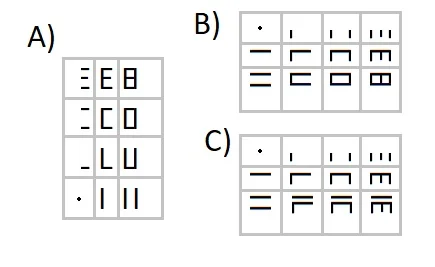
Here is what we ended up with:

Even this may change again.
So, I repeat, Don't grow attached to your ideas, because your idea will no longer be yours if the project accepts it.
I created this project but even I'm not its master. I am just a cog in the machine feeding the beast.
My dramatic 7:34 am post has now come to its conclusion.
r/EncapsulatedLanguage • u/atrawa • Aug 10 '20

r/EncapsulatedLanguage • u/HS1D4ever • Aug 12 '20
