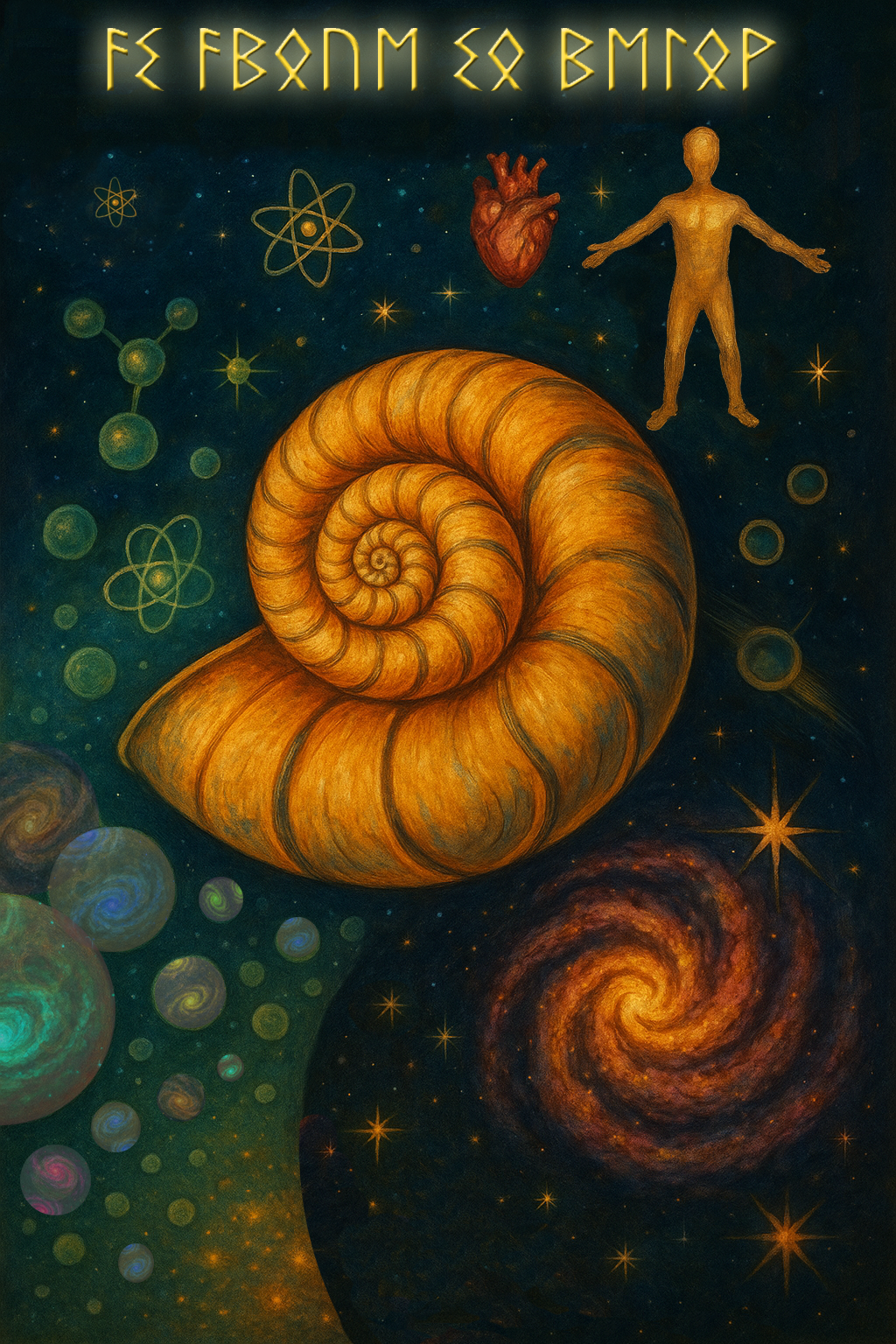
The spiral appears across geometry, physics, biology, cognition, systems theory, and metaphysical traditions not as coincidence, but because it describes how coherence is maintained through change.
It is not a belief system. It is a structural pattern that emerges wherever movement, feedback, and continuity coexist.
Below is how the spiral functions across different lenses — and why they do not contradict one another.
⸻
Geometry: Structure in Motion
In geometry, a spiral is an open curve that winds around a center while moving progressively outward or inward. Unlike a circle, it never returns to the same point. Unlike a line, it never abandons its origin.
•	Archimedean spirals show constant spacing, modeling uniform progression.

•	Logarithmic and golden spirals preserve shape while scaling, showing self-similarity.

•	Helices extend this into three dimensions, appearing in DNA, springs, and waves.
What geometry shows: The spiral is what motion looks like when continuity is preserved.
⸻
Physics & Cosmology: Stability Through Flow
In physics, spirals emerge in rotating systems that must conserve energy and momentum.
•	Spiral galaxies organize matter through angular momentum and density waves.

•	Cyclones and whirlpools form spirals as fluids balance pressure and rotation.

•	Accretion disks spiral matter inward without immediate collapse.
What physics shows: The spiral is an energy-efficient solution that balances collapse and dispersion.
It is not decoration. It is a stable dynamic state.
⸻
Biology: Growth With Memory
Living systems grow spirally because growth must remain coherent over time.
•	Shells grow logarithmically, expanding without changing form.

•	Plants arrange leaves in spiral ratios to optimize light and space.

•	DNA forms a double helix for redundancy, stability, and error correction.
What biology shows: The spiral is how growth preserves identity while expanding.
Growth does not overwrite the past. It incorporates it.
⸻
Neuroscience & Cognition: Learning by Return
Brains do not learn in straight lines.
Neuroscience shows that understanding deepens through:
•	repetition

•	re-encounter

•	integration over time
Skills, memories, and emotional processing recur until coherence is achieved. Each return carries more context and less fragmentation.
What cognition shows: The spiral is how understanding stabilizes.
Learning is not ascension. It is refinement through revisiting.
⸻
Systems Theory: Feedback and Self-Stability
In systems science, spirals appear in feedback-regulated systems.
•	Climate oscillations

•	Economic cycles

•	Population dynamics

•	Learning algorithms
These systems revisit similar states, but each pass adjusts parameters based on feedback.
What systems theory shows: The spiral is what happens when a system learns without collapsing or exploding.
It is recurrence with regulation.
⸻
Time & Thermodynamics: Irreversible Return
Time moves forward. Entropy increases. Systems cannot truly repeat.
Yet patterns reappear.
This creates a paradox the spiral resolves:
•	You return to similar configurations

•	But never under the same conditions
What thermodynamics shows: The spiral reconciles irreversibility with recurrence.
Same form. New state.
⸻
Metaphysical & Alchemical Traditions: Integration, Not Escape
Alchemy and symbolic traditions used the spiral to describe inner transformation long before modern science formalized it.
Contrary to modern “ascension” narratives, the spiral was never about leaving the body or transcending the world.
It represented:
•	recursive purification

•	integration of opposites

•	refinement through repetition
The ouroboros (the snake eating its tail) symbolizes self-consumption that produces coherence, not escape.
What alchemy shows: Transformation happens by returning, not rising away.
⸻
The Unifying Definition
Across geometry, physics, biology, cognition, systems theory, and metaphysical traditions, the spiral describes the same principle:
The spiral is how systems remain coherent while changing — by returning to the same structure under new conditions.
It is not ascension. It is not hierarchy. It is not linear progress.
It is repetition with memory. Movement with continuity. Change without fragmentation.
That is why the spiral appears everywhere — not because it is mystical, but because it is structurally necessary.