I’ve dug into Cerebras quite deeply, I noticed that the stock has something that none other AI stocks offer,
They have a specialty in chips that are literally multiple times the speed and efficiency of Nvidia.
This reminds me of the entire memory playoff, no one would ever assume that out of everything Memory would be the category to prevail, and go up thousands of percent
Cerebras absolutely brings the vague feeling of Underappreciation and Under market-recognition.
This company literally offers the market an improved/enhanced model that does 3 core things
Seprates the AI trade from nvidia’s monopoly, which has yet to be seen
They offer the Future. They bring us the current market’s mainstream core but improved tenfolds
The most critical point. Their partnerships. Microsoft, Oracle, Amd and etc, which shows INTEREST.
And if you ask me? An Nvidia partnership is also due in time
Of course this is all just conspiracy, I have 204 shares at 119 cost basis so I’m down horribly rn,
But not worried in the slightest. 500$+ stock soon
Would like to know if anyone has any critical bear cases that actually amount to something, I can’t find any🙏🏻
We've been held down at the moment because of the market uncertainty/pricing in a rate hike (and to an extent CBRS just doing its thing, it's been bouncing up and down since it IPOed), but once the Fed meeting is over then there'll be certainty (regarding rates) and with the Anthropic IPO upcoming I think it'll touch 300 (I doubt it'll hold it, but I expect it to hit 300 briefly) in the pre Anthropic IPO runup; I observed this with the SpaceX IPO months ago, made a lot of money off space stocks, because a rising tide lifts all boats, and space stocks pumped over 100% (LUNR, RDW, RKLB, FLY, you name it) because people were all excited about space and they bought a bunch of proxy space stocks, and then when SpaceX actually IPOed they dumped, because people were moving their money from the proxies to the main thing.
I expect a similar situation to play out with AI/semi stocks, huge runup pre Anthropic IPO, but I think what happens when Anthropic actually goes public is a bit of a tossup, I think that'll either be the last gasp rugpull, and from there we drill, or the glorious AI company has gone public, and it's more euphoria and gains all around, now, obviously, an OpenAI IPO would probably be somewhat better given that CBRS has direct ties with OpenAI and not Anthropic, however, like I said, I'm still pretty confident that it'll lift semis across the board, I'd set my limit sell pretty high
TL;DR Almost every chip designer dices the wafer and reconnects the pieces, so one defect cannot scrap it. Cerebras refuses: it treats the whole wafer as one chip, with 4 trillion transistors and 900,000 cores. Where Nvidia engineers around the memory wall, Cerebras removes it — and its moat sits outside TSMC.
What the WSE actually is
The norm is to cut a wafer into dozens of stamp-sized dies and stitch them back together. Cerebras asks why cut at all. It divides the wafer into 84 identical grids, interconnected so they behave as one chip, each holding about 10,700 cores of 0.05mm² against roughly 3mm² for an Nvidia unit — 900,000 in all, each with a router, a compute engine and 48KB of SRAM.
Think of it as a library. A GPU keeps the encyclopaedia in a stack room — HBM — and every character written needs the whole set fetched down one 8TB/s corridor. Cerebras builds no library: it hires 900,000 people, each memorising a passage, so nothing is fetched. Weights live in SRAM beside the compute units.
How GPUs fight the memory wall
The wall is severe. On Llama 70B at FP8, a B300 spends 8.8ms moving weights out of HBM against 0.028ms computing — 99.5% of the time the compute sits idle, and Rubin does not fix it, bandwidth rising 2.75 times against compute 3.5 times. The answer is batching, as every user reads the same weights — up to 313-398 requests before bandwidth is the waste instead.
Two problems follow. KV cache caps the batch, because weights are shared but conversation memory is private: at FP8 an 8K context is 1.3GB per user, and a B300's 288GB leaves 217GB after the model, so the ceiling comes at 167 users, not 313. And batching trades latency for throughput — hence the fast and slow tiers.
Nvidia's answers are rack-level memory, lifting the KV ceiling, and disaggregated inference, splitting prefill from decode across clusters joined by a cache pool. With Groq's LPU inside VR200's LPX rack, decode splits again: attention keeps the full HBM bandwidth rather than fighting the feed-forward network, whose weights sit in the LPU's SRAM. But KV cache still lives in HBM.
How the wafer is actually built
In the WSE, KV cache sits on chip too, with 21PB/s bandwidth and sub-1ns read latency against 0.1-1µs for GPUs. That starts at lithography: a stepper exposes at most 26mm × 33mm, so it fires 84 times to fill the square.
Conventionally the scribe lines between exposures go to the saw; Cerebras instead draws micron-scale copper across them in the top metal layers, half of each wire at the right edge of exposure N and half at the left of N+1 — high up, since misalignment lower down would break it.
Testing then inverts its purpose. Conventional testing finds good dies to keep; WSE testing maps which cores are broken, since the dies are one piece and I/O exists only at the edge.
Each core has its own SRAM and router — enough to test itself and report through the mesh — with redundant paths from four directions, telling a dead router from a dead region.
TSMC delivers an uncut 300mm wafer with cross-reticle interconnect and micro-bumps; the rest is Cerebras. Cut the 215mm square from the circle, wasting 35% of the area, and you have 83 grams of silicon drawing 23kW at 0.8V.
Solder would shear off as silicon and PCB expand differently, so millions of micro-springs absorb the mismatch, power arrives vertically from VRMs underneath, and the sandwich takes four tonnes, spread evenly.
Next major regression would be series G valuation of $8.10B (2025 Sept.), which was prior to the $25B revenue deal with OpenAI. If that happens, then we live in an alternate universe.
Cerebras loves to claim that their output interactivity is 2000 tok/s/user on Kimi K3.1 2.8T, but based on their demo (YouTube video “Cerebras Demo: Running Kimi K3.1 at 2,000 Tokens/Sec”), that is only for short contexts with a context prompt less than 100 tokens long.
Interesting that they don’t show their p99 TPOT at medium (100k+) to long contexts (600k+) on agentic multi-turn workloads, which would affect performance as they need to load the KV cache for all of the previous tokens in the context for Kimi K3.1 Pro’s Gated MLA layers (full attention).
Also somewhat misleading is that whenever they quote a GB300 NVL72, they quote it at the maximum power of 150kW per rack. Based on our GB300 experiments with Kimi K3.1 Pro on GB300 NVL72 low-latency megakernels, the measured all-in rack power is less than 30% of maximum power, as low latency is memory-bound.
We welcome Cerebras to demonstrate their claims on AgentX Preview if they are actually confident in them, as it tests all of the things that their marketing does not. We wonder what excuse (coping) they will give this time to avoid demonstrating their claims, considering the tests take less than a couple of hours and can be done during off-peak hours.
TL;DR Cerebras took its no-stitch, wafer-scale idea to the extreme, but customers didn't want bespoke hardware, so it turned into a neocloud running its own chips. It got lucky riding demand for ultra-low-latency inference and now holds about 700MW of secured data center capacity, its most valuable asset. But its bargaining power is weak: big customers get warrants and discounts, and the outlook hinges on delivering the OpenAI megadeal.
Our take: a lucky break, but thin leverage
In Part 1, Longbridge Dolphin Research covered Cerebras' first-principles bet: if chips get cut and stitched back together, why not skip the cut and build one giant wafer. The company stuck to that path relentlessly and took on every obstacle head-on.
The result was hardware almost nobody wanted to buy outright. Deploying it means data center retrofits, custom 21°C liquid cooling and bespoke hosts, so Cerebras ended up hosting the machines itself and selling compute by the megawatt.
It then caught the inference wave: SRAM-heavy wafers are great at low-latency decoding, and that won it cloud logos like OpenAI and AWS. In a world short on power and data centers, the ~700MW it locked in early is now its core asset.
But winning customers came at a price. OpenAI, G42 and AWS all received warrants, about $1.1B of warrant assets by June 2026, which are really discounts. Among the chip vendors we track, Cerebras has one of the weakest bargaining positions, which means more downside when the sector de-rates.
How far has the product come?
Founded in 2015, Cerebras spent over three years fixing yield, power, cooling and cross-reticle wiring before launching its first wafer-scale engine in 2019. WSE-2 moved to 7nm and doubled cores and SRAM; WSE-3 moved to 5nm but added only ~6% more cores, and on-chip SRAM has effectively topped out at 44GB.
WSE-3 Turbo (Aug 2026) keeps the same wafer and doubles bandwidth purely by doubling the clock. After more than two years with no true WSE-4, we think the next wafer hit trouble.
The core reason: SRAM has stopped shrinking. TSMC's N3E SRAM bitcell is about the same size as N5, so moving to 3nm would lift on-chip memory only from 44GB to about 60GB at high cost. Big models still spill off-chip.
So for Gen 4, Cerebras shifted R&D from process shrinks to power delivery and rack design. CS-4 doubles power headroom to push the clock from ~1.4GHz to ~2.8GHz, puts three wafers in one 42U rack, turns each wafer into a swappable "backpack" module, and cuts in-rack wafer-to-wafer latency from ~5µs to ~2µs.
From chip company to compute company
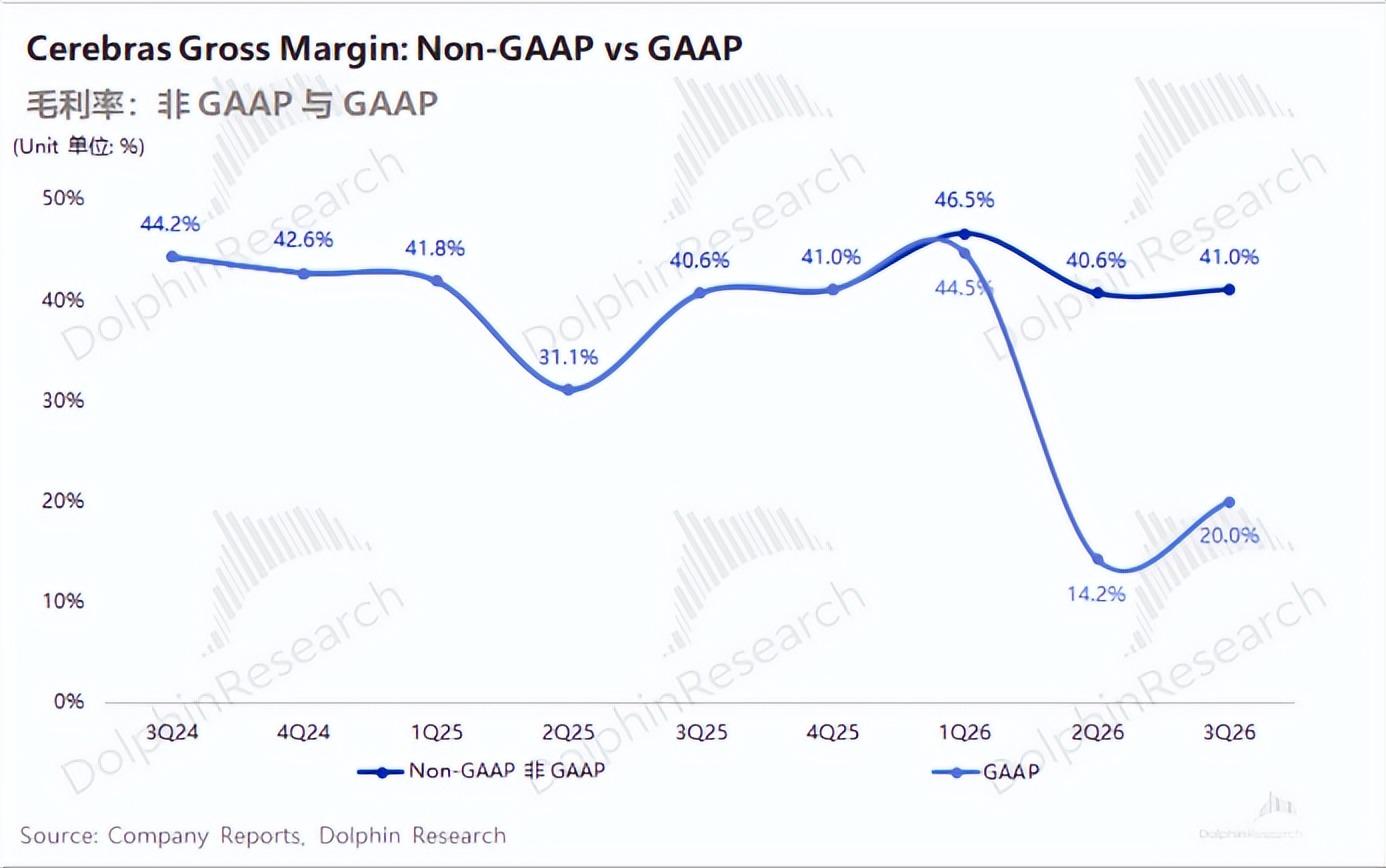
Cloud revenue overtook hardware in Q2, and cloud gross profit overtook hardware in Q3. Hardware margins depend on yield, which relies on ~7% design redundancy with limited upside; cloud margins depend on pricing and utilization, so scale matters more.
OpenAI buys compute, at a discount. OpenAI holds warrants for 33.4M non-voting shares at a near-zero strike. About 30% have vested: one tranche when OpenAI funded a $1B note, another when Cerebras' market cap topped the trigger after its IPO.
The remaining 70% vest as capacity is delivered, across 750MW signed plus a 1,250MW option.
The ~$823M of warrant value is amortized against revenue through Oct 2031. In short, Cerebras sells compute, then sells it at a discount, and OpenAI holds the leverage.
G42 buys systems and got free warrants. Together with MBZUAI, the Abu Dhabi group made up over 80% of revenue in 2024–25 and received two unconditional warrant tranches, about $300M of amortization.
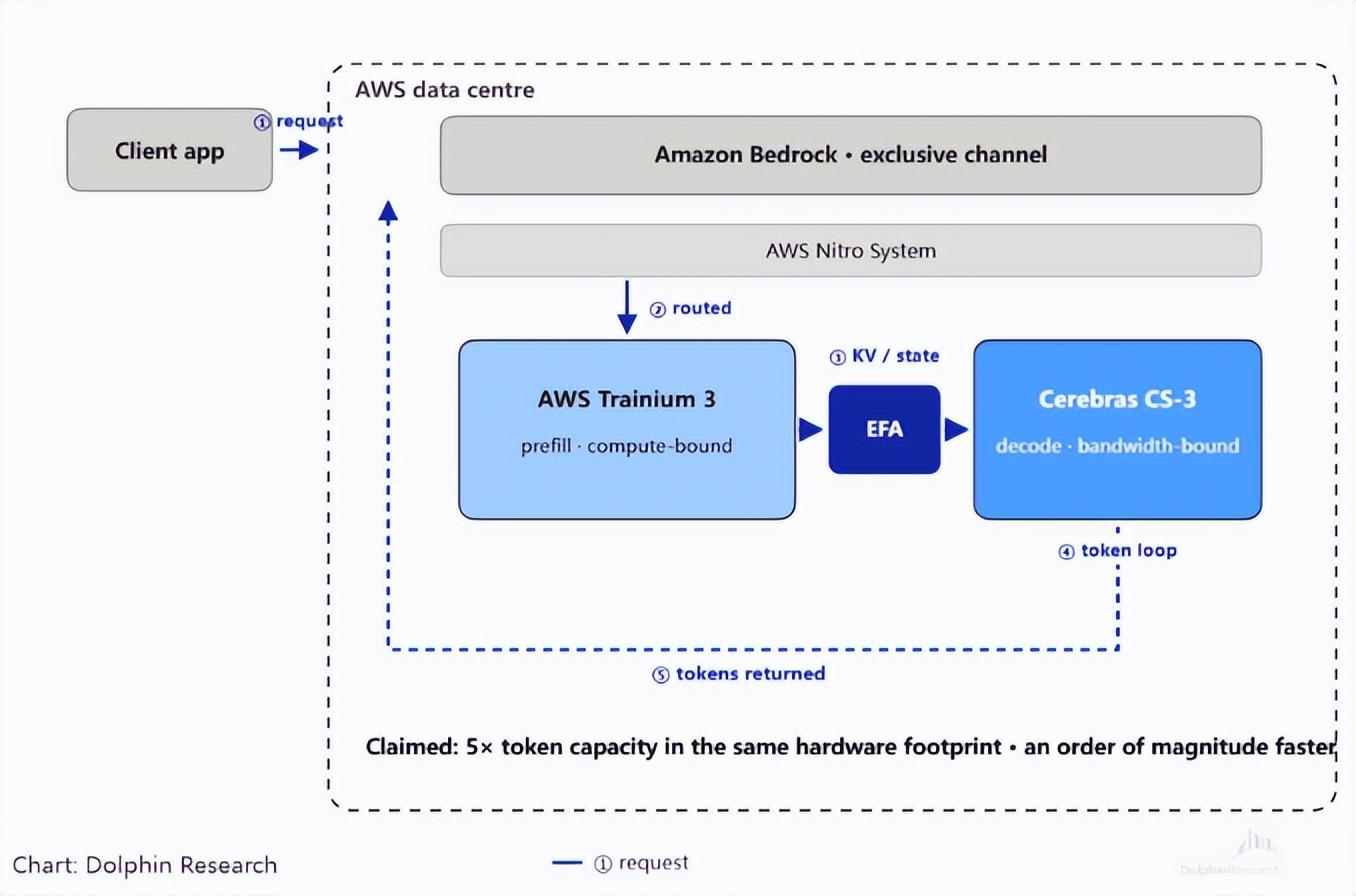
AWS uses finance-lease-style purchases. AWS runs prefill on Trainium 3 and decode on CS-3 to offer a low-latency tier on Bedrock. Terms favor Amazon: purchase options, price locks, Bedrock exclusivity and minimum capacity reservations.
If AWS under-consumes, capacity sits idle; if it over-consumes, concentration spikes again. AWS pays for its warrants, which vest with payments, and the final contract is still being negotiated.
Cerebras defines "core revenue" as GAAP revenue plus warrant amortization minus pass-through data center revenue, to show the business before these discounts.
What the numbers could look like
The key drivers are how fast capacity comes online and lease pricing. After build-out delays this quarter, our base case assumes 600MW of OpenAI's first 750MW lands on time, with total capacity rising from 88MW in 2026 to 875MW in 2028.
We model OpenAI at $7.5M per MW per year and other customers at $4.5M, low because of long-term anchor deals, and estimate capex of roughly $16B per GW excluding buildings and systems.
On that basis, cloud revenue grows from about $950M in 2026 to about $2.85B in 2027 (per guidance), and core revenue reaches about $7.8B in 2028, with core operating profit scaling from 2027 to roughly $2.9B in 2028 as cloud gross margin rises. The outlook hinges on delivering the OpenAI deal; capacity ramps and delivery timing are the big uncertainties.
Hey folks, just joined the club and looking to DCA on the regular. What are the largest current downside risks besides all the macro stuff going on right now?
The final 180-day insider lock-up period for CBRS expired on November 10, 2026, meaning all remaining locked shares from its May 14, 2026 IPO are now unlocked and eligible for public trade. The biggest technical supply overhang is finally gone. No more scheduled unlock dates hanging over the stock. Excited to see how it runs from here!