r/AquaticSnails • u/Electrical-Hold9530 • 12h ago
Help Request Really shrimps eat snails??
98
Upvotes
r/AquaticSnails • u/boostinemMaRe2 • Jun 27 '25

This is a post for anyone in doubt of the effects No-planaria (Betel Nut extract) and similar dewormers have on snails.
I accidentally exposed my Mystery and Rabbit snails to a single, full-strength dose of No-Planaria for 24-36 hours. I had previously operated under the assumption it was only harmful to Nerites; wrong! After that time the mentioned snails were all completely withdrawn into their shells and appeared to have absolutely given up. After 2 days of moving to untreated tanks, air baths, highly oxygenated breeder boxes with carbon and Purigen they are finally starting to come around.
As an aside, the Ramshorns took zero issue with the NO-P treatment. Stick to traps unless absolutely necessary, as the tank is now unsafe for these snails for at least 4 months.
r/AquaticSnails • u/PapaDonsPizza • Jun 22 '25
In this Reading:
Ecology of the NZMS, and its threat to local waters
How to distinguish NZMS form Malaysian trumpet snails
Why you should care, legally and ethically, as an aquarist
Prevention and removal from your aquariums
What to do if you see them in a store, or get them in a shipment of plants
iNaturalist gallery:
https://www.inaturalist.org/taxa/129201-Potamopyrgus-antipodarum/browse_photos
In the months leading to writing this, I have noticed a drastic increase in the number of posts on aquatic snail subreddits asking for snail ID, and pictured is the highly invasive New Zealand Mudsnail (Potamopyrgus antipodarum), or the NZMS for short. They are coming with plants in local fish stores, and, according to some replies, even being given away to unknowing customers by unknowing employees.
Not only is it illegal to spread these snails, it can have catastrophic effects for local waters. In my area, they have found their way into a large number of waterways, and many areas where they are not yet present connect to infested waters. There are currently no removal methods for them, only preventing introduction. My hope in writing this is to spread the word about this invader in the hobby, and hopefully help slow its spread in our tanks and waters.
These snails, as their name suggests, hail from New Zealand, where they grow to about 12mm. In their invasive populations, they grow to only 4 to 6 mm in size. Invasive populations are all female, and parthenogenetic, meaning a single snail can create clones of itself without another present. While this is true for a few common aquarium snails, these invaders reach staggering densities, with a population in Sweden reaching up to 800,000 individuals per square meter. On the bright side, they are livebearers, so we don’t need to worry about eggs.
In their native range, they are controlled in number by several parasitic flatworms, which sterilize infected individuals. In their invasive ranges, they have no natural predators, and are even capable of surviving being eaten, with one study showing they can survive 12-24 hours inside a rainbow trout. They do this by sealing off their operculum, a strategy that unfortunately also works to resist chemical treatments like bleach.
Their diet consists primarily of biofilm and algae, and due to their high reproductive capacity, they outcompete native invertebrates that occupy the same niche, with some populations becoming 95% of the invertebrate biomass. In other words, the organisms that depend on these communities for food, can have their food supply reduced by up to 95%, and the invertebrates that once occupied that niche will also be drastically reduced in number.
The main snails these will be confused with are Malaysian Trumpet Snails (Melanoides tuberculata), or MTS for short. Courtesy of u/Gastropoid, a moderator of r/AquaticSnails, Figures 1 and 2 are some pictures comparing the two.


Figures 1 & 2: Comparison of NZMS and MTS
The main differentiating factor is the maximum size, with NZMS never reaching over a cm in length. Additionally, the MTS have many striations/grooves on their shell whorls, and often some red patterning, where the NZMS is largely smooth and plain. Color can vary from tan/grey to black for the NZMS, and some populations have developed slightly different shapes to their shell, such as spikes or a keel on the whorls (Fig. 3). NZMS typically have 7-8 whorls, whereas MTS often have up to 10-15, though juveniles may have less in both species, making differentiation hard in overlapping sizes. There are other similar species, but the MTS seems to be the most common confusion in aquariums.

Figure 3: Alternative phenotype
If you are at all uncertain as to the identity of your snails, DO NOT add them to your tank. Quarantine, get a nice closeup picture with a ruler, and ask for ID from one of the aquatic snail subreddits, or another reliable aquatic snail/aquarium forum.
The short answer is no, not really. As stated earlier, these will outcompete any other invertebrate in the wild. This applies to the snails and shrimp in your tank as well. They are extremely efficient grazers, meaning you can’t really control them by controlling the food. They will proliferate as long as there is any biofilm in the tank.
They also pose a significant ecological, and potentially legal risk as long as they’re in your tanks. It is illegal to knowingly distribute or introduce this species in many states in the US, and consequences include some hefty fines, even jail time in some cases.
So if you just keep them in your tank with no escapees, it’s fine, right? Not really. Many states have bans on possessing the snails at all, and since they exist in your tank, it’s possible they’ll be spread by you. It could be on plant trimmings, in your nets, even down the drain; I’ve even had some on my arms after sampling an infested stream.
The point here is there is no acceptable amount to knowingly harbor, and they cannot be allowed to exist in the hobby as “just another snail.” I love all snails, like many of you reading this, and would never condone harming them in an aquarium, but these will cause irreparable harm to our native aquatic ecosystems, especially the native snails. There is no removing them once they invade, only containing and limiting spread.
If that was not enough to convince you, let’s look back a few years at marimo moss balls. They were banned entirely due to them spreading zebra mussels, another aquatic invasive species. Additionally, the spread of Chytrid fungus has led to restrictions on the amphibian trade. If things continue to progress at this rate, there’s no telling what kind of restrictions might be imposed. It’s possible there will be none, but it’s also plausible all snails will be banned, as in the case of crayfish in Pennsylvania.
Removal is a meticulous but doable task, so prevention is key, but there are few viable methods. They can survive just about any chemical treatment that is safe for your fish, shrimp, and plants. This includes prolonged exposure to bleach, hydrogen peroxide, and even fenbendazole, which is sometimes used to treat hydra and planaria infestations, often killing snails as well. I have not heard any conclusive results for copper and planaria-zero as of yet, but copper will also make your tank unsafe for invertebrates for a very long time. The USGS and many state agencies recommend quaternary ammonium compounds (QACs) found in cleaners like Formula 409 for fishing gear, but these are not safe for aquarium use.
ETA: Salt is likely ineffective, as they can survive even brackish estuaries. Vinegar doesn't seem to have been tested much. Alcohol is also a mixed bad, and not worth considering outside preservation in 70% ethanol.
Several abiotic treatments will kill them. Obviously, a firm finger on a hard surface to flatten them will work, but do be careful. The embryos inside are extremely small, and potentially viable. Freezing solid for at least 4 hours at 26F/-3C, as well as hot water of 120F/46C for 10 minutes, with longer preferred, can kill them. Drying in a low humidity, preferably hot environment, for at least 48 hours is recommended for fishing gear, but they can live over a month on moist surfaces, so use this method with caution. Ensure ALL surfaces are COMPLETELY dry for well over 2 days, and always use drying in conjunction with a guaranteed lethal treatment when possible. While not useful for prevention in plants, these methods are viable for nets and nonliving materials.
Additionally, certain water parameters seem inhibitory to their reproduction. Low TDS and hardness, fast currents in streams, and an acidic pH all make it hard for them to establish. While none of these can prevent a tank infestation, it can certainly slow them down a bit.
Many have recommended biological control such as assassin snails, puffers, and loaches. This is not a remotely sure method of removal. They can survive digestion by the loaches and larger puffers, and smaller predators like pea puffers and assassin snails, assuming they eat them at all, will never eradicate them. Given their small size and lack of “meat”, they aren’t really eaten by these predators to begin with. Remember: one will make more, and it is usually illegal and always ecologically irresponsible to harbor and/or distribute ANY quantity of them. There is no “safe” amount.
Another method often used when dealing with unwanted snails is baiting. You add food, wait for them to swarm, and remove them with it. This will not work, as it will also never get them all. It will only temporarily lower their numbers.
A method that does show promise is reverse respiration treatments. I reached out to the authors that pioneered the method on their website, and while they didn’t test it with NZMS specifically, they told me it had a 100% mortality rate in MTS, where even bleach failed due to their tight fitting operculum. I also have used it on plants from an infested stream and it seems to work well so far, with my few trials having complete mortality of the NZMS. The website explaining the method is here: https://reverserespiration.com/. It sounds complicated by the name, but it really only requires some unopened and in date carbonated water, a container, and 12 hours of darkness.
Even with an effective treatment, quarantine plants for an additional 2 weeks to ensure no surviving hitchhikers are present. It is possible the treatment had survivors from a number of potential errors, including old carbonated water or incomplete submersion.
Additionally, since they survive the digestive tracts of fish, quarantine all new arrivals in a bare bottom tank, observing their feces for any snails. The amount of time to do this varies by fish, but quarantine should generally last a week or two at minimum anyway, so that should be plenty of time. Extend the quarantine if live NZMS are observed, as the fish may re-ingest them.
I have also seen them hiding in the shells of larger species of snail. For this reason, it is imperative you quarantine snails as well, not just fish.
It is also worth noting that it is very easy to miss them on yourself. They can stick to your arms, under your fingernails, or even between your fingers. I’ve had some in my hair while out sampling from swatting a bug on my head. Make sure you don’t reach into a tank without washing your hands thoroughly in a bucket/bowl and checking for NZMS. If there are some, apply a lethal method to them and throw them in the trash.
Note: “lethal methods” are hot, cold, and crushing, as well as reverse respiration. Utilize at least one method before disposing of them.
First, don’t panic. This is fixable, but it’ll take some work, space, and a few supplies. The long story short: you need to ensure all surfaces and water that even potentially had NZMS are exposed to one or more of the above mentioned 100% lethality measures. In our case, we’ll stick to reverse respiration, freezing, and hot water.
Notify any places you recently added animals or plants from that you found them in your tank so they can inspect their own facilities. In the guts of fish and on plants are primary transport vectors for the NZMS.
We’ll start with the bad news; you’re going to need to break down your tank entirely, and likely have to replace a few things, at least short term. The good news: summer and winter will work in your favor here, as they will give you the temperature extremes needed to kill the snails, either outside in the freezing cold, or in the back of your car in a hot parking lot.
A few things to remember before I go further: these snails can be eaten by your fish, and they can survive. This means you need the fish to be able to poop out any eaten snails before adding them to a new tank, or into the original tank after decontamination. I can tell you from personal experience, you want to be thorough, or you may have to do this all again.
Additionally, you should always assume any surface in contact with the tank or its water, or anything in it has NZMS, and NEVER cross contaminate with these things. THIS INCLUDES YOUR HANDS!!! Apply a lethal method to all of them before use again. The babies are very small, and can easily be glossed over in a hurry.
Lastly, NEVER dump live snails down the drain. It isn’t worth the risk that they find their way into local waters during the path to and through the water treatment and discharge process.
Now, on to the process at hand. Get a tank, bucket, or something that can house your fish for a week or two while you work on the main tank. Add a NEW filter, and some beneficial bacteria. This can be bottled, or it can be from squeezing a filter you are certain had no possible NZMS invaders. Add all of your fish, and nothing else. Pick a material the snails will stand out against, as we need to observe daily at minimum to ensure no NZMS came out.
You will need to monitor water quality closely for ammonia and perform regular water changes during this time, as we cannot truly cycle this tank in the short time before we add the contaminated fish. Alternatively, you may cycle it ahead of time, but assume all water and objects used in or leaving the original tank are contaminated in that period, and apply lethal methods before using them elsewhere.
Take all of your plants out, and wash them in a bucket of tank water, manually removing as many snails as possible. You can treat them all, but personally I take cuttings of what I can, and then salvage as many crown plants like swords and crypts as possible. These plants will all be treated with reverse respiration, so grab a few containers and a bunch of seltzer/club soda, and treat them that night. Once treated, rinse in a bucket of clean water, and add to another bucket separate from your fish. We don’t want any snails coming out of the fish and onto the plants.
To dispose of water, do not dump it near any body of water or down the drain. Separate the solids out of the water, and freeze for 4 hours or soak in 120F water for 30 mins, then throw them in the trash. Water can be dumped in the grass, but make sure there are no storm drains, ponds, streams, or any potential introduction hazards nearby, such as flood zones, to be safe.
Now onto the tank. Drain it, disposing of the water as mentioned above. The substrate is best placed in a garbage bag, frozen, and thrown away. This can be done in batches. Alternatively, near-boiling water can be poured on it, but do be careful. A pot of boiling water is both heavy and hot. It can hurt you. NEVER boil or bake large rocks! If they have air pockets internally, they can explode, and rock shrapnel is never fun. If you wish to keep the substrate for any reason, it must be dried after freezing or boiling water for several months. Make sure it is bone dry for at least a month. If you do not wish to keep it, either throw it in the garbage, or bury it in a place that is nowhere near water or could wash into any, after it is dry. Make sure a lethal method has been used prior to doing either. Rinse the tank and dispose of the water as directed above. Allow it to dry thoroughly and remain bone dry for at minimum 48 hours, then vacuum/wipe it out, immediately putting the dirt and/or towels in the garbage.
Wash your lid in scalding hot water, and dry in a low humidity area for at least 2 days. Dispose of the water as directed above. The light should be fine, but it won’t hurt to give it a once over. Filters, heaters, and any other equipment should be soaked in hot water of 120F or above for 30 minutes, or frozen, and all filter media discarded after freezing and replaced. Dispose of the water as described above. Make sure the equipment can handle the temperature you choose to use.
Now your tank should be completely deconstructed, and all your equipment and tools used in the deconstruction are treated and drying. After the 48-72 hour drying period, set up the tank as normal. During this period, monitor the fish in quarantine, regularly vacuuming the bottom of the quarantine tank and scalding or freezing it before disposal. We want to make sure all NZMS are out of their system. If you find any NZMS with the fish, remove and kill them immediately, and extend the quarantine until none are present for a week. This is excessive, but necessary to guarantee they haven't eaten the snails again. A snail trap in the tank with them could prove useful during this time to easily detect the snails. Once the fish are clear, add them to the tank again, and decontaminate the quarantine setup with the applicable methods from above.
You should now be free of the NZMS. Congratulations, and thank you for your diligence. It was hard, but worth it in the long run. Make sure to quarantine all plants in the future, treating with reverse respiration in the process, as well as any fish you buy. Not only is it good practice to begin with, it will save you many headaches in the future.
First and foremost, notify the owner with as much information as possible, and let them know what they are dealing with. Feel free to share this reading with them for methods of removal and quarantine. Check back in a week or two, and see if they eliminated the issue. In these instances, they shouldn’t sell anything from the contaminated system, especially plants, effective the moment you mention the invasive snails, or they will aid in their spread. Make sure to note the similarities to Malaysian trumpet snails when discussing it, as many confuse the two, and both can be present in the same tank. If they are baby MTS,that’s great! But it’s not worth the risk that they aren’t, and a positive ID should be gotten.
Additionally, proactively notify your LFS! It’s clear the snails are coming from plants from what I’ve seen on Reddit, and many LFS owners I’ve spoken to were unaware it was happening, and thanked me for the head’s up. Prevention is key!
If the owner or management haven’t taken steps to remedy the issue, you unfortunately must report it to your local aquatic invasive species agency. Who handles it varies by state, but a quick google search should tell you who to contact. It’s never fun to have to do this, but these stores are responsible for what they sell, and you will have given them due courtesy to solve the issue beforehand. With online retailers, I personally would notify the state agency they fall in the jurisdiction of after the issue is resolved as well, or ask them to get an inspection. If they truly remedied the issue, there won’t be any trouble for them, and it may help your state agencies know if there are contaminations further up the supply chain.
Thanks again to u/Gastropoid on Reddit for the photos and information contributions, and to the many other Redditors that provided valuable information on their encounters with these snails. Many thanks to the team behind Reverse Respiration for their hard work and valuable contributions to the hobby, as well as the information they provided on the method for NZMS.
Last, and certainly not least, thank you. I truly appreciate you taking the time to read this. I encourage you to share this valuable information to as many people as you can, especially your local fish stores, to aid in preventing the spread of the NZMS in our tanks. If you have any questions, feel free to reach out to me on the site this is posted, and best of luck on your aquarium journeys!
Bruce, R. L., Moffitt, C. M., & Dennis, B. (2009). Survival and Passage of Ingested New Zealand Mudsnails through the Intestinal Tract of Rainbow Trout. North American Journal of Aquaculture, 71(4), 287–301. https://doi.org/10.1577/A08-033.1
Geist, J.A., Mancuso, J.L., Morin, M.M. et al. The New Zealand mud snail (Potamopyrgus antipodarum): autecology and management of a global invader. Biol Invasions 24, 905–938 (2022). https://doi.org/10.1007/s10530-021-02681-7
National Park Service:
https://www.nps.gov/yose/learn/nature/invasive-animal-species.htm
NZMS Collaborative’s ID Guide:
https://www.nzmscollaborative.org/index.php/nzms-basics/biology
Oregon State University (Includes AIS Treatment Effectiveness Table):
https://www.dfw.state.or.us/conservationstrategy/invasive_species/docs/NZ_Mudsnails_10-page.pdf
Reverse Respiration Treatment:
https://reverserespiration.com/reverse-respiration
UC Riverside Center for Invasive Species Research:
https://cisr.ucr.edu/invasive-species/new-zealand-mud-snail
USGS NAS (Non-Indigenous Aquatic Species):
https://nas.er.usgs.gov/queries/factsheet.aspx?SpeciesID=1008
r/AquaticSnails • u/Electrical-Hold9530 • 12h ago
r/AquaticSnails • u/Tomytheboy • 10h ago
Devo me preocupar com o fato dele estar se esforçando para evitar que a concha vá para cima?
r/AquaticSnails • u/Kind_Soil5247 • 5h ago
Got a new phone with an impressive lens. Here are some snail baby footage
r/AquaticSnails • u/Low_Economist5954 • 12h ago

I was at petco getting a mystery snail and asked what this snail was. The lady said it was a pest snail and me being the one to like pest snails I asked if I could have it for free. She said yes and now im home with a free snail and a mystery snail. I was looking closer at it and it doesnt really look like a pest snail. It looks a bit like a devil spike baby. But can't find any images online of a baby devil spike snail. So im wondering if anyone here knows what it is. Its the snail ontop of the mystery snail
r/AquaticSnails • u/myheadisrotting • 3h ago

r/AquaticSnails • u/danika088 • 4h ago
I have four snails and they’re all tucked in their shells and their shells are looking bad, but I haven’t changed anything in their shells looked really good before
r/AquaticSnails • u/skibidiohemgee • 2h ago
My supposedly rabbit snails have just been causing me so much stress with the whole cycling process and me constantly worrying about parameters, nutrition, and everything in between. I’ve been having hallucinations about my snails in the middle of the night which tells me that is more stress than any of it is worth.
I tried to find them a local home before but they weren’t able to drive to meet me and they lived too far for me to go to them. How can I find someone close by to sell them to? I know Facebook marketplace doesn’t allow people to sell live things. People mention local groups but I don’t know what exactly I’m supposed to look up or if any of those exist near me. Most of the pet stores near me are just commercial chains and I don’t feel comfortable with giving my snails to them because I don’t trust what’ll happen to them. I really just want what’s best for the snails and my mental health too. And can people usually charge a rehoming fee? I was hoping I could make back at the very least a small amount especially after everything I’ve bought for them already. 🥲
Any advice is appreciated!
r/AquaticSnails • u/LoudAd9818 • 5h ago
I recently got back from a trip to st Barthélemy. I collect shells and I am very careful to not bring anything live, but unfortunately I missed this little guy. Poor thing- I feel awful! Idk how he survived the flight but he is alive and poked an antenna (?) out today too! I live in the tristate area in the United States and I have no way of getting him back to the carribean. Should I make him an enclosure and keep him as a pet? I want him to be taken care of. I know I should not give him freshwater etc. I would really appreciate any advice please!!!!!
r/AquaticSnails • u/Flat_Tangerine_5647 • 5h ago
Please be kind 💔 i will try to preload answers to questions im expecting.
I have two planted tanks. A 10 gal and an 18 gal long tank. Same water source.
My 10 gal has a single betta, a few pest snails (like 10?) and one mystery snail. I have a sponge filter. Substrate is sand and fluval stratum. I have a few plants and a large piece of driftwood. I also have floating frogbit and omg duckweed that i swear i pull out every frigging day.
My 18 gal also has sand and fluval stratum. It has the same plants and same driftwood. It houses 5 panda corys, 2 rabbit snails and pest snails. I’m using both a sponge filter on one end and large HOB filter towards the other end.
Here is where it’s weird. Both tanks have been cycling about 8 months. Both have crushed coral. Both were doing beautifully. Snails were thriving. Until they weren’t. I started noticing pest snail deaths. Then a few pond. Then i lost one of my rabbit snails. I have done SO MUCH research and reading.
Parameters were great for so long. Right now they are 5 nitrate, zero ammonia and nitrite. GH is very hard (always at least 250 on the strips and is consistent with the liquid tests). For a long time my ph was neutral at about 7 and my KH stayed high (around 120 on the strips). But randomly i have had a ph crash to like 6 as well as the KH buffer crash down to 40 if im lucky. My tap water tests excellently. Hard water, neutral ph and about 120 KH. I did a large water change yesterday and about an hour after the parameters were the desired ones. Tonight when i got home i did another strip test and the ph is 6.5 and the KH is already back to 40.. both tanks..
i continue to have snail deaths and i don’t know what to do. I’ve had tanks for a few yrs and i am new-ish to snails and im so sad to be losing even bladder snails.
Any ideas? Oh fish are fine btw. Only reason I’m really worried is the snail deaths.
r/AquaticSnails • u/Nickster-09 • 1h ago
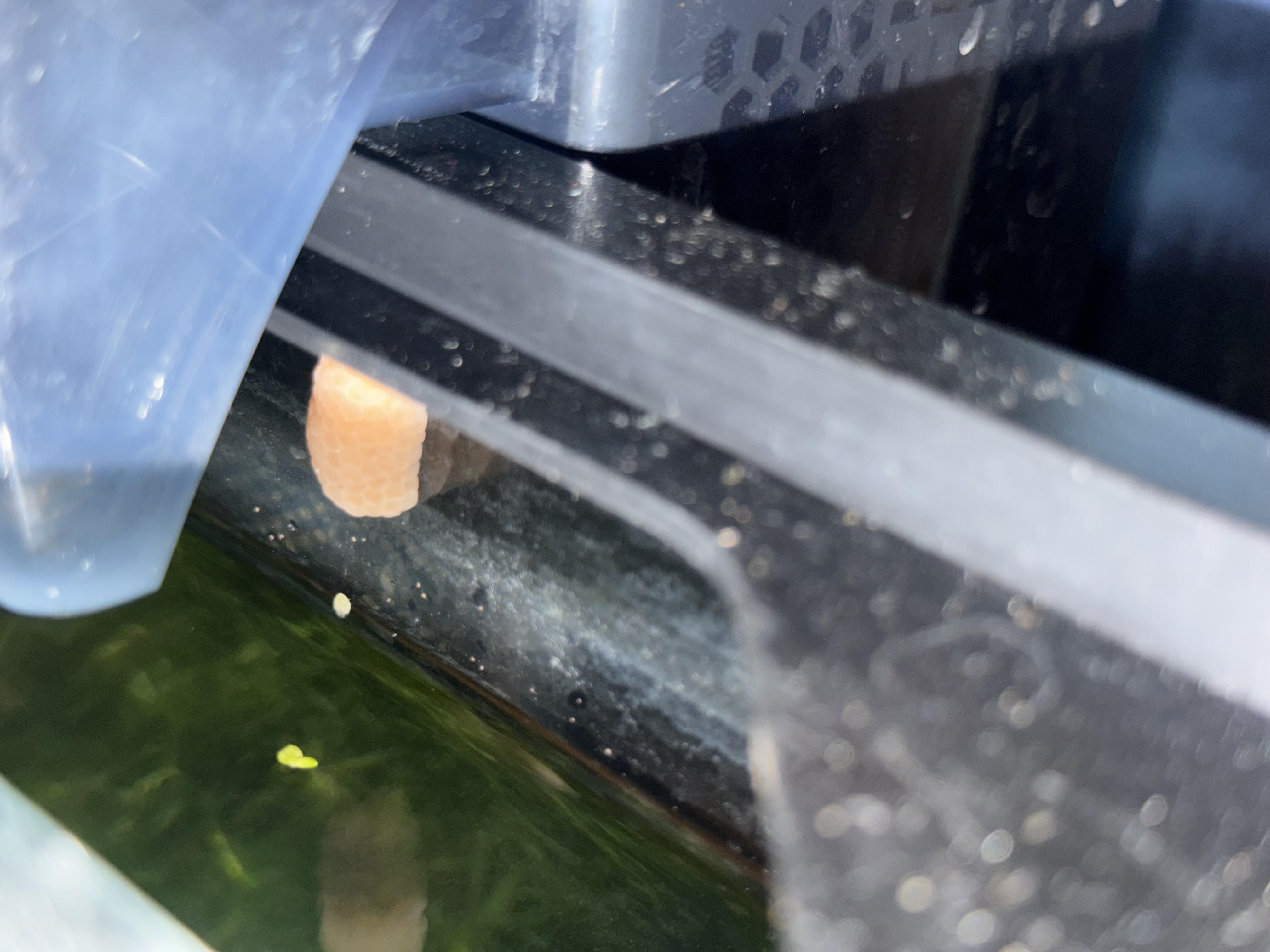
Mystery snail egg clutch on side on tank, will they be able to fall down into the water just fine? For context it’s behind the filter, an inch above the water. I’ve raised clutches before but have never left it alone and would like to ngl.
r/AquaticSnails • u/Salt_Street_7755 • 2h ago

Long story short, I heard about another sub where people were complaining about my deceased step-son’s grave marker. I don’t even want to look, but I was telling my husband about how everyone on Reddit is so mean, except the people in the Aquatic Snails sub.
You know what he said?
It’s probably because they are a little slow. 🤣
I love you guys. Pics of my snails because I love them too.
r/AquaticSnails • u/creecher98 • 6h ago

I’m new to keeping snails and was just wondering if this is normal behavior for Nerite snails.
r/AquaticSnails • u/ytpmetears • 8h ago
r/AquaticSnails • u/Bitch-juice- • 2h ago
Is this zebra snail super puffy or am I just worrying too much? He is one of a few that I got from pet supplies plus to try and give a better snail life. All the others have started moving around a bit and exploring, but he has mostly stayed at the bottom. I am new to Nerites and mostly have a bunch of Ramshorns in my other tank.
r/AquaticSnails • u/danika088 • 4h ago

r/AquaticSnails • u/Sarahnonymous • 1d ago

I was just trying to take a few snail morph photos for u/snailmomkitty, but everyone was hamming it up, so I had to share a few. Look at all those cute faces! Please comment with your own picture-day foot-shots 🐌
r/AquaticSnails • u/ghoulishfrog • 14h ago

(This is Ganymede, I’ve had him for a year and a half and he’s everything to me. He currently lives in the 10 gallon planted aquarium portion of a large paludarium with ramshorn and bladder snails, kept at 73°F with a 25% water change typically every other week )
I got him when he was much smaller, and I’ve never had any issues like this with him in the past, even when he’s moved tanks a few times. I’m suspecting that my family members didn’t actually follow my instructions and feed him like they were supposed to while I was gone, causing a calcium and nutrient deficiency leading to his shell deteriorating and cracking… but this also kind of doesn’t look like typical shell deterioration?
When I got home and saw this I immediately tested the water which showed no issues (0ppm ammonia, 0ppm nitrite, ~15ppm nitrate, 7.8pH, 16 dGH, 11dKH) but did a 25% water change as the nitrates were a bit higher than normal. I’m on well water so thankfully my tap water is naturally dechlorinated and hard with a high mineral content, so I don’t have to worry about adding anything for pH/GH/KH, but I’m wondering if there’s maybe something I’m missing here.
He typically gets fed a rotation of algae wafers, blanched vegetables, sinking pellets, crab cuisine, etc. I’m thinking the cause is probably my family members not keeping up with his dietary needs and feeding him as per my instructions like they said they did… but I want to make sure there isn’t more going on and that I’m doing all I can for him.
Any advice or help is much much appreciated~!!
r/AquaticSnails • u/TamsenClaire • 15h ago
I have two mystery snail and I am curious how you are really supposed to tell a true apple snail and a mystery snail appart. My two little guys have very different faces but neither of them eat my plants. One of them only comes out when the lights are off and the other one is out all day long. I can post pictures if people want I am just trying to learn more and understand how you tell. THANK YOU!
r/AquaticSnails • u/Sharkeyisback • 1d ago
UPDATE: Strong indications that she is passing away. I’ll leave this post up as it may help others.
She’s floating, there’s movement, but her body seems strange and hanging oddly far out of her shell. She’s has been lethargic for weeks now. I give her air baths. There’s a little dish suctioned on the side of the aquarium, just below the water line so she can siphon air when she needs and it keeps her from dangerously floating in swirls from the filter flow. She eats algae wafers. The waters parameters are perfect. I’m noticing the edge of her shell looks thin and jagged, but there’s lots of coral in the tank. She passes the sniff test. I’m guessing she’s near her end. But this hanging it all out is new. Any advice?
r/AquaticSnails • u/SnailPosterwhodraws • 14h ago

Look at this ramshorn sink my duckweed. Where else are my bladder snails going to live if you sink their homes!?!?
r/AquaticSnails • u/TulsiGanglia • 15h ago
I am looking for a good home for 3(+?) Hercules snails, 1 devil spike snail, 1 rabbit snail (black with yellow speckles), a few wandering pond snails and ramshorn snails, and maybe a few hundred of at least two kinds of MTS in the Piedmont region of Virginia. They are fine where they are for the moment, but in the mid-long term, I need to find them someone who can give them a good home, together or separate. I might have a home for two of the larger ones.
If you are not able or willing to give them a home, I’d also appreciate tips or suggestions on how to vet folks who show interest.