r/AncientCoins • • May 07 '24

We've been getting a lot of new posters and commenters here lately. Welcome! (Everyone please read the full text inside)

148 Upvotes

Unfortunately, a lot of the new people here aren't familiar with the culture of this subreddit or the ancient coin collecting world in general.

A lot of the ideas that you are bringing to this subreddit -- especially if you're North American and also especially if you've been collecting modern coins for years, don't always carry over directly to the world of ancient coin collecting.

Our subreddit is configured so that people using low-age or low-karma accounts will not see their posts and comments appear here immediately after you make them. They are being set aside until a human moderator is able to review them manually. This can take anywhere from a few minutes to a few hours.

The same is true of people who don't have much karma on this subreddit, even if you have an older account and have accumulated lots of karma on other subreddits. Part of this is because spammers, scammers, and trolls use newer, low-karma accounts, and part of it is to give you a chance to familiarize yourself with the culture of this subreddit.

We have also configured our subreddit to hold back posts and comments from accounts with a low Contributor Quality Score ("CQS") as determined by the admins of reddit. This takes into account your behavior on all of reddit. If you would like to find out what your own CQS score is please make a post on this subreddit -- /r/CQS. The result will be sent to you within seconds via private messaging, and no one else will be able to see what it is.

As you continue to participate here in good faith most of these limitations will eventually no longer apply to you, and you will be able to post and comment normally.


Thank you for your good faith participation here, and while I have your attention please allow me to remind you of this subreddit's few simple rules:

1) Civility is the price of participation here. Please act like adults and keep things pleasant.

We appreciate kindness and helpfulness here. We won't tolerate people bickering in the comments, swearing at or insulting others, etc.

We have a lot of people coming to r/AncientCoins from the world of modern ones. Please help them understand the differences and find answers to their questions without being a jerk. If you can't manage that we don't want you here, and you will be banned.

2) Unwelcome participants get banned.

Pursuant to Rule #1, the owner/founder/head moderator of this subreddit reserves the right to ban anyone at anytime for any reason he sees fit.

We very rarely ban real people - and we ban no one who is acting in good faith. We mostly only ban annoying bots, karma whores, griefers who post using numerous alt accounts, people who post coins that they don't own but act as if they did, people who swear at or are rude/insulting to others, and persistent trolls who disrupt our discussions.

3) Memes, joke posts & other shitposts may only be posted here on the last day of each month.

Fun is fun, but there's such a thing as too much of an execrable thing. Memes, joke posts, and other shitposts may only be posted on this subreddit on the last day of each Gregorian calendar month in your time zone.

Please don't try to sneak those kinds of posts in by flairing them as "educational" or anything else. If you just can't wait, please submit them over on our companion subreddit /r/AncientCoinMemes instead.

Ultimately, the mods of this subreddit may remove anything posted here at their discretion.


We ask that you please be patient with the process, as we check our queues several times a day. If you make a post or comment and it isn't immediately approved, PLEASE just leave it up and one of us will get to it as soon as we can. We are unpaid volunteers doing this on our own time.

Thank you.


r/AncientCoins • • Jun 12 '25

New rule regarding the use of ChatGPT, other LLMs, and the deceptive use of AI imagery on this subreddit

92 Upvotes

It has actually been a policy here for years that we don't permit ChatGPT-type posts. In the past they were usually just quietly removed, as were AI-generated images that were used deceptively.

It feels like we already have too many rules on this subreddit, but it looks like it's time to join other subreddits by implementing this one.

One issue is that these LLM generated texts aren't automatically vetted for accuracy, and some weird and unreliable stuff can creep in. Another is that they are based on plagiarism.

They often give results that feel like a bad student trying to pad out the word count of a writing assignment, and don't actually contribute much to this subreddit.

It seems like some people here, when they are bored, entertain themselves by feeding prompts into ChatGPT and then posting the results here. Sometimes they do this as conversation starters, but sometimes it feels like they are just trying to show off or something.

Speaking of plagiarism -- which is bad, it is fine to post a paragraph or two of relevant information here that you have found online, if you give appropriate credit and a link.

It's also fine to quote text from a relevant book or journal with appropriate credit. Many reddit users are more likely to give a brief glance at something that you have copied and pasted here than they would be to follow a link and read extensively off-site.

What's not great is if you post massive walls of text, unless the information is presented well and is relevant to our discussions, and not padded out.

If you feel that you simply MUST use an LLM for grammar and spelling purposes, do it well. Make it undetectable. Consider quoting Wikipedia or another reliable and curated online reference instead.

If you are using an LLM as a translator, that is fine. Just make it a translation of your own, unpadded words. Consider using DeepL or Google Translate instead.

Speaking of walls of text, I'll end here.

Thank you.


r/AncientCoins • • 11h ago Bravo

Newly Acquired Achaemenid Ultra Rarity: Obverse Die Match Across Metals on Carradice Type III Daric and Siglos

Post image
130 Upvotes

Have you ever had one of those days where someone told you about a phenomena in numismatics that should exist based on what we know, but we've never seen examples of it? I remember Harlan Berk telling me about a particular Lydian Croesus denomination that he strongly suspected did exist but hadn't seen and the feeling he felt when one finally came out of a private collection and hit the market.

That's what happened here. Professor Ian Carradice had long hypothesized that Imperial Achaemenid coins both Darics and Sigloi were likely struck with the same dies from Type II onwards given their similarities, but never found a match pair he could publish. I found this cross metal die match one a few months ago at two completely different points of sale. The Daric at an auction house, the siglos on eBay.

For folks that don't collect Imperial Achaemenid coins, let me explain why this is so hard to mentally accept holding in my hand tonight. This is what happened to these coins. Think about the odds at each step.

- They were minted at the same location using the same obverse die approximately 2,400 years ago. The mint run would have been thousands of coins. They would have likely just moved from finishing producing the gold darics and the mint workers pushed on using the same die for the silver siglos here, before the die eventually broke.

- The two coins, part of the same mint run, could have been separated as soon as days after their production, depending on where the gold and silver needed to be spent.

- The two coins now likely departed on completely different economic paths. The daric infinitely less worn as it was used in higher value transactions or even just as a prized gift from the Great King himself. The siglos had a harder life, through commerce as you can see it is considerably more worn.

- Both coins then almost definitely separated, suffered through 2,400 years of floods, storms, wars, famine, disease, and redrawing of borders that felt like forever.

- After each was re-discovered, regardless of when they were re-discovered, the person that found them resisted the temptation to melt them for bullion or to restrike them in the coinage of another empire.

- Each coin then re-enters the stream of modern commerce as a piece of numismatic history. Each coin separately is owned likely by multiple people over potentially centuries, with lost provenance along the way that cannot be re-traced.

- Each coin then is handled by a numismatist who attempts to re-sell it in the year 2026.

- A certified moron like me, identifies each independently, match them and luckily, win both.

- They survive being shipped to my doorstep, where they are reunited under the same roof, perhaps after as much as 2,400 years of being apart.

Guys, I don't know what to tell you. The odds of that happening, in my mind, are incalculable. A few million to one? Much more? I don't know. I'd leave that for Warren Esty to say next time I see him.

The feeling? The satisfaction? Impossible to articulate in words because it shouldn't be possible.

Note: For any skeptics, it's a confirmed die match. When superimposed their key details line up perfectly. I use software I designed myself to do this. When struck on gold and silver with the same die, certain variations like striking angle at the time of minting and photography lighting make them feel that they are not, like that right side of the V in the middle of the robe, but they are in-fact a match.


r/AncientCoins • • 3h ago

Authentication Request Thoughts on this Tiberius coin?

Thumbnail
gallery
11 Upvotes

Unsure if it is real or not, could not find a comparable fake anywhere though.


r/AncientCoins • • 1h ago

Advice Needed Stolen/misdelivered coins update...and what to do about USPS?

5 Upvotes

Good news/frustration with USPS!

A couple months ago, I shared that a package worth over $2k was stolen or misdelivered. DHL handed it off to USPS and didn't ask for a signature confirmation. They didn't notify me of the tracking number, and I had no idea they used USPS for final delivery. USPS claims to have left the package on my porch. I had just moved to a new place and didn't have cameras up.

Ultimately, I think I only got the refund from DHL's insurance because I persuaded the person at the postal inspection service to write me a letter stating it was misdelivered. I argued that a scan in the vicinity of my house isn't proof of delivery and the carrier admitted to not even knowing himself that they delivered DHL. It took almost two months to get the refund, but I have to thank Sol Numismatik for cooperating and helping me get the refund.

I've tried to learn from this experience. I now have 4 cameras pointed at my front yard, porch, and mailbox. I installed a locked parcel delivery box (which may alert people to the value of packages). I pay for signature confirmation and insurance every time.

And yet, my carrier is still finding a way to thwart my efforts. I've had AT LEAST 5 pieces of mail misdelivered to my neighbors in 2 months, including a big check. To make matters worse, my carrier signed for me on a package. I can't see his signature to see if he wrote my name, but it claims I signed, and I got the alert while i was at work. My wife was at home, but he didn't bother knocking. I reported it to my local USPS, and they said they would "talk to him," but if it happens again, I'm filing a report with the postal inspection service again. I find it appalling that I got to such effort to keep packages secure, and my post office is so careless.

In the past I've had mostly good experiences with USPS and DHL, and strongly preferred them to FedEx, which is a curse word in my book. But I guess it just depends on the competence of your carrier.

Any other suggestions on getting coins in hand safely?


r/AncientCoins • • 6h ago

From My Collection Celtic Britain Dobunni Silver Unit

Thumbnail
gallery
12 Upvotes

Whilst being not the rarest or most expensive in my collection, this Corio coin minted in southwest UK around 10-20BC has fulfilled a huge desire in my collecting journey - it was found around 4 miles from my house in an area I’ve hiked my whole life by a tribe whose ancestry I share.

Cotswold Eagle Head B / Corio Head Class B
Composition: Silver
Weight: 0.92 g
Diameter: 13.6 mm

Reverse
Triple-tailed annulate horse left, linear mane, front legs disjointed. Stylised bird's head (eagle) and wheel above. Wheel in front. Three-to-five-petalled flower below.

Obverse
Stylised moon head right, ring eye, stalk lips, large boss on chin, pelleted crescents for hair, headband. S-shapes with irregular pellets in front.

I would love to see any other Dobunni/British Celtic coins in your guys collection!


r/AncientCoins • • 11h ago

Newly Acquired Eukratides Drachm

25 Upvotes

This came in just in time for my birthday! My first Bactrian coin, it looks like he received a black eye but still a nice looking piece!

Bactria
Eukratides I
170-145 BC
Silver Drachm
4.15 grams, 19 mm
Diademed head of Eukratides right.
Dioscouri galloping right, each with a spear and palm branch, monogram to lower right. "ΒΑΣΙΛΕΩΣ ΕΥΚΡΑΤΙΔΟΥ"
Bop 2D


r/AncientCoins • • 3h ago

ID / Attribution Request Can anyone help me identify this coin?

Thumbnail
gallery
5 Upvotes

Hi everyone! I’m trying to identify this coin, but I haven’t had any luck so far 😹 i’ve attached photos of the obverse and reverse. it weighs 6 grams.
any suggestions? thank you!


r/AncientCoins • • 20h ago

Not My Own Coin(s) Share your favourite ancient coin, best example!

Thumbnail
gallery
107 Upvotes

I want see your favourite coins, preferably in gold, and its best example/specimen. Mostly for my own amusement and education purpose. I'm building an ancient gold coins catalogue and I would hate to miss out on beautiful types.

Here are some of mine, hope you'll like them.


r/AncientCoins • • 8h ago

Hello, i have a question. How we can tell which Artabanos coin is this? III or IV?

Post image
7 Upvotes

r/AncientCoins • • 10h ago

Authentication Request Is my pontius Pilate coin fake?

Thumbnail
gallery
9 Upvotes

Hey, bought this coin from my local coin shop for 70$. Assumed it was real. As I was looking on eBay I see another coin with extremely similar strike, wear, and patterning. Are both of ours fakes? At least I’m pretty sure they look identical to me. Thank you.


r/AncientCoins • • 1d ago

Newly Acquired Mail day! The last Severan, and yet, the first in my collection.

129 Upvotes

Shout out to Gert Boersema, fastest shipping in the west.


r/AncientCoins • • 18h ago

Advice Needed Advice on Breaking slabs

Post image
27 Upvotes

Hey guys, I’ve got a small collection of loose tetras and man, I can see the appeal of being able to take them out of the sleeve, hold em, and view them up close. Now, I have a couple of slabbed tetras from before when I first started that I’ve been highly debating freeing them from the slabs. Is there any ways that I can remove them without smashing the slab with a hammer? Or is that the only way? Any advice is appreciated! Also the bottom two are thicker, I assume that really doesn’t make a difference?


r/AncientCoins • • 1d ago

Newly Acquired Kingdom of Macedon, Alexander the Great Drachm (posthumous)

Thumbnail
gallery
66 Upvotes

Hi everyone!
I just got this drachm from a small auction in Europe. If I’m not mistaken, it was minted at the Abydos mint (Price 1577). It has some beautiful toning and is in fairly high grade. Although these aren't rare, they are surprisingly difficult to find with iridescent toning.


r/AncientCoins • • 20h ago

Constantine Nummus

Thumbnail
gallery
22 Upvotes

Minted in London


r/AncientCoins • • 18h ago

Advice Needed Roman coins

Post image
14 Upvotes

I got these coins from arena club and im getting conflicting results on their worth. Any help would be much appreciated.

i also have 36 others of lower value if anyone would be interested in looking at.


r/AncientCoins • • 21h ago

Newly Acquired Leo I Tremissis

Post image
20 Upvotes

Got mail! Leo I Tremissis, won at the latest eLive Premium Künker Auction 449, lot 4270,

1.49 g

14.8 mm

RIC 611

My first ever win on an auction :)


r/AncientCoins • • 13h ago

ID / Attribution Request Alexander Tetradrachma in Poor condition ID help

Thumbnail
gallery
4 Upvotes

Hi all, I posted this a while back but I have a camera made of a potato at the best of time so reposting with some marginally better photographs.

Purchased at the Missouri Numismatic Society annual show and it is my first tetra. The dealer said it was posthumous but I was wondering if anyone knew if it was possible to ID given it's condition is so poor, especially on the reverse. Looks like to me the back had some nasty horn silver at some point

Any help is appreciated!


r/AncientCoins • • 1d ago

Enigmatic Caesar Denarius Minted for African Campaign

Post image
26 Upvotes

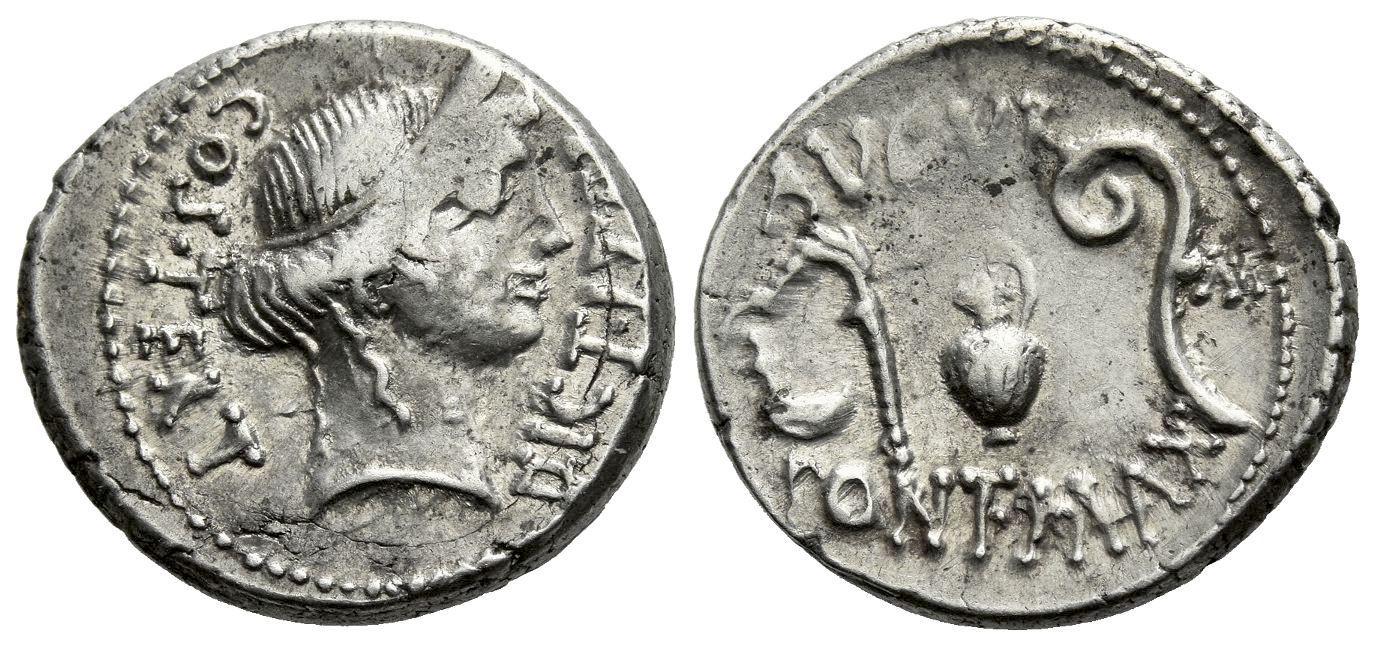
The obverse of the coin depicts the head of Ceres facing right with the inscriptions COS-TERT and DICT-ITER surrounding. The reverse depicts four priestly implements: the simpulum, aspergillum, capis, and lituus. AVGVR is inscribed above and PONT-MAX is below. Letter M in the right field. Syd 1024; Crawford 476/1b. Struck 46 BCE. Ex. Naville Numismatics.

BTW, anyone have an opinion on what a fair grade and market value of this coin would be? Feel free to drop your thoughts down below.

Julius Caesar began his African campaign, one of the last chapters of his civil war, to suppress remaining Optimates resistance after the assassination of Pompey in December of 47 BCE. The above issue was an extremely important coin struck for the purpose of this campaign.

Religious significance

Caesar relied heavily on religious propaganda to support his political authority. He was the first Roman to hold the offices of pontifex maximus and augur at the same time. On this issue, the lituus represents his authority as augur, while the simpulum, aspergillum, and capis represent his authority as pontifex maximus, the chief religious authority of the Roman Republic. A gold coin struck under Aulus Hirtius in Rome in 46 BCE (Crawford 466) has a similar reverse of priestly implements. The two types acted as a coordinated effort that year to advertise Caesar's supreme religious authority. Priestly implements continued to appear on coinage issued by Caesar every year from 49 BCE until his death in 44 BCE. This marks the importance he placed on his priesthoods and shows how tightly religious authority was intertwined with political legitimacy and power in the Roman Republic (Cody, pp. 294-295).

Dating the issue

This issue was struck in 46 BCE. On the obverse, COS TERT represents Caesar's third consulship, which began in January of 46 BCE. DICT ITER represents his second dictatorship, which began in October of 48 BCE and ended in October of 47 BCE. Curiously, the moneyer kept Caesar's title as dictator even though his time in that office had officially elapsed. This is likely explained as a way to keep broadcasting a past honor than as a minting mistake. Caesar was declared dictator for the third time after his victory at Thapsus in April of 46 BCE. Coins struck after this point inscribe DICT TERT, placing the issue before his third dictatorship. Scholars date the issue to between January and mid-April of 46 BCE, with mid-April allowing time for news of the victory to reach the mint (Woytek 2003, p. 249).

Location of the mint

The location of the mint is still somewhat uncertain. Although the issue was certainly struck during Caesar's African campaigns, no hard numismatic evidence or coin hoards definitively prove where (Crawford 1974, p. 478). Some sources place the mint in Africa, possibly at Utica, based on the known timeline of Caesar's movements there. However, this assumption relies on the conventional explanation that the issue was a triumphal type distributed among Caesar's victorious troops after Thapsus, which modern scholarship heavily disputes. That explanation rests on reading the "D" and "M" marks on the reverse as marking the coins as donative and triumphal gifts, as discussed below. The theory is highly unlikely, though not impossible, and without it the case for an African mint weakens.

Attributing the mint to Utica specifically is even more implausible on timing. Caesar gained control of the city only after his victory at Thapsus, and he was declared dictator for the third time shortly afterward. It is highly unlikely that so many coins, as evidenced by hoards and die counts, could be struck in the short period between the battle and his proclamation as dictator tertium.

The inscription points the same way. The coin carries Caesar's full titles rather than simply CAESAR (Crawford 1974, p. 93), while coins struck under his direct authority were often signed with his name. It was therefore likely struck not by a mobile military mint moving with Caesar, but by an official away from the battlefield (Woytek 2003, p. 249). The issue also omits the moneyer's name, unlike Hirtius, who put his initials on the coins he issued in Rome. This sets it apart from the normal layout of Rome issues and ties it more specifically to Caesar's African campaign as a special issue meant for military circulation.

If the conventional argument is set aside, the issue is better understood as struck by an official for Caesar in early 46 BCE to finance the African campaigns. Woytek proposes Sicily, an important staging ground for those campaigns. Instead of Africa, the obverse bust of Ceres can then be reinterpreted as linked to Sicily, also a well-known breadbasket of the Roman Republic (Woytek 2003, p. 253).

The "M" and "D" enigma

This coin has the control mark "M" on the reverse, but another type of the issue has the mark "D" on the right of the reverse. The "D" type is much more common, appearing at roughly a 2:1 ratio among surviving coins (Woytek 2012, p. 94). Die studies link the same obverse die to both reverse types, so both must have been produced at the same mint. Why, then, have two different marks for coins coming out of one mint?

The conventional theory is that the letters abbreviate Donativum and Munus, assigning the coins for distribution to soldiers and to the public as a whole, respectively. This theory is highly unlikely, though not impossible. It has little supporting evidence, and no other coin of this period is marked with its intended use. Instead, from differences in artistic style and the spatial distribution of the engraving, Woytek concludes that the letters are signatures of two different die engravers (Woytek 2012, p. 95). This also has few known parallels in Roman Republican coinage, and some scholars reject it as well. In 2012, Crawford disagreed with Woytek and argued that the letters were standard mint control marks (Crawford 2012, p. 341). Numismatic scholarship has not conclusively resolved the question.

In summary

The coin was likely struck between January and mid-April of 46 BCE to finance Caesar's war in Africa. Crawford 458 was likely minted in the East between 48 and 46 BCE and Crawford 457, minted in 47 BCE, is very scarce, so this issue likely provided the largest silver financing of the campaign (Crawford 2012, p. 341). The two types, distinguished by the reverse "D" and "M", were likely engraved by two different die engravers who added the letters as either signatures or mint control marks. Rather than being struck under Caesar's direct authority in Africa, the issue may have been struck by a moneyer stationed in Sicily and assigned to supply coins for Caesar's army on campaign.


r/AncientCoins • • 15h ago

ID / Attribution Request Anybody know what this might be?

Thumbnail
gallery
4 Upvotes

Looks Greek but I’m at a loss trying to identify it.


r/AncientCoins • • 1d ago

Newly Acquired My first roman emperor, Diocletianus

Thumbnail
gallery
19 Upvotes

My first authentic coin. Very interesting emperor and not too much hype around him.


r/AncientCoins • • 1d ago

im thinking proto money, any thoughts?

Post image
49 Upvotes

r/AncientCoins • • 1d ago Bravo

Newly Acquired Caesar’s Venus & Aeneas denarius - did it predate his African campaign?

Post image
69 Upvotes

My latest addition is a silver denarius of Julius Caesar. The obverse shows Venus wearing a diadem. On the reverse, her son Aeneas flees Troy with his father Anchises on his shoulder. In his outstretched hand he holds the Palladium, the sacred image of Athena believed to protect the city. It’s a scene of pietas, the Roman sense of duty to family and the gods. For Caesar, it was also a claim about his own ancestry. The Julii traced their descent through Iulus, the son of Aeneas and grandson of Venus. The only word on either side of the coin is CAESAR, engraved beside Aeneas.

In 48 BC, Caesar defeated Pompey at Pharsalus in Greece. Pompey fled to Egypt, where he was murdered before Caesar arrived. Many of Pompey’s surviving supporters made their way to North Africa. There, with the backing of King Juba I of Numidia, Metellus Scipio and Cato the Younger helped assemble another army. According to Plutarch, Cato was offered command but declined because Scipio, as proconsul, outranked him. Scipio led the army in the field, while Cato took charge of Utica, where he stockpiled grain, strengthened the walls and had trenches dug around the city.

In Roman Republican Coinage (1974), Michael Crawford placed this denarius at a military mint accompanying Caesar in North Africa in 47–46 BC. On his reading, the issue helped finance the campaign against Scipio. It was a substantial issue. Crawford estimated that some 390 dies were used for the head of Venus alone. Caesar sailed from Sicily in December 47 BC, so almost all the striking would have fallen in 46. In April of that year, he routed Scipio’s army at Thapsus. When word reached Utica, Cato helped those who wanted to leave find ships, then took his own life before Caesar reached the city.

Bernhard Woytek proposed an earlier date and a different mint. In Arma et Nummi (2003), he suggested that striking may have begun in Asia Minor in late 48 BC and continued into 47. One clue was a hoard reportedly found at Halicarnassus. Of the 62 Roman Republican denarii it contained, five were examples of this type. Another was the alignment of the dies. You can see it on this coin. Turn it over from left to right and Aeneas is upside down. Woytek associated that consistent alignment with eastern workshops. Crawford later raised a fair objection. In a civil war, the craftsmen who struck the coins could travel just as readily as the soldiers.

Woytek suggested that Caesar’s lieutenant Domitius Calvinus may have overseen the striking. While Caesar was fighting in Alexandria, Calvinus commanded an army in Asia Minor and managed Caesar’s finances in the region. When Caesar called for reinforcements, Calvinus sent two legions to Egypt. One was the 37th, formed from soldiers who had fought for Pompey and surrendered. Within months of Pharsalus, some of Pompey’s own men were sailing to Caesar’s aid.

We have no record of which troops received these denarii. What interests me most is where each interpretation places the coin in the civil war. On Crawford’s reading, Caesar struck it in Africa to help pay for the campaign that ended at Thapsus. If Woytek is right, the first of these denarii may already have been changing hands in Asia Minor while Scipio and Cato were still gathering their forces in Africa.

Coin details

Issuer and denomination — Julius Caesar, silver denarius
Proposed dates and mints — North Africa, 47–46 BC (Crawford), or Asia Minor, late 48–47 BC (Woytek)
Weight, diameter and die axis — 3.83 g, 17 mm, 6 h
Obverse — Diademed head of Venus facing right
Reverse — Aeneas advancing left, holding the Palladium in his right hand and carrying Anchises on his left shoulder. CAESAR in the right field
References — Crawford 458/1, Sear CRI 55, Sydenham 1013, RBW 1600


r/AncientCoins • • 1d ago

From My Collection Romanus IV Class G Anonymous Follis

Thumbnail
gallery
7 Upvotes

this is a Byzantine Romanus IV Class G Anonymous Follis, dating from 1068–1071AD. On the front, it features Jesus Christseated on a throne, facing forward, with Hisright hand raised in blessing and a scroll inHis left hand. On the reverse, it depicts the Virgin Mary with her hands raised in prayer.

Romanus IV Diogenes ruled the Byzantine Empire during one of its most turbulent periods. A military man by background, he came to the throne in 1068 with the ambition of restoring the empire's military strength and defending its eastern territories against the growing Seljuk Turkish threat. His reign was marked by military campaigns, political rivalries, and internal instability. His greatest historical turning point came in 1071, when his army suffered a decisive defeat against Sultan Alp Arslan at the Battle of Manzikert, where Romanos himself was captured. Following his release, political rivals had already taken control of Constantinople, and he was eventually deposed, blinded, and died in 1072.
Although his reign lasted only about three years, Romanos IV Diogenes remains an important figure in Byzantine history. His time on the throne coincided with a major turning point that would profoundly shape the future of the Byzantine Empire and the history of Anatolia.