Welcome to What-If Wednesday, the weekly megathread for scenarios you'd like to talk over but haven't necessarily developed much yet.
Please use this thread instead of posting just a "What-If" question without any lore - those will be removed by the mods. r/HistoryWhatIf is a better option for that kind of post. Thank you!
Background: The US National Union Party has won ever election since 1932 following a landslide victory against the Bull-Moose Progressive Party, and has helped the US recover greatly from the Great Depression and kept the US out of WW2 in Europe, however, now the NUP's popularity has began to decrease quite a bit after Hughie Long's presidential run from 1939-44 (took over as president following the death of Edward P. Costigan during his 2nd term).
State of the Union: While the US recovered from the Great Depression faster than OTL under Long, his semi-authoritarian style made him somewhat unpopular within the NUP and in the public eye. This is would cause the 1948 election to be a more contested one. Following his election, Wheeler has promised to keep America neutral on the overall world stage and in the coming Cold War, while expanding the US-Mexico Alliance into a Pan-American one. (Monroe Doctrine meets NATO, if that makes sense).
Cold War Summary: This alternate Cold War will primarily be between a moderate-lead, and newly established USSR, versus a Social-Nationalist Germany, both of which I have lore for in the attached links.
For those not in the know, Al Capone was an infamous crime boss in Chicago during the 1920s. He used the Lexington Hotel as his headquarters. During the 1980s, an underground vault was discovered near the hotel and was speculated to have been owned by Capone. Tribune Entertainment decided to finance a live broadcast of the opening of the vault on April 21st, 1986. It was the highest rated syndicated TV special in history with roughly 30 million viewers. After an incredible amount of hype with people guessing that there would be treasure or corpses inside, the host Geraldo Rivera and a excavation team used explosives to breach the vault, revealing…nothing. As you can imagine, it was incredibly disappointing and now on Reddit, whenever people post a picture of a miniature safe that they're trying to break into, Redditors joke that it will be just a repeat of the TV special with nothing of value inside. But what if that wasn't the case? What if Al Capone, predicting that people in the future would try to steal his treasure, deliberately booby trapped this vault?
Cut to 1986. This time, the vault bears an ornate plaque with the following inscription:
This vault is the private property of Al Capone.
There is no fortune here for the thief nor reward for the curious. Let this warning be heeded: anyone who crosses this threshold will risk the wrath of Al Capone.
Obviously, this does nothing to deter Tribune Entertainment, who are only more excited to break into the vault, assuming that because there's a warning, there must be something incredibly valuable inside. On April 21, 1986, only three months after the Challenger explosion was filmed live, Geraldo Rivera and his crew demolish a wall to step into the vault. At first, it seems like nothing is there. They walk in and explore, trying to find something to report. Then, someone accidentally triggers the booby trap. Secret boxes of dynamite hidden within the vault detonate in a massive explosion, killing Rivera and a dozen others as the camera feed cuts to black. What happens next? How would this change the course of history? Would there be any effect on pop culture?
I've heard about the Liverbirds which is an all-female British rock group that is very active in Germany.
I also heard that Brian Epstein expressed interest in their music, but they would eventually decline and begin their residency at The Star club in Hamburg when they signed with a German music manager.
That got me thinking: what if the Liverbirds went with Brian Epstein, and what if they signed with Parlophone and did an album with George Martin shortly after?
By the way, I think that when they'd do an audition with EMI Studios ITTL, they would bring the Beatles in to attend, and John would be blown away by their musical talents (given John dismissed them when they performed at the Cavern Club).
Author's Note / Point of Divergence:In this timeline, the 2014 indie game Yandere Simulator was never conceived, and the real-life 2009 Icelandic criminal channel gunnarrunar87 never existed. Instead, the name "Ayano Aishi" and the archetype of the monotone, obsessive webcam confessor originated from a real, notorious 2009–2010 Icelandic criminal case that permanently scarred early internet history.
Overview: "ég er enn ástfanginn" (grammatically misspelled in the masculine form for "I am still in love") is a 3-minute-long webcam confession uploaded in early 2009 on YouTube by a 21-year-old Japanese-Icelandic woman legally going by the Japanese name Ayano Aishi due to her mother being asian and her father being icelandic (born November 25th, 1988; Reykjavík).
For over a year, the video was treated as an obscure, unintentional comedy meme on Icelandic forums—largely due to the absurd cultural contrast of a pale Scandinavian woman in a dimly lit Reykjavík bedroom using a self-invented Japanese persona while speaking monotone Icelandic. Following the events of August 2010, however, the channel became one of the most infamous artifacts of early YouTube history, forever associating her name with extreme obsessive violence in online pop culture.
Video Contents & "The Mosquito Monologue": Recorded in low-resolution 240p without cuts or background music, the video consists of Aishi staring unblinkingly into her webcam and delivering a flat, emotionless monologue directed at an love interest man called Taro she repeatedly refers to as "ástin mín" Halfway through the confession, she abruptly shifts topics to deliver a bizarre, deadpan tangent that would later become the video's most quoted line: "People talk a lot about mosquitoes abroad. Because there are no mosquitoes in Iceland, to me they just sound like urban legends. Something that drains life silently without you ever noticing... I think we are alike." She ends the video by casually mentioning she is posting the link on Facebook and stating, "Ég elska þig" ("I love you").
The August 2010 Case & Trial: Iceland has one of the lowest homicide rates in the world, often going entire years without a single murder. In August 2010, the country was shaken when Reykjavík police arrested Aishi for a series of calculated stabbings targeting individuals close to a man mentioned in her video—making her one of the very few documented serial killers in modern Icelandic history and arguably the most despised figure in the country.
During her high-profile trial, Aishi shocked prosecutors and the public alike after court security discovered she had smuggled a small physical remain of one of her victims into the courtroom, holding it tightly in her closed palm throughout the proceedings so "Taro would know the work was finished."
Years later, distant relatives leaked scans of crude, ballpoint-pen notebooks confiscated from her bedroom, featuring amateur simple art style sketches with Icelandic captions detailing her crimes and personal "lore."
The Stefán Karl Stefánsson Connection: Because Iceland’s online community in 2009 was tiny, late Icelandic actor Stefán Karl Stefánsson (best known globally as Robbie Rotten in LazyTown) revealed in a 2017 interview that he was one of the very first users to stumble upon ayanoaishi88's upload. Stefánsson recalled initially thinking it was an experimental acting project by a local student, noting he almost left an encouraging comment before feeling an inexplicable chill from her blank stare—a memory he admitted haunted him after her face dominated national headlines the following year.
Legacy & Current Status: Today, ayanoaishi88 remains frozen on YouTube as a digital time capsule, with its comment section serving as an archaeological split between 2009 users mocking her robotic delivery and modern viewers arriving from TikTok and YouTube icebergs.
Because of this real-life tragedy, no game developer ever dared to use the name "Ayano Aishi" in fiction—leaving ayanoaishi88 as the sole, chilling owner of the name. Due to Iceland’s strict privacy laws and rehabilitative prison system, Aishi's current whereabouts remain officially undisclosed, sparking endless online debate over whether she remains institutionalized or is living quietly under a new, monitored identity somewhere in Iceland today.
One situation: They don't invade Belgium (so UK doesn't join and they don't have to do unrestricted sub warfare due to blockade meaning USA won't join either) and setup defensive lines with good chunk of French territory on the Western Front and go all out on the Russian Empire alongside Austria-Hungary while also funding Bolsheviks/Finnish rebels. If Belgium isn't invaded and Russia collapses earlier then it gives good opening in Western Front. I would say Russia collapses somewhere in 1916. Once the East is secure, Germany would load 30 to 40 battle-hardened veteran divisions and thousands of heavy siege guns onto trains heading west, massing over 60 divisions on a narrow 150-mile front to smash through the Lorraine Gap or Verdun and force an exhausted, isolated France to sue for peace.
Second Situation: Same thing but all in on France without invading Belgium and relying on Russian internal conflict and instability, defensive lines in eastern front, and austria-hungarians to cause their chaos and still eventually sending Vladimir Lenin back to Russia.
It relies on quick invasions and not having a royal blockade.
WW2
If Hitler isn't racist, never do holocaust and integrate minorities into Germany after invasions to reduce stability (VERY UNLIKELY).
Try to make peace immediately after 1940.
If Hitler doesn't get what he wants from 1940 diplomacy, then isolate Japan from the pact after they bombed Pearl Harbor so you don't declare war on them. Prioritize starving and bombing the Britain to its breaking point while sending units to Middle East and oil territories (/w help from Italy) instead of for a USSR invasion (not as much though). Also take the suez canal from british. If he really wants to invade USSR, finish the middle eastern campaigns quickly (likely 1942), send units from their to the future eastern front along with other units. Siege the Baku fields first because thats 80% of the USSR'S oil while doing what they did in real life for early victories.
I don't see a way they could fully cause the Soviet's to collapse as he had move resourced west of Ural Mountains already, USA was still supplying them (unless they halted it to invade Japan), and Hitler would likely not capitalize on how the Slavs in Soviet Ukraine, etc didn't like the so terrorizing them would just turn them against you as well.
I made a 13-minute alternate-history video on this: in February 1959, Canada cancelled the Avro Arrow, fired over 14,000 people in one afternoon, and ordered every plane cut into scrap. But what if Diefenbaker had kept the jet and dropped the missiles instead?
The real history is all sourced in the description; everything after 20 February 1959 is labelled speculation. Honest question for the sub: was scrapping it the right call, or should Canada have kept building its own fighters?
So basically the Turks settle in thefertile area of Ukraine And don't go to anatolia and the turks Are heavily Europeanized they adopt nestorianism and Adopt Cyrillic too and also there language is basically Russian with significsnt Turkic influence
Name: Federative Republic Of Kayistan
Currency: Kayistani Lira
Government: Constitutional Monarchy
Prime Minister: Реджеп Тајип Ердоған (Redzhep Tayip Erdohan)
Dunasty: Османоглу (Osmanoglu)
King: Харун Осман Османоглу (Harun Osman Osmanoglu)
Related to this post wherein Union Pacific acquires a better (read accepting GE's electrification modernization offer) Milwaukee Road and Burlington Northern acquires Western Pacific and Denver & Rio Grande Western, it got me thinking how different things would be if the Rock Island railroad had a much cleaner more graceful breakup than it did in reality.
Had the Rock Island railroad broke up more gracefully.
In addition to acquiring Rock Island's stake in the DFW-Houston mainline, Burlington Northern would also acquire the Tucumcari-Memphis "Choctaw Line". This allows Burlington Northern to better-leverage the recently-acquired St. Louis-San Francisco railroad (Frisco). Burlington Northern would also acquire the line from Little Rock down south to Louisiana.
Like in reality, Southern Pacific would acquire the mainline from Santa Rosa all the way into Kansas City and onward to St. Louis (though after 1982 Southern Pacific would sell the Kansas City-St. Louis Line to Burlington Northern in favor of doing trackage rights with Union Pacific's ex-Missouri Pacific mainline. Southern Pacific would also acquire the Rock Island mainline spanning from Colorado to Chicago (including the connector from Belleville to McFarland), the branch line from Liberal to Amarillo, the DFW-Herington line (instead of Missouri-Kansas-Texas acquiring it), and the Topeka-Trenton-Davenport line (including the Trenton-Polo line that leads into Kansas City). To finance this, Southern Pacific sells their famed Coast Line (spanning from Los Angles all the way to San Francisco), the Soledad Canyon line from LA to Palmdale via Valencia, and the St. Louis-Southwestern "Cotton Belt Route" line to Burlington Northern. Burlington Northern also acquires trackage rights to SP's mainline from Tucumcari down to El Paso and westward to Los Angeles, as well as the Central Valley line from Stockton all the way down to Palmdale and the Port of Los Angeles line. Kansas City Southern also acquires trackage rights on Burlington Northern's Tucumcari-Amarillo line. As Southern Pacific has a more complete mainline (with only a gap between the Salt Lake City area and Denver), Southern Pacific goes on to acquire trackage rights to the DRGW line to close the gap.
CNW acquires the Allerton-Twin Cities "Spine Line" from Allerton up north.
Remaining lines (at this point all radiating from Iowa) are sold to Iowa Interstate.
With Southern Pacific now having its own full LA-Chicago mainline, the disastrous SPSF merger attempt never happens and both Southern Pacific and Santa Fe are in a better financial position. It is also because of this that they do not buy the Chicago-St. Louis segment of the Alton line in the late 80s., instead being acquired by Burlington Northern, though SP gets trackage rights to it.
Like in the linked post, Southern Pacific and Union Pacific (this time having acquire Milwaukee Road) merge in 1993, and a large amount of Rock Island fat was trimmed off to satisfy the ICC.
UP divests the Colorado-Omaha mainline, the Belleville-McFarland connector, the Liberal-Amarillo line, and the McFarland-Topeka line to Kansas City Southern. The Trenton Cutoff and the Kansas City-Allerton line are sold to Canadian Pacific. The Chicago-Omaha line is sold to Amtrak, and the Allerton-Davenport line is sold to Iowa Interstate. Kansas City Southern acquires trackage rights from Topeka to Liberal from UP, as well as the Santa Fe's Southern Transcon from Amarillo to Los Angeles, thus resulting in a rare period where at Vaughn junction railfanners saw Union Pacific, Santa Fe, Burlington Northern, and Kansas City Southern trains at the same spot.
UP terminates trackage rights on the DRGW line in favor of the Overland line. In exchange, Kansas City Southern acquires trackage rights on BNSF's Rio Grande and Feather River lines, and UP's Donner line to access the San Francisco Bay Area. Trackage rights to Burlington Northern's Alton line from St. Louis to Chicago are also terminated in favor of UP's own ex-Missouri Pacific line.
Two years later, the Chicago & Northwestern is acquired by Canadian Pacific, and the following year Burlington Northern and Santa Fe merge to form BNSF Railway. Upon the merger
The Coast Line and the Soledad Canyon line are sold to Caltrans.
The Tucumcari-Amarillo Rock Island line is sold to Kansas City Southern.
Trackage rights to SP's mainline from Tucumcari to Los Angeles via the Sunset Route are terminated. All Choctaw line freights go to/from LA via the existing ex-Santa Fe Southern Transcon.
Trackage rights to Southern Pacific's Central Valley line are truncated to just Fresno to Stockton. Additionally Union Pacific acquires trackage rights to the ex-Santa Fe line from Fresno to the Bay Area.
The St. Louis-Chicago Alton line is sold to Gateway Western, which would go on to be acquired by Kansas City Southern in the early 2000s, giving them direct access to Chicago.
Kansas City Southern terminates trackage rights to the Southern Transcon in favor of Union Pacific's Golden State and Sunset lines.
In 2023, Canadian Pacific and Kansas City Southern Merge to form CPKC. Thus the Chicago-LA, Chicago-Bay Area and Chicago-Pacific Northwest markets are served by Union Pacific, BNSF and CPKC (even if CPKC has to rely on BNSF and UP to gain access to the Bay Area and LA).
i was looking at hitlers concept art for the swastika so for my design i just picked a simple cross to make my successful ww2 germany stand out.
in this timeline the confederacy partially won the civil war via having south atlantis a landmass in the atlantic ocean allowing them to hold on long enough for a british intervention which eventually came. also germany won ww2 and the two created the Unity Pact along with venice though they left later on.
at the moment the two are declining heavily as leftism has swept the youth in radicalization, the reich slowly decays and the confederacy may be breaking up any moment while anarchist bombings and a invasion from canada may happen any time now
TL: DR: With a opened hydrogen cryogenic terminal in Sabah, the Philippines finally begun to make inroads in Africa's refined oil market.
For nearly a decade, global energy analysts had watched Aliko Dangote construct a colossus on the Atlantic coast. What began as a 650,000-barrel-per-day facility in the Lekki Free Zone had rapidly metastasized into an aggressive, debt-fueled bid for continental hegemony, by 2030. Backed by tens of billions of dollars in syndicated commercial loans, the Dangote Group completed a sweeping $34.3 billion expansion in 2029 that doubled Lekki’s capacity to 1.4 million barrels per day—and followed it up in 2030 by opening a second $15 billion, 700,000-barrel-per-day mega-refinery across the continent in Lamu, Kenya.
With both twin-coast giants now finished and online, Nigeria’s refining juggernaut commanded 2.1 million barrels per day of modern processing power straddling both the Atlantic and Indian Oceans—dwarfing the Philippines’ combined 1.25 million-barrel-per-day domestic refineries.
The threat was immediate and existential: locking Manila out of African crude slates and Indian Ocean fuel markets altogether. With both coasts active, Dangote began starving Manila’s 11.5+ NCI refineries of Ugandan and West African crudes, flooding the Indian Ocean rim with competing fuels, and squeezing the profit margins of Philippine Oil Companies just as the Philippines’ industrial metamorphosis was hitting full stride.
However, inside the offices of SK Liguasan Oil and Gas Corporation (SKLOGC) and Prime Energy Resources Development, analysts saw the fatal structural flaw hidden beneath Dangote’s newly completed steel and concrete.
Because both mega-projects had just come online carrying nearly $50 billion in high-interest commercial debt, reliant on expensive fossil-gas steam reformers for hydrogen and exposed to chronic Niger Delta pipeline pilferage, Lagos and Lamu had to sell fuel at steep margins just to service their loans. Across the Indian Ocean, the Philippines held the exact opposite hand: $70 billion in debt-free sovereign cash, 4.54 billion cubic feet per day of Zambales white and green hydrogen sent out from the PETRONAS-built Sabah Cryogenic Terminal, and high-complexity refineries already generating 80,000 bonus barrels per day out of heavy crude bottoms.
"What Lagos also forgot was that Philippine VLCCs had already been loading Uganda’s 'Pearl Sweet' crude at Tanga since late 2026...”
Instead of fighting Dangote head-on in Lagos or Nairobi, Manila launched a silent, two-ocean encirclement—bypassing Nigeria entirely to build an energy empire that would double the GDPs of multiple nations overnight, undercut Dangote’s debt-heavy margins by $10 a barrel, and turn his newly completed twin mega-refineries into distressed assets ripe for a Philippine cash buyout.
The Six Capital Accords
In early 2032, under the cover of an ordinary SADC Ministerial Council on Energy, Mining, and Transport Corridors in Lusaka, Philippine diplomats quietly convened a closed-door backchannel summit with the energy and finance ministers of Angola, Zambia, Mozambique, Zimbabwe, Madagascar and Namibia. Unlike Beijing’s state banks or Western development lenders, Manila arrived without high-interest loan agreements or austerity demands. Instead, Philippine envoys laid down a historic, $70 billion equity offer—promising 100% debt-free cash financing, guaranteed local ownership stakes for all six host nations, and direct access to 4.54 billion cubic feet per day of Zambales white and green hydrogen via the Philippine 800-tanker fleet.
During the closed-door session in Lusaka, the African ministers pressed Manila’s delegation on a practical question:Why would developing economies focused on diesel, fertilizer, and mining need imported liquid hydrogen?
Engineers of the Prime Energy Resources Development laid out the math on the spot: by feeding Lobito and Mozambique’s plants with zero-carbon Zambales white hydrogen from MARINA cryogenic tankers instead of burning local gas in expensive reformers, their refineries could crack heavy crude bottoms into Euro-6 diesel $10 a barrel cheaper than Dangote, synthesize low-cost ammonia fertilizer for Southern African farms, and ship refined fuels and metals into Europe completely free of EU carbon border taxes. Within forty-eight hours of seeing the margins, the ministers in Lusaka had already huddled together behind closed doors—comparing notes, pooling their collective leverage, and forming a unified six-nation negotiating front. Rather than letting Manila cut six separate bilateral deals, Angola, Zambia, Mozambique, Namibia, Zimbabwe, and Madagascar agreed to bargain as a single SADC+ bloc—demanding uniform majority host-nation ownership (anchored by structures like the 51% Sonangol, 26% Zambia, and 23% PNOC Lobito split), dual-fuel backup designs so their plants could run on local gas if needed, and integrated cross-border rail and power links connecting all six economies.
Across Luanda, Lusaka, Maputo, Windhoek, Harare, and Antananarivo, opposition lawmakers grilled government negotiators over whether relying on MARINA’s hydrogen tankers would create a new form of foreign dependency, demanding strict local-content quotas and constitutional protections for state assets.Over six months of discreet negotiations —hammering out Production Sharing Contracts (PSCs), host-nation royalty splits, local hiring quotas, and parliamentary ratifications—Southern African leaders realized Manila was offering a clean break from Western restricative and exploitative loans, as well as Chinese debt traps. By late 2032, the Luanda-Lusaka–Maputo–Windhoek-Harare-Antananarivo Accords, better known as the Six-Capital Accords were formally signed and ratified, unlocking the first tranches of Philippine cash. While Prime Energy Resources Development immediately took over joint operations of Angola’s active 200,000-bpd Lobito Refinery (completed in 2027) to begin undercutting Dangote’s Atlantic fuel shipments, Philippine engineers and prefabricated modules simultaneously arrived to expand Lobito to 500,000 bpd and break ground on new greenfield mega-projects across Mozambique, Namibia, Zimbabwe, and Madagascar scheduled to open in stages between 2034 and 2037:
Angola & Zambia (The Lobito–Copperbelt Corridor — $9.5 Billion): Operating under a 51% Sonangol, 26% Zambia, and 23% PNOC ownership split, Manila bolted prefabricated 11.5+ NCI hydrocracking modules and a Zambales cryogenic hydrogen jetty onto the active Lobito Refinery to scale capacity from 200,000 bpd to 500,000 bpd by 2035, while upgrading the Benguela Railway straight into Zambia’s Copperbelt.
Mozambique (The Indian Ocean Lock — $24 Billion): Across the continent in the Rovuma Basin, Manila financed 20 MMTPA of LNG liquefaction trains alongside a 100,000-bpd Gas-to-Liquids (GTL) synthetic fuel complex (65% PNOC equity) and a deepwater port hub at Nacala.
Namibia (The Orange & Kavango Offshore Hub — $16 Billion): Engineered for rapid early returns, PNOC deployed Philippine-built Floating Production Storage and Offloading (FPSO) vessels across Namibia’s massive Orange and Kavango deepwater basins alongside an upgraded rail and port corridor at Walvis Bay.
Zimbabwe & Madagascar ($20.5 Billion): Breaking ground in 2033, Manila funded gas-fired power stations, heavy rail spurs, and Zambales-backed ammonia fertilizer pipelines linking Zimbabwe directly to Lobito and Nacala, while across the Mozambique Channel, **Madagascar deployed Philippine-financed thermal steam-injection facilities to unlock its vast Tsimiroro heavy oil reserves—**alongside a modernized logistics hub at Antsiranana, and with it, steady port and demurrage fees paid by the Philippine merchant fleet sealing a strategic maritime lock over the Mozambique Channel.
Crucially, Manila did not wait until 2037 for its new greenfield plants to open before squeezing Dangote’s market share. With 200,000 bpd of refining capacity at Lobito active from late 2032—reinforced by the Philippines’ merchant marine hauling discounted Euro-6 diesel, jet fuel, and Zambales-made fertilizer, as well as other consumer goods straight from Luzon and Mindanao into Walvis Bay, Nacala, and Beira—Manila locked Southern and East African governments into ten-year off-take treaties at prices $8 to $10 per barrel below Dangote’s break-even threshold.
This accord inevitably reached the Dangote’s executives thru sympathetic business contacts inside Lusaka’s ministries, where Dangote’s massive Ndola cement empire gave him deep political reach. Armed with that intelligence, Lagos did not sit idle. Acting like a seasoned monopolist, Dangote immediately launched a three-pronged defensive counter-play:
Locking Up East & West African Feedstocks: Lagos raced to sign binding, multi-year off-take contracts to corner Ugandan crude flowing through the East African Crude Oil Pipeline (EACOP) for Lamu alongside West African blends for Lekki, while pressuring fuel distributors across Uganda, Tanzania, and Rwanda into exclusive long-term supply agreements before Manila’s ships arrived.
Funding Opposition Lobbies in SADC: Behind the scenes, Dangote’s regional networks quietly bankrolled opposition MPs and local business lobbies across Lusaka, Harare, and Maputo during the six-month parliamentary debates—fueling the fierce public outcry over "Asian hydrogen dependency" in a bid to derail ratification of the Six-Capital Accords.
Emergency Debt Restructuring: Recognizing that a debt-free competitor backed by cheap white hydrogen would eventually squeeze his margins, Dangote’s treasury team scrambled to London and Dubai to refinance and extend the maturities on his $49+ billion in syndicated commercial loans before global markets priced in the Philippine threat.
The moment, the accord broke in Bloomberg however, everything for Dangote Group fell, like a stack of cards, as London and Dubai lenders refused to lower Dangote’s interest rates, hiking his risk premiums instead. Overnight, syndicated credit desks priced in the reality of a $70 billion, debt-free Philippine competitor armed with cheap Zambales white hydrogen and live Atlantic refining capacity at Lobito—turning Dangote’s $49+ billion loan pile from a triumph of leverage into a ticking time bomb.
Author's Note (POD / Context): In this alternate timeline, Natsume Akatsuki never creates KonoSuba (2012), and the real-life pro-logging book Truax (1995) doesn't exist either. Instead, the character design and personality of Aqua originate from a bizarre, forgotten 1995 children's book illustrated by Rumiko Takahashi.
In 1995, at the absolute peak of Ranma ½’s popularity, manga legend Rumiko Takahashi took on one of the strangest commissions of her entire career: a short, full-color picture book for young children titled Aqua and the Forest (Aqua to Mori / アクアと森).
Commissioned by a Japanese forestry and timber association as a direct counterpoint to the growing global influence of Dr. Seuss’s The Lorax (1971), the book has since become one of the rarest pieces of Rumic World memorabilia—and an infamous internet meme.
The Plot: The story follows Aqua (featuring her iconic blue hair, short skirt, and dramatic crybaby personality), a clumsy water spirit and self-proclaimed "Mother Nature" figure. In the opening pages, Aqua throws a tantrum upon seeing a young lumberjack cutting down trees, demanding he stop immediately.
Instead of arguing, the smiling lumberjack takes Aqua on a walk through the woods to explain sustainable forestry:
• He shows her that for every tree harvested, five new saplings are planted in its place (which Aqua excitedly waters using her magic).
• He explains that loggers only harvest non-native, cultivated timber trees while leaving old-growth native forests untouched.
• He asks Aqua what humanity would build houses and books out of without wood—pointing out that relying solely on plastic and steel would deplete oil and minerals far worse for the planet. By the end, Aqua realizes the lumberjacks aren't villains, blesses their work, and happily waves goodbye.
Takahashi’s Explanation & The Western Backlash: In a 1996 interview, Takahashi explained she accepted the project after noticing how many children at the time were demonizing loggers as heartless monsters after reading translated environmentalist stories. She wanted to teach kids the difference between illegal deforestation and responsible reforestation in a lighthearted way. While the book was warmly received in Japan as a cute, harmless educational fable, its limited English release in the late 90s triggered massive backlash:
• Corporate Propaganda Accusations: American educators and environmentalists slammed the book as shameless timber-industry lobbying disguised as cute manga.
• The "Hentai" Misunderstanding: Because Aqua wore a typical 90s Takahashi outfit (an ultra-short skirt and a tight sleeveless top, similar to Lum or Shampoo), clueless Western parents and early 2000s forum users frequently mistook scanned pages of the book for hentai or "inappropriate anime."
• The Dr. Seuss Estate: Lawyers for Dr. Seuss Enterprises were reportedly furious, viewing the book as a blatant attempt to undermine The Lorax’s message, effectively halting any wide Western distribution. Interestingly, however, Audrey Geisel (Ted Geisel's widow) later remarked in an interview that she actually found Aqua’s character design adorable—joking that with her bright blue palette, Aqua looked like the Lorax’s fiery orange "soulmate" and opposite half.
Legacy Today: For years, Western manga fans were baffled by an official late-90s crossover illustration featuring all of Takahashi’s major protagonists—Lum, Ataru, Ranma, Akane, Inuyasha, and Kagome—with a mysterious blue-haired girl crying in the corner with a watering can. Today, original 1995 physical copies of Aqua and the Forest sell for hundreds of dollars among lost media collectors. Following the 2012 Lorax movie and the "How Bad Can I Be?" meme boom, Aqua experienced a massive ironic resurgence online—immortalized in fanart either getting lectured by the Lorax or shipped with him as the ultimate "Tree-Hugger x Lumberjack" power couple.
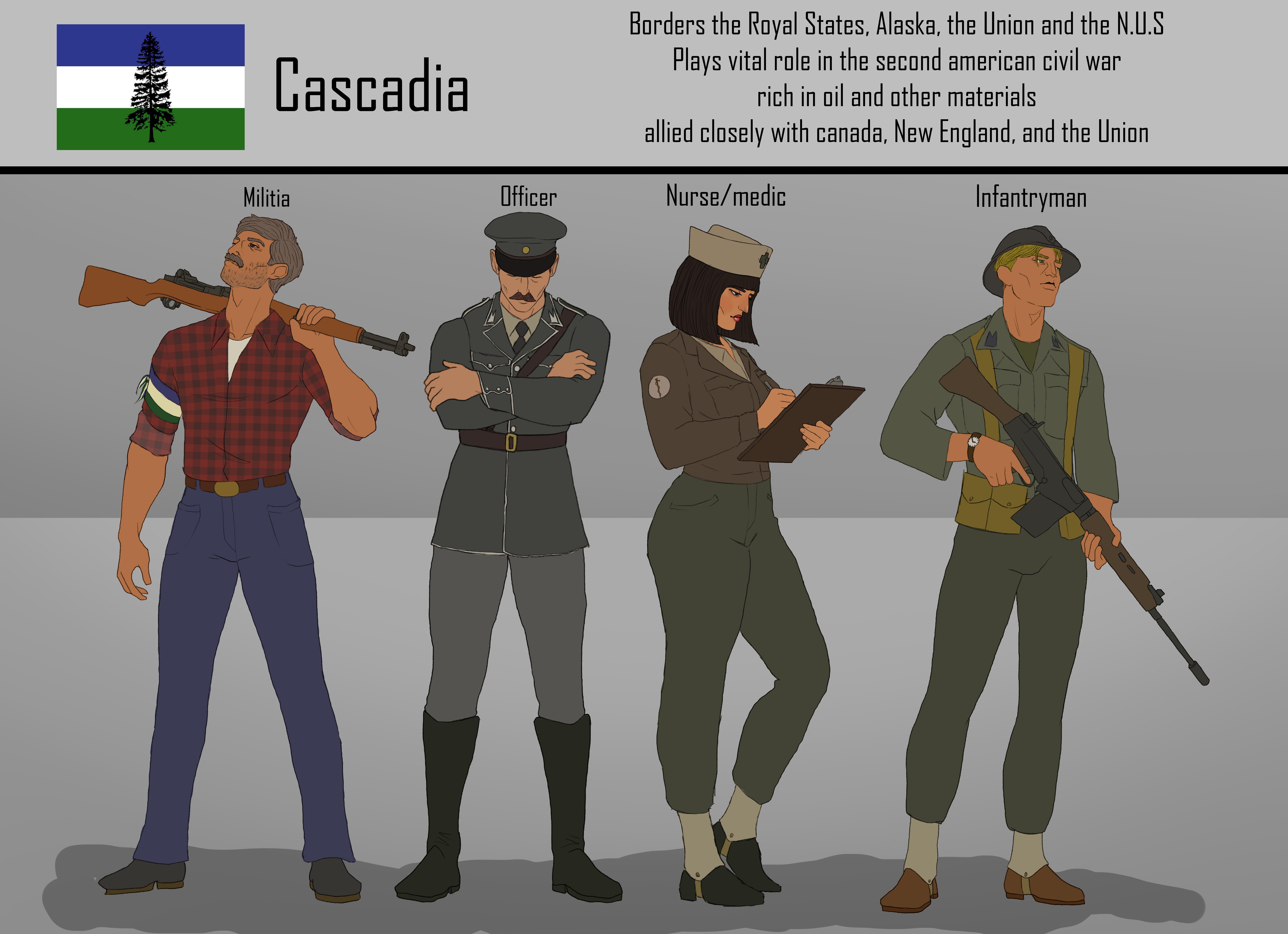
The Brother War of 1861-1868 ended in a crawl. Americans on both sides lost many lives and supplies and so to end the war against fathers and sons, there came the Mason Dixon Treaty of 1868. Slavery was ended, however states had more authority unto themselves, and could unionize into coalitions, making the American south both its own government, but ultimately, it was under the authority of the Union government. Over time more and more states created their own coalitions, New England, Cascadia, Texas, and the Western Royal States.
Nestled in the Northwest of the US, this coalition is made up of a peaceful populus, largely wealthy from the large oil reserves that are dug and traded with Alaska. However the peaceful nature of the coalition will change when a large oil vein is found on the boarder of the southern Cascadian states, and the Royal states, sparking conflict. Will they be able to negotiate, or will this be the spark that ignites the second American civil war?