r/Abaqus • • Jan 26 '22

Why is total energy in ABAQUS Dynamic/Explicit continuously increasing?

28 Upvotes

I performed a low-velocity impact simulation on a composite laminate with a hemispherical tip impactor. The simulation got aborted after 30 minutes of runtime due to 1 excessively distorted element. But the most concerning part is that my total energy increased from 1.5 J to 199 J within 7ms (Total step time = 10ms). Viscous dissipation and artificial strain energy are incredibly high, whereas internal energy is negative! which is quite absurd.

Why am I facing these weird results? Because no error popped when I simulated except for the distortion error towards the simulation end.

Also, the stress contour is very weird. It's almost transparent when zoomed out. But that could be at least attributed to the simulation abortion, but why all these are happening without any modelling error is what's quite intimidating. Is it because my mesh is too coarse just outside the impact zone?

I have followed the exact procedure for this simulation as per the video given below -

https://www.youtube.com/watch?v=IVe1uoqmdT8

I shall be grateful to anyone who would help me resolve this. I can post more details on the model here if it's required.

Thank you


r/Abaqus • • 10d ago

Learning Abaqus

Thumbnail
gallery
20 Upvotes

Hi, I am learning Abaqus because i get in my Uni motostudent team, they gave me that exercise, but i cannot make the simulation run properly. i Have those two plates that are connected
through a bolt that is pressing them together to avoid that they slide, one is fixed, on the other one i have a 100N concentrated load, the boalt load is 2500N. I have a contact between the plates, one between the plate and head of the screw and one between the bottom plate and the nut, i have a tie between the bottom (trheated) part of the bolt and the bottom plate hole, i did the loading in 4 steps, the initial were i put the fix costrain on the bottom plate, the second one where i put the bolt load, the third one where i fix the lenght of the bolt and the fourth where i put the actual load (axial 100N on the top plate). I didi the mas at 1.5 mm and is everything in hex structured, i partitioned all the parts (i also tried differnt ways to mesh it and it stil do not work). Can anyone help me to make it work please?


r/Abaqus • • Jul 10 '24

Newton Cradle Pressure Waves with Abaqus Explicit

18 Upvotes

r/Abaqus • • May 29 '26

We're crowdsourcing an Abaqus dataset - open to all users

15 Upvotes

Based on a hunch, we are running a light‑hearted but serious computational exercise on reproducibility open to absolutely every Abaqus user. We are releasing four small Abaqus input files for a cylindrical shell under uniform meridional compression. No knowledge of shells whatsoever is required.

https://imperialcollegelondon.app.box.com/v/RRX-Participant-Materials

Our request to the community is simple: please run these to completion without any parallelisation, then run the provided Python script to extract the data into .csv files. Complete the very short metadata Excel questionnaire, place the .csv and .xlsx files into a uniquely named .zip archive, and send it back to us. The whole process should take no more than 30 minutes.

Please repost and forward this to any Abaqus user you know — we’d like as many submissions as possible across a wide range of Abaqus versions and hardware. Our target is 1000.

Please make no modifications to the input files of any kind and let them run as far as they go. If anything interesting emerges, we will prepare a short publication and acknowledge all participants.


r/Abaqus • • Dec 12 '20

Tutorial Hello everyone, please who can recommend the best way to learn ABAQUS CAE for FEA/FEM from beginner to pro, it could be a course, bootcamp, or anything else. Idc what it will take... thank you !

12 Upvotes

r/Abaqus • • Nov 17 '20

Tutorial Importance of Mesh Independence & Why you should care about it

Thumbnail
maxshear.com
12 Upvotes

r/Abaqus • • Jul 16 '26

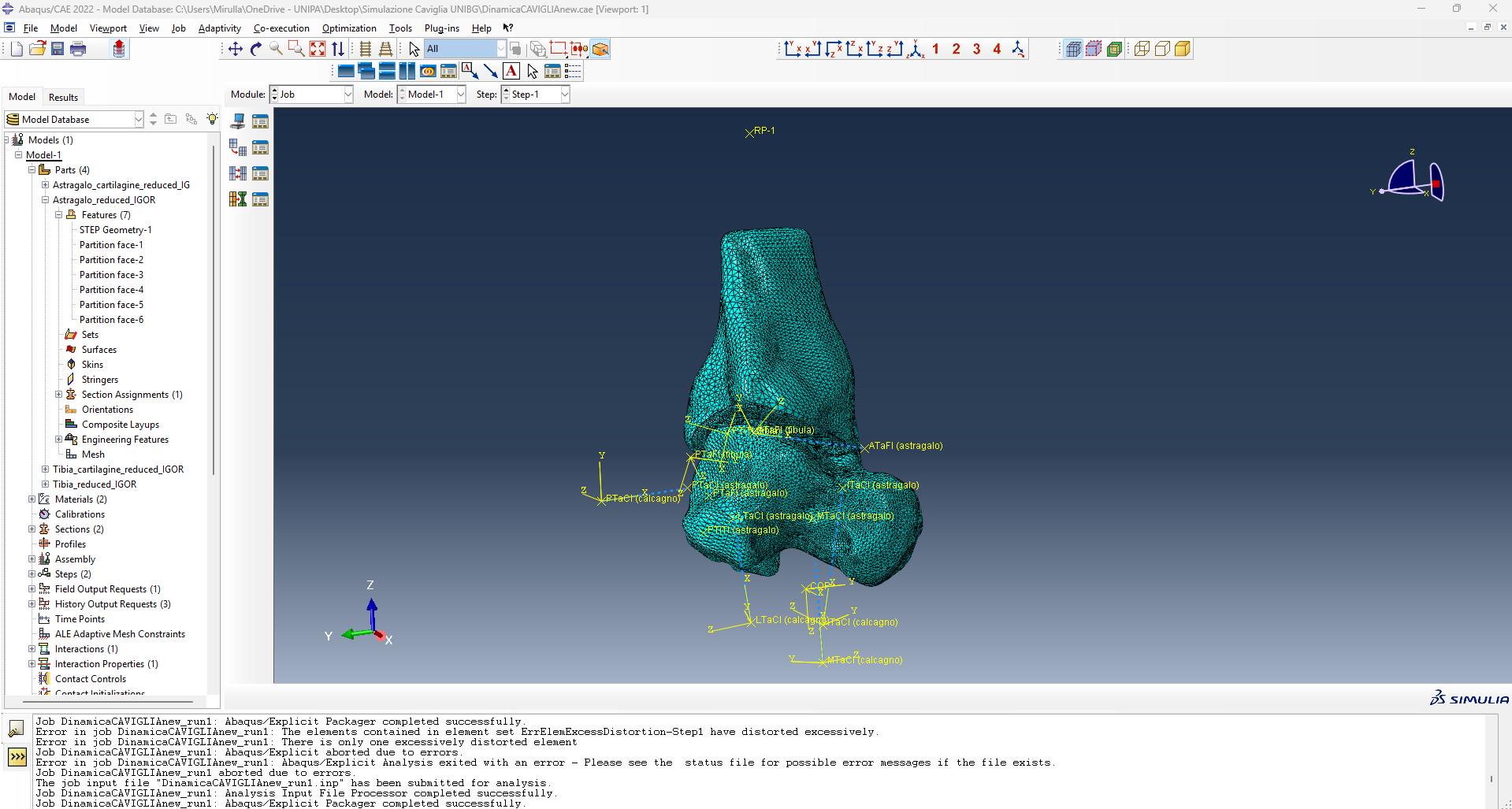
Dynamic explicit analysis of ankle joint

Post image
11 Upvotes

I am working on an explicit dynamic simulation in which the model consists of four parts: the talus, the talar cartilage, the tibia, and the tibial cartilage. I am also using nonlinear connectors to simulate the ligaments, and the applied load consists of forces and moments derived from gait analysis.

I am unable to get the simulation to converge due to excessive element distortion, and I suspect that the problem stems from the contact conditions rather than the mesh. Can anyone suggest how to model the contact to make the simulation converge?

Currently, the contact is set to surface-to-surface using the penalty method, with normal and tangential stiffnesses specified.


r/Abaqus • • Aug 28 '25

three point bending w foam material

Thumbnail
gallery
11 Upvotes

the actual experiment exhibit brittle failure starting from the tension side(bottom side). In my simulation, the compression side exhibit higher stress than my compression side. Any advice?

I haven’t introduce crack yet but the stress distribution seemed to be wrong

what could be wrong?


r/Abaqus • • Oct 06 '26

Abaqus learning

10 Upvotes

Hi i´m wondering if you have some recommendations of Abaqus CAE courses (i don't mind to pay for them) that could be useful to improve my skills to simulate impacts on living tissues in Abaqus CAE explicit.


r/Abaqus • • Apr 24 '26

Abaqus appreciation

9 Upvotes

Just taking a moment to say I love Abaqus. I’ve used, extended , automated for almost 20 years. Used to work there too!

I am doing a project at work that requires LS-Dyna. Great code. Innovative for sure. But abaqus is just so darn easy to use. I love it.


r/Abaqus • • Sep 01 '25

Help on Compression Test Using Load

Post image
9 Upvotes

Hi all,

I’m simulating a compression test in Abaqus and it works fine when I use displacement control, but I’m struggling to apply a fixed load of 50 N (≈5 kg) instead. I’d like some advice on what I need to change in my setup.

Here are the steps I followed for the displacement-controlled case:

  1. Imported the specimen as deformable and created fixation + loading plates as rigid bodies.

  2. Assigned PETG material properties to the specimen.

  3. Assembled all three parts.

  4. Created a Static, General step.

  5. Defined interaction: hard contact with friction coefficient 0.3.

  6. Boundary conditions:

    • Fixation plate → encastre at its RP.

    • Loading plate → RP locked in all directions except Z; applied displacement of –5 mm in Z.

  7. Meshed all three parts.

  8. Submitted the job → results look fine with displacement control.

Now, I want to replace the –5 mm displacement with a load of 50 N.

Any corrections to my workflow above or suggestions for how to properly set up a load-controlled compression test would be really helpful.

Thanks!


r/Abaqus • • Jul 02 '26

Is there a way I can force Tet meshing to follow some kind of pattern?

Thumbnail
gallery
8 Upvotes

I have this holed unit cube which is partitioned in 8 regions and the 2 regions in which the hole is are identical.

When meshing them with Tets I am getting an extra internal node on one of them but I would like for both of them to be meshed similarly.

Is it possible to force abaqus mesher to at least match the same number of nodes and Tets on both regions?


r/Abaqus • • Jun 12 '26

Requesting Guidance in Learning Abaqus

8 Upvotes

Hi, I'm hoping to learn Abaqus for my research. I want to conduct test like stress-strain curve generation, three-point bending test, tensile test, fatigue test, these kinds of stuff. I am completely new to this software and the concepts too. Is there any free resources online where I can find well organized tutorials from the beginner level? Any youtube channel or website?

Thanks in advance.


r/Abaqus • • Nov 22 '25

How to Introduce TPU Material Properties in Abaqus to use for Simulation?

8 Upvotes

I’m working on an Abaqus simulation that uses TPU material. I found several papers with tensile test data for TPU, but I’m not sure how to properly define or introduce TPU as a material in Abaqus. Can someone guide me on how to set up TPU material properties in Abaqus?


r/Abaqus • • Mar 10 '23

With what strain value should strain gauge value from physical testing be corelated to in FEA?

8 Upvotes

Question might sound easy but hear me out. When we test any structure, gauge gives strain value. But when i do similar simulation in abaqus software, we have multiple strain values at same location i.e strain at node, element face, element centroid, at eleemnt integration points with 0 to 100% averaging etc depending on software we use. So how to corelate and with what value should we corelate testing strain data with FEA strain data?


r/Abaqus • • Aug 27 '26

Help with non linear thermomechanical analysis

Thumbnail
gallery
7 Upvotes

Hello. I am trying to run a non linear Fea on a cfst column. The analysis is sequentially coupled thermomechanical analysis, and I am trying to model a column which, according to literature fails by buckling. I have tried everything from changing material properties, mesh partition, to adding imperfections and even switched to Dynamic Implicit Quasi static, but at the point where the column is supposed to collapse and show negative displacement, the solver always fails. At that exact same point. I have reached the end of my wit in trying to make this work so any suggestion would be greatly appreciated.


r/Abaqus • • Aug 16 '26

Problem in unloading part

Post image
7 Upvotes

During an cyclic analysis part i faced a problem which is during unloading or we can say when the displacement going to zero, load almost peaks.....that is when

Displacement=0

Load = Almost maximum

But it should be

Displacement==> 0

LOAD ==> 0

(In image you can see the blue line is experiment one and yellow is from abaqus )

During loadin it matches but when its time for unloading its way off the line

I jst need what might cause it thats all


r/Abaqus • • May 06 '26

Abaqus – Negative eigenvalues & zero pivot with contact (CLT model works with tie and cohesif)

Post image
7 Upvotes

Hi everyone,

I’m facing a convergence issue in Abaqus during a nonlinear mechanical analysis.

Model description:
- 5-layer CLT (cross-laminated timber) panel with orthotropic material behavior
- Supports modeled as rigid bodies with reference points (RP)
- Surface-to-surface contact between the CLT panel and the supports

The issue:
The model converges well when using:
- tie constraints
- or cohesive behavior

However, when I replace them with contact, I consistently get:

- "The system matrix has XXX negative eigenvalues"
- "Zero pivot at node ... DOF 1 / 3 / 5"
- "Overconstraint detected at node ... (APPUIS-1 / APPUIS-2)"
- "Displacement increment for contact is too big"
- followed by: "Too many attempts made for this increment"

What I have already tried:
- Frictionless contact
- Reducing the initial time increment
- Checking master/slave definition
- Verifying no initial overclosure/interference
- Applying BCs only on reference points (no BCs on contact surfaces)
- Checking rigid body definitions

Key observation:
The problem only appears when using contact — the model runs fine with tie constraints.

I would really appreciate any help, feedback, or suggestions from anyone who has faced a similar convergence issue with contact.

Thanks in advance


r/Abaqus • • Mar 18 '26

FEA simulation

Post image
7 Upvotes

r/Abaqus • • Jan 21 '26

📊 How to Convert Experimental Data to Abaqus Material Tables — The Right Way

7 Upvotes

📊 How to Convert Experimental Data to Abaqus Material Tables — The Right Way

In this video, I explain step by step how to convert experimental stress–strain data into a format that Abaqus actually understands:

• Engineering vs true stress–strain

• Plastic strain definition

• Common formatting mistakes that silently break simulations

This is essential if you’re working with nonlinear materials, plasticity, or experimental validation.

🎥 Watch it on my YouTube channel FEAMaster

👉 https://www.youtube.com/@FEAMASTER?sub_confirmation=1

#abaqus #tensiletest #stressstrain #material #feamaster


r/Abaqus • • Sep 22 '25

Abaqus validation assistance

Thumbnail
gallery
7 Upvotes

Hello, I have been stuck at a particular place in Abaqus software with experimental validation. I hope you all can help me in this aspect. I have matched the acceleration response of undamaged case as attached with experimental collected data at the centre of the beam through model updating. The shear crack is generated by deleting the crack part with the same crack parameters as experimental. After matching the undamaged response, I tried overlapping the experiment and simulated acceleration responses, but they aren't matching. I'm not able to find the core reason here. Is it due to damping?


r/Abaqus • • Jul 12 '25

Made a YouTube Channel for Engineers: Abaqus, FE-SAFE, Fatigue Simulations

7 Upvotes

Hey folks!

I’ve been posting a lot of simulation tutorials lately — mainly focused on Abaqus, FE-SAFE, SYSWELD, and fatigue analysis.

Topics I cover include:
✔️ Welding simulation (with and without DFLUX subroutines)
✔️ Fatigue life prediction in FE-SAFE (S–N, ε–N, welds, multiaxial)
✔️ Crack growth with XFEM
✔️ High-velocity impact, tensile test simulations, etc.

If you're into CAE, finite element methods, or just want to improve your workflow in Abaqus or FE-SAFE, you might find my channel helpful.

🎥 YouTube channel: FEA Master
🔗 https://www.youtube.com/@FEAMASTER?sub_confirmation=1

I’m always open to feedback, content requests, or collabs — just drop a comment or reach out!


r/Abaqus • • May 17 '25

Abaqus scripting = Geometry generation is super slow (40+ minutes)

Post image
7 Upvotes

Hi all,

I'm currently developing a parametric wingbox model in Abaqus. The geometry is constructed by first generating 2D sketches for each wing station, from which I create wires. I then use the loft feature to create shell surfaces between each pair of adjacent wire sections. This is repeated multiple times to loft the upper and lower covers and stringers.

The model includes over 20 stringers on both the upper and lower covers. All sketches and wires are generated in just a few seconds, but the lofting operation itself takes a very long time, over 40 minutes in total. The slowdown appears to be entirely due to the repeated shell lofting.

Has anyone encountered similar performance issues? Any suggestions for optimizing loft operations or improving geometry generation performance in Abaqus would be greatly appreciated.

(CPU: I7-8750H, not the best, but should not be a bottleneck at this point)

Thanks in advance!


r/Abaqus • • Apr 07 '23

Abaqus - Low velocity impact

Thumbnail
gallery
7 Upvotes

Hi everyone! It is one of the first times I use abaqus and am going crazy with a problem

I’m modeling the impact between a steel bullet and a composite plate and I have to get the graph that follows, but as you can see my graph looks more like an exponential. Can you help me with that?

I modeled the bullet as rigid, while the plate is a deformable. The contact is surface-to-surface, the plate is narrow on all sides, while the bullet can only move on the z axis (ie in the direction of the plate). Finally, the bullet has a constant speed.

I didn’t insert the damage model because I have to get this graph without inserting the damage. On the other hand, I inserted a friction coefficient between bullet and plate.

I checked the contact conditions, the time step and the boundary condition but obviously something is wrong.

Thanks to anyone who can helps me!