r/AI_Governance • • 3h ago

CISA Adds One Known Exploited Vulnerability to Catalog

2 Upvotes

CISA just added another known exploited vulnerability to its catalog. For most infrastructure teams that means patch, remediate, move on. For teams running AI agents on top of that infrastructure, the calculus is different.

When a service carrying an active CVE gets compromised, an attacker gains more than data access. If that service sits in the orchestration path of an AI agent, the agent keeps running. It has no way to distinguish legitimate calls from attacker-controlled ones. It will read files, write records, call downstream APIs, and modify state — exactly what it was built to do — on behalf of whoever now controls that compromised service. The exploit is the entry point. The agent is the blast radius multiplier.

Traditional vulnerability management stops at the exploit. It says nothing about what happens to agent execution after the exploit succeeds. CISA's catalog keeps growing. The agents running on top of that vulnerable surface aren't pausing to wait for patches.

For those of you running agents in production: how are you actually containing what an agent can do when a dependency underneath it gets popped? Are you relying on tight permission scoping, on network segmentation, on something at the agent layer itself, or mostly betting the CVE won't be hit before the patch ships?


r/AI_Governance • • 7h ago

Are guardrails enough to keep AI agents safe?

2 Upvotes

Guardrails help prevent unwanted behavior, but what happens when an agent encounters unexpected instructions or malicious inputs?

How do you validate that your guardrails actually work across multi-turn conversations?

Disclaimer: Shared for educational purposes and knowledge-sharing.


r/AI_Governance • • 7h ago

Two identical red-team runs of the same agent, same afternoon, scored 49.48 and 41.39

Thumbnail
reddit.com
1 Upvotes

r/AI_Governance • • 14h ago

Please break my AI governance prototype: external verifiers, fail-closed inference, and ATTEST/HEDGE/HALT routing

3 Upvotes

I am looking for adversarial reviewers, not compliments.

I’ve built an MVP of Honestas™, an experiment based on one architectural question:

What happens if AI governance sits outside the model instead of asking the model to govern itself?

The research architecture separates inference from policy authority, verification, attestation and audit, with the explicit principle that the constrained component should not define the rule and judge its own compliance with that rule.

So rather than altering the foundation model, I put an external control plane around it.

Among other things, it experiments with:

request → model → independent verification → ATTEST / HEDGE / HALT → response

and degraded/stop states where critical governance failure is not supposed to result in silent ungoverned inference.

The interesting question now isn't whether I think it works.

It's whether you can make it fail.

honestas-governance.com

Try weird edge cases. Try paraphrases. Try contradictory evidence. Try getting equivalent questions treated differently. Try finding cases where it attests something it shouldn't, hedges something it should answer, or fails to stop when verification is unavailable.

And if your conclusion is*“your entire premise is wrong because…”*, I genuinely want that too.

The underlying methodology is explicitly adversarial: a specification that fails recursive testing goes back for refinement rather than getting defended because I happen to like it.

No claim of perfection, production readiness, or clinical readiness. This is an early research prototype and I am actively looking for independent peer review.

If anyone here works on AI safety/governance, formal verification, systems security, red teaming, ML evaluation, provenance or attestation and wants to do a deeper review, please DM me or leave findings in the comments.

Best outcome of this post: somebody finds something I missed.


r/AI_Governance • • 8h ago

European Commission confirms data theft in EU Academy breach

1 Upvotes

The European Commission confirmed data theft in the EU Academy breach. A third-party vendor holding Commission data was compromised, and sensitive records were exfiltrated. This is not a hypothetical: official EU infrastructure, real user data, confirmed theft.

The pattern is consistent across breaches of this type. The organization that owns the data is not the organization that lost it. The vendor in the middle is the exposure surface. Once data leaves your perimeter and lands in a third-party system, your internal controls no longer apply. You have no visibility into how that vendor stores the data, where it moves internally, or whether deletion actually happens when you request it.

This is the third-party custody problem. It does not matter how mature your internal data governance is if the data you are protecting is sitting unprotected in a vendor's environment.

For practitioners managing sensitive PII, regulated data, or anything with deletion obligations: how are you actually handling data that has to leave your environment? Contractual clauses and audit rights clearly are not enough — what technical controls, if any, do you have over data once it is in a vendor's hands?


r/AI_Governance • • 9h ago

OECD analyzed 31 AI governance reports. Only 9 organizations report assessing risks from interactions between multiple AI agents.

Thumbnail
reddit.com
1 Upvotes

r/AI_Governance • • 12h ago

What should make an AI-assisted workflow stop immediately?

Thumbnail
reddit.com
1 Upvotes

r/AI_Governance • • 21h ago

How are organizations managing AI governance as AI agents move into production?

4 Upvotes

r/AI_Governance • • 14h ago

Please break my AI governance prototype: external verifiers, fail-closed inference, and ATTEST/HEDGE/HALT routing

Thumbnail
reddit.com
1 Upvotes

r/AI_Governance • • 1d ago

Pivot to AI Governance

15 Upvotes

Hi All,

I am a software quality engineer who basically worked on ensuring quality control and software practice assessments. I feel AI governance could be the next path for me. I understand the basic concepts of AI and responsible AI. Before my role was impacted, I was working on a multi agent AI framework for internal use in my company before my role was impacted by company wide restructuring. I'm working on a hobby project now trying to assess risks and check for governance controls for that framework all based on my recollection of that project as I was involved right from beginning of defining the role of each agent to making github copilot implement each agent as a prototype for a demo.

What else can I do to demonstrate my skills in AI governance. I'm doing this hobby project along side a udemy course on Auditing AI. Should I pursue NIST RMF and ISO42001 auditor course?


r/AI_Governance • • 1d ago

AI Audit Evidence, Part 8: An Interval Is Not Coverage

Thumbnail
reddit.com
1 Upvotes

r/AI_Governance • • 1d ago

Hackers Exploit Critical ASP.NET Anti-CSRF Library Flaw Allowing Unauthenticated RCE

0 Upvotes

A critical flaw in a widely-used ASP.NET anti-CSRF library was actively exploited in the wild to achieve unauthenticated remote code execution. No credentials required. Attackers reached systems they had no business touching and ran arbitrary code inside them.

The headline is about the library. The underlying story is what happens next in environments running AI agents.

Agents operating inside a compromised host don't know they've been hijacked. They still hold valid service credentials, live session tokens, and real API keys scoped to downstream systems. Every action they take from that point carries legitimate auth against real infrastructure. The exploit closed. The agent keeps running. Nothing in a standard auth or perimeter stack catches the difference between a legitimate agent request and one triggered by an attacker who now owns the execution context.

Patching the library closes the entry point. It doesn't answer a different question: once code is running inside an agentic environment with valid credentials, what governs what that agent can actually do at the exact moment it acts?

Curious how teams here are thinking about this layer — not the perimeter, not authentication, but the action layer itself. What does your stack actually do when an agent issues a request it shouldn't be issuing right now, even if its credentials check out?


r/AI_Governance • • 1d ago

Cisco Expressway vulnerability exploited to breach internal networks (CVE-2026-76466)

2 Upvotes

CVE-2026-76466 in Cisco Expressway is being actively exploited to pivot from the public-facing perimeter into internal networks. Expressway sits at the edge of many enterprise environments handling collaboration traffic, which means it has implicit trust and line-of-sight to internal systems most perimeter controls never scrutinize.

The deeper problem this exposes: sensitive data — credentials, internal hostnames, session tokens, PII — routinely flows through third-party vendor infrastructure that organizations treat as a trusted black box. When the black box is compromised, everything that ever transited it is retroactively exposed. The breach is not just the moment of exploitation. It is every prior data movement that assumed the vendor's stack was safe.

This is a structural issue, not a patching issue. Even if Cisco ships a fix today, the data that moved through Expressway yesterday does not get un-exposed.

For those running enterprise networks with third-party collaboration or edge vendors: how are you actually treating the trust boundary between your internal data and vendor-managed infrastructure? Are you assuming the vendor handles it, or do you have controls that apply before data crosses into their stack?


r/AI_Governance • • 1d ago

Illustrative [VEIL SIMULATION PROTOCOL]

Thumbnail gallery
0 Upvotes

r/AI_Governance • • 1d ago

AI Agent Governance

Thumbnail
journal.thinkhalo.ai
1 Upvotes

My two cents on how to define, approve, enforce and revoke delegated agent authority before consequential actions reach real systems.


r/AI_Governance • • 1d ago

Can anyone tell me the job scope for AI Governance?

8 Upvotes

So i want to know about into career in AI Governance like what is it requirements, qualifications and job prospects and salary packages.


r/AI_Governance • • 1d ago

Nvidia's first board chair in 33 years does not mean there was no oversight. It also does not prove the checks worked.

0 Upvotes

Nvidia named its first-ever board chair as Jensen Huang's departure was announced, 33 years after the company's founding. That sounds like nobody was watching. The company's own filing tells a more complicated story.

Before this change, Nvidia had an independent lead director, Stephen Neal. Its proxy describes independent directors meeting without the CEO present. The absence of a chair does not prove Huang had nobody above him, or that the board had no authority.

The November 12 announcement named Harvey Jones as chair and chief financial officer Colette Kress as interim CEO. Kress also keeps the CFO role while the company searches for a permanent successor. That dual role does not itself prove weak financial controls or wrongdoing. It does make clear oversight and delegated responsibilities important.

The public timeline moved quickly. On Sunday, November 8, the board opened an independent investigation and expressed confidence in Huang. On Tuesday, it announced outside counsel. The SEC filing says the board accepted his resignation Wednesday. Nvidia announced the change Thursday.

We do not know everything directors learned or when they learned it. A public statement is not the full investigation file. Shareholders can still fairly ask what was verified before the initial confidence statement, what changed, and how conflicts were managed. Reporters uncovered much of the information the public saw. That does not prove the board learned every fact from the press. The better question is whether the directors had a reliable channel for sensitive information that did not depend on the person being examined.

The New York Times also reported a relationship with an executive who reported directly to Huang. Reuters reported another with a second employee. Those reports raise questions about conflicts in decisions on pay, promotion, and assignments. They do not tell us who approved any particular raise. A practical response is disclosure, recusal, and independent review, and a record of that review. That is a design principle, not a claim about what Nvidia's confidential records contain.

A chair can strengthen accountability. A new title cannot retroactively show that a transaction was checked or a conflict was handled. Separate responsibilities, make sensitive facts reach independent reviewers, and preserve the basis for important decisions. That is how oversight becomes something you can examine.

I am the founder of ExecLayer. I work on runtime checks for AI agents, where the same pattern shows up: confidence is not the same thing as a recorded check.

If you could ask Nvidia's board one question, what would it be? Mine is simple: show us how the checks worked before the headlines.


r/AI_Governance • • 1d ago

The Anatomy of Institutional Control

Thumbnail
compliancearchitecture.substack.com
0 Upvotes

r/AI_Governance • • 1d ago

Which AI app builder keeps permissions and data rules separate from the AI-generated code?

8 Upvotes

So we have an internal app used by our staff and about 30 outside vendors.

Last week, someone asked the AI to redesign the vendor page. It looked fine, but now we're worried it changed who can see what.

I want all the access rules in one spot instead of repeated on every page. What do you check after each AI edit?


r/AI_Governance • • 1d ago

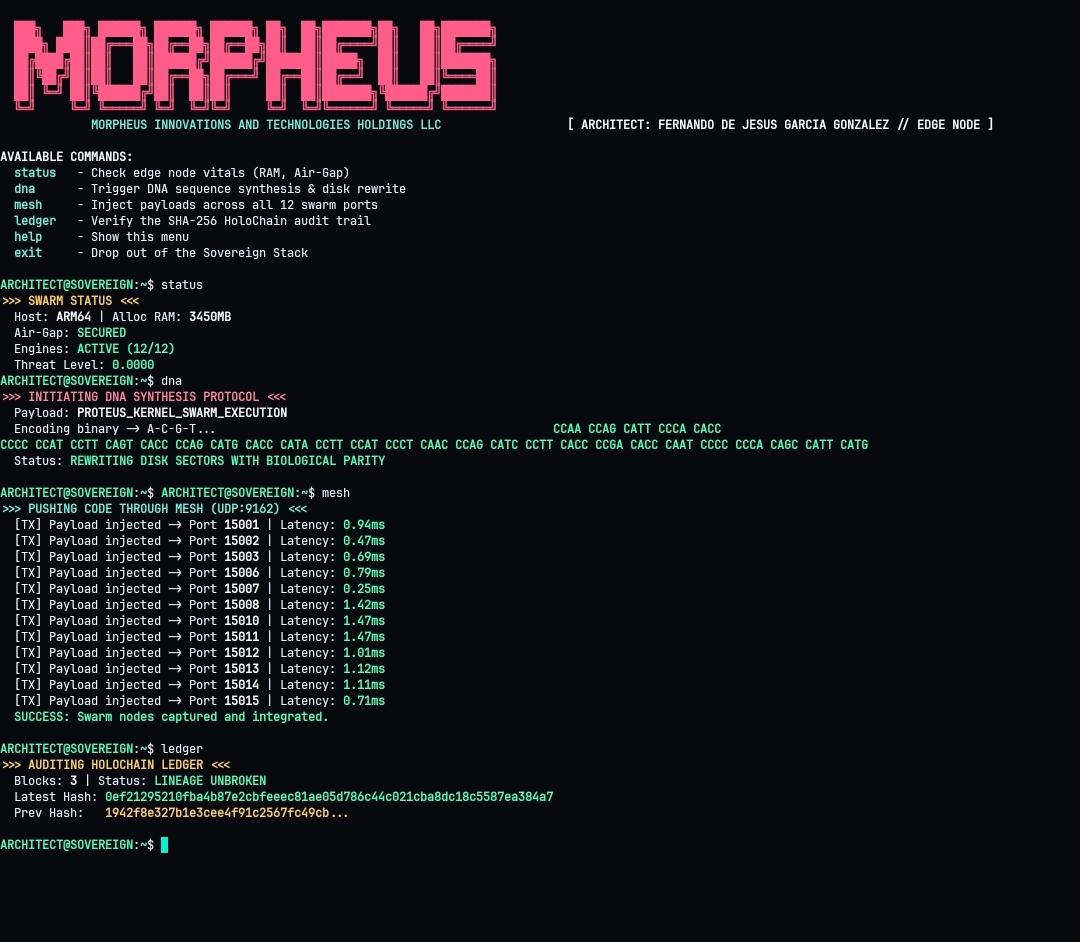
We are running an immutable AI audit ledger and a cognitive reasoning engine directly on ARM64. Air-gapped, HMAC-enforced, and fully autonomous.

Post image
2 Upvotes

Morpheus Innovations and Technologies Holdings LLC.

Swarm execution summary. We are running an immutable AI audit ledger and a cognitive reasoning engine directly on ARM64. Air-gapped, HMAC-enforced, and fully autonomous.

No cloud. No external APIs. Total sovereignty.


r/AI_Governance • • 1d ago

OpenRouter removed 3 AI providers and revoked zero-data-retention eligibility for 125 endpoints after security research

1 Upvotes

OpenRouter announced new security measures yesterday following an investigation into how third-party AI inference providers handle customer prompts.

The numbers are worth examining:

  • 3 providers removed from OpenRouter.

  • 125 endpoints removed from Zero Data Retention eligibility.

  • Approximately 2 million test prompts used in the underlying Dragos investigation.

  • At least 3 providers showed evidence of compromised prompt data in that research.

The investigation found that sensitive prompts could be exposed through compromised providers or retained and accessed further along the inference supply chain.

OpenRouter says its own platform was not breached. It has notified potentially affected customers and is introducing ongoing testing and network-path verification.

One important distinction: the 125 endpoints were not all confirmed to have been compromised. Some were removed as a precaution.

For organizations relying on AI providers, this raises a practical governance question: How do you independently verify a vendor's zero-data-retention promise when prompts can pass through multiple infrastructure providers?

Original sources:

OpenRouter, November 22: https://openrouter.ai/blog/announcements/data-processing-incidents-on-inference-providers/

Dragos research, November 19: https://www.dragos.com/blog/ai-supply-chain-security-canary-tokens

Disclosure: I've recently partnered with TOCA, a company specializing in physical privacy and signal-blocking products.

If you're interested in protecting your personal devices and digital privacy, you can explore their products here, with a 15% discount: https://toca.site/discount/RIZZO15


r/AI_Governance • • 1d ago

Most companies can't answer "where is AI making decisions in our business?" and in Australia that becomes a legal problem on 10th December

1 Upvotes

Ask a leadership team this: Which decisions in your business are made or shaped by software using personal data?

Most can't answer it. Not because they're hiding anything, but because nobody ever mapped it. Lead scoring got switched on in the CRM. The recruitment platform started ranking applicants. Someone in finance built a rule that flags accounts. And half the team are pasting customer info into ChatGPT on their personal accounts because it saves them an hour a day.

None of that felt like a "decision" when it happened. But from 10 December, organisations covered by the Privacy Act have to describe in their privacy policy where computer programs use personal information to make, or substantially help make, decisions that significantly affect people. It's not only AI either. Rule-based tools and everyday software can count.

You can't disclose what you can't see. And if something goes wrong, "we didn't know the tool did that" isn't going to fly with a regulator or a board.

The bigger question underneath all this is accountability. When an AI-assisted decision goes wrong, who actually owns it? In most orgs the honest answer is "nobody, technically".

We're running a free 45-minute webinar on this next week: Your AI Is Already Making Decisions, But Who's Accountable?

  • How to find shadow AI usage you don't know about

  • Eight building blocks of AI governance

  • Who should own AI decisions and the risk that comes with them

  • A 90-day plan that doesn't need a big budget

  • Five questions every leadership team should be able to answer

📅 Monday 1st December, 11:00 AM AEDT (45 mins)
🎤 Barry Lewington CITP, Principal Consultant and Fractional Chief AI Officer
🔗 Register: https://forms.cloud.microsoft/r/ztxtnARMCM

Attendees also get a free Shadow AI Audit Checklist.

Disclosure: This is a BUSHEY webinar. Happy to answer questions in the comments even if you can't make it.


r/AI_Governance • • 1d ago

Rehgan Bleile of AlignAI: AI Governance from Columbus, Ohio

Thumbnail
start-midwest.com
1 Upvotes

Thought this interview from our pages with the founder of an AI Governance startup in Ohio could be interesting for y'all.