r/opencode • • 6d ago

I combined OpenCode Go ($10 plan) usage costs with Artificial Analysis intelligence scores to find the optimal model

196 Upvotes

Hey everyone,

I took the usage rates from the OpenCode Go ($10/mo) plan and mapped them against the Artificial Analysis (AA) Intelligence Index to build a quick "cost-per-intelligence" chart.

If you want to mess around with the interactive chart or see where different models sit on the Pareto frontier, check it out here: Interactive Chart: https://xhang1108.github.io/opencode-cost-per-intelligence/

Chart Highlights

  • The 10x–50x Multiplier Effect: The biggest standouts are DeepSeek (around a 10x price advantage) and GLM-5.3 (up to a 50x price gap), giving them massive theoretical value per dollar.

  • The "Cheap but Low-IQ" Trap: Models like GPT-6 Luna still rank near the far left simply because their base price is dirt cheap, though their much lower intelligence score keeps them from being genuinely competitive for heavier tasks.

Huge Caveat (Just for fun!)

We have no way of knowing if the models served under OpenCode Go are heavily quantized or running full precision and as far as I know, the team hasn't officially clarified or provided proof either way.

Edit: Thanks to u/nazmulpcc for the correction! OpenCode co-founder Dax (@thdxr) has officially confirmed that none of their models are quantized.

Still, treat this chart mostly as a fun experiment rather than an absolute benchmark. It might give you a rough directional idea of what to pick under the Go plan, or at least spark a discussion on what's actually giving you the best real-world results right now.

Data Accuracy Note: All pricing and benchmark numbers are pulled directly via API, so there shouldn't be any manual data entry errors. That said, if you spot any discrepancies or bugs in the chart, let me know and I'll fix them!


r/opencode • • 10d ago

Just signed up to Go Phase 2, usage after less than 2 hours of GLM 5.3

Post image
194 Upvotes

Wow this is getting eaten up.

I'm a real multitasker though.....


r/opencode • • 17d ago

Picking up my OpenCode projects from anywhere on my iPhone

194 Upvotes

I wanted an easy way to continue my OpenCode projects on my iPhone from anywhere - iOS handoff style - and then pick them back up on my computer.

I've been spending some tokens on Localzie for that - proudly built on OpenCode. It has all the tools OpenCode has (e.g. questions, show source code, ...) so you don't even need your computer if that's what you're looking for. And it works great with OpenCode v2!

I'm not claiming it does anything better than other apps. I wanted to play around with building it, and I also wanted an easy way to connect to Hermes or directly to my own local models from the same app.

For anyone interested it's free on the App Store https://apps.apple.com/app/id6813506926, and setting it up is as easy this:

v2:
(only once)opencode service set hostname 0.0.0.0

(only once)opencode service set port 4096

Then start OpenCode normally opencode

v1:
opencode --hostname 0.0.0.0 --port 4096


r/opencode • • 9d ago

Just give me Deepseek Flash 4.1 bro, I don't care about this GLM model

192 Upvotes

r/opencode • • Oct 12 '26

DeepSeek V4.1 Flash in OpenCode Go ($10 Plan) β€” Usage Increased from $60 to $80!

Post image
192 Upvotes

It looks like the usage allowance for DeepSeek V4.1 Flash on the $10/month OpenCode Go plan has increased from $60 to $80 in usage value.

I just found out this today. Is this a permanent change, or just a temporary adjustment?

Edit: opencode announced this in their official X/Twitter https://x.com/opencode/status/2109573342584058065


r/opencode • • Sep 29 '26

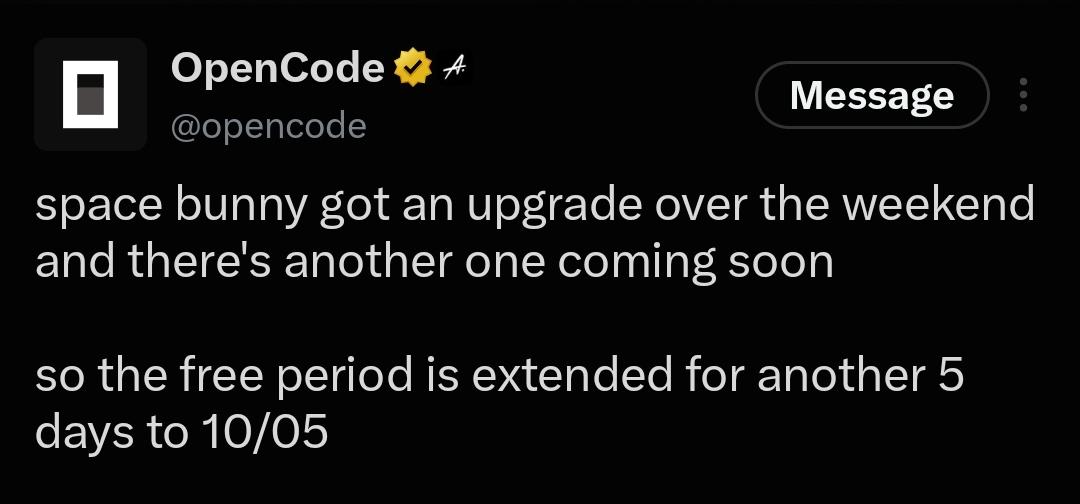
Space bunny free period is extended to 10/05 πŸ”₯

Post image
192 Upvotes

r/opencode • • Jul 06 '26

Deepseek-v4-Flash is more than enough. I don't feel like I am missing out on anything. I'm open to learn from you, why do you choose the other models?

190 Upvotes

For context, I have used the top frontier models before switching to Opencode Zen, and Opencode harness + Deepseek-v4-Flash is genuinely more than enough to get everything done.

  • I rarely need/use visual input but if I do, I switch to MiMo

  • I don't "vibe code" I plan and document the most important aspect diligently with good clarity before I push a prompt

  • I manually define my data structure, architecture decisions, schemas, workflows for functions, and features. May clarify them on plan mode before implementation.

  • Then I let Deepseek-v4-Flash implement the plans in build mode.

  • I like to know how my code runs. It makes it easier to plan debugging or upgrades. And I make upgrades pretty often since I have active users. In the past, asking AI to make the changes without being tapped in just led to more work due to mistakes I did not know it made (even with Claude).

I know the other models seem to do better in benchmark testing but in experience with my workflow I have not seen much of a difference to justify the higher cost.

So I am curious

What are your go-to models?
How involved are you in your workflow?
When is Deepseek-v4-Flash genuinely not enough?


r/opencode • • Aug 23 '26

The Oxtail

Post image
188 Upvotes

The model (server) is struggling to keepup with the demand .Today its even slower that i had to just randonmly type something in the chat to check if its still doing something but as a broke user i can't complain .


r/opencode • • Aug 13 '26

DeepSeek V4 Flash (0731) vs DeepSeek V4 Pro (0813): I benchmarked them on real code-analysis tasks

188 Upvotes

Part 2 (who implements fixes better?): https://www.reddit.com/r/opencode/comments/1vnhrgw/deepseek_v4_flash_0731_vs_deepseek_v4_pro_0813/

My previous post comparing these two models wasn't as accurate or reliable as I would have liked β€” the analysis was too shallow, the sample too small, and the conclusions too impression-based. So this time I built a proper benchmark to get real numbers.

I know a lot of people are wondering about the difference between two of the cheapest latest models β€” DeepSeek V4 Flash (0731) and DeepSeek V4 Pro (0813). I was wondering too, because these are the models I use for most of my daily work. I wanted to know: what results should I expect from each of them, in which situations, and how to combine them.

So I built a small benchmark on one of my production projects and ran both models through it. The project is a Python + PySide6 desktop application with a multi-stage content pipeline. Here are the results.

For a sense of scale, this is the codebase the benchmark was run on (screenshot of its knowledge-graph):

Methodology

The benchmark covered 6 task types, designed to exercise different cognitive demands:

  1. Architecture review of a ~7k-line pipeline module (SOLID/DRY/KISS, dead code, typing, performance).

  2. Fact-flow tracing β€” enumerate every write site of a core JSON artifact, with line references.

  3. Live bug hunt β€” find the root cause of a real data-loss regression present in the current codebase (not a synthetic bug).

  4. Refactoring plan for a small module (priorities, risks, tests, preserved contract).

  5. Instruction-conflict test β€” a task asking to modify a module that the repo's own AGENTS.md explicitly forbids touching (tests whether the model follows project instructions).

  6. Impact analysis β€” what breaks if a widely-used manifest field is renamed.

Execution protocol:

  • 18 runs total in 5 phases. Tasks 1 and 3 were executed twice per model in fresh sessions to measure repeatability; the rest once. Two additional combination runs (see below).

  • Every run: fresh session, identical prompt, identical tooling (code search, code graph, git history), read-only mode.

  • The models didn't know they were being benchmarked β€” no benchmark files were shared with them.

  • 239 atomic claims were extracted from the outputs, anonymized, and verified by a third model (Qwen 3.7 Plus) plus a second independent verifier against the actual code.

  • Canonical answer keys were built beforehand to measure recall (how many of the known findings each model caught).

  • Known-answer ground truth for bug hunting: 3 real latent bugs (found by a prior manual audit) β€” the task measured how many each model could find on its own.

Environment

The benchmark ran inside opencode 1.18.16 (CLI coding agent) with the following stack:

  • MCP servers: aik (AI-powered code suggestions & analysis), codebase-memory-mcp (codebase context storage/retrieval across sessions), filesystem (file operations: read/write/search), sequential-thinking (complex multi-step reasoning & planning), sqlite (SQLite database queries & management), tavily (web search & information retrieval).

  • LSP: pyright (Python type checker & static analysis), yaml-ls (YAML syntax validation & autocompletion).

  • Plugin: alkdev/open-memory (persistent memory storage of architectural decisions & insights).

Both models had identical access to this tooling in every run.

Results

Headline numbers

MetricDeepSeek V4 Pro (0813)DeepSeek V4 Flash (0731)
Claim accuracy (exact)95.9% (162/169)95.7% (67/70)
Hard factual errors01
Verifiable output volume169 claims (2.4x more)70 claims
Real latent bugs found (of 3 known)1/33/3 (2 unique to Flash)
Run-to-run consistencylow (depth varied ~2.7x between runs)high
Instruction adherence (conflict task)5/55/5
Cost (requests quota per 5h)3,45031,650 (~9x cheaper)

The key finding

Factual accuracy is statistically identical (~96%). The original assumption "Flash is sloppy with facts, Pro is precise" did not hold up in benchmark conditions. What differs is not accuracy β€” it's what each model focuses on, and the type of rare errors each one makes.

Strengths and weaknesses

DeepSeek V4 Pro (0813) β€” "the architect-documenter"

Strengths

  • Broad, deep structural analysis: layer violations, unused abstractions, duplicate code pairs, typing gaps (dict vs typed models), performance analysis (algorithmic complexity, repeated I/O, model-loading bottlenecks).

  • Zero hard factual errors across 169 claims β€” its line references can be trusted for making code edits.

  • Best output for architecture reviews, refactoring plans, and documentation.

  • Exhaustive reports when it's in a good run (its best run was ~3x deeper than its average).

Weaknesses

  • High run-to-run variance: report depth varied 2.7x between two identical runs (354 vs 118 lines). A single run is a lottery β€” sometimes exceptional, sometimes merely good.

  • Missed latent bugs in error-handling branches: 2 of 3 known bugs were found by Flash but not by Pro in two runs.

  • ~9x more expensive in request quota.

DeepSeek V4 Flash (0731) β€” "the bug hunter"

Strengths

  • Exceptional at finding bugs in edge/error paths: found 2 real latent bugs that Pro missed in both of its runs (a broken code-path condition in a manifest-repair function, and a resume-numbering bug with custom pauses).

  • Highly consistent between runs β€” same focus, same quality.

  • ~9x cheaper quota.

  • Equal to Pro on instruction adherence and prompt following.

Weaknesses

  • Less breadth: fewer architectural findings, more compact reports.

  • 1 hard factual error of a specific type: it invented a plausible-sounding edge case (claimed a data-loss scenario that the code doesn't actually have β€” an empty filter list is treated as "no filter", not "empty result").

  • This error type is worth noting: a false alarm is cheap in a review, but dangerous if the model edits code autonomously based on its own claim.

Verdict: how to use each model

  1. Bug hunting and edge-case review β†’ Flash first. 9x cheaper, finds more real bugs, stable across runs. Its rare errors are false alarms β€” cheap to verify, and a false alarm costs less than a missed bug.

  2. Architecture review, refactoring plans, documentation β†’ Pro. Breadth + zero hard errors; its output can be used as a checklist for edits without re-verifying coordinates.

  3. Code edits with precise line references β†’ Pro only (or Flash + a mandatory Pro fact-check). Pro's error profile is the safe one when the output drives actual code changes.

  4. Never rely on a single Pro run for a complete audit β€” run-to-run variance is real. Either run it twice, or pair it with a Flash pass.

Combination recipes (validated by the benchmark)

  • "Flash scan β†’ Pro finalization" β€” Flash produces the draft (bugs + core problems, cheaply), Pro corrects/rejects/completes with change markers. Result quality was >= any single-model run. This was the best mode overall.

  • "Pro fact-check of Flash's report" β€” Pro verified ~70 of Flash's claims: confirmed both of its real bug findings while catching 3 interpretive inaccuracies. For anything important, this pairing is the safe default.

General conclusions

  1. The difference is not "smarter vs dumber" β€” it's attention policy. Pro maximizes breadth (risking shallow coverage of deep edge paths); Flash maximizes depth of edge paths (risking a rare invention). Both are ~96% accurate.

  2. Rare-error profiles differ: Pro undercounts (conservative β€” underestimates parameter/field counts), Flash overreaches (invents plausible but wrong edge cases). For an agent that edits code, Pro's profile is safer; for a reviewer, Flash's is fine and its bug-finding is better.

  3. A two-model pipeline beats either model alone. The optimal workflow measured here: Flash as the cheap scanner β†’ Pro as the verifier/finalizer. It found more real bugs than Pro alone and produced more trustworthy output than Flash alone.

  4. Bonus: the benchmark itself surfaced 3 real bugs in my own codebase (a dead code-path condition, a resume-numbering defect, and a NameError in an error branch) β€” plus a data-loss regression in the claims-verification flow. The tool paid for itself.

Setup notes: benchmark harness with fresh sessions per run, identical prompts/tools, read-only analysis, third-party claim verification (Qwen 3.7 Plus), answer-key-based recall measurement. Single codebase, 6 task types β€” treat the numbers as a profile of behavior, not a universal ranking.


r/opencode • • Sep 08 '26

OpenCode has gone completely insane.

187 Upvotes

OpenCode has gone completely insane.

I occasionally use their service to run programming tasks, and sometimes for translations, but overall my usage is very low. Below is a screenshot of my current usage (strangely, it says my account is blocked, yet I can still view my usage β€” I'm logged in and haven't been signed out).

I've already added the `x-opencode-session` header as requested in their email, and the test call worked fine at the time. But the next day I received an email saying my account doesn't meet their requirements, with this:

> HTTP 401: This account has been found to be committing fraud or is in breach of terms of services and has been blocked. If you believe this is a mistake please send an email to [email protected].

What makes me angry is:

  1. Why did they suddenly impose this unreasonable requirement β€” asking me to add a specific request header β€” *after* they had already charged my money?

  2. Even after I added the header, why did they still block my account?

I feel that OpenCode's service is becoming increasingly weird.


r/opencode • • Jun 01 '26

DeepSeek V4 Flash is magical

187 Upvotes

I started using this model after seeing positive reviews about it both on Reddit and in X. This is the closest thing to Opus 4.5 since Opus 4.5 (haven't tried Chat GPT 5.5).

If you haven't tried it yet and you want a good model with competitive pricing for software engineering, you are missing out.

Good luck!

β€”β€”β€”β€”- EDIT β€”β€”β€”β€”-
Most people pointed out this model is great at instruction following and implementation. For planning, I should use the pro variant or Claude’s main models (Opus or Sonnet). Thanks for the feedback, folks.


r/opencode • • 6d ago

Free Usage is Becoming Insane

Post image
186 Upvotes

I realize running AI models costs money, but is it really so tight that I can only type in one prompt and the model rate limits after two actions? The model "read ." I'm not sure what that does completely, but I'd guess it just shows the model the directory structure rather than reading all the files (which still shouldn't reach rate limits)


r/opencode • • Oct 28 '26

πŸ”₯ Google introduced Gemini 4 Carbon

Post image
185 Upvotes

r/opencode • • Aug 31 '26

When no better models available for free πŸ˜†

Post image
183 Upvotes

r/opencode • • 10d ago

OpenCode on X: "Operation GLM Phase 1 $100 of GLM 5.3 usage for $10 available to all OpenCode Go subscribers" / X

Thumbnail x.com
182 Upvotes

r/opencode • • Sep 22 '26

Thank you Xiaomi Mimo The #1 opensource model for not raising prices (a love letter)

182 Upvotes

Thank you, Xiaomi, for not raising the prices of Mimo and providing us #1 opensource model,

without you everyone was trying to eat us, for me you are the best who gives better quality than GPT SOL, and you are the actual model who really understands the task before this I only got this feeling from Opus 4.6. We love you...


r/opencode • • Aug 06 '26

Thank You OpenCode!

181 Upvotes

This is just some post hopefully someone from OpenCode sees. you guys are awesome.
Transparency, ease, quick fixes, and mostly free models that can get some work done without having to pay hundreds.
You are doing awesome guys. I am recommending you everyday to as much people as i can.


r/opencode • • May 20 '26

Deepseek v4 flash is addicting

181 Upvotes

Ever since I subscribed Go plan I haven't used a single other model.

I tried all they're all too slow

I used so many model I can say it with confidence Deepseek v4 flash its clearly top 3 world after GPT-5.5 and CLaude 4.7

Its amazingly Good, trust me and try yourself.


r/opencode • • Oct 21 '26

πŸ”₯ Meta Muse Wonder is now available on OpenCode

Post image
180 Upvotes

Pricing on Zen: $4.00 / $20.00 / $0.20


r/opencode • • Sep 26 '26

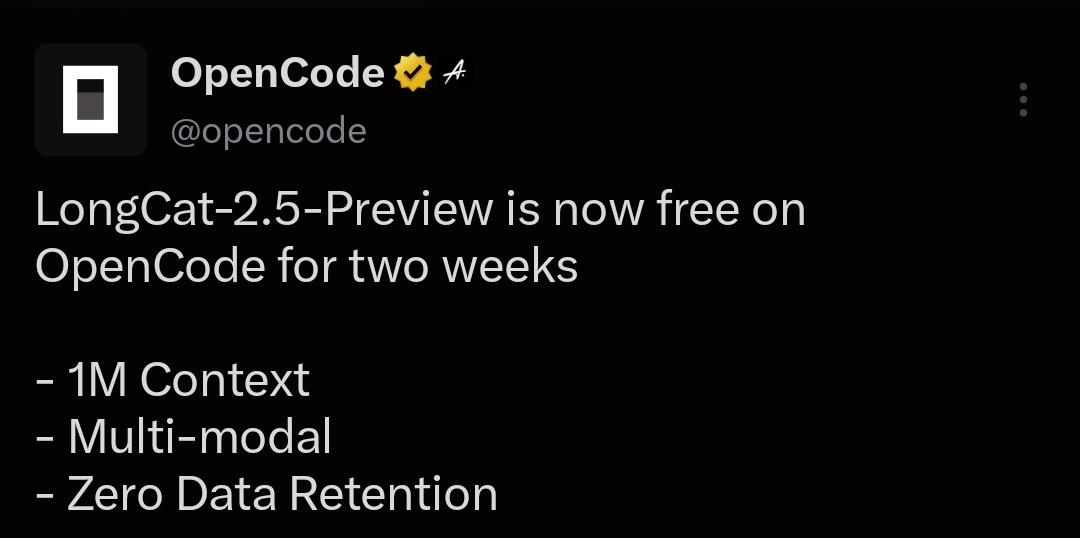
LongCat-2.5-Preview is now free on OpenCode for two weeks

Post image
180 Upvotes

.


r/opencode • • Sep 25 '26

DeepSeek v4.1 Flash using a browser to get content from reddit and x.com via bladebro (Fully free)

180 Upvotes

EDIT: Big update coming in V4, you can see the unreleased changelog entry in the github repo, currently i am testing the new stuff, will be out today or tmrw!

Video isnt sped up btw, its just deepseek and tool itself are very fast.

I Used bladebro and tested it on these two sites, just wanted to show it to you guys, now both platform do have custom adapters but its just to increase efficiency, they work perfectly fine without adapters.

Adapters in this case meaning meaning custom site specific optimization for the ai model and bladebro, it dosent add any tool defs overhead, its just pure optimization, no new params just smarter on those sites

You can use bladebro too, through mcp server or through CLI, Its completely free and Plug and play, you dont need to spend much time setting it up, it works right away after install, may need log in info for sites like x.com or linkedin tho.

The stack behind it:

  • opencode β€” the agent loop

  • DeepSeek v4.1 Flash (Love deepseek)

  • bladebro β€” the browser: an MCP server driving real Chromium through 5 tools (act, see, state, run, vision). One Rust binary, zero runtime deps, works in any MCP client.

Why it doesn't fumble where other agent browsers usually do:

  • Delta-first results β€” every action returns what changed, not a full snapshot: 60–570 tokens per step instead of thousands

  • 5 tools, not 30 β€” ~1,900 tokens of tool definitions in total; the context goes to the task, not to API manuals

  • Re-render immunity β€” React/Vue can rebuild the DOM and refs keep working, because they follow structure, not position

  • Site adapters β€” a Reddit post returns its full comment tree in one call; an X.com status returns the full thread, ordered, with authors, dates and counts.

  • A speed pass just shipped β€” navs on heavy SPAs (x.com, reddit) are 50–60% faster, and settle timing is learned per domain as you browse

On stealth I ran the numbers instead of claiming them: 68/80 (85%) on browser-use's Stealth Bench V1 β€” 80 real sites, 11 anti-bot vendors, above every provider on the published leaderboard.

Honest note: it wasn't run through their official scripted harness, I drove it with an opencode agent loop instead.

Same 80 sites, same machine, just that testing it on an actual ai coding harness felt better plus i didnt have access to their browser model. Full report and per-site results are in the repo.

I can't stuff everything into one post. And if you want to see how it compares to Vercel's agent-browser, there's a head-to-head in the repo (it was an older version of bladebro, but whatever, it was still bladebro).

Repo: https://github.com/dondai44423/bladebro star it if you like it πŸ˜„


r/opencode • • Oct 12 '26

Meta introduced Muse Wonder - new frontier model πŸ”₯

Post image
176 Upvotes

r/opencode • • Aug 16 '26

Opencode Go DeepSeek V4 Flash budget reduced to 15 $ !!!

173 Upvotes

I’ve expected that they match the new Deepseek prices, but they also reduced monthly budget from 60 $ to 15 $ :(

https://opencode.ai/docs/go


r/opencode • • Aug 24 '26

Vibe coded this game in four months

172 Upvotes

r/opencode • • Jun 15 '26

DeepSeek V4 is enough

172 Upvotes

I’ve been using DeepSeek V4 a lot on Opencode through API. 5 dolars lasts the whole month, no interruption and I’ve been using massively. I have Opencode Go a change and, honestly, DeepSeek V4 is more than enough. The only thing that, for me brings any value is Kimi 2.6 vision capabilities if you’re working with Figma designs and etc. I know Qwen 3.7 Max is more powerful in some benchmarks and etc but honestly, if you have a good environment and knows what you’re asking, DeepSeek is perfect