r/opencode • u/torrso • Aug 24 '26
OpenCode Go's usage limits have become absurdly difficult to understand
When I subscribed to OpenCode Go, the offer was simple: $10/month gives you $60 of usage.
This was easy to understand. Models had dollar denominated token prices, the Usage page showed dollar costs, and I had a $60 monthly allowance.
I could even understand how it was possible, the average subscriber only uses a fraction of their quota, paying for more than they use, allowing the excess to be used to pay for the heavy users who use more than they pay for. That and possibly upstream bulk discounts.
At some point OpenCode introduced a lower $15 usage limit for some of the more expensive models. I didn't use them much, partly because I never really understood how it works, so I didn't pay much attention to it, I was only using DeepSeek V4 Flash.
In hindsight, I can understand the reasoning: Before the more expensive models, the average user must have used something like 16.7% of their quota, therefore: $10 / (16.7 / 100) = $59.80 - they could offer $60 for $10. When prices went up or more expensive models became popular and the users didn't change their usage habits, the average user might now have ended up using something like 67% of their quota instead of 16.7%, meaning you can only offer $10 / (67/100) = $14.90 - thus, introduce the $15 bucket.
DeepSeek V4 Flash moved from the $60 tier to $15, then a day later to $30 after OpenCode apparently got a better deal.
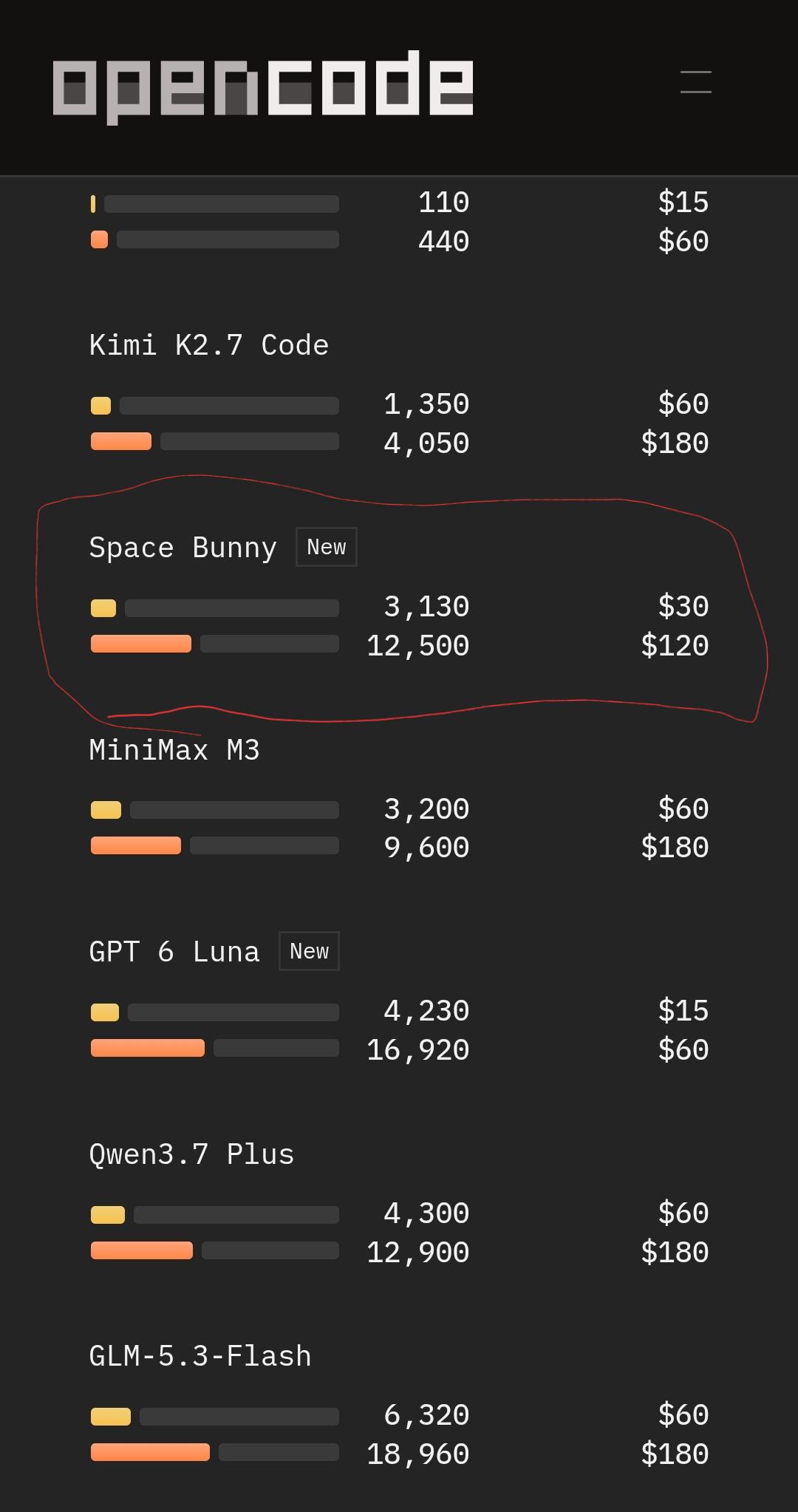
So.. Now Go has models with $15, $30 and $60 "usage limits".
This is where I completely lose the plot. I'm fairly sure not all of the models offered in Go will be able to decipher it either.
The dollar cost shown on the Usage page is apparently based on the model's per-token price. So when DeepSeek's upstream pricing changed, two things seem to have changed at once:
each request became more expensive
the usage allowance for that model dropped from $60 to $15
Those effects multiply.
How much did the effective DeepSeek allowance actually change for my workload? Who knows. How did the next day bucket swap from $15 to $30 affect my weekly/monthly quota? Monday I had $15 and used $9 and had $6 left, Tuesday they gave me $15, but I still only had $6 left. Hmm?
This isn't helped by another common misunderstanding:
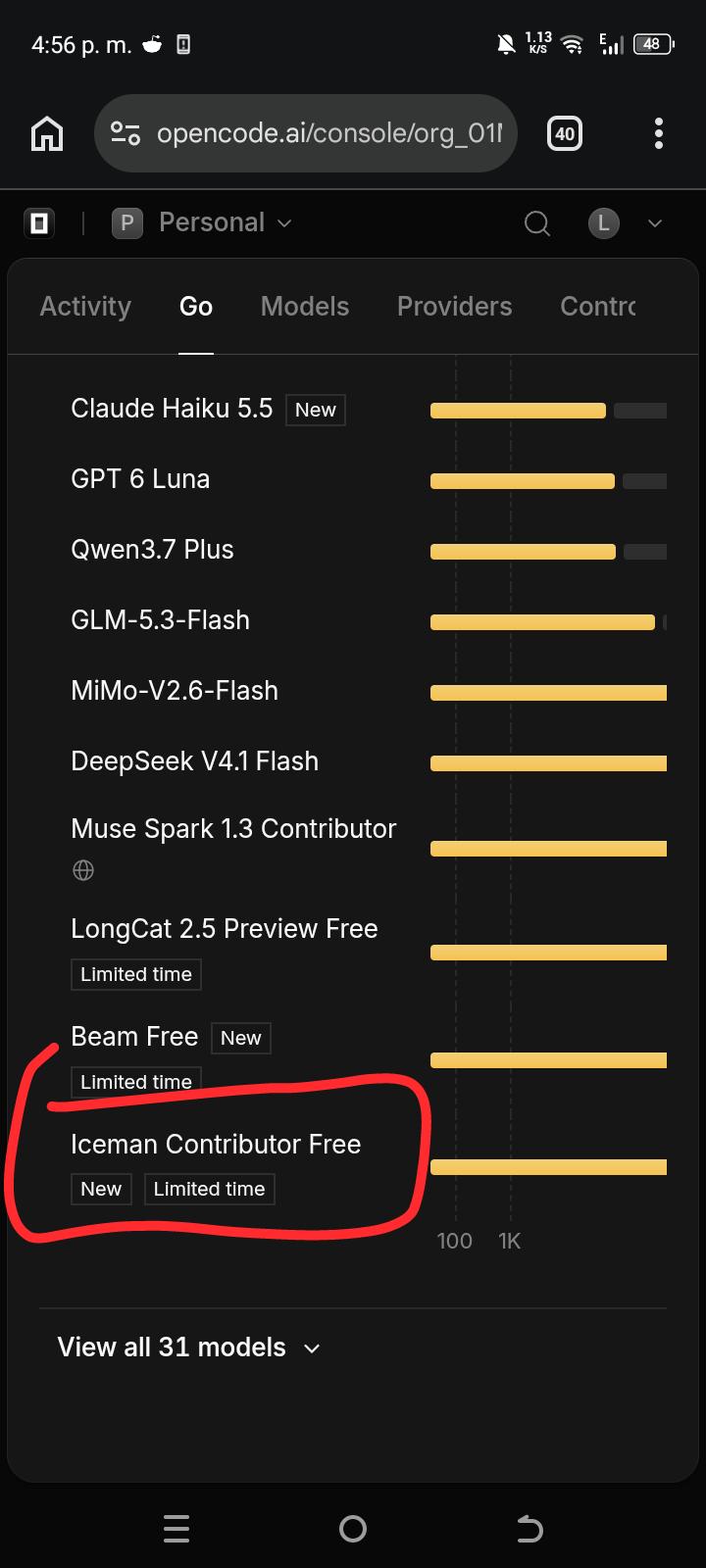
The yellow bar chart on the Go landing page is not the usage limits.
I've seen a lot of people interpret it that way understandably. But those bars are estimates of how many "average" requests you can make based on assumed average token counts. They're estimates, not quotas. When the yellow bar of model X changes, it doesn't mean "OpenCode changed the limits of model X from 34900 to 2500", it means "OpenCode now estimates you will get approximately 2500 average requests using this model only". The yellow bar chart is not the usage limits.
My Go dashboard currently says:
Monthly usage: 83%
The Usage page shows dollar costs per model and day but it doesn't explain how those $9 dollars on Monday turned into 83%.
As far as I can tell, the $15/$30/$60 limits aren't actually independent buckets at all. They seem to be different rates against one shared normalized quota.
So $1 shown on the Usage page can consume 1x, 2x or 4x as much of my subscription depending on the model and the underlying model price can fluctuate.
For example, if I use:
$1 on a $60 model
$1 on a $30 model
$1 on a $15 model
the Usage page says I've used $3. But apparently the actual subscription consumption is 1/60 + 1/30 + 1/15 = 11.67%.
Nothing in the UI tells me this.
And if I have 17% left, what does that mean? $10.20 on a $60 model, $5.10 on a $30 model or $2.55 on a $15 model?
Apparently all three, because they're really three representations of one hidden balance.
Historical usage is even harder to audit. My Usage page can say:
DeepSeek V4 Flash: $9.48
But DeepSeek went from $60 to $15 to $30 while its per-token pricing was also changing. So how much monthly quota did that $9.48 consume? Do I now have $5.62 or $20.52 left. I can't tell from the dashboard. (what really happened was that the one day DS4F was in $15 bucket, I capped my weekly usage and was blocked from using even the free models until I added balance and enabled extra use).
And that's the part I think takes OpenCode Go from "bad user-experience" into consumer-protection problem territory.
I understand this is a $10 product and the financial impact for me is completely insignificant. I'm not claiming OpenCode is breaking any law, but both EU and US consumer-protection frameworks generally expect important limitations, quantities and pricing mechanisms to be presented clearly and comprehensibly. OpenCode is not alone in this, most of the providers obfuscate their limits and usage, either by not disclosing it, giving vague promises like "5x entry tier subscription usage" or a confusing credits-based system with multipliers (pointing at xiaomi). This was exceptionally clear in OpenCode Go when I subscribed but changed into one of the most difficult ones to understand.
A usage limit is one of the most fundamental characteristics of a metered subscription. A customer shouldn't have to reverse-engineer any undocumented formula to understand how much of their paid entitlement remains.
The solution seems simple:
One limit. Models at different prices. That's it.
Do the ugly math on OpenCode's side. Don't make subscribers do it.
If Go has a $60 monthly allowance, display one $60 allowance. I'd even be ok with an occasionally changing allowance based on projections and any excess from previous cycles.
Then give each model a final Go token price that reflects whatever subsidy or multiplier OpenCode can afford.
If a model needs to effectively cost 2x as much, bake that into its Go token price. If it needs to cost 4x as much, bake that in too.
If the economics of a model become impossible after an upstream price hike, remove the offending model from Go until the math works again.
I'd much rather see:
DeepSeek V4 Flash temporarily unavailable on Go due to upstream pricing changes.
than:
DeepSeek is still available, but your $60 for that model is now $15 while using it, except that's not really a separate $15 balance, and the token price changed too, and it all feeds into one percentage meter you can't reproduce. Oh, actually, take that back, now it's $30 unless you also use the $60 models which will eat your $30 allowance at 2x rate.
The Usage page could simply show:
DeepSeek V4 Flash API value: $1.42 ($x/$y/$z mtok) Go usage charged: $2.84 Remaining: $10.63 / $60 (18%)
Done. Or if you prefer, don't even show the upstream API value unless you want to be exceptionally transparent about it. Essentially that request was $2.84, making the model price $x/$y/$z from user's perspective.
And please don't solve this by inventing "Go Credits". We already have a perfectly good unit for prices: dollars.
One allowance. Final dollar prices per model. Show what was deducted. Show what's left. Manage token prices and available models and make it work financially so that you can continue to provide the service at a profit margin you expect from it.
If you can't make the math work, the obvious conclusion is that the offering must change or end. I like OpenCode Go and publishing the /data is delightfully transparent. But as much as I like it, I think I'd rather see it change completely or even come to an end than to see it continue on this current path.