r/explainlikeimfive • u/valoror • 13d ago
Mathematics [ Removed by moderator ]
[removed] — view removed post
34
u/thunderfbolt 13d ago
Calculators can only test numbers one by one. Math problems are usually about finding rules that work forever.
Like Goldbach’s Conjecture:
We know 2+2=4.
Goldbach’s Conjecture asks if every even number bigger than 2 can be made by adding two prime numbers together.
Like: 3+3=6, 3+5=8, etc.
We can keep putting numbers into the calculator to check, but we don't know if this is true for all even numbers all the way till infinity.
3
7
1
u/GumboDiplomacy 13d ago
So I don't have a Nobel prize, much less a degree in mathematics, but shouldn't that be understood? Prime numbers larger than 2 must be odd, and two odd numbers added together must be even. How is there a possibility it can be considered a conjecture and not a rule? Genuinely asking.
12
u/thunderfbolt 13d ago
That's kind of the whole point. It's not that mathematicians don't think it's true. It's that nobody has figured out how to mathematically prove it must be true for every even number.
We can check trillions of examples and find that they all work, but that doesn't guarantee there isn't some ridiculously large number where it fails.
The challenge isn't finding examples where it works. It's finding a mathematical proof that guarantees it can never fail, no matter how large the numbers get.
6
u/Specialist_Nobody530 13d ago
I’ll add here that there have been countless times where we assumed something was true because we checked every conceivable case, just for some absolutely stupid counterexample to be found.
Here are some fun-filled examples:
The Pólya conjecture was widely believed to be true. It claimed that more numbers up to x are divisible by an odd number of prime numbers than an even number of prime numbers. It’s true until you check the number 906,150,257.
There is no way to write out the integral of x/ln(x) using the well known operators, but if you were to evaluate the integral of x/ln(x) from 1 to t, and if you were to plot the number of primes up to t, then graph of the integral of x/ln(x) eventually matches with the number of primes perfectly. That being said, it’s horribly off up until maybe around t=10^8.
The integral of x/ln(x) always seems to be a little bit below the actual number of prime numbers, and people thought that it might always be slightly below. Nope, first counterexample is at 1.3972*10^316.Borsuk’s problem is a bit convoluted, but it (distantly) says something like this: You have an n-dimensional shape. Can you cut up that shape such that you have n+1 shapes and the longest distance across any of those smaller shapes is shorter than the longest distance across the original shape?
Nope! First counterexample is this wacky 63rd-dimensional shape.3
u/JollyJuniper1993 12d ago
The Fischer-Griess Monster group is my favorite example. To simplify it a bit, they figured out there‘s a type of symmetry that occurs in 196,883-dimensional space that doesn’t occur in lower dimensional space.
8
u/thebombzen 12d ago
You are thinking of it backwards. The conjecture statement is not the statement that the sum of two primes bigger than 2 is always even. This is true, as you pointed out, and not particularly difficult to see why.
The conjecture says that every even number bigger than 2 can be split into a sum of two odd prime numbers. It isn't particularly clear why you can always split a number into two primes, especially because primes get more and more rare the farther you go.
4
u/Vannak201 13d ago edited 13d ago
Because as numbers get bigger, prime numbers become less frequent. So it is possible that some large number can't be expressed as the sum of two prime numbers. It's also very difficult to determine if large numbers are prime or not.
Source: I actually have no idea but that seems right
3
u/Yoneda-lemon 13d ago
That doesn’t imply that a given (even) number is the sum of two primes though. All you can assume is that it can be represented as a sum of two odd numbers.
3
u/RemoveOk8270 12d ago
Sum of prime numbers above 2 is of course a even number. But the question is can every even number be represented like that?
15
u/another-princess 13d ago
A lot of math problems can't be solved with calculators alone. For example, the Collatz conjecture posits a property about all natural numbers, of which there are infinitely many. No amount of simple computation would prove the Collatz conjecture - you'd need a logical proof.
5
u/unwitting_hungarian 13d ago
And, a logical proof is not something a calculator can make.
Usually I think proofs include lots of words, sentences, and paragraphs, right?
3
u/fox-mcleod 13d ago
No. You can do a proof as a series of arithmetic steps.
The difference isn't that calculators use numbers, it's that is that a calculator doesn't know the process for producing the proof.
Its a completely different kind of knowledge work.
Calculators follow known algorithm. Math is about finding new ones.
1
u/MidnightAtHighSpeed 13d ago
That's kind of complicated. A lot of proofs will involve "exposition" like that, but the idea is that in order for an argument to count as a proof it needs to be so airtight that you could break it down into a sequence of formal, logical steps that even a computer could follow. Historically, the tendency was to not actually write proofs that formally, and just write them precisely enough that a competent mathematician could, in principle, read the proof and make a complete formal description of it. In recent years (and in particular with the rise of AI-generated proofs, which tend to be very long and very dense and very hard to follow even when correct), there have been enough seemingly-correct proofs that turned out to be flawed that people have wanted that level of formality as a baseline, which has led to computer proof assistance systems (the big one you'll hear about a lot is Lean) which aim to make the process of formalizing proofs a bit less tedious. Systems like that usually also include systems that, in effect, are calculators for generating proofs. Usually they're only used for small sections of larger proofs, since they take an impractically large amount of computation time to find long proofs, but they can be useful. Those systems still aren't perfect, and for instance it's conceivable that a flawed proof can still be verified in Lean because of a bug or logical flaw in Lean itself, but in the ideal case there's nothing humans can do that a computer couldn't, at least with enough time to think.*
*this technically depends on certain assumptions about the physics of cognition but it's a very mainstream position to hold, afaik
1
u/unwitting_hungarian 13d ago
Ah, interesting.
So, "calculators solve math problems" is actually possibly true for all problems in the field of math, where "calculators" includes "computers capable of operating a given set of instructions on a given set of data", is that right?
Can this be expressed better, but in a way that includes the calculator reference in the post title but also precludes the implied conclusion?
Half jokingly?
1
u/MidnightAtHighSpeed 13d ago
That's probably true if you stick enough asterisks on the "all problems" there. There are some fundamental limitations on both computation and mathematical logic that we know apply to computers, it's just that we don't really have any good reason to believe they don't also apply to human mathematicians.
If there's a clever phrasing to capture all of that I can't think of it. The pithiest way to frame the problem might be "P is probably not equal to NP" but it's a bit of work to explain the logical connection there (assuming the listener even knows what that means to begin with).
Basically, we don't know any more efficient way to find correct proofs by computer other than guessing a bunch of different options and seeing if they're correct. This is speculative on my part, but I suspect that both human thought and whatever the eventual limits of AI will be will not fundamentally change this besides making somewhat more promising guesses in some cases. The problem is, the longer the minimum length of the proof, the more proofs there are to guess and the fewer (ratiowise) there are of them that are correct, so you need to make more or much better guesses on average to find a correct one. The end result is that complex ideas requiring complex proof require a lot of computation, for some problems probably more than is physically possible given the combined efforts of human civilization. There's no hard impossibility here (ignoring fundamental limitations I mentioned earlier like uncomputability/Goedel's incompleteness theorem-type issues which always apply), you could make a calculator that will eventually find a proof of a solution to whatever problem you give it as long as such a proof exists, it might just take a billion billlion billion years or longer to actually finish running.
1
u/unwitting_hungarian 13d ago
Fascinating. I wonder what the curve plotting solution-finding on a timeline of known problems looks like in that case.
Does the known-problems pile still grow at any significant rate if the curve of known solutions grows beyond a point?
1
1
u/Yoneda-lemon 13d ago
Usually that’s the case. Sometimes a proof can be done via computation though. Usually that only really works for counter examples though.
14
u/perryspotsider 13d ago
People have to figure out how the math works in order to make the buttons on calculator and tell the computer inside a calculator how to give the right answer.
Until people figure out the math, they can't invent the right buttons or tell the calculator what to do.
7
u/My_Soul_to_Squeeze 13d ago
Your post is already being down voted, but I like the question. Cutting edge math problems are like riddles. You can understand all the words, but still have no idea how to find an answer.
There's a funny example of this in a Simpsons episode. There was a famous math problem called Fermat's Last Theorem that went unsolved for hundreds of years. He claimed to have a proof that there is no solution to the equation an + bn = cn for n greater than 2. (Obviously, for n equal to 0, 1, or 2, there are infinitely many solutions. N>2 was an open question for a long time.)
In the episode, the equation 178212 + 184112 = 192212 appeared on screen, a disproof of the theorem by counterexample if it was true. You can type it in to a calculator, and it will seem to be correct. Your calculator will tell you 2.541210259e039 for both sides of the equation.
However, this is simply due to your calculator not having enough space to display/ do calculations with all the digits of the numbers involved. The equation above is false. It just looks true if you don't use an advanced enough tool to investigate.
Now, as you can see, it's very difficult to verify a single example. Proving there isn't a single possible solution from any combination of numbers is a huge challenge. You can't just try every number. You have to find a better way to do it. Calculators just can't do that.
3
u/ChillAhriman 13d ago
Your post is already being down voted, but I like the question.
Yeah, kinda weird to downvote a question that, as obvious as it may look to anyone with advanced education, has been posted in a subreddit called "Explain like I'm five".
6
u/kalancodragon 13d ago
Because a lot of the unsolved problems look something like this:
https://imgs.xkcd.com/comics/unsolved_math_problems.png
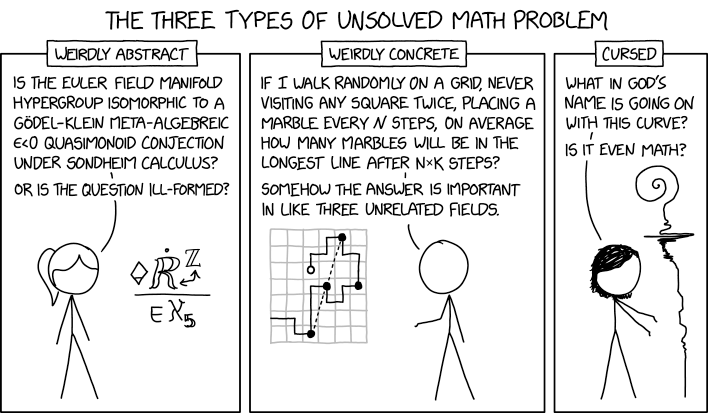
There are some of them where calculators simply will not help you, and some of them are asking questions where a conventional numerical answer isn't even what's being sought after.
3
u/OddEmergency604 13d ago
In college, I had a classmate ask if we could use a calculator on a test and the professor laughed at that guy and said, “sure. But it won’t help you.”
That was in intro to set theory
2
u/JollyJuniper1993 12d ago
Why would somebody even think a calculator would be helpful with set theory lol
2
4
u/TheWellKnownLegend 13d ago
So the confusion here is that what mathematicians consider a math problem and what school students consider a math problem are very different things.
Lemme give an example: A salesman has 10 towns he wants to visit, and they're all some distance apart from each other.
A school question would be: Here are the cities, here are the distances. What's the shortest possible path this salesman could take to visit each city exactly once?
A mathematician would be asking: What if it was 20 cities? What if it was 100? What if the distances were all different? Is there any trick we can use to ALWAYS know the shortest possible path? How can we prove that there's no shorter path? Is that possible?
The student is solving a problem. The mathematician is solving an entire class of problems, and they have to invent new methods to do that. New mathematics. A calculator can't do that, because a calculator can't think.
10
u/BendyAu 13d ago
A machine can only solve what its programed to understand
-25
u/hevo4ever-reddit 13d ago
until ai…
7
u/LCDRformat 13d ago
No, AI can only understand what it is programmed to understand
2
u/RJrules64 13d ago
Kind of… he’s not wrong, AI has already solved a bunch of unknown maths problems that it could not possibly have been trained to solve.
Everyone loves pretending they know how AI works because it makes them feel safer in their understanding of the world, but it’s not quite as simple as “it’s just predicting the next word bro”
2
u/Disastrous_Wealth755 13d ago
The only proofs I’ve heard of are counter examples which are like the easiest thing to find and doesn’t actually require any innovative thought
-2
u/going_up_stream 13d ago
AI can't understand anything. It can only output what looks probably correct based on context. It's no better than a smart middle school slacker with a decent memory
3
u/Thavralex 13d ago edited 13d ago
You can have whatever opinion you want about whether the advent of AI is positive, but when it comes to its ability, you should start living in reality. This statement:
It's no better than a smart middle school slacker with a decent memory
is simply not compatible with the fact that it has been used to solve a bunch of very high-level math problems. Unless you somehow want to argue that this middle school slacker somehow could have done that too?
2
-4
2
u/jamcdonald120 13d ago edited 13d ago
the "math" you learned in school isnt math. its computation.
Real math is proving truths, not crunching numbers. if someone asks you "whats 2+2" thats a computation. easy on a calculator. even something weird like 5.19.1x /76.1=5 is just computation.
Real math is stuff like "find 3 numbers, where a3 +b3 =c3, and a, b, and c are all integers, are there any?" how would you even ask a calculator to do this? just check all the integers? they are infinite. if there isnt an a b and c that works, how do you prove it?
These are the problems that go unsolved (well, not this particular example, its been proved there are none except for a=b=c=0). not simple calculator problems.
1
u/Tasty_Gift5901 13d ago
First, there are some problems that will take the literally forever to calculate an answer to on a computer. brute forcing doesn't work in most cases, because the number of edge cases you need to resolve to have an exact answer may be infinite.
Second, math is about building a series of logically steps. It's more like it's own language where you start by defining some words, then putting those in a sentence and then sentences to make a paragraph and so on into you have a "book" or the proof needed. Running calculations is very different from putting words together, and cant be done on a calculator.
1
u/BananaBird1 13d ago
Most math problems mathematicians current work on aren’t just calculating a value.
They are things like “prove the sum of two prime numbers can never have certain properties” or “what is the smallest number of steps needed to arrange any possible list in a very specific order”. Or even things like “does an answer to this question even exist under the current rules of math”.
1
u/MidnightAtHighSpeed 13d ago
Take a (positive, whole) number. If it's even, divide it by two. If it's odd, multiply it by 3 and add 1. Then, repeat. For instance, if you start with 5, first you get 16, then 8, then 4, then 2, then 1, then 4 again, and it just gets stuck in that 4, 2, 1, loop. Now, if you do this with other numbers, you'll find that they seem to tend to end up in this same loop, eventually. So naturally, you might wonder if all numbers end up in this loop. Every number we've tested does, but there might conceivably be a bigger loop, or a chain of numbers that gets larger and larger forever. But what's the answer? This problem is the Collatz conjecture, and it is not even close to being solved.
So, the first thing you'll see is that this isn't the kind of thing you can type into a calculator. It's not trying to find the value of a specific number, it's trying to prove a property about all numbers, which is conceptually a lot harder. Most famous math problems are like this: they aren't just finding some value, they're showing that some mathematical concept obeys certain rules (or not).
You could write a computer program that just checks each number one by one and sees if they enter the 4-2-1 loop or not, and maybe it will eventually find another loop, but even if you run it for a billion years and find that the first gazillion numbers all enter the 4-2-1 loop, you don't know that the gazillion+1th number isn't the first one to escape it. This is also very common in math problems: there are infinitely many possible cases to check, so you need to be more clever than just checking cases one at a time even if you do use computers to help.
1
u/fox-mcleod 13d ago edited 13d ago
Calculators are for calculation.
Math is much much more than just calculation.
If I take two giant odd numbers—so huge nobody has ever added them together before—and add them up, will the answer be even or odd?
If the numbers are big enough it's actually possible to make them too big for any calculator to ever find the answer to what they add to.
But math is knowing it doesn't matter how the calculation comes out. Odd numbers always add to even numbers — and math is also knowing how to prove it.
As we make the questions more complicated, they become harder and harder to calculate, and we have to rely more and more on math. But not all math is already known.
1
u/redditbody 13d ago
Calculators do arithmetic. That is a subset of all mathematics. For example calculators cannot do a geometric proof.
1
u/Lizlodude 13d ago
My maths friend is asleep, but I'll give it a shot.
Say you have a square, and you want to put some circles in it. If the square is 1 unit wide and the circles are one unit wide, you can put 1 circle in it. If the square is 2 units wide, you can put 4 circles in it. What about if the square is 17 units wide? We can try to shove a bunch of circles in there to find out, or we can look at a bunch of examples and make a formula to get the answer (in this case: # of 1-unit circles = square width ^ 2) so we can now just do 17^2, or 289. (This is ignoring circle packing, because I'm lazy and don't feel like looking up that formula)
Now what if we want to know how many circles we can fit in an octagon? It would be useful to have a formula to find out how many circles can fit in an octagon, I wonder what that formula would look like? Is there even a formula for that? I don't know, (read: I'm lazy and don't look it up) let's try and find out.
Many "hard math problems" aren't so much doing math on a calculator, but figuring out what math needs to be done to answer a question, or figuring out if something even can be done with math at all. That gets more into logical proofs rather than things like 2+2, and as previously stated, I'm lazy and really did not enjoy that class in uni.
1
u/Paradigm84 13d ago
More complex maths problems often go beyond “find an answer to this equation” and look also at the opposite - “can you prove there is no answer to this equation”
For an equation like xx = -1, we know that there are no real numbers for x that answer that equation because it can be proven. A result like this can be seen easily if you graph y = xx, you’ll see the line never goes below y = 0.
But what about a more complex equation? Take the Pythagoras theorem of 3 numbers, a, b and c where a2 + b2 = c2. There are lots of sets of values that work for this equation, like a=3, b=4 and c=5. But what if you change it from 2 to a 3 or 4 or 10, how many sets of positive whole numbers work for those equations? Turns out, there are none, it’s a proved theorem called Fermat’s Last Theorem which says that type of equation doesn’t work when 2 is changed to anything bigger.
But how do you prove that? You can’t just keep trying numbers, there are infinitely many! Turns out, for some problems like these you need incredibly clever people to find a way of transforming the problem so that we can attack it in a different way. These types of things boil down to very high level math, creative problem solving and an almost masochistic will to keep making tiny incremental progress.
This type of problem, like the Collatz Conjecture, are examples of math problems that are pretty simple to explain, but extremely difficult (or in Collatz’ case, maybe impossible) to solve. Fermat’s Last Theorem is solved, but it took over 350 years of work, from many of the workd’s brightest minds to solve. The solution is complex enough that’s at best probably quite literally a one in a million people that would grasp it end to end, if not significantly less than that.
For the reasons above, calculators aren’t useful anymore. In pure mathematics a calculator eventually becomes a paperweight with buttons on it.
1
u/notunoblivious 12d ago
Mathematicians (especially applied mathematicians) do make extensive use of numerical calculations, for example, to find approximate solutions to complicated equations that arise in engineering problems. This often requires developing specialized algorithms, demonstrating that they work, and implementing them in software. You can think of this as a series of specialized, souped-up calculators. A standard calculator is extremely limited: it cannot be programmed to perform a large number of calculations automatically. You can do that with one of those fancy graphic calculators, but they have limited processing power and awkward interfaces.
Prominent unsolved mathematical problems are always conceptual: they require you to find new connections between ideas or new ways of doing things. If they simply required you to apply a known method to a new case, then someone would already have done it.
1
1
u/BeautifulPhase9857 12d ago
a calculator can check a billion cases, but infinity is annoyingly larger than a billion, so you need a proof that covers every possible number instead of just the ones you tried
1
u/Ktulu789 12d ago
Take it this way. What is pi? The ratio of the radius to a circle.
Now: What is it's value? It "can" be calculated by computer, but it has infinitely many decimals. A computer set to that task will be forever calculating π.
Yet, that's a simple example but it is solved, we approximate it to as many decimals as the problems need it.
But there are problems in math that still haven't been PROVEN. That's not a thing a calculator can do because we don't know yet which calculations are needed to either proof they are true or not.
For instance: it is proved that any circle, no matter the size has the same π value. Or that any triangle in a plane has the same sum of the internal angles. That means that we know equations to demonstrate that it is true for all circles and triangles. Hence we can use a calculator to run those equations. But there are questions we don't know.
1
u/LargeTubOfLard 12d ago
Some math solutions have physical limits and will break down if you try to abuse them enough so the problem remains unsolved.
1
u/WaddleDynasty 12d ago
Math problems aren't what does this times that plus something give you? like in school.
They are do all infinite numbers do something and can we proof that there are no exceptions?
1
u/Calm-Map-5449 13d ago
a calculator can check 10 million examples, but it can’t check infinity, so the hard part is proving there’s no weird exception hiding somewhere beyond the calculator’s patience
1
u/changyang1230 13d ago edited 13d ago
Maths is not calculation at higher level.
Using a famous example:
Prove that you can NEVER find three integer numbers x y and z that will fit x^3 + y^3 = z^3.
Calculator can’t do that.
And what if not just 3, you want to prove 4, 5, 6 etc, EVERY number above 2 won’t work.
And that would be one of the most famous mathematical problems of all time that took 300+ years before Andrew Wiles famously cracked it.
0
u/violetferns 13d ago
Because the problems are so hard that they don’t even know what to use the calculator for.
•
u/explainlikeimfive-ModTeam 11d ago
Please read this entire message
Your submission has been removed for the following reason(s):
Rule #2 - Questions must seek objective explanations
Straightforward or factual queries are not allowed on ELI5. ELI5 is meant for simplifying complex concepts (Rule 2).
If you would like this removal reviewed, please read the detailed rules first. If you believe this submission was removed erroneously, please use this form and we will review your submission.