r/codinginterview • • Apr 30 '22

How do I crack the online coding interviews?

9 Upvotes

Data structures and algorithms are likely to be a big part of the coding difficulties, you should spend some time studying them before your interview. In your preparation, try to replicate the actual interview conditions: To simulate the time pressure of coding difficulties, practice on a whiteboard with a timer. Practice explaining your thought processes aloud as you write your code. There are many courses which helps in preparation. Try it out Logicmojo one of the prominent course that has helped many candidates to crack top tech companies' interviews.

It's also crucial to conduct research on the organization, since this will provide you with a better understanding of the languages, frameworks, and other technologies it employs. You can also conduct research about the company's present plans and goals in order to better understand and communicate how you will contribute to the organization. This will help you to crack behavioral round interviews.

Here is a list of things you must be comfortable with:

  • The fundamentals of your preferred programming language: Refresh your knowledge on the fundamentals of programming, such as how to divide strings, declare and use 2D arrays, process command-line parameters, and read/write from/to files. These may seem obvious, yet they are easy to overlook in a high-stress setting such as an interview. Then move towards difficult topics like graphs,greedy, and dynamic programming.

  • Data structures and algorithms (DSA): Complexity analysis, arrays, stacks, queues, linked lists, trees, graphs, hash tables, heaps, sorting, and searching are all important concepts to remember. Begin solving easy code challenges as you become more familiar with these topics. Some of the best websites to learn data structure and algorithms are Logicmojo, Geeksforgeek, Leetcode, etc.

  • Soft skills: While the interview will be primarily focused on technical skills, there will also be behavioral and soft skill components. It's a good idea to speak with the company's recruiter to receive a complete understanding of the hiring process.

In a programming interview, both hard and soft abilities are evaluated. If one or the other is missing, the answer is a resounding no.


r/codinginterview • • Dec 29 '21

10 interviews with FAANG/Big Tech companies - let me know if you need a mock interview buddy!

9 Upvotes

***Got into Microsoft after 10 FAANG/Big Tech interviews

I’ve been in the industry for 3 years as a software engineer now (although I’m still technically in school for my MS).. and I’ve never seen the market so hot in terms of hiring for CS students /Software Engineers . I, as well as my friends, had so many recruiters reaching out to us for interviews - and many of them FAANG/Big Tech companies. So I figured I didn’t have anything to lose when I decided to do 10 interviews over the span of 6 months. It was a whirlwind, but man, it was a struggle to remember all of those Data Structure/Algorithm fundamentals without LeetCode + AlgoExpert.

I had interviews at Meta, Google, Reddit, Microsoft, Amazon, and LinkedIn. And it was SUCH a mixed bag. Honestly, i used to think you had to be a genius at getting into these companies (and you obviously have to have some sort of willpower/intelligence), but after this process, It’s definitely all about preparation and reacting to failure. They expect you to try 2,3,4 .. even 5 times before actually getting in. By the time I got to my tenth interview (MSFT), I had essentially failed my way to the top. My mock interviews had just been REAL interviews… bumbling through speaking out loud, preparing for certain concepts (easy/medium/hard) by difficulty months in advance, doing practice “tests”, practicing my elevator speech etc. they’re testing you on literally how far you’re willing to go in order to get the role. Anyways, I’m curious about other people’s experiences interviewing with FAANG/Big Tech companies - If you need a mock interview buddy, let me know! I’d love to help out.

I’ve also documented a lot of my experiences with this on YouTube - hopefully this will help clarify the process for anyone that’s just starting out (my YouTube channel


r/codinginterview • • Jun 21 '20

Sliding Window Technique | Google Coding Interview | Maximum Size SubArray Of Size K

Thumbnail
youtu.be
9 Upvotes

r/codinginterview • • Jan 24 '20

Coding Interview Preparation Phases

9 Upvotes

Crawl Phase

Step 1 : Basic Concepts

Learn the basic data structures and algorithms. Learn the basic concepts and terminology to build your vocabulary of programming.

Step 2 : Code

Code the representation and operations for the data structures in your list.

Step 3 : Coding Drills

Design coding drills and practice the algorithms in your list.

Step 4 : Analyze

Analyze the time and space complexity of your code.

Step 5 : Test

Test your code using test cases. Debug and fix any bugs.

Step 6 : Take Notes

Take notes to help you review later. Learn from your mistakes.

Step 7 : Pros and Cons

After you have learned about the data structures in your list, compare the pros and cons of using similar data structures.

Walk Phase

Step 1 : Understand the Problem

Understand the problem statement before you design the algorithm.

Step 2 : Identify the Approach

Identify the data structure, algorithm and strategy to solve the problem.

Step 3 : Outline the Solution

Outline the solution at a high level.

Step 4 : Identify the Obstacles

Identify the obstacles to solving the problem. Revisit your study materials to gain a deeper understanding of the concepts. This is a top down approach to assimilation process.

Step 5 : Work Backwards

Work backwards from the solution. Design and practice coding drills. Practice coding the solution and understand the solution. This is a bottom up approach to assimilation process.

Step 6 : Test

Test your code with test cases.

Step 7 : Analyze

Analyze the time and space complexity of your solution.

Step 8 : Take Notes

Review your solution and reflect. Take notes on where you made mistakes and review your solution.

Run Phase

Step 1 : Form Links

Connect the dots between problems you solved in walk phase.

Step 2 : Problem Types

Solve problems by category.

Step 3 : Recognize Patterns

Summarize common patterns used for solving problems within the same category.

Step 4 : Take Notes

Take notes on where you made mistakes to help you review later.

Step 5 : Practice

Practice articulating your solution.

Step 6 : Evaluate Progress

Form a study group. Take mock interviews.

Customized Action Plan

I can guide you in creating a customized action plan for your situation. Sign up here https://go.oncehub.com/BalaParanj for your FREE session and we will figure it all out. Why is this free? Because I believe in Zig Ziglar's quote:

You can get everything in life you want if you will just help enough other people get what they want.

r/codinginterview • • Jan 05 '20

Coding Interview Success Blueprint

9 Upvotes

The following notes is based on the book: The 4 Disciplines of Execution by Chris McChesney.

There are some goals that are so important or require such significant change that simply trying harder isn't going to get it done. If you have one of those important goals, if you are dedicated to getting breakthrough results, this approach is for you.

For example, if you want to achieve an ambitious career goal, the challenge is usually not one of capability. It's not that they're incapable. It's not that people are lazy. It's not that they're stupid. The problem is they're busy.

There are rules for doing this. We call those rules, disciplines and there are four of them. When you hear them, they're going to seem very simple, almost obvious. But I assure you, they are the key to achieving breakthrough results.

Discipline 1: Focus on the Wildly Important Goal

Focus

Discipline one is focus on the wildly important. And what that means is to select a single, wildly important goal, in addition to everything else that has to happen in your life. Think about when you achieved something truly significant. How many things were you focused on? Focus is the first irrefutable law of execution.

There are two key aspects to the first discipline. They both begin with the letter F. The first we've talked about that's focus.

Finish Line

The second is finish line. The wildly important goal has to have a finish line. You have to know how you won. The easiest way to do that is to put it in the form of from X to Y by when. For example, you wouldn't want the goal of coding better, right? Even if that was really important to you. There's no specific finish line associated with that. So you might think of a result associated with coding better and define the goal around that, for instance, getting your dream job by the end of the year. If you wanted to gain coding skills, you wouldn't just say gain coding skills, you put it in the form of going from Software Engineer to say Software Engineer at Google by March 1. There's a specific finish line for people to really succeed. There's a switch in our heads we call the game on switch and we want to throw the game on switch. The first discipline of execution requires that we narrow the focus and define the finish line.

Discipline 2: Act on the Lead Measures

Identify the Lever

Discipline two, act on the lead measures. This is the discipline of leverage. The wildly important goal that you identified and discipline one is like a big heavy rock. It's like a big rock, because you haven't moved it yet. The discipline two is all about identifying the lever that we're going to use to move the rock. If you've got a rock, you're going to need a lever, and all levers share two characteristics. First, you can move a lever, it's influenceable. Unlike the rock, it moves. And second, it's predictive, you can predict that when the lever moves, the rock is also going to move.

Influenceable and Predictive

Those are the same two characteristics of a lead measure. If your goal is to get your dream job, going from Software Engineer to Software Engineer at Google, if that was the big rock, we had to move. What's the lever? What could we measure that is both influenceable and predictive of gaining coding skills. If you said study and practice, you're on exactly the right page. We can influence our study and our number topics mastered, our number of coding problems practiced much more directly than we can influence getting the dream job, and it is predictive of gaining coding skills. Now you may at this point, be saying to yourself, wow, this is brilliant. How do you guys do it? Are you telling me that if I want to get my dream job, I should study and practice? There's a huge difference between knowing that we should study and practice and knowing how many topics we've mastered, and how many coding problems we have practiced. The only people that know that data are the people that are gaining coding skills.

Discipline 3: Keep a Compelling Scoreboard

Discipline of Engagement

Discipline three is keep a compelling scoreboard. It is the discipline of engagement. It's what keeps us in the game. People play differently when they are keeping score. If you are watching group of kids play basketball from a block away. Could you tell even if you couldn't hear them, just by watching them whether or not they were keeping score? What would you look for? What would give it away? Would there be a change in intensity? Would there be more celebration? Would they be more likely to play by the rules, if they're keeping score, you're going to see all that more. There's a huge difference in people's behavior. There is a huge difference in your behavior when you're keeping score.

Characteristics of a Compelling Scoreboard

A scoreboard that's going to keep you engaged are fairly straightforward.

  1. It has to be very simple.

  2. It has to be visible.

  3. You've got to see both the lead measure, the thing you're acting on, as well as the results you're hoping for.

  4. And finally, just by looking at it, you have to be able to tell whether you are winning or losing.

Create a Winnable Game

What you've done is you've turned that goal, that breakthrough result into something that feels like a game. There is no greater driver of engagement than feeling like you're winning.

Discipline 4: Create a Cadence of Accountability

Discipline four is how we play that game. Discipline four is the discipline of accountability, create a cadence of accountability. This requires a weekly rhythm of public accountability and will require you to recruit a coach or a partner, somebody that you will feel accountable to. And you'll need to visit with this person every week for at least a few minutes. This is one of the reasons why it's essential to pick a wildly important goal because we are talking about a serious commitment here. It's best if this meeting happens at the same time every single week. During this meeting, there are three things that need to happen.

  1. Report on the commitments that you made last week, every week. You're going to make a few commitments to move the lead measure.

  2. Review and update the scoreboard.

  3. Finally, make a commitment for what you're going to do to move the lead measures next week.

There's a reason that we call these the four Disciplines of Execution. These require discipline, this delivers, breakthrough results, in the words of Jim Rohn: "We must all suffer from one of two pain, the pain of discipline, or the pain of regret". We really like the pain of discipline.

Customized Action Plan

I can guide you in creating a customized action plan for your situation. Sign up here https://go.oncehub.com/BalaParanj for your FREE session and we will figure it all out. Why is this free? Because I believe in Zig Ziglar's quote:

You can get everything in life you want if you will just help enough other people get what they want.


r/codinginterview • • Oct 15 '25

Behavioral Interview

8 Upvotes

Hey guys I have a behavioral round tomorrow for a AI startup
Do you guide me with any resources with curated questions /answers using STAR


r/codinginterview • • Oct 14 '25

Preparing for a coding interview for one hour

8 Upvotes

Hi everyone,

I’ve been invited to a coding interview, and the company mentioned there will only be ONE coding question for ONE hour. I’d really appreciate your advice to help me prepare effectively.

My main question is about what to expect:
I’ve watched a lot of mock interviews on YouTube, and those often look like a conversation—candidates discuss the problem and approach with the interviewer, get hints, clarify requirements, etc. In my case, since there’s only one question for the whole hour, does that mean it’ll mostly be just me working solo and making sure my code runs, with little or no conversation? Or should I still expect some back-and-forth or guidance?

If you’ve experienced this kind of format, I’d love to hear your advice or tips on how to best approach it and what the interview might be like. Thanks so much for any help!


r/codinginterview • • Sep 12 '24

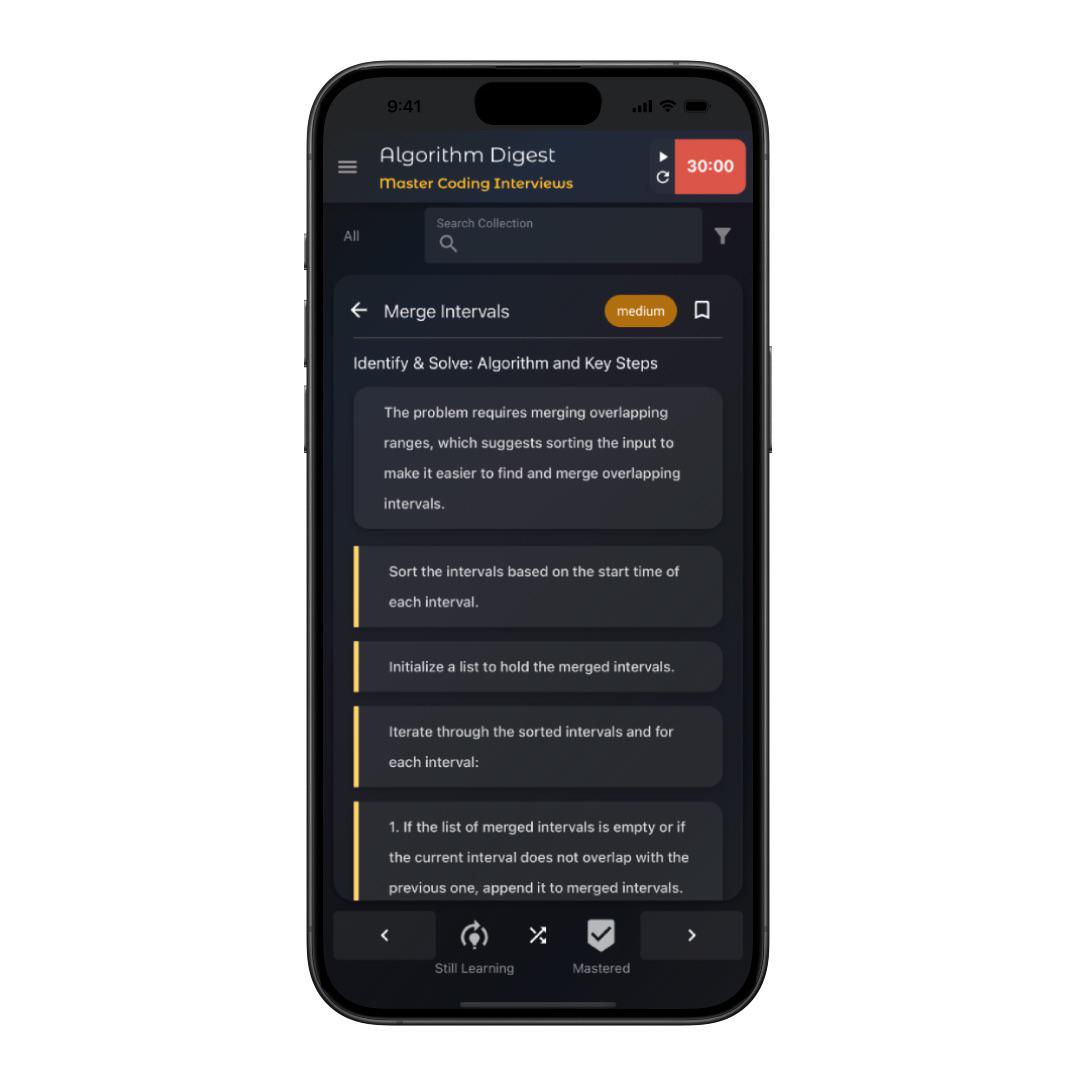
I created a tool that makes coding interview prep faster and more effective

Post image
8 Upvotes

I’ve built Algorithm Digest, a platform designed to streamline technical interview prep for software engineers. It’s free to try, and I’ve poured in everything I learned from preparing for and landing a job at Meta.

Website: https://algorithmdigest.com

How it works:

Algorithm Digest saves you hours of grinding through coding problems. The tool presents algorithm challenges from top companies, helps you break them down step by step, and provides clear explanations and solutions—all in a single page format.

•	Question Breakdown: Every problem comes with clarification questions, test cases, and tips to identify the algorithmic pattern.
•	Structured Learning: It guides you from recognizing the algorithm to implementing code, while showing you time/space complexity.
•	Progress Tracking: You can mark questions as mastered or “still learning” to keep track of your journey.

I’ve added advanced filtering options so you can dive into specific data structures or algorithms, like dynamic programming or sliding window.

Why I built this:

Preparing for technical interviews can be overwhelming and time-consuming. From doing hundreds of problems on LeetCode to reading dense solutions, I realized there had to be a better way. Algorithm Digest brings everything together to help you master coding problems efficiently and get that dream job faster. 🚀

If you’re prepping for an interview, or just want to sharpen your coding skills, give it a try!


r/codinginterview • • Aug 31 '24

I made a 5 hour leetcode video

Thumbnail
youtube.com
8 Upvotes

Hey guys, I am a software engineer and I have quite a bit of experience with leetcode.

So I spent a few months making and editing this leetcode tutorial video where I go through all the data structures and answer questions. Kinda to show people it's not that hard.

So just sharing this provide some value back to the community that helped me when I first started

Let me know what you think


r/codinginterview • • Jan 07 '24

Developed a Free AI Tool for Mock Interviews!

8 Upvotes

Hey folks!

Excited to share something I have been working on – a new, free interview prep tool for both technical and behavioral interviews. Our goal is to offer a more dynamic, conversational practice experience for job interviews; powered by AI. Check us out: aptico.xyz.

Why We Created Aptico:

We know how challenging the recruitment process is, and how frustrating it can be to find effective prep methods. That's why we created Aptico. It's our way of making interview prep more flexible, accessible, and a bit less daunting.

Also, Leetcode is boring, repetitive, and really just tests our memorization skills. Aptico is aimed at making the practice process a little more dynamic and more realistic… with AI ;).

Aptico's Key Features:

  • Conversational AI Interviews: Work with AI to get to an answer just like you would with an interviewer.

  • Customized Questions: Uniquely tailored to your specific role, company, level, and more. No more two sum and reversing a linked list: unless that’s what you want!

  • Technical Interview Prep: We also offer technical coding interviews where you can code in any language, talk through questions with our AI and receive real-time support.

  • Instant, Detailed Feedback: Get scores and areas of improvement right after your session.

We’re stoked to see how Aptico can help out job seekers like us, and we’d really value your thoughts. Comment or DM me with any feedback/suggestions.

You can use Aptico for free here: aptico.xyz

Thanks, and here’s to nailing those interviews!


r/codinginterview • • Jan 04 '24

Bad experience with Pratiti Technologies interview

8 Upvotes

The interviewer joined 7 minutes late into the meeting. After joining the call he did not apologize. His questions were good. I was unable to answer them. But in between his internet (or my internet) seemed off and I could not listen to him. Then he became rude and started shouting the questions in rude manner. He asked me to sort a map with ascending order of values. I started the implementation with stream api. In between he says rudely that did you listen to the question properly? I had enough of this man. And I had similar experience in the past where I just continued the interview. But today I told him I do not want to continue the interview. He was shocked. I had to repeat it 3 times. Then he told me to cut the call.

  1. Difference between Hashtable and ConcurrentHashmap

  2. Difference between Map and Flatmap

  3. Internal working of ConcurrentHashmap

  4. Microservices architecture

  5. Difference between singleton bean and singleton scope

  6. How to handle exception in Springboot

  7. Code a program to sort a map based on values in the map.


r/codinginterview • • Jan 18 '23

What to ask in an interview to save your valued time- found this on Pinterest today.

Post image
8 Upvotes

r/codinginterview • • Sep 20 '22

The Definitive Guide to Graph Problems

Thumbnail
giulianopertile.com
8 Upvotes

r/codinginterview • • Sep 28 '21

Best Buy software engineering internship interview.

8 Upvotes

I have an interview next week with Best Buy for a software engineering internship. They did not specify but told me there would be a 20-minute technical portion of the interview. Any advice on what to study? I'm mainly versed in java, c++, and python and says so on my resume, do you think they will ask me any language-specific questions or in general questions?

Update: It was 40 minutes just general questions about leadership, teamwork, and stuff like that. The technical interview was asking me what projects I made and to describe how they work.


r/codinginterview • • Jun 12 '21

PLACEMENT READY ROADMAP, BEGINNER TO INTERMEDIATE

8 Upvotes

As I have been preparing for Coding Interviews, I found it difficult to manage resources, everything is scattered randomly over the internet, so I thought why not combine everything at one place, if even one person benefits from my work, I will be so glad that I made an impact in somebody's life.

I have created a github readme, which contains all resources, be it for Learning Data Structures & Algorithms, or for preparing Theory Subjects like, Operating Systems, DBMS, Computer Networks, OOPs Concepts, System Design (which are often neglected by students, and find difficult to what to study as these topics are so vast) at one place

It is a one stop solution for the preparation for product based companies, from beginners to placement ready candidates.

If you like my work, or want to contribute to help others, STAR⭐, FORK🍴 the repo

Or SHARE🔗 with friends, students

https://github.com/sachuverma/DataStructures-Algorithms

I also daily add code solutions for some of the questions list given in the readme, currently it's not complete but will be complete in a few days

If you have suggestions, what more things I can add in the resources list, I will be glad to hear you out


r/codinginterview • • Oct 11 '20

An All-In-One Guide to SWE/Technical Interviews as Students and New Grads

8 Upvotes

Hey guys!

It's fall so it's that time of year -- recruiting season.

I know that interview and recruiting process get's crazier every year and this year is even weirder because of COVID-19. For those people still looking for a good place to start, I compiled some of favorite resources for behavioral/technical/cultural interview prep and just some of my personal tips and advice.

I would say some of my favorites are CSDojo videos, the Byte-by-Byte guide, and the Tech Interview Handbook. Going through these definitely helped me get my Amazon internship and the other coding practice websites, GitHub repos, websites, and guides here were really useful for some of my other friends too.

https://blog.thecodex.me/software-engineering-technical-interview-guide/

Check them out and I hope they help! But feel free to share your thoughts and comment some of our favorite SWE/tech interview resources below!

Thanks,

Avi


r/codinginterview • • Oct 06 '20

How To Convert A Sorted Array To A Binary Search Tree - LeetCode 108

Thumbnail
youtu.be
8 Upvotes

r/codinginterview • • Oct 03 '20

Mindmaps For Coding Interviews | Last Minute Coding Tips

Thumbnail
youtube.com
8 Upvotes

r/codinginterview • • Apr 11 '20

Coding Interview Question: Single Number (LeetCode 136)

Thumbnail
youtu.be
8 Upvotes

r/codinginterview • • Mar 15 '20

Coderbyte Assessment for Intern.

8 Upvotes

Hi, So I have received a Pre-Interview Code Assessment for an internship. The Assessment is on Coderbyte and is timed. I was wondering if anyone has taken such an assessment and what I can expect to find? Thanks!


r/codinginterview • • Mar 11 '20

Backend Engineer II Interview at Spotify Stockholm

Thumbnail
blog.rampatra.com
8 Upvotes

r/codinginterview • • Feb 12 '20

Top 20 Java String Interview Questions And Answers

Thumbnail
blog.soshace.com
8 Upvotes

r/codinginterview • • Jul 23 '19

Big O - practice?

8 Upvotes

Hi - Last week I did the interview exam at Amazon. I answered the 2 coding exercises (all tests passed), but after that part I was asked to provide the complexity for my solutions. I believe that's the part I failed as I got an 'unfortunately....' email back.

I left college long time ago, and to be honest I do remember the basics for big O (like O(1) is linear/single expression, O(n) is for cycles, O(n^m) is for when we have m nested cycles, and so on), but as this is not something I calculate daily on my current job, I was thinking on review it again, just in case I got a call from any other company (I'm not actually looking for a new job, I just want to take the opportunities I get and, if an offer is appealing, well... maybe I move)

Anyway, does anybody know of a good site/book to review & (most important) PRACTICE Big O? A friend just borrowed me his 'Cracking the coding interview' book. I'm doing the exercises and calculating the Big O as I know/remember, but I don't know if that is OK or not (the book doesn't provide such info per solution to the exercises).

I also found some sites (like this: https://rob-bell.net/2009/06/a-beginners-guide-to-big-o-notation/). But same thing: I'm calculating the Big O in the same way I did for the interview, and I don't see the error in my response, so I would like to know if there is a better site/reference to practice big O.... maybe?

Thanks in advance!


r/codinginterview • • Aug 25 '25

Devs, how do y’all prep for tech interviews in 2025, now that ai is everywhere? drop your hacks

7 Upvotes

devs, how do y’all prep for tech interviews in 2025, now that ai is everywhere? drop your hacks

what i usually do:

  • watch mock interview vids on youtube for my stack, steal the questions lol

  • make a mind map of my knowledge, super clutch — just glance at it and everything comes back. sometimes i even keep it open in a side tab during the interview

  • run q&a drills with ai, kinda like stress-testing myself under “fake” interview pressure

what’s actually worked for you guys in practice? let’s build a list of tricks, from intern level all the way up to senior


r/codinginterview • • Apr 27 '25

Company Wise Leetcode Questions (Updated April 2025)

7 Upvotes