r/ROS • u/Least-Accountant-136 • Jul 04 '26
Built an autonomous ROS 2 agricultural robot – looking for technical feedback and suggestions

Hi everyone,
I'm Hatim Ahmed Hassan, a Mechanical Engineering graduate with a strong interest in robotics and autonomous systems.
Over the past several months, I've been developing an autonomous agricultural robot as a personal learning project. The goal has been to design and integrate the complete system myself—from the mechanical design and ROS 2 software to navigation, computer vision, and simulation-based testing.
Repository:
https://github.com/xaatim/beam_agrobot_v2
I'm posting here because I'd really appreciate honest technical feedback.
Some questions I'd love your thoughts on:
Does the overall system architecture make sense?
Are there any design decisions you would change?
What would you improve if this were your project?
Are there any obvious weaknesses or bad practices that I've overlooked?
If you were reviewing this as part of a robotics portfolio, what would stand out?
One thing I'd like to mention: I'm not looking for collaborators on this project. My goal is to learn every part of the system by building it myself, even if that means taking longer. I'm mainly looking for constructive criticism and ideas that can help me become a better robotics engineer.
Thanks in advance! I genuinely appreciate any feedback, whether it's positive or critical.
Edit: Thanks for the feedback so far — tank treads over the castor setup got confirmed by a few people here, so that's locked in as a priority for V3. For anyone curious, here's where V3 is headed:
Drivetrain (Tank Treads): Zero-radius spin turns for tight crop rows — bumped up after this thread's feedback.
Arm (6-DOF): Complex nozzle orientations, e.g. spraying upward under leaves.
Vision + 3D Perception: Mast-mounted global camera + 3D LiDAR fusion for full environmental point clouds.
Terrain Safety: IR-based cliff/drop detection feeding the costmap.
GPS/GNSS: Precise localization across large outdoor fields.
Battery SOC: Auto return-to-base charging.
Mobile Manipulation: Base repositions automatically if a crop is outside arm reach.
Task Planning: Nav2 Behavior Trees for autonomous row-by-row watering logic.
Fleet Coordination: Multi-robot namespace + task allocation for simulating several AgroBots in the same field.
6
u/TinLethax Jul 04 '26
3D lidar would be more appropriate for the non flat surface terrain. These 3Ds are often quite expensive when buying it new. But you can look at something Unitree 4D L1 or L2 lidar. Or second hand Velodyne or Hesai on eBay.
And for the SLAM, tou can go with point-lio. It's very easy to use and only require simple 6 axis IMU.
1
u/Least-Accountant-136 Jul 04 '26
yeah 3D LiDAR is definitely already on the list for the simulation side, was already planning on it
since this is self funded and I can't really afford to make expensive mistakes, my plan is to finish the software and simulation first, get everything working and validated there, then look into buying second hand hardware like Velodyne/Hesai once I know exactly what I need. appreciate the Unitree suggestion too, wasn't aware of that option and it sounds like a more budget friendly path when I get there
and thanks for the point-lio tip, will look into it, good to know it only needs a basic 6 axis IMU, makes the whole setup more approachable cost wise
2
u/Zarrov Jul 05 '26
Dont Go with a unitree l2. Its Not good, too shaky and problems with imu. I got two and i am disappointed.
1
u/Least-Accountant-136 Jul 06 '26
good looking out, definitely scratching the L2 off the hardware list then. guess I'll stick to hunting for a used velodyne or hesai when it's time to actually buy stuff.
3
u/jfrascon Jul 04 '26 edited Jul 04 '26
Autonomous mobile robotics engineer here. I've worked in several agro projects with robots with different kinematics chains. If you want a successful product for agro projects, used tracks, like the ones you see in tanks. The work like a charm in uneven terrain, wet terrain, hills, etc Go to jazzy, humble is old and does not have important features jazzy has. Differential GPS best, lidar 3D, front and back (best with integrated imu for SLAM) if possible, and rgbd camera. www.eurecat.org so see some of our projects with mobile robotics and Collab robotics por picking fruit
1
u/Least-Accountant-136 Jul 04 '26
yeah tracks are already on the list for v3, good to hear that confirmed from someone who's actually worked on agro robots
on jazzy vs humble, didn't realize humble was missing stuff that matters, will look into migrating
great idea on the diff GPS + dual lidar setup, adding both to the list, the second lidar especially since it'll cut down on navigation errors. gonna redesign the whole chassis for v3 around tracks, dual lidar, and the rest of this
one issue I actually ran into recently, my lidar was picking up the robot's own chassis, especially the water tank, so I had to limit the scan to 286° instead of full 360° to exclude the rear where the tank sits. figured that's relevant context for the dual lidar setup too
one thing I'm actually stuck on though, my current arm is 5-DOF and a bit shorter than I'd like, thinking about making it 6dof and extending it. the robot's chassis is pretty big (~900mm long) so I'm not worried about the arm tipping it over, more worried about torque implications on the arm itself with the extra length. and i am curious how you'd approach that
appreciate you sharing eurecat's work too, will check it out
2
u/jfrascon Jul 04 '26 edited Jul 04 '26
I'm attaching here the URL of an European project based on agro with different platforms, so you grab ideas. In the provided link you will find several documents created along the project: https://www.robs4crops.eu/deliverables/ Specially for you the document https://www.robs4crops.eu/wp-content/uploads/2024/04/D3.1-Autonomous-Capabilites-Definition.pdf Hope you find interesting stuff. Well, in reality you can sniff around in the deliverables page, there is plenty of public info. The deliverables with proprietary algorithms for crop autonomous navigation are not published there but I guess with all the info there you can grab ideas. I maintain several ros2 repos in my personal GitHub in case you want to check them out. https://github.com/jfrascon?tab=repositories
1
u/Least-Accountant-136 Jul 04 '26
yeah gonna go through those, that autonomous capabilities doc especially, appreciate you pointing me to the right one instead of just dumping the whole page on me
still pretty new to a lot of this so having real research to learn from instead of guessing helps a ton. and no worries on the proprietary stuff, makes sense they'd keep that part closed
will check out your repos too, curious how someone who actually does this for a living sets up their stack, probably gonna learn a lot just reading through it. thanks for taking the time on all this
1
u/jfrascon Jul 04 '26
In my personal GitHub I just publish the side packages I can make public from my professional development. Things that I keep use using over an over again, like helpers. These holidays I plan to publish a repo with a complete multirobot simulation just for teaching purposes in a workshop I'm giving at a local ROS Meetup
1
u/Least-Accountant-136 Jul 06 '26
even just the helper packages are super useful to look through, honestly. that multirobot simulation repo sounds exactly like what i'll need later since fleet coordination is on my v3 list. definitely post it in the sub or let me know when you publish it, would love to check it out.
2
u/Riteknight Jul 04 '26
Change the wheels to tracks, increase ground clearance, not sure about articulated arm choice, basically you built a robot and looking for a problem, to be honest, try to find a problem and engineer a solution around it, fit as many use cases as possible, agri solutions thrive with implements/attachments. Take end user feedback and improve the solution.
2
u/Least-Accountant-136 Jul 04 '26
yeah tracks are already planned for v3, ground clearance is a good point too, gonna look into that
on the arm, fair, though the vision-guided detect-and-water part was really the core thing I wanted to learn, arm was more a means to that
and yeah I hear you on problem-first vs solution-first, this one started more as a learning project for me to get the full pipeline down. but that's a great point on attachments/implements, making the base modular with swappable end-effectors so it can switch between modes instead of being single-purpose. gonna add that to my list, really useful idea, thank you
2
u/Sabrees Jul 04 '26
AFAIK lidar is quite limited in open fields? The caster wheels also look like they might get stuck in the mud?
I've taken a GPS-centric approach to mine, that has it's own issues of course..
Feel free to steal any of this if it's useful: https://github.com/Agroecology-Lab/feldfreund_devkit_ros
I'll take a deeper look at https://github.com/xaatim/Beam-Command-Center that might be useful for multi robot coodination
2
u/Least-Accountant-136 Jul 04 '26
yeah good call on both honestly, lidar's not great in open fields that's why 3d lidar + depth fusion is on my v3 list. casters are a weak spot too, tank treads should fix that mud/tight turn issue
what problems are you hitting with the GPS approach? kinda curious since I've got GPS/GNSS on my list too lol
thanks for the repo, will dig into it. and for command center, it's mostly telemetry right now but the plan is to hook it into the robot so users can see the robot's info there, its state, battery, location and all that in real time. let me know if anything from your setup looks useful for the multi robot side
2
u/Sabrees Jul 04 '26
I mean no specific problems, It's all just complexity..
We currently support the ~£600 Septentrio or the most well supported~£200 F9P. Then you have to choose the right ROS driver etc etc.
I know you said you want to do it alone, but over the last 6months we have solved, or at least part solved a lot of the issues on your roadmap.
I'd at least spin up our stack and take a look at it.
1
u/Least-Accountant-136 Jul 04 '26
yeah that makes sense, complexity is complexity even without a single "problem" causing it lol
good to know about the F9P vs Septentrio price/support tradeoff, will keep that in mind when I actually get to buying hardware
and yeah I get what you mean, taking a look at your stack isn't really breaking my "do it alone" thing, more like learning from how you solved it rather than skipping the work myself. will definitely go dig through it, appreciate you pointing me to it directly instead of me having to reinvent the GPS driver mess from scratch
1
u/Sabrees Jul 04 '26
Then you just need to decide what fusion to run against the IMU & RTK data..
3
u/Snoo_92391 Jul 05 '26
Building on u/Sabrees point about picking a fusion, I work on the localization layer of that feldfreund stack he linked, so this is the exact rabbit hole I live in. Two things bite you outdoors way harder than getting a fix in the first place:
Heading. Position from GPS is easy, yaw is the hard part. A dual-antenna GNSS compass gives you true heading but only with clear sky, and a magnetometer on an ag robot gets wrecked by the drive motors. So you end up fusing wheel-odom yaw + gyro + whatever GPS heading you can get, and getting that right is most of the battle.
False fixes. Every RTK receiver will eventually report FIXED while sitting a meter off, bad integer ambiguity, or multipath bouncing off your own water tank and chassis. The nasty part is it reports a tight covariance, so a naive filter trusts the garbage completely and lurches.
Since you're building it yourself (genuinely the right call for learning this stuff), worth reading two approaches side by side: how robot_localization wires up navsat_transform + dual EKF, and FusionCore (the layer I work on) for how the outlier gating and dual-antenna heading are done. Even if you roll your own, seeing both helps.
1
u/Least-Accountant-136 Jul 06 '26
this is pure gold. I honestly hadn't even thought about the drive motors wrecking the magnetometer, but that makes complete sense. that false fix issue with tight covariance sounds like an absolute nightmare to debug if you aren't expecting it.
I'm definitely going to study robot_localization and FusionCore side by side. having your outlier gating as a reference is going to save me weeks of banging my head against the wall. it really seems like I have a lot to learn before I get to the hardware building stage. thank you very much.
1
u/Least-Accountant-136 Jul 06 '26
exactly. figuring out the right EKF setup for that fusion is going to be my next massive rabbit hole.
2
u/Maximum_General2993 Jul 04 '26
autonomous robotics engineer here:
find a way to reliably estimate YAW (others call it azimuth) angle which tells you where the robot is pointing at, with respect to true North. I used a GNSS-RTK compass but GNSS-RTK only works with full unobstructed sky view so evaluate other localization techniques (visual-inertial odometry, wheel odometry, SLAM, etc and fuse data wisely)
outdoor robotics is HARD: first of all, you won't be able to see your laptop screen/log/terminal in the daylight, then the environment is unpredictable. Ground clearance must be at least 150mm. All wheel drive or tracks. No caster wheels.
only go testing outdoors when the hardware is 100% solved (field work/adjustment suck)
1
u/Least-Accountant-136 Jul 06 '26
appreciate the advice, especially from someone in the industry. tracks and dropping the caster wheels are already locked in for V3, and I'll definitely make sure to design in at least 150mm of ground clearance. for yaw, my plan is to fuse wheel odometry, IMU, and SLAM to handle the GNSS dropouts. completely agree on the outdoor testing too , that's exactly why I'm keeping everything strictly in simulation until the design is bulletproof.
2
u/Maximum_General2993 Jul 06 '26 edited Jul 06 '26
also: GNSS dropouts is not "no data" on "no fix" but legit fixes with locations off by 10-20 meters. look at GNSS meta-data like HDOP, VDOP, horizontal accuracy, etc...
1
u/Least-Accountant-136 Jul 06 '26
confident bad data is way worse than just losing the signal, that makes a lot of sense. someone else in the thread actually mentioned false fixes doing the exact same thing. definitely adding HDOP/VDOP gating to my localization checklist to filter those out. appreciate the heads up.
2
u/achllle Jul 04 '26
Agro is slang for aggressive. Just FYI if English isn't your first language.
1
u/Least-Accountant-136 Jul 06 '26
English isn't my first language, so I appreciate the heads up lol. I was just using it as short for agriculture. Good to know though, I will probably change the name later!
2
u/Zarrov Jul 05 '26
Dont underestimate how hard it is to build proper hardware. I am doing the same as you in my Hobby and the Hardware takes so much time.
1
u/Least-Accountant-136 Jul 06 '26
I actually believe it. my background is mechanical engineering so I know exactly how much of a massive time sink the physical hardware is gonna be. definitely expecting a lot of pain there lol.
2
u/Jems_Watt_7120 Jul 05 '26
What simulation software are you using? Is it Gazebo sim or any other? I am just curious to know. And How hard is it to implement custom robot model for gazebo?
1
u/Least-Accountant-136 Jul 06 '26
yes I'm using Gazebo. since I created the robot design in SolidWorks, I used the URDF exporter plugin to export it as a URDF. honestly it's not too hard to implement, but getting the inertia values and joint limits right can be a bit of a headache at first.
2
u/Zarrov Jul 05 '26 edited Jul 05 '26
I am working on this a few years now... Localization ist hard I guess... And building robust Hardware is as well.
And it will cost double the money you would think it costs.
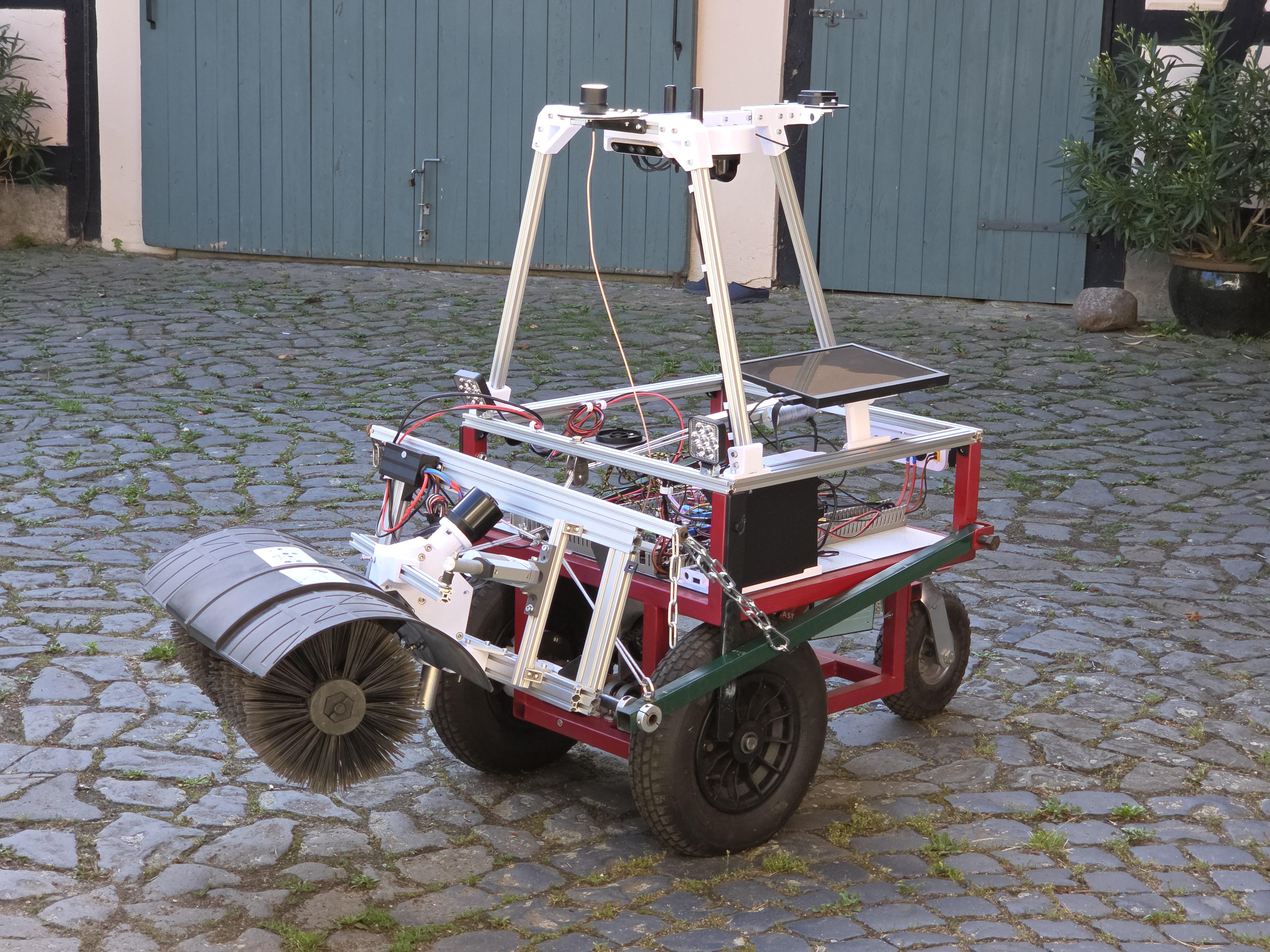
1
u/Least-Accountant-136 Jul 06 '26
The double cost rule is exactly why I'm trying to squeeze everything out of simulation before buying anything.
also your robot looks incredibly solid. what use case did you build it for?
1
u/low-control-labs Jul 17 '26
I wanted to tell you to do something like this in terms of wheels. Bigger in the front, even if you have all wheel drive and at least do front wheel drive instead of rear wheel drive. Navigating things in mud is hard enough already.
I have an app to train these types of vehicles I am working on my own the app will be free on the Google Play store soon
2
u/Mountain_Reward_1252 Jul 05 '26
Cool one. Why don't you use 3d Lidar?
1
u/Least-Accountant-136 Jul 06 '26
thanks man. 3d lidar is actually the plan for v3. I just started with 2d and rgb-d to get the core slam and navigation working in sim first before tackling full 3d point clouds.
2
u/Zarrov Jul 05 '26
I got some questions, because I have the same problems: Drivetrain (Tank Treads): What's your proposed track length and width and where do you get them from? I want to experiment with tracks but have problems to source them for reasonable prices.
. • Arm (6-DOF): I want one as well, I want it to remove grass and weeds. What's your planned model?
• Vision + 3D Perception: yea I am using a d455 and a unilidar L2. Don't use the L2 it's bad. Right now I am looking into buying a robosense airy. What's your planned odometry algorithm for lidar based odometry?
• GPS/GNSS: Precise localization across large outdoor fields. My experience with rtk gnns is mixed. Next to buildings or large trees the signal is often not stable enough.
• Battery SOC: Auto return-to-base charging. What's your planned battery tech, voltage and capacity?
How do You plan to manufacture the frame? I went with aluminium profile first and then switched to welded steel frame because it was not stable enough.
What's your planned drive motor(s)? How much weight do you want to move.
1
u/Least-Accountant-136 Jul 06 '26
to give you some context, the robot is still entirely in the simulation and software stage right now. since this is self-funded, my plan is to validate all the physics, torque, and logic in sim first before dropping money on physical hardware and manufacturing.
for weight, the goal is to carry about 30 to 50 kg of water plus the robot's own weight. I'm still calculating the exact track dimensions, motor specs, and battery sizes in sim based on that payload.
appreciate the heads up on the L2 and the frame stability. I'm doing stress tests in CAD right now to see if I'll need welded steel to handle that 50kg sloshing around. I'll definitely share where I source the tracks and motors once I actually get to the buying phase!
1
u/low-control-labs Jul 17 '26
Not sure if you are aware of the SO101 open source arm? They are quite tiny but quite inexpensive
11
u/Magneon Jul 04 '26
The caster wheels won't work well on dirt, particularly as front wheels. Maybe if they're the back wheels?
Mud, pollen, and dust will coat the lidar over time.
It really depends on what use case the robot is built for.
Is it for tending a small home veggie garden, an orchard, picking strawberries, etc. will the crops need to be planted specifically to support the robot, or will the robot be designed to work with specific crops as they are usually planted?
If you're not constrained by some specific hardware I'd also recommend using Jazzy or Kilted, since humble is pretty old at this point.
How waterproof is the arm and robot in general?
Some food for thought :)