r/pmp • • Mar 02 '25

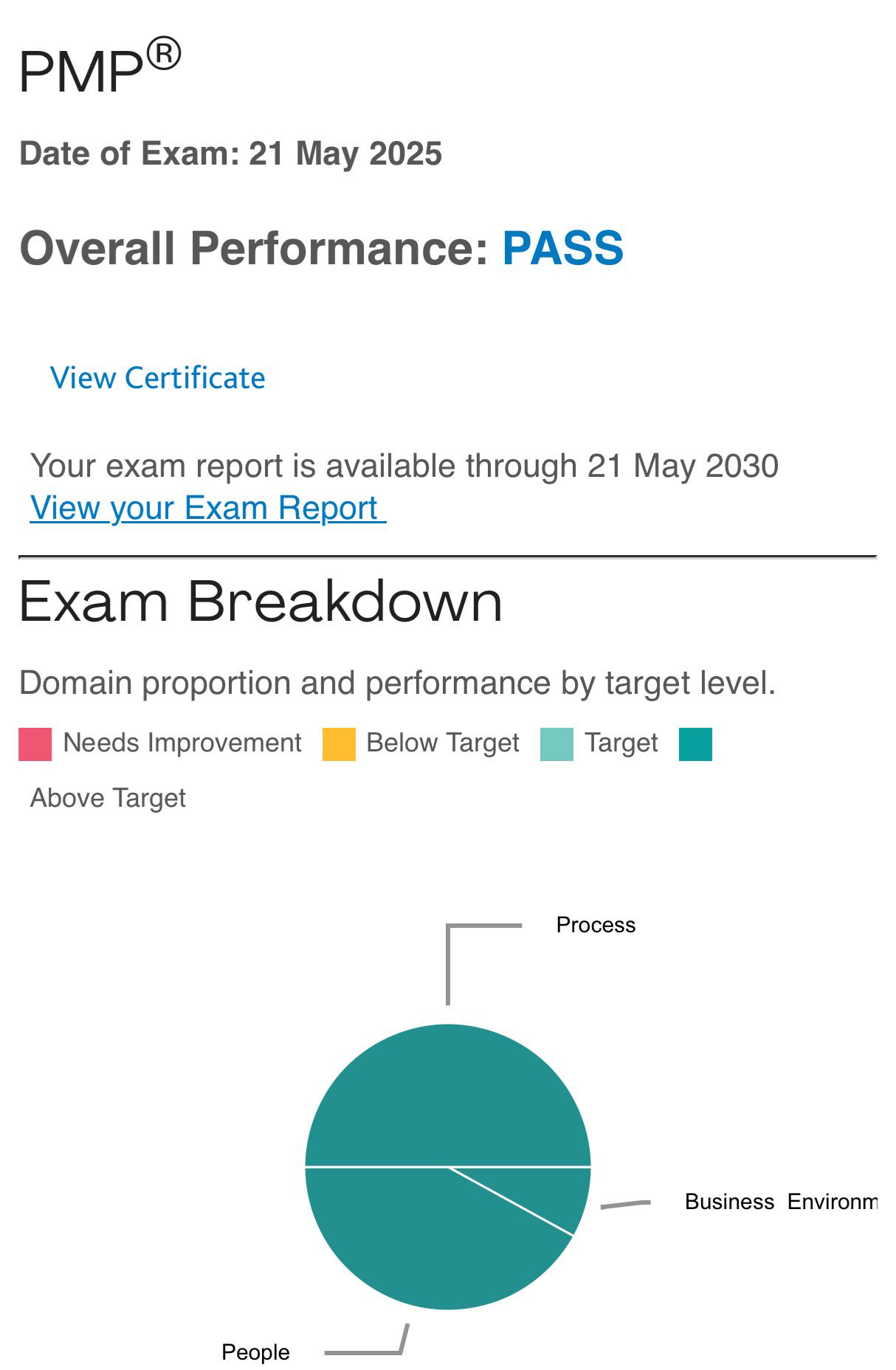
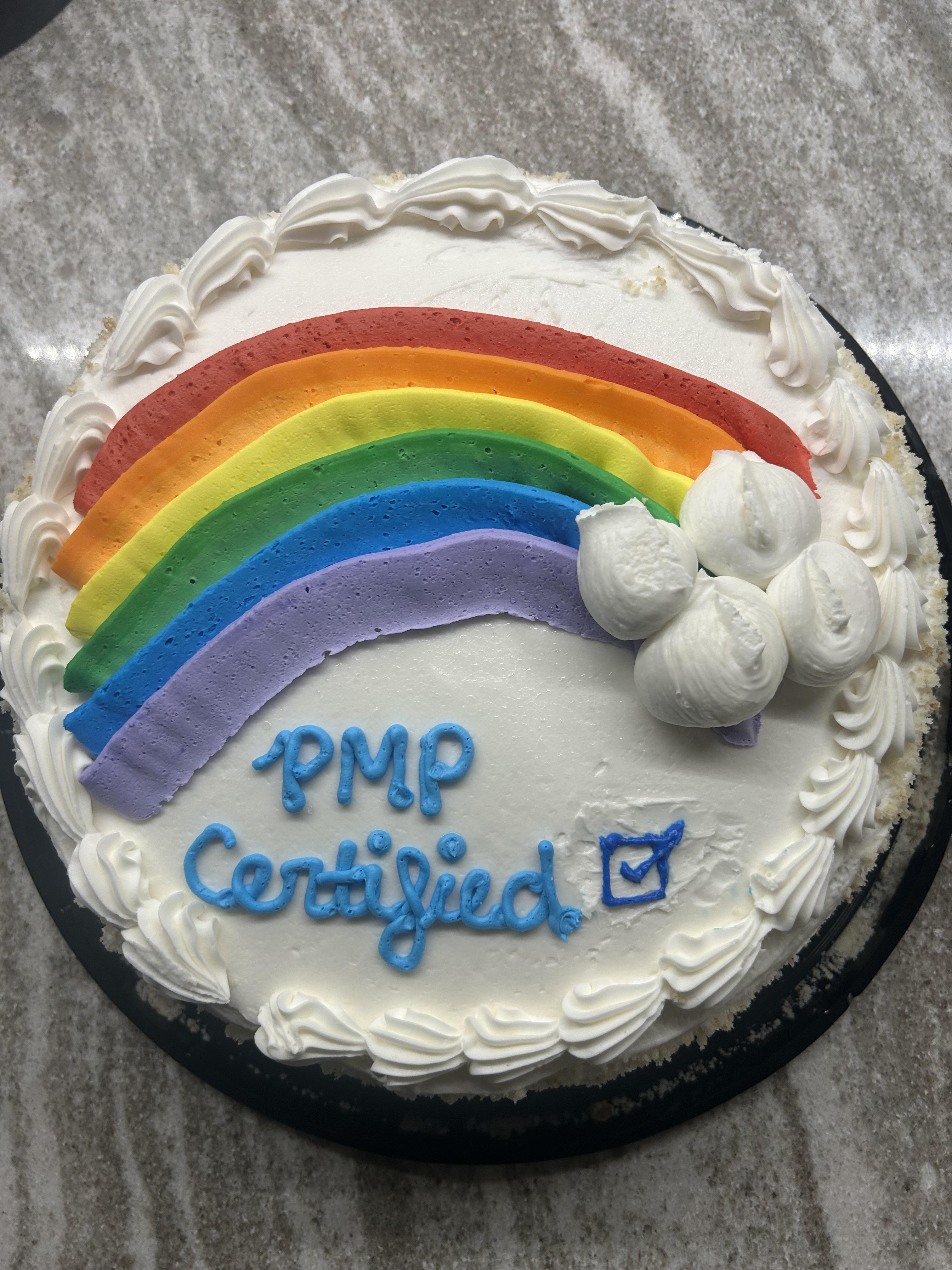
Celebration/Thank you 🎉 I passed! Cake to celebrate!

Post image
1.1k Upvotes

Came home to this surprise after passing last week!

This subreddit really got me through to the end. I learned the best resources and study strategies here, I am so grateful! Good luck to everyone else out there, it’s worth the time and energy.


r/pmp • • Jan 06 '23 Take My Silver

I Passed PMP Exam in 2 Weeks (AT/AT/AT) Study Guide 2023

917 Upvotes

Ultimate PMP Study Guide [2023]

Link to YouTube video I created for studying: https://youtu.be/__su7eIFRRU

Resources Used:

  1. Example notes on concepts/questions I missed

Study Plan - 2 Weeks (35 hours total):

  1. You will probably need to take this course to get the 35 PDUs to take exam

  2. 13.25 hours total (on 2-3X speed)

  • Submit application to PMI for eligibility to take exam

  1. DO spent thoughtful time filling out the PMI application, if you don’t follow the PMI specific-guidelines, your application WILL fail (I didn’t read the guidelines carefully and my application failed the first time, resubmitted & reformatted work experience and got approved)

  2. 2 hours total

  1. 0.75 hours total

  • Week 2 (18 hours)

    • AR TIA simulator (take all 6 practice exams to “master” the PMBOK mindset)

  1. Each exam (60 questions) took me ~ 45 min to complete and I spent an additional 45 min to review through all questions/answers (1.5 hour ea)

  2. 9 hours total

  1. I did all 200 questions, but that’s probably overkill. Great detailed explanation and additional prep (I just fast forwarded to each question and then checked my answer against David’s explanation)

  2. 3 hours total

  1. The PMI PMP Practice exam was very similar to the PMP exam (I thought the practice exam was harder than the actual exam)

  2. The exam was $99 on PMI’s website, but I used the discount code “STVIPRAC” and got the exam for free!

  3. Best representation of actual-exam questions (makes sense because PMI created it)

  4. Took the exam into 2 chunks (3.5 hour for the first 180 questions, 1.5 hour for remaining 81 questions)

  5. 5 hours total

  • Take notes on all PMI PMP Exam questions you get wrong (create a spreadsheet) and review days before your exam for key concepts you don’t fully know

  1. Example notes I made/studied here

  2. 1 hour total (reviewing any terms/concepts)

My Exam Day:

  • Took in person at Pearson Venue (reduces risk of technical issues/staff were very nice)

  • Exam had 180 questions & 230 minutes to complete

    • Finished exam with 50 minutes to spare (used ~55 min/60 questions and 5 min to review any flagged questions at the end)

    • Once you complete a 60 question section, you CANNOT go back (make sure you take time to double check any questions you are uncertain about)

  • Used both breaks (exam had a 10 minute break after every 60 questions)

  • Strategy: I read all the questions first, then read the passage, then the answer choices

    • Question has key details (such as “what to do first/next” etc.)

    • Always tried to anticipate the answer before looking at the answer options (tried to minimize being influenced by trick answers)

  • Questions are tricky – slow down and be confident/flag any questions for later review

  • Did not have formula calculations to do (you should prepare to know the general ones: SPI/CPI/SV/CV etc.)

  • Post exam, you receive your performance results immediately (pass/fail)

Reflections:

Link to study guide I created:

https://docs.google.com/document/d/1JPnKcL44ljeRFi0p51R_T9ml-zfXu2Cpz4JG4RVMOmE/edit?usp=sharing

Please let me know if you have any questions!


r/pmp • • Feb 11 '22

Passed Today 11-02-2022 AT/AT/AT, exam tips

871 Upvotes

Thank you!! Thank you so much!! I did it with the help of this community!!

To give some context, I been lurking in this forum since September last year. Before this, I got some PMP courses from Udemy special offers but haven´t even began to view them. But I have experience as PM and already got my Agile PSM. I viewed the Andrew Ramdayal at 1.25 to get the credits. Used his free course to do the experience submission. When I got the OK from PMI I was very busy (I have bought TIA Exams but I lost them since they only last for two months). I decided to but it again and do it in two weeks. Reviewed the Mindset and Hybrid sections again. Really you only need AR´s course and TIA exams. That is enough. If you need more questions, do buy the Udemy Ray questions. Did only two of Ray mocks due to time constraints, but they are good. TIA is better because it is better explained. Vargas video on the 6th edition is fundamental. Never saw the 7th edtion Vargas. After the AR course in the first 2 weeks, I really studied like 3 hours daily for 2 weeks. Also saw some of AR youtube sessions (only the last 10 minutes)

The exam:

Lots of situational questions, no calculations, 2 SPI/CV. 2 drag and drop on definitions. No IMTB personality types.

Tips: Calculations:

Always remember than (SPI and CPI above 1) or (CV and SV above cero) are good, below is bad. S is Schedule and C is Cost.

Situational questions:

First, make it a habit to read the last sentence (the main question) FIRST before reading the whole prompt. So you know to search what to…

Do? Action, normally see impact or if there is something already set in stone (The approval has been given, Law regulations enforced) then do it

Do first? Normally review a document/asses situation

Should have been done? Look for Reactive things. Not actions to do now that there is a problem.

Not do? Least likely/most likely? Most important least important? Notice the subtlety.

Second, what framework are you in? (Agile, hybrid, predictive/waterfall?). That will Help eliminate good sounding options that are not valid because they are from another framework.

Third, which process are you in? Are you initiating, executing, M&C, closing?

Play this game until you got it almost perfectly. You need to know where you are in the situational questions to exclude the options that are in before or later in the time

https://pmaspirant.com/project-management-process-group-and-knowledge-area-mapping-game

Mentality:

Always think like servant leader, forget about experience while attempting pmp

Never ask for others to do your job (The sponsor, the pmo, the product owner...)

Always try face to face communication,

Train your people is normally the best option.

May/might/claims = questions is about risk

Will/should/could = questions is about issue

Related to team issue = team charter

Stakeholder related = stakeholder engagement

Action is next step, assessing and review is 1st step

Remember while selecting answer = assess > review > action/implications

If questions related to safety problem, stop the project immediately (unless may stop..)

If question likely to have problem due to new law may introduce or from internet information = update the risk register. If not may then do the action to follow it.

If there is problem due to new law implications, seek for guidance

Problem between member = team charter, meeting preferably face to face(not apply in case of multiple locations)

Asking help from Sponsor and pmo is NOT an option

Before any change, always asses and check impact

Change request is approved in formal process. NEVER implement any change by yourself. Always with approval.

If anything missed in scope which may lead to rejection of deliverable = change request

Adding extra features = talk to team

Meeting and coaching are the best options for conflict.

Quality control customer are best option

Not performing as expected = Quality

Bottom-up estimate is best option for cost

Prototype is best option for demo

Never remove a member, remove a vendor or hire a consultant

There should be predetermined acceptance rules for acceptance of delivery

If project required close, follow the formal process always.

If stakeholder don't know about agile, coach and teach them about agile

If there is any issue related to payment/contract with vendor always ask them to check with appropriate department

Delay in item sent by vendor/ quality issue with vendor, meet and brainstorming with team and come up with solutions

Always add communicated with pmo about status of project and customer in Sprint

Sprint is important for communication for both customer and team.

Not to take any bigger actions like a change request or closing a project without taking care of the smaller tasks first. So whenever we see that “what should PM do next/first” it’s almost always a preliminary action like reviewing a plan or meeting with the team and using the information gleaned in THAT step to make the decision on the larger task:

1- assess/ analyze the problem to find out root cause

2- review the plan

3- meeting

You got this!


r/pmp • • May 06 '26 Mindblown Bravo

PMP Exam I barely studied and got ATs across the board. It comes down to 3 things.

Post image
697 Upvotes

My 3 keys to acing the exam. They might not work for you, but they did for me.

  1. Remember that this is a test of your knowledge of the PMI process, not in being an effective project manager in reality. Convert "what should the project manager do" to "what does the PMI say the project manager should do" in your head. It helps.

  2. Learn how to read questions and answers. The questions always give way more info than necessary, and if you squint you can translate most answers into what they really mean.

-Increase budget

-Delay the project

-Something that sounds good but has nothing to do with the problem

-or Solve the problem in the PMI approved way without adding time or money

Pick that last one.

3) Trust your gut. I only did 1 full length practice exam (got a 78 on that) and about 10 mini practice exams. The thing I noticed was that most of my wrong answers, I spent more time on, and usually I changed the answer a couple times before moving on. My first instinct was usually right. When I just took the exam for real, every time I felt stumped, I went with my gut and didn't overthink it.

Good luck everybody, I'm looking forward to never looking at any of this shit again if I don't have to!


r/pmp • • Jun 01 '25 Bravo

Celebration/Thank you 🎉 I passed the PMP, you can too + key mindset for the exam

631 Upvotes

Thank God, passed the PMP! 😊

As I reflect, here’s what I think actually works:

Step 1) Learn the content (1–2 weeks)

Start by familiarizing yourself with the content.

If you don’t have the 35 hours, try a Udemy course: Andrew Ramdayal / David McLachlan (Just pick one. Watch at 1.5x or 2x speed.)

If you already have 35 hours, consider a course like Yassine Tounsi’s 5-hour cram course (Udemy).

If you prefer reading, Rita Mulcahy’s PMP Prep Guide is a solid choice.

Take notes if possible — or if not, use:

  • Third3Rock Cheatsheet, or

  • David McLachlan’s Course Summary notes (usually comes with the Udemy course)

Step 2) Learn the mindset (2–3 days, refer to the later part of this post below for key mindset points)

This is what actually helps you navigate through PMP-style questions.

What worked for me:

  • Watching Ramdayal’s “200 Ultra Hard Questions” on YouTube (It’s long. Like really long. But worth it.)

  • Watching Mohammed Rahman’s videos for extra practice

Eventually, it’ll click — in the exam, you should be able to eliminate 2 out of the 4 options. Sometimes you’d be able to get directly to the right option!

Step 3) Practice questions (2–4 weeks)

This step is critical. I tried a lot of resources, and honestly, PMI’s Study Hall was the closest to the real exam.

I used the Essentials version: 700+ questions, 15 mini exams (15 questions each), 2 full mock exams (175 questions each)

If you have the budget or your company covers it, you can go for the Plus version — it has more exams (20 minis, 5 mocks).

Do all the questions. Review why they’re right or wrong. Yes, they feel tricky. That’s exactly why they’re helpful. Don’t get discouraged by low scores. Just keep practicing until you start averaging 80%+. Focus mostly on Moderate and Difficult questions. You can skip most of the Expert ones.

Oh and when Study Hall explanations didn’t make sense, I used ChatGPT. Honestly, it helped a lot and gave clearer insights.

Key PMP Mindset / Notes:

General:

1.	Always discuss, investigate, determine root cause, review, analyze, assess, ask/consult before deciding or taking action — especially if it says ‘what should PM do first or next’.
2.	Collaborate with the team when making decisions or developing plans.
3.	Act as a servant leader — support, coach, and mentor your team.
4.	Focus on prevention over inspection — deal with risks and issues proactively.
5.	Base actions on data, trends, or impact assessments, not assumptions or gut feelings.
6.	Refer to the project vision or objectives if the team is confused or misaligned.
7.	Respect organizational processes and governance — don’t bypass them.
8.	Avoid escalating or involving third parties like HR, sponsor, or steering committee — unless the situation explicitly calls for it.
9.	Don’t delay, pause, or stop the project unnecessarily — keep progress moving.
10.	Don’t overreact — avoid firing, rejecting, or making extreme decisions unless ethically required. If all the options sound bad, try to pick the better one. If all the options sound good, try to pick the one that must happen first.

Stakeholders & Communication:

11.	If a stakeholder is unresponsive → revisit the Stakeholder Engagement Plan.
12.	If a stakeholder missed updates → check the Communication Management Plan.
13.	Meet 1-on-1 with stakeholders to resolve conflicts or understand preferences.
14.	Tailor communication style and frequency to stakeholder needs, not fixed cycles (e.g., not “monthly” or “daily” by default).
15.	Consider cultural and individual preferences, especially with global teams.
16.	Don’t act immediately on requests — analyze feasibility and impact first.
17.	Keep stakeholders engaged and informed throughout the project lifecycle.

Agile / Hybrid:

18.	Product Owner owns the backlog and prioritizes based on value and stakeholder input.
19.	Team owns sprint backlog, story points, and velocity estimation — empower them. Ideally, velocity should be consistent.
20.	Once a sprint begins, no changes.
21.	Use demos for progress, retrospectives for improvement, and refinement for clarity.
22.	Backlog Grooming / Refinement can happen before sprint planning. Ensure safety / health / security regulations are included in Definition of Done.
23.	If the org is transitioning to Agile → provide training and coaching.
24.	Agile is feedback-driven — use MVPs and early releases to validate and adapt.
25.	Use video calls for distributed teams to maintain face-to-face communication.
26.	Avoid command-and-control behaviors — support sustainable pace and shared ownership. Burn down chart shows work remaining. Burn up chart shows work completed. Spike is the horizontal part of the graph. Bottleneck in Kanban is when the number of items = WIP limit
27.	Hybrid = when part of the project is predictive (e.g., regulatory) and part is adaptive (e.g., user interface).

Predictive (Waterfall):

28.	Can’t update baselines (scope, schedule, cost) without a formal change request.
29.	 Initiating a change control processes involves assessing the impact.
30.	Work authorization and governance systems must be followed.
31.	Project charter = high level; scope baseline = scope statement, WBS, WBS dictionary.
32.	Cost baseline = estimates + contingency; project budget = cost baseline + management reserves. CPI, SPI > 1; CV, SV > 0 means good (under budget, ahead of schedule).
33.	Risk, quality, and stakeholder management are ongoing efforts, not one-time tasks. For schedule delays, prefer Fast Tracking over Crashing (unless the question says additional funds are available). For resource optimization, prefer Smoothing over Levelling (to avoid changing the critical path).
34.	If a project is terminated early, a formal project closure must still happen.

Risk & Issue Management:

35.	“Something may/might happen” = risk, “has/will happen” = issue.
36.	Add new risks to the risk register, and active issues to the issue log.
37.	Don’t ignore or delay risk response — act early and appropriately. If a known risk materializes → it becomes an issue; execute the planned risk response. 
38.	Use Monte Carlo simulation for scenario-based risk analysis. Like when there’re multiple scenarios that need to be analyzed.
39.	New regulations? → Assess impact first, then update risk register if applicable.
40.	Escalate only if the issue exceeds your authority — not just because it’s difficult. Contingency reserves are for known risks and management reserves are for the unknowns. Generally, approval is not required for using contingency reserves, but it is necessary for using management reserves.

Quality, Procurement & Resource Management:

41.	Quality Control = product-level; Quality Assurance / Plan Quality = process-level.
42.	If a deliverable is rejected → review the acceptance criteria.
43.	For vendor/supplier issues → refer to the contract and procurement agreements.
44.	If a team member lacks knowledge → arrange training or mentoring. Refer to OPAs, historical info, or lessons learned — especially if a similar project was done before. Consult SMEs if absolutely no idea.
45.	For resource constraints → work with the Functional Manager to resolve.
46.	Establish and follow a Team Charter / Social Agreement with team norms and ground rules.
47.	Use the team charter or conflict resolution techniques for team issues or misbehavior. Collaboration (win/win) is usually best for conflict resolution. Compromise is the second best.
48.	Recognition should be timely, relevant, and based on team member preferences. Team evaluation should be fair and transparent.

Red Flags:

49.	Be cautious of options with harsh tone: instruct, demand, force, command.
50.	Avoid answers with:

•	Rigid phrases: always, never, only, immediately, do nothing, pause project.
•	Specific timelines: weekly, monthly, daily (unless the question says so).
•	Third-party escalation: HR, sponsor, steering committee — unless the scenario involves them.
•	Single-constraint focus: answers that mention just cost, schedule, scope or quality, without considering the others.

Wow, that turned into a long post lol 😅 — but I’d be happy if it helps someone out there.

Good luck and all the best! 🙏

r/pmp • • Aug 21 '24 Bless Up Polished Silver Turd Take My Silver Silver is Forever

Celebration/Thank you 🎉 I 1.75x'd my salary ($80k/yr --> $140k/yr) 4 months after passing the exam-- sharing my job hunting experience.

631 Upvotes

Hello Everyone!

TL;DR

27 year old engineer studied for 4 months, passed the exam, applied to 125 jobs, and earned a job making $60k more a year.

FULL POST

In February of 2024 I passed the PMP exam by following the advice in the sub. I studied the Andrew Ramdayal Udemy course, read some Rita Mccauley content, completed the study hall, and crammed with the Third3Rock notes. I started studying in November of 2023 and took the exam in February 2024.

After I passed the exam, I immediately started hunting for a new project management job. I started with browsing online job boards and applied to some decent listings, I also connected with a local staffing agency who recommended a few more jobs to me, but ultimately I found that going directly to a company's website produced the most amount of jobs to apply to. When you apply directly on a company's website a lot of times you can sign up for new postings that match your qualifications-- seeing these in my inbox were helpful too.

I grinded through applications from mid-February 2024 to early June 2024, I would guess 125+ jobs, and landed three interviews. I prepped HEAVILY for the interviews. I researched the companies, familiarized myself with the industry, financial performance, etc. I also spent hours of time practicing answering common project management interview questions. I watched a ton of Youtube and LinkedIn videos and spent some time doing mock interviews with ChatGPT. Doing all this prep combined with the skills I learned while studying for the PMP gave me SO MUCH CONFIDENCE going into the interviews.

I applied to the company I landed at in late April, my first interview was in early May, second interview was mid-May, third and final interview was in early June, my first day as a PM was in mid-June. My new company is a massive $100B+ corporation to which I had no previous ties to. I cold applied directly on their corporate website and they picked me!

My Qualifications:

Male

27 years old

Western Pennsylvania, USA

Bachelor's in Mechanical Engineering from a local (fine but not particularly prestigious) school.

PMP Certificate

5 years experience as a Manufacturing Engineer + Project Manager for a mid sized local corporation.

As the title says, I went from $80k --> $140k by earning my PMP and jumping jobs. I spent probably $800 total on the test itself and study materials. I could have done it more cheaply but I am a happy studier, was genuinely interested in the content, and wanted to perform well on the test so I bought some supplementary materials. I ended up with a T/AT/AT fwiw.

I obviously could not be happier with my decision to pursue the PMP certification. I strongly beat my target salary (I was thinking $130k best case dream scenario), turning an $800 investment into $60k annually. I am so much happier working at the new company. I am two months into the job and crushing it!

I am not smarter than you, I am not a better PM than you, I just committed to my goal and grinded out the work for 8 months and countless hours. You can do the same!


r/pmp • • Jul 20 '25

Off Topic One Year After Getting My PMP – What Actually Happened?

583 Upvotes

About a year ago, I proudly shared a post here celebrating the achievement of earning my PMP certification. It felt like a major milestone — and it was. But naturally, the big question that follows is: What happens next?

For many of us, passing the PMP feels like reaching the summit. We study hard, sacrifice time, and put in the work — and once we pass, there's a sense of huge relief and accomplishment. But let me be honest with you: that moment is only the beginning.

After earning my PMP, I shifted gears and focused on marketing myself. I updated my LinkedIn, crafted a clear value proposition, and made sure my PMP achievement was visible and memorable on all platforms. Because, let’s face it — we’re all salespeople in a way, offering our time and expertise to the best opportunity available.

This visibility worked. Headhunters and recruiters began reaching out with expressions of interest and job offers for project management roles across various local companies. I narrowed it down to two exciting opportunities, went through the interview processes, and received generous offers from both.

Eventually, I accepted a Project Manager position at a major mining company — a role that is both high-impact and rewarding. The PMP absolutely played a key role in opening those doors.

To anyone preparing for the PMP: Keep pushing. And once you pass, don’t stop. Market yourself, tell your story, and be visible. The cert is powerful — but it’s up to you to turn it into real career growth.


r/pmp • • Jun 14 '26 Bravo

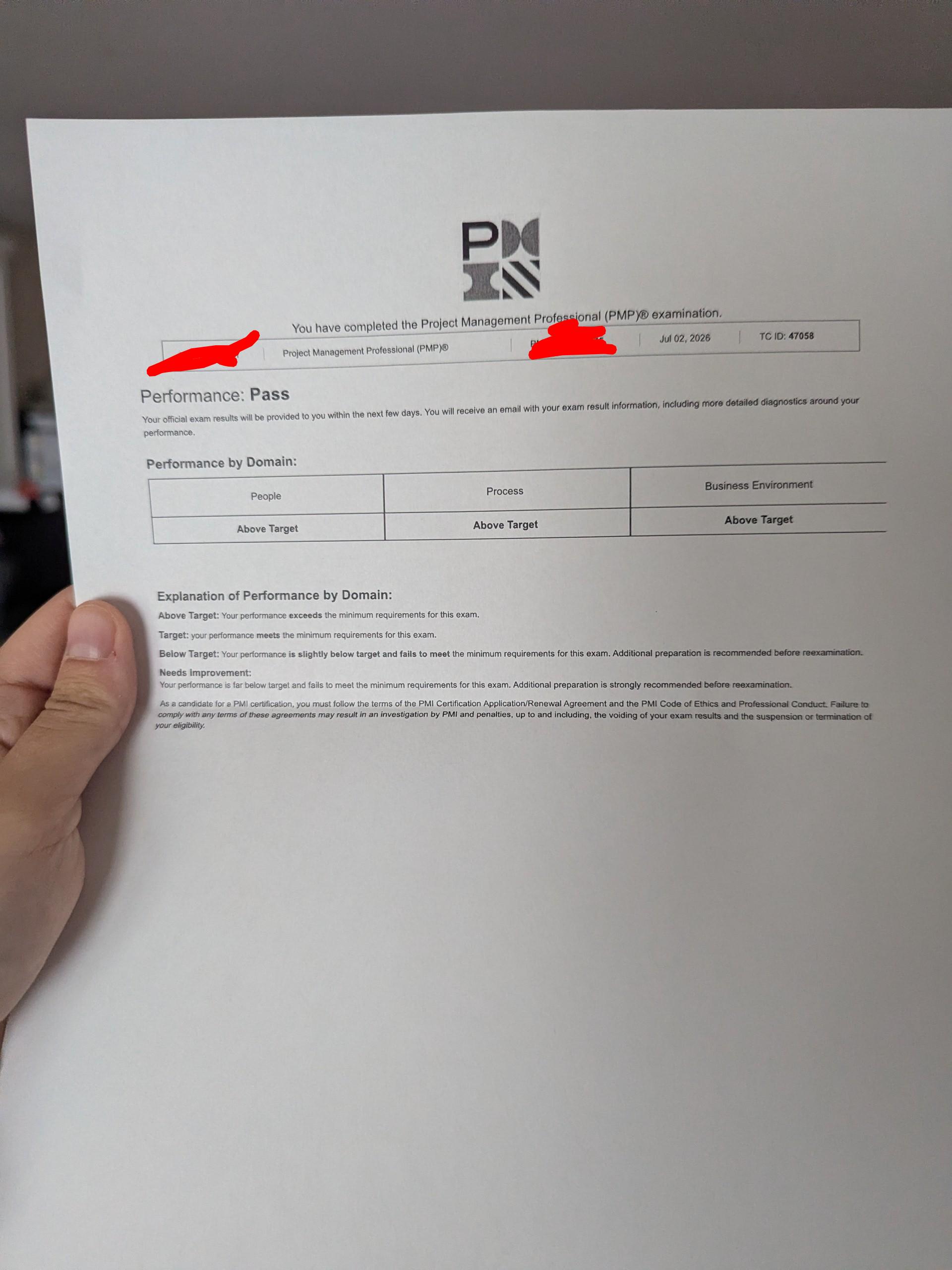
PMP Exam Passed today. Cancer and all. – Thank you! 🥹

Post image
549 Upvotes

I’ve been a PM for seven years in aviation. Airline launches, TSA certifications, cross-functional chaos — I’ve lived this stuff. Went in overconfident. Shocker.

What I didn’t know when I signed up was that I was a few weeks out from a cancer diagnosis.

The past six months have been a lot. Treatment is its own full-time job. So is actually working full time — because that wasn’t optional given the current state of events. There were days I had to talk myself into opening a single practice question. Retention felt impossible. Failed a second time anyway. Kept going.

Coming out of treatment I had one motivator: the new format rolls out July 8th and I was absolutely not dealing with that. So I finally let my type A personality take a seat. Stopped forcing my real-world instincts onto every question and just finally committed to the PMI way of thinking.

Passed today. Three attempts deep. Twenty-five days to spare. I don’t think the proctor appreciated my immediate “holy f*ck” but she understood once I explained. Fair enough.

I have more posts saved in this subreddit than I do on my Instagram. You all kept saying it — mindset, mindset, mindset — and I kept nodding and not fully believing it until the third time around. I get it now. I really get it.

Thank you for beating it into my head. Truly.

What made the difference for me this last round:
🙌🏼AR Mindset - admittedly had not watched this
🙌🏼AR 200 Hard - went through 50 and felt like I had it
🙌🏼SH Practice questions - correcting in real time was SO helpful - (practice exams you have to wait til the end to see corrections which is helpful but not AS helpful to me)


r/pmp • • Jul 07 '26

Off Topic Employer is not impressed

Post image
541 Upvotes

So after 3 months of studying and practice exams, i just passed on Friday! My job title is project manager II and i project manage clinical research studies.

I told my bosses that I passed after a meeting that we all had together today and I was met with questions about why I didn't just get the SOCRA CCRP (Certified Clinical Research Professional).

The biggest reason is because our hospital system is willing to pay for the courses/exam to get the PMP but don't cover anything regarding the CCRP. I tried to explain the pmp's value and that I felt like I did gain a lot from my studying but they just seemed less than impressed...

I'm pretty disappointed. I talked to my direct supervisor before signing up for this exam and she was supportive but told me that she didn't know very much about it. I had hoped to use this to ask for a slight pay increase (I've also taken on more responsibilities from another project manager leaving our group) and now I don't feel like I can ask... So this kind of feels like now I just have my PMP for in case I leave this job...


r/pmp • • Feb 19 '25

Celebration/Thank you 🎉 Passed on my 5th Attempt

Post image
521 Upvotes

I'm happy to share that I passed PMP on my 5th attempt, I would like to thank the group for the knowledge sharing and thank God for his mercies. I don't have any special suggestions or plans to share from my preparation, as the group has lot to offer. A word for those who failed like me, I mentioned about the number of attempts I had before I passed PMP just to let you know a failure doesn't define and you, push yourself encourage yourself and believe in yourself. Be strong and I know you are PMP certified.


r/pmp • • Jan 08 '23

Post Exam Tips I passed my PMP exam today with 3 ATs. Sharing what worked for me.

515 Upvotes

I took the exam today and couldn't believe I got 3 ATs! For context, I'm a dad of 2 small kids and have a 9-to-5 job. After work, I have to attend to daddy duties and, by the time the kids are all tucked in for bed, I'm just too exhausted to devote time for study.

I'm a classic example of student syndrome. I applied in December 2021 but kept rescheduling the exam until the last possible date. I didn't have a structured review approach and only had ad-hoc study times when my personal and work schedule permitted it. I took 2 days off work prior to the exam to do a deep-dive review.

What really helped me is this subreddit. So shout out to all the anonymous folks here who have selflessly shared their exam tips.

(Also a special shout out to my wife who made a hearty breakfast for me so that I had the stamina to go through more than 4 hours of grueling, mind-numbing project management questions.)

As my way of giving back, here's what worked for me during the exam. You would probably find most of the things here are a rehash of other posts awhile back but I'm reiterating them since they proved to be extremely helpful to me.

  1. Learn Andrew Ramdayal's PM mindset by heart. For the uninitiated, this is part of his PMP Exam Prep Course at Udemy (Section 27), which outlines your way of thinking as a PM if you're working on a traditional/predictive or an agile project. This is helpful since almost all of the actual PMP questions are situational. If you do have the time though, go through the entire course.

  2. To reinforce your mastery of the mindset, invest on the PMI Study Hall or the TIA Mock (or both) and practice answering as many questions as you could. Between the two, I would recommend investing on the SH for exam conditioning; the questions there are more like the actual PMP questions than the TIA questions, both in structure and content. On average, I was hitting 65-70% on the SH mock exams. Without the expert questions, I was 85-90%.

  3. If you have time, also watch this guy's practice questions, answers, and explanations. Helps you solidify the PM mindset.

  4. Watch Ricardo Vargas' PM processes video. THIS IS REQUIRED READING WATCHING! I was struggling with all the processes and ITTOs and how they all fit together but the way he explained it totally made sense. If PMBOK only structured them the way Vargas did, then this would have helped more people tremendously. Once you have a good grasp of the processes, it would be easier for you to eliminate choices that look okay but are, in fact, wrong because they're not part of the project phase that the question is asking about.

  5. More on the mindset: The prescribed approach is to always think it through BEFORE you act on something (unless it deals with dire consequences like health and safety or mandatory regulations). So questions about what you should do first or next almost always calls for thinking it through (i.e. assessing the situation, evaluating the impact/ root cause, or reviewing the plan) BEFORE doing the actual action.

  6. The rule of don'ts (not absolute but in general): Don't remove a team member or a vendor. Don't escalate to sponsor or PMO or product owner. Don't ask for budget increase. Don't add more people. Assess the situation, evaluate the impact/root cause, review the plan, meet with the team, then come up with the best solution.

  7. If a team member is deficient in skill, put them on a training. If the stakeholders or the org are new to agile, show them the benefits of agile (i.e. workshops, trainings).

  8. If a stakeholder complains about a missed or incomplete/incorrect item, revisit the agreed criteria and walk them through it. If a stakeholder complains about comms or status report, revisit the management comms plan/stakeholder engagement plan then find out where they're coming from (i e. what do they need?). If a stakeholder wants to know more about the project status, invite them to sprint reviews.

  9. You are a servant leader. Your role is always to support the team. Team conflict? Put them in "one room" and facilitate mediation. Demotivated? Find out why, then act based on their personal motivations. Erring team members? Remind the team about ground rules. Shared resource? Talk to the functional manager and figure something out.

  10. Changes? Assess and evaluate the impact on the project then go through the formal change process, including approval. Never put a change through without approval.

  11. If project is delayed, follow the following (in order of priority): a. Check risks and re-estimate b. Fast-track c. Crash d. Cut scope e. Reduce quality

  12. Take note of cue words: May/might/could means revisiting the risk register and risk management plan. Will/would/has (or any event already done) means revisiting the issue log and requiring an issue resolution.

  13. MVP is the way to go when there are just too many wish lists from stakeholders but limited resources. Use prototype when demonstrating the product's value.

  14. Face to face communication is always the best unless team is dispersed geographically, in which case you have to settle with virtual meetings.

  15. In the process of closure? Get formal acceptance of the project deliverable with stakeholders BEFORE lessons learned, BEFORE handover to Ops, BEFORE releasing team.

  16. SPI is Schedule while CPI is Cost. To remember if it's good or bad, treat 1 like 100%, which is the ideal baseline. Anything above 1 is good; anything below 1 is bad.

  17. Lucky to have stumbled on this terminology post before my exam. They appeared as a drag and drop question in my exam; be sure to understand the terms.

  18. PearsonVUE onsite exam tip: Use the highlight function to mark key words. Use the strikethrough function to narrow down your choices so you could focus on the 2 most plausible answers; this ups your chances of getting it right.

EDIT: Some users here advise it's better if you don't use these options and just mentally take note of the 2 most plausible answers. My answer is it would all depend if you're a fast test-taker or not. In my case, I had at least 45 minutes to spare to go back and review my marked questions so the highlight and strikethrough functions proved really useful. But if you think the 4.5 hours is just enough to answer 180 questions, then this tip won't work for you. Size up how you're doing with the time through your mock exams and then decide.

19. COVID tip: If you have even the slightest cough, reschedule (or opt for virtual exam instead)! My seatmate was escorted out after 30 mins. because she was constantly coughing. o_O

20. Take your 2 breaks even if you're on a roll. I was feeling good during the first set (60 questions) but figured exam fatigue would set on me soon so I took the break to keep calm, refresh my mind, and stretch a bit before going back to the exam room.

21. Sub to this subreddit. r/pmp is truly a treasure trove of insightful advice and PMP exam tips. Indeed, crowdsourcing is one of the greatest gifts of the Internet! Thank you!

Go break a leg! Good luck!


r/pmp • • Jul 22 '26

Celebration/Thank you 🎉 Finally cashed in on my PMP

467 Upvotes

Encouragement for anyone who struggled to recognize the ROI of their PMP right away!

I FINALLY just landed my dream job and got an AMAZING offer from Lockheed Martin, 7 months after getting my PMP.

I have been a construction PM in Colorado for the last 4 years. I decided to pursue my PMP last fall since I felt I wasn't getting paid market value. (For reference I have 7 years professional experience, 4 years PM experience, a bachelor's degree, and two direct reports, paid $77k annual with no bonus). In Colorado that is not a livable wage for a single mom with two kids. I told my employer I was starting on the PMP path, and they implied that I would get a raise when I did. I studied my ass off for 3 months, took 5 full length practice tests, and passed on my first attempt AT/AT/AT in January, a week before my annual performance review.

At my performance review my manager gave me glowing, very positive feedback, and the told me I'd be getting a 2% raise....slap in the face. They didn't even match inflation, so I practically took a pay CUT after getting my PMP. I immediately started applying for every PM role I possibly could. First three months I never got a single response on over 50 applications. (These were not just "click-to-apply" apps from LinkedIn, these were carefully thought out, cover letter included, applications directly through employers' own websites).

I started to feel very discouraged because I've read so many stories from other people who immediately got 10%,15% or even 20% raises after earning PMP, or getting better offers at another company right away.

I kept applying, messaging any recruiters I could find on LinkedIn, and still another month of never hearing back or getting a couple "we regret to inform you that your no longer under consideration for the PM role" emails.

By May I was feeling so discouraged and like I had spent all those months of studying and thousands of dollars prepping for my PMP to see no return on it. FINALLY at the end of May I started getting interview requests.

I interviewed for three different roles at Lockheed Martin, got shot down for the first two and told I was "runner up" but that they ultimately went with the candidate who already had security clearance (as it costs them about $60-$70k to get someone cleared). My LM recruiter told me that it's very difficult to compete against internal candidates since the barrier to getting clearance is so high.

Walking into my third interview I was feeling so discouraged. But I put my best foot forward, did a little bragging about myself which I HATE to do but felt like I needed to promote myself since I was getting nowhere. In the interview my new manager specifically mentioned that she was interested in me because I have my PMP. The next day I got a call from the recruiter offering me the PM role, starting salary of $95k with bonus package and great benefits AND I'll be getting a clearance!

I am so happy that I decided to pursue getting my PMP and so thankful that it is finally paying off! I hope this post reaches other people who might have been feeling the way I was after earning the PMP and not seeing a ROI right away. Keep your chin up, keep applying and know that there are employers out there actively seeking PMP candidates.


r/pmp • • May 09 '26 Heartwarming

PMP Exam I passseedddd. AT/AT/AT

Post image
447 Upvotes

I don’t usually post on these but I just want to say I passed. This thread definitely helped me. I used AR course on Udemy for my credits. Used his and DM videos on YT to become more well rounded. I’m so happy.


r/pmp • • Sep 01 '26

Ask Me Anything My PMP just got me a 6 figure salary

445 Upvotes

Hi everyone! I just want to share a career update and hopefully I can provide some guidance to anyone who needs some support during this time trying to find a job.

I’ve spent the majority of my career in public education, about 11 years total. I have been a special education, professional, a teacher, a special education, teacher, special education coordinator, and I rose all the way up to my districts office. I eventually left the public space and went to a private company only to be laid off within five months. My period of unemployment lasted over nine months and it’s the first time I’ve ever been let go from a job in my life. As you can imagine, this was one of the most depressed I’ve ever been and even calls me to start taking medication. I eventually found a job back in a public education space and went on to work for a nonprofit after that role.

As you can imagine, none of these roles were paying me anywhere near six figures. Being in education for the majority of my career also had me insecure about transitioning to a different career path. On top of that I was struggling financially, and living check to check. That’s why I decided to pursue my PMP in October 2025. I took the test in February and passed on my first try ( score wasn’t great but it doesn’t matter). I have been on an intense job hunt since February with multiple ghosting after multiple rounds of interviews, and hundreds, if not thousands, of applications sent.

I secured a lucrative salary with a large private company recently! I just want to let you know that you should stay persistent. You will find what you need. It will be very difficult and I’ve been in your shoes before, but persistence is what will lead to your success!

Feel free to ask me any questions about how I found jobs and got interviews. Thank you to the sub for helping me during my PMP prep.

Edit: here is the Claude prompt

Here is the prompt I used to build my project in Claude(my “years of experience in project management” was teaching and non profit educational work!) :

I want to recreate an accurate listing of jobs that align to my resume. I am looking for work in ed tech, project management, and related fields. I want the jobs to be fully remote and $100,000 OTE or over. I want this in a spreadsheet with links that take me directly to the job posting, not just the career pages of the website. This information must be up to date with active links to active job postings. Search popular career sites like LinkedIn, but also niche sites like BuiltIn and similar. I need active project management or adjacent jobs in the EdTech space. Make sure to build a cover letter PDF with any tailored resume you make. Save those files in my job search folder, and label and place each build into a folder labeled with the current date. If one exists already, place the files in that folder.

My background: [X] years in program and project management, spanning [Industry A], [Industry B], and [Industry C]. Experience includes managing [Y]+ concurrent projects or implementations at [Company A], portfolio work in K-12 EdTech at [Company B] and [Company C], and [relevant certification, e.g., AI workflow automation credential] from [Certifying Body]. Certifications: [Cert 1], [Cert 2]. Location: [City, State].


r/pmp • • Jul 14 '26

Celebration/Thank you 🎉 PMP really gives you new wings

444 Upvotes

TLDR:
Hello all.
I earned my PMP certification a year ago. But nothing really changed after I got certified. Here's a long story of traps I fell into. If you don't see a promotion or pay raise coming your way after all the efforts, maybe it is waiting for you in the next building

A bit of background...
I work as a Project procurement specialist in a renowned electric equipment manufacturing firm- a global market leader in some segments. The pay was decent, my role involved handling additional responsibilities - basically acting as a project manager coordinating multiple departments, managing Factory acceptance test , commissioning activities, and handling every aspect of a traditional waterfall project but without a Project manager title. I was always the go-to person on multiple projects, but with a bleak title - Project procurement specialist.

I brought it up multiple times to my manager to which he recommended PMP certification was the path to a title change. I did so promptly, only to stare blankly at the ceiling.

First thing after I emailed him the shiny certificate, he sent out a company-wide email saying I was the youngest and probably the 3rd person in the division to be certified. Congrats. That's it.

There were lot more projects assigned to me, with increasing scope. I burnt personal time, weekends and what not, thinking I would have the title soon with a bigger paycheck. Nope, nothing.

The common gaze
Everytime, I brought up the topic of getting a Project manager title my manager got evasive. It was something he was working hard to get & shoud happen in near future, same answer for a few months. Then I started applying for internal roles, the HR was too slow and when they got back to me, after maybe 2 months or more, I was told my work closely aligns with the new role but they would not consider me because I lacked the title. In their eyes, I was a mere procurement chap. I lowered the bar and even applied for Associate project manager roles. Then I was told I was overqualified or probably out of budget. Same thing on loop.

Journey to the title
After almost 9 months of internal battle and a dodgy manager, I was fed up and started applying externally this May, exactly a year after I got certified. Within a month, I landed the role of Project Manager with a competitor clearing 3 levels of interview. They were surprised with the responsibilities I had handled and drilled down to the finest technical query during interviews. Had I not handled it, I would have surely failed.

There were few questions about why I was a frantic job hopper - 3 jobs in 7 years. I gave them a carefully crafted answer - No one starts their job as a project manager. This role requires a lot of empirical knowledge. Often people start their career in sales, engineering or other functions, procurement in my case. And, each switch brought me one step closer to getting the title. I explained in detail about the added responsibilities with each job which helped me function as a project manager. Almost immediately, I felt a change in the meeting atmosphere, the tides turned in my favour. The HR was a bit apprehensive of my previous title. But my PMP certification made me stand out among other applicants and the panelists had tested me in detail over the interview. Finally I got the offer after a week.

The Circus
Now I dropped my resignation at my current firm, my manager and his boss lost it immediately. Their words - We are absolutely disappointed, we were about to offer you a similar role next week with a grade change as well. It got funny when I asked about the role proposed.

Again, a role similar to a Technical project manager, basically handling projects tasks without a title. Didn't fall for this trap again. I realized the longer I work without a title, the more it would affect my functional experience down the line as a project manager.

My exact reply was - "When I already have an offer to work as a Project manager, why would I work similar to a project manager."

The icing on the cake is my new job is really close to my home, essentially reducing my commute time from 2 hours/day to a mere 20 mins ride. They say good things take time. Maybe PMP can be your catalyst.

Edit: Wow....I never expected this post to blow up like this, it has struck a chord with so many people. Seems so many people have had or are currently in a similar phase. May the Force be with you. All the best.

Fixed some typos, I will try to reply to all queries over comments.


r/pmp • • Apr 17 '24

Celebration/Thank you 🎉 After 16 years…. Finally took PMP and passed!!

426 Upvotes

Firstly I am so grateful for all the info on Reddit. This community is inspiring and so incredibly supportive and generous in sharing.

16 years ago my company sponsored me to take the PMP. Well life happens, I had 3 kids, our family relocated, I took 8 years off work…By then my work experience was no longer valid. PMP just seemed so elusive and unattainable. But if I can do it, you can too!!!

When my application was approved I gave myself 5 weeks. I booked my exam right away because Parkinson’s law. If you give yourself 6 months, it’ll take 6 months. But honestly after 3 weeks of studying I wish I had scheduled it earlier. I was worried that I’d start forgetting what I learned.

To give some perspective, I have a full time job, mid 40s, 3 kids, and a brain fog is my norm. I’d study and fall asleep. I started waking 5am and 6am to study. Taking a nap after work, then studying. But did the most on weekend mornings. I took brain supplements from Amazon lol. I don’t know if it helped, figured a placebo couldn’t hurt.

I did much of what posters recommended:

  • Udemy Andrew for PDUs

  • Ricardo Vargas process video

  • David Machlachlan YouTube - Agile 200, Waterfall 100, PMBOK 150

  • 3rd Rock notes

  • study hall plus

  • PMAspirant matching process game

Honestly think I over studied. For me Study Hall was the key. DM videos instilled confidence. I found it was easier for me to stay awake by doing questions than to listen to Udemy. If I could go back, I’d focus just on Study Hall. I scored 50-67% at first on questions. I did 4 practice exams scoring 71, 73, 72, 71 including expert questions. Took screenshots of all wrong answers and reviewed the explanation later in day.

I found the test to be much less wordier than study hall and less ambiguous than Study Hall. SH definitely prepared me well as I found the test easier than SH.

One thing I’d mention is the night before I took SH sample Pearson test and that really messed me up. It mentioned questions were not from SH and meant to demonstrate functionality but when I got like 50% that really affected my confidence. Not a good way to go to bed!! So I’d suggest skipping. Pearson allows you to do a brief practice right before test. I did use the highlight and strike out feature of the test and found it very helpful. I completed the test in 3 hours.

I’m planning on taking ACP next. Going through Udemy now. Figure I’d continue now that the juices are flowing lol.

Best of luck to you all!!!


r/pmp • • Jun 06 '26 Heartwarming Bravo

Study Groups Very pregnant and very glad that’s over3 in comments.

Post image
407 Upvotes

r/pmp • • May 22 '25 Heartwarming

PMP Exam Passed my PMP! … The REAL truth about the exam

Post image
399 Upvotes

Hi All, (PS this is a long read so I apologize in advance but I am just trying to help anyone who needs it)

I passed my PMP exam yesterday on my first attempt! Got my provisional pass right there and then and just got my results back this morning (15 hours after I finished) and I got AT/AT/AT! I wanted to break down my studying procedure and give you all actual tips and tricks about writing the exam that helped me a lot as few people asked me for it from my previous post in this subreddit (https://www.reddit.com/r/pmp/s/YZfybMeXXf)

About me: I have an engineering background (mechanical engineering degree) with 5+ years of Project Management experience in a traditional environment. Agile methodology was all new to me.

Pre-Exam: Overall I probably took at least 6-7 weeks to study but took few days off in between for a trip and taking care of my young toddler at home. My home life and work life is extremely busy so I studied often either at work in my spare time or late at nights after my daughter was put down to sleep. I know all of the other posts usually mention the same few videos and materials they studied but I wanted to break it down in a similar way but also let you know what worked and what didn’t.

Initially my application was rejected as I never wrote my experience in the “PMI” way and after I did that it was instantly accepted within a day or two. I did my 35 hours of mandatory class time at my local university (didn’t really help honestly). Now into the juicy stuff:

  1. MR Mindset Video MUST WATCH https://youtu.be/83y-aBdS1iY?si=IkLcpwzhY1cIpUfv

You have to, I repeat, you have to watch this video and understand the 23 mindset rules explained by MR. This video alone will help you answer around 40-50% of the exam (sometimes even more)! Write these rules down, remember them, become one with them, I don’t care do whatever it takes to answer every situational question with this mindset. Even if you are stuck on a question, these rules will help you cross out the wrong answers from the 4 and usually you’ll be left with 2 good answers which is a 50% chance of picking the right one compared to 25% chance prior. This video will make the difference between if you pass or fail the exam.

One thing I would like to say about the mindset video is the escalating principle (watch the video first then come back to this). The video mentions never to escalate to the project sponsor unless it’s about the budget/money involved in the project. Yes that makes sense BUT try to understand that and understand when it’s necessary to escalate. I got 2 questions where the only choice was to escalate, I know few people overlook this and just quickly cross out this option from the choices but think before you act!

2) PMI Study Hall I ended up getting the study hall 1 week prior to my exam. I will say this, some of the questions in the SH are stupid. They are worded weird and sometimes the answer goes against the PMI mindset which made no sense to me. BUT don’t stress too much over those questions as the questions on the actual exam were worded much better and easier to understand. I scored 75% on my one and only mock exam I took and was scoring around 70-87% on the mini tests.

There’s one more thing I want to say about the SH. A lot of people mention to use the grade you get on the mock exams to indicate if you are ready or not for the real exam. To certain extent, yes you can do that but the real challenge in the exam is your reading ability and time management. I will talk more about this later when I explain my experience at the exam but use this practice exam to benchmark how fast you can go through the exam and still be answering the questions correctly.

3) DM & AR YouTube Videos A lot of mentions of both DM and AR videos in all the posts but I will say this. The questions they go over are not on the same level as the questions you will see on the exam. What I learnt from their videos though is the process of breaking down a question, understanding the key words, understanding exactly WHAT the question is asking and then eliminating the wrong answers and finally picking the right answer the actually ANSWERS the question.

I do suggest watching DM 110 drag and drop question video and AR 200 Ultra hard questions (for this video watch the mindset video first then answer these, AR will help break down the questions using the mindset) Links below:

DM Drag & Drop https://youtu.be/wwNUBe21jtMsi=pRaICgXDEweX5Men

AR 200 Ultra Hard Questions https://youtu.be/1sWpc6765AI?si=8RJ0lVlOF312cWCd

Other than that, watch these videos a day prior and day of the exam to refresh yourself of everything.

https://youtu.be/k25eJDUU-J0?si=zmlzMobui9NSD-Rk https://youtu.beeUOJ_yEeyucsi=WCXqrmUx3PPGwCAZ

4) THE EXAM

Now what everyone has been waiting for. I will break down my experience with the exam and the tips/tricks that worked for me.

I initially booked my exam late April but I fell ill for an entire week and pushed it back to late May (glad I did). I took my exam in person downtown and I work near the building so day prior I went there to get familiar with the area and made sure the area existed (like when you check if your gate is real at the airport LOL).

Day of the exam I arrived around 45 minutes early, went through the whole check in procedure and they allowed me to start the exam early. I know some posts mention the moment they sit down they quickly write down everything on the paper like formulas etc but the exam proctors mentioned brain dumped prior to seeing the first question wasn’t allowed. I actually never used my paper and pen other than fidgeting around with the pen.

Few tips and tricks: The exam is long… really long that your eyes will start hurting towards the end because of the prolonged exposure to the computer screen. I didn’t realize this until I sat back down from my second break that I could adjust the screens brightness (head smack). I adjusted the screens brightness as I had few minutes left in my break and then the remaining of the exam the stress on my eyes were reduced so make sure to do this at the beginning!!!

Like I mentioned before, you need to figure out your pace and timing. First 60 questions you should have 155 minutes remaining and after the next 60 you should have 80 minutes remaining. I ended the exam early with 25 minutes to spare which gave me enough time to review my flagged questions. As well take your breaks! But when you do take your breaks, you are not allowed to go back to the previous section of questions, so when you finish the first 60 questions and you still have some time before the 155 minute mark, review your flagged ones as you can’t come back to those after.

Highlighting and crossing out: This is huge… in the SH highlighting key phrases was a weird procedure but during the actual exam it’s much easier. Highlight as you read! Don’t read the question then go back to highlight as you will be wasting valuable time. Look for key words like “may” (difference between a risk or issue), “first” “next” “solve” etc, keywords as in how the question is worded. Of course highlight the meat of the question when it talks about agile or risks or change control what have you, but these other keywords will help you narrow down your answers.

Use the mindset and PMI thinking to cross out the incorrect answers right away. Get good at this. This will be super helpful. Maybe only 2-3 times in the exam when I reviewed my flagged questions I was like “wait a minute, maybe the crossed out one is the answer” but 99% of the time you can tell which 1-2 answers are 100% incorrect. Then just pick the answer that ANSWERS the question. If you have time just talk it through in your head if the answer you picked actually answered the problem. Time isn’t on your side so this process literally needs to be happening within seconds.

Flagging questions: The questions I knew I 100% answered correctly (or incorrectly but didn’t know) I never flagged them. The ones I was uncertain of, I picked an answer, flagged the question and moved on. When I came back to review them, I asked myself why I picked this answer and tried to justify it to myself. If it made sense, I’ll unflag the question and move on, if not then I reviewed the answers again. What worked for me here was not rereading the whole question but quickly scanning the highlighted parts to remind myself of the question… only do this if you are comfortable with it, might not work for everyone. When you get to the reviewing part at the end of each section prior to your breaks, there’s a way to only review your flagged questions rather than all of them. This is what I did, I only reviewed my flagged ones.

Overall, the actual exam questions were worded way better than SH. I had around 5-6 drag and drop questions (I loved these, they were easy) and around 2-3 graph questions. I had 0 calculation questions so I did not use a single formula nor my physical calculator they provided but I did still get questions on EVM, SPI CPI etc. I would say I got around 45-50% situational questions where the mindset came into play, and I would say I answered few questions within 15 seconds and moved on. Like I mentioned, I finished with 25 minutes to spare and when I finished my last section, I had around 8 questions flagged and took my sweet time answering them knowing I had a lot of time on my hands. I probably flagged 20ish questions in my first section, 13 in the second and 8 in the final 60.

Lastly and not least, practice reading. Practice reading fast and highlighting keywords/phrases. This will make or break your experience on the exam.

Other than that, I am glad I am done with this exam and look forward to helping anyone else that needs help! Thank you for reading all of this if you got to the end and know if I can do it, so can you!


r/pmp • • Jan 28 '25

PMP Exam Passed My PMP in 4 Weeks with 3 ATs on My First Attempt! Sharing My Study Plan, Techniques, and Resources

388 Upvotes

Disclaimer: This is a detailed post, but I promise it’s worth the read if you’re prepping for the PMP exam.

Why I Wanted the PMP Certification?

I’m a consulting professional with 6.5 years of experience in Consulting, Project Management, and B2B Sales. While I had 3 years of Project Management experience, I hesitated to pursue the PMP certification due to common myths—like the exam being extremely tough with a 60% pass rate. Plus, life got busy with work and personal commitments. One day, I reflected on my Project Management experience and questioned whether I was truly following best practices. I had always thought of PMP as just a career booster, but a conversation with a close relative (a seasoned PMP) changed my perspective. He explained that PMP isn’t just about career growth — it’s about developing a structured thought process, improving problem-solving skills, and becoming better at managing people. Inspired, I decided to take the leap and prepare for the exam. He gifted me Andrew Ramdayal’s Udemy Course (PMP Certification Exam Prep Course 35 PDU Contact Hours/PDU) and encouraged me to give it a shot. After watching the initial videos, I felt confident that the exam was doable with the right preparation. The challenge? Balancing a full-time consulting job, family commitments, and a tight 4-week timeline.

Week-1: Laying the Foundation

  • I started with AR’s Udemy course and decided to take detailed notes instead of rewatching videos. To save time, I used the NoteGPT Chrome extension to generate summaries and key points from each video. I invested enough time in understanding and absorbing the core concepts by going through the notes after watching every video in the course. This approach helped me build a strong conceptual foundation.

  • Halfway through the course, I began practicing questions from online sources and YouTube. My initial scores were around 50%, but I quickly realized the exam is all about scenario-based questions that test understanding, not just memorization.

Week – 2: Doubling Down on Effort

  • I started putting extra effort by waking up early, hitting the gym first thing in the morning, and studying for 4-5 hours before I log in for my office work in the afternoon. The morning routine kept me focused and productive.

  • By the end of Week 2, I completed the Udemy course and submitted my PMP application using the course completion certificate, my degree certificate and details of my 36 months Project Management experience. While waiting for approval, I practiced Andrew Ramdayal’s 200 Ultra-Hard PMP Questions on YouTube and scored 81%. This was a turning point—it helped me develop the PMP mindset.

Week-3: Mock Exams and Analysis

  • My PMP application was approved after 5 days, and I immediately subscribed to PMI Study Hall Essentials.

  • When I started with “Practice exams” questions on StudyHall, I used to score only between 60% - 70% and in fact, my first full-length mock exam score on StudyHall was 67%, which was discouraging. However, after reading Reddit discussions, I learned that Study Hall questions are tougher than the actual exam. This gave me hope and I decided to analyze my mocks.

  • I created a “PMP - Tracker Sheet cum Error Log” to analyze my mistakes and focused on weak areas. For every wrong answer, I developed my own analysis method called "Rule of Three":

    1. Understand the mistake.

    2. Rewatch the relevant topic videos from AR’s course on Udemy.

    3. Review my NoteGPT key notes and summary of that topic.

  • In the “Practice Questions” of StudyHall, there are around 30 different topics with 10-25 questions each and I have practiced only those topics which I was extremely weak at.

  • I also used ChatGPT to analyze my error log and generate key takeaways, which helped me refine my PMP mindset.

  • I didn't want to push it any further, so I set a target of 10 days to take my PMP exam and scheduled it.

Weak – 4: Final Push

Exam Day Experience:

  • Despite my preparation, I only slept 5 hours the night before due to exam anxiety.

  • When I woke up on exam day, I chose not to revise anything. As I got ready, I followed Andrew Ramdayal’s suggestion and wore a blue shirt — symbolizing success. While getting dressed, I kept telling myself, 'I will definitely pass this exam.'

  • I arrived early at the Pearson Vue Testing Center, completed the formalities, and started the exam with 230 minutes on the clock.

  • Right from Question 1, I went into the mode of PMP mindset while solving the questions.

  • About 10-15 questions were extremely tough, and I went with my gut feeling. I also encountered 5-6 drag-and-drop questions (which were slightly difficult) and one question where I had to type the answer choice, instead of selecting it, which surprised me.

  • Throughout the exam, I kept a close watch on the timer, aiming to spend approximately 1 minute and 15 seconds on most questions. By the end of the first section, I had 150 minutes remaining, 70 minutes by the end of the second section, and 30 seconds left by the end of the final section.

  • I used my two breaks to visit the washroom, grab a banana, and drink ORS. It honestly felt like I was running a marathon.

  • Once I completed the exam, I was prompted to submit feedback about the exam experience and the testing center. After leaving the testing center, the person in charge handed me my tentative scorecard, which indicated that I had passed the exam.

  • Within 36 hours, I received a PMP badge from Credly and another email from PMI asking me to login into myPMI at CCRS Exam analysis for accessing the certificate and the detailed exam analysis report, which included Above Target (AT) ratings in all the 3 sections.

Re-sharing the details of my resources that I have utilized:

Above all, it was my self-confidence and trust in the process from the very beginning that enabled me to pass the PMP exam with 3 ATs in just 4 weeks, while managing a full-time job and attending to family commitments. If I can achieve this, I'm confident you can too. All the best!


r/pmp • • Apr 15 '25

Celebration/Thank you 🎉 Got laid off less than a week ago… and just passed my PMP!!!

Post image
387 Upvotes

Hey everyone,

First of all, I just want to say thank you to this community. The insights, support, and shared experiences here were such a big part of my preparation.

I got approved to take the exam a year ago, but kept pushing it back until—literally—the last possible day, which was today. I got laid off last week, and just a few days before that, I was already grinding hard to study. Once the layoff hit, it was like, “Okay, this is it—I have to get this done now.” So I hustled and knocked it out in 5 intense days.

Some resources that helped: • AR’s PMP course on Udemy – This was amazing. I watched it all at 2x speed to move fast but still soak in the content. The mindset videos were especially helpful—I had them playing constantly to stay focused. I also made special notes anytime he said, “this is likely to show up on the exam,” and reviewed those constantly. • PMI Study Hall – Really solid for practice. I did one last full-length exam on it yesterday, and it helped me focus and feel more confident going in.

As for the exam itself: • I had 4 drag-and-drop questions • 2 formula-based questions • The rest were scenario-based questions (mostly Hybrid and agile)

And to anyone out there still studying: believe in yourself. You can do this. Even when it feels overwhelming, push through—you’re way more capable than you think. Keep going and don’t give up!


r/pmp • • Jul 13 '26

Off Topic Passed PMP exam two weeks ago, got fired today

384 Upvotes

Joined this company as a business analyst in February and during the interview I mentioned to the director that I was studying for the pmp certification which he also mention that he took 20 years ago. Fast forward to two weeks ago, took the exam on the 2nd and passed. Told the director the same day and all he said was “that’s a big deal” and gave a thumbs up certificate picture I sent on teams. Manager called me in this morning and broke the news lol. Had a feeling this would happen because the company doesn’t have project manager roles. So I guess they saw me as a flight risk. Rookie mistake I guess but yeah just wanted to rant innit.

EDIT: This role was originally a 3 months contract and manger mentioned I’d only get hired if I did well during those three months which I did and got hired. Shortly after hired full time, HR mentioned that I would be getting a raise next month (August) so I assumed if I mentioned this cert I would get a better raise but I guess not. On paper it says i got fired for “inability to consistently perform business analyst responsibilities” which i can assure you its absolutely not true.

Just yesterday I got a message from my former colleague in my former Ba role telling me that my old boss misses me and wants me back. Also wo passes a PMP exam but cannot perform responsibilities of a BA? Lol

Lesson learned definitely. And I hope others can learn from my mistake.


r/pmp • • Feb 08 '23

PMP Certification The PMP certification was totally worth it :)

375 Upvotes

Update - today I accepted the role as a Senior level program manager for a top food and beverage company in the United States. Less than a year ago I was let go from a job that paid half of what I’m accepting today. Got my PMP & CSM and interviewed countless times, only for it not to work out. Today, I accepted an offer that seems like a dream come true. With no degree. Thanks to everyone for their kind words and support in this thread and on Reddit in general - anything is possible.


r/pmp • • May 27 '26

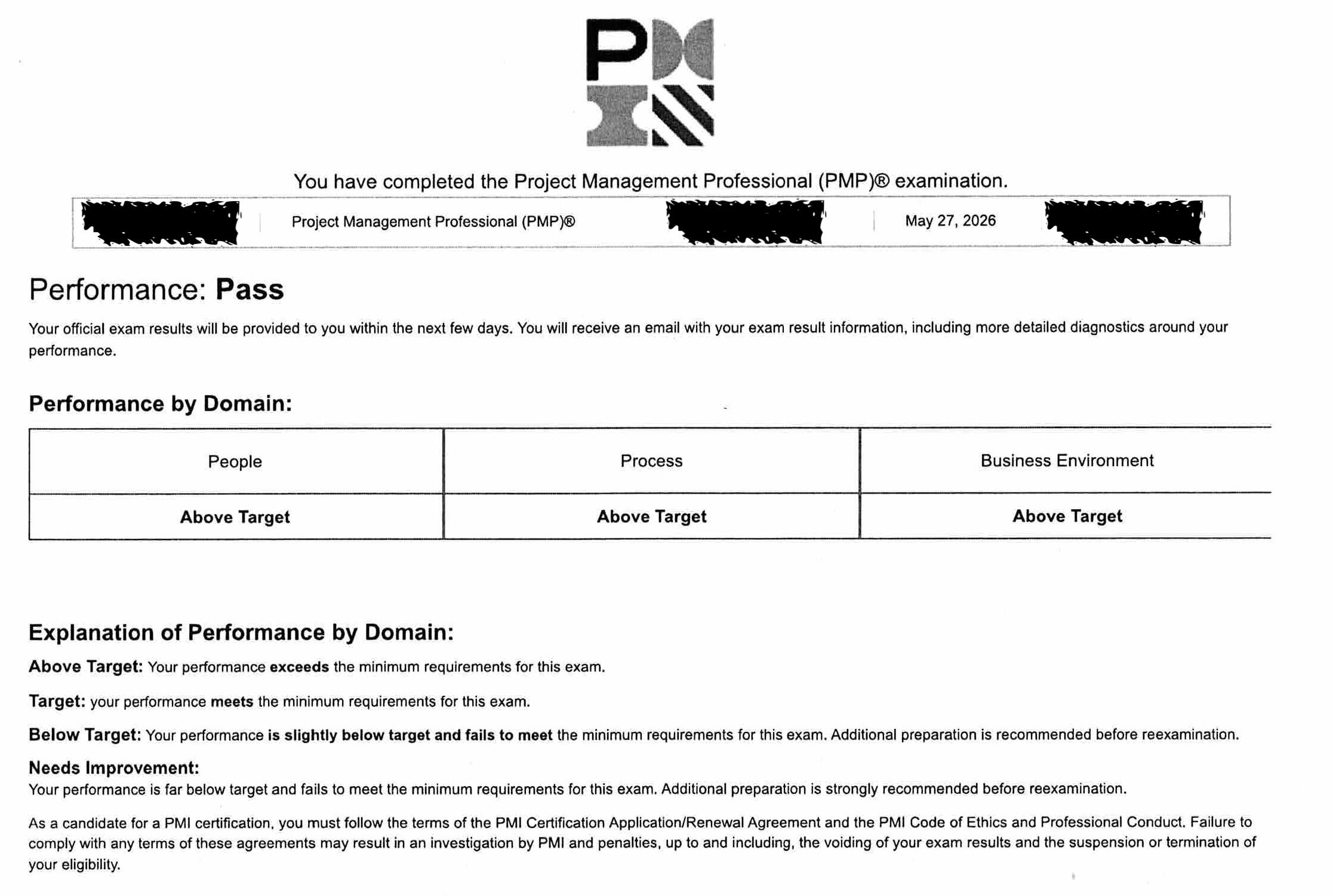
Celebration/Thank you 🎉 Well, I passed. PMP is officially oversaturated.

Post image
367 Upvotes

First off, thanks to all the PMPs and PMP candidates on this sub who are helping and learning and collaborating on this journey together.

Study Tips.

I did Andrew Ramadayal (AR) for my course, but found Phill Akinwale (Praizion) and Muhammad Rahman to be more engaging. PM Aspirant was good for gap filling.

I took all 5 Study Hall Practice Exams and did all Practice Tests.

What I think really helped was this: I used an AI agent to track my stability or instability across the Category scores. Then once all exams were completed. I did something a bit insane: I filtered all moderate and difficult questions that I had missed from my weak areas and compiled them into a single file, I used that to create something I called "Practice Exam 6". I used an independent AI agent to take Practice Test 6.

ETA: My actual prompt for Practice Exam 6:
"I have attached a file containing [X] questions and their solutions. Please present each question to me verbatim, one at a time, in a Socratic quiz format. Rules:

  1. Read directly from the file before presenting every question, without exception — do not generate questions from memory or training data.

  2. Present the question and answer choices exactly as written in the file.

  3. After I answer, tell me if I'm correct. If I'm wrong, guide me toward the correct answer through Socratic questioning rather than just giving it to me.

  4. If I require a pushback to arrive at the correct answer, count it as incorrect.

  5. If my answer is correct, but my rationale is weak, guide me to a better understanding.

  6. Keep a running score of correct vs incorrect answers after each question.

  7. If you are uncertain that a question matches the file exactly, re-read the file before presenting it."

** I'm posting an example of the input file format as a comment.

I shut down all studying/prep 20 hours before the test.

ETA: The prompt for the gap tracker was:
"I'm going to give you two files. The first file contains the PMI Domains broken down into subject categories. The second file is my score on a PMP practice exam, broken down by category name, the number of questions answered out of the total within that category (e.g., 1 of 2, or 5 of 5), and the percentage correct.

Please do the following:

1. Track my performance per category across all practice tests uploaded.

2. Identify apparent weaknesses based on my scores.

3. When I upload additional practice test results, compare them to previous results, identify trends, and flag high levels of variation between tests.

4. Provide a rolling average across all practice tests uploaded to date.

5. Map each category to its corresponding PMI domain using the domain list provided in the file.

6. Flag any category where I answered fewer than 3 questions total and note that the percentage may not be statistically reliable due to the small sample size.

Present your analysis in a clear, organized format grouped by domain, so I can see both granular category performance and broader domain-level trends."

The PMP Domain - Categories map file comes from the Exam Content Outline. You can copy and paste from there.

The second file is just a copy/paste of your practice exam score by category.

The Test.

I took it at a testing center. Can't recommend that enough. If you can get to a testing center, do that.

I got to the testing center about 30mins before open and I did 7 warm up questions from Study Hall's QotD cycle.

Something I will say very clearly... the actual exam questions and exam answer options read much much much more clearly than Study Hall. And I didn't encounter anything that I felt had Study Hall's Expert Question "Moon Logic".

I somehow had about 15 drag and drop questions. It was a bit much, but they weren't too hard.

191 minutes.

ETA: When you signup either PMI or Pearson will give you a 25-Question Sample PMI test to take. Don't dismiss this out of hand. Those questions were the closest to actual exam questions. In structure, language and difficulty. Really take your time with that one.

https://www.pearsonvue.com/us/en/pmi/sample-test/pmp.html

ETA: I used these free practice tests before I EVER purchased Study Hall, just to get a decent idea about my baseline.

https://oliverlehmann.com/free/free-pmp-practice-questions/

https://www.edwel.com/Free-Resources/PMP-Certification-Practice-Exam.aspx

https://academy-pq.app.mometrix.com/practicequestion/products/PMP

https://www.project-management-prepcast.com/pmp-practice-exam-questions-sample-test


r/pmp • • Apr 07 '25

PMP Exam You can do PMP. I did it in 20 days

359 Upvotes

I’ve been meaning to get my PMP certification ever since I took a project management class back in 2013. At the time, I didn’t meet the experience requirement. By the time I did, I had already shifted into cybersecurity, picked up a few other certs… and PMP just kept getting pushed down the list.

In early 2025, I finally decided to go for it.

I started studying on Valentine’s Day (Feb 14) and took the exam on March 5. That gave me about 20 days to prep—and I passed with AT/AT/AT.

⸝

Here’s what helped:

🧠 Study Materials I Actually Used: • PMP Prep Simplified by Andrew Ramdayal – straightforward and beginner-friendly • Third3Rock’s PMP Cheat Sheets • ChatGPT – great for simplifying tough topics (like Integration Management or WBS vs Define Activities) • PMI Study Hall PMP® Plus – solid practice exams and performance analytics

✍️ I read through the main book, highlighted as I went, and rewrote notes in my own words. That helped move stuff from short-term memory to long-term.

Used ChatGPT heavily for on-the-spot clarification and mnemonics.

⸝

Practice Test Progression: • First full-length test (Feb 23): ~62% • Final test (March 4): ~73%

Each test helped me identify weak spots, so I’d study those areas more intentionally.

⸝

Exam Day Tips: • Real exam = 180 questions, 230 minutes, 2 optional 10-min breaks. • Mentally exhausting. I got a headache from reading tiny black text on a bright white screen for hours. (Still wondering why there’s no dark mode.) • Bring a snack you can consume quickly. I went with a protein shake. • Use your break time wisely—it goes fast. Know where the restroom is. • I highly recommend taking the test at a test center if that’s an option. You avoid tech issues and get your results instantly.

⸝

Final Result:

Scored AT/AT/AT across all three domains. The breakdown showed up in my PMI profile the next day.

⸝

My Takeaways: • The PMP content isn’t hard once you get into it—it just needs a structured approach. • Understanding why each process exists makes memorization a lot easier. • ChatGPT helped break things down in a conversational, quick way. • You don’t need months to prepare. 20 focused days can be enough if you commit. • If you’ve been putting this off like I did… now’s a good time to start.

Happy to answer questions or share more about how I structured my 20 days. Good luck to anyone else on the PMP path!