r/leetcode • • Nov 01 '25

Intervew Prep Maybe I have to do PhD now to avoid public embarrassment

Post image
2.1k Upvotes

Done so many things.

Applied to over 600 tech companies, interviewed at 40, no offer yet in last 3 years.

Read over 6 DSA books, done system design, done AI, done over 1000 LC problems

Fan of all cs legends.

Still no job.


r/leetcode • • Jun 19 '25

Tech Industry Finally!

Post image
2.0k Upvotes

r/leetcode • • Aug 03 '25

Discussion from skipping meals to a faang offer; had to share this somewhere

2.0k Upvotes

a lower middle class boy who struggled most of his life just to get multiple meals a day. i rarely spoke much, always underconfident around anything remotely luxurious. somehow, i managed to land a decent job after college and pulled my family out of debt. everything was built on credit. now, we’re a happy family.

but today, the biggest thing happened: i got an offer from a faang company, with a salary three times what i was earning before.

i haven’t told anyone yet, not even my family, because they probably wouldn’t understand what this really means. but i’m overwhelmed. i just needed to share it somewhere and feel what i’ve achieved.

definitely getting myself a pastry after this.

edit 1: first off, thank you all so much for the overwhelming support. i genuinely didn’t expect this kind of response and it really means a lot. 🙏

to answer some of the common questions:

where i’m from: india

preparation: i focused heavily on leetcode (400+ questions), especially blind 75 and system design. hellointerview helped a lot. mock interviews helped too

interview type: dsa rounds (lc medium to hard), lld, system design, and behavioural (nothing new, all questions are there on lc)

yoe: 3.5 years

advice: consistency over intensity. even 2-3 questions a day, every day, adds up. and don’t skip system design prep even if you’re early career

thank you again. still letting this sink in and yes, i got that pastry 🍰


r/leetcode • • Apr 20 '25

Discussion Reminder: If you're in a stable software engineering job right now, STAY PUT!!!!!!!

2.0k Upvotes

I'm honestly amazed this even needs to be said but if you're currently in a stable, low-drama, job especially outside of FAANG, just stay put because the grass that looks greener right now might actually be hiding a sinkhole

Let me tell you about my buddy. Until a few months ago, he had a job as a software engineer at an insurance company. The benefits were fantastic.. he would work 10-20 hours a week at most, work was very chill and relaxing. His coworkers and management were nice and welcoming, and the company was very stable and recession proof. He also only had to go into the office once a week. He had time to go to the gym, spend time with family, and even work on side projects if he felt like it

But then he got tempted by the FAANG name and the idea of a shiny new title and what looked like better pay and more exciting projects, so he made the jump, thinking he was leveling up, thinking he was finally joining the big leagues

From day one it was a completely different world, the job was fully on-site so he was back to commuting every day, the hours were brutal, and even though nobody said it out loud there was a very clear expectation to be constantly online, constantly responsive, and always pushing for more

He went from having quiet mornings and freedom to structure his day to 8 a.m. standups, nonstop back-to-back meetings, toxic coworkers who acted like they were in some competition for who could look the busiest, and managers who micromanaged every last detail while pretending to be laid-back

He was putting in 50 to 60 hours a week just trying to stay afloat and it was draining the life out of him, but he kept telling himself it was worth it for the resume boost and the name recognition and then just three months in, he got the layoff email

No warning, no internal transfer, no fallback plan, just a cold goodbye and a severance package, and now he’s sitting at home unemployed in a terrible market, completely burned out, regretting ever leaving that insurance job where people actually treated each other like human beings

And the worst part is I watched him change during those months, it was like the light in him dimmed a little every week, he started looking tired all the time, less present, shorter on the phone, always distracted, talking about how he felt like he was constantly behind, constantly proving himself to people who didn’t even know his name

He used to be one of the most relaxed, easygoing guys I knew, always down for a beer or a pickup game or just to chill and talk about life, but during those months it felt like he aged five years, and when he finally called me after the layoff it wasn’t just that he lost the job, it was like he’d lost a piece of himself in the process

To make it worse, his old role was already filled, and it’s not like you can just snap your fingers and go back, that bridge is gone, and now he’s in this weird limbo where he’s applying like crazy but everything is frozen or competitive or worse, fake listings meant to fish for resumes

I’ve seen this happen to more than one person lately and I’m telling you, if you’re in a solid job right now with decent pay, decent hours, and a company that isn’t on fire, you don’t need to chase the dream of some big tech title especially not in a market like this

Right now, surviving and keeping your sanity is the real win, and that “boring” job might be the safest bet you’ve got

Be careful out there


r/leetcode • • Feb 09 '25 More of this please

3000 Solved! Talk to the real me- AMA

Post image
2.0k Upvotes

r/leetcode • • Aug 19 '25

Intervew Prep [BREAKING] Google goes back to in-person interviews for most roles due to so many cheaters using AI virtually.

2.0k Upvotes

Google is opting for in-person interviews for hiring employees as jobseekers use artificial intelligence tools to help answer questions and complete tests.
....
"We'll introduce at least one round of in-person interviews for people just to make sure the fundamentals are there," Pichai told the podcast. "I think they'll end up being important."
....
Google adds to the expanding list of organisations that are adopting a retro approach to hiring as more jobseekers rely on AI during recruitment.

https://www.hcamag.com/us/specialization/hr-technology/google-opts-for-in-person-interviews-amid-surge-in-ai-aided-candidates/545926


r/leetcode • • Nov 11 '25

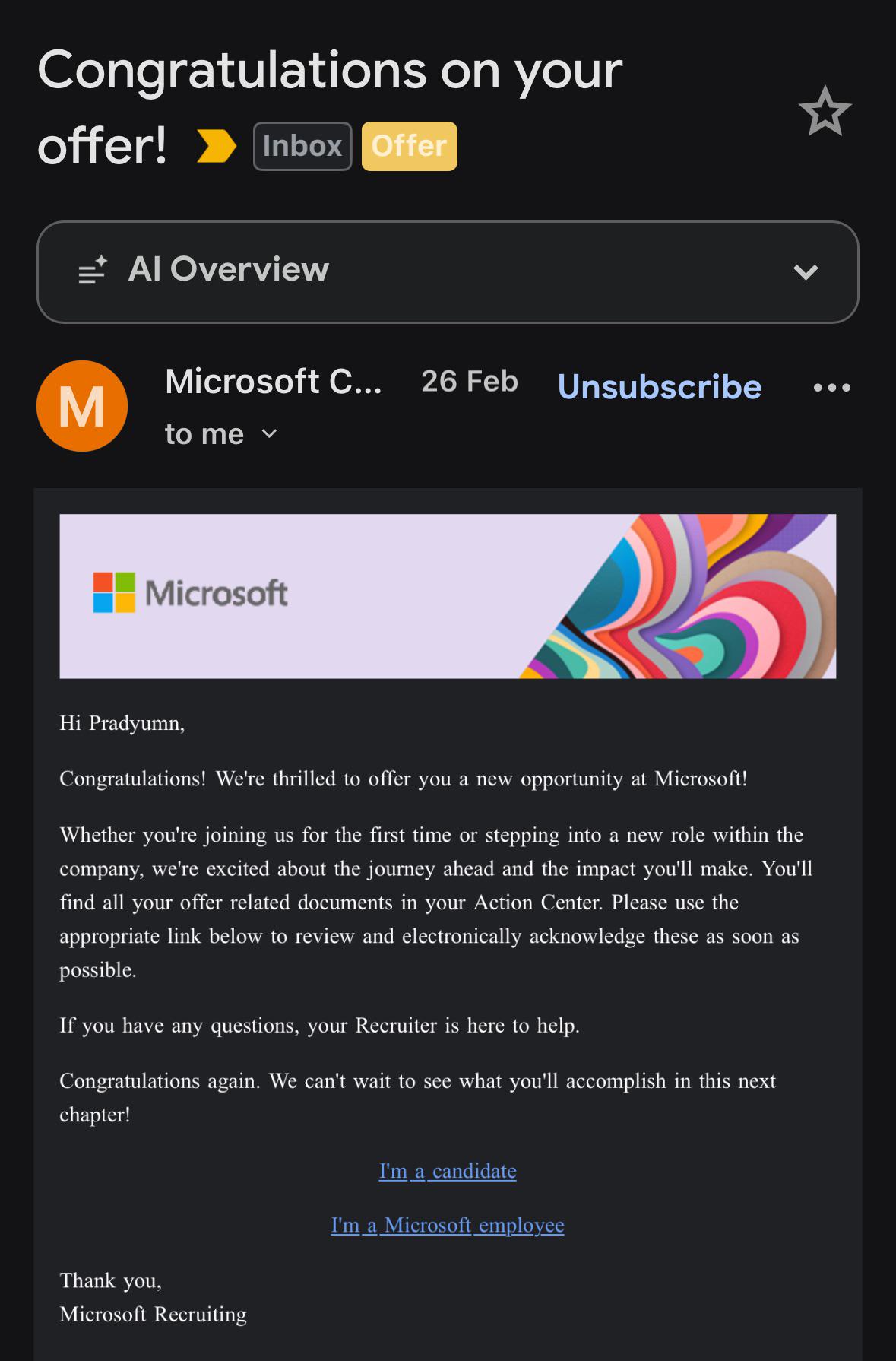
Intervew Prep Just got SWE offer from Microsoft after 1 year of grinding LeetCode — lucky to have guidance from my ex-Amazon sister

Post image
1.9k Upvotes

Hi everyone,

I’m super excited to share my journey after one year of nonstop prep. It’s been exhausting, but finally, it’s over — I got a Software Engineer offer from Microsoft!

I’ll share everything that helped me: my LeetCode prep strategy, how I built my resume, how I reached out for referrals on LinkedIn, how I approached interviews (both technical and behavioral), and what I learned about what interviewers actually expect.

Of course, this is just my experience, so take it as one data point. It might not work exactly the same for everyone — but hopefully, it gives you some insight or motivation.

First, to get interviews, your resume is everything. From my experience, metrics are key.

If your resume doesn’t have any numbers, fix that immediately. Recruiters (who are usually non-technical) care about measurable impact. Add metrics like:

Reduced system latency by 20%

Boosted user engagement by 15%

Improved efficiency / revenue / load time

Anything quantifiable helps because it’s easy to understand. Without metrics, they can't understand what you have done, cuz they are non-tech. Imagine you are a swe and read a resume from a doctor without metrics:D, it's like read alien language.

For referrals, just search something like “software engineer at Google site:linkedin.com” on Google or directly on LinkedIn. Then message people politely.

Keep your message short and highlight 2-3 impressive things about yourself — maybe a project, past experience, or key achievement.

Not everyone will reply, and that’s totally fine. Just keep trying. Some people do it for the referral bonus, but many also genuinely want to help. If you still get no response, apply directly — sometimes companies simply have too many candidates or outdated job posts. Don’t get discouraged; just keep going.

About technical interviews, for me, each technical round was about 1 hour — usually:

~30 mins discussing past experience

~30 mins solving a LeetCode problem

Tip: Be ready to talk deeply about everything on your resume. They will ask. For each role or project, having 4–5 bullet points is enough. I practiced with ChatGPT acting as an interviewer, which helped a lot.

Now, about LeetCode prep — the most exhausting part for most of us 😅

In my experience, interview questions are usually medium-level and clean, not crazy hard. Let me explain:

Online assessments might include hard problems, since you just submit code automatically cuz there's no interviewers here.

But live interviews are different. Interviewers are often senior engineers with 5–6+ years of experience. They need to do their work everyday and can't remember every tricky DSA trick — they just want to see how you communicate, reason, and approach problems.

A friend at FAANG told me a funny story: She was sitting next to a senior engineer who had an interview at 9 a.m., and at 8 a.m. he was just chilling with a cup of coffee, picking a random top LeetCode question to ask. So don't be so stressful:D

So focus on mastering common patterns and top ~150 LeetCode problems, especially the medium ones. Learn to solve them cleanly and explain your thought process clearly.

That’s probably enough for now — this post is already long 😅

If you have any questions, feel free to comment or DM me. I’m happy to help however I can.

(Btw, my sister — who guided me a lot — is an ex-Amazon engineer and even co-authored a blog on AWS. If you ever really need help urgently, we’re both open to doing a quick call to share what we know.)

Good luck to everyone still grinding. Keep going — your time will come!

P/S:

For dsa prep:

At first I picked random problems and solved them without a strategy. When I met a new problem it often took me a long time — or I couldn't solve it at all.
Then I changed my approach: I started solving problems grouped by topic. I followed LeetCode Top 150, began with the topics I knew best, and then dug deeper.
Solving many problems in the same topic helped me recognize patterns and learn techniques — I could see the telltale signs of each problem type.
If I get stuck, I study solutions: find a clear, well-explained solution with readable code, pick the easiest one, and read it line by line. Ask yourself why they wrote each line, what each variable means, which data structure they chose, and how the loops work.
You can practice on any site (NeetCode is fine). The key is the same: learn the common patterns and train yourself to recognize them in new problems.

To connect with people, I suggest building things first — like personal projects, contributing to open source, joining a university lab, or working on non-profit projects. You can also join competitions or hackathons to gain achievements. That way, you’ll have something real to show and talk about.

To prepare for interviews — both technical and behavioral — just drop your CV into ChatGPT and prompt something like:
“Hey ChatGPT, act as an interviewer at a FAANG company. You’re interviewing me for a Software Engineer / AI / [your role] position.”
It’s a great way to practice answering real-style questions and get feedback instantly.

About the timeline: I submitted my CV in June, got the first interview in September, then one round per week — 4 rounds in total. But companies can ghost or stop the process at any time. It depends on many factors we don’t know, so if that happens, just move on and look for other opportunities.
Personally, I’ve interviewed with Microsoft 3 times and ~10 times with other companies, and I’ve been rejected many times for various reasons. The key is to keep practicing and learning, because that’s the only way forward. Otherwise… we’d just have to quit 😄

P/S: Since I’ve been getting a lot of DMs with the same questions — and they keep increasing — please comment your questions below and check my previous replies first. I can’t reply to every DM!


r/leetcode • • Jan 28 '25

Leetcode turned my biggest fear into my biggest strength

1.9k Upvotes

Two years ago, I was a nervous wreck. I’d always been decent at coding but the thought of coding interviews made me freeze. I couldn’t even get past “easy” problems on Leetcode without looking at hints. The fear of failure was so bad that I’d just avoid applying to roles altogether.

Then something shifted. Instead of trying to brute-force my way through endless problems, I started treating every problem like a conversation. I’d walk myself through the problem, explain my thought process, and focus on improving step by step.

I started seeing interviews differently—not as something to “ace” but as a chance to show how I think. The more I practiced this, the more confident I became. It wasn’t overnight (trust me, there were nights of pure frustration), but the improvement was real.

Fast forward to today: I’ve cleared interviews at two companies I’d once thought were out of my league. I also found that tools and platforms designed to simulate real interviews helped a lot, especially ones that let you practice with hints or feedback along the way.

I just wanted to share this because I know a lot of people feel stuck or intimidated by Leetcode and coding interviews in general. If you’re in that place, know that it’s totally normal. Take it slow, practice explaining your ideas, and don’t be afraid to use resources.

If I could go from freezing up at “easy” problems to landing my dream job, so can you! Much love ❤️

EDIT: Many of u dm'ed me with questions what I've used to prepare, here's all:

  • LeetCode: obvious one

  • NeetCode videos: His YouTube channel is amazing for breaking down tricky problems into easy-to-understand steps

  • Interview.Codes: practicing with an ai interviewer/mock interviews, it gives you subtle hints when you’re stuck and generate feedback raport at the end with things to improve etc. Super useful for building confidence without relying on full solutions and being forced to think out loud (that was the hardest part for me as for not native english person).

  • hellointerview: very good free resources on system design. They have also paid resources and real mock interviews however they were too expensive for me

Next month I'll be a Googler (L4) 🎉


r/leetcode • • Jun 15 '25

Intervew Prep One year of leetcode

Post image
1.9k Upvotes

Definitely more than I need for algo sections.


r/leetcode • • Oct 21 '25

Discussion That's why leetcode is so important

1.9k Upvotes

solves outages!


r/leetcode • • Jul 29 '25 Helpful

Discussion [Breaking] Interviews at FAANG will no longer focus on LeetCode, instead they will leverage real world skills using AI.

1.9k Upvotes

Meta has already started the process of phasing out LeetCode, and instead having candidates do real world tasks during the onsite, where AI use is allowed:

https://www.wired.com/story/meta-ai-job-interview-coding/

“AI-Enabled Interviews—Call for Mock Candidates,” a post from earlier this month on an internal Meta message board reads. “Meta is developing a new type of coding interview in which candidates have access to an AI assistant. This is more representative of the developer environment that our future employees will work in, and also makes LLM-based cheating less effective.”

Amazon is another FAANG who has said through internal memos that they will change the interview process away from LeetCode, and focus on AI coding instead, with an emphasis on real-world tasks.

Other FAANGs, and hence other tech companies are likely to follow.

What this means: The focus will shift away from LeetCode and algorithmic type questions. Instead, the candidate will need actual engineering skills that are representative of real world work.


r/leetcode • • Jun 01 '25

Question Why not just Heapsort?

Post image
1.9k Upvotes

Why learn other sorting algorithms while Heapsort seems to be the most efficient?


r/leetcode • • Jul 01 '25 Wholesome Seal

Intervew Prep A Straightforward Guide To Getting Your First FAANG Offer

1.9k Upvotes

Edit:

Thank you all for the overwhelming support and response to this guide. A lot of you have asked me for personal resume reviews, and I did over a 100 by now. I, however will not be doing so going forward. But don't worry, I am not hanging you out to dry. I have finally posted A Straightforward Guide To Building A FAANG Ready Resume which contains all my knowledge and insights about resumes. I will still reply to queries more general in nature in the comments or DMs. All I ask is to ask a question instead of a vague "Please guide me". Thank you guys again for all the support. Cheers!

I have created this guide with a lot of research, feedback, trial and error, and customisation. I have personally used this to secure an offer at a FAANG company.

I'll be using some terms in this guide:

  • This guide will be mainly targeting two candidate groups: L4 and below (<4-5 YOE) and L5 and above (>4-5 YOE).

  • Some section maybe be only applicable to specific candidate groups which I will explicitly call out.

  • I'll also mention cooldowns at every stage in case you get rejected.

How to Apply:

The best way by far is to directly apply on the company job portal. Ex: Amazon Jobs, Google Careers, etc. Make sure your resume is well prepared. Resume prep is out of the scope of this guide, and I might post a guide on that too some time down the line, if there's interest. Be sure to apply ONLY after are confident in your preparation, since rejection will put you on a cooldown. Sometimes, you may get lucky, and a recruiter may contact you themselves. Google and Amazon do this often.

Note about Cooldown:

First let's talk about what a cooldown is. A cooldown is a time period, where you cannot apply to the company. The system will auto-reject your application. Please, don't try to game the system to bypass the cooldown period by changing emails, numbers or other info. The system already accounts for this, and can potentially permanently blacklist you, right from the parent company to all this subsidiary companies.

Note on Paid Resources:

You will see a lot of paid resources around the internet. Please, for the love of god, DO NOT BUY any resource with your money. You can find everything you need for free on Youtube (Neetcode, Striver, CrackingFAANG, etc). The only thing I suggest you to buy, ONLY AND ONLY IF you can afford it is Leetcode Premium.

General Hiring Process:

  • Online Assessment which will include 2 or more coding question, generally of Medium or Hard difficulty, as well as a System Design section (L5+ only) that will be in a multiple choice form, which you will have 60-120 minutes to complete. The evaluation is done by an automated system, and the criteria is different for every company, and even every org within the company. Attempting and getting rejected at this stage will put you on a 6 month cooldown.

  • Phone Screening Virtual Interview which will be completely technical in nature. Do note that Amazon focuses on Behavioural questions as well (50%). L4- candidates may expect one or two DSA questions, and L5+ candidates can expect both DSA and System Design questions. Getting rejected at this stage will put you on a 12 month cooldown.

  • 3-4 Virtual or Onsite Interviews, likely on the same day, back to back. L4- candidates may expect all the rounds to be based on Behavioural questions, DSA questions and LLD questions (Amazon Only). L5+ candidates may expect all rounds of L4- candidates, and an additional round based on HLD (System Design). All rounds are usually non-elimination in nature, but your recruiter may cancel upcoming rounds if you bomb a round really badly. Getting rejected at this stage will put you on a 12 month cooldown.

Evaluation Criteria:

The evaluation was very relaxed up until last year. But, I'm seeing that they have really tightened their process, and expect nothing but perfection in every round, especially for L5+ roles.

Now, let's move to the actual prep.

Your preparation will be split up into potentially 4 spaces:

  • Data Structures and Algorithms (DSA)

  • Low Level Design (LLD)

  • Async Programming and Grasp of Language

  • High Level Design (HLD)

Timeline for Preparation:

This is very difficult to say, since every person is different. There are a lot of variables such as Natural Skill, Dedication, Current Responsibilities, Available Time, etc. Some successfully prepare in 4 months. Others take a year or more. But do note that this is a very tedious and time consuming process. So you'll have to work very hard and stay dedicated.

AI Usage in Preparation:

I highly recommend using ChatGPT or any other LLM in your preparation. Use it as a teacher and mentor. For example, you could use it to explain complex parts of an algorithm, or to evaluate your code, or to explain why some cases fail for your code. I personally used ChatGPT very very heavily in my preparation, and my guide heavily encourages the use of it.

Data Structures and Algorithms (DSA):

This is required for all candidates.

Firstly, you'll have to choose a language. Choose a language that you are most comfortable with. If you're already working, just choose whatever you use everyday at work. If you have no experience or have no inclination to a specific language, choose a language that is easy to understand and easy to write such as Python or Javascript, or a language you use in your studies. Remember, during DSA, you should not be fighting the language syntax or the compiler, and should focus only on your logic.

Next, create a Leetcode account, if you haven't already.

Now comes the part where a lot of you get overwhelmed. Where and how should I start?
My advice would be to start with a Roadmap that is freely available. Ex: Neetcode 150, Striver's A2Z Sheet, etc. Start solving questions from the roadmap. Use Youtube, as well as the Leetcode Solutions Section for help.

Once you're confident with the Roadmap questions, buy Leetcode Premium if you can afford it, and solve Company Tagged Questions, sorted on Frequency. Try solving at least 50 Top Questions of the Company, which will have an intersection with your roadmap questions too. If you're feeling like you're a bit bored of the Roadmap Questions, you can do this step in parallel the roadmap. I did this too. I recommend this only after you get a good grasp on the algorithms.

Use ChatGPT heavily when you don't understand from the resources available.

Here's a bonus and important tip. Use Spaced Repetition. You can search for this on r/leetcode for more info. In simple terms, it's just resolving problems every couple of days, especially the long and tricky ones. This will make it easier to recognise patterns, make you faster while solving problems, and help you remember patterns. Personally, this helped a lot during my preparation.

This whole process will crush your confidence, humiliate you, and question your existence. But if you stick with it, by the end, you'll feel pretty good about yourself, and be able to solve most Medium questions and some Hard questions too.

Low Level Design (LLD):

This is required for all candidates. Google does not ask this for L4- though.

There aren't any Leetcode style platforms to practice LLD on. So we're gonna improvise.

Now there's gonna be a little bit of work for you. Gather as many LLD questions as you can based on company from Leetcode Discuss Section, r/leetcode, ChatGPT, and the internet is general, sorted from latest. This way, you'll be preparing for questions that are recently asked.

Brush up on your Object Oriented Programming fundamental from any free resources, if you haven't already.

Now, you're all set to start practicing. Pick a question and feed it to ChatGPT and analyse the answer. Study it. Understand it. Then try doing it yourself. Ask questions back to ChatGPT for why specific design decisions were made. This way, you'll implicitly learn a couple of Design Patterns. Then solve another question and feed your solution to ChatGPT and ask it to evaluate. Learn from it. Eventually, you'll get good at it.

Don't overthink this stage. Solve maybe 5-10 questions and move on. You should be good.

Async Programming and Grasp of Language:

This is required for all candidates.

Now, on to the interesting part of your prep.

Ask ChatGPT for questions on Async Programming in your language and try to implement it. If you're not able to, ask ChatGPT to answer it, and learn from it.

Here's a sample question you can solve. Write a class that has an addItem method, which adds an item with an expiry. You class should automatically delete the item once it expires. Can you do it without creating multiple threads or processes or timers? How do you make it as real time as possible?

Again, don't spend too much time on this. A week or two should be more than enough.

High Level Design (HLD):

This is required only for L5+ candidates.

This will be a whole new game for beginners. So let's get started.

Do not attempt to solve previous question found. Questions are usually org specific, so it's difficult to predict what may be asked in your interview.

The only resource you'll need is HelloInterview. They have written content from fundamentals to problems. Don't try to memorise solutions. All the solutions are written in an incremental manner. So understand each design decision. Reread solutions as much as possible.

Spend a lot of time in this stage, since System Design is very strongly judged at L5+ levels.

Finally, we reach the end of this guide. I'd like to point out that this is NOT a universal one size fits all guide for everyone that guarantees a FAANG offer. Some strategies of mine would work for you, in which case double down on it, and some won't.

A Final Note:

I will not now and not ever start a course, free or paid, or teach any of the things mentioned. I will, however, answer to any queries or doubts that are general in nature, in the comments or in DMs. So feel free. Also, I am NOT promoting any of the resources that I have mentioned.

Good Luck and All The Best !


r/leetcode • • Aug 24 '25 Mindblown

Discussion What DATA STRUCTURE is "Solution by IITian" ?

Post image
1.8k Upvotes

Problem is from today's weekly contest, Jump Game IX.


r/leetcode • • Nov 16 '24

Discussion Dude wrote BFS algo in SQL

Post image
1.8k Upvotes

Source: LinkedIn The most bizarre coding interview I've ever done was at Facebook when as usual I asked a candidate to write in any language of their choice..

And they nonchalantly said "I'll write it in SQL", to which I almost let loose a chuckle until...


r/leetcode • • Dec 01 '25

Tech Industry the grass really is greener - grateful @ Google

1.8k Upvotes

hey all, long time lurker in this sub, using a throwaway account. i started at Google as an L3 SWE about 6 months ago, and just wanted to share some positive things i’ve noticed, both to give some hope and to practice a bit of gratitude after a long grind to get here. this is a long post and a humblebrag so feel free to not read any of this.

background: 28yo asian male. worked as an aerospace eng for a few years, pivoted using a CS masters, then worked at a smaller tech company before G. currently in a chill org with moderate impact. not cloud, ads, or AI. i've grinded leetcode for about 2 years, 700+ problems solved, 1750 contest rating.

disclaimer: these observations and opinions are purely my own. i'm aware that Google is a massive company, and experiences between engineers can be vastly different depending on team.

after 6 months at Google, i’ve noticed several ways that working here has improved my life. i think i’m lucky to have seen/worked at both an entirely different industry and a smaller tech company first. it has provided me a good baseline of how the other side lives, which a lot of people who joined big tech right out of school might not have. there is a lot of talk on reddit/blind about how big tech can be a nightmare, but honestly, my experience has been the opposite.

—

1. financial worries have ceased to exist

i made a decent living in aero (130k) and at the smaller tech company (110k). this year at G, i am on track to make over 250k. the important thing is that although my TC doubled, the amount i save each month is closer to 7-8x what i saved before. i went from saving about 1k per month to closer to 8k. it is a huge shift. i went from feeling guilty about nights out with friends, expensive dates, small nice-to-have purchases to not really thinking twice about it. that alone was a huge weight off my shoulders.

2. people treat me differently

I never really flexed where I worked / went to school, and never appreciated those who showboated things like this. i don't tell people where I work unless explicitly asked. However, it's hard to ignore the difference in the way people treat you once they know you work as a SWE at Google. even though there are companies that pay more and/or are more prestigious, the average non-tech person seems to view Google above places like databricks/snowflake/roblox.

•male peers

among male peers (especially indian/asian), i notice an immediate increase in respect (lol). suddenly my opinion seems to carry more weight.

•women and dating

in your later 20s, when dating becomes more purposeful, women tend to treat you better once they find out you work at G. it's almost amusing how when women you date introduce you to their friends, 'he works at Google' is one of the first things i hear, preceding other superficial things like height/wealth/looks.

•family

i come from a traditional asian household, and my parents have always linked prestige with how well they were doing as parents. now that i work for Google, they treat me more like an adult and brag to their peers whenever they get the chance. not saying i agree with that mindset.

3. my quality of life has significantly improved

my day-to-day life looks completely different now. i take the Google shuttle to and from work, get free breakfast and lunch (not gourmet, but definitely better than my own cooking), and get to work in a Google office. it is understated how nice the office is. the downtown views are insane (i am on the 25th floor), the decor is beautiful, and there are couches and chairs everywhere. some people rarely work at their desks. a lot of people on reddit value remote work over any office time, but sitting by a window with a penthouse style view and free snacks makes the day go by faster.

4. coworkers/tools are generally higher quality

companies like Google that focus on cheesy traits like 'googlyness' actually seem to end up with healthier teams and more balanced engineers. from what i have seen in my org and nearby orgs, people are friendly, humble, and not blatantly competing for impact. at my previous companies, i commonly ran into super introverted engineers who were hard to work with, unmotivated/incompetent engineers, or worse, know-it-alls who tried to flex their CS knowledge any chance they got. i haven't found many people like that here.

in terms of tooling at Google, there is a tool for just about everything (almost a bad thing since you become a bit spoiled). AI tools here are top notch and in general can help you 'eat the frog' pretty easily for tasks like boring refactors/writing design docs as well as spotting errors or teaching you things.

5. my mental health has improved

i struggle with comparing myself to others. it used to bother me a lot that people who started as SWEs in big tech right out of college are now one or two levels above me and make two to three times what i make. but the gap has closed enough that it feels easier to manage.

at previous companies, i always thought about exit opps and looked at coworkers who left for better places with a pang of jealousy. i was always leetcoding / upskilling on the side just in case a better company would reach out. after six months here, the question has shifted from 'what exit opportunities does this give me' to 'how can i keep my boss happy / stay here as long as possible'. now that i am not constantly looking at the next thing, i feel a lot happier and can focus on other areas of my life.

—

this is not a complete list, and i am not saying working at Google has no drawbacks. it is still just a job at the end of the day, and work pressure is greater and expectations are higher here. but compared to my past roles, it is far better in almost every way. best of luck to those still grinding LC for an opportunity like this - it's worth it.


r/leetcode • • Sep 02 '25

Discussion I absolutely despise cheaters -_-

Post image
1.8k Upvotes

All those people who take pride in cheating their way through interviews, I hate you all! You are the one who rips genuine people off, of what they deserve. I hope someone punches some sense into your thick brains -_-

Rant + Meme over :(


r/leetcode • • Nov 27 '25 Wholesome Seal Bravo

Intervew Prep I failed Google interviews twice before succeeding. Then I interviewed dozens of candidates. Here is why people fail.

1.8k Upvotes

Before getting accepted to Google I actually failed the interviews twice.

I have a background in applied mathematics, and I did a lot of competitive programming. But I always had one interview with a basic concept one should know (like unit tests), that I didn't at the time. I actually decided to go on and start a degree in computer science to learn more, and finally I passed the interviews.

After I joined Google, I used GDPR to request the interview feedback logs from my previous failed attempts (this works in the EU). Reading the interviewers' raw notes was interesting for sure. It confirmed exactly where I had been going wrong, I got insights I wish I had known years earlier. Insights that most people don't really focus on.

When I started working at Google I quickly wanted to start interviewing people. After 6 months working there one can start interviewing. I interviewed people for L3 and L4 level positions. Based on my dozens interviews, here are the reasons why most people fail:

1. Not clarifying requirements. This is in my experience the number one thing leading to rejections, especially in the later rounds. A lot of candidates assume things about the problem and start implementing a solution to the wrong problem.

  • The reality: You are intentionally not given all the information. They try to find out if you can spot ambiguity. This is an essential skill for an engineer, the importance of this cannot be stressed enough.

  • The fix: Don’t rush to write code. Make sure you understand the problem first. Ask if you need to check against edge cases (empty input etc), don’t just assume.

2. Not being quick enough. The Google interview problems are not the most difficult, but they require fluency. The issue for candidates is usually not to come up with the idea, it’s to implement it.

I had numerous candidates who stumbled when implementing a breadth-first search algorithm. If you interview with Google you should be able to comfortably implement these more basic algorithms.

3. Lack of communication. Many candidates fail to communicate how they think. As an interviewer I cannot easily assess a candidate who doesn’t communicate well. Communication is an important skill, which is valued at Google. Make sure that you share how you are thinking, interviewers know that we can have bad ideas when brainstorming so don’t feel the pressure to only share brilliant ideas. Communicating more openly also helps the interviewer guide you in case you need hints.

4. Bad quality code. Although a less common reason for rejection, it’s important to know the programming language you choose and be able to write good code. Make sure to have good variable and function names, create helper functions, and if you can, use language-specific features.

  • If you are using Python, use list comprehension instead of a for-loop to transform a list.

  • Don’t use “a” as a variable name for a list of nodes, be descriptive, use “nodes”.

It is hard to practice communication, clarify requirements and code clarity on LeetCode. LeetCode only checks if your code runs, not if you explained your thought process or asked the right questions. Most people I interviewed actually knew the algorithms quite well, or at least well enough to get hired.

So I think some people need to focus a bit more on other things that just leetcode.

I'm happy to discuss and answer any questions you might have


r/leetcode • • Mar 01 '26

Discussion Finally got it after a lot of struggle! (not an SDE)

Post image
1.8k Upvotes

This was 4 month long wait, in the meanwhile i joined a startup as well, left it in two weeks and was anxious if i was gonna get it or not but HERE WE GO🥳🥳


r/leetcode • • Mar 13 '25

Cleared Google and Meta after 5 months of grind [L5 Offer]

1.8k Upvotes

I've been meaning to write this for quite some time and finally got to it today. This is me giving back to this community which has helped me a lot throughout my interview process.

I started applying in April 2024 and had my last interview towards the end of September 2024. I got offers from both Meta and Google in the first week of October 2024. In total I interviewed with 9 companies and got 3 offers. It was a long and stressful process but worth every drop of sweat once I got the offers.

Here's all the things I did

  1. Started Leetcode in April end and continued till August, targeting 2-3 questions every day. Did roughly 200 questions in total, started with easy and then mostly medium, only a handful of hard ones at times. Also did a lot of tagged questions for Meta and Google. (Invest in Leetcode premium for a few months, it's worth it)

  2. Redoing questions after few weeks is a must. Especially the ones you didn't crack in your first attempt.

  3. For System Design - I followed Hellointerview and Jordan has no life[YT]. Hellointerview is best to start with and gives you a structured approach for design interviews. Having a structure is extremely useful in actual interviews. Jordan gives you more depth of concepts, so do this as you get closer to your interviews.

  4. I brushed through Grokking as well for design but it didn't add much to my overall prep after the above two.

  5. For Behavioral - I prepare 15-20 answer keys for common behavioral questions using the STAR framework. I did it once and it worked for all behavioral interviews. I used Hellointerview's StoryBuilder tool to prepare answers among other things.

  6. Mock interviews - Definitely do free mocks(Exponent, Discord communities), and if possible a few paid ones. It will get the jitters out before the actual interview.

  7. I did a lot of reading on design principles and Java concepts(I use Java primarily) which came in handy in a lot of non FAANG interviews.

  8. Document your progress. It's the only way to know you're getting closer to your goal.

One last but very important thing is to take care of your own mental health. The prep and interview process can get tiring and stressful, especially in the face of rejections. Hence it's very important to keep yourself calm and composed throughout the process.

Thank you to everyone in this community for your help throughout the process. And all the best to everyone grinding and waiting for your dream offer. Keep calm and trust the process. Cheers!

Few useful links


r/leetcode • • Oct 28 '25

Discussion That’s unbelievable!

Post image
1.7k Upvotes

I don’t even know what to say…

All those people who give their everything their time, their peace, their joy just to make it into these so-called big organizations… the ones who stay up late, sacrifice moments of happiness, and push themselves beyond limits, believing it will all be worth it someday.

And then, in the end, it’s over before you even realize it like it all passed in the blink of an eye.


r/leetcode • • Oct 25 '25

Intervew Prep I hope the job market is not so bad.

Post image
1.7k Upvotes

Saw this quote the other day. Made me tensed.

Edit: Some are asking for my prep material as I am on my last month or else I will do a service job:

  • Not doing LC any more after 3 years. Explained before why.

  • Reading 2 books:

    • DSA Takeover Cheatsheet: Nice list of coding patterns with code snippets and sample problems

    • Beyond Cracking the coding interview

    • Got 2 more books based on suggestions but not reading them now as it looks out of scope. Read one other book before. It was nice.

  • For AI, I got a mentor from Meta (hired for a month; daily meeting for an hour) and on his suggestion, reading the book "AI Engineer's Silicon Cheatsheet"

Have 2 interviews lined up in November.


r/leetcode • • May 02 '25

Discussion Is this a joke?

Post image
1.7k Upvotes

As I was preparing for interview, so I got some sources, where I can have questions important for FAANG interviews and found this question. Firstly, I thought it might be a trick question, but later I thought wtf? Was it really asked in one of the FAANG interviews?


r/leetcode • • Nov 04 '24

Tech Industry Bye Bye Leetcode (For Now!)

Post image
1.7k Upvotes

r/leetcode • • Aug 28 '25

Discussion Fuck this. I’m switching to DevOps

1.7k Upvotes

I’m so fucking sick of these mind games you have to play with these interviewers. I had an interview the other day:

Write a function for a 4 way stop. The goal is to move traffic through the most efficient way possible. Timing of the lights doesn’t matter. Assumed traffic’s only goes straight, no left or right turns to worry about. Assume all of the cars traveling either north/south or east/west are able to clear the intersection on their turn.

I did a great job gathering these requirements, and communicating my thoughts, but doing so took so much time and was like pulling teeth to get anything out of the interviewer. Now if you read the problem, then you’d realize that because timing isn’t a requirement, there’s no need for a queue. I clarified that with the interviewer and then wrote a basic solution with a class, tuple for directions etc. Rejected.

What was the fucking point of this question? Sure, I could add in timing next, but I just wasted half the time trying to pull these basic fucking requirements out of the interviewer’s head.

I had a devops interview today and it was soooo refreshing. It was a chill conversation about K8s, observability tooling, and what types of SRE challenges my team faced. But the weird thing is, if don’t move forward to the next round, I wouldn’t even be upset because at least I was treated like an actual professional instead of like an 8th grader talking to their algebra teacher.