r/computervision • • Dec 11 '25

Showcase Road Damage Detection from GoPro footage with progressive histogram visualization (4 defect classes)

640 Upvotes

Finetuning a computer vision system for automated road damage detection from GoPro footage. What you're seeing:

  • Detection of 4 asphalt defect types (cracks, patches, alligator cracking, potholes)

  • Progressive histogram overlay showing cumulative detections over time

  • 199 frames @ 10 fps from vehicle-mounted GoPro survey

  • 1,672 total detections with 80.7% being alligator cracking (severe deterioration)Technical details:

  • Detection: Custom-trained model on road damage dataset

  • Classes: Crack (red), Patch (purple), Alligator Crack (orange), Pothole (yellow)

  • Visualization: Per-frame histogram updates with transparent overlay blending

  • Output: Automated detection + visualization pipeline for infrastructure assessment

The pipeline uses:

  • Region-based CNN with FPN for defect detection

  • Multi-scale feature extraction (ResNet backbone)

  • Semantic segmentation for road/non-road separation

  • Test-Time Augmentation

The dominant alligator cracking (80.7%) indicates this road segment needs serious maintenance. This type of automated analysis could help municipalities prioritize road repairs using simple GoPro/Dashcam cameras.


r/computervision • • Jun 05 '26

Showcase SLAM Camera Board

631 Upvotes

Posting an update here with simplified PCB and robustness. Mighty Camera runs VIO on-device in a tiny package. But for it to be useful, you need things like mapping (and later occupancy, loop closure etc).

Here is a demo of lightweight mapping which uses VIO pose from Mighty and generates a semi-dense map on host-side in realtime.

It’s early but this will be part of the SDK along with other goodies.


r/computervision • • Aug 27 '25

Showcase I built a program that counts football ("soccer") juggle attempts in real time.

622 Upvotes

What it does: Detects the football in video or live webcam feed Tracks body landmarks Detects contact between the foot and ball using distance-based logic Counts successful kick-ups and overlays results on the video The challenge The hardest part was reliable contact detection. I had to figure out how to: Minimize false positives (ball close but not touching) Handle rapid successive contacts Balance real time performance with detection accuracy The solution I ended up with was distance based contact detection + thresholding + a short cooldown between frames to avoid double counting. Github repo: https://github.com/donsolo-khalifa/Kickups


r/computervision • • Feb 20 '26

Showcase Tracking ice skater jumps with 3D pose ⛸️

582 Upvotes

Winter Olympics hype got me tracking ice skater rotations during jumps (axels) using CV ⛸️ Still WIP (preliminary results, zero filtering), but I evaluated 4 different 3D pose setups:

  • D3DP + YOLO26-pose

  • DiffuPose + YOLO26-pose

  • PoseFormer + YOLO26-pose

  • PoseFormer + (YOLOv3 det + HRnet pose)

Tech stack: inference for running the object det, opencv for 2D pose annotation, and matplotlib to visualize the 3D poses.

Not great, not terrible - the raw 3D landmarks can get pretty jittery during the fast spins. Any suggestions for filtering noisy 3D pose points??


r/computervision • • Oct 22 '26

Showcase Artistic application of monocular depth estimation – Vathography

Thumbnail
gallery
581 Upvotes

Hello everyone,

Happy to introduce Vathography, an art practice that turns depth maps estimated from a single photograph into artworks, as part of a photographic creative process.

The monocular depth estimation model:

Marigold V2 (Apache-2.0): https://huggingface.co/spaces/huawei-bayerlab/marigold-v2-web

Paper: https://arxiv.org/abs/2609.08084

To estimate depth maps from high-resolution photographs, I have developed a tiled ComfyUI node you can try here:

https://github.com/vathography/ComfyUI-Marigold-V2-Tiled-Depth-Vathography

Open source (AGPL-3.0); the depth maps it produces are free to use, including for commercial work. 

The approach used to make high resolution work: one global pass (up to 2048 px) for the overall shape, 1536-px tiles for the detail, each tile aligned to the global estimate, then merged with a Laplacian pyramid.

Would you recommend a different approach?

Feedback and suggestions on how to improve it are welcome.

Vathography explained 9min: https://youtu.be/DVYgwRaTKkA

The practice uses free tools and is open to everyone. If you try it, I'm curious to see what you create


r/computervision • • Jul 28 '26

Help: Project Beginner here: My pothole detection model mistakes the roadside for potholes.

579 Upvotes

Hello!

I am a beginner at this and am trying to make a project.

The first four seconds are the portion where the model confuses the roadside with a pothole. The latter half is kind of working okayish!

But, It is confusing the roadside for a pothole. What is the best way to make my model learn this?

Should I add classes of what is not a pothole to the training dataset?

I used a dataset of about 4,100 images. What is the ideal number of non-pothole images I should add?

Or should I somehow teach the model to detect the edge of the road so that it avoids classifying the roadside as a pothole?

Also, I am planning to use a drone. Since the ideal flying height would make the potholes appear much smaller, should I apply transfer learning, or should I train the model from scratch to make it work on drone footage captured from that height?

And is segmentation practical for this dataset? Like finding area of the pothole from the pixels or should i focus on detection only.


r/computervision • • Sep 08 '26

Showcase I made a computer vision tool for comparing dancers’ sync!

575 Upvotes

As a dancer who's been learning a lot of choreography recently, I’m always looking to improve my sync with others. A quantitative tool like this can offer frame-by-frame analysis, which can help dancers as they practice.

I used ViTPose+ Large through the VLM Run Gateway for pose estimation, and compared poses between the dancers. The pose similarity metric could be workshopped more, but it's interesting that it still highlights key moments pretty well.

Yes, this is me dancing with my friends Mico and Sydney!

The code is open-source on GitHub! I just created this vision-demos repo so that I can share these projects. Feel free to try it out and let me know what you think! Link in the comments.

🎵: I Want You Back - *NSYNC

Choreography: Scott Forsyth


r/computervision • • Sep 14 '26

Showcase Trained a multi-spot parking occupancy detector using a DINO backbone + procedural Blender synthetic data

572 Upvotes

I built this parking lot occupancy detector to work on real-world security cameras which tend to have lower angles and lots of obstructions from other cars.

I have seen other parking lot detection CV demos that use off-the-shelf object detectors (like standard YOLO bounding boxes). They would generally only work on impractical camera setups (e.g., drone shots or 200+ foot high cameras).

A couple of technical takeaways from training this that might be interesting:

  1. DINO Backbone vs. Standard CNNs: I tested several backbones, but the DINO Vision Transformer performed the best by a good margin. Because DINO learns patch-level representations without supervised class labels, it captures semantic surface texture (the difference between empty asphalt, tree shadows, and car undercarriages) and proved far more invariant to direct sun glare and rain washout than supervised backbones.

  2. Synthetic Data via Blender (The Biggest Upgrade): Public parking datasets are fairly limited and rarely capture extreme conditions. I built a parametric Blender pipeline to procedurally reconstruct parking lots and vehicles—randomizing asphalt PBR textures, camera angles/heights, sun positions, and vehicle placements. Mixing synthetic data with real sequences was surprisingly effective and gave the single biggest jump in zero-shot generalization to unseen cameras. One huge advantage of the synthetic data is that the labeling was always right (human annotation for far-off, angled parking spots is suprisingly error prone)

  3. The parking spots are drawn on the ground plane, and the vehicles are fairly disconnected from that visually. The large receptive field allows the model to learn interesting "cheats" that a human might also use to infer that a car is there even when it can't really be seen. For example, it may use a shadow on the pavement to identify that the space is occupied even if the body is blocked by another car.

Code:

The web app is open source on GitHub: https://github.com/lotvulture/lotvulture

The repo includes a community model and a higher-accuracy engine as a commercial feature: https://www.lotvulture.com/

Happy to answer questions about the synthetic data pipeline or edge inference trade-offs!


r/computervision • • Mar 31 '26

Showcase Tracking a dancing plastic bag with object detection - the American Beauty stress test

569 Upvotes

To stress-test our model we pointed it at this classic scene. The "American Beauty" bbox style was just for fun. Had to match the vibe.


r/computervision • • Jul 22 '25

Discussion It finally happened. I got rejected for not being AI-first.

549 Upvotes

I just got rejected from a software dev job, and the email was... a bit strange.

Yesterday, I had an interview with the CEO of a startup that seemed cool. Their tech stack was mostly Ruby and they were transitioning to Elixir, and I did three interviews: one with HR, a second was a CoderByte test, and then a technical discussion with the team. The last round was with the CEO, and he asked me about my coding style and how I incorporate AI into my development process. I told him something like, "You can't vibe your way to production. LLMs are too verbose, and their code is either insecure or tries to write simple functions from scratch instead of using built-in tools. Even when I tried using Agentic AI in a small hobby project of mine, it struggled to add a simple feature. I use AI as a smarter autocomplete, not as a crutch."

Exactly five minutes after the interview, I got an email with this line:

"We thank you for your time. We have decided to move forward with someone who prioritizes AI-first workflows to maximize productivity and help shape the future of technology."

The whole thing is, I respect innovation, and I'm not saying LLMs are completely useless. But I would never let an AI write the code for a full feature on its own. It's excellent for brainstorming or breaking down tasks, but when you let it handle the logic, things go completely wrong. And yes, its code is often ridiculously overengineered and insecure.

Honestly, I'm pissed. I was laid off a few months ago, and this was the first company to even reply to my application, and I made it to the final round and was optimistic. I keep replaying the meeting in my head, what did I screw up? Did I come off as an elitist and an asshole? But I didn't make fun of vibe coders and I also didn't talk about LLMs as if they're completely useless.

Anyway, I just wanted to vent here.

I use AI to help me be more productive, but it doesn’t do my job for me. I believe AI is a big part of today’s world, and I can’t ignore it. But for me, it’s just a tool that saves time and effort, so I can focus on what really matters and needs real thinking.

Of course, AI has many pros and cons. But I try to use it in a smart and responsible way.

To give an example, some junior people use tools like r/interviewhammer or r/InterviewCoderPro during interviews to look like they know everything. But when they get the job, it becomes clear they can’t actually do the work. It’s better to use these tools to practice and learn, not to fake it.

Now it’s so easy, you just take a screenshot with your phone, and the AI gives you the answer or code while you are doing the interview from your laptop. This is not learning, it’s cheating.

AI is amazing, but we should not let it make us lazy or depend on it too much.


r/computervision • • Oct 01 '25

Showcase basketball players recognition with RF-DETR, SAM2, SigLIP and ResNet

545 Upvotes

Models I used:

- RF-DETR – a DETR-style real-time object detector. We fine-tuned it to detect players, jersey numbers, referees, the ball, and even shot types.

- SAM2 – a segmentation and tracking. It re-identifies players after occlusions and keeps IDs stable through contact plays.

- SigLIP + UMAP + K-means – vision-language embeddings plus unsupervised clustering. This separates players into teams using uniform colors and textures, without manual labels.

- SmolVLM2 – a compact vision-language model originally trained on OCR. After fine-tuning on NBA jersey crops, it jumped from 56% to 86% accuracy.

- ResNet-32 – a classic CNN fine-tuned for jersey number classification. It reached 93% test accuracy, outperforming the fine-tuned SmolVLM2.

Links:

- code: https://colab.research.google.com/github/roboflow-ai/notebooks/blob/main/notebooks/basketball-ai-how-to-detect-track-and-identify-basketball-players.ipynb

- blogpost: https://blog.roboflow.com/identify-basketball-players

- detection dataset: https://universe.roboflow.com/roboflow-jvuqo/basketball-player-detection-3-ycjdo/dataset/6

- numbers OCR dataset: https://universe.roboflow.com/roboflow-jvuqo/basketball-jersey-numbers-ocr/dataset/3


r/computervision • • Oct 25 '25

Showcase Pothole Detection(1st Computer Vision project)

541 Upvotes

Recently created a pothole detection as my 1st computer vision project(object detection).

For your information:

I trained the pre-trained YOLOv8m on a custom pothole dataset and ran on 100 epochs with image size of 640 and batch = 16.

Here is the performance summary:

Parameters : 25.8M

Precision: 0.759

Recall: 0.667

mAP50: 0.695

mAP50-95: 0.418

Feel free to give your thoughts on this. Also, provide suggestions on how to improve this.


r/computervision • • Aug 23 '26

Showcase I honestly did not think I will be able with on-device models

531 Upvotes

Hi all, I follow this sub for a few months but never actually post anything.

I just wanted to show you my latest achievement in card recognition. I am really proud of it

I spent weeks finetuning a model so everything you can see here runs one-device. No backend.
Inference speed is about 10ms by card on my iphone 16e.

I dont know if I can promote the app name here so I wont.

I hope you found this interesting :)

EDIT :
I feel it's OK to share the project name since I earn nothing from it : here it is : skanit.ai

EDIT2: this model is not yet deployed in the app, it should be available next week


r/computervision • • Oct 13 '25

Showcase SLAM Camera Board

530 Upvotes

Hello, I have been building a compact VIO/SLAM camera module over past year.

Currently, this uses camera + IMU and outputs estimated 3d position in real-time ON-DEVICE. I am now working on adding lightweight voxel mapping all in one module.

I will try to post updates here if folks are interested. Otherwise on X too: https://x.com/_asadmemon/status/1977737626951041225


r/computervision • • Sep 29 '26

Discussion LibreYOLO, the MIT computer vision library with +100 model families

527 Upvotes

Hello! This is the fourth post about LibreYOLO in the computervision subreddit. Every time I posted here you gave overwhelming support to the project, and for that I'm very grateful. A lot has shipped since the last post!

For those who are new to LibreYOLO: it's a computer vision "meta library" with 100+ models under a familiar, easy-to-use API. I created it because there was no generalist computer vision library covering most use cases under a permissive license, and the most popular YOLO library requires a paid license for closed-source commercial use or research.

It's now starting to be adopted by many companies and individuals, but I still think that there is a very big potential to grow. I don't want to bore you with a list of capabilities that the library has, but it has everything that you would expect from a serious, production ready library.

I want to thank the 20+ contributors for their work, and every company and individual who has supported the project. I also want to thank the reddit computer vision community since 99% of the initial traction has come from here.

Let me know what you think about this library and ideas to improve it. We really listen to the feedback.

How can you support the project? The best way is to upvote this post and star the repo: https://github.com/LibreYOLO/libreyoloFor companies and philanthropists, there is now an Open Collective (https://opencollective.com/libreyolo). Over the next months, donations will fund GPU hours to develop and train the LibreYOLO26 and LibreYOLO27 MIT models, and to retrain from scratch the models whose weights have a restrictive license, such as YOLO-NAS.

Library: https://github.com/LibreYOLO/libreyoloWebsite: https://libreyolo.comBenchmarks are on: https://www.visionanalysis.org


r/computervision • • Sep 01 '26

Discussion World Labs' new Atlas model: Space-time simulation, "bullet time" from 3 cell phones, and scalable Real-to-Sim

519 Upvotes

World Labs just revealed their new omni world model, Atlas, and the space-time simulation features look like a massive leap for novel view synthesis and robotics training.

A few standout technical claims from their space-time simulation drop:

  • Sparse-View "Bullet Time": They are generating frozen-time, free-camera multiview fly-throughs using footage from as few as three to five ordinary cell phones. No calibrated camera arrays, green screens, or professional capture studios are required to reframe the shots.

  • Generative Real-to-Sim: For robotics, it doesn't just reconstruct a static 3D environment. As a simulated robot moves through the space, Atlas actively generates the RGB and depth data the robot's body-mounted cameras would observe along that specific trajectory.

  • Physical Interactions: From casual real-world recordings, the model aids in building simulations that capture how objects move and interact. It supports rigid, articulated, and deformable objects, allowing users to dynamically alter lighting, backgrounds, and object positions to generate diverse robotic training data.

  • Under the Hood: It’s built as a multimodal autoregressive diffusion transformer. Unlike models that rely on coarse text prompting for camera movement, Atlas uses precise camera geometry as a native input to ground everything in a shared "spatial context."


r/computervision • • 29d ago

Showcase [Anomaly Detection] PatchCore on Orange line 🍊

509 Upvotes

PatchCore running on orange line, trained on good oranges only 🍊

  • RF-DETR (instance seg) detects every orange, ByteTrack tracks them

  • Cropped orange imgs are sent to PatchCore, which compares each patch to a memory bank of normal patches → heatmap

  • Each orange is inspected multiple times while it rolls around on rolling conveyor, as anomaly could be present only on one side and not the other

This is super useful in cases where anomalous data is hard to come by, and anomaly detection training requires zero defect/anomalous labels. PatchCore runs at ~100ms on Jetson Orin AGX (at ~200 images, compute time scales with training data).


r/computervision • • Nov 17 '23 Take My Silver

Showcase I built an open source motion capture system that costs $20 and runs at 150fps! Details in comments

508 Upvotes

r/computervision • • Aug 14 '24

Showcase I made piano on paper using Python, OpenCV and MediaPipe

505 Upvotes

r/computervision • • 16d ago

Commercial I used webcam head tracking to turn my Windows desktop into a 3D window

501 Upvotes

I’m developing Holoscape, a Windows wallpaper app that uses webcam head tracking to update the viewpoint in a 3D scene.

Moving sideways reveals different parts of the forest, with nearby trees shifting more than distant ones. This creates the illusion of looking through a window.

What would you measure to evaluate how convincing the effect is, especially tracking latency and stability?

I’m the developer. If you’d like to follow the project, you can wishlist Holoscape on Steam.


r/computervision • • Feb 12 '26

Showcase My home-brew computer vision project: Augmented reality target shooting game running entirely on a microprocessor.

478 Upvotes

This setup runs a bastardised Laplacian of Gaussian edge detection algorithm on a 240Mhz processor to assess potential locations for targets to emerge.

Written about the techniques used here, along with schematics and code.


r/computervision • • May 15 '26

Showcase Mobile tailor - AI body measurements

476 Upvotes

r/computervision • • Jul 15 '24

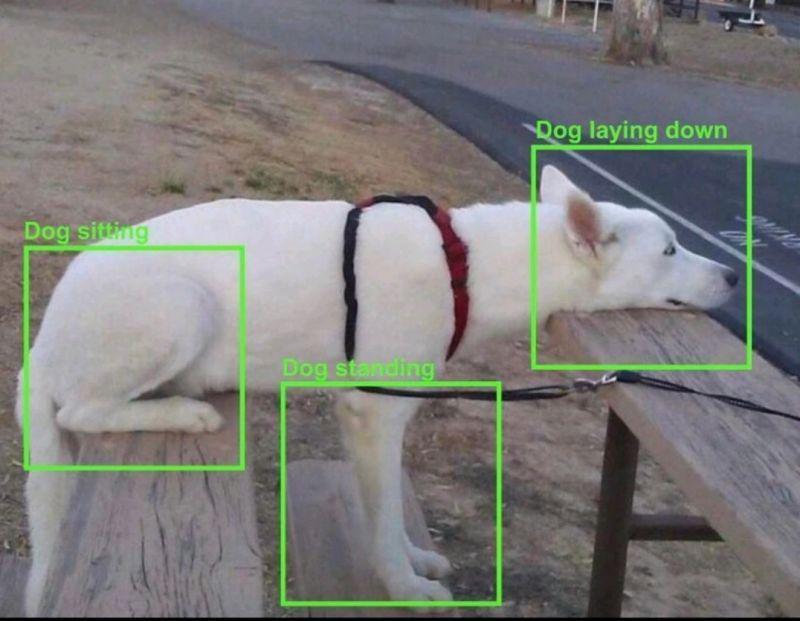
Discussion Can language models help me fix such issues in CNN based vision models?

Post image
475 Upvotes

r/computervision • • Dec 07 '22

Showcase Football Players Tracking with YOLOv5 + ByteTRACK Tutorial

474 Upvotes