r/computervision • u/FT05-biggoye • Apr 25 '22
Showcase Work in progress, my "object in hand" feature extraction model.
366
Upvotes
r/computervision • u/k4meamea • Nov 29 '25
r/computervision • u/kvnptl_4400 • Dec 29 '24

r/computervision • u/Gloomy_Recognition_4 • Sep 17 '25
I’m Antal Zsiros, a senior computer vision specialist. Through my website, antal.ai, I sell my personal side projects which are professionally-built prototypes for computer vision applications, designed to save you from the costly process of building from scratch.
All solutions are coded purely in C++ using OpenCV for maximum efficiency. Every purchase includes the complete source code, detailed documentation, and build guides.
You can test every solution instantly in your browser to evaluate its capabilities and ensure it fits your needs before you buy: https://www.antal.ai/demo.html
r/computervision • u/CellistTraditional • Aug 08 '26
r/computervision • u/danlapko • May 07 '20
r/computervision • u/RandomForests92 • Feb 09 '23
r/computervision • u/RandomForests92 • Dec 14 '22
r/computervision • u/Portality3D • Oct 17 '25
Working on a computer vision project for real-time head tracking and 3D perspective adjustment.
Current approach:
Head pose estimation from facial geometry
Per-frame camera frustum correction
Anyone worked on similar real-time tracking projects? Happy to hear your thoughts!
r/computervision • u/_AmmarkoV_ • May 24 '26
A standalone C++ inference engine for 3D full-body pose estimation and wanted to share it as an open-source release.
It a BGR frame (webcam, video, or image) and returns per-person:
- 70 3D keypoints — full body + both hands (MHR-70 format)
- Full MHR (SMPL-like) mesh (18439 vertices) via native C LBS
- Camera translation + focal length estimate
- 2D projected keypoints for overlay
Pipeline
YOLO11m-pose → DINOv3-ViT-H backbone → 6-layer decoder → MHR + camera heads → C LBS
~9 ms ~96 ms ~5 ms ~4 ms ~2 ms
The backbone dominates (it's a ViT-H). Total ~120 ms / frame for 2 persons on an RTX 3090, ~8–9 fps end-to-end. --skip-body drops the LBS step if you only need pose
params.
The original project is Python + PyTorch. The C++ runtime compiles to a single shared library (libfast_sam_3dbody.so) with no Python dependency — useful for embedding in
robotics pipelines, game engines, or any latency-sensitive application. There's also a plain C API for ctypes, so Python users can call it without PyTorch installed.
Outputs to CSV
./fast_sam_3dbody_run --from video.mp4 -o joints.csv
Writes one row per person per frame with all 70 joint XYZ coordinates — header compatible with the Python dumper format.
Repo: https://github.com/AmmarkoV/SAM3DBody-cpp
Models (HuggingFace): https://huggingface.co/AmmarkoV/SAM3DBody-cpp-onnx-models
r/computervision • u/shoonee_balavolka • Sep 26 '26

I’m experimenting with a DLSS-like system for GBA games.
The goal isn’t simple upscaling. I want a model to take a 240×160 frame and reconstruct it into a higher-resolution remastered version while keeping the original layout and style.
The core idea is to reuse the previous high-resolution frame as the base, then only modify the parts that changed:
Output = Base + Gate × Residual
For training data, I’m planning to use my own game engine. I can generate random maps and render the exact same scene twice:
low-resolution retro version
high-resolution remastered version
This gives me perfectly aligned LR/HR training pairs automatically. I can also export object masks, motion data, and other metadata if needed.
I’ve trained and deployed several deep learning models in production before, but I don’t have much experience designing and training a model architecture from scratch. This one is also image-to-image, so I’m not yet confident the approach will work as well as I’m imagining.
If anyone here has experience with image restoration, video super-resolution, temporal consistency, or neural rendering, I’d really appreciate feedback on the architecture and training approach.
r/computervision • u/SKY_ENGINE_AI • Dec 22 '25
Hello everyone. My team was discussing what kind of Christmas surprise we could create beyond generic wishes. After brainstorming, we decided to teach an AI model to…detect Santa Claus.
Since it’s…hmmm…hard to get real photos of Santa Claus flying in a sleigh, we used synthetic data instead.
We generated 5K+ frames and fed them into our Yolo11 model, with bounding boxes and segmentation. The results are quite impressive: the inference time is 6 ms.
The Santa Claus dataset is free to download. And it’s a workable one that functions just like any other dataset used for AI.
Have fun with it — and happy holidays from our team!
r/computervision • u/unofficialmerve • Nov 19 '25
r/computervision • u/iam-sm • Nov 30 '25
Hey everyone, I’ve been trying to get a deeper understanding of 3D data processing, so I built a small end-to-end pipeline using a clean dataset (BraTS 2020) to explore how volumetric MRI data turns into an actual 3D mesh.
This was mainly a learning project for myself, I wanted to understand voxels, volumetric preprocessing, marching cubes, and how a simple 3D viewer workflow fits together.
What I built: • Processing raw NIfTI MRI volumes • Voxel-level preprocessing (mask integration) • Voxel → mesh reconstruction using Marching Cubes • PyVista + PyQt5 for interactive 3D visualization
It’s not a segmentation research project just a hands-on exercise to learn 3D reconstruction from MRI volumes.
Repo: https://github.com/asmarufoglu/neuro-voxel
Happy to hear any feedback from people working in 3D CV, medical imaging, or volumetric pipelines.
r/computervision • u/kw0lf • Apr 05 '19

r/computervision • u/mxhong • Apr 19 '21

r/computervision • u/Optimal-Length5568 • May 22 '26
Just tested the new Ultralytics Semantic Segmentation models on video inference and honestly the results are super clean 👀
The new -sem models include:
• yolo26n-sem.pt
• yolo26s-sem.pt
• yolo26m-sem.pt
• yolo26l-sem.pt
• yolo26x-sem.pt
Big upgrades:
✅ Pixel-level scene understanding
✅ Semantic masks directly in inference outputs
✅ Cityscapes + ADE20K support
✅ PNG mask datasets supported
✅ Mosaic, MixUp, CutMix & perspective transforms now support semantic masks
✅ Real-time video inference performance 🚀
This feels like a huge step for:
🚗 Autonomous Driving
🤖 Robotics
📹 Smart Surveillance
🏙️ Smart City Applications
⚡ Edge AI
I tested it on video and shared the demo here:
https://youtu.be/swnAMHKZU20
Curious to know:
Do you think semantic segmentation will become the next major focus after object detection?
r/computervision • u/ConferenceSavings238 • Nov 23 '25
Hey everyone,
I’ve been working on a lightweight object detection framework called YOLOLite, focused specifically on CPU and edge device performance.
The repo includes several small architectures (edge_s, edge_n, edge_m, etc.) and benchmarks across 40+ Roboflow100 datasets.
The goal isn’t to beat the larger YOLO models, but to provide stable and predictable performance on CPUs, with real end-to-end latency measurements rather than raw inference times.
For example, the edge_s P2 variant runs around 90–100 FPS (full pipeline) on a desktop CPU at 320×320 (shown in the video).
The framework also supports toggling architectural settings through simple flags:
--use_p2 to enable the P2 head for small-object detection
--use_resize to switch training preprocessing from letterbox to pure resize (which works better on some datasets)
If anyone here is interested in CPU-first object detection, embedded vision, or edge deployment, I’d really appreciate any feedback.
Not trying to promote anything — just sharing what I’ve been building and documenting.
Repo:
https://github.com/Lillthorin/YoloLite-Official-Repo
Model cards:
edge_s (640): https://huggingface.co/Lillthorin/YOLOlite_edge_s
edge_s (320, P2): https://huggingface.co/Lillthorin/YOLOlite_edge_s_320_p2
The model used in the demo video was trained on a small dataset of frames randomly extracted from the video (dataset available on roboflow)
CPU:
AMD Ryzen 5 5500 3,60 GHz Cores 6
r/computervision • u/Clicketrie • May 16 '22
r/computervision • u/datascienceharp • Dec 18 '25
Quick start guide in the docs: https://docs.voxel51.com/plugins/plugins_ecosystem/apple_sharp.html
r/computervision • u/datascienceharp • Jun 20 '25
VGGT eliminates the need for geometric post-processing altogether.
The paper introduces a feed-forward transformer that directly predicts camera parameters, depth maps, point maps, and 3D tracks from arbitrary numbers of input images in under a second. Their alternating-attention architecture (switching between frame-wise and global self-attention) outperforms traditional approaches that rely on expensive bundle adjustment and geometric optimization. What's particularly impressive is that this purely neural approach achieves this without specialized 3D inductive biases.
VGGT show that large transformer architectures trained on diverse 3D data might finally render traditional geometric optimization obsolete.
Project page: https://vgg-t.github.io
Notebook to get started: https://colab.research.google.com/drive/1Dx72TbqxDJdLLmyyi80DtOfQWKLbkhCD?usp=sharing
⭐️ Repo for my integration into FiftyOne: https://github.com/harpreetsahota204/vggt
r/computervision • u/nacrenos • Nov 22 '24
I was thinking that YOLO was open-source and it could be used in any commercial project without any limitation however the reality is WAY different than that, I realized. And if you have a line of code such as
from ultralytics import YOLO
anywhere in your code base, YOU must beware of this.
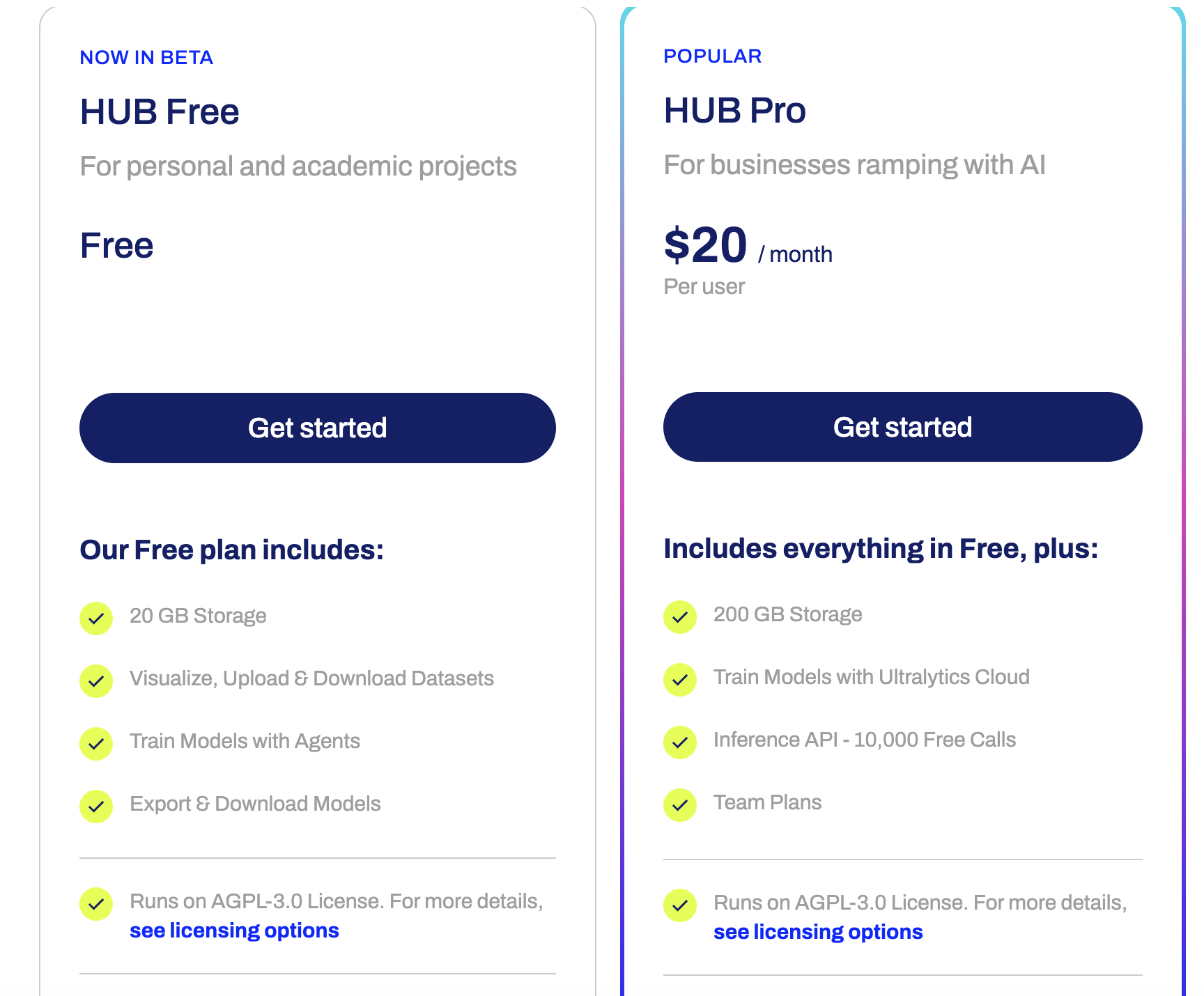
Even though the tag line of their "PRO" plan is "For businesses ramping with AI"; beware that it says "Runs on AGPL-3.0 license" at the bottom. They simply try to make it "seem like" businesses can use it commercially if they pay for that plan but that is definitely not the case! Which "business" would open-source their application to world!? If you're a paid plan customer; definitely ask about this to their support!
I followed through the link for "licensing options" and to my shock, I saw that EVERY SINGLE APPLICATION USING A MODEL TRAINED ON ULTRALYTICS MODELS MUST BE EITHER OPEN SOURCE OR HAS ENTERPRISE LICENSE (which is not even mentioned how much would it cost!) This is a huge disappointment. Ultralytics says, even if you're a freelancer who created an application for a client you must either pay them an "enterprise licensing fee" (God knows how much is that??) OR you must open source the client's WHOLE application.
I wish it would be just me misunderstanding some legal stuff... Some limited people already are aware of this. I saw this reddit thread but I think it should be talked about more and people should know about this scandalous abuse of open-source software, becase YOLO was originally 100% open-source!
r/computervision • u/fullartREVERSEholo • Oct 28 '25
I'm working on a Python-based facial-recognition program that analyzes live streams of congressional hearings. The program analyzes the feed, detects faces, matches them against a database, and overlays contextual data back onto the stream (e.g., committees, donors, net worth, recent stock trades, etc.).
It’s functional and works surprisingly well most of the time, but I’m struggling with a few persistent issues:
Accuracy drops substantially with partial faces, glasses, and side profiles.
Frames with multiple faces throw off the matcher and it often picks the wrong face.
Empty shots (often of the room) frequently trigger high-confidence false positive matches.
I'm searching for practical advice on models or settings that handle side profiles, occlusions, multiple faces, and variable lighting (InsightFace, DeepFace, or others?). I am also open to insight on confidence thresholds and temporal-smoothing methods (moving average, hysteresis, minimum-persistence before overlay update) to reduce flicker and false positives.
I've attached a clip of the program at work. Any insights or pointers for real-time matching and stability would be greatly appreciated.
r/computervision • u/Ultralytics_Burhan • Sep 25 '25
