r/computervision • • Mar 15 '26

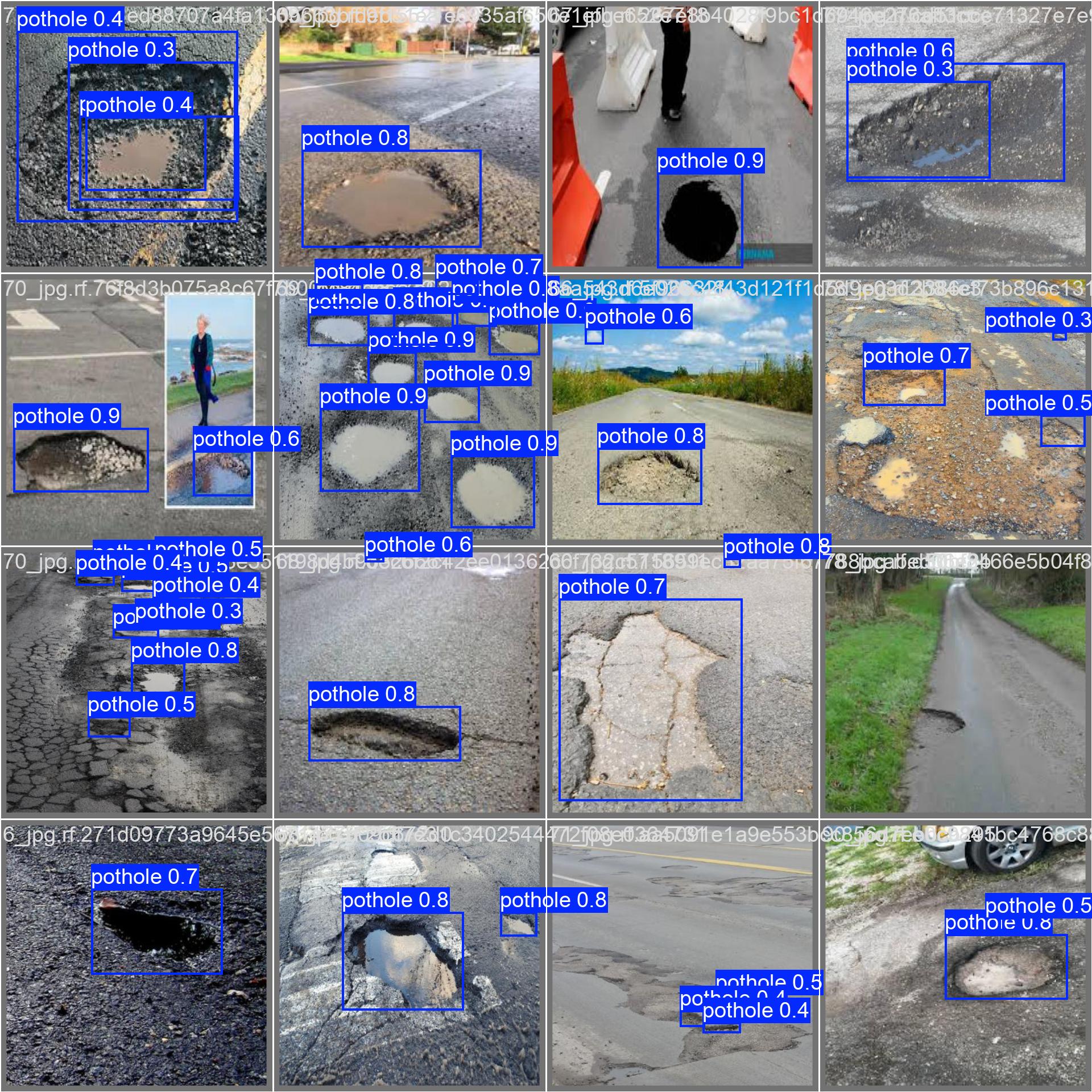
Showcase Made a CV model using YOLO to detect potholes, any inputs and suggestions?

Post image
293 Upvotes

Trained this model and was looking for feedback or suggestions.
(And yes it did classify a cloud as a pothole, did look into that 😭)
You can find the Github link here if you are interested:
Pothole Detection AI


r/computervision • • Mar 01 '26

Showcase Tracking Persons on Raspberry Pi: UNet vs DeepLabv3+ vs Custom CNN

289 Upvotes

I ran a small feasibility experiment to segment and track where people are staying inside a room, fully locally on a Raspberry Pi 5 (pure CPU inference).

The goal was not to claim generalization performance, but to explore architectural trade-offs under strict edge constraints before scaling to a larger real-world deployment.

Setup

  • Hardware: Raspberry Pi 5

  • Inference: CPU only, single thread (segmentation is not the only workload on the device)

  • Input resolution: 640Ɨ360

  • Task: single-class person segmentation

Dataset

For this prototype, I used 43 labeled frames extracted from a recorded video of the target environment:

  • 21 train

  • 11 validation

  • 11 test

All images contain multiple persons, so the number of labeled instances is substantially higher than 43.
This is clearly a small dataset and limited to a single environment. The purpose here was architectural sanity-checking, not robustness or cross-domain evaluation.

Baseline 1: UNet

As a classical segmentation baseline, I trained a standard UNet.

Specs:

  • ~31M parameters

  • ~0.09 FPS

Segmentation quality was good on this setup. However, at 0.09 FPS it is clearly not usable for real-time edge deployment without a GPU or accelerator.

Baseline 2: DeepLabv3+ (MobileNet backbone)

Next, I tried DeepLabv3+ with a MobileNet backbone as a more efficient, widely used alternative.

Specs:

  • ~7M parameters

  • ~1.5 FPS

This was a significant speed improvement over UNet, but still far from real-time in this configuration. In addition, segmentation quality dropped noticeably in this setup. Masks were often coarse and less precise around person boundaries.

I experimented with augmentations and training variations but couldn’t get the accuracy of UNet.

Note: I did not yet benchmark other segmentation architectures, since this was a first feasibility experiment rather than a comprehensive architecture comparison.

Task-Specific CNN (automatically generated)

For comparison I used ONE AI, a software we are developing, to automatically generate a tailored CNN for this task.

Specs:

  • ~57k parameters

  • ~30 FPS (single-thread CPU)

  • Segmentation quality comparable to UNet in this specific setup

In this constrained environment, the custom model achieved a much better speed/complexity trade-off while maintaining practically usable masks.

Compared to the 31M parameter UNet, the model is drastically smaller and significantly faster on the same hardware. But I don’t want to show that this model now ā€œbeatsā€ established architectures in general, but that building custom models is an option to think about next to pruning or quantization for edge applications.

Curious how you approach applications with limited resources. Would you focus on quantization, different universal models or do you also build custom model architecture?

You can see the architecture of the custom CNN and the full demo here:
https://one-ware.com/docs/one-ai/demos/person-tracking-raspberry-pi

Reproducible code:
https://github.com/leonbeier/PersonDetection


r/computervision • • Dec 08 '25

Showcase Chores.gg: Turning chores into a game with vision AI

286 Upvotes

Over 400 million people have ADHD. One of the symptoms is increased difficulty completing common tasks like chores.

But what if daily life had immediate rewards that felt like a game?

That’s where the vision language models come in. When a qualifying activity is detected, you’re immediately rewarded XP.

This combines vision AI, reward psychology, and AR to create an enhancement of physical reality and a new type of game.

We just wrapped up the MVP of Chores.gg and it’s coming to the Quest soon.


r/computervision • • Nov 06 '25

Research Publication About to get a Lena replacement image published by a reputable text book company

Post image
285 Upvotes

r/computervision • • Jan 10 '23

Showcase Train YOLOv8 ObjectDetection on Custom Dataset Tutorial

283 Upvotes

r/computervision • • Jan 22 '26

Showcase Turned my phone into a real-time squat tracker using computer vision

280 Upvotes

Hey everyone, I recently finished building an app called Rep AI, and I wanted to share a quick demo with the community.

It uses MediaPipe’s Pose solution to track lower-body movement during squat exercises, classifying each frame into one of three states:
Up – when the user reaches full extension
Down – when the user is at the bottom of the squat
Neither – when transitioning between positions

From there, the app counts full reps, measures time under tension, and provides AI-generated feedback on form consistency and rhythm.

The model runs locally on-device, and I combined it with a lightweight frontend built in Vue and Node to manage session tracking and analytics.

It’s still early, but I’d love any feedback on the classification logic or pose smoothing methods you’ve used for similar motion-tracking tasks.

You can check out the live app here:
https://apps.apple.com/us/app/rep-ai/id6749606746


r/computervision • • Jan 05 '26

Discussion Implemented 3D Gaussian Splatting fully in PyTorch — useful for fast research iteration?

280 Upvotes

I’ve been working withĀ 3D Gaussian SplattingĀ and put together a version where theĀ entire pipeline runs in pure PyTorch, without any custom CUDA or C++ extensions.

The motivation wasĀ research velocity, not peak performance:

  • everything isĀ fully programmable in Python

  • intermediate states are straightforward to inspect

In practice:

  • optimizing Gaussian parameters (means, covariances, opacity, SH) maps cleanly to PyTorch

  • trying new ideas or ablations is significantly faster than touching CUDA kernels

The obvious downside is speed
On an RTX A5000:

  • ~1.6 s / frame @ 1560Ɨ1040 (inference)

  • ~9 hours for ~7k training iterations per scene

This is far slower than CUDA-optimized implementations, but I’ve found it useful as aĀ hackable referenceĀ for experimenting with splatting-based renderers.

Curious how others here approach this tradeoff:

  • Would you use a slower, fully transparent implementation to prototype new ideas?

  • At what point do you usually decide it’s worth dropping to custom kernels?

Code is public if anyone wants to inspect or experiment with it.


r/computervision • • Oct 15 '26

Help: Project Detecting sewer pipe defects in CCTV inspection video: anyone working on something similar?

275 Upvotes

The clip shows defect detection on sewer CCTV footage across different pipe types and materials. The defect classes follow EN 13508-2.

Curious to compare notes with anyone working on this:

  1. How do you handle false positives that depend on the pipe material, e.g., seams or streaks on plastic pipe being picked up as cracks?

  2. Detection, segmentation, or frame-level classification: what has worked best for you, especially for defects that cover large areas?

  3. How do you evaluate: per frame, per defect, or per meter of pipe?

  4. Any tricks for rare defect classes: synthetic data, augmentation, or oversampling?


r/computervision • • May 05 '26

Showcase Lessons from building a real-world LiDAR perception pipeline (failures, tradeoffs, what broke)

275 Upvotes

I recently built an end-to-end perception pipeline on 128-beam infrastructure-mounted LiDAR — the kind you'd see on a pole at an intersection, not on a vehicle. 184k points per frame, 10 sequential frames, busy urban scene. Ground removal → clustering → classification → tracking. All classical methods, no neural nets for detection.

I want to share the parts that surprised me most, because they're not the parts you'd expect.


Ground removal was harder than classification.

I went through 6 iterations. The first one — standard RANSAC on the full point cloud — locked onto a bus roof instead of the road. A bus roof has more coplanar points in a local region than the actual road surface, and it passes the horizontal normal check because it IS roughly horizontal. Took 6-7 seconds per frame too.

The fix that eventually worked: since the sensor is fixed (infrastructure-mounted, doesn't move), I calibrate the ground plane once using only nearby points where ground dominates. Then I use a polar grid (not Cartesian — polar matches how LiDAR actually scans) with distance-adaptive thresholds. A bus only covers a narrow angular span in polar coordinates, so adjacent wedges still see the road beside it. The Cartesian grid couldn't do this — the bus filled entire cells.

One detail that cost me hours: even after calibration, extrapolating the ground plane equation to 100m range introduced ~2m of height drift from a residual tilt of just 0.01 in the normal vector. I had to abandon plane extrapolation entirely.

For production on fixed sensors, none of this matters though. You'd just accumulate a reference map of the empty scene and compare each frame against it. O(1) per point. But I didn't have empty-scene frames, so I had to solve it the hard way.


One parameter change in clustering had more impact than any algorithm choice.

I used BEV grid projection + connected components (DBSCAN was way too slow on 140k points). Started with 8-connectivity where diagonal cells count as connected. A car parked next to a wall shared one diagonal cell — they merged into one giant cluster, got rejected by the size filter, and the car vanished completely.

Switching to 4-connectivity fixed it. One parameter. Bigger impact than the choice between DBSCAN and connected components, bigger than the grid resolution, bigger than the morphological operations I tried and reverted (erosion kernel erased small pedestrians at range — they only occupied 2Ɨ2 cells).


Pedestrian vs bicyclist confusion is a representation problem, not a model problem.

These two classes have 100% overlap on every basic geometric feature — z_range, xy_spread, point count, density. The only discriminator I found was the vertical point distribution: pedestrians have roughly uniform density head-to-toe, bicyclists have more points at wheel and shoulder level with a gap between.

But here's what convinced me this isn't solvable with more features: across all feature sets I tested (19, 23, and 35 features), the confidence gap between correct predictions (0.87 avg) and misclassifications (0.60 avg) was 0.277 ± 0.002. Identical. More features didn't make the model more certain about hard cases. That's the Bayes error rate of the geometric representation, not a model limitation. You'd need a fundamentally different representation (raw point patterns via PointNet, or temporal context) to push past it.


Tracking humbled me the most.

The Kalman filter and Hungarian assignment are textbook. What's not textbook is the tuning.

The most impactful design choice: asymmetric track lifecycle. Tentative tracks die after 1 miss — false alarms appear once and never repeat, so they die immediately. Confirmed tracks survive 3 misses — real objects get temporarily occluded but come back. Without this asymmetry, you're constantly trading off ghost tracks against lost real tracks. There's no single threshold that handles both.

I also switched from Euclidean gating to Mahalanobis because a new track with unknown velocity should accept matches from further away, while an established track with tight covariance should be strict. Euclidean with a fixed gate can't express this.


Full pipeline code, ablation tables, confusion matrices, and detailed failure analysis: https://github.com/bonsai89/lidar-perception-pipeline

This is infrastructure perception (fixed sensors), not vehicle-mounted — different tradeoffs from what most of this sub discusses. Curious if anyone here is working on similar fixed-sensor setups. DMs open.

Context: perception engineer, previously at Toyota Technological Institute, Japan (camera-LiDAR-radar fusion, 5 papers) and TierIV, Japan (Autoware/ROS2 perception). First time working with infrastructure-mounted LiDAR — coming from vehicle-mounted, the differences were bigger than I expected.

Also exploring roles in robotics / perception if anyone knows teams working on similar problems.

r/computervision • • Feb 25 '26

Showcase Fun Voxel Builder with WebGL and Computer Vision

275 Upvotes

r/computervision • • May 13 '25

Showcase Using Python & CV to Visualize Quadratic Equations: A Trajectory Prediction Demo for Students

273 Upvotes

Sharing a project I developed to tackle a common student question: "Where do we actually use quadratic equations?"

I built a simple computer vision application that tracks an object's movement in a video and then overlays a predicted trajectory based on a quadratic fit. The idea is to visually demonstrate how the path of a projectile (like a ball) is a parabola, governed by y=ax2+bx+c.

The demo uses different computer vision methods for tracking – from a simple Region of Interest (ROI) tracker to more advanced approaches like YOLOv8 and RF-DETR with object tracking (using libraries like OpenCV, NumPy, ultralytics, supervision, etc.). Regardless of the tracking method, the core idea is to collect (x,y) coordinates of the object over time and then use polynomial regression (numpy.polyfit) to find the quadratic equation that describes the path.

It's been a great way to show students that mathematical formulas aren't just theoretical; they describe the world around us. Seeing the predicted curve follow the actual ball's path makes the concept much more concrete.

If you're an educator or just interested in using tech for learning, I'd love to hear your thoughts! Happy to share the code if it's helpful for anyone else.


r/computervision • • Nov 19 '25

Discussion SAM3 is out. You prompt images and video with text for pixel perfect segmentation.

272 Upvotes

r/computervision • • Aug 12 '20

Weblink / Article 3D scanning app for iPad and iPhone.

271 Upvotes

r/computervision • • 23d ago

Discussion C++ Sky Tracker 1.1.0, free for students

270 Upvotes

Some time ago I posted here about Sky Tracker, back then it was still in test phase. Now its officially stable version with 2 main profiles, default for sky and correlation for the rest.

https://www.reddit.com/r/computervision/s/N8sVsBnirt

It has free demo apps for Windows, macOS and Linux so you can test it for free on your own videos. Also for students the license is free (for 1 year).

Default profile is based on template matching, correlation is… correlation šŸ˜„ But also has tiny ML option for more tough videos.

https://sky-tracker.deneb-systems.com


r/computervision • • Mar 05 '26

Discussion Image Augmentation in Practice — Lessons from 10 Years of Training CV Models and Building Albumentations

Post image
270 Upvotes

I wrote a long practical guide on image augmentation based on ~10 years of training computer vision models and ~7 years maintaining Albumentations.

Despite augmentation being used everywhere, most discussions are still very surface-level (ā€œflip, rotate, color jitterā€).

In this article I tried to go deeper and explain:

• The two regimes of augmentation: – in-distribution augmentation (simulate real variation) – out-of-distribution augmentation (regularization)

• Why unrealistic augmentations can actually improve generalization

• How augmentation relates to the manifold hypothesis

• When and why Test-Time Augmentation (TTA) helps

• Common failure modes (label corruption, over-augmentation)

• How to design a baseline augmentation policy that actually works

The guide is long but very practical — it includes concrete pipelines, examples, and debugging strategies.

This text is also part of the Albumentations documentation

Would love feedback from people working on real CV systems, will incorporate it to the documentation.

Link: https://medium.com/data-science-collective/what-is-image-augmentation-4d31dcb3e1cc


r/computervision • • May 31 '26 Bravo

Showcase LibreYOLO v1.2.0 epic release: 16 model families now supported

264 Upvotes

This is the third post that I do on reddit to speak about LibreYOLO, the support has always been super strong and I'm very thankul for it. I’m trying not to make too many posts so I don’t bother you, but this release is epic :)

The v1.2.0 is historic for the scope and scale of the added features:

  • YOLO9 and RF-DETR are heavily tested and production ready

  • 16 models in total, added: DEIM, DEIMv2, RT-DETRv2, RT-DETRv4, EdgeCrafter, DAMO-YOLO, RTMDet, PicoDet, YOLOv9-E2E, L2CS-gaze. They are very experimental and expect stability to improve with time.

  • Added 3 new tasks aside detection: segmentation, keypoints and gaze detection.

Added the boring but important features that make the difference:

  • Gradient accumulation so you can train with effective larger batch sizes even with a small GPU

  • Hooks for getting info while training

  • Multi-GPU training

  • Test Time augmentation

  • Ton of bug-fixes often reported and fixed by contributors

  • Set a standard for metadata inside the models

The goal is still the same: make LibreYOLO a practical, comfortable, MIT-licensed computer vision library that people can use in real projects without worrying about restrictive licensing.

What to expect in the near future:

  • Every model will get heavily tested

  • Benchmarks for different models and hardware published in https://www.visionanalysis.org/

  • Integrations with tensorboard, mlflow, weights and biases, etc.

  • A YOLO9 segmentation variant

I want to thank all the contributors and for the v1.2.0 release a special thanks to Imagra93, testdummyvt and Magellol. If you have any questions, feedback, suggestions, feel free to write.

🌟 If you are reading this and support the LibreYOLO initiative, star the repo: https://github.com/LibreYOLO/libreyolo


r/computervision • • Dec 28 '19

When you've been using sparse data for too long...

Post image
262 Upvotes

r/computervision • • Oct 03 '25

Showcase RF-DETR Segmentation Preview: Real-Time, SOTA, Apache 2.0

260 Upvotes

We just launched an instance segmentation head for RF-DETR, our permissively licensed, real-time detection transformer. It achieves SOTA results for realtime segmentation models on COCO, is designed for fine-tuning, and runs at up to 300fps (in fp16 at 312x312 resolution with TensorRT on a T4 GPU).

Details in our announcement post, fine-tuning and deployment code is available both in our repo and on the Roboflow Platform.

This is a preview release derived from a pre-training checkpoint that is still converging, but the results were too good to keep to ourselves. If the remaining pre-training improves its performance we'll release updated weights alongside the RF-DETR paper (which is planned to be released by the end of October).

Give it a try on your dataset and let us know how it goes!

Nov 13 2025 Update: A pre-print of the RF-DETR paper is now available on Arxiv.


r/computervision • • Jul 05 '20

OpenCV Hey everyone! An update on the Sudoku Solver. It can solve in real time now! This is a recording of the screen recording I did cause for some reason my .mp4 files aren't showing up! Check out the GitHub link below! Cheers!

260 Upvotes

r/computervision • • Apr 06 '22

Discussion Coordinate GAN - Image synthesis with same structure but different textures

258 Upvotes

r/computervision • • Jul 01 '26

Research Publication HOI-DETR: off-the-shelf hand–object interaction detection from a single RGB image

257 Upvotes

HOI-DETRĀ is a zero-shot framework for hand–object interaction: it detects hands, the object in-hand (1st object), and the object acted on through a tool (2nd object), plus the interaction links between them, all from a single RGB image.
The attached video is a zero-shot in-the-wild video prediction using HOI-DETR.

🌐 Project page: https://ahmaddarkhalil.github.io/HOI-DETR/
šŸ“„ Paper:Ā https://arxiv.org/abs/2606.17384
šŸ’» Code:Ā https://github.com/AhmadDarKhalil/HOI-DETR
šŸ¤— Demo (upload your own image):Ā https://huggingface.co/spaces/ahmaddarkhalil/hoi-detr-demo


r/computervision • • Aug 20 '26

Showcase I made a rock climbing tool using computer vision!

256 Upvotes

I prompted VLM Run’s visual agent Orion to segment all of the blue bouldering holds, and it did a good job! It is interesting that now we can prompt VLMs to segment all of the holds, rather than creating a new dataset from scratch to train a model.

With holds detection + pose estimation, I can show how each hold gets activated as a hand or foot uses it. Once we touch the final hold with both hands, the route is completed, and I show the overall path of my torso midpoint.

A tool like this could help climbers understand their movement better. I’m still very much a beginner at bouldering, so I could use all the help I can get 🤣

There are definitely things to improve, but overall I’m encouraged by this first demo šŸ™‚

Models used:
- VLM Run’s Orion for segmentation
- ViTPose+ Huge for pose estimation (via Hugging Face šŸ¤—)
- RT-DETR for person detection (via Hugging Face šŸ¤—)

Shoutout to Daniel Reiff and his bouldering + computer vision project for the inspiration!

Link to Daniel Reiff's bouldering + computer vision blog: https://blog.roboflow.com/bouldering/


r/computervision • • May 31 '22

Showcase Pothole Detector based on YoloV4

254 Upvotes

r/computervision • • Jul 31 '23

Discussion 2023 review of tools for Handwritten Text Recognition HTR — OCR for handwriting

253 Upvotes

Hi everybody,

Because I couldn’t find any large source of information, I wanted to share with you what I learned on handwriting recognition (HTR, Handwritten Text Recognition, which is like OCR, Optical Character Recognition, but for handwritten text). I tested a couple of the tools that are available today and the training possibilities. I was looking for a tool that would recognise a specific handwriting, and that I could train easily. Ideally, I would have liked it to improve dynamically with time, learning from my last input, a bit like Picasa Desktop learned from the feedback it got on faces. I tested the tools with text and also with a lot of numbers, which is more demanding since you can’t use language models that well, that can guess the meaning of a word from the context.

To make it short, I found that the best compromise available today is Transkribus. Out of the box, it’s not as efficient as Google Document, but you can train it on specific handwritings, it has a decent interface for training and quite good functions without any payment needed.

Here are some of the tools I tested:

  • Transkribus. Online-Software made for handwriting detection (has also a desktop version, which seems to be not supported any more). Website here: https://readcoop.eu/transkribus/ . Out of the box, the results were very underwhelming. However, there is an interface made for training, and you can uptrain their existing models, which I did, and it worked pretty well. I have to admit, training was not extremely enjoyable, even with a graphical user interface. After some hours of manually typing around 20 pages of text, the model-quality improved quite significantly. It has excellent export functions. The interface is sometimes slightly buggy or not perfectly intuitive, but nothing too annoying. You can get a long way without paying. They recently introduced a feature where they put the paid jobs first, which seems to be fair. So now you sometimes have to wait quite a bit for your recognition to work if you don’t want to pay. There is no dynamic "real-time" improvement (I think no tool has that), but you can train new models rather easily. Once you gathered more data with the existing model + manual corrections, you can train another model, which will work better.

  • Google Document AI. There are many Google Services allowing for handwritten text recognition, and this one was the best out of the box. You can find it here: https://cloud.google.com/document-ai It was the best service in terms of recognition without training. However: the importing and exporting functions are poor, because they impose a Google-specific JSON-Format that no other software can read. You can set up a trained processor, but from what I saw, I have the impression you can train it to improve in the attribution of elements to forms, not in the actual detection of characters. And that’t what I wanted, because even if Google’s out-of-the-box accuracy is quite good, it’s nowhere near where I want a model to be, and nowhere near where I managed to arrive when training a model in Transkribus (I’m not affiliated to them or anybody else in this list). Google’s interface is faster than Transkribus, but it’s still not an easy tool to use, be prepared for some learning curve. There is a free test period, but after that you have to pay, sometimes up to 10 cents per document or even more. You have to give your credit card details to Google to set up the test account. And there are more costs, like the one linked to Google cloud, which you have to use.

  • Nanonets. Because they wrote this article: https://nanonets.com/blog/handwritten-character-recognition/ (also mentioned here https://www.reddit.com/r/Automate/comments/ihphfl/a_2020_review_of_handwritten_character_recognition/ ) I thought they’d be pretty good with handwriting. The interface is pretty nice, and it looks powerful. Unfortunately, it only works OK out of the box, and you cannot train it to improve the accuracy on a specific handwriting. I believe you can train it for other things, like better form recognition, but the handwriting precision won’t improve, I double-checked that information with one of their sales reps.

  • Google Keep. I tried it because I read the following post: https://www.reddit.com/r/NoteTaking/comments/wqef67/comment/ikm9iy3/?utm_source=share&utm_medium=web2x&context=3 In my case, it didn’t work satisfactorily. And you can’t train it to improve the results.

  • Google Docs. If you upload a PDF or Image and right click on it in Drive, and open it with Docs, Google will do an OCR and open the result in Google Docs. The results were very disappointing for me with handwriting.

  • Nebo. Discovered here: https://www.reddit.com/r/NoteTaking/comments/wqef67/comment/ikmicwm/?utm_source=share&utm_medium=web2x&context=3 . It wasn’t quite the workflow I was looking for, I had the impression it was made more for converting live handwriting into text, and I didn’t see any possibility of training or uploading files easily.

  • Google Cloud Vision API / Vision AI, which seems to be part of Vertex AI. Some infos here: https://cloud.google.com/vision The results were much worse than those with Google Document AI, and you can’t train it, at least not with a reasonable amount of energy and time.

  • Microsoft Azure Cognitive Services for Vision. Similar results to Google’s Document AI. Website: https://portal.vision.cognitive.azure.com/ Quite good out of the box, but I didn’t find a way to train it to recognise specific handwritings better.

I also looked at, but didn’t test:

That’s it! Pretty long post, but I thought it might be useful for other people looking to solve similar challenges than mine.

If you have other ideas, I’d be more than happy to include them in this list. And of course to try out even better options than the ones above.

Have a great day!