The Small Discussions thread is back on a semiweekly schedule... For now!
FAQ
What are the rules of this subreddit?
Right here, but they're also in our sidebar, which is accessible on every device through every app. There is no excuse for not knowing the rules. Make sure to also check out our Posting & Flairing Guidelines.
If you have doubts about a rule, or if you want to make sure what you are about to post does fit on our subreddit, don't hesitate to reach out to us.
Where can I find resources about X?
You can check out our wiki. If you don't find what you want, ask in this thread!
Our resources page also sports a section dedicated to beginners. From that list, we especially recommend the Language Construction Kit, a short intro that has been the starting point of many for a long while, and Conlangs University, a resource co-written by several current and former moderators of this very subreddit.
i want to do lexember for the first time this year, but i never felt my prior langs were robust(?) enough to make the most of it and i'm a bit intimidated. what grammar do you like to finalize before you start a lexicon challenge? esp if you've done lexember/junexember with a newer conlang, what worked + what would you do differently?
from where i felt stuck in the past i know i want to nail down some verbs: ditransitive verb alignment, lexical typology of handling/motion verbs, serial verb constructions, changing valency, reflexives, impersonal and labile verbs. i also want to decide nouny vs verby adjectives, negation, comparatives, and copulas. but idk if i'm overlooking big typology areas that impact how a lexicon is divided + organized.
The few times I've tried Lexember it's gone best with a simple base word list and room to coin or compound pretty freely. My advice is to have your phonology set up, a Swadesh list, or similar, and maybe a sense of how words will compound in your language. My failure to complete is more about life with ADHD than a lack of interest.
If you can justify the mechanism by which this happened, go for it, but it does seem very likely to me that there would at least be a handful of other words that do end in consonants.
Thank you for your reply 🙂! I think I'll try to change things a bit instead of attempting to justify how the current arrangement evolved (see also my discussion above with zzvu about this)
Maybe have a sound change that causes word-final vowel loss, but then have the vowels added back to content words by analogy with their inflected forms. In this case, like the other commenter said, I'd expect other examples of word-final consonants, especially in function words (adpositions, demonstratives, conjunctions, etc).
Thank you for your suggestion 🙂 ! After reading your reply, I've looked a little bit into the terms you mentioned such as analogical change, and I see that there are some interesting processes in natlangs that I can study more and maybe find some inspiration from in the future.
Unfortunately I'm still at a beginner level at this stage, so I'm afraid what you're suggesting (as far as I can understand it) might be too advanced for me for now. Thus atm I might be better off by:
just allowing word-final consonants to more kinds of words and situations (and not just for case marking dependents like now).
Removing word-final consonants from the conlang all together: maybe mark case with a change of the word-final vowel rather than by adding a consonant after it?
I've been reading up on some isolating/analytic languages for speedlang 16 and I found mention that classifiers are only required in Khmer when counting units of time, measure, and money. Is anyone else familiar with any other languages that have classifiers that are largely optional except in specific circumstances? The classifier system is the last thing I really need to work out and I want to see what else is out there.
If a language doesn't distinguish tone on checked syllables, what happens when syllabification is affected by morphology? E.g., if it has /çɑb/ + /ǎ/, how would tone be determined for the first syllable of /çɑbǎ/?
Seems like you could determine that for yourself. Some options i could imagine:
All closed syllables get the same tone in this situation, effectively only contrasting with words that don't derive from closed syllable roots.
The following syllable determines the tone, with rules you choose. Maybe a high tone causes the prior syllable to be low, maybe a contour tone splits itself over the two syllables, etc.
The tone is determined by what consonants are in the syllable, which depending on how tone evolved could match which consonants created which tone during tonogenesis.
If you developed tone diachronically, think about how this word would've evolved on its own. Additionally, tone may be allophonic but still present on checked syllables and only become phonemic in certain instances.
I'm currently creating a language where the majority of adjectives are verb-like. I've come up with unique roots in the proto-lang for words like be big, be small, be whole, be red etc, but I'm struggling with how to derive adjectives for less basic meanings. How do natlangs derive verb-like adjectives without having noun-like ones?
Just because a language has verb-like adjectives, doesn’t mean those adjectives can’t be derived from other word classes. Take the Japanese adjectival verb 大人しい otonasii ‘to be obedient, docile, quiet’ from the noun 大人 otona ‘adult.’
It’s a very common adjective forming suffix, and it goes back quite far; I’m not aware of any solid etymology.
It’s important to note that you don’t need a lexical source for every morpheme, in fact that would be very strange! Look at PIE, it’s full of morphemes without any clear etymologies, just used to derive different word classes. It’s totally fine if you just wanna say ‘X morpheme derives adjectival verbs from nouns’ or something like that.
Thanks for your reply. I have a couple of ways to make nouns into verbs, but I don't think any would make sense for this context, as they sort of imply transitivity, which wouldn't make much sense.
I am making an agglutinative conlang. Each word is about 1-2 lines long, the numeral system is balanced nonary, and the only way to refer to a color is with the hex code, converted from base 16 to balanced base 9. Any more ideas to make it eviler?
Sound changes are often motivated by physiology, acoustics, distribution. Here is a couple of examples of sound changes and the rationale behind them.
[k] > [t͡ʃ] before front vowels. In [k], the tongue body touches the velum (i.e. the soft palate). But in the following front vowel, the tongue body is fronted towards the hard palate. To ease the transition, the tongue body is fronted in anticipation of the front vowel, leading to [k] > [c]. This also increases the area of contact between the tongue and the palate. Therefore, it becomes harder to release the occlusion all at once, and there appears a significant stage where too narrow a gap between the tongue and the palate for all air to pass through is formed. This leads to friction, or in this case affrication since it follows a full occlusion: [c] > [t͡ʃ].
Unrounding of rounded front vowels. Acoustically, the height of the second formant correlates with the size of the space between the palatal constriction and the lips: the larger the space, the lower the formant. The size of this space can be changed by moving the tongue body forwards and backwards. That is why front vowels have higher F2 and back ones have lower F2. This space can also be augmented by rounding (specifically, protruding) the lips. Therefore, rounded vowels have lower F2 than unrounded ones. In sum, vowel backing has a very similar effect on F2 as vowel rounding, which is why back vowels tend to be rounded and front vowels unrounded: this way the two can be easily distinguished as the two gestures enhance each other acoustically. Rounded front vowels lie in the middle: F2 is raised by vowel fronting and lowered by rounding, the two gestures cancel each other out. In a vowel system simplification, these interior vowels are likely to change and join a more peripheral set with a high or a low F2.
Various chain shifts. Changes can leave phonetic and phonological gaps, where sounds and phonemes that would be expected in the inventory are no longer part of the language. This leads to other phonemes developing new allophones or entire new phonemes appearing through borrowing or other, subsequent changes that fill the gaps but may in turn create new gaps that want to be filled. This process is then repeated until some temporary equilibrium is reached.
To answer your question, if you can explain the logic behind a change, then it's fine if you can't find an exact example of it in a natural language.
I want my personal jokelang to have rich possibilities for puns. The obvious thing would be to include lots of homophones. I could do this, but it feels like "baking in" the jokes, i.e., I'm choosing possible puns before hand by picking which words are homophones. I'm more interesting in creating a system that allows many possibilities to discover puns.
I made a post asking about this a week ago, but for whatever reason it got only a few upvotes and no comments, and almost immediately became buried on Reddit.
Eliminate mandatory grammatical marking (case endings, verb agreement, articles, etc.). It'll show up where it isn't wanted and ruin your joke.
But, add in a bunch of entirely optional derivational morphology that adjusts the feel of the word without really changing its meaning. This gives you a lot more potential to stick affixes onto word A to make it sound more like word B, while preserving the meaning of the joke.
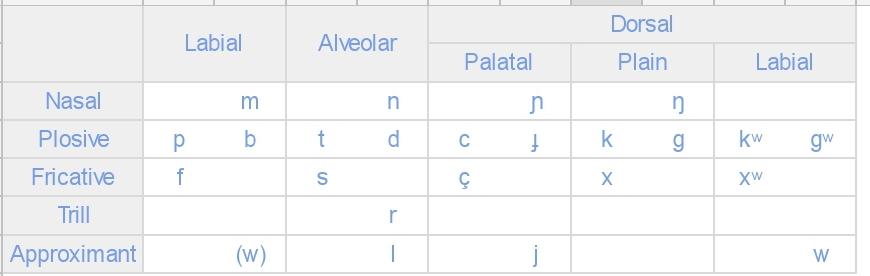
asking here too-- are there cool secondary factors i can reinforce a [nʲ ɲ] contrast with? for context, the current C inventory-- oral-nasal pairs are conditioned by vowel phonation, and (?) phonemes i'm not sure abt:
bilabial
alveolar
palatal
velar
glottal
t ts
tɕ c
kʷ
ʔ~h
m~b
n~d
nʲ~dʑ(?) ɲ~ɟ
ŋʷ~ɡʷ
ɸʷ
ð(?) z
ç~ʝ
(w)
l~ɹ~ɻ(ʷ)
j
(w)
i'm specifically trying to get [nʲdʑ]-- i want the phoneme count pretty spare with heavy allophony, so my instinct was a sequence /djV/ > [nʲdʑV] / #_V, [dʑV] / V_V. but in #_Ṽ and Ṽ_Ṽ contexts i don't want to neutralize [ɲ] /ɟ/ with [ɲ] /dj/. in careful speech i can do [nʲ ɲ] easily enough but i worry that speaking quickly they won't be clear without some other phonetic contrast. (altho for some reason i don't worry this about [tɕ] vs [c]...?)
I made a language isolate spoken on an island abt the size of West Nusa Tenggara, 170 miles south of Java. It’s fairly developed and I’m really happy with it! I want to make an English creole off of it, similar to Singlish. The languages that influence it affect it in this order: English, Deci basa (my language), Sundanese, Tagalog, and Hokkien. Do these make sense? Do you have any ideas for influence or the language in general?
For many creoles (though not all), you have a situation where one language provides the backbone (ie grammar) and the other(s) provide the vocabulary.
So, Singlish (afaik) is more or less grammatically like English, but uses vocabulary from Chinese etc, and a couple of sentence-level inflections like ending sentences with laa and aa.
Haitian Creole, meanwhile, has a backbone of Fongbe (iirc) with items re-lexicalised using French words.
So you might want to ask yourself: do you want your language to have mostly a grammatical backbone of English or Deci Basa? Or, do you want it to be more thoroughly 'mixed'? There's a lot to read about creole-type languages!
I would bet that noun class markers could definitely be an areal spreading feature, especially if there is a high degree of bilingualism among the speakers of the two languages. Even syntax can be borrowed across languages (a good example is the influence of Russian syntactic constructions on indigenous Siberian languages), so I'd say there probably isn't a limit to what can be spread! :)
I could be wrong though, so might be worth getting a second opinion.
How do I get better at using grammar? I’ve been making conlangs for 5 years yet I still struggle to make grammar. Like, I understand how noun cases work, and…sadly, that’s where it almost ends. I have a basic idea of how copula verbs, grammatical gender, articles, and time distinctions work but beyond that, I’m still clueless.
By having at least a shallow familiarity with as many languages as possible, to have a better idea of what kinds of ways grammar can operate. By "shallow familiarity" I mean e.g. even though I don't speak a word of Hebrew, it's helpful for me to be aware of what a "construct state" is.
Just trying to learn any foreign language at all is helpful simply for exposing you to the sheer breadth of what "grammar" deals with that otherwise would escape your notice - e.g. before taking French classes I don't think the distinction between a direct vs. indirect object had ever occurred to me, even though it exists in English too. It's especially helpful though if the languages you're familiar with aren't solely in the same family as your native language. e.g. if you're a native English speaker, and the foreign languages you've studied are Spanish and German... your conlangs are kind of inevitably going to end up looking pretty Indo-European-y, and pretty western Europe-y in particular, since that's all you know.
I don't know what you personally know about non-IE grammar, but I would start a new conlang's grammar by deciding:
The morphosyntactic alignment: a language's answer to "who's doing what and how can you tell?"
what phrases will be head-marking vs. which phrases will be dependent-marking (case marking is a form of dependent-marking)
head directionality
how many grammatical person, gender, and number distinctions to make
what categories verbs inflect for (tense? aspect? agreement with subject and/or object(s)? evidentiality?)
default word order
a handful of derivational patterns to start out with
since these will affect everything else down the road. If you aren't actively deciding these things, your brain will choose them on autopilot for you.
Is there any known example of allophony that is heavily conditioned by syntax at the clause level?
For example, phoneme /x/ is realized as [y] only in dependent clauses or indirect speech clauses? Compare:
I love that boat!
And that's when she said, "nigh nove that moat!"
In the sentences above, the italicized parts are underlyingly identical but in the second example, a series of nasalization is applied to it because it is an embedded clause.
I am partly inspired by several Amerindian languages that, during storytelling, use special registers for certain characters (cannibals, or animals) where a series of wholesale sound shifts are applied (something like, all /ʃ/ are shifted to /tɬ/, can't remember the exact details).
Wondering if such a phenomena exists but less tied to storytelling and more deeply embedded into grammar.
My hunch is no, and it seems like in general a langauge's phonology seems to interact with morphology but operates independently of syntax (apart from intonation?). (If any of you are aware of references that discuss this, I'd be grateful for them too)
I think that phonology and syntax tend not to interact much, but it does occur to me that if subclauses require a different grammatical mood (like a subjunctive), I could see that causing all subclause verbs to have a certain flavour to them, especially if the subjunctive form causes progressive/regressive nasalisation across the whole word.
Nouns might be harder, but again perhaps they have to take a certain case structure when in subclauses, which could lead to the similar situation with the verbs.
If you did implement this system, you would sometimes have main clauses with the nasalised elements, but could ensure that effectively everything in subclauses gets nasalised.
Also, even though something isn't attested and might not be very likely, try it out anyway! Especially if you think it would be fun :)
Prosody can interact with both phonology and syntax, so there is some indirect interaction that can occur. If you subscribe to the syntax-first hypothesis on prosodic phrasing, and the language has some prosodic phrase peripheral allophony (think Pirahã's (iirc) /b/ alternating to [m] at the beginning of intonational phrases), then syntax could be construed to affect phones on the edges of certain phrase levels.
This wouldn't be strictly limited to embedded clauses, but it could establish a pattern that regularlises over time to be applied specifically to embedded clauses if the language is strict about it's prosodic phrasing.
Alternatively, I think having some sort of prosodic phrase level peripheral allophony irrespective of clause type would be really fun where the language just has specific ways of saying certain phones in certain prosodic environments that at first glance don't appear to have any rhyme or reason for.
I would think those Amerindian examples are moreso elements of cultural... register? Performance? than actual productive grammatical phonological shifts to put sentences into the "anthropophagitive mood" or whatever you could call it. It'd be like calling doing a funny voice or accent when making a joke "speaking in the jocular mood," which is composed of simply applying some basic phonological changes to every word.
In your example, it seems pretty implausible just because there's not really any reason to do it, if it's already clear it's a dependent/indirect clause or what have you, marking it by changing the phonological forms of the whole thing seems like it would just be more confusing than anything (like how in your example, "moat" is already a different word, and it seems likely this sort of overlap would happen often unless the sound change turns everything into new phonemes). The closest you could probably reasonably get would be if you did have some sort of subordinate mood that, through phonological evolution, ended up resulting in different forms for whole words, but even then you'd need it to be marked on at least enough different parts of speech that it could theoretically analogize to all of them. If it's just the verb (which is the most reasonable possibility) it'd be a leap to have that then spread through the whole phrase, regardless of complexity.
This is almost exactly the inventory of European Spanish, so it’s pretty hard to argue that it’s non-naturalistic.
Having /d/ as the only voiced stop strikes me as a bit odd — why didn’t it shift to /ð/ along with the presumed /b/ > /v/ and /g/ > /ɣ/?
If anything I’d say that this inventory is a bit… safe. Like I said, it’s basically Spanish. No need to change it, but maybe for your second conlang look farther afield for inspiration.
In a naturalistic lang I'm working on at the moment, I intend to a) introduce vowel length, and b) get ride of glottalized consonants from the parent language. One way I thought to kill two birds with one stone is for speakers to reanalyise the glottalized articulation of the consonant as a quality of the following vowel, then reinterpreted as length, keeping vowels distinct and compartmentalized. Something along the lines of:
*CˀV > *CVˀ > CV̄ *CVCˀ# > CVˀC# > CV̄C#
This wouldn't be the only source for vowel lenghtning, just one of them. Does this change seem naturalistic? Thoughts?
(it's one argument for the glottalic theory about Proto-Indo-European)
Ah the glottalic theory! I read its Wikipédia article again and it makes mention of an allophonic phenomenon of (ʔ) insertion in between VC’ sequences, found in some languages. I'll draw this putative evolution into my WIP lang and use the alveolar series to illustrate that, since that one boasted the most contrasts in the parent lang (note that I wish to reduce the contrast between unvoiced/voiced/glott unvoiced/glott voiced into a much simpler aspirate/non-aspirate):
In syllable-initial position, C[+glottalized] does not affect the proceeding vowel, so *tV > tʰV but *tˀV > tV. Other forms of vowel lengthning are irrespective of glottalization, e.g., drop of glottal codas and then coda fricatives in post-stressed syllables. So, *tˀV > tV but *tˀVh > *tV̄.
I picked mastodon.art (@[email protected]) and a few other conlangers have too, though several of those accounts seem to be squatting — people who grabbed an account, but haven't cut ties with the Site Formerly Known As yet.
There are a few of us there. A few more would be welcome. :)
Not a question but a cry of despair: I recently switched from Safari to Chrome because the newest version of safari was acting buggy for me, and I realized that Chrome doesn't display certain diacriticals from Chiingimec correctly. These are letter + digraph combinations that don't exist in real languages (I made them by copy-pasting letters into the IPA alphabet keyboard, then putting the digraphs on them) and I guess if they don't display right in the world's most popular browser, I am going to have to change my orthography.
Things that don't display correctly for me anymore in Chrome on Mac OS 13.3:
<Э̆ э̆> <О̆ о̆> <Ө̄ ө̄>
In each case I see the diacritical to the right of the letter rather than right on top of it. In Safari, I see the diacritical right on top of the letter. What do you see and what browser/OS are you using?
I tested this on 6 different browsers. On my system (macOS Sonoma 14.0) It displays correctly in Firefox, Brave and Safari, but not in Chrome, Edge or TOR.
These are letter + digraph combinations that don't exist in real languages
Nitpicking, but yes they do—
‹э̆› is one of several letters used for /ə/ in Tundra Nenets
I have noun classes and my 1st, 2nd and 3rd person pronouns are all in alignment with the classes
With regards to the demonstrative, interrogative, indefinite, and quantifier pronouns (i.e. that, what, anyone, all) should these be in noun-class alignment as they are pronouns too?
What are your noun classes? Depending on what they are, you might not have noun classes in all persons. For example, when would you ever use a first person inanimate form?
Right, yeah. I don't have pronouns in all noun classes.
This language is for a fiction world. The magic system in the fiction world is based around everything having a soul, from gods to pebbles, everything has a soul. But bot everything has the same kind of soul.
So the noun class is based around the kind of souls that exist: greater god, lesser god, location, person, animal, evolving (plants and rocks and minerals), and fire. There's multiple fantasy races so the difference between person and animal is speech. Location is like forest, river, etc, which can all have their own spirits, and fire technically doesn't have a spirit at all.
So, yeah, only really the lesser gods and people classes have first person pronouns, everything else except fire and evolving has second person pronouns, and fire and evolving has only third person pronouns.
Which doesn't really tell me what to do with demonstrative, interrogative, indefinite, and quantifier pronouns (i.e. that, what, anyone, all).
I think the only set of pronouns besides personal that would have all gender distinctions would be demonstrative pronouns. Interrogative pronouns typically have only the distinction between human/animate and non-human/inanimate, just like English who and what. The only ones that are gendered are those that function kind of like adjectives, like for example which-FEM woman. Indefinites are kind of the same story, since they are often related to interrogatives. Quantifier pronouns can typically function as adjectives modifing the noun, so they can also exhibit agreement : All-ANIM animals. Also, plural pronouns very often have less noun-class distinctions than singular
Would it be reasonable to reuse middle voice morphology to produce a converb which is coreferential to the main clause verb, and use active or passive morphology to indicate some sort of a switch reference? Thanks in advance.
converbs in one of my languages do essentially that. vanawo uses a symmetrical voice system with an active-stative system in intransitive sentences. converbs are assumed to be coreferential with the subject of the main clause, and are only marked for voice if the subject of the converb is different, or if the subject is the same but the valency of the verb is different and non-inferable from context. so for example:
penun na igavieat-AV 1SG sleep-CVB “i ate, then went to bed”
penun na igavi yegu naeat-AV 1SG sleep-CVB 3SG.ERG 1SG “i ate, then was put to sleep by her”
penun na megaunvi ye neieat-AV 1SG CAUS-sleep-AV-CVB 3SG 1SG.OBL “i ate, then she put me to sleep”
penun na igashvieat-AV 1SG sleep-PV-CVB “i ate, then non-volitionally fell asleep”
Is liaison mandatory for a naturalistic conlang? If i had the sound change s > ʃ /_#, would that sound also occur with a word right after it? Lets take /hos/ > /hoʃ/, would "hos ara" have to be pronounced as /hos ara/ or /ho 'sa.ra/ or /ho 'za.ra/ or something like that? Or can it just be /hoʃ ara/? or maybe even have a different liaison by voicing the palatal frictive, for example?
My question is, can sound changes that occur at word boundries also occur even if a word comes after it? cuz thats basically like filling the gap and not having a boundry anymore.
If it is possible and naturalistic, can someone explain why?
Not mandatory, you can have liaison or similar or not, however you like. A sound change that occurs word finally can also apply when followed by another word. Although in these cases it might often be that originally the sound change only applied utterance finally, but later got analogized to all word final positions.
So for example, /hos/ could first evolve to /hoʃ/ utterance finally but stay as /hos/ or something else before another word. But later this variation is leveled and the word is always analogized to /hoʃ/ because that's how it's pronounced in isolation, that's a perfectly naturalistic thing to happen
If you want to ask the moderators something directly just send a modmail. When I was modding it was easier to have a group discussion on modmails than on posts.
[Cʰ] is one segment with a secondary articulation, [Ch] is two separate segments. You might favor one over the other if
The language in question lacks /h/ entirely and only has /ʰ/ (so no words like English ‹happiness› /ˈhæpinɪs/ or Tagalog ‹tahimik› /taˈhimik/ "quiet" or Levantine/Shami Arabic «كره» ‹kirih› /kirih/ "he/it hated"), or [h] only appears as an allophone of another phoneme such as /t k f θ s x ɣ ħ/
The language in question has /h/ but regulates where /Ch/ can appear in ways that it doesn't regulate /Cʰ/ (say, "not if it would put /h/ in a coda" or "no clusters larger than 2 consonants" or "only if it spans a syllable or word boundary"), or vice versa (say, "aspirates can't geminate but tenues can" or "no aspirates before /s ʃ x ħ/")
/Cʰ/ affects neighboring phonemes in ways that /Ch/ doesn't, or vice versa (for example, in Ancient Greek the first consonant in a cluster had to have the same aspiration as the second)
/Cʰ/ undergoes changes that /Ch/ doesn't, or vice versa (say, /pʰ tʰ kʰ/ → [ɸ θ x] but /ph th kh/ → /p t k/)
/Cʰ/ interacts with nonsegmentals differently from /Ch/ (say, stress assignment based on syllable/mora weight)
4
u/ThalaridesElranonian &c. (ru,en,la,eo)[fr,de,no,sco,grc,tlh]Aug 01 '23edited Aug 01 '23
Kehrein & Golston (2004) argue that there isn't. They reject segments characterised by laryngeal features altogether (p. 326):
What is novel is our claim that laryngeal features only characterise prosodic levels above the segment; segments never license these laryngeal features on their own. A number of predictions follow from this claim that do not follow from segmental or subsegmental accounts of laryngeal licensing. Specifically, we expect to find: [...] No segment/cluster contrasts within a margin or nucleus [...] pʰ ~ ph
Section 4 of their article covers ‘No segment/cluster contrasts within a margin or nucleus’. There, they propose two possible phonetic differences between [ʰ] and [h] (the very same that u/storkstalkstock suggested) but find that no language makes such distinctions and their phonetic realisations may vary greatly (pp. 346–347):
We can think of only two ways to perceive a difference between [ʰ] and [h], or between [’] and [ʔ]. The first is in terms of phonetic length. It is well known of course that languages differ with respect to the duration of glottalisation or aspiration. Aspirated and ejective alveolar stops in Apache, for instance, have a VOT of 58 and 46 ms respectively, and in Navajo 130 and 108 ms (Cho & Ladefoged 1999: 219ff). We might represent the Apache cases as [tʰ t’] and the Navajo cases as [th tʔ]. But although languages vary to a large degree in the phonetic length of aspiration and glottalisation, no language makes contrastive use of it, i.e. no language contrasts /Cʰ/ and /Ch/ or /C’/ and /Cʔ/ under this interpretation.
The second way to distinguish /Cʰ C’/ and /Ch Cʔ/ involves phonetically aspirated and glottalised sounds vs. sequences of independent consonants and laryngeals. A few languages seem to contrast singletons and clusters in this way, e.g. the Salish languages Secwepemctsin (‘Shuswap’; Kuipers 1974) and St’at’imcets (‘Lillooet’; van Eijk 1997). But a lot hinges in these languages upon the syllable structure one assigns such words. As we will see below, there is a great deal of evidence that such contrasts involve tautosyllabic vs. heterosyllabic clusters. If single-segment Cʰ and C’ are tautosyllabic, while multi-segment Ch and Cʔ are heterosyllabic, the difference between laryngealised segment and laryngeal segment reduces again to prosody. Such cases are in line with our proposals as long as the contrast is across margins and not within them, as seems to be the case.
In sum, no language seems to have both Ch clusters and aspirated Cʰ segments or both Cʔ clusters and glottalised C’ segments within an onset, nucleus or coda. And if no language has both, no language contrasts the two a fortiori. Linguists may imagine a difference, deciding to treat glottalisation as subsegmental [p’] in one language and as segmental [pʔ] in another. But if they contrast in no language, the distinction is probably specious.
Kehrein, W., & Golston, C. (2004). A prosodic theory of laryngeal contrasts. Phonology, 21(3), 325-357 (pdf)
Depending on the author and language in question, there may be. If I were to write these both when describing the speech of a single language it would most likely be to distinguish a difference in timing and/or phonemic behavior, with the superscript being shorter and necessarily a part of the same syllable and phonemic consonant as C. The regular [h] would be its own segment following a C that is a separate phoneme, and likely in a separate syllable.
I've been reading a lot of different things about noun classes and nothing has actually specifically answered my question yet, so I'm hoping someone here can.
What effect does noun class have on a sentence?
Like, do I need different pronouns for each noun class? Do I need different articles? Do my verbs need noun class specific affixes? Can noun class affect tones or sentence word order?
What are the most essential minimum level sentence elements I need for each noun class?
All you need for noun class is some kind of agreement markers. This may be with pronouns, with articles, with adjectives, with verbal person markers, etc. You just need to reflect your noun classes somewhere other than nouns.
So, to clarify, my agreement marker can be on anything from one to all of pronouns, articles, adjectives and/or verbal person markers (like just articles or articles and pronouns or all four?)
Yes, one to all, although this isn’t an exhaustive list. You could also have them on things like determiners, adpositions, quantifiers, complementisers, and a whole punch of things I’m probably forgetting. It kinda depends on what word classes exist in you clong. The point is that agreement needs to show up somewhere that isn’t nouns.
My language has the sound change u → i / _Cu (Which is based on the Proto-Tanna to Kwamera sound change u → {e,i} / _Cu). Let's say there was a word like "kumutu". Due to there being multiple /u/ vowels within this word, how would this word change (i.e, would it become "kimutu", "kumitu", "kimitu", or something else)? Also, what about words with even more sequential /u/ vowels (e.g, "ukumutu")?
From what I understand of sound change notation, the rule you’ve given is ambiguous, and doesn’t specify what happens in the case of multiple consecutive u’s. You’d have to clarify that with additional notation and/or prose.
(Both SCA2 and Lexurgy produce kimitu if you put this rule in without qualifications)
As for how to decide which variation to go with… you really have to understand why this change is happening. It looks to me like it could be a dissimilation rule, i.e. if there are two copies of a sound in quick succession, it’s easy to stumble over the pronunciation, and speakers may compensate by replacing one of the sounds. If that’s the case, maybe only the middle /u/ in a sequence of three would change (yielding kumitu), since that one change is enough to get rid of any consecutive /u/s.
You’ll have to make the call whenever you encounter edge cases like this.
Any conditional sound change can mess up your inflections. You have two options to make them consistent:
Don’t. There’s now a predictable alternation in your inflections.
Apply analogy. Imagine that your speakers get confused about the alternation and reset things to the most common variant.
Natural languages usually end up doing both, with levelling repeatedly grinding down complicated inflections except for the most common words, which stay as irregular forms.
It can, and you have a lot of creative freedom here. Tone can affect vowel quality but often not in a systematic way. It has been observed that the larynx is raised on higher pitch and lowered on lower pitch. Here's a quote from an old article (Parmenter, Treviño, & Bevans, 1933, p. 79):
To resume: for the higher pitch the back cavity is shorter, its width at the base of the epiglottis is greater, at the tip of the epiglottis slightly greater, above the epiglottis narrower, the front cavity narrower, and the opening (lips and jaws) shows no significant change. As to the magnitude of the changes, they are greatest at the vocal cords and least at the lips. In other words, the changes in the pharyngeal cavity are greater than those in the buccal cavity.
This, in theory, should result in higher resonant frequencies (especially F1) on higher pitch and lower ones on lower pitch. Vowels with higher F1 can be perceived as ones articulated lower, and those with lower F1 as higher. However, Zee (1980), upon inspection of tone in Taiwanese, comes to this conclusion (p. 257):
Vowels are in fact affected by tonal difference, although not in a systematic fashion for different speakers.
I can't give you an academic citation but according to an answer on stackexchange, there are languages where high pitch correlates with higher vowels, i.e. vowels with lower F1, which is opposite to the conclusion that follows from [PTB 1933].
To be honest, it's a mess. Yes, there can be a correlation between tone and quality, which can even be phonologised. What kind of a correlation exactly, is up to you, it appears. Most probably one involving vowel height, though.
I'm making a script for my natlang, which contains [n] and [ŋ]. The script is higly phonetic, but I don't know if I should make seperate graphems for these or just create one (since the given consonants are very similar) ? In the second case they would be distinguishable simply by being before a plosive in a word. Are there natural languages that have seperate graphems for these sounds?
Are these actually separate phonemes, or are they completely determined by their environment? Scripts generally work at the phonemic level, so if those sounds are entirely predictable from their environment, they’ll likely share a glyph.
Of course there are natlangs that distinguish those sounds in the script — English has <n> vs. <ng>. Languages that use the Latin script tend to use digraphs for /ŋ/, simply because Latin didn’t have this phoneme. But Korean Hangul is a good example of a script that has completely separate glyphs for /n/ and /ŋ/.
If they're allophones, though, I wouldn't write them differently. Native speakers don't usually notice allophonic differences, so it wouldn't make much sense to encode them in native orthography. Consider aspirated vs. unaspirated stops in English: pin starts with aspirated [pʰ], but virtually no native speaker (except maybe a few bilinguals or phoneticians) can hear the difference between that and the unaspirated [p] in spin.
Sometimes allophony can get reflected in writing when the allophone is identical to an existing phoneme, making the alternation perceptible to natives. Catalan is an example of a language that does this: The word for 'friend' is phonemically /amig/, but word-final devoicing changes the uninflected form to [amik]. The feminine form, which retains the voicing, is spelled amiga, but the masculine (uninflected) form is amic.
Romanization is another matter entirely, and you can do what you want.
Does anybody know of any natlangs where all nasal vowels are long and all oral vowels are short? Trying to implement it in a conlang but I genuinely can’t find any precedent for it IRL.
idk abt irl examples but you can get vowel length + nasalization from coda /h/ or /m n ŋ/ dropping with compensatory nasalization and lengthening on the vowel. if you don't want length on oral vowels don't drop other codas or have them do other things (fricatives debuccalize to /h/ after first /h/ is lost, medial clusters simplify to geminates, etc).
as the other response pointed out it's not a phonemic length contrast but i think it's really nice!
Lithuanian nasal vowels became long oral vowels - it's why the ogonek represents nasality in Polish and length in Lithuanian. I imagine there must have been a time when they were long and nasal before they lost the nasality
came here to ask about differentiation among (near-)homophone pairs
Does this exist in real life? Where words of homophone or near-homophone pairs undergo phonetic dissimilation to distinguish from each other. Is there any example of this phenomenon occuring in real languages?
It could be, but I was looking for etymologically unrelated homophonous words of completely distinct meanings (like no and know). Here, it's just the same word 'ān' used in similar and closely related ways, that happens to split into 'one' and 'a'/'an'.
I don't know of dissimulation per say, but in the development of Mandarin Chinese lots of homophones arose, which led to many homophonous words ending up in compounds to disambiguate them. Now, I don't speak Mandarin, but let us imagine an Examplish example where through some phonological change the word for head and leg merged into a form like baku. There are also the words for topnara and lowsi, so in order to disambiguate head from leg the speakers of Examplish begin to use compounds narabakuhead and sibakuleg, which then become fossilized as single lexical units.
It doesn't necessarily have to be a graduated sound change, it may be applying alternation to one or both of the words if one or both homophonous words are borrowed.
That does happen sometimes, yes. I can never remember the language, but I once read of a language that irregularly altered the vowel of a number word to avoid it becoming homophones with another number word. I think this sort of thing probably only happens in cases where words would have significant semantic overlap or where one word is taboo and the other isn't. It certainly seems to be less common than distinguishing by adding on morphology.
I know tense marking and agreement normally shift to the auxiliary verb when there is one, but what about other inflections? Say you have the sentence "they were made to leave" and "be made to leave" is:
CAUS-⟨PASS⟩leave
If the verb for "finish" doubles as an auxiliary verb marking the perfective, would "were made to leave" be:
CAUS-⟨PASS⟩finish leave,
finish CAUS-⟨PASS⟩leave,
or something else? Or does it differ according to language?
I recall this being discussed in my morphology class but I no longer have access to the slides to find some sources. I believe valency changing operations like to stay with the main verb? But I also imagine it's a trend and not a rule: nothing's ever a rule.
is there an established distinctive feature (like [±front], [±round] etc.) that encompases mid vs non-mid vowel? I want a way to distinguish /i ɯ u a ɑ/ from /e o ɛ ʌ ɔ/ but also /e o/ from /ɛ ʌ ɔ/ through distinctive feature analysis
phonetic realization of the vowels:
/ɯ ʌ a/ are central [ɯ̈ ʌ̈ ä]
/e o/ are near-close [e̝ o̝], they are not centralized so not [ɪ ʊ]
The way you did it with [±high] and [±mid] is exactly how I've seen 4-height systems described with 2 height-related features. For an example, see Vowel features, paired variables, and the English vowel shift by W. S.-Y. Wang (1968), Table 4b, p. 701 (pdf).
Another option is to use the more classic set of [±high] and [±low] that allows you to distinguish between three heights (as their positive values are mutually exclusive) and use another feature such as [±tense] or [±ATR] for any heights beyond that. However, in this case, I would also expect tenseness or ATR to be phonologically specified for at least some other vowels, f.ex. /i/ vs /ɪ/, /a/ vs /ə/.
If you look closely, OP /u/FireGoldPenguin has an undefined category P and a sound ʁ that appear in the sound changes box (specifically, i/o/ʁ_P) but not the categories box.
Like any other language. Are you having difficulties with some specific part of the romanization? In the future, try to include specific information in your question.
You're going to have to be more specific. It's the phonology that matters, not the species of the speakers. If they have plosives, fricatives, voicing, and other features of human speech, it's easy enough to romanize. If their language is based on a very different system of sound production, or doesn't use sound at all, you're going to have to do something ad hoc.
Hello! I'm making a Germanic Language for an Alt-Hist timeline where it is spoken in the North Western parts of Iberia. How would you romanise /x/ if you were a monk from the 11th Century? Neither Galician-Portuguese nor Old Spanish had that phoneme, so I don't know how to romanise it. (btw digraphs are allowed)
I think they would probably use <g> or <c> or <k>, and just have it be underspecified and not necessarily distinct from the graphemes for /g k/. If the reader broadly knows what's being written (and is fluent in the language), you don't need to explicitly specify a different symbol for each phoneme. :)
Does anybody have any ideas for lexical sources of derivational morphology? I have the basics, such as agents, augmentatives, diminutives and the like, but I need a lexical source for abstract nouns from adjectives, results of verbs, patients of verbs, to name a few. I would like to make my current conlang have quite a rich derivational morphology. Any help appreciated!
I don't have any cogent examples offhand. The English adjective>noun of quality suffix -ness seems to derived ultimately from the PIE suffix -tus which created action nouns from verbs, so there comes a point where you can just create the derivational morphology without it necessarily having to be linked to a lexical item. You don't need a derivational affix to need a lexical antecedent to have your derivational morphology be 'rich' (in your words).
However, having said that, if you remain keen to find lexical antecedents for patients of verbs, nouns from adjectives, results from verbs etc, I think it would be worth investigating languages with highly analytical grammar, like Chinese, Thai, Vietnamese, Yoruba, Rapa Nui, etc. Because these languages tend to have each word contain a single morpheme, you get certain kinds of compounds where the lexical items are clear; and in your conlang you can copy this strategy but just smoosh the items together so that they stop being separate words.
I'm working in a new conlang and I want to have a converb system. I watched Biblaridion's video about converbs and I got some ideas about what I want to do, but I still have some difficulties with it. So, I need help to finish my system.
Basically, my language has seven grammatical cases (nominative, accusative, dative, genitive, locative, instrumental and comitative) and my system is almost finished, but I want to use all of them to make converbs.
accusative: ???
accusative comes from a word meaning “to go; to”, so it’s important to notice that it also means a movement towards something.
dative: in order to (purposive converb)
originally from a word meaning “to give; to/for”. for > benefactive > dative
genitive: after (perfective converb)
genitive comes from a word meaning “to come; from”, so it’s important to notice that it also means a movement away from something.
locative: while (imperfective converb)
originally from a word meaning “to stay or to be at/in”. In Biblaridion’s video, he says that the locative case can develop into a conditional converb too, but I don’t know how to split the locative into two different usages.
instrumental: because (causal converb)
from a word meaning “to use; using > by means of”.
comitative: ???
from a word meaning “to follow; with”.
So, I want to know how to solve the locative problem, into what to develop the accusative and comitative cases and how to make the system more naturalistic.
You might be able to use the comitative as a sort of imperfective, and then use the locative for the conditional. That's just my own reasoning though, I don't know if any natlang does the same.
I might switch the "while" converb over to the comitative (justified by "with" > "alongside" > "at the same time/place as" > "while"), and then use the locative for the conditional. For the accusative you could do a resultative/terminative converb ("resulting in X; ending in X") which could probably then be chained with the conditional for "if X, then Y" clauses
For the accusative, you could use "take"; the English Wikipedia article on serial verb constructions gives examples from several separate languages where the theme/patient is marked with the verb "take" (and one where "take" is understood to have an implicit direct object):
1) Akan (Niger-Congo; Ghana, Côte d'Ivoire, Togo)
   ‹Aémmaá de sikaá maá Kofä›
   Amma take money give Kofi
   "Amma's giving money to Kofi"
2) Nupe (Niger-Congo; Nigeria)
   ‹Musa bé lá èbi›
   Musa came took knife
   "Musa came to take the knife"
3) Yoruba (Niger-Congo; Nigeria, Benin, Togo)
   ‹Ó mú ìwe wá›
   3SG took book came
   "He/she/it/they^(sing.) brought the book"
4) Maonan (Kra-Dai; southeastern China)
   /ɦe² sə:ŋ³ lət⁸ pa:i¹ dzau⁴ van⁶ ma¹ ɕa⁵ vɛ⁴ kau⁵ fin¹ kam⁵/
   1SG want walk go take return return come try do look accomplish Q
   "Could I walk there to bring it back and try it?"
I really struggle with making the sounds of the IPA. I'd love to hear what the language I'm making sounds like, but I definitely don't pronounce it right.
Is there a website where I can put in the IPA for a word or sentence and have it spoken back to me?
Like I could enter /moq.ra.tiʃ/ and it would tell me how it sounds?
This may be useful to you: http://ipa-reader.xyz/. However, it is heavily influenced by the "native language" of the voice that reads it. If you would like, you could also DM me lines of IPA and I would be happy to pronounce them for you.
could enter /moq.ra.tiʃ/ and it would tell me how it sounds?
No, phonemes (//) are purely theoretical and do not necessarily reflect the actual speech sounds used when saying a word. There are tools like Praat that can turn phones ([]) into audio, but it's not an exact science.
[t͡s̪] > [s̪] > [θ] occurred in Castilian Spanish. Different intermediate stage, but the starting sound and the end result are the same.
[tʰ] > [θ] occurred in Greek, for example.
For [t͡s] > [tʰ], I can't come up with an example off the top of my head but it doesn't sound too implausible. It can also be two separate changes, deaffrication and aspiration, in either order.
As another commentor mentioned, this does not seem unnaturalistic and I could definitely see it happening in natural languages. However, lenition is more common than fortition, so a change like [t͡s] → [tʰ] → [θ] seems a bit less likely to me than something like [t͡s] → [t̪͡s̪] → [s̪] → [θ] (Maybe even just [t͡s] → [s] → [θ] as [s] → [θ] happened in Proto-Algonquian to Shawnee). However, the sound changes also very much depend on the other phones and phonemes of the language along with the phonotactics, tone, stress, neighboring influence, etc. Also, this is just a general trend, there are many examples of outlandish sound changes like *dw → erk / # _ in Armenian and *b → nt̠͡ʃ / V _ V in Sundanese, so many "unnaturalistic" sound changes can be justified under the right conditions.
I use conworkshop and my conlang includes two polyphthongs, ø̈ʉ and ɵ̞ʉ, but I can't add the proper quality to the actual sounds I want to add them to, is there any way I can do that, or no?
I’m working on a proto-lang with animate and inanimate gender that only shows agreement on demonstrative pronouns. I want to evolve the distal demonstratives into two different copulas, but I don't know whether the process is naturalistic or not. Simplified exemples:
Proto-lang:
I, that-animate person “I’m a person”
I, that-inanimate tree “I’m a tree”
Tree, that-animate I “the tree is me”
the verb-like demonstratives agree with the “object”.
Modern language:
I be-animate person. "I'm a person"
I be-animate tree. "I'm a tree"
tree be-inanimate I. "the tree is me"
the verbs (from demonstratives) agree with the subject.
It’s a nominative-accusative language with verbal agreement based on the subject, but I don’t know whether the new copula verb must agree with the subject or “object”.
I don't know if it looks naturalistic and it's likely to happen.
Does anyone know if there are any games, solo rpgs, books that are fun for someone to get into conlang? I would have thought for sure it would be a great concept for a solo rpg, designing your own constructed language and figuring out how it works, but I cannot seem to find any.
My partner is having his birthday on a plane, a long plane ride, and I wanted to gift him with something that would tickle those creative nooks of a "brain of video game designer stuck in QA for Large Game Company" kind of guy, who likes world building a teensy too much.
There is a hypothesis that interprets PIE laryngeals as dorsal fricatives, corresponding to the three series of dorsal stops. It's one of the cleanest interpretations in terms of their place in the phonemic inventory but there's not too much evidence in its favour.
To be fair though, the indexed h's only suit them because they are traditionally said to be laryngeal, not dorsal. If you're sure that your sounds are true dorsals, you can extend the use of the acute:
*x́ /ç/, *x /x/
Also, *y /j/, for sure. And if you have IPA /y/, use other characters for it, like *ü.
I'm working on a language rn called Qvơįth (I swear the name looks cooler when not typed in Reddit) and the language has tones (i'm not sure if it would be considered a pitch accent or fully tonal language. So far my system is that the tone was originally always high on penult and the vowel before and after were lower but I also had the idea to merge the tones of lost vowels or new diphthongs to create contours). However, I use the letters ą ę į y̨ ơ and ư to represent some vowel sounds (I don't use ǫ and ų because I just REALLY like the Vietnamese letters). I can't easily put accents over į ę ą and y̨ so denoting where the tone is (and which one it is if I go with the contour idea) would be very difficult using diacritics. Are there any other ways that y'all can think of that could be used to show tone?
What's wrong with accents over ąęįy̨? ą́ę̀į̂y̨᷉ or whatever you need. These characters aren't predefined in Unicode (just like y̨ on its own) but you have combining diacritics that you can stack on top.
Wait can I use unicode for diacritics that go over other diacritics? (im on chromebook so for the most part ive just used the CTRL X on the extended keyboard for accents, which cannot stack.). If so I am DEFINITLY using those! Thanks
Yep, totally! You can stack as many diacritics as you want: ǫ̫̊̑
There are several blocks for combining diacritics in Unicode but the main bulk, the basic diacritics are in the block Combining Diacritical Marks (0300–036F). I quite like the website I linked because it's easy to use, easy to navigate, there's info about Unicode blocks, and you can even hover your mouse over a symbol and copy it to the clipboard. But there are countless other sites where you can copy Unicode symbols.
Also note that there is a combining ogonek itself (U+0328). But there are also precomposed letters in Unicode like ą (U+0105), ę (U+0119), and others, but not y̨. So ę (U+0119) looks the same as ę (U+0065 U+0328) but the former is one Unicode symbol and the latter is two symbols. You can see all Latin letters with diacritical marks that are precomposed in Unicode on this Wikipedia page.
Phonemically, I would transcribe it as /de͜ɪ/, because it's a diphthong. English does not phonemically have /e/, so analyzing it as /e/ plus a consonant makes no sense.
Phonetically, it doesn't matter. The sounds are effectively identical. Except in the rare cases that a language contrasts diphthongs with vowel-semivowel sequences, the two can be considered equivalent.
For your conlang, I would go with whichever makes the most sense from a phonological standpoint. To use two of my conlangs as an example, I would transcribe it as /tej/ in Tsounya because 1) coda consonants cannot follow phonetic diphthongs, though they can follow simple vowels (in other words, the semivowel occupies the coda position), and 2) any semivowel can follow any non-high vowel, and no vowels occur exclusively in diphthongs. On the other hand, I'd go with /de͜ɪ/ in Feogh, because 1) simple vowels and diphthongs are identical from a phonotactic standpoint, and 2) the diphthong inventory includes /e͜o/ and /e͜a/, which can't be analyzed as containing semivowels.
How would you recommend I romanize ɲ and ʎ. My language is supposed to be spoke by an nomadic people in Mauritania and Mali. It takes some influence from Afro-Asiatic languages of the Sahel. I would prefer to use digraphs over diacritics. I feel like <ll> and <nn/ñ> are too European-esque. Also, how should I mark the distinction between ɑ and æ. I don’t mind diacritics here. My other vowels are e, i, o, u. Thx in advance!
"nh" and "lh" work great for the palatals (although of course that's not actually any less 'european' than "ll" and "nn" are, but i do like them more.) nj/ny/lj/ly also exist but i always struggle more with reading those intuitively whenever they're not word-initial for whatever reason so i try to avoid them. If you're not against using characters that are harder to type, æ already seems like a great choice for the [æ] sound. alternatively you could maybe use a double 'aa' if you don't have an existing long vowel distinction marked that way in order to keep things neat and typeable, although its a bit less intuitive. ä for one of the two could also work.
I'm not the biggest fan of <ñ>, but for ɲ and ʎ, I usually use <ny> and <ly>. My native language, Portuguese, uses <nh> and <lh>. I think they're good options too.
Now, how do the languages that influenced your lang romanise them?
how can I install a IPA keyboard? I have an huawei. I tried some things, but it's either a keyboard that's only accessible trough the web, or it just is confusing.
It's important to at least know enough about the worldbuilding to know what writing implements your speakers use, since that will affect the design of your glyphs.
There's some usefulness in having an idea of how the script came to be too, if you want it to be realistic. You would not expect a civilisation that independently invented writing a few centuries earlier to be using an alphabet, they'd more likely use a logographic or mixed logographic and phonetic system. If your script wasn't invented by a person who specifically wanted it to be easy to learn, it wouldn't be naturalistic to make it a featural script.
Where can I find sources for language evolution, and what types of changes can occur?
I’m trying to build a family tree and accents for the languages in my conworld, and I want to return to a project I abandoned of an alternate history IE conlang.
Index Diachronica is known for… questionable reliability. It’s best used as inspiration when you get stuck, rather than a reference for whether a change is “natural” or not. To create realistic sound changes, you really have to understand the mechanisms that drive sound changes.
That’s the problem, I’m familiar with it only on surface level, like I’ve never understood how /ɣ/ and /ʕ/ merged in Hebrew, or how /g/ shifts to /d͡ʒ/ in some languages
An imperative or jussive form. French has you do this when the command has a general audience and you're not telling a specific listener or reader to do something—take a sign that says «Ne pas fumer» "No smoking" (because «Ne fumez pas» "Do not smoke" sounds more aggressive), or the "Share" button on Facebook being labeled «Partager» rather than «Partagez»
A participle or verbal noun. In my Amarekash, a form related to the French and Catalan infinitives is used as a future/purposive participle that can mean "ready/fixing/preparing/about to …" or "made/scheduled/intended for …" depending on the context—for example, »Jú l-mec el-àtakallemar« /xu‿lmɛk ɛlɑtækælɛmær/ "He's the guy to talk to [right now]"
A conjugation used in dependent clauses (relative, adverbial, complement, etc.)
A stem that periphrastic TAME auxiliaries fuse onto it
An adverbalizer (like if "To be honest" eclipsed "Honestly" and then univerbalized to *"Tobonest" or something like that")
If I knew more about how infinitves work in your conlang, I could spitball more specific ideas.
Infinitives tend to be noun-like, so the obvious answer is noun derivation. But get creative! Evolve the different uses of the infinitive into fun stuff. Say your infinitive is used in a periphrastic tense, maybe it evolves into a tense affix. Or it gets used in complementation, then the infinitive becomes a subjunctive mood. Have fun with it.
where could i find help on developing/evolving dialects out of a standard language? been curious about this for a while now — it'd take my worldbuilding project to the next level!
Evolving dialects is more or less the same thing as evolving daughter languages. There's only two real differences.
The first should go without saying: The changes should be minor. A few sound changes, a handful of regional vocabulary, and maybe a grammatical change or two.
The second is that dialects develop in parallel. If you have a proto-language, then pick point on your list of sound changes where your dialects diverge and evolve them differently past that. If you have an older form of the language, even better, start there. If not, you can hack it. There's basically three ways features can differ between dialects:
The regional dialect innovated where the standard dialect preserves an older feature. Take the standard feature and evolve the regional one from it, or borrow something (usually words) from a neighboring language.
The standard dialect innovated where the regional dialect preserves an older feature. Evolve this backwards. E.g., give the regional dialect a phonemic distinction that merged in the standard dialect or a couple archaisms in the everyday lexicon.
Both dialects innovated in parallel. Ask yourself how a feature could have developed, then how the original feature could have developed differently. Two phonemes could have evolved from a common ancestor, or a word could take on different connotations in each dialect.
Question about syntax. I want to implement some sort of head movement in my language, but I don’t want to just copy English’s subject-aux inversion in polar questions. I was thinking I could implement a similar thing in subordinate clauses. So there would be complementizer phrase with a null head, but a [+subordinate] condition which would trigger T to C raising. So instead of “I hope that you will come to the party” you would get “I hope will you come to the party.” Don’t know if anyone has seen something like that before, but if you’re familiar with syntax and can comment it would be much appreciated:
What is the difference between an adposition and a particle? In all descriptions and definitions I found, adpositions seem to be a kind of a particle while particles are an umbrella term for... Particles?
Adposition is a word that takes a noun phrase as its complement and specifies this noun phrase's syntactic and/or semantic role. Syntactically, an adposition can be said to mark the dependency of the noun phrase that is its complement on some head outside of the adpositional phrase.
Particle is an apophatically, negatively defined term. If you can't or don't care enough to tell what part of speech something is, you call it a particle. Particles can vary greatly in their functions. They can have grammatical or lexical meanings.
The IPA is intended to represent speech sounds that humans make. There's an "extended IPA" (extIPA) intended to also represent speech impediment sounds (for example, sounds that you can only make if you have a cleft palate), as well as notations for recording things that happen during a transcription of a speech or conversation (say, how long someone pauses while talking, when they're laughing or coughing or sighing or clapping, when someone in the background shuts a door, when there's mumbling or indiscernable speech, etc.), but that's about it.
The IPA isn't intended to represent other sounds, such as the strum of a violin or the mrrp of a cat. It also can't transcribe non-oral units of speech like you might encounter in a sign language, a language like kay(f)bop(t) (which has phonemic hats), or body language and facial expressions.
So I’m working on a project where a ton of Spanish speakers immigrate to the area between Savannah GA and Charleston SC, leading to an interesting culture, and most importantly a Spanish dialect (borderline mixed language) with tons of influence from AAVE, Gullah, and Southern English. I haven’t really figured out where the Spanish speakers would be from, or what would cause them to move there, so any help with that would be great. Possibly a civil war in Mexico, Columbia, Venezuela, or Cuba. Any ideas are super helpful!
In languages with /k͡p/, is that phoneme contrastive with /p/ word initially after a pause in speech? If so how? Maybe an allophone with a velar or labial off-glide?
Yes it is, just as-is. Both releases are still audible, and impressionalisticly, the labial release is duller/thuddier than plain /p/ due to the altered release burst strength, as a result of the airflow first being interrupted at the velum. There's probably also some formant stuff going on, but I haven't looked into formants of labialvelars versus labials and velars.
vassal ultimately comes from a word meaning "one who stands under" (a servant). State actually derives from the same very old root about standing, and the political sense is from idioms like "state of the republic" or whatever.
But of course your conlang doesn't need to work like English. I'd consider what kinds of conceptual metaphors you have. Maybe you have a metaphor POLITICS IS THE FOREST, and then a state could be a very old tree, and a vassal state a vine. There's lots of fun explorations here.
If you don't have any conceptual metaphors, this is a good opportunity to figure out some! And if you don't want to, there's nothing wrong with just inventing new roots that mean "vassal" or "state". After all not everything has to be derived.
I feel like it's not too crazy of an idea that p becomes a fricative, as well as voiced stops becoming fricatives, but t and k or whatever else you have remain.
Sure. If you're going to yeet any of the "basic" stops, /p b/ are good candidates. /p/ is a common unvoiced stop to be left out (see Arabic and friends), and /b/ pretty often lenites.
I'd say kx>cç>tʃ is probably more likely than kx>ts if it's unconditioned, unless you're wanting to drag a pre-existing /ts/ with it. Velars can sometimes spontaneously shift forward, but normally k>ts-type changes only happen under palatalization.
i find p͡f a bit hard to pronounce, since i had /k.k/ into /k͡x/ and /t.t/ into /t͡s/ so i wanted/p.p/ info /p͡f/. I already did k.k > k͡x > t͡sʰ > t͡ʃʰ > t͡ʃ, ive kept /t͡s/, and know i want to change /p͡f/ into something, all i can think of is /f/. Is there any cool naturalistic sound that this affricate could evolve to? you can stretch it a bit if it means a cooler sound lol
Every time I make a parent language that's meant to evolve into more child languages, it always starts as an analytic language. How am I supposed to start a language with little to no prior history that isn't analytic? Do all languages just begin as analytic languages?
How am I supposed to start a language with little to no prior history that isn't analytic?
It's a common misconception among conlangers that parent languages need to be "basic". It's totally fine to just make up some morphology from nothing. (And probably a lot easier too!) Many real-world protolanguages have complex morphology with nebulous origins.
Do all languages just begin as analytic languages?
Linguists can't reconstruct all the way back to the beginning of language, but the languages as far back as they can go are pretty much the same as modern languages, so there's no reason to believe that there's some even further point back where everything was analytic. But there's also no way to know for sure.
If you really want ɬ in your language though, here are a couple ways I can think of to create it:
Word final devoicing: l > ɬ _# (you would probably want to let other consonants devoice as well)
Consonant cluster coalescence: sl or hl > ɬ (the new coalesced consonant picks up on the fricative qualities of /h/ or /s/, and also the lateral qualities of /l/)
Lastly: θ > ɬ. The Algonquian languages have a weird relationship where these two go back and forth between each other, so you could potentially create the dental fricative through lenition and then have it shift to the lateral fricative
Index diachronica says the other direction is more common, but there is one line saying that this is a speculated change in proto-Algonquian. If you’re not comfortable with that though you could definitely justify a ʃl cluster becoming the lateral fricative. You’d just have to create the cluster first
All kinds of sounds can lenite, but this isn't lenition, this is fortition. Since [ɬ] is an unvoiced fricative, it is less sonorous than a voiced approximant. Lenition is when sounds become more sonorous.
No. Between two vowels is an environment you would expect lenition (vowels are very sonorous). Since the sound change is fortition, you would not expect it in this environment.


6
u/Brromo Aug 01 '23
I know it's probably not a big deal, but I feel like I just opened my third eye
If a language with Consonant Mutation then incorporates articles or something, the former mutations are now infixes